Watch the Building the LEGO Dream documentary on LEGO.com
Posted by CapnRex101,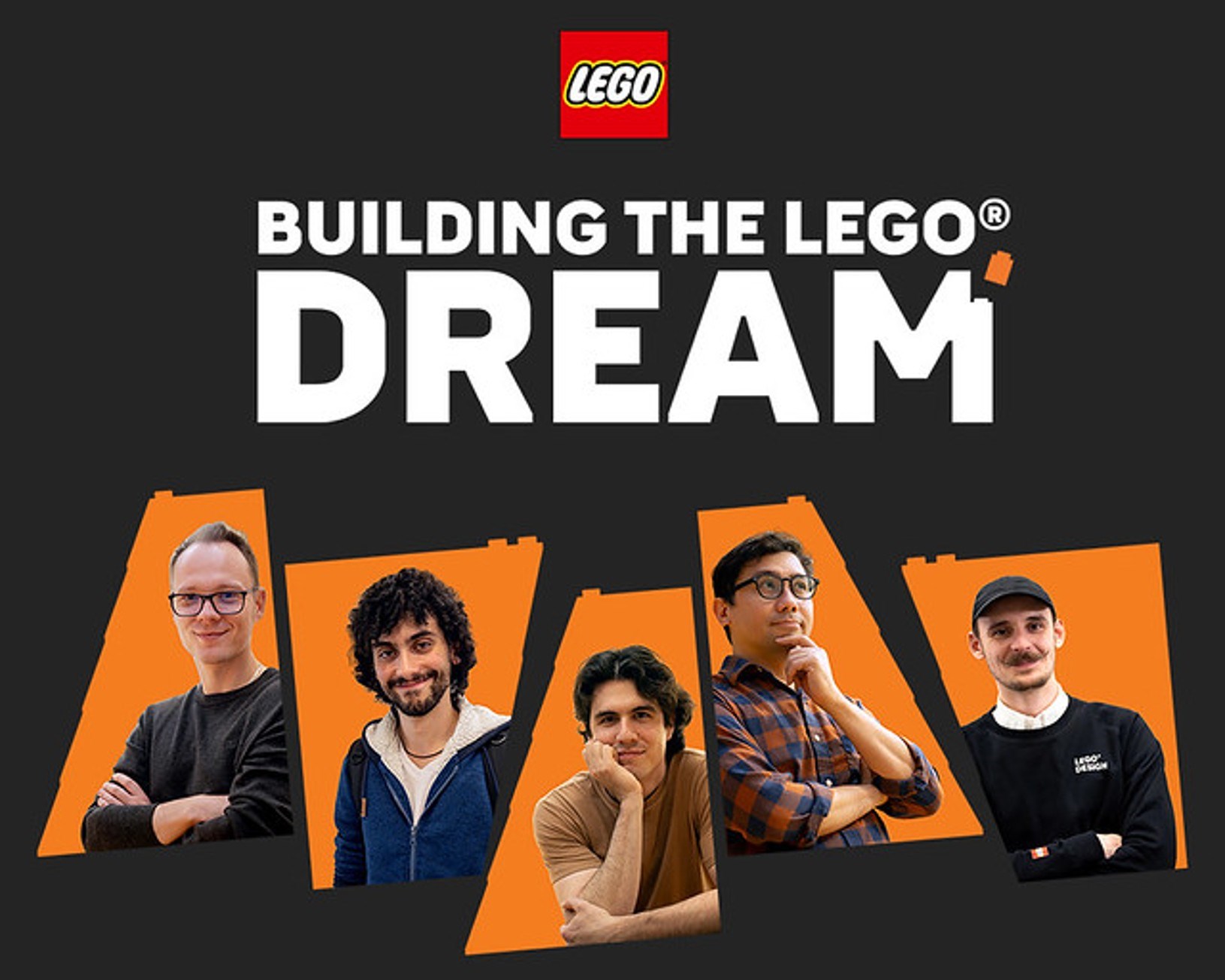
An increasing number of LEGO designers come from the fan community nowadays, including LEGO Ideas fan designers. A new 46-minute documentary follows five of these Ideas fan designers on their journeys to become model designers.
Huw and I had an opportunity to watch the documentary at Bricktastic yesterday and it certainly gives some interesting insights. You can watch it now on LEGO.com.
The five designers featured in the documentary are:
- Alex Storozhuk - fan designer of 21330 Home Alone
- Sandro Quattrini - fan designer of 21335 Motorised Lighthouse
- Josh Bretz - fan designer of 21339 BTS Dynamite
- Ivan Guerrero - fan designer of 21324 123 Sesame Street, 21346 Family Tree and 40533 Cosmic Cardboard Adventures
- Thomas Lajon - fan designer of 21344 The Orient Express Train
51 likes
26 comments on this article
Interesting. I didn't know so many Ideas designers were getting fulltime jobs as Lego employees. In retrospect, it's an obvious talent pipeline. Good for Lego and good for us!
To bad that you have to submit your ideas through studio I think. It means you build on your computer. The essence of lego for me is being away from those machines. I bet there a lot designers who make great objects in real life, but they will never be chosen if the don't use studio. A lot of missed great builds...
What a brilliant documentary!
@ikke said:
"To bad that you have to submit your ideas through studio I think. It means you build on your computer. The essence of lego for me is being away from those machines. I bet there a lot designers who make great objects in real life, but they will never be chosen if the don't use studio. A lot of missed great builds..."
I suspect that LEGO’s product development process requires designers to use CAD, so some ability to use it is a job requirement. If so, it makes sense to recruit from a talent pool that already has that skill.
Obviously they start with a lot of talent and creativity, and in the end it's mostly killed by the restrictions and guidelines necessitated by corporate greed and by needing to always cater to the lowest common denominator.
Which is why I would never want to work for LEGO, even if I had the talent to begin with. The environment and restrictions would frustrate me even more as a designer than how they frustrate me as a customer.
@ikke said:
"To bad that you have to submit your ideas through studio I think. It means you build on your computer. The essence of lego for me is being away from those machines. I bet there a lot designers who make great objects in real life, but they will never be chosen if the don't use studio. A lot of missed great builds..."
No, you can build a design IRL for submission, it’s allowed - I think it just doesn’t happen as much because it’s more expensive and of course you then have to do the photography which is another skill.
@AustinPowers said:
"Obviously they start with a lot of talent and creativity, and in the end it's mostly killed by the restrictions and guidelines necessitated by corporate greed and by needing to always cater to the lowest common denominator.
Which is why I would never want to work for LEGO, even if I had the talent to begin with. The environment and restrictions would frustrate me even more as a designer than how they frustrate me as a customer. "
Working with Lego is pretty much the definition of having limitations. It's a system. That is what makes it fun and challenging. To find ways of approximating the actual shape that you are after with what is available, while making it structurally sound. When designing for other people, you also add another layer of complexity, in that it has to be easily replicated. That doesn't stop creativity. In my experience, adding some limitations usually makes creativity really flow.
If you don't want those limitations you may as well just be sculpting with clay, or use any 3D-software and then print your sculpture designs. That way you don't have to adhere to any system of available shapes, colors, or stability issues caused by certain pieces not connecting well enough to each other.
@ikke said:
"To bad that you have to submit your ideas through studio I think. It means you build on your computer. The essence of lego for me is being away from those machines. I bet there a lot designers who make great objects in real life, but they will never be chosen if the don't use studio. A lot of missed great builds..."
BrickLink Designer Program - requires you to submit your project thru the use of Studio. Which makes sense as the largest part of the design process falls on you and the released product will be essentially identical to what you submit [save for the revision project you go thru with their team to make sure your model is practical]. Submitting thru studio also gives them a quick and easy way to vet submissions for following the parts palette, etc.
Ideas - allows you to submit your idea just about any way you can, since the Ideas team will take the successful projects and redesign them from the ground up anyway, with varying degrees of the original submission, if any, remaining.
Sigh. I'm sure it's a great documentary (I haven't watched it yet), but they couldn't find a single female AFOL turned designer to feature? There have been several who have been hired in the last few years.
@RTS013 said:
" @AustinPowers said:
"Obviously they start with a lot of talent and creativity, and in the end it's mostly killed by the restrictions and guidelines necessitated by corporate greed and by needing to always cater to the lowest common denominator.
Which is why I would never want to work for LEGO, even if I had the talent to begin with. The environment and restrictions would frustrate me even more as a designer than how they frustrate me as a customer. "
Working with Lego is pretty much the definition of having limitations. It's a system. That is what makes it fun and challenging. To find ways of approximating the actual shape that you are after with what is available, while making it structurally sound. When designing for other people, you also add another layer of complexity, in that it has to be easily replicated. That doesn't stop creativity. In my experience, adding some limitations usually makes creativity really flow.
If you don't want those limitations you may as well just be sculpting with clay, or use any 3D-software and then print your sculpture designs. That way you don't have to adhere to any system of available shapes, colors, or stability issues caused by certain pieces not connecting well enough to each other."
The best creative ideas usually come from restrictions. Sure, many people like big impressive builds with thousands of pieces, but often sets below 100 bucks (or even below 50) are much better products. I'd also much harder to create something (good) that appeals to a lot of people globally than some might think. Only those who are truly talented can pull that off. The best LEGO City sets usually aren't the big ones, but the small 10-20 bucks sets. Of course, you can come up with something much more elaborate at home, with more advanced building techniques, but that's not the point of a consumer product. That's the difference between a hobby and a career.
The same is true for music: Taylor Swift may not make the best songs in the world (as subjective as that is), but she makes the type of songs that a lot of people want to hear, while still managing to tell her own story through those songs. It's not that easy to create a song that millions of people like, let alone to do that repeatedly and build a career out of it. That takes talent, even if it seems simple. Naturally, there's much more to it than just talent, but without the talent it wouldn't work at all.
@RTS013 said:
" @AustinPowers said:
"Obviously they start with a lot of talent and creativity, and in the end it's mostly killed by the restrictions and guidelines necessitated by corporate greed and by needing to always cater to the lowest common denominator.
Which is why I would never want to work for LEGO, even if I had the talent to begin with. The environment and restrictions would frustrate me even more as a designer than how they frustrate me as a customer. "
Working with Lego is pretty much the definition of having limitations. It's a system. That is what makes it fun and challenging. To find ways of approximating the actual shape that you are after with what is available, while making it structurally sound. When designing for other people, you also add another layer of complexity, in that it has to be easily replicated. That doesn't stop creativity. In my experience, adding some limitations usually makes creativity really flow.
If you don't want those limitations you may as well just be sculpting with clay, or use any 3D-software and then print your sculpture designs. That way you don't have to adhere to any system of available shapes, colors, or stability issues caused by certain pieces not connecting well enough to each other."
Building off that, there's a saying among many artists that "limitations breed creativity"—that working within certain constraints can lead to creative solutions to design challenges you might not otherwise consider. I feel like this is a core element of working within a system like Lego, but even moreso for official model designers, who are inherently limited by the fact that they have to reach an end result that works as a consumer product. In some ways, Lego's designers have capabilities average builders don't (prototyping a new part to solve a design challenge no other part could satisfy), but on the same note, they have limitations other builders don't (budget, making things easily buildable for varying age ranges, etc.).
Certainly not every Lego builder has what it would take to enjoy working within those sorts of limitations. But I doubt official Lego designers resent all those limitations either, not when they're so closely tied to the core appeal of building a satisfying toy for a wide audience. If you view that as "appealing to the lowest common denominator" then you probably don't have the right mindset for any sort of career in toy design—it's hard to make kids happy when you aren't willing to meet them on their level, and look down on them instead.
@Lyichir said:
"Certainly not every Lego builder has what it would take to enjoy working within those sorts of limitations. But I doubt official Lego designers resent all those limitations either, not when they're so closely tied to the core appeal of building a satisfying toy for a wide audience. If you view that as "appealing to the lowest common denominator" then you probably don't have the right mindset for any sort of career in toy design—it's hard to make kids happy when you aren't willing to meet them on their level, and look down on them instead."
AFOLs commenting on kid's products in a nutshell. ;-)
Fantastic little documentary, thanks for the article flagging it!
I love how they all speak English... except, ofcource, the Frenchman. :P
Great documentary!
Definitely going to be giving this a watch.
@ToysFromTheAttic said:"The best LEGO City sets usually aren't the big ones, but the small 10-20 bucks sets."
60430 almost got enough nominations in to be a possible choice in the overall Best Set poll, after all!
@JayCal isaid:"I love how they all speak English... except, ofcource, the Frenchman. :P"
watched Monty Python and the Holy Grail this morning (it's free with ads on YouTube, for those who don't know), so I can't help but think of, "I'm French. Why do you think I have this outrageous accent, you silly king?"
@MeganL said:
"Sigh. I'm sure it's a great documentary (I haven't watched it yet), but they couldn't find a single female AFOL turned designer to feature? There have been several who have been hired in the last few years."
Yeah, not even managing to convince 1 in 5 to participate doesn’t say anything good about their recruitment pipeline and the existence of any efforts to avoid a sausagefest tbh. Even allowing for the additional incentives for women not to expose themselves to online nonsense.
any update on the amazon reductions feature? definetly the sites second best thing after inventory
Okay, some of those guys are making me feel old. "My first set was a Bionicle set..." I hit drinking age the year Bionicle came out! "The first set I bought I bought with my own money was on lego.com..." I'd been buying sets with my own money for years before lego.com (or the World Wide Web itself) even existed! On the other hand, there were moments I felt closer to them. "I'm an introvert..." Same here. "I just drink hot chocolate, I'm not a coffee person..." Ditto. "I used to work retail, so I'm fixing the shelves..." I feel you. "You see this tire? Maybe it's a tire, maybe it's a turbine." "I have two of them (referring to wheels) because it was a motorcycle, but I'm going to turn them into propellers for a rocketship or an airplane..." All parts are Space parts! Overall, a very enjoyable watch. I'd love to be able to see the history wall shown in the video in person. And, of course, the archive of every set ever, even if seeing them handle those sets with their bare hands made the archivist in me cringe. Oh, and the behind the scenes featurettes were fun too, don't miss those.
@MeganL said:
"Sigh. I'm sure it's a great documentary (I haven't watched it yet), but they couldn't find a single female AFOL turned designer to feature? There have been several who have been hired in the last few years."
At least it has Monica Pedersen, the marketing director for Ideas and Fenella Charity, the Friends design lead. but yeah, they could have done better.
@ToysFromTheAttic said:
" @RTS013 said:
" @AustinPowers said:
"Obviously they start with a lot of talent and creativity, and in the end it's mostly killed by the restrictions and guidelines necessitated by corporate greed and by needing to always cater to the lowest common denominator.
Which is why I would never want to work for LEGO, even if I had the talent to begin with. The environment and restrictions would frustrate me even more as a designer than how they frustrate me as a customer. "
Working with Lego is pretty much the definition of having limitations. It's a system. That is what makes it fun and challenging. To find ways of approximating the actual shape that you are after with what is available, while making it structurally sound. When designing for other people, you also add another layer of complexity, in that it has to be easily replicated. That doesn't stop creativity. In my experience, adding some limitations usually makes creativity really flow.
If you don't want those limitations you may as well just be sculpting with clay, or use any 3D-software and then print your sculpture designs. That way you don't have to adhere to any system of available shapes, colors, or stability issues caused by certain pieces not connecting well enough to each other."
The best creative ideas usually come from restrictions. Sure, many people like big impressive builds with thousands of pieces, but often sets below 100 bucks (or even below 50) are much better products. I'd also much harder to create something (good) that appeals to a lot of people globally than some might think. Only those who are truly talented can pull that off. The best LEGO City sets usually aren't the big ones, but the small 10-20 bucks sets. Of course, you can come up with something much more elaborate at home, with more advanced building techniques, but that's not the point of a consumer product. That's the difference between a hobby and a career.
The same is true for music: Taylor Swift may not make the best songs in the world (as subjective as that is), but she makes the type of songs that a lot of people want to hear, while still managing to tell her own story through those songs. It's not that easy to create a song that millions of people like, let alone to do that repeatedly and build a career out of it. That takes talent, even if it seems simple. Naturally, there's much more to it than just talent, but without the talent it wouldn't work at all."
Taylor does not make good songs. She has teams of people write songs for her, and performs with a backing track and auto-tune (even while performing live) because she has zero talent.
Modern pop music is relatively simple to make because it's minimalist, excessively promoted and appeals to how people already feel. This is why we had a song exclusively made with AI reach number one on the charts several months back. It's not music--it's vibes.
Mini-rant aside, I think what @AustinPowers is referencing is that you're put on a team, told what to build, told what parts you're allowed to use based on what LEGO is producing, how much time you have and provided a specific budget to build it in. Considering how IP focused LEGO is these days, it's likely you'll end up designing something that also has to adhere to the source material. Then, if you last long enough, you'll get to make the same model every few years, but this time you'll have access to dozens of new slopes, tiles and wedge parts that LEGO has since produced because the designers couldn't figure out how to capture complex shapes, so specialized parts were needed.
That's not creative. It's derivative.
Speaking of Bricktastic - there was no coverage of news for the 2026 event?
"I start my day by taking the bus", at these prices this guy isn't paid enough to own a car?
11:20 - "There's not just 10 designers". Well how do you think LEGO releases 300 new sets a year? AI?
Jamie hasn't aged in 15 years.
@crawlerbot said:
""I start my day by taking the bus", at these prices this guy isn't paid enough to own a car?"
Typical American thinking. In Europe, many people use buses, some don't drive cars, they don't have a driving license...
I am glad some people have managed to succeed as personally found Lego Ideas, Bricklink Designer program a lot of time and energy with too much competition (nearly 600 odd submissions at the last round). I don't mind using Studio as I only have around 10% of the parts available, so this helps to work out what parts I need to buy after various revisions for the odd moc I think is worthwhile to build, plus you get all the high quality renders and animations for no extra effort.
@Vesperas said:
" @ToysFromTheAttic said:
" @RTS013 said:
" @AustinPowers said:
"Obviously they start with a lot of talent and creativity, and in the end it's mostly killed by the restrictions and guidelines necessitated by corporate greed and by needing to always cater to the lowest common denominator.
Which is why I would never want to work for LEGO, even if I had the talent to begin with. The environment and restrictions would frustrate me even more as a designer than how they frustrate me as a customer. "
Working with Lego is pretty much the definition of having limitations. It's a system. That is what makes it fun and challenging. To find ways of approximating the actual shape that you are after with what is available, while making it structurally sound. When designing for other people, you also add another layer of complexity, in that it has to be easily replicated. That doesn't stop creativity. In my experience, adding some limitations usually makes creativity really flow.
If you don't want those limitations you may as well just be sculpting with clay, or use any 3D-software and then print your sculpture designs. That way you don't have to adhere to any system of available shapes, colors, or stability issues caused by certain pieces not connecting well enough to each other."
The best creative ideas usually come from restrictions. Sure, many people like big impressive builds with thousands of pieces, but often sets below 100 bucks (or even below 50) are much better products. I'd also much harder to create something (good) that appeals to a lot of people globally than some might think. Only those who are truly talented can pull that off. The best LEGO City sets usually aren't the big ones, but the small 10-20 bucks sets. Of course, you can come up with something much more elaborate at home, with more advanced building techniques, but that's not the point of a consumer product. That's the difference between a hobby and a career.
The same is true for music: Taylor Swift may not make the best songs in the world (as subjective as that is), but she makes the type of songs that a lot of people want to hear, while still managing to tell her own story through those songs. It's not that easy to create a song that millions of people like, let alone to do that repeatedly and build a career out of it. That takes talent, even if it seems simple. Naturally, there's much more to it than just talent, but without the talent it wouldn't work at all."
Taylor does not make good songs. She has teams of people write songs for her, and performs with a backing track and auto-tune (even while performing live) because she has zero talent.
Modern pop music is relatively simple to make because it's minimalist, excessively promoted and appeals to how people already feel. This is why we had a song exclusively made with AI reach number one on the charts several months back. It's not music--it's vibes.
Mini-rant aside, I think what @AustinPowers is referencing is that you're put on a team, told what to build, told what parts you're allowed to use based on what LEGO is producing, how much time you have and provided a specific budget to build it in. Considering how IP focused LEGO is these days, it's likely you'll end up designing something that also has to adhere to the source material. Then, if you last long enough, you'll get to make the same model every few years, but this time you'll have access to dozens of new slopes, tiles and wedge parts that LEGO has since produced because the designers couldn't figure out how to capture complex shapes, so specialized parts were needed.
That's not creative. It's derivative."
Thank you.
Exactly the point I was trying to make.