Review: Education Science Kits
Posted by benbacardi,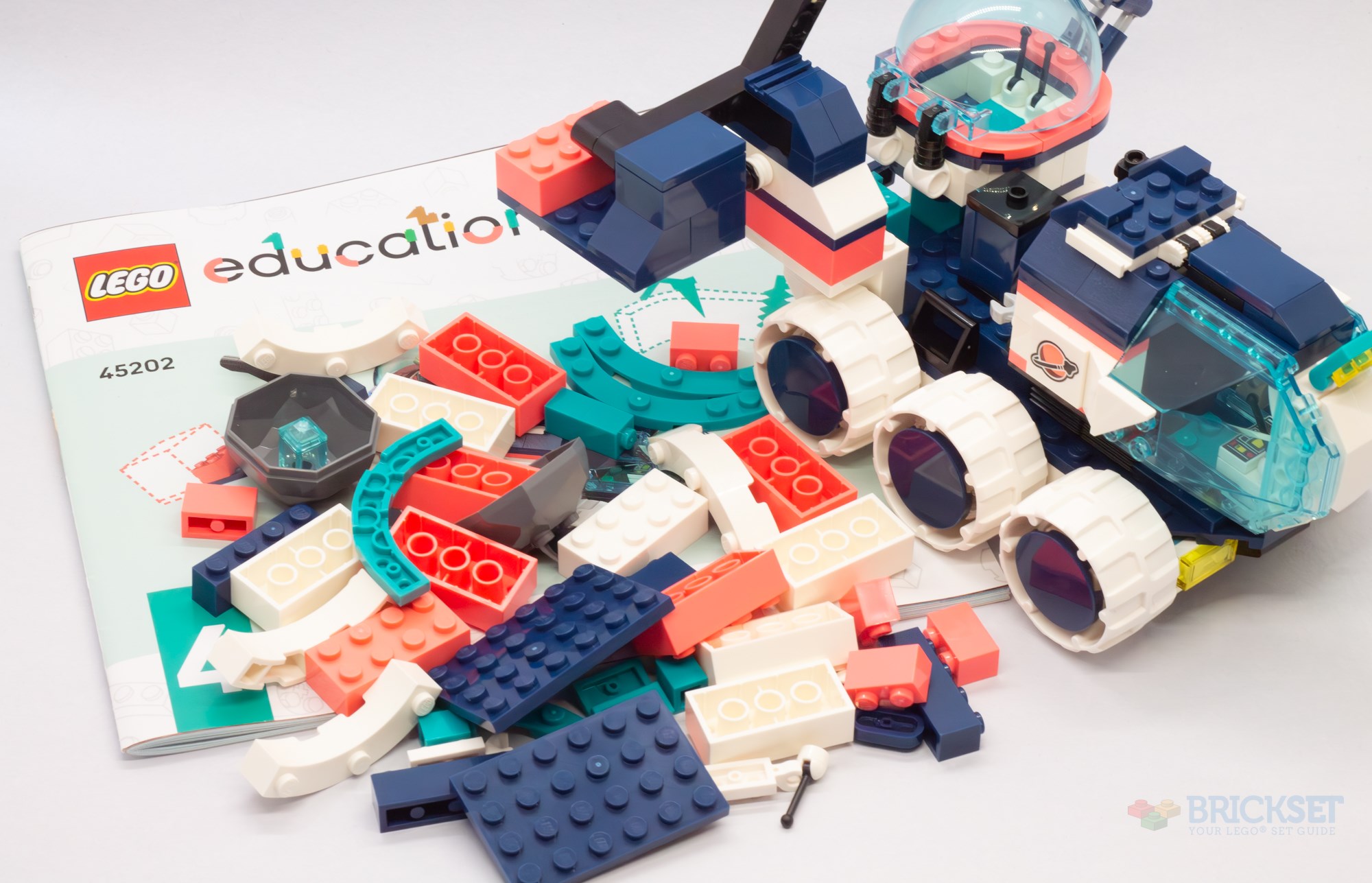
For the first time since the start of the LEGO Education line, LEGO has introduced sets specifically intended to be purchased as regular sets, rather than through schools and other learning environments. The four LEGO Education Science Kits are available as standard retail sets and are part of a range LEGO is calling Learning at Home.
But what are they, and how do they differ from regular LEGO sets? I've had a look at the format the sets take, how they intend to provide education and learning opportunities, and whether they actually have any useful educational value.
Summary
An interesting concept that doesn't quite hit the mark, but the minifigures have some great new prints in lovely colour scheme!
- Good minifigures
- New, unique concept
- Educational value feels forced
- Limited brick selection for free builds
- Expensive for what they are
The set was provided for review by LEGO. All opinions expressed are those of the author.
The Concept
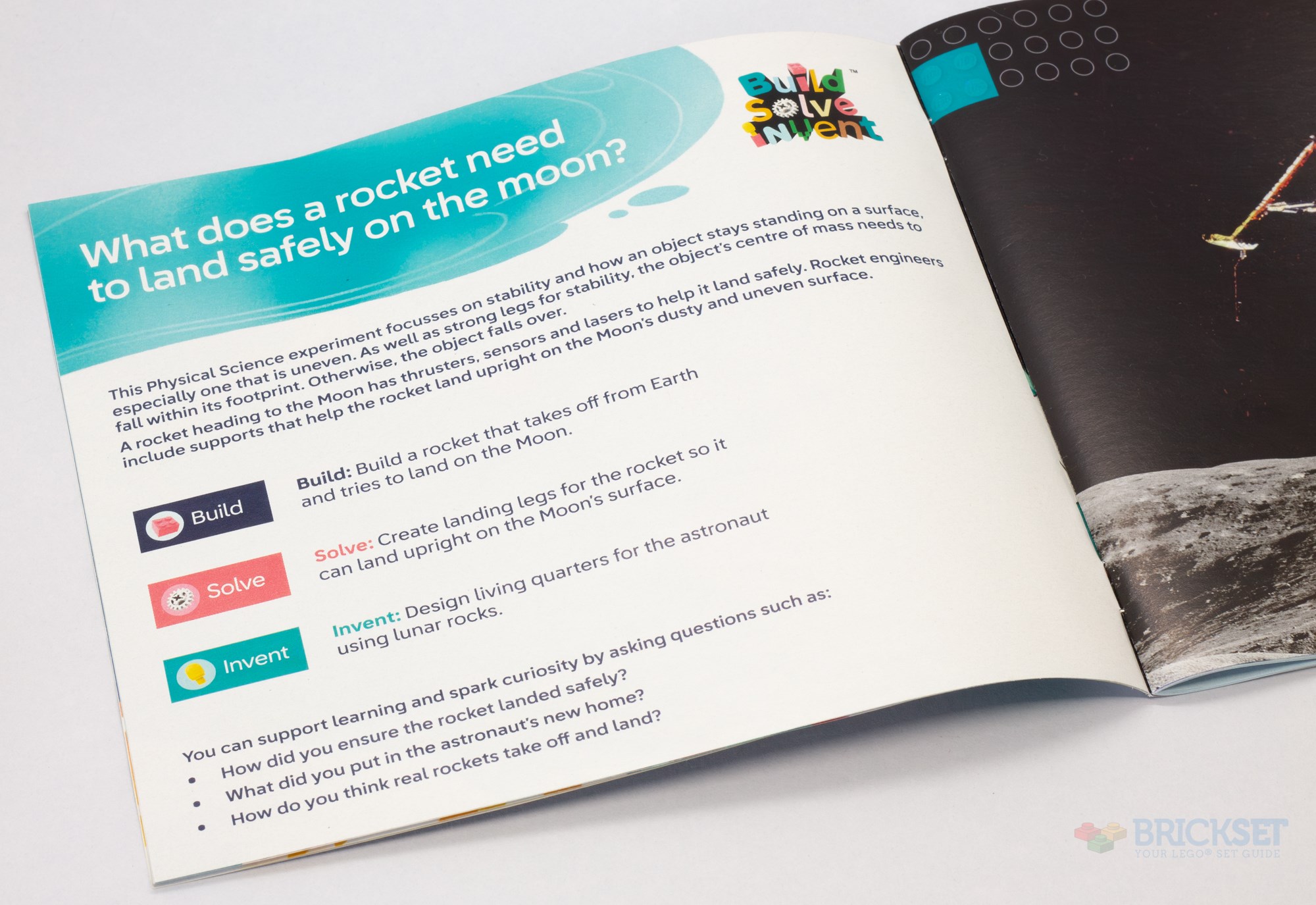
The four LEGO Education Science Kit sets are designed to teach children about a specific area of science by providing them with a framework to both learn and play at the same time. The four sets available now focus on space exploration and animal conservation. Explained at the front of the first instruction manual in each set, the "Kits" contain two or four experiments with three "phases" of play: Build, Solve, and Invent.
The Build phase is classic LEGO—follow the instructions to construct a model that is the starting point of the experiment. For instance, this could be a penguin and an icy slope, or a Mars landing vehicle. There's always a flaw, though...
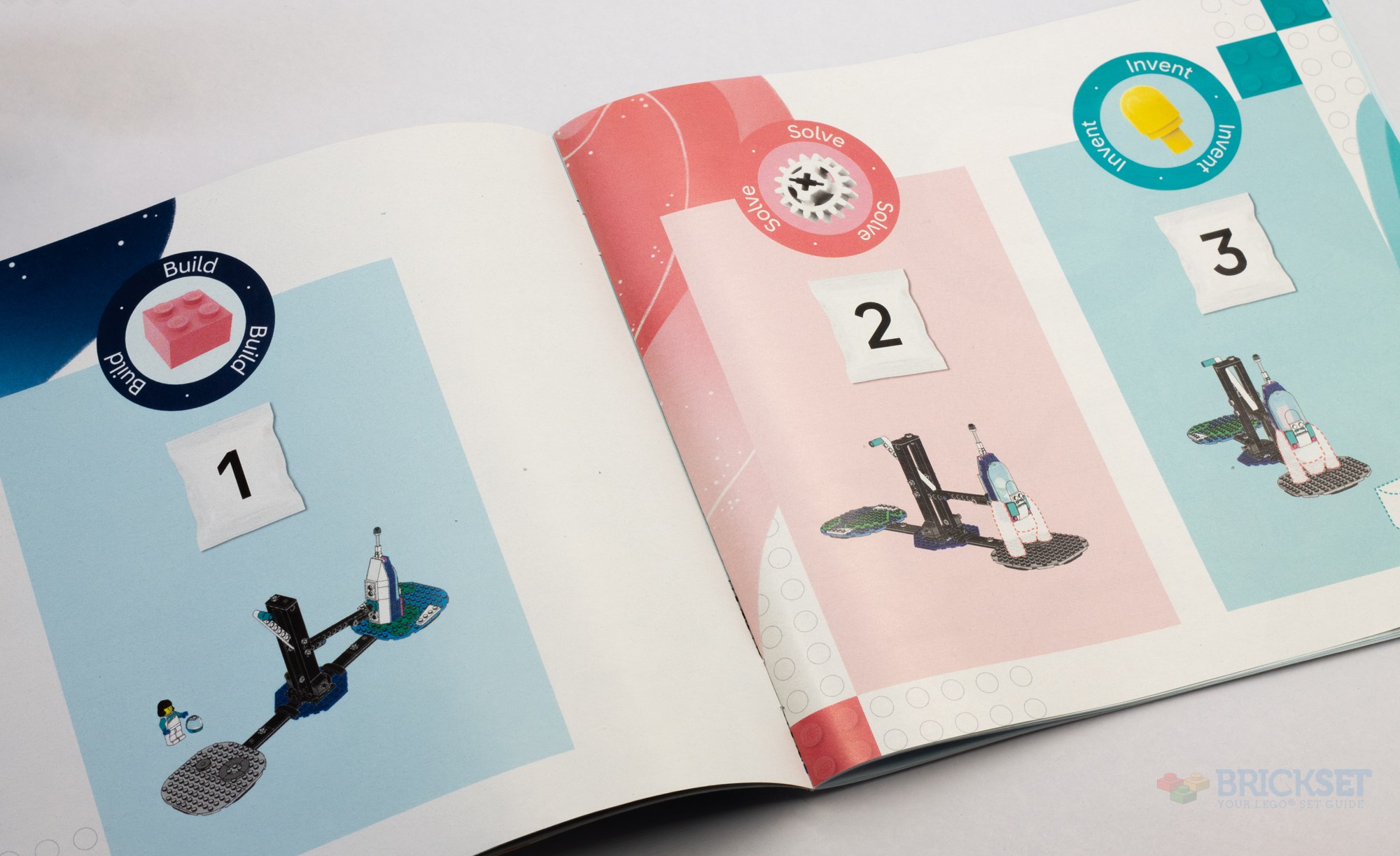
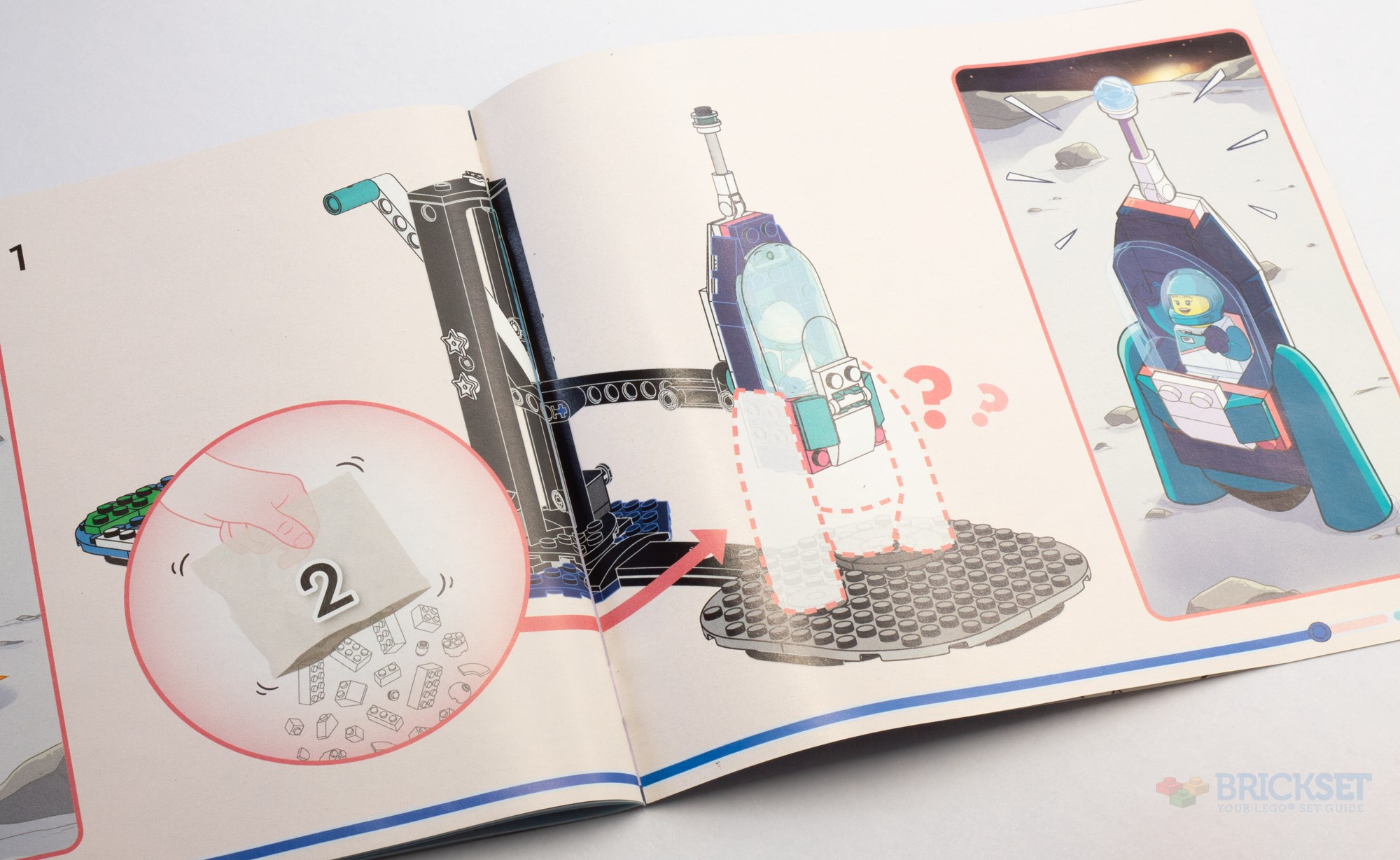
… because the Solve phase is where the builder must use the bricks provided from the next bag to fix that flaw, in whatever way they like. There are no hints beyond some very basic outlines and cartoon drawings of a potential solution.
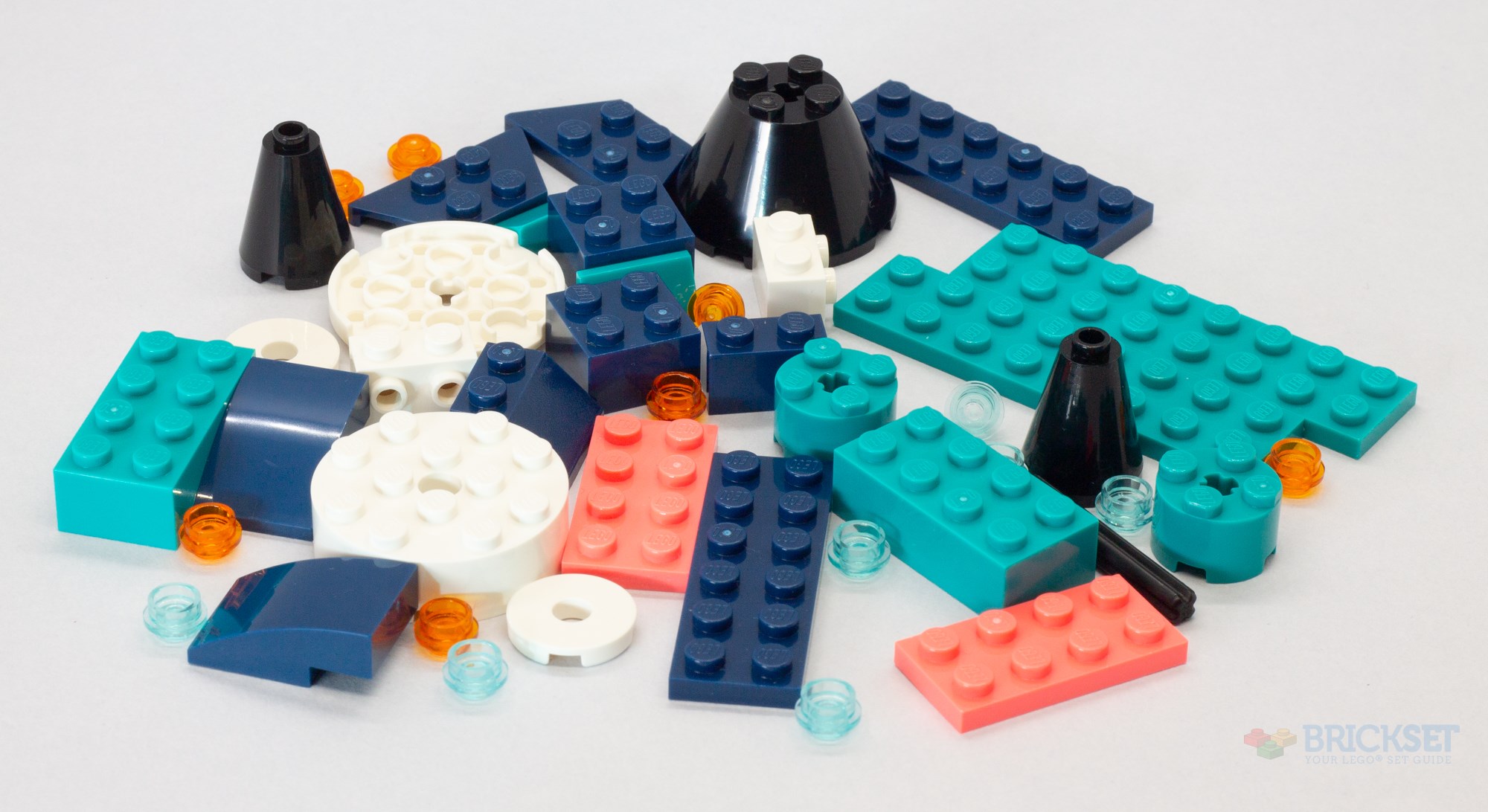
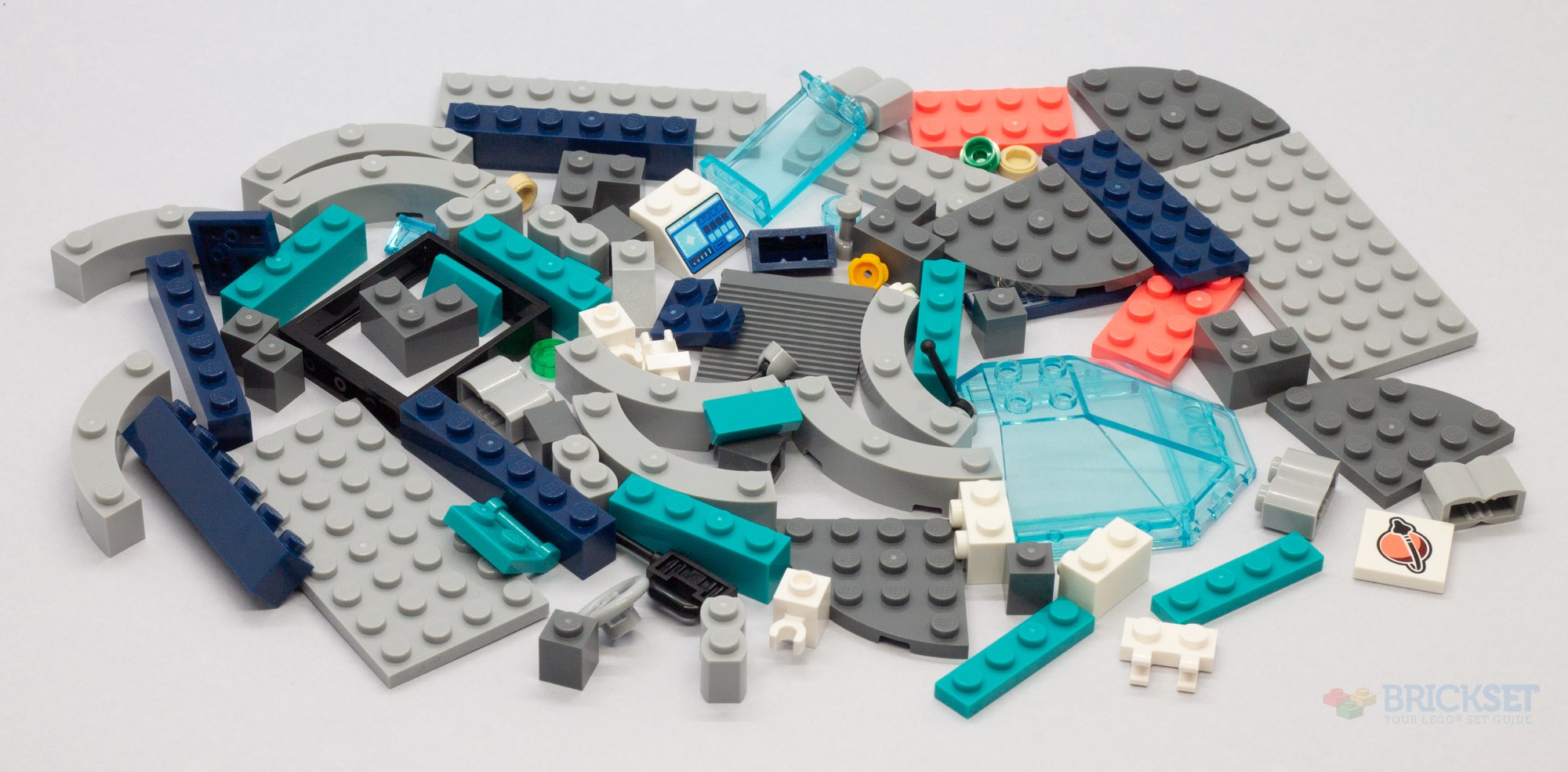
Finally, another bag of bricks provides more "free play", where you are encouraged to be creative and Invent a small new model within the guidelines—such as a boat for a photographer, or a lunar habitat.
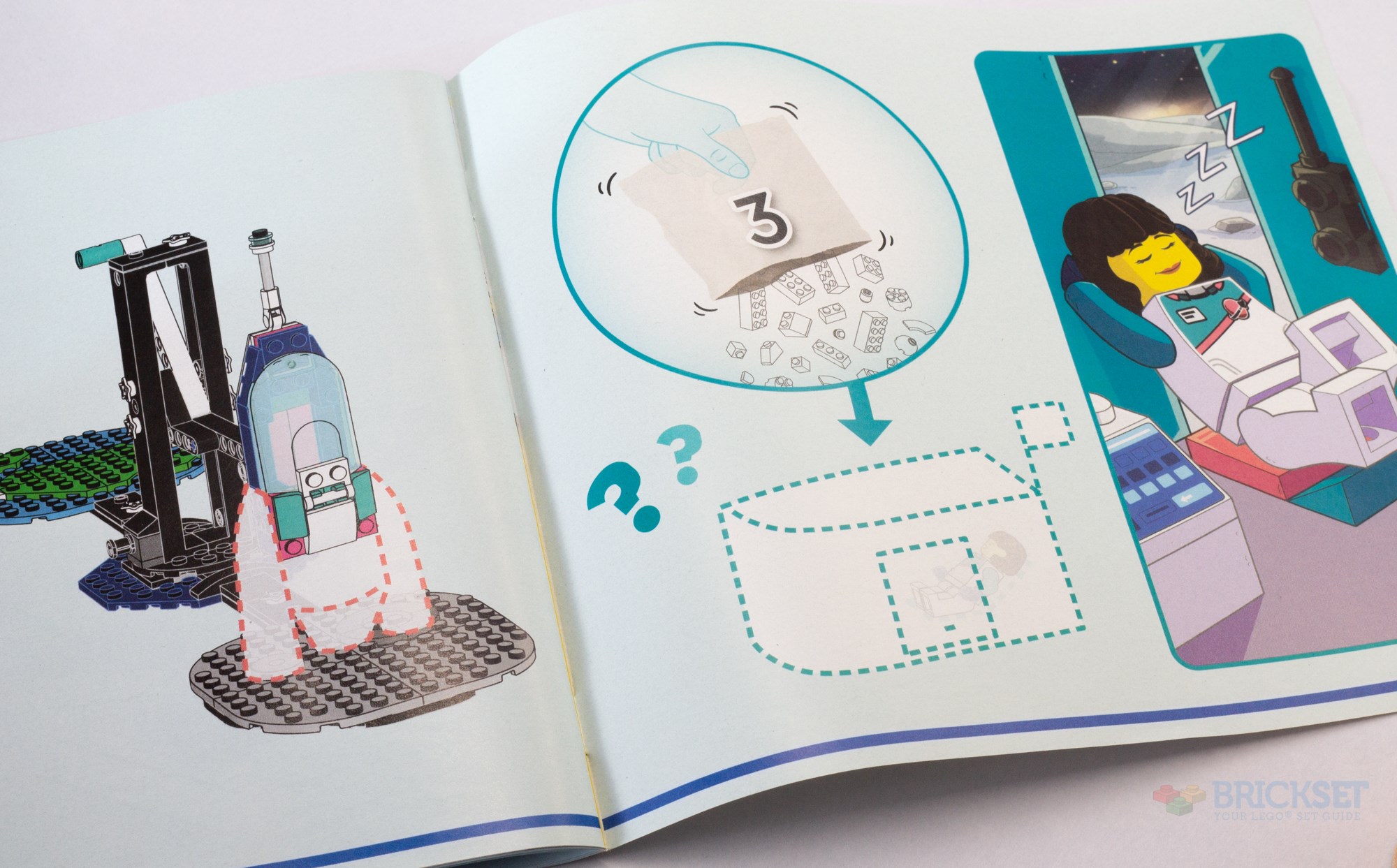
The sets are clearly designed to be used under adult supervision, as the instructions include tips for how you can support your child's learning and spark their curiosity by asking specific questions about what their thought process and what they're trying to achieve.
The Sets
The four sets all follow the pattern above. Below I have summarised each mission, and taken a look at the minifigures included in the sets, which are arguably the most interesting aspect.
45200 Moon Mission Science Kit
£44.99 / $49.99 / €49.99 • 519 pieces
The Moon Mission science kit contains two "experiments" for children to try their hand at, and is aimed at ages 8+.
- The first is intended to teach stability—children are asked to build a rocket and a small section of Earth, space, and the Moon, solve the problem of the rocket falling over by designing a landing structure, and invent a small lunar base for the astronauts.
- The second is about growing plants in space. You build a lunar greenhouse for some plants, solve the problem of transporting water to the greenhouse, and invent a moon-based kitchen to make food with the plants.
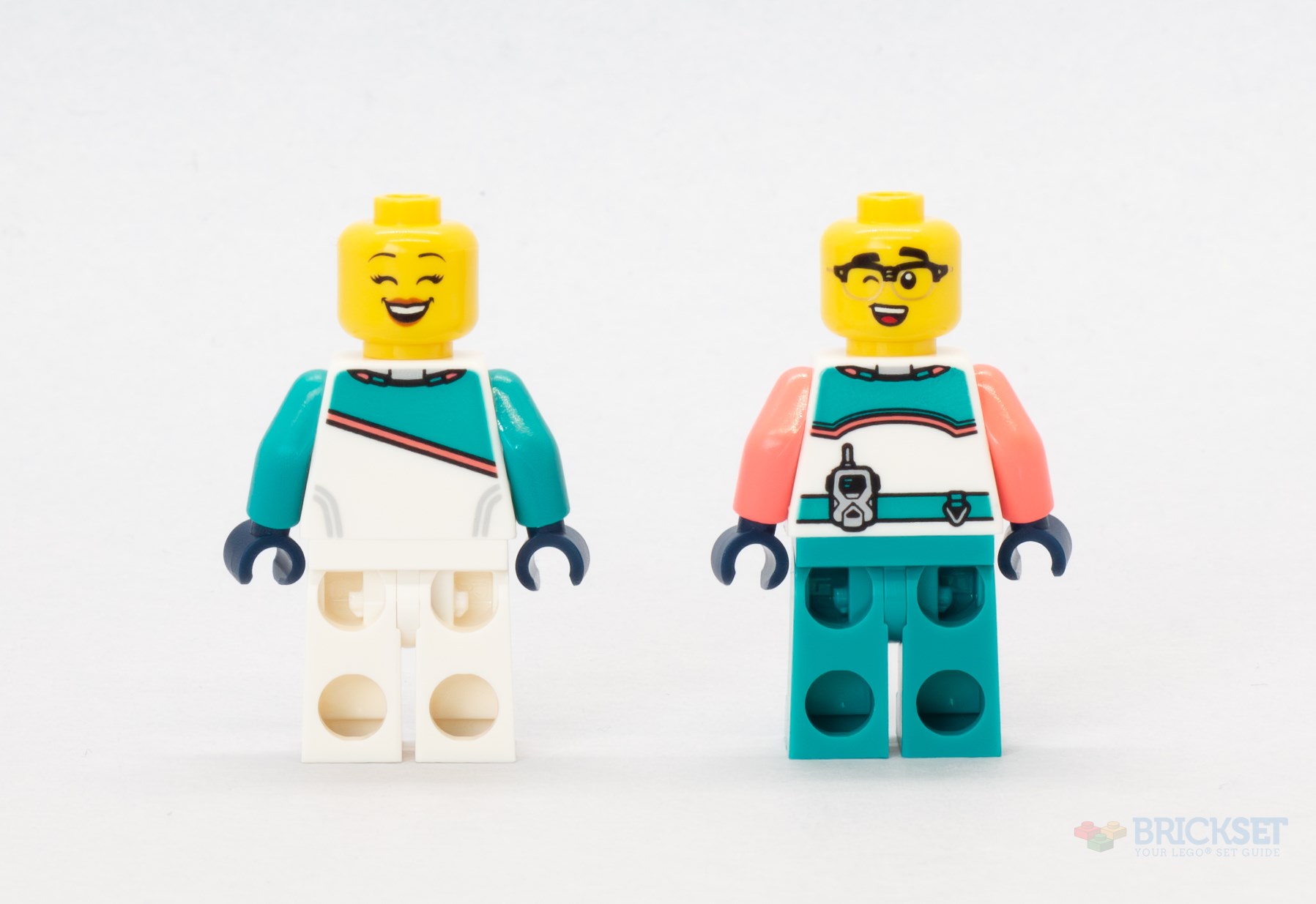
Two minifigures come with the set, one for each mission. Both are astronauts, and I was pleased to see they are wearing different outfits. The colour scheme of all four sets seems to be white, teal, and coral, which works very well in my opinion. The female astronaut is wearing a primarily white flight suit, with a small Classic Space logo and identification tag on the torso. She comes with both hair—a dark brown bob—and a helmet, and has a choice of two different smiling expressions.
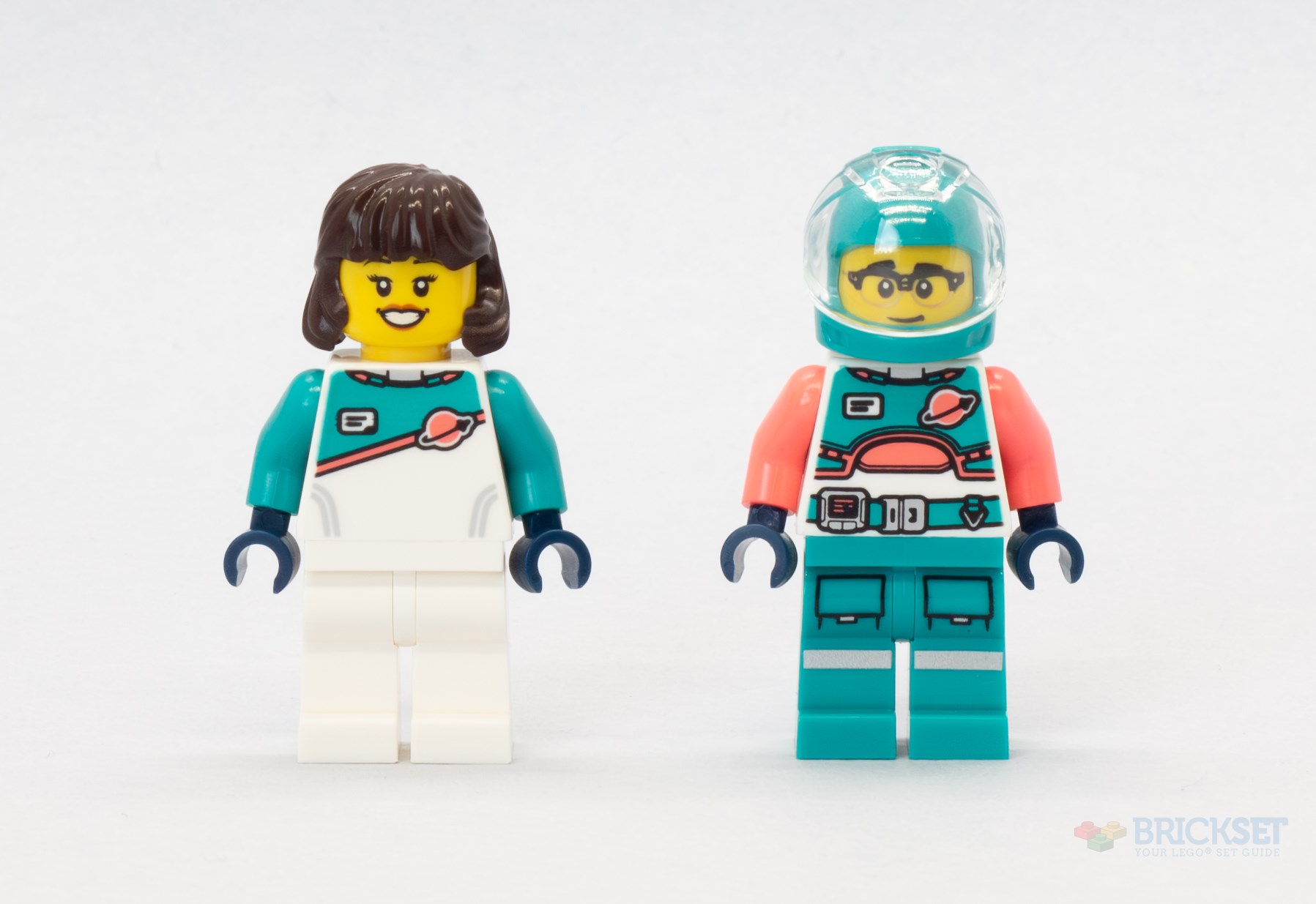
The second astronaut's space suit looks more heavy duty, suited for life in space rather than during flight, and is primarily teal with coral arms. Unlike his counterpart, he has printed legs with pockets and high-visibility stripes, and his torso is much more detailed, showing a utility belt with a control panel and walkie talkie. He is a very confident chap, wearing glasses atop a cheeky smile on one side, and giving a wink the other.
Both torsos are new to these Education sets.
45201 Antarctic Animals Science Kit
£44.99 / $49.99 / €49.99 • 461 pieces
The smallest of the four sets takes us to the South Pole; the Antarctic Animals science kit contains two experiments, aimed at ages 7+.
- Build an icy slope and a pair of penguins, solve the problem caused by a hole in the ice, and invent a small boat for the scientist to observe and take photos from.
- Build a blue whale and some krill for it to eat, solve the problem of the food falling out of the whale's mouth, and invent a small boat for the scientist (yes, again).
Once again, a minifigure is included for each activity, one male, one female. The scientist studying the penguins is wearing a dark blue and teal jacket with a small emblem that looks like a compass rose with an S or a path inside it. He has floppy brown hair and and two happy expressions on his stubble-dotted face. The hair can be swapped for a helmet when on the water.
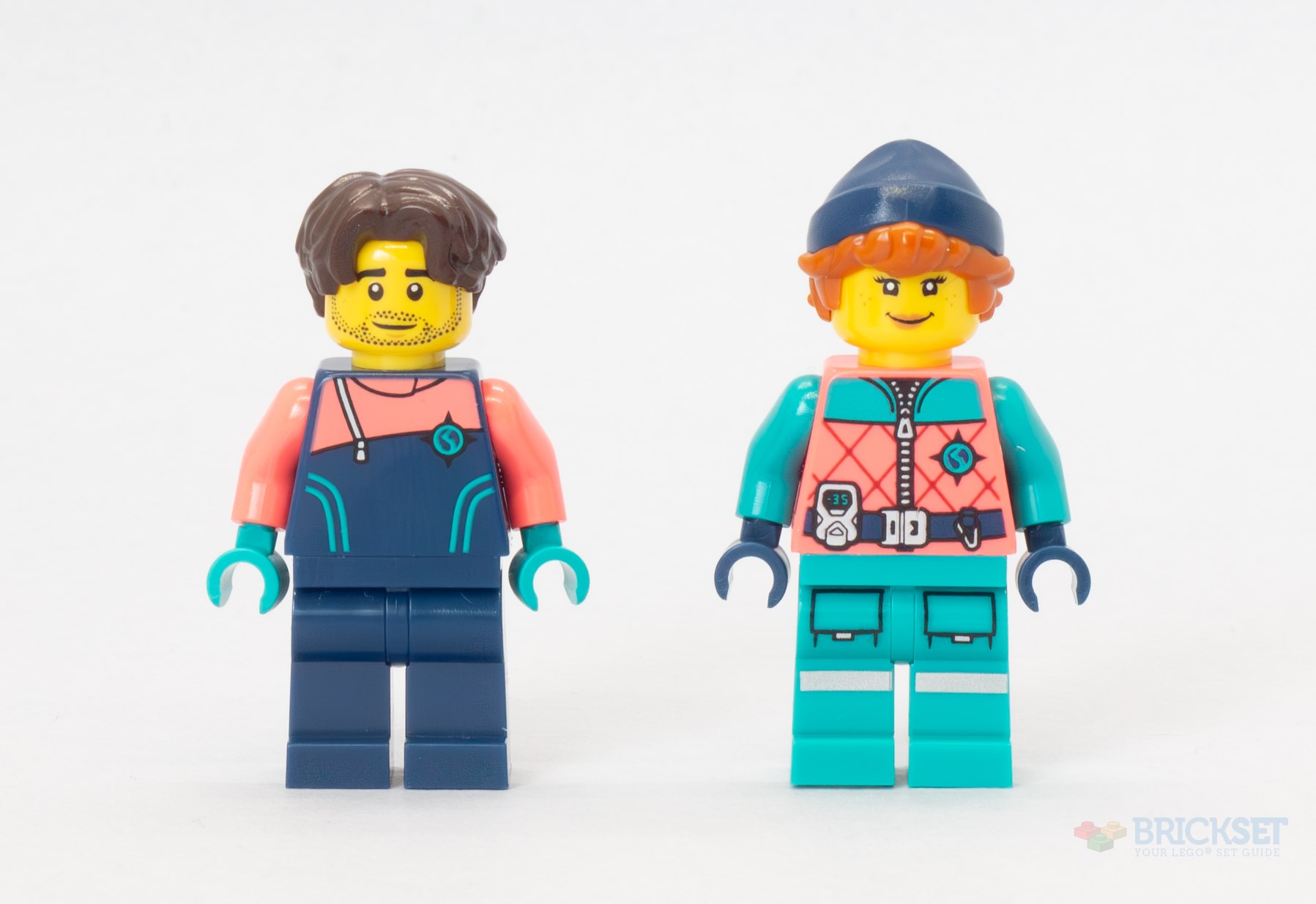
The whale scientist looks to be wearing a much warmer coral padded jacket with teal arms, which zips up the middle, and also includes the same compass emblem. The outfit is finished with a utility belt to which a few pieces of equipment are attached, and the same teal legs as the explorer astronaut above. I like the dual-moulded beanie hat, and her two expressions include a satisfied smile on one side and a more worried or confused mouth beneath orange safety goggles on the other.
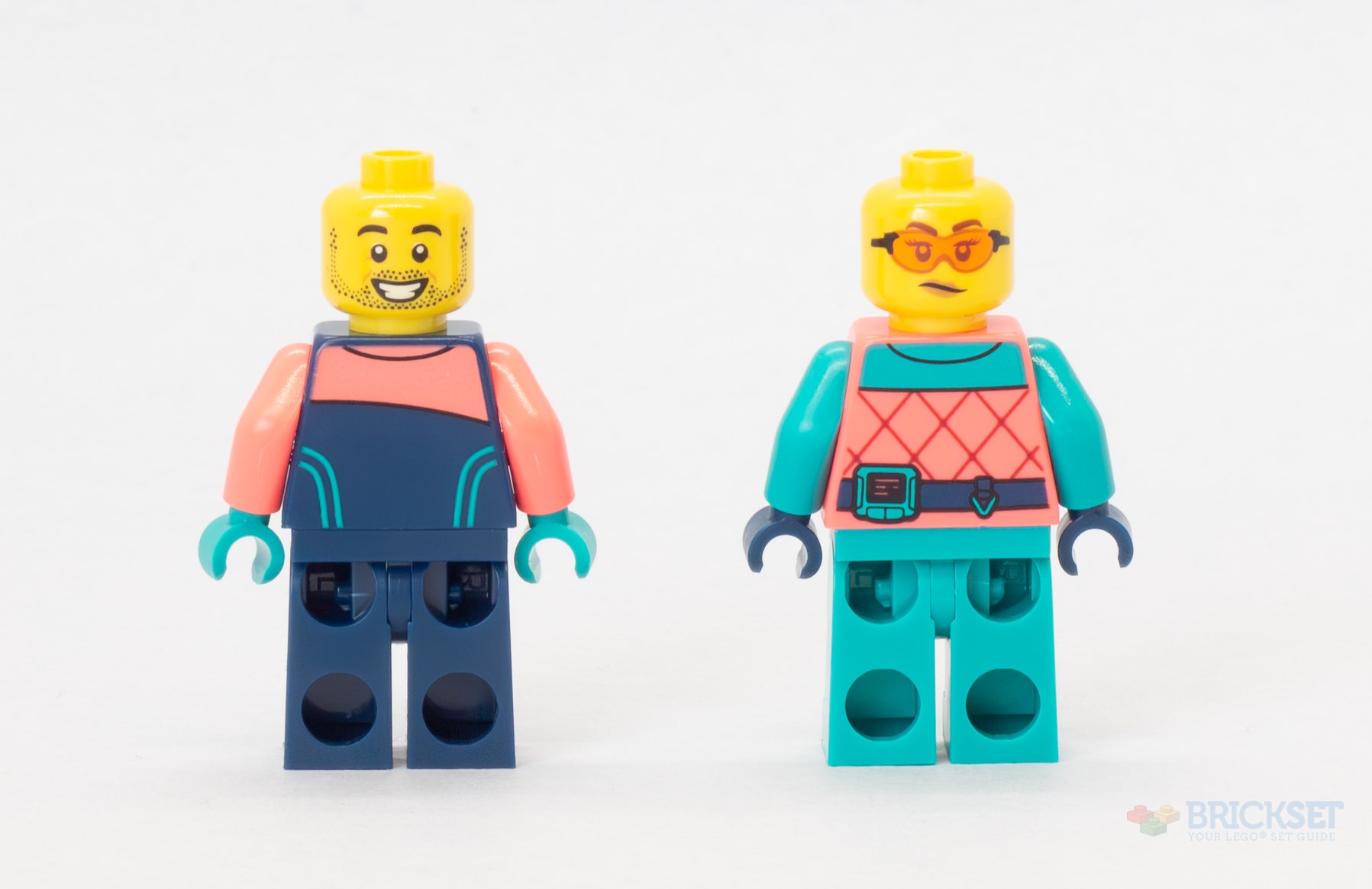
Once again, both torsos are new.
45202 Mars Mission Science Kit
£89.99 / $99.99 / €99.99 • 933 pieces
The first of the two larger sets, aimed at children aged 9 and above, includes four independent space-themed missions. As before, each mission has its own instruction booklet and follows the same format, using between 3 to 5 bags for each.
- Build an astronaut training simulator, solve the problem of the simulator falling over, and invent a spaceship-like pod for the astronaut to sit in during training.
- Build a crewed Mars landing vehicle, solve the problem of landing supports, and invent a resupply pod.
- Build a Mars base, solve the problem of damage caused by Martian winds, and invent a communications tower.
- Build a Mars rover, solve the problem of rocks in your way, and invent a collection area for the rock samples.
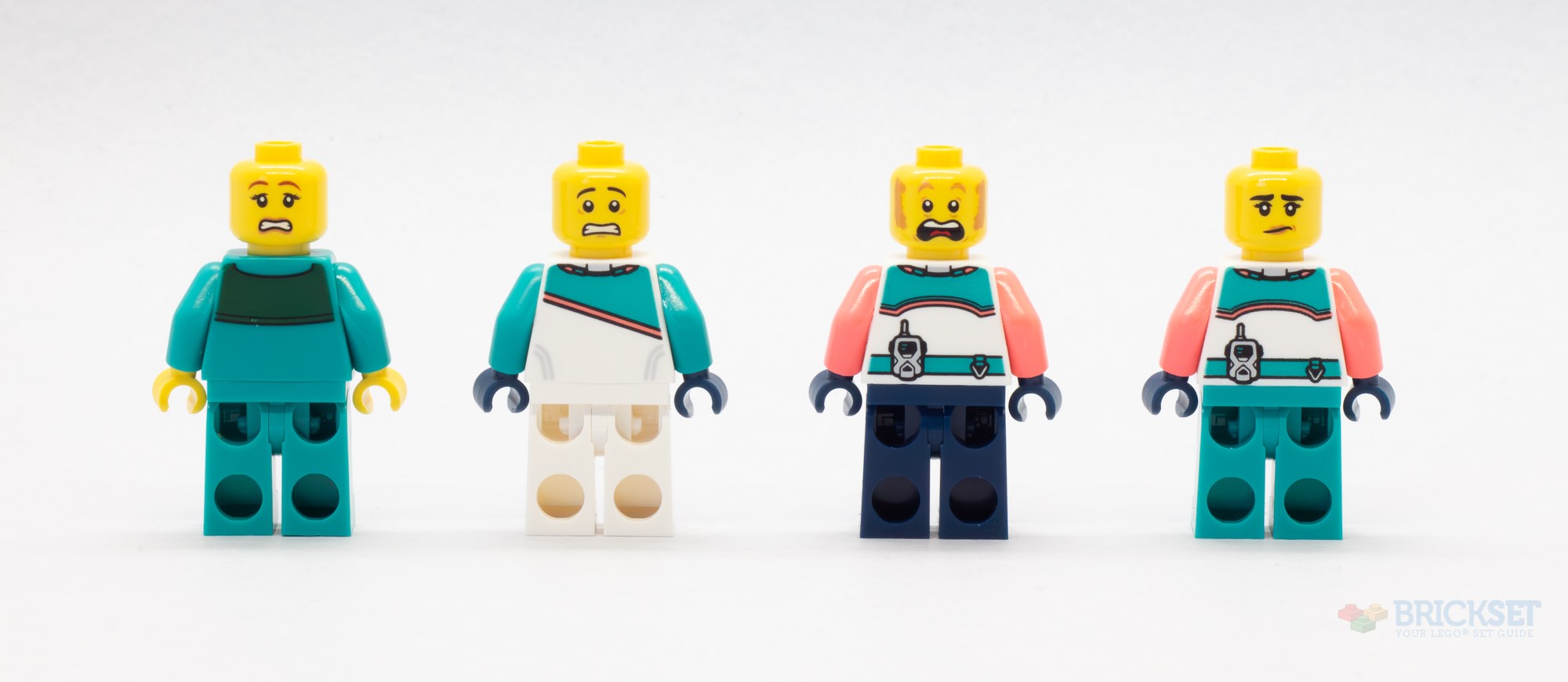
Four minifigures are included in this larger set. All astronauts, three reuse the same torsos found in the smaller Moon mission set above, but the first wears a teal and dark green tracksuit instead. She is the astronaut included with the training simulator mission, and as such has no need for a spacesuit or helmet. She doesn't look to be enjoying her training, with two expressions varying from slightly worried to very worried!
The astronaut in charge of piloting the landing vehicle is wearing the same flight suit as his lunar counterpart, and he also has a very worried expression until you manage to build his spaceship some landing supports, at which point you can flip his head to a satisfied lopsided smile.
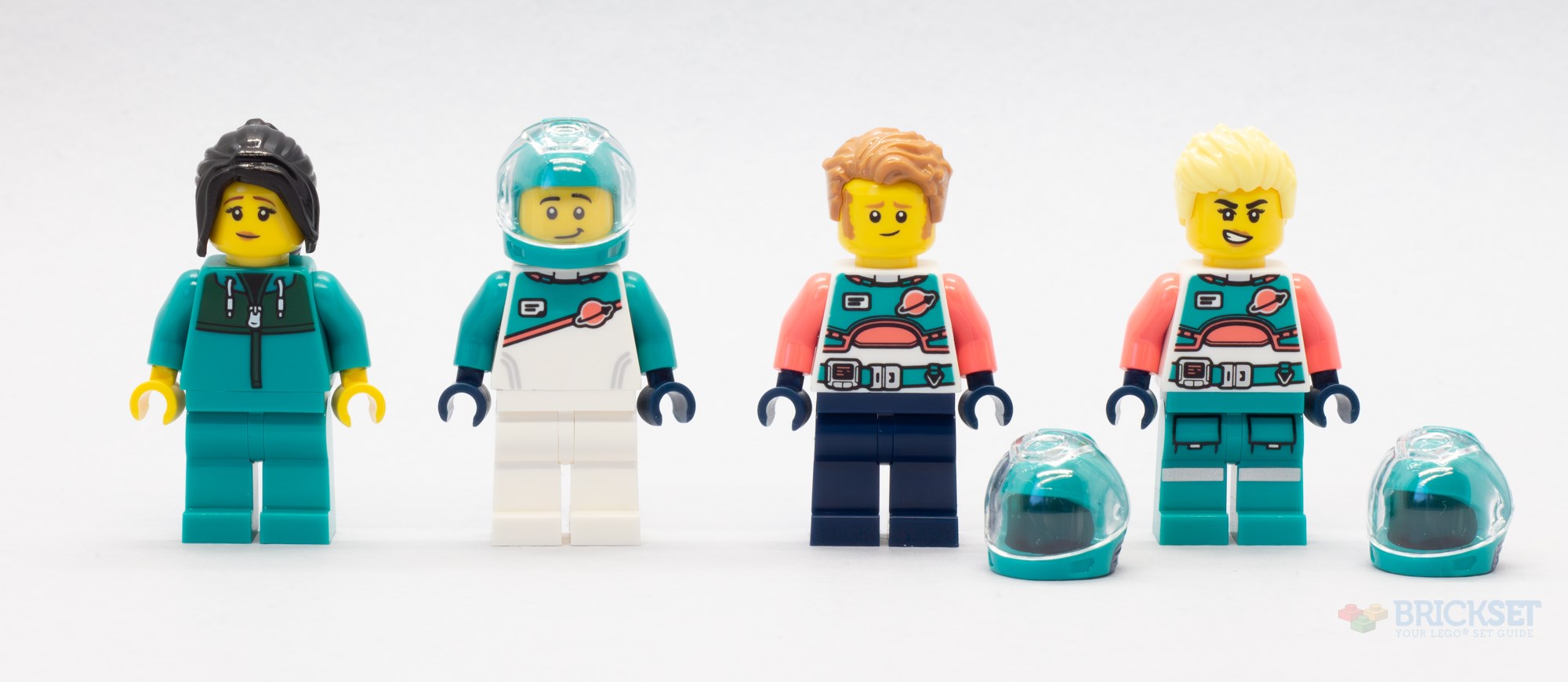
The final two share the same more heavy-duty spacesuits. I feel very sorry for the male astronaut attempting to protect his shelter from the Martian weather, as his is the most terrified of all the expressions! I like the combination of wavy, tousled hair and the sideburn prints on his head.
The final astronaut is a blonde female, the pilot of the rover. She's wearing a very determined expression on one side, and yet another worried face on the other! I would have thought any space programme would have chosen more imperturbable candidates for the astronaut cohort chosen to colonise Mars!
45203 Arctic Animals Science Kit
£89.99 / $99.99 / €99.99 • 1134 pieces
Finally, the last of the sets also includes four animal science missions, this time at the top of the world in the Arctic.
- Build an arctic cabin for the scientists, solve the problem of getting down from the roof of the cabin, and invent a sledge for the research equipment.
- Build a walrus and its baby, solve the problem of the walrus not being able to cuddle its baby (yes, really), and invent an underwater vehicle for collecting poo samples.
- Build a baby reindeer and mum, solve the problem of the reindeer being cold, and invent a hide for the scientists to observe from.
- Build a polar bear and an ice floe, solve the problem of the bear not being able to climb onto the slippery floe, and invent a suitable vehicle for the scientist.
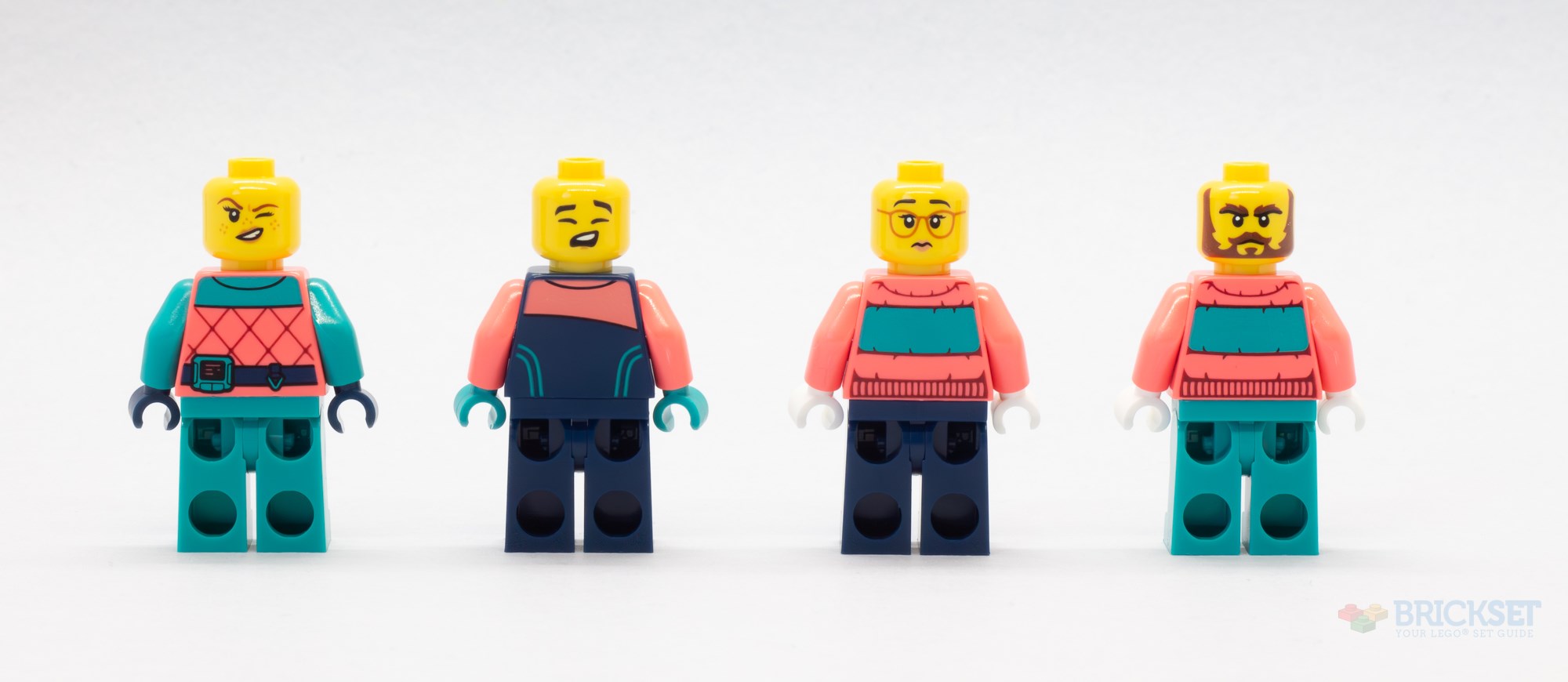
As is the pattern now, each mission contains its own minifigure. The first two repeat the outfits from the Antarctic set, although this time the dark blue and coral jacket is repurposed as a diving suit, complete with teal air tanks and a snorkel. The female scientist has two very determined expressions, one with a distinct squint (perhaps the bright sunlight reflecting of the snow is to blame). The diver has a confident smile on one side, and an unusual closed-eye, open-mouth expression on the other.
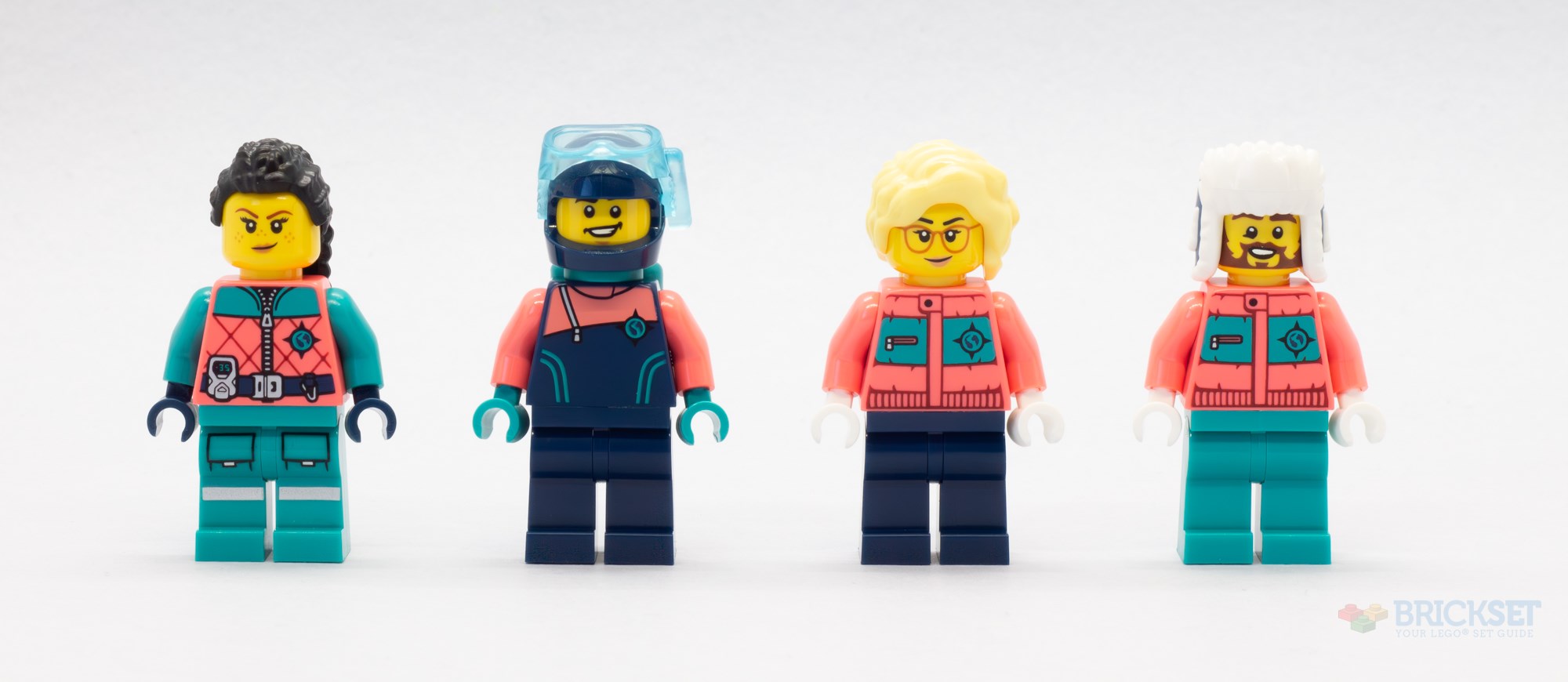
The remaining two scientists are both also wearing very warm zip-up jackets, though different to the quilted one used before. Primarily coral, with a large teal strip across the chest, the jacket features the compass emblem and a zip pocket on the other side. Both also wearing gloves, the bespectacled female scientist has wavy blonde hair and a happy or worried expression, whereas the male has a dark beard and moustache and wearing a cosy winter hat.
A look at a mission
Let's look a bit more in-depth at one of the missions—the final Mars mission:
How could you move rocks on Mars?
This Physical Science experiment is based on testing and improving a device that changes potential energy into kinetic energy. Potential energy is stored energy that can be transferred into different forms when you need it. An object has kinetic energy when it moves.
One kind of potential energy comes from gravity. If you increase the weight of the object, it has more potential energy. This makes more kinetic energy when the object moves, making the object move further.
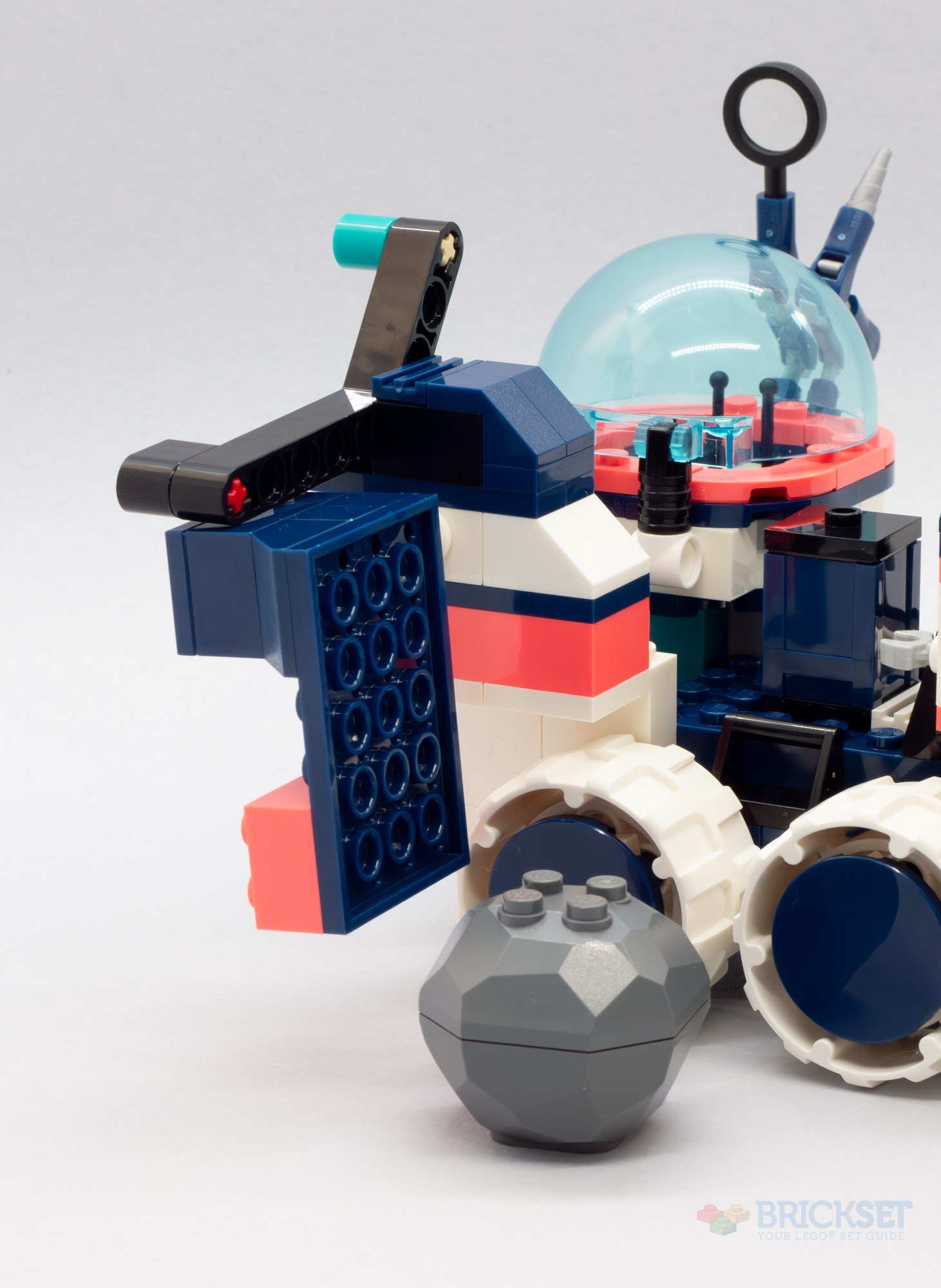
The build phase has us using a couple of bags of bricks to construct a six-wheeled Mars buggy. I quite like most of the design—the cockpit lifts forwards on hinges to allow access to the single seat cabin, there's a loading bay in the middle with a storage crate, and a second seating area beneath an observation dome houses controls for a robotic drill and a magnifying glass. The strange blocky contraption at the rear on the right, however, is very crudely built!
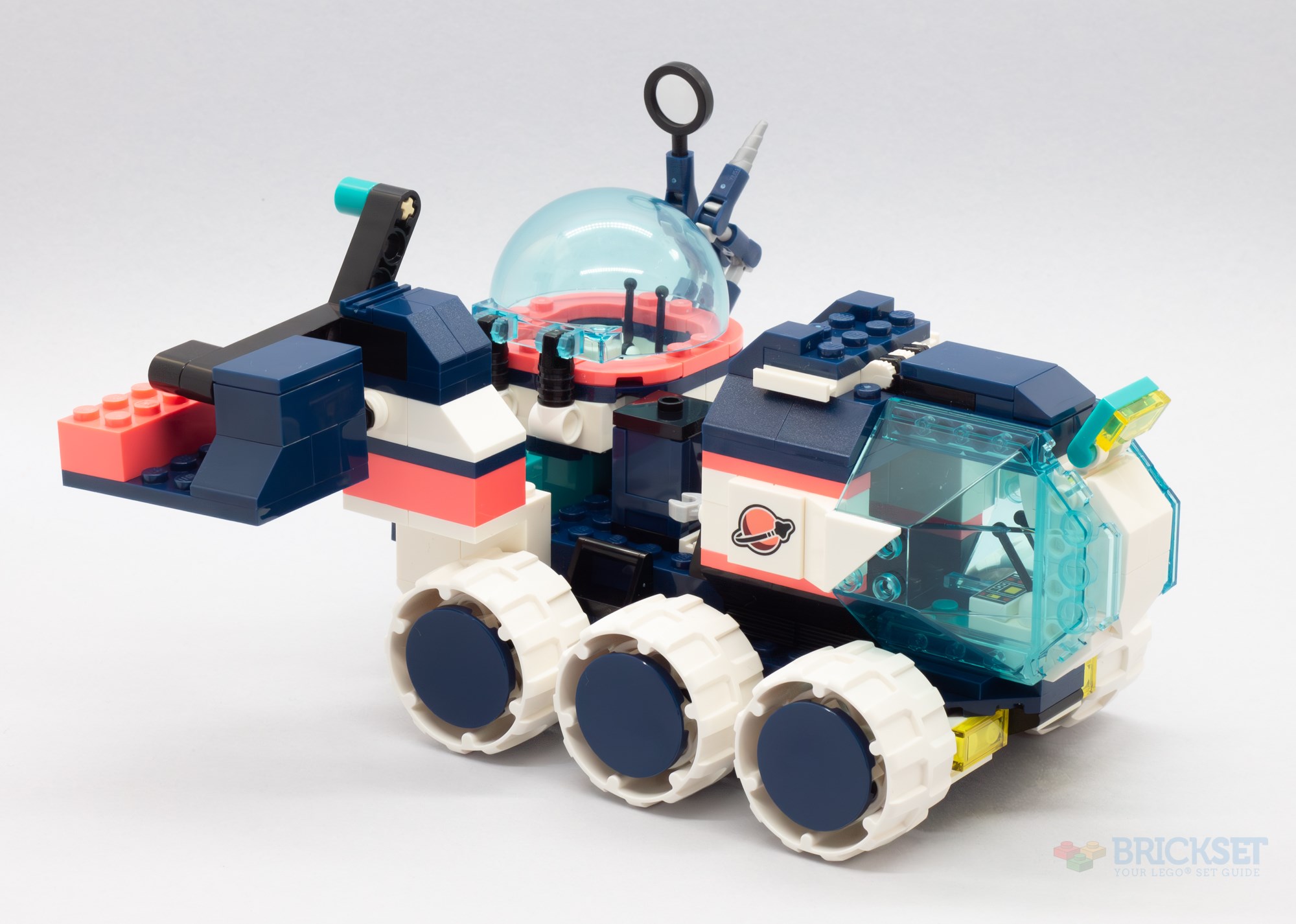
It turns out that this is the part of the buggy that needs to be solved. It is an arm designed to kick rocks along the ground—pressing on the Technic leaver releases the arm and it swings down—but it doesn't have enough power to move anything very far.
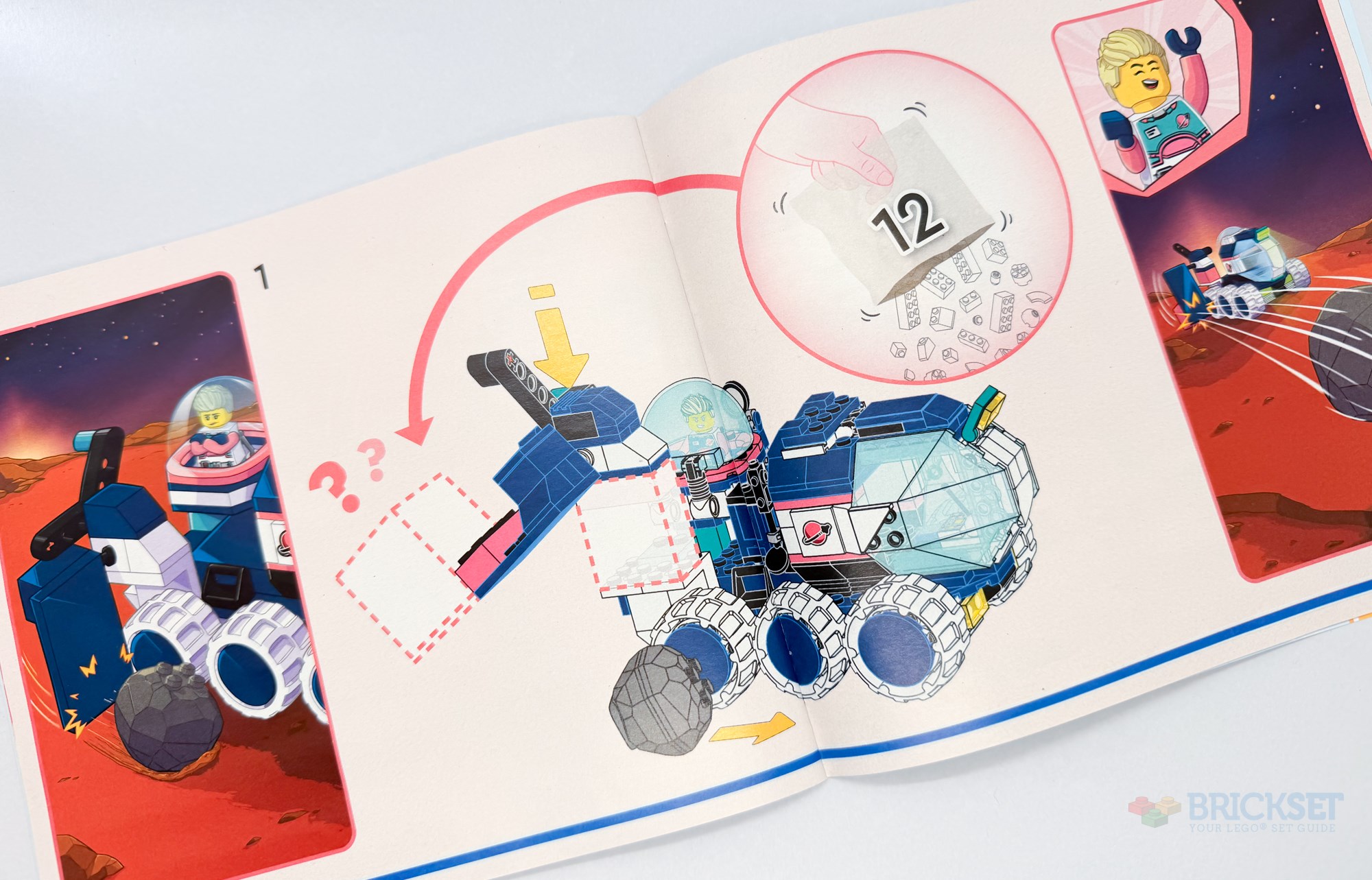
The instruction booklet tells us, without words, what the problem is, and gives us some hints in the form of the dashed areas of how to solve it. In this case, we're meant to use the bricks in bag 12 to increase the height and length of the arm, to give it more power when it swings down—this is the "potential and kinetic energy" teachable moment.
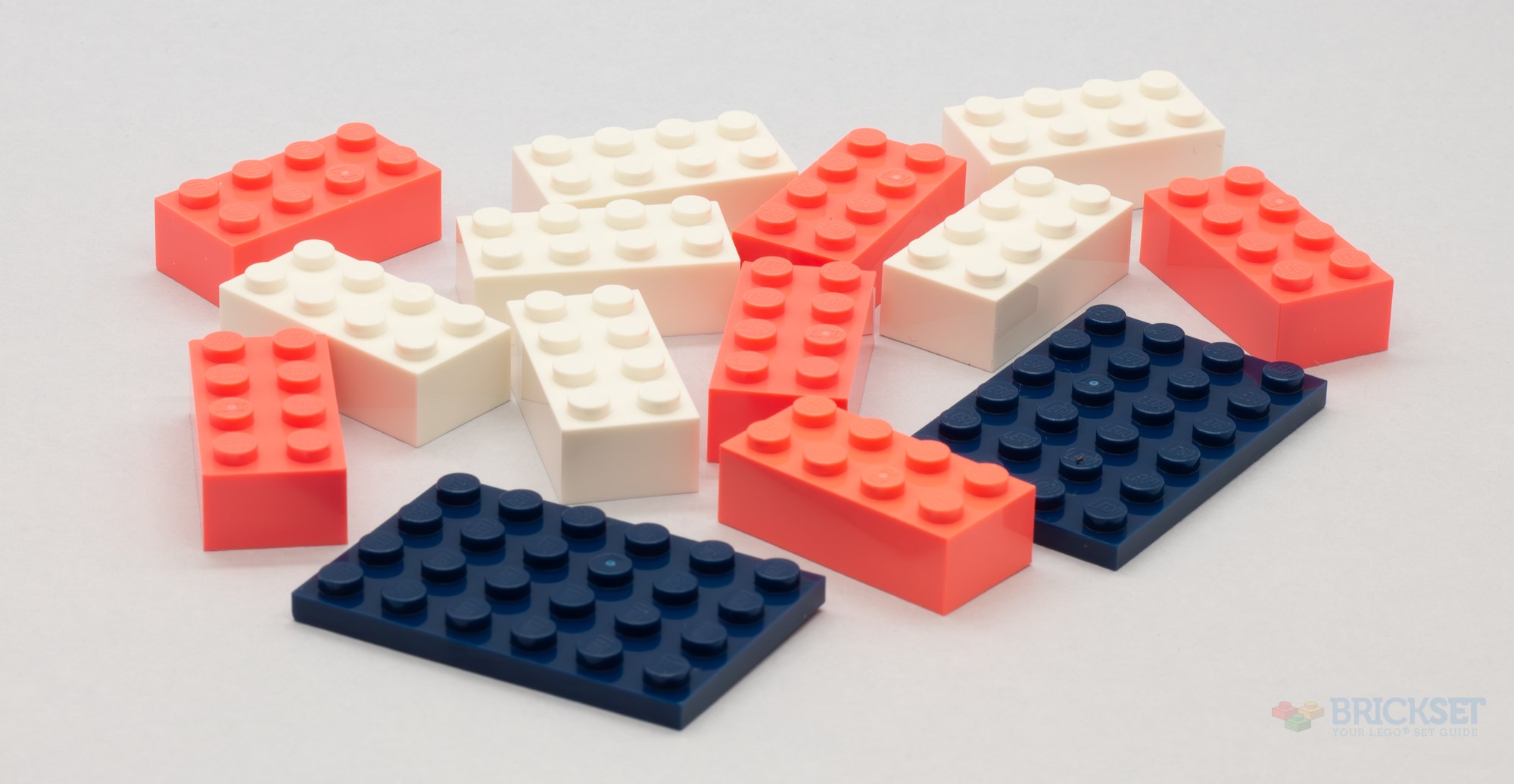
Opening bag 12 reveals a rather disappointing selection of bricks…
But I did my best to crudely increase the power of the arm as instructed! It looks even more ridiculous now than it did before, but it does work—the provided rock travels a lot further than it did before.
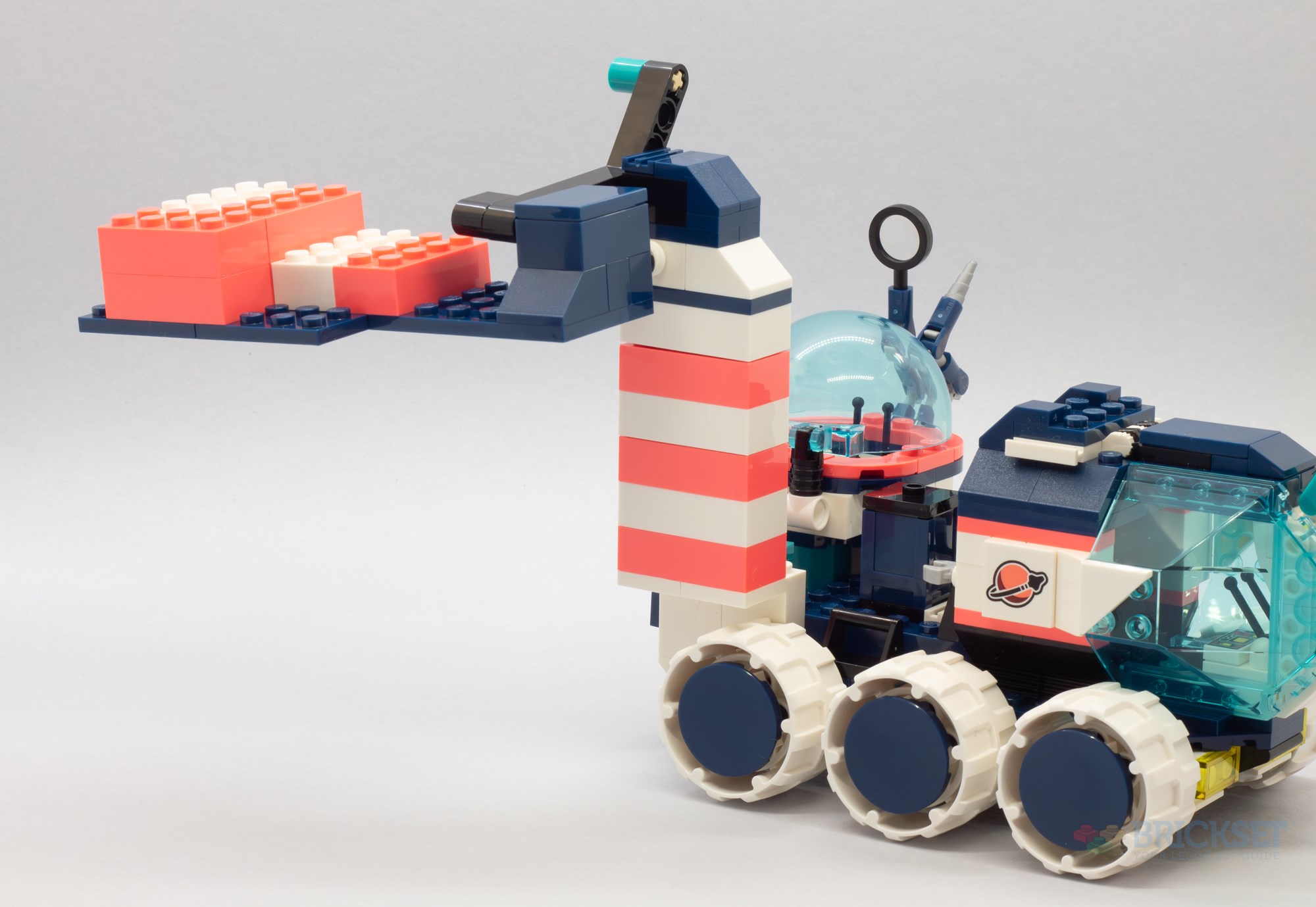
With that solved, the only question is where to gather all these rocks for analysis. Bag 13 provides the parts necessary for the invent phase, where we are encouraged to build a collection area.
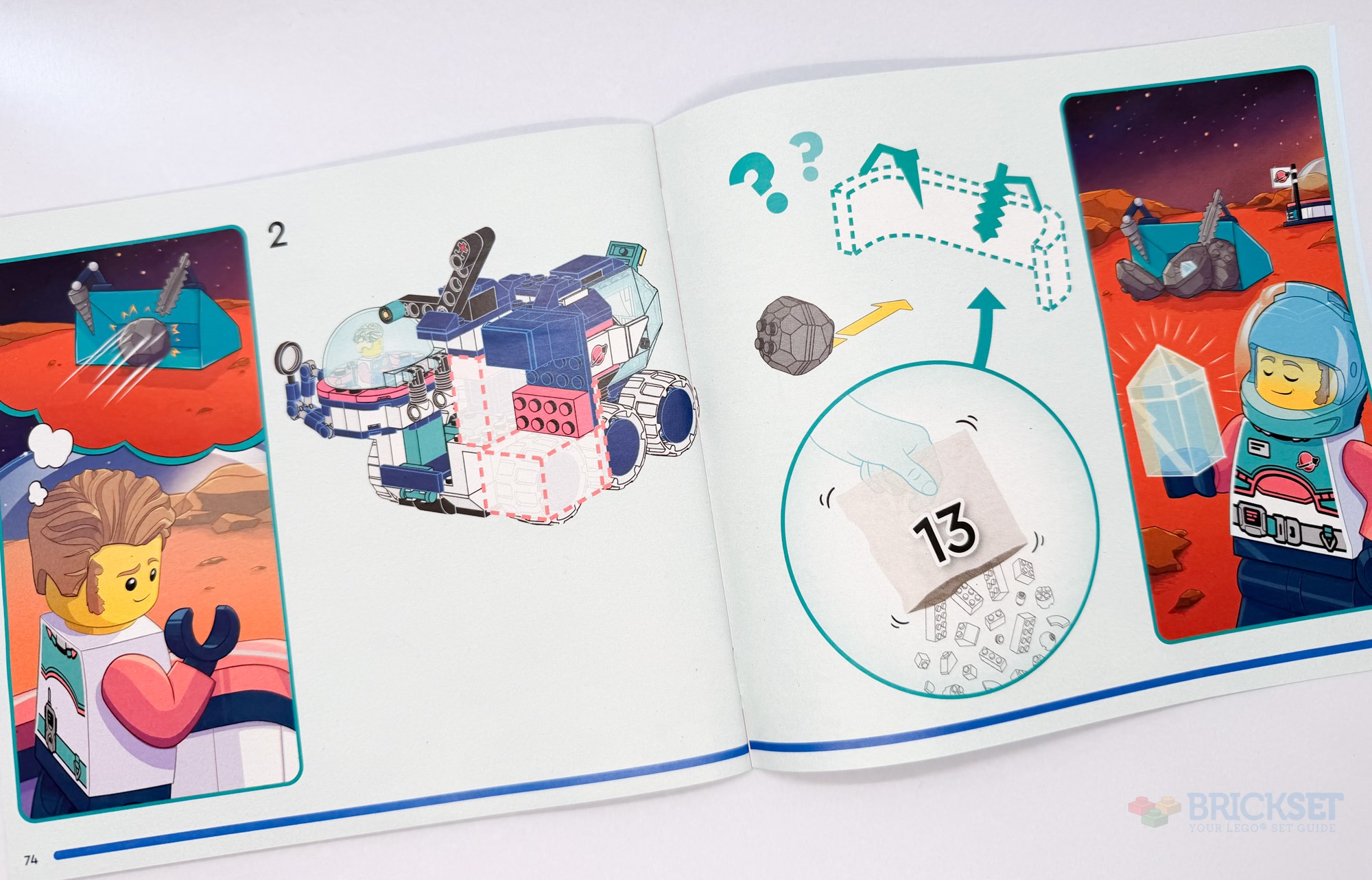
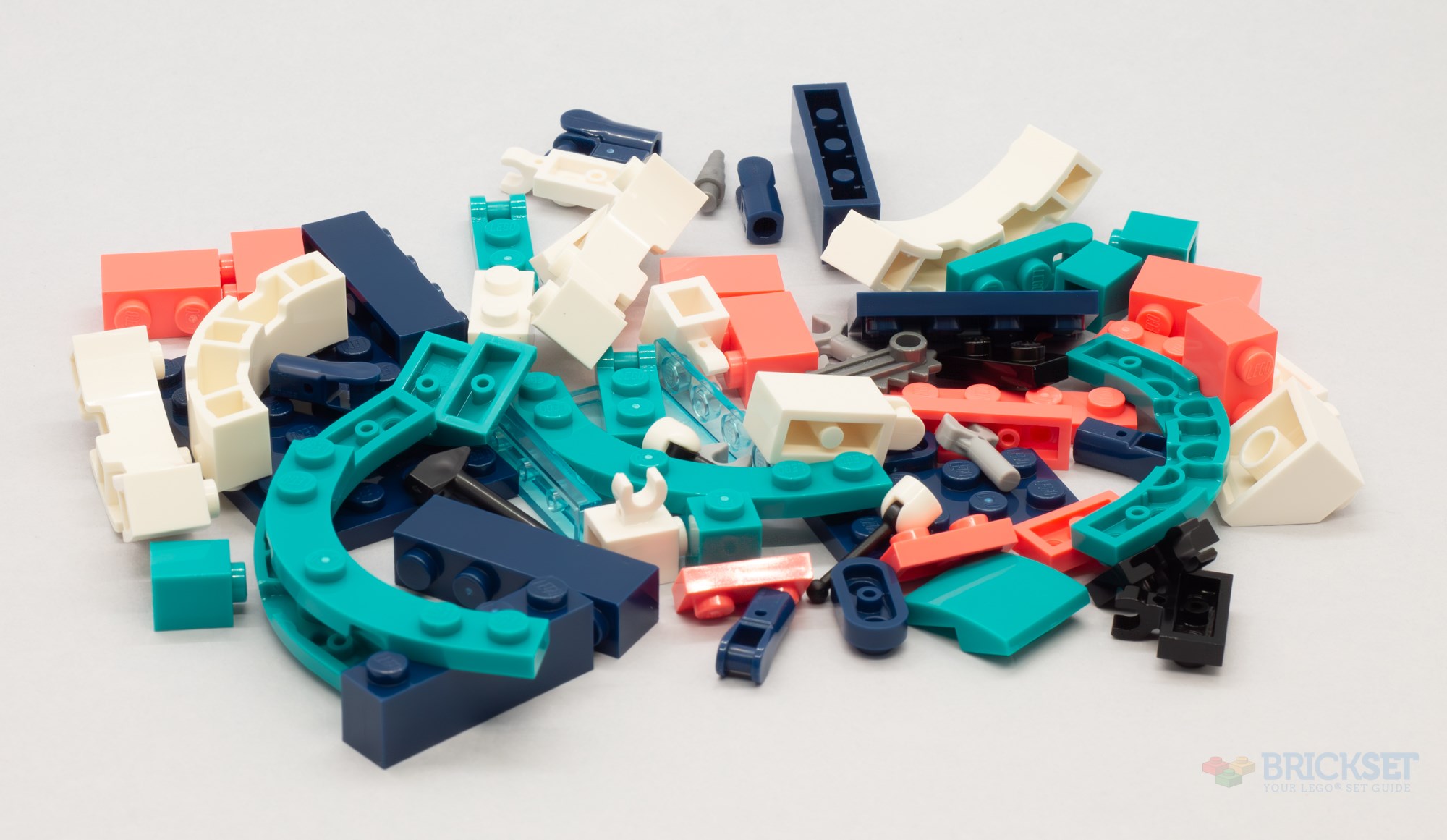
We have a few more pieces this time around, but although it is entirely free-build, they really are leading you in a specific direction with their choice of parts and the dotted outline in the instruction manual.
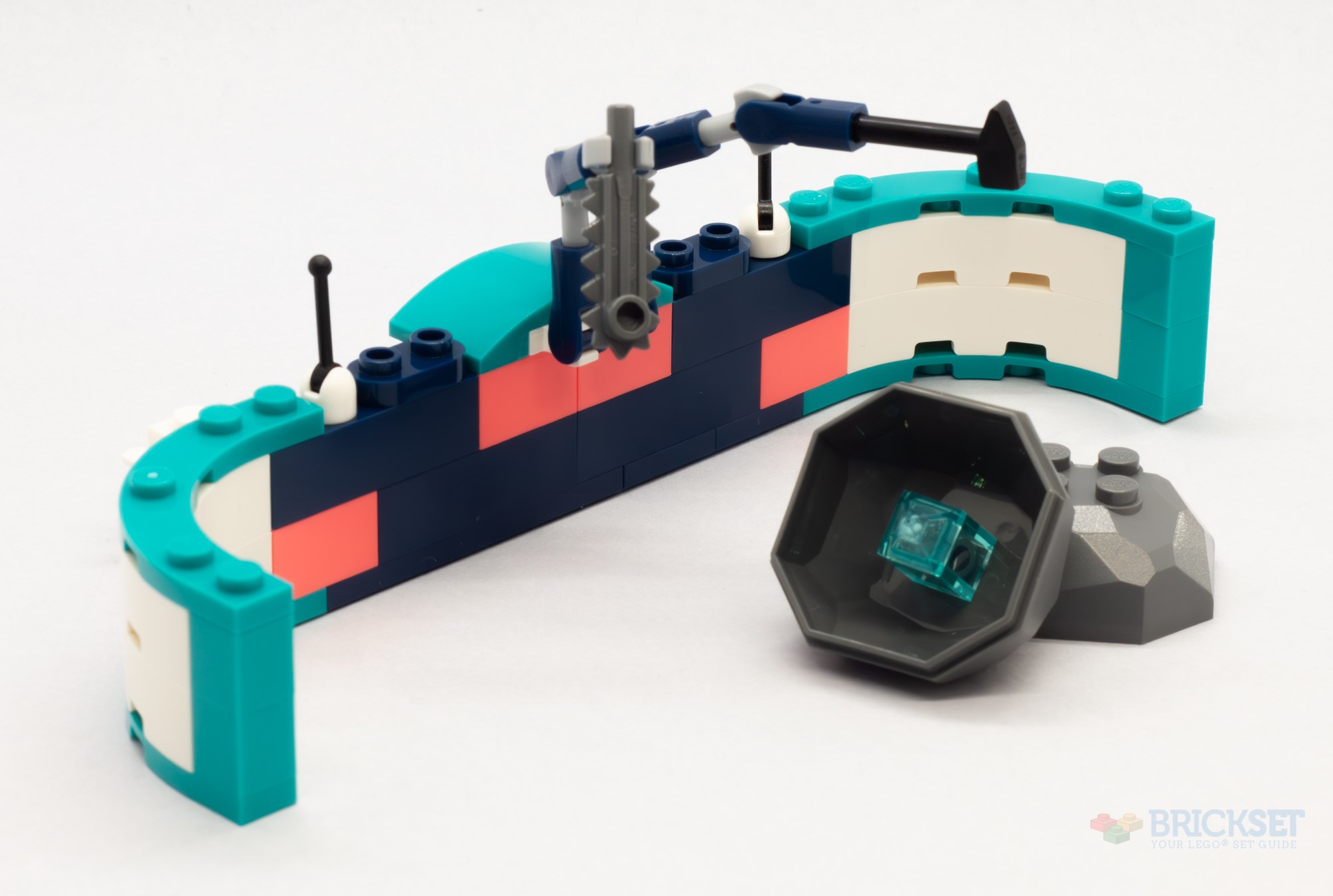
Below is my rudimentary attempt. I didn't use all the pieces, and I didn't spend very long on it—I'll be honest, it wasn't particularly fun to build within such constraints. The limited number and utility of the pieces available really only led in one direction with very little room for creativity.
Verdict
I always appreciate LEGO trying something new, and I can see what they are getting at with these sets. The build, solve, invent concept is a neat idea, encouraging children to not just play with the bricks but to introduce various challenges and iterate on solutions for them. However, the experiments feel somewhat forced, with an odd selection of scientific concepts applied where they wouldn't be in reality—a Mars rover would never fling rocks around with a giant kicking arm, and penguins don't construct safe paths down icy slopes before diving into the sea.
On the initial page of each instruction booklet there are suggested questions for the parents to prompt their children with when thinking about solutions, but in reality most children are just going to want to play with the LEGO, and anything they do learn from the brief science lesson is unlikely to stick, in my opinion. Even during the free build sections, the limited selection of bricks constrains their creativity and leads to models that are far less creative than they would otherwise build with the rest of their collection.
On a practical note, the way the sets rely on specific numbered bags for the free-build sections while others are reserved for the instruction-led builds makes replaying the activities later on slightly awkward. Unless you’ve been careful to keep track of which elements came from which bag, it’s very easy to incorporate a piece into a solve or invent free build that’s needed further on in the instructions, forcing you to dismantle part of your own model in order to continue.
I do love the cohesive colour scheme chosen throughout all four sets, though—it feels suitably "educational" and "science" to me, and the minifigures are pretty good. Are they worth the relatively high price, though? Personally, unless my children particularly asked for one of them, I would rather spend the money on a set with more playability. LEGO has plenty of educational advantages already—improving fine motor skills and creativity to name only a couple—without having to explicitly force it into the sets.
- Buy 45200 Moon Mission Science Kit at LEGO.com »
- Buy 45201 Antarctic Animals Science Kit at LEGO.com »
- Buy 45202 Mars Mission Science Kit at LEGO.com »
- Buy 45203 Arctic Animals Science Kit at LEGO.com »
76 likes
39 comments on this article
I definitely think this is one of those reviews where the target audience ie. children should have been enlisted to test the sets.
The idea seems similar to the Lego City Missions sets from a few years ago, only with printed instructions instead of the online-only ones from those. They involved solving how to finish a build to complete a task:
https://brickset.com/sets/theme-City/subtheme-Missions
This is unfortunately nothing new. LEGO has always produced expensive educational sets - and I don't know if schools can get subsidies to buy experimental bricks, or if TLG is just vastly overestimating how much funding goes into public education. Or, option 3, maybe this is part of a plan to pay teachers in LEGO bricks.
It's not that I don't like this sets. Neat colour-scheme, fun builds, I'm on board - but if we're expected to pay 30% extra just to teach children "how not to make your LEGO thing fall", I feel that's something regular sets do just fine. I don't see the additional educational value here. Schools, give that money to your teachers instead.
Thanks for the review, @benbacardi! Would be interesting to see a review of you guys for classic educational sets, ie. those that aren't sold to the public and get a verdict if they are better of these four.
@chrisaw said:
"I definitely think this is one of those reviews where the target audience ie. children should have been enlisted to test the sets. "
To be honest, my son and daughter are both target age and they did work through the first couple of missions but had little interest in continuing. I should have included that more explicitly in the review, you're right, though it did influence my overall comments.
There are cheaper and better LEGO sets to teach kids stuff. The sets look fine, though.
Pretty much confirms everything I thought on first look when they were revealed. Limited educational value, and the target audience would find it boring.
I know its not impossible to make educational experiments fun, so I've really got no clue why and how LEGO keep missing the mark.
Homeschooling for the win!
@Crux said:
"This is unfortunately nothing new. LEGO has always produced expensive educational sets - and I don't know if schools can get subsidies to buy experimental bricks, or if TLG is just vastly overestimating how much funding goes into public education. Or, option 3, maybe this is part of a plan to pay teachers in LEGO bricks.
It's not that I don't like this sets. Neat colour-scheme, fun builds, I'm on board - but if we're expected to pay 30% extra just to teach children "how not to make your LEGO thing fall", I feel that's something regular sets do just fine. I don't see the additional educational value here. Schools, give that money to your teachers instead."
At least in the US, schools can receive subsidies. A school that one of my friends worked at had a few mindstorms EV3 sets they used for a STEM program that they gave me after they phased them out of the curriculum.
@Iconetic said:
" @Crux said:
"This is unfortunately nothing new. LEGO has always produced expensive educational sets - and I don't know if schools can get subsidies to buy experimental bricks, or if TLG is just vastly overestimating how much funding goes into public education. Or, option 3, maybe this is part of a plan to pay teachers in LEGO bricks.
It's not that I don't like this sets. Neat colour-scheme, fun builds, I'm on board - but if we're expected to pay 30% extra just to teach children "how not to make your LEGO thing fall", I feel that's something regular sets do just fine. I don't see the additional educational value here. Schools, give that money to your teachers instead."
At least in the US, schools can receive subsidies. A school that one of my friends worked at had a few mindstorms EV3 sets they used for a STEM program that they gave me after they phased them out of the curriculum."
So, does that mean they weren't happy with mindstorms, too?
Having worked in both k-12 education and having been a university professor, I think the "Education" value added here is a bit of a stretch (and certainly doesn't justify the price). With the right narrative aimed at the right audience, nearly all Lego sets can be considered educational, but these offerings are, at best, on par with "regular" kits we've already seen coming out of City and Friends and IMO a step down from things like their Discovery theme from twenty years ago. Phasing out the Spike sets is a blow to long term consumers of Lego Education sets, but pitching these as specialized educational tools is adding insult to injury. Who is running Lego Education these days?
One of the Summary points was that these are: "Expensive for what they are".
Perhaps the design or execution is not what you expect for this price. But as far as price per piece, these are a LOT less expensive than Star Wars and most City sets (in USA).
Thanks for the review.
I like the idea and colour scheme, but I see more educational value in just giving kids some of the basic Lego sets and let them build from imagination.
Of course that's not for everyone. So maybe bring back the Lego ideas Books?
These seem like the kind of thing you'd get if you observed a small number of education workers in a very specific workshop - exactly what you need for one particular guided session and not much good for anything else....
I love the minifigs and very much hope to see them turn up on pick a brick or build a minifig eventually, but otherwise I don’t feel these hold all that much appeal. I’d hoped for more flexibility in what parts were provided, to be honest.
It always hurts my heart a little to see a British person use the American term (homeschooling) and not ours (home education). I do understand that when the media started covering us more they were lazy and didn’t bother to actually get the usage right, though, and thus the American one ended up better known here. But I don’t have to *like* it. Especially given the philosophical differences.
@jkb said:
" @Iconetic said:
" @Crux said:
"This is unfortunately nothing new. LEGO has always produced expensive educational sets - and I don't know if schools can get subsidies to buy experimental bricks, or if TLG is just vastly overestimating how much funding goes into public education. Or, option 3, maybe this is part of a plan to pay teachers in LEGO bricks.
It's not that I don't like this sets. Neat colour-scheme, fun builds, I'm on board - but if we're expected to pay 30% extra just to teach children "how not to make your LEGO thing fall", I feel that's something regular sets do just fine. I don't see the additional educational value here. Schools, give that money to your teachers instead."
At least in the US, schools can receive subsidies. A school that one of my friends worked at had a few mindstorms EV3 sets they used for a STEM program that they gave me after they phased them out of the curriculum."
So, does that mean they weren't happy with mindstorms, too?"
It's more likely that they weren't happy with the lack of backward compatibility as TLG evolved the product. It's very hard to manage a lab for kids and have a standard curriculum if you don't have a homogenous baseline to start with. It's hard enough to keep order in a STEM lab filled with kids without having to deal with this _table_ working with an ancient RCX and those tables using EV3s and while this table is using SPIKE; parts and cables get mixed up and half the class time is wasted just trying to mix and match compatible components. Over time things wear out and replacements just aren't available anymore and sooner or later you just have to rebaseline on the next generation because you don't have enough of one generation of controller brick (and family) to service an entire class at once. Even with subsidies, that can be a pretty expensive and frustrating proposition for a lot of schools.
@Hiratha said:
"It always hurts my heart a little to see a British person use the American term (homeschooling) and not ours (home education). I do understand that when the media started covering us more they were lazy and didn’t bother to actually get the usage right, though, and thus the American one ended up better known here. But I don’t have to *like* it. Especially given the philosophical differences."
Unfortunately, media most likely pursued classroom education and thus were unable to learn the differences in philosophies
@yellowcastle said:
" @Hiratha said:
"It always hurts my heart a little to see a British person use the American term (homeschooling) and not ours (home education). I do understand that when the media started covering us more they were lazy and didn’t bother to actually get the usage right, though, and thus the American one ended up better known here. But I don’t have to *like* it. Especially given the philosophical differences."
Unfortunately, media most likely pursued classroom education and thus were unable to learn the differences in philosophies"
It has, admittedly, been an ongoing source of amusement (frustrated amusement, but amusement nonetheless) to see quotes from people in the home ed community saying “home education blah blah home education blah did we mention we call it home education because it’s about EDUCATION not SCHOOL(ing) blah blah home education” followed immediately by a paragraph where the journalist writing the article calls it home schooling. Not too quick on the uptake.
@Hiratha said:
" @yellowcastle said:
" @Hiratha said:
"It always hurts my heart a little to see a British person use the American term (homeschooling) and not ours (home education). I do understand that when the media started covering us more they were lazy and didn’t bother to actually get the usage right, though, and thus the American one ended up better known here. But I don’t have to *like* it. Especially given the philosophical differences."
Unfortunately, media most likely pursued classroom education and thus were unable to learn the differences in philosophies"
It has, admittedly, been an ongoing source of amusement (frustrated amusement, but amusement nonetheless) to see quotes from people in the home ed community saying “home education blah blah home education blah did we mention we call it home education because it’s about EDUCATION not SCHOOL(ing) blah blah home education” followed immediately by a paragraph where the journalist writing the article calls it home schooling. Not too quick on the uptake."
As we are a non-school house, I will need to ask the Mrs. about how/if our philosophy falls into either camp.
Want to really challenge your kids for problem solving? Give them all the pieces from a Friend's set without any instructions and just the box images. That has the same "educational" value and color scheme as these wannabe sets.
"Build a Mars base, solve the problem of damage caused by Martian winds..." But if you have to evacuate that base, make sure that you don't leave anyone behind. I should watch The Martian again. Anyway, I'm not going to be picking up any of these sets, but I'm definitely going to have to remember to look for some of those minifigure parts on PaB, especially the astronaut ones. Loving the teal neo-Futuron.
They're puzzle sets more than educational sets.
@R0Sch said:
"Want to really challenge your kids for problem solving? Give them all the pieces from a Friend's set without any instructions and just the box images. That has the same "educational" value and color scheme as these wannabe sets."
This.
I mean, true, I never understood who the educational sets were for. At least of the schools I went to in Germany, none would have had any funds for such "extra" stuff. All the equipment in any of the STEM classes had to be specially certified to fit into the curriculum (we are talking Germany here after all) and made by licensed manufacturers (of which LEGO was none of).
Sometimes schools have private extra funding provided by the parents, but that tends to be used for activities outside of the curriculum, like afternoon supplementary tutor lessons, school outings and excursions etc.
I would have loved to use LEGO in school for any kind of activity, but alas it was not to be.
@yellowcastle said:
" @Hiratha said:
" @yellowcastle said:
" @Hiratha said:
"It always hurts my heart a little to see a British person use the American term (homeschooling) and not ours (home education). I do understand that when the media started covering us more they were lazy and didn’t bother to actually get the usage right, though, and thus the American one ended up better known here. But I don’t have to *like* it. Especially given the philosophical differences."
Unfortunately, media most likely pursued classroom education and thus were unable to learn the differences in philosophies"
It has, admittedly, been an ongoing source of amusement (frustrated amusement, but amusement nonetheless) to see quotes from people in the home ed community saying “home education blah blah home education blah did we mention we call it home education because it’s about EDUCATION not SCHOOL(ing) blah blah home education” followed immediately by a paragraph where the journalist writing the article calls it home schooling. Not too quick on the uptake."
As we are a non-school house, I will need to ask the Mrs. about how/if our philosophy falls into either camp."
Home Education- you are educating your kids at home
Home Schooling- kids are at home, but the school is still providing learning (most often for kids who are ill/temporarily unable yo attend)
It does seem to really annoy many Home Edders when its called Home school, I think partially as people then assume we have kids in our houses sat at desks etc
@Terreneflame said:
" @yellowcastle said:
" @Hiratha said:
" @yellowcastle said:
" @Hiratha said:
"It always hurts my heart a little to see a British person use the American term (homeschooling) and not ours (home education). I do understand that when the media started covering us more they were lazy and didn’t bother to actually get the usage right, though, and thus the American one ended up better known here. But I don’t have to *like* it. Especially given the philosophical differences."
Unfortunately, media most likely pursued classroom education and thus were unable to learn the differences in philosophies"
It has, admittedly, been an ongoing source of amusement (frustrated amusement, but amusement nonetheless) to see quotes from people in the home ed community saying “home education blah blah home education blah did we mention we call it home education because it’s about EDUCATION not SCHOOL(ing) blah blah home education” followed immediately by a paragraph where the journalist writing the article calls it home schooling. Not too quick on the uptake."
As we are a non-school house, I will need to ask the Mrs. about how/if our philosophy falls into either camp."
Home Education- you are educating your kids at home
Home Schooling- kids are at home, but the school is still providing learning (most often for kids who are ill/temporarily unable yo attend)
It does seem to really annoy many Home Edders when its called Home school, I think partially as people then assume we have kids in our houses sat at desks etc
"
It can also be less specifically a-school-is-involved and also includes, hm… trying to replicate the styles and hierarchies of school classrooms and classroom learning, but in the home - although there’s not much difference between that and what you describe aside from the involvement of someone getting paid, I suppose. Home education doesn’t try to mimic school at all, because it doesn’t start with the assumption that how schools do it is the only correct way.
(There’s also some variety within and beyond that - unschooling for example - but at that point we would be well off into the extremely specific weeds of home education philosophy and beyond the scope of this comment thread.)
(Although on the home education subject it’s always nice when educational things are available to all families and not just the ones who use schools, since that was frequently frustrating back in the 90s and I understand involved quite a lot of letter writing and campaigning from my parents and others, so while these kits don’t seem to quite hit the spot I am glad they’re universally accessible.)
@Terreneflame said:
" @yellowcastle said:
" @Hiratha said:
" @yellowcastle said:
" @Hiratha said:
"It always hurts my heart a little to see a British person use the American term (homeschooling) and not ours (home education). I do understand that when the media started covering us more they were lazy and didn’t bother to actually get the usage right, though, and thus the American one ended up better known here. But I don’t have to *like* it. Especially given the philosophical differences."
Unfortunately, media most likely pursued classroom education and thus were unable to learn the differences in philosophies"
It has, admittedly, been an ongoing source of amusement (frustrated amusement, but amusement nonetheless) to see quotes from people in the home ed community saying “home education blah blah home education blah did we mention we call it home education because it’s about EDUCATION not SCHOOL(ing) blah blah home education” followed immediately by a paragraph where the journalist writing the article calls it home schooling. Not too quick on the uptake."
As we are a non-school house, I will need to ask the Mrs. about how/if our philosophy falls into either camp."
Home Education- you are educating your kids at home
Home Schooling- kids are at home, but the school is still providing learning (most often for kids who are ill/temporarily unable yo attend)
"
The government uses both home education and home schooling to mean the same thing.
https://www.gov.uk/home-education
@CCC said:
" @Terreneflame said:
" @yellowcastle said:
" @Hiratha said:
" @yellowcastle said:
" @Hiratha said:
"It always hurts my heart a little to see a British person use the American term (homeschooling) and not ours (home education). I do understand that when the media started covering us more they were lazy and didn’t bother to actually get the usage right, though, and thus the American one ended up better known here. But I don’t have to *like* it. Especially given the philosophical differences."
Unfortunately, media most likely pursued classroom education and thus were unable to learn the differences in philosophies"
It has, admittedly, been an ongoing source of amusement (frustrated amusement, but amusement nonetheless) to see quotes from people in the home ed community saying “home education blah blah home education blah did we mention we call it home education because it’s about EDUCATION not SCHOOL(ing) blah blah home education” followed immediately by a paragraph where the journalist writing the article calls it home schooling. Not too quick on the uptake."
As we are a non-school house, I will need to ask the Mrs. about how/if our philosophy falls into either camp."
Home Education- you are educating your kids at home
Home Schooling- kids are at home, but the school is still providing learning (most often for kids who are ill/temporarily unable yo attend)
"
The government uses both home education and home schooling to mean the same thing.
https://www.gov.uk/home-education "
If you consider for a moment that I don’t think the government has the sole authority on educating children, imagine how excited I am at the prospect of them getting to dictate what we call it.
But more seriously: Well, yeah, they have to - and should - acknowledge that some people do indeed use that term. It’s their job to include the terms people use, so as to confuse the fewest number of people, not to take an absolutist stance on home education philosophy.
However, I will also point out that they clearly privilege home education as the primary term and only mention the others as you-may-also-hear. Because home education is the main term used by people who educate their kids outside of school in the UK, and if you tag ‘elective’ on the front it’s also the official legal term, which for all they don’t get to dictate is at least an indication of what people have been using before and after the legal term was created. Home schooling is neither in primary use nor part of the legal term, it’s just used by people who don’t know any better because it’s the most-used-in-America term and America is very, very loud.
These don't feel like real science experiments in any way. Much more like "science" created by product designers, rather than scientists.
My daughter has been doing science in primary school using a similar structure, but those experiments did real science and only needed household junk for materials.
I really see zero added value in these sets.
@DoonsterBuildsLego said:
"These don't feel like real science experiments in any way. Much more like "science" created by product designers, rather than scientists.
My daughter has been doing science in primary school using a similar structure, but those experiments did real science and only needed household junk for materials.
I really see zero added value in these sets. "
Agreed. It seems obvious to me that the best education, especially when it comes to science, should involve a combination of both show and tell, with hands on experiments when appropriate. However, the kinetic energy potential (trebuchet) experiment could have been demonstrated more easily with two different sized spoons, some mashed potatoes and a target a few feet away... or a game of golf... or playing on a drum with two different sized sticks... or even with a simple rubber band.
Personally, knowing that it could've been demonstrated in a fraction of the time it took to build everything, at a fraction of the cost of this set and in a way that probably would have been more fun for kids, I can't really see why anyone would care about this, especially for educating a kid at home.
Even if I were a science teacher, I'd be more apt to use whatever budget I was provided toward a kit that could teach a broader range of scientific topics. I'm not sure what LEGO can really demonstrate beyond simple machines and elementary level physics. Does LEGO even produce magnets anymore? I'm inclined to think that magnets are a necessary component of every elementary level science kit.
I think the educational potential of LEGO lies in the imaginative and partner / team building experience, but even at maximum potential, it still pales in comparison to what learning a musical instrument provides. There have been countless studies done now demonstrating the Mozart effect and even more, that learning a musical instrument, regardless of age, consistently provides an intelligence benefit, especially if you play with a group or ensemble.
@Hiratha : so if I understand correctly it's legal in the UK (and the US too?) to decide to educate your children outside the school system?
Because over here that would be illegal. Sending your children to school is compulsory here, and failing to do so can get you into jail even. The laws regarding the subject are very strict.
@AustinPowers said:
" @Hiratha : so if I understand correctly it's legal in the UK (and the US too?) to decide to educate your children outside the school system?
Because over here that would be illegal. Sending your children to school is compulsory here, and failing to do so can get you into jail even. The laws regarding the subject are very strict. "
In the US, there are vague federal guidelines and then actual rules vary from state to state (and territories). Demonstrating that you are educating your children is pretty much required but the means one uses to pursue that goal can vary wildly. The most generous exemptions often are connected to religious beliefs in states populated by people with the most distain for STEM - but that's a debate for a different forum. When it comes to home instruction, many states take a trust but verify approach, offering guidelines as to the _minimum_ level of instruction considered acceptable on various topics and then requiring remote learners to pass standardized tests every few years - but as I said, it really varies from one state to the next.
Charter Schools are also big in some parts of the US. They also vary wildly in quality and focus. Some are set up more like prep schools for kids whose parents feel (often rightly) that the public school system isn't challenging them enough. Some are designed to restore many of the art and music programs that are often first on the chopping block when a school budget gets frozen or slashed. Some are designed to be "safe zones" for the values of one speciality community or another (e.g. promising to teach intelligent design rather than evolution, or avoiding "uncomfortable" topics in history or controversial books in English class).
The founding principles are that "learning can happen anywhere" and that parents should have the ultimate say in how/what their child learns. Sometimes it works well and gifted individuals are able to thrive rather than sleeping through boring lectures that focus on testing to the test; and then sometimes you end up with gullible, sheltered and/or easily triggered populations who actively defend voting against their own self-interests because they were never taught basic principles of causality and consequence. If the answer were obvious, we wouldn't be debating the question, but that's about how things are in the US.
Now back to our regularly scheduled Lego discussions...
@AustinPowers
Yes, very legal in the UK. You have a legal obligation to ensure your children are educated; you do not have an obligation to see it done in a school. Mix of families who participate for philosophical reasons and families whose child/ren for whatever reason didn’t thrive in school and had to be removed for their own wellbeing - usually either extreme bullying or neurodivergence. Or both.
@Terreneflame said:
" @Hiratha said:
"It always hurts my heart a little to see a British person use the American term (homeschooling) and not ours (home education). I do understand that when the media started covering us more they were lazy and didn’t bother to actually get the usage right, though, and thus the American one ended up better known here. But I don’t have to *like* it. Especially given the philosophical differences."
Home Education- you are educating your kids at home
Home Schooling- kids are at home, but the school is still providing learning (most often for kids who are ill/temporarily unable yo attend)"
@Hiratha -- I'm not sure what the "philosophical differences" between the UK and US systems of educating at home really are, but I suspect they are more minor than you believe.
I have never heard the term Home Education used in the United States--"educating your kids at home" has always, in my experience, been called Home Schooling on this side of the pond. What is defined as "Home Schooling" by @Terreneflame *does* exist in the US, but is called "remote learning" (without capitals). As far as I know remote learning first became widely available during Covid, but continues to take place on what would have been "snow days" or "weather days" before schools had the ability to provide virtual classrooms.
The process of education--like that of voting--is governed by the individual states but subject to guidelines from the federal government. @ShaydDeGrai gives a very good overview of how this works out in practice--although the issues mentioned in @Hiratha 's most recent post also can apply to American children, including the possibility of some children being expelled from public (non-fee-paying, government-established, universally available) schools, in which case (I assume) the parents are required to find some alternative way to have them educated.
Lego-related content--I suppose these modules could also serve as a template for how building with Lego could be incorporated into other lesson plans, but frankly I think the Master Building series would be a much better starting point for that. It isn't just the children who are being pressured to do one specific thing in each module--it's also the teacher. Not, in my opinion, a recipe for a very successful learning session!
@Vesperas said:"Does LEGO even produce magnets anymore?"
I know there were those big chunky magnets that were in a couple of sets back in 2020 (https://brickset.com/parts/design-65209 and https://brickset.com/parts/6285589/brick-4x4x1-1-3-w-magnet-no-1) but beyond that, I don't know. Do train sets still use them? I only own two train sets, and both of those are from last century.
@Hiratha said:
" @AustinPowers
Yes, very legal in the UK. You have a legal obligation to ensure your children are educated; you do not have an obligation to see it done in a school. Mix of families who participate for philosophical reasons and families whose child/ren for whatever reason didn’t thrive in school and had to be removed for their own wellbeing - usually either extreme bullying or neurodivergence. Or both."
Interesting.
Over here, in the case of (extreme) bullying, mobbing, etc. the kid has the choice to go to a different school - or the bully is expelled and has to find another school.
In the case of neurodivergence (if I understand the term correctly - in my day it was called "children with special needs") there are either special schools that are equipped to adequately deal with such children, or, more often than not these days, such children tend to be integrated into normal classes - so that both sides can learn and profit from the experience.
In any case there is no reason for letting kids be taught at home by their parents. I mean, seriously, teachers have to study for many years in order to be allowed to teach at all. How can anyone expect parents, who are typically laymen when it comes to teaching (let alone have the time and resources), to be able to achieve what a school can?
Got both space sets and will be combining these to build a shuttle craft. Really like the space suits, parts, and colors. Getting +1,450 pieces with 6 minifigures for $150 and NO stickers feels like a good value to me.
@AustinPowers said:
" @Hiratha said:
" @AustinPowers
Yes, very legal in the UK. You have a legal obligation to ensure your children are educated; you do not have an obligation to see it done in a school. Mix of families who participate for philosophical reasons and families whose child/ren for whatever reason didn’t thrive in school and had to be removed for their own wellbeing - usually either extreme bullying or neurodivergence. Or both."
Interesting.
Over here, in the case of (extreme) bullying, mobbing, etc. the kid has the choice to go to a different school - or the bully is expelled and has to find another school.
In the case of neurodivergence (if I understand the term correctly - in my day it was called "children with special needs") there are either special schools that are equipped to adequately deal with such children, or, more often than not these days, such children tend to be integrated into normal classes - so that both sides can learn and profit from the experience.
In any case there is no reason for letting kids be taught at home by their parents. I mean, seriously, teachers have to study for many years in order to be allowed to teach at all. How can anyone expect parents, who are typically laymen when it comes to teaching (let alone have the time and resources), to be able to achieve what a school can? "
You raise a vary valid point about teacher qualifications. Again, in the US, the "standard" varies from state to state (with some being extremely lax due to general shortages of people willing to pay for expensive college degrees so that can apply for jobs that barely pay a living wage). Where I live, the standard to teach in a PUBLIC school used to require a Masters in Education as well as a BS or BA in one's teaching subject area. Teacher shortages, particularly in STEM, eventually pressured them into supporting a teaching certificate program as an alternative to a master's in education as well as giving credit for practical experience (as a way of encouraging retirees in STEM related fields to go into k-12 education. I'm not sure what the current standard is but a friend of mine who was a certified high school teacher in another state for over a decade was told she didn't meet minimum criteria to be a public school teach in my state.
Private schools, charter schools and remote learning situations are an entirely different story, particularly in private schools run by religious organizations (e.g. The Catholic Church) where the US mantra of separation between church and state motivates most states not to impose restrictions on hiring practices on those institutions and by extension of "equal treatment under the law" non-religious institutions get the same exception. So basically, in most states, if a private school wants to hire you, you are by definition "qualified" for the position.
As for the question of what makes parents qualified to teach "X" at home, that has actually given rise to a micro tutoring economy (at least in my state). Full time private tutors and underemployed professionals (particularly in areas like reading instruction, math and science) make house calls on a regular basis to supplement the home instruction the kids are receiving from their parents. I have a mechanical engineering friend with such a side-hustle. One day a week she loads up her trunk with SPIKE kits and iPads and runs a half-day session on physics, mechanics and programming at her client's house for kids from three different families who are pooling resources to support remote learning. (And, for the record, the public school district these kids would normally be attending doesn't have a Lego robot lab, so in this case they're getting something more than what the state is offering FWIW)
If another parent were asking me, I’d suggest that any decent Creator 3-in-1 set would both be more fun and inspire more varied ideas and creativity than these sets. Though it would be a nice addition to the 3-in-1 instructions if they prompted more invention, such as, “now use the rest of the parts to make a tree for the bird to sit on.”
^ I agree with the consensus above; these sets provide little value.
With that out of the way, does anyone else think that the dark-haired minifigure from 45203 looks a little like Rumi from "Kpop Demon Hunters"?