Review: 60511 Vintage Steam Train
Posted by FlagsNZ,
In the first of a series of three reviews of this year's LEGO City train releases, I look at 60511 Vintage Steam Train.
This is the first minifigure scale steam train to be released in the LEGO City theme (there have been some micro steam trains included in LEGO City advent calendars).
Read on as I take a detailed look at this attractive, compact, vintage LEGO City steam train. The review also includes some comments on the return of some key train components after a few years' absence.
Summary
60511 Vintage Steam Train, 575 pieces.
£79.99 / $89.99 / €89.99 | 13.9p, 15.7c, 15.7c per piece.
Buy at LEGO.com »
A very atractive, compact LEGO steam train that operates smoothly on a full train layout
- Return to metal axles on the carriage wheels
- No stickers - only printed parts
- Operates well when upgraded with Powered Up components
- Powered Up is not included with this set
- Not a full circuit of train track
- More expensive than similar 2026 LEGO City trains
The set was provided for review by LEGO. All opinions expressed are those of the author.
The box
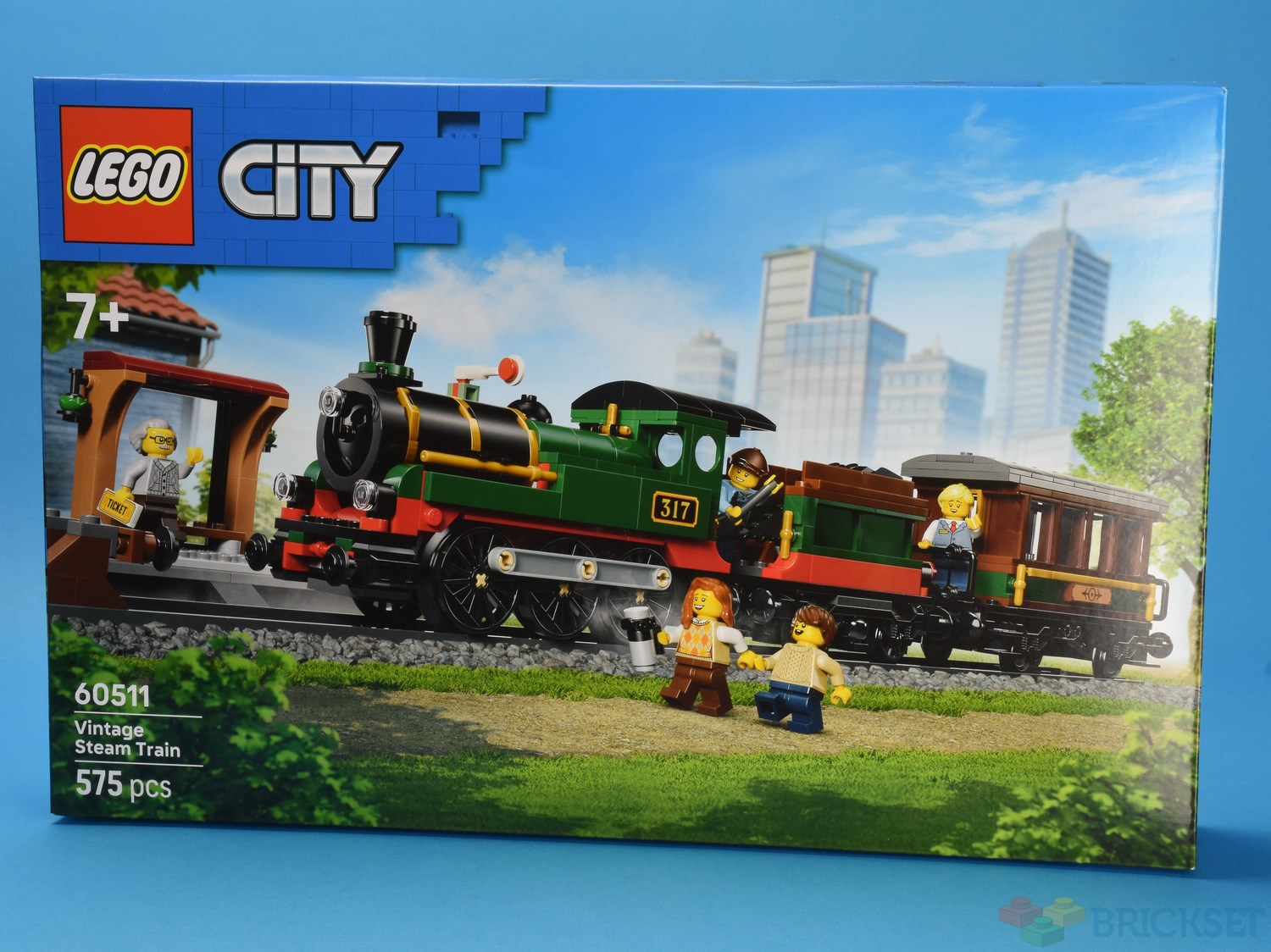
The image on the front of the box shows 60511 Vintage Steam Train waiting at the end of the branch line. The vintage steam train is waiting at a small platform where an elderly gentleman is ready to board the train using his ticket.
There are two rail employees on board the train and a mother and son are walking on a grass path next to the engine.
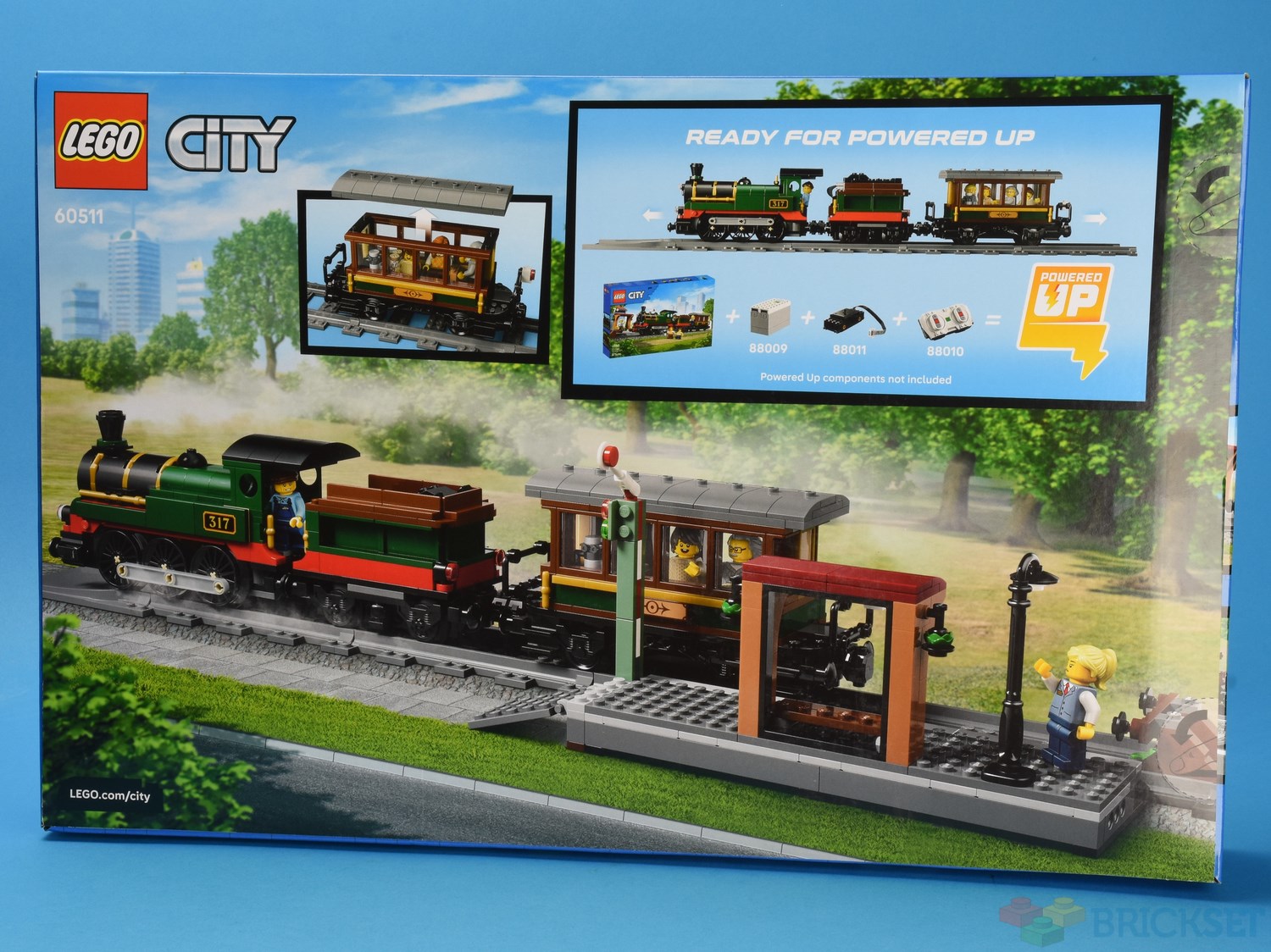
The rear of the box shows that the train has just departed. Faint wisps of steam are being emitted from the chimney.
There are two smaller images that indicate that the roof of the passenger carriage lifts off to reveal the interior decor. This set is also capable of being upgraded using Powered Up components.
Instructions
There are four separate instruction booklets.
The first booklet contains the instructions to assemble the platform and the end-of-line buffer stop.
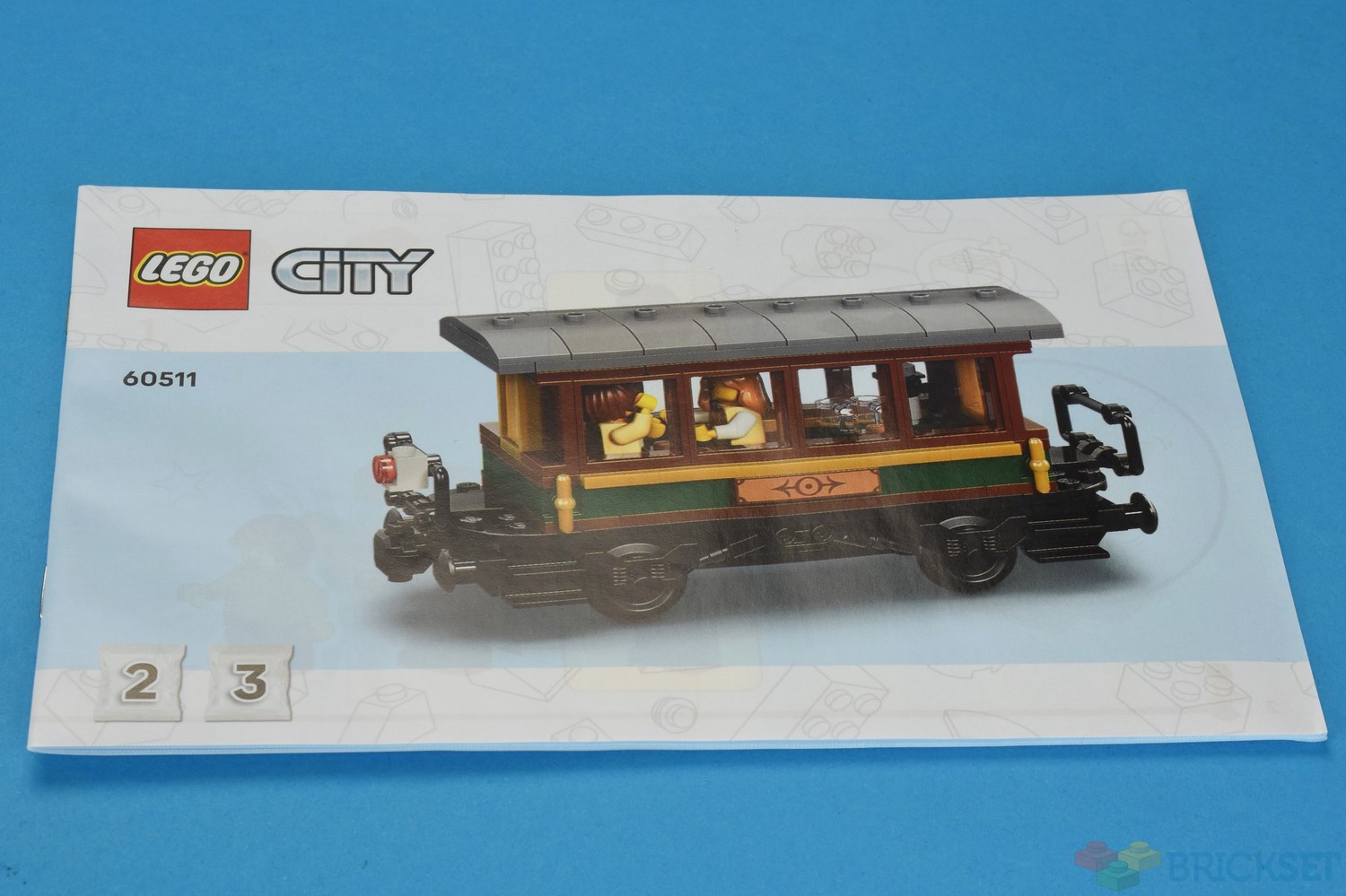
The second booklet contains the instructions to assemble the passenger carriage.

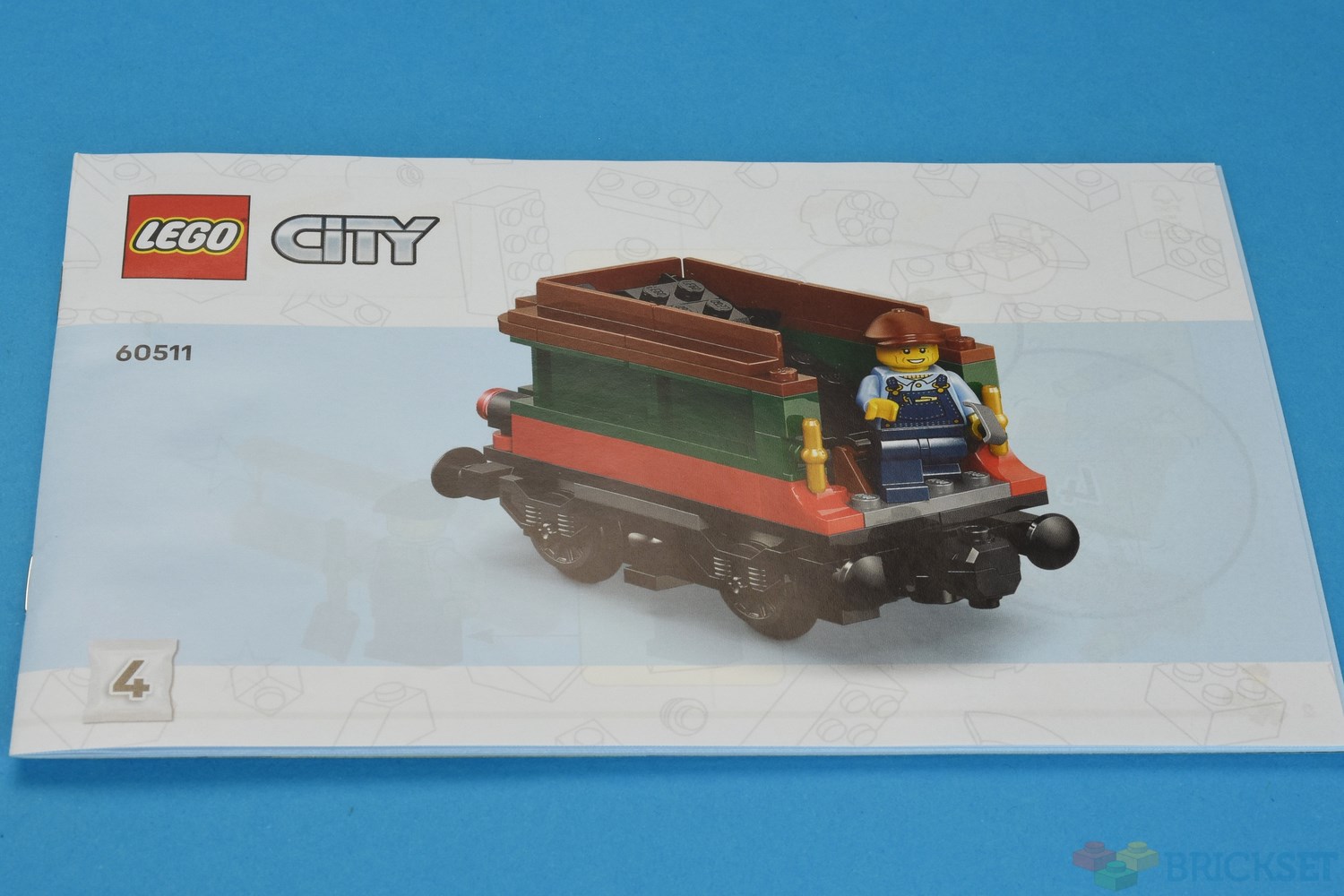
Booklet three contains the instructions to assemble the tender.
Booklet four, the largest book of the four, contains the instructions to assemble the vintage steam engine.

The parts
60511 Vintage Steam Train contains 575 parts. Rebrickable has the complete inventory which can be obtained using this link.
The parts are divided into six numbered paper bags.
There is a perforated plastic bag that is loose in the box that contains five magnetic train buffers and a train rail ramp. This ramp has appeared in seven other sets and is really useful to re-rail trains onto train track.
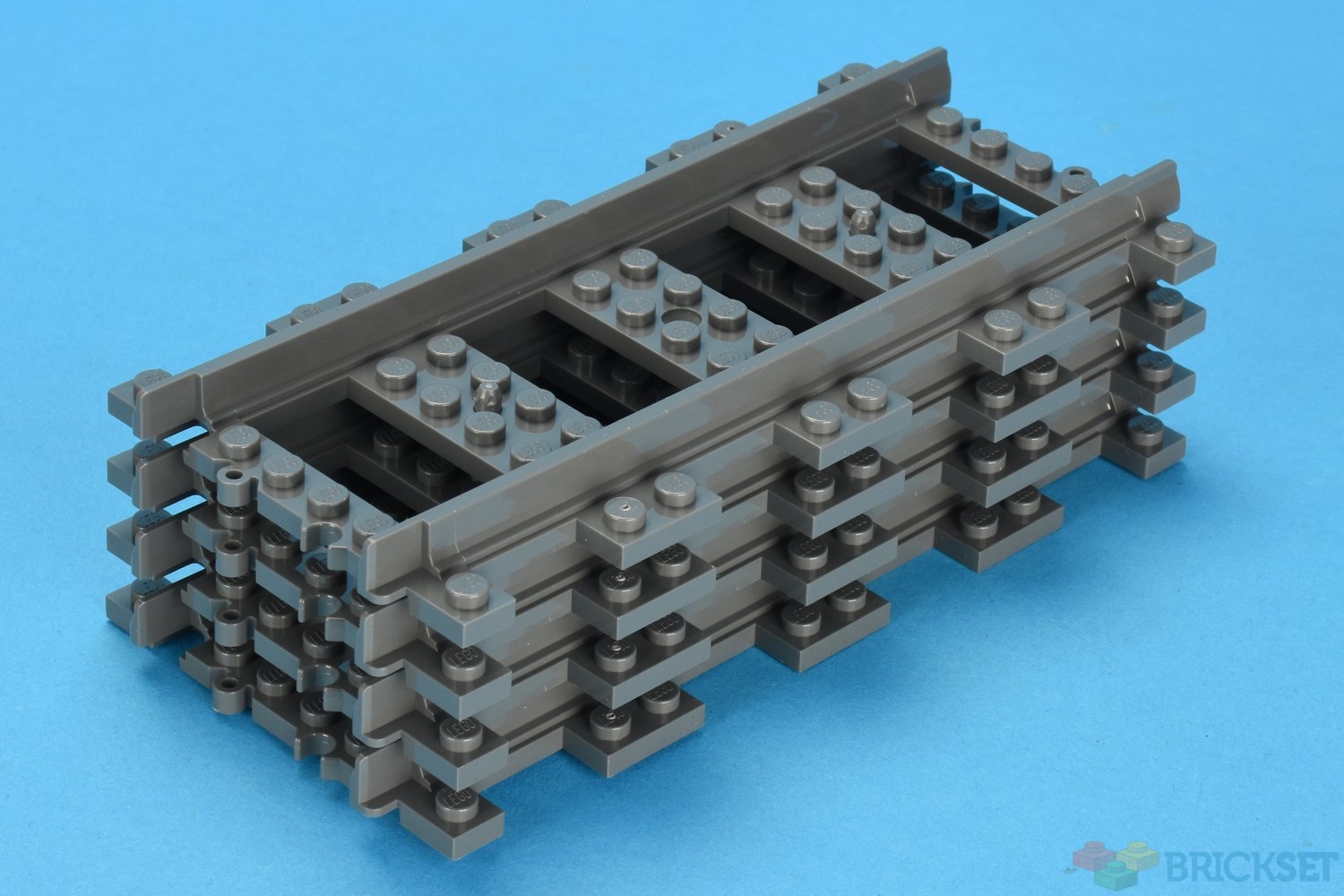
There is also a bundle of four straight track elements.
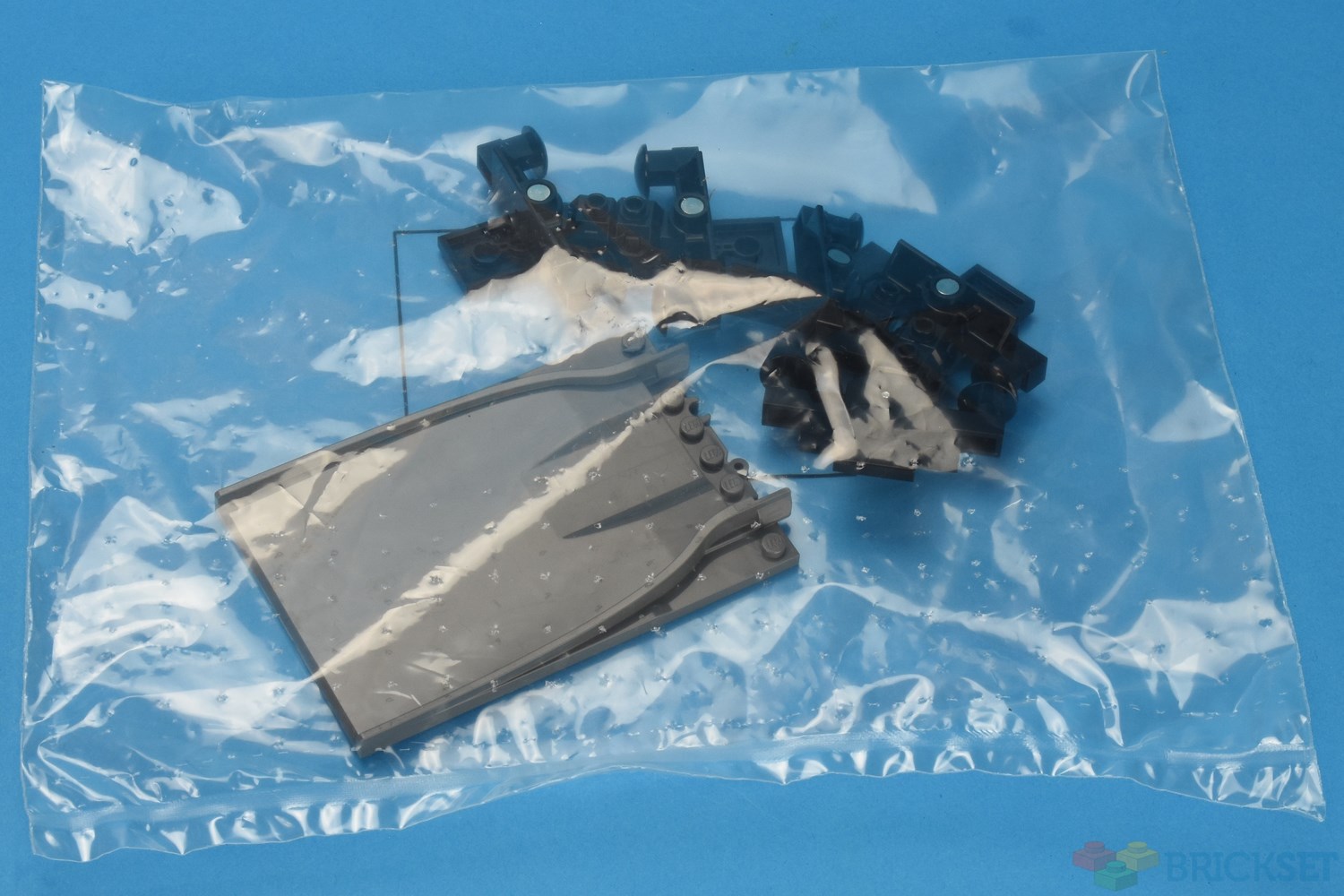
There are two unnumbered small bags. They each contain three engine driving wheels: two with a flange and one that is flangeless.

Printed parts
There are no stickers used in this set. Instead, there are four printed elements which include:
- Two 2x4 earth green tiles with engine number 317 printed in shiny brass on a brown board. This printed part is unique to this set.
- A vintage LEGO train logo printed on two 1x4 reddish brown tiles. This element is also seen in 60506 Classic Beach Tram released this year.
There is nothing special about the other two printed parts. Comments appear later in the review.

Minifigures
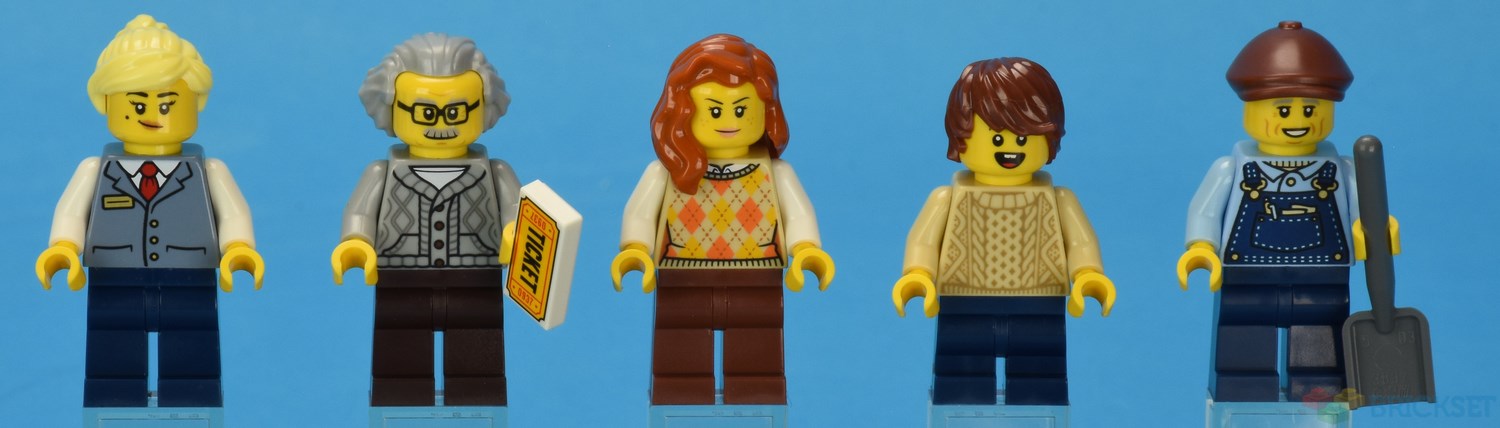
The set includes five minifigures; two adult males, two adult females and one youth.
Two minifigures work for the LEGO rail network and there are three passengers.
There is an employee who looks after the passengers on the train. She wears a neat uniform jacket with a name badge. Under her jacket she wears a white blouse with a red tie.
This torso has been seen in five other sets.

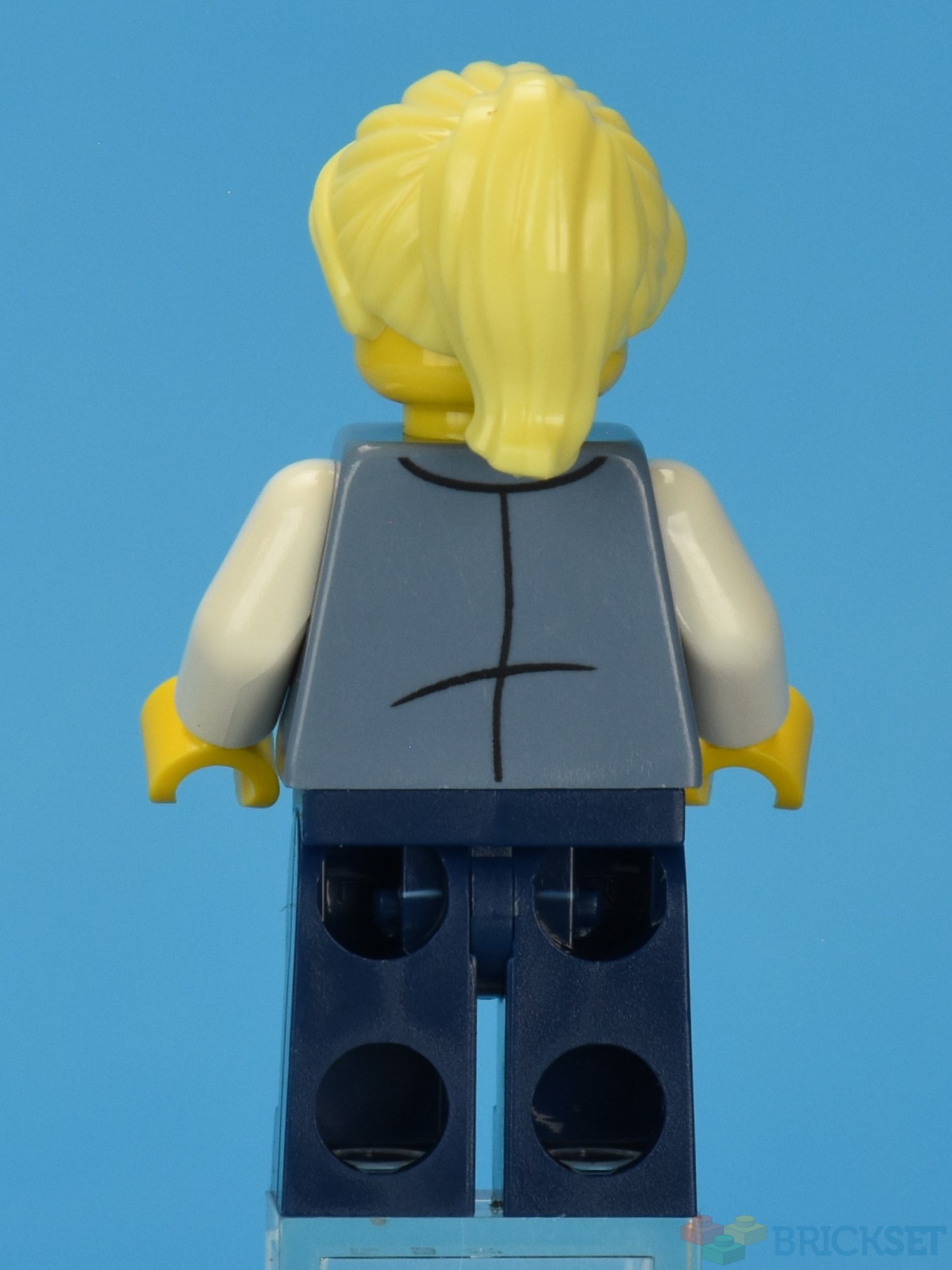
This minifigure has two expressions. She is smiling in one expression and has a smirk at other times. She has a beauty mark on her right cheek.

There is a gentleman waiting to board the vintage train.
The gentleman is wearing a light grey knitted cardigan with buttons. He has a white singlet under his cardigan.
This torso has been seen in seven other sets.



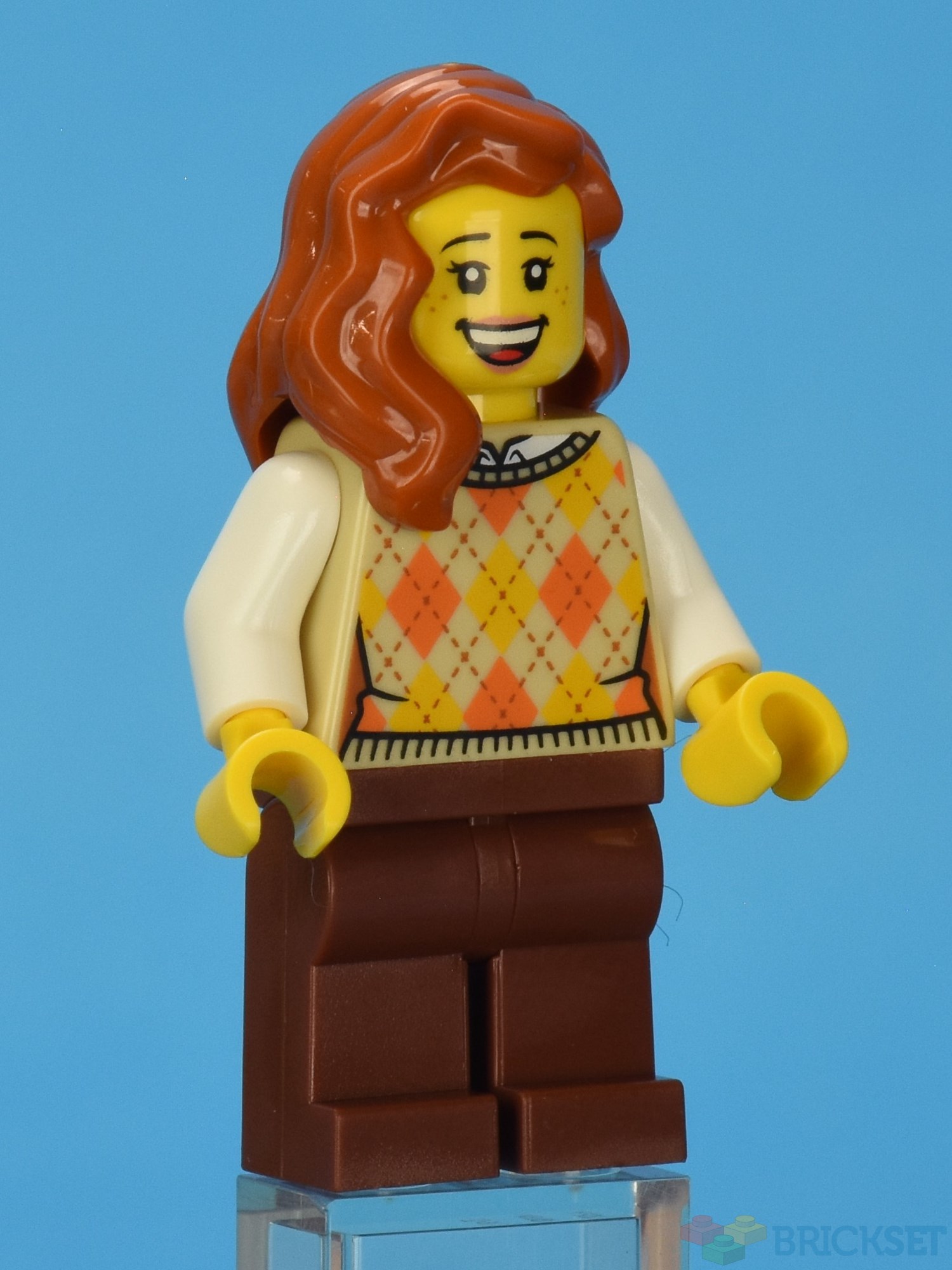
There is a female passenger aboard the vintage train. The female passenger is wearing an argyle-patterned jumper. The argyle pattern is made up of orange and light orange diamonds.
The female passenger has mid-length dark orange hair that is draped over her front right shoulder.
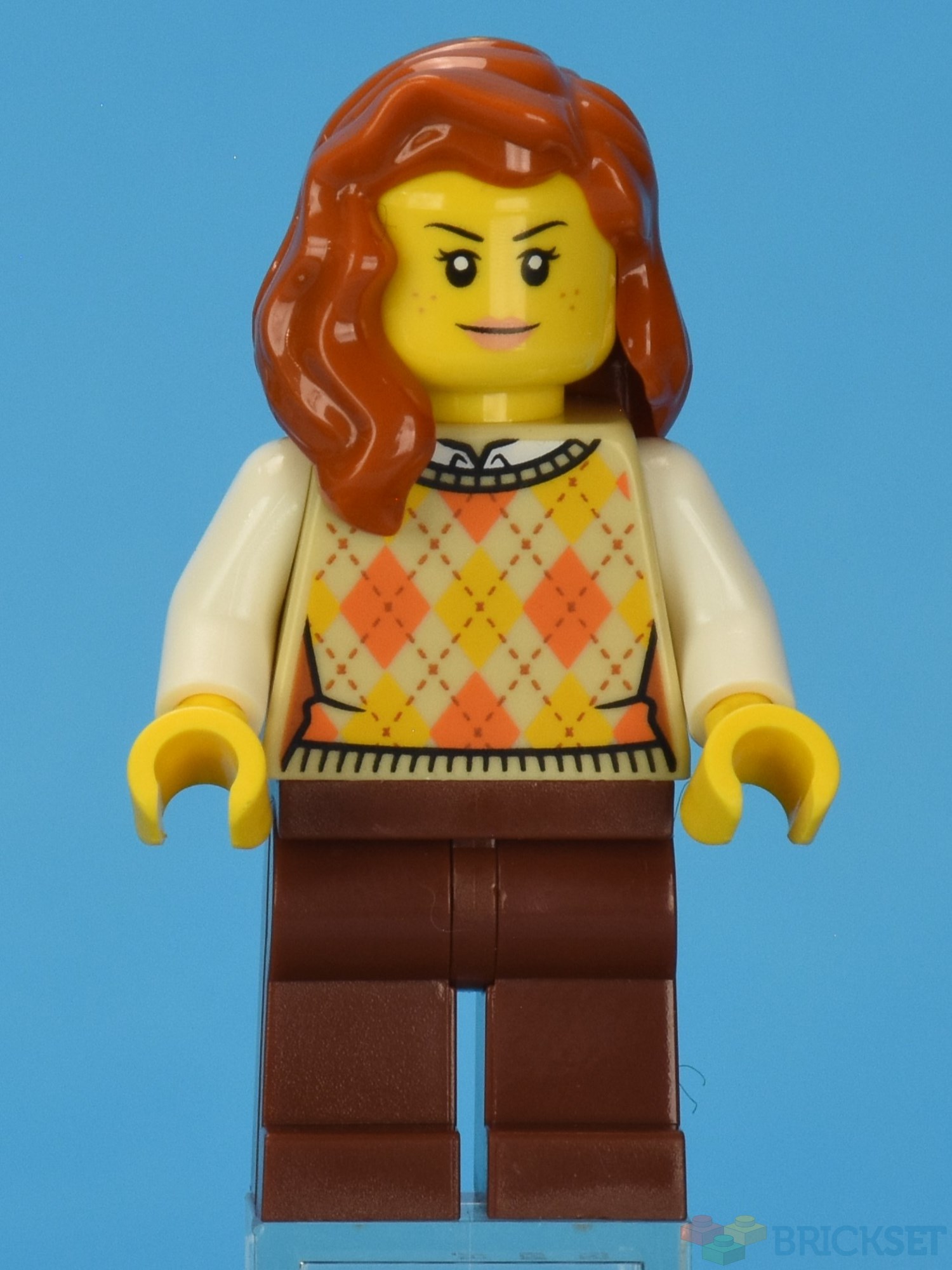
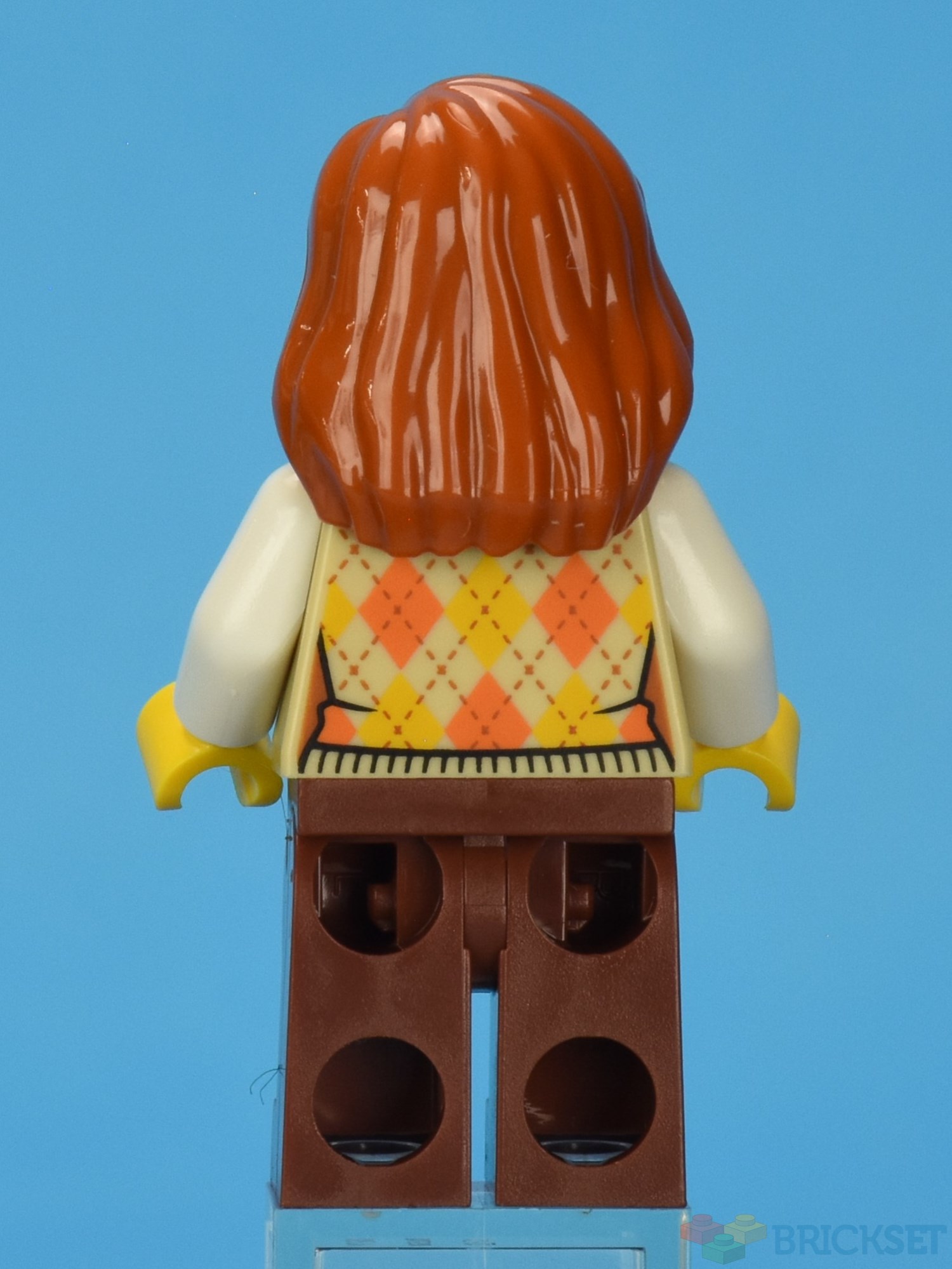
This minifigure has two expressions; her mouth is closed in one expression, and she is smiling with an open mouth in the other expression.
The younger minifigure is wearing an Aran knitted jumper. These jumpers are worn by mariners and fishermen. This torso first appeared in 21310 Old Fishing Store.

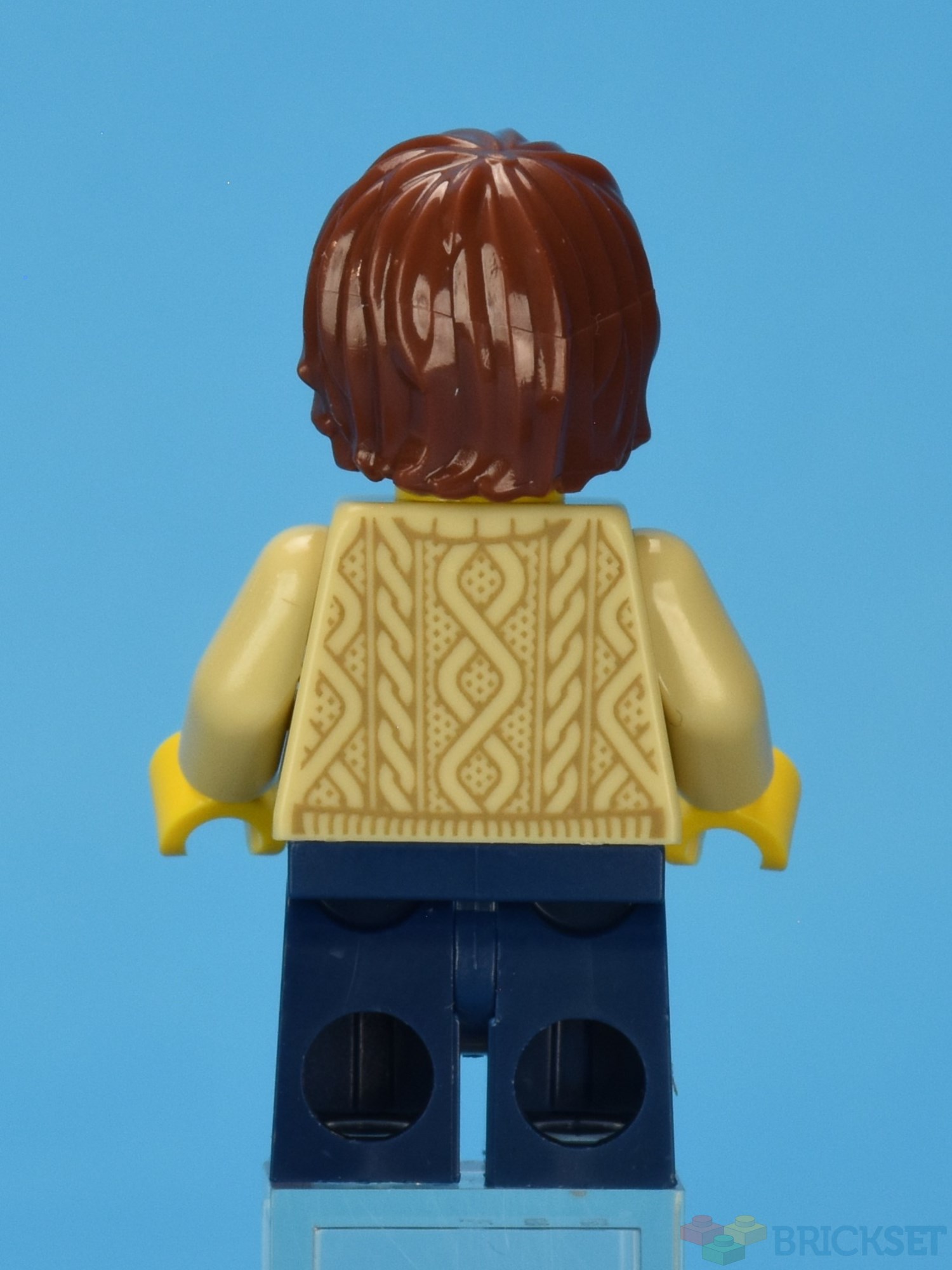
The youngster has two expressions. He has an open-mouthed smile but also looks surprised.

There is an overworked engine driver who also acts as the fireman operating the steam engine. These are two major roles and are usually performed by two people.
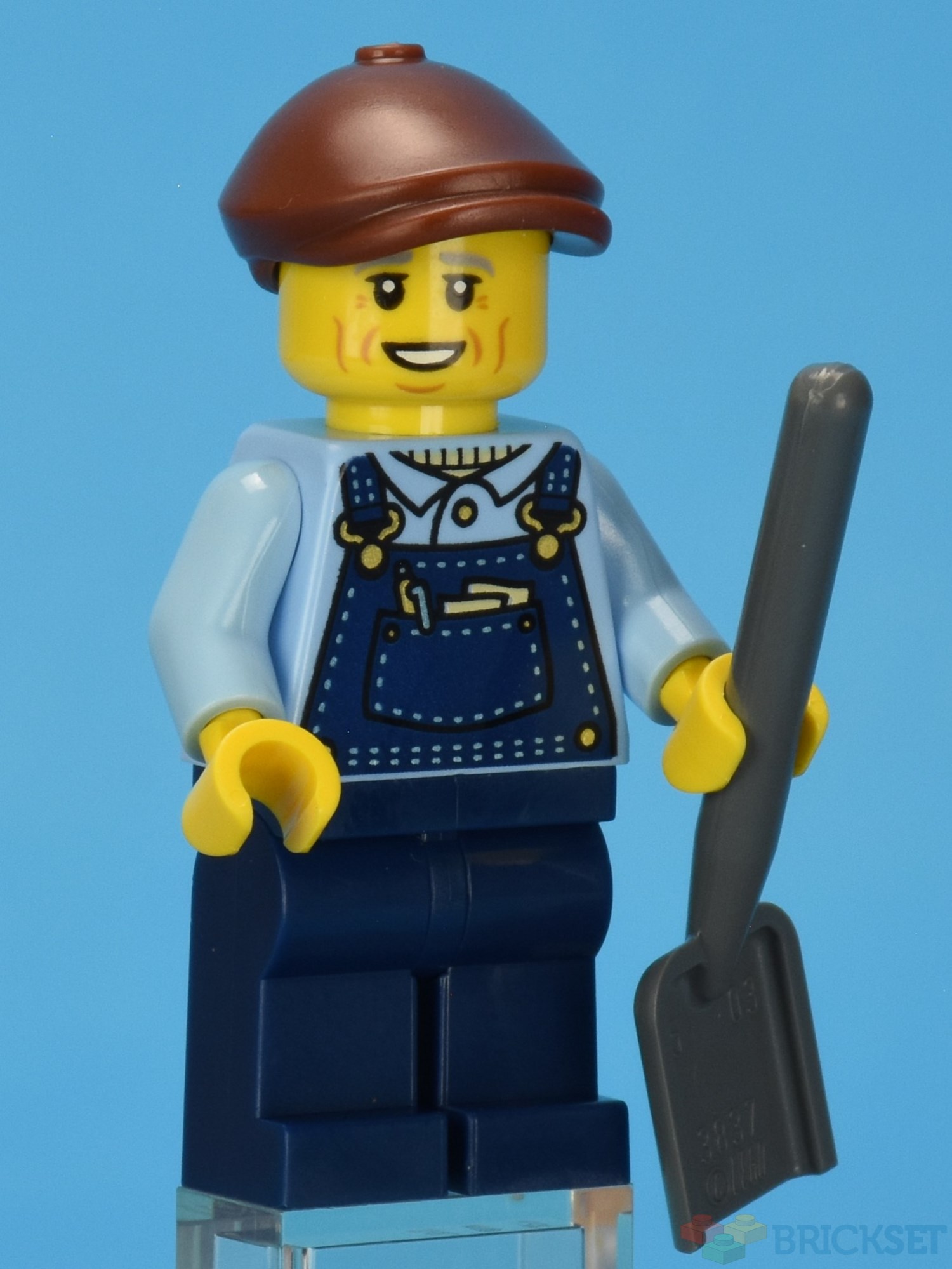
The engine driver wears a blue denim bib overalls with tan stitching. He has a pen in his pocket with a small notepad. The bib overalls have metal fastenings. This torso has been seen in two other sets.
The engine driver is wearing a reddish brown flat cap (sometimes known as a cheese cutter hat). This style of cap was often known as a train engineer's cap.
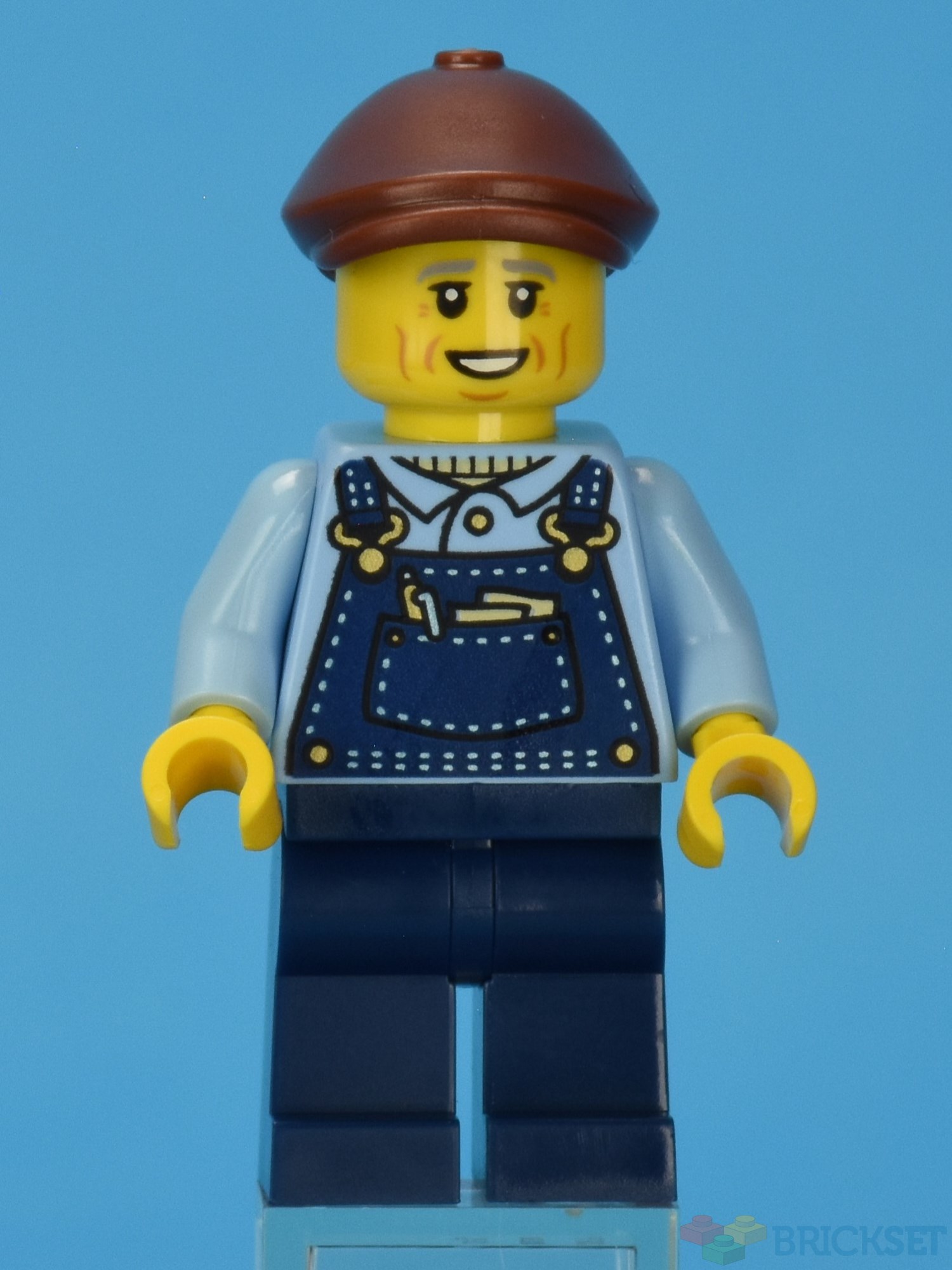
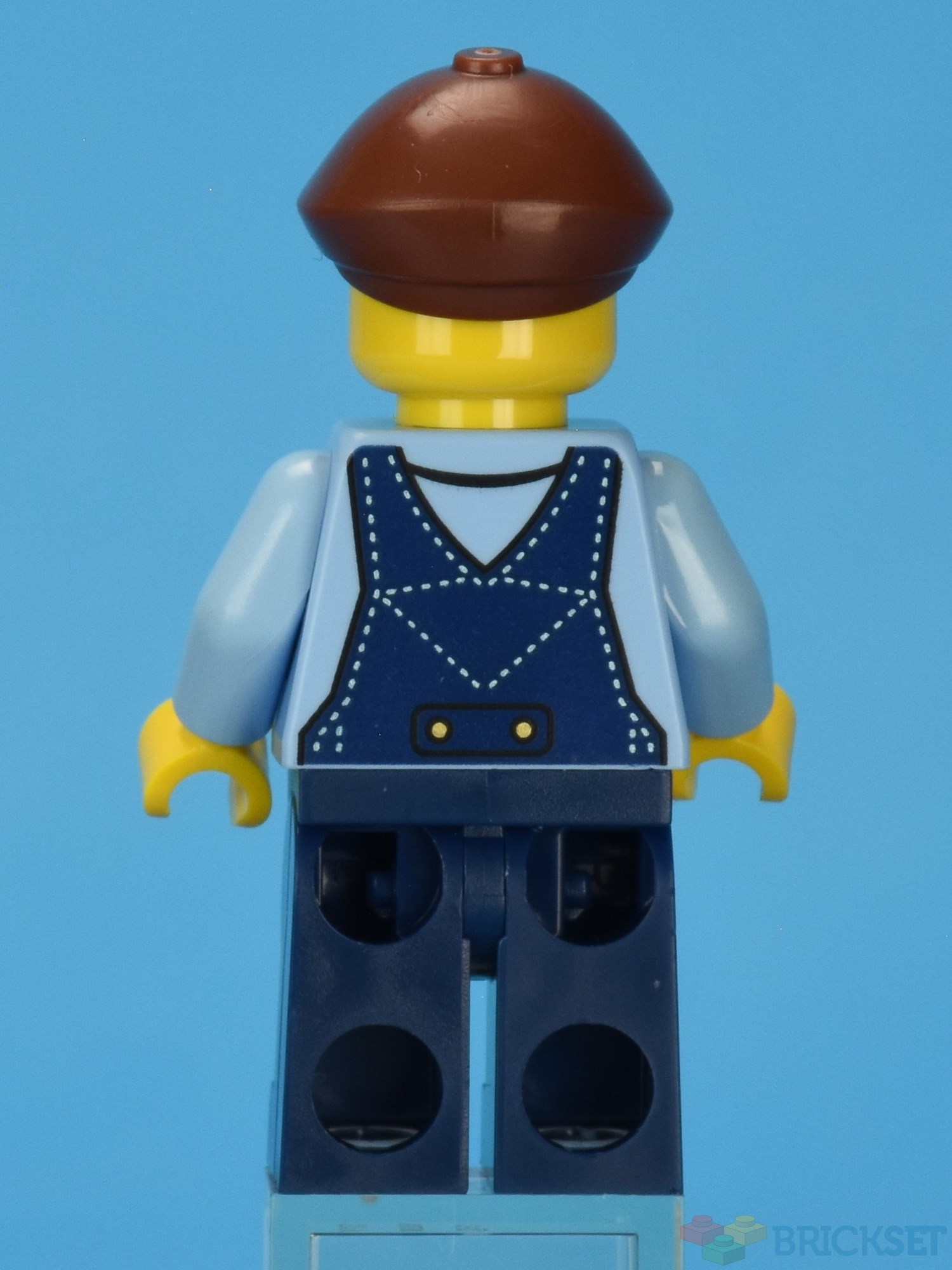
While the engine driver has a smile, he also has quite a worried expression. He holds a shovel which he uses to shovel coal into the vintage steam engine's fire box.
The build
Bag 1 assembles the small train platform.
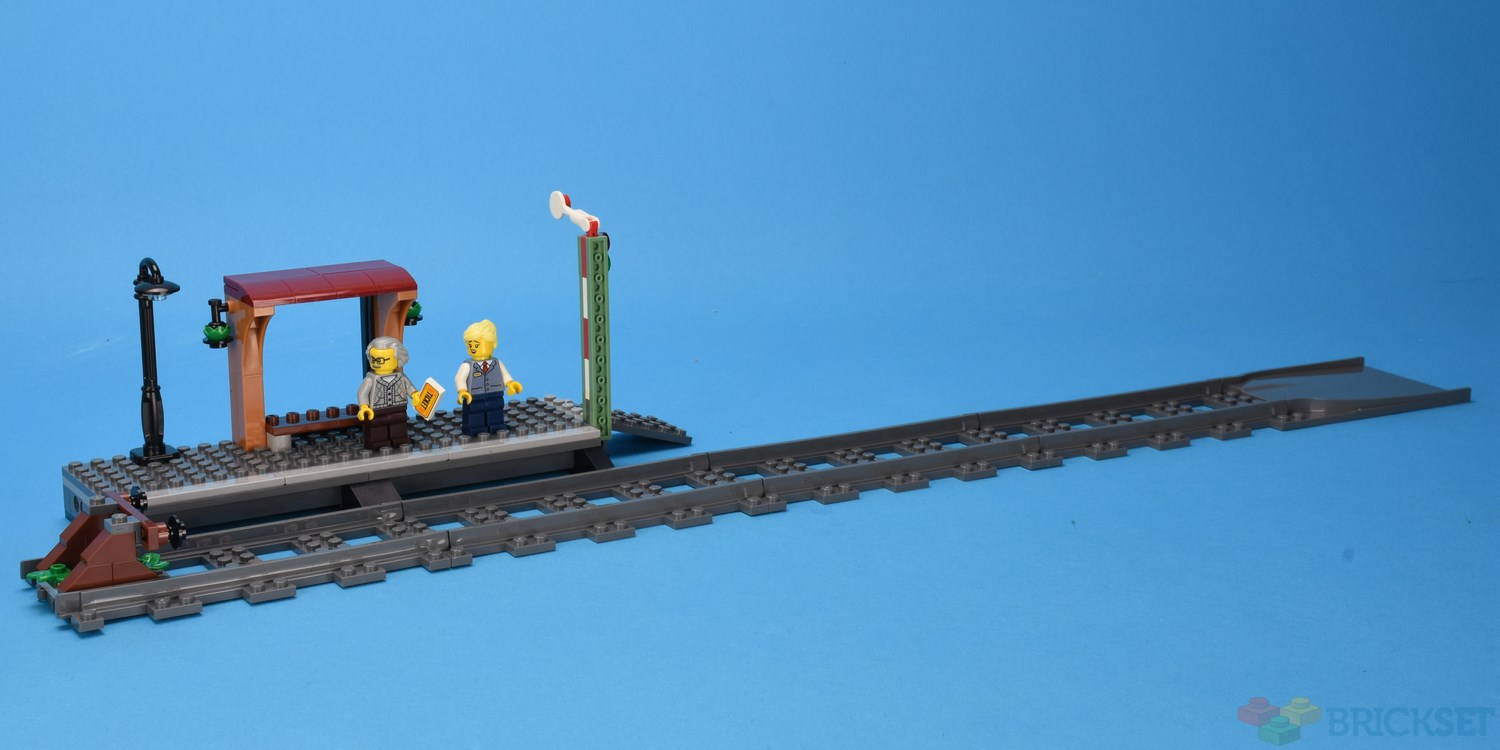
There is a small shelter on the platform where passengers can sit while they are waiting for their train journey. There is a wrought iron lampstand on the platform.
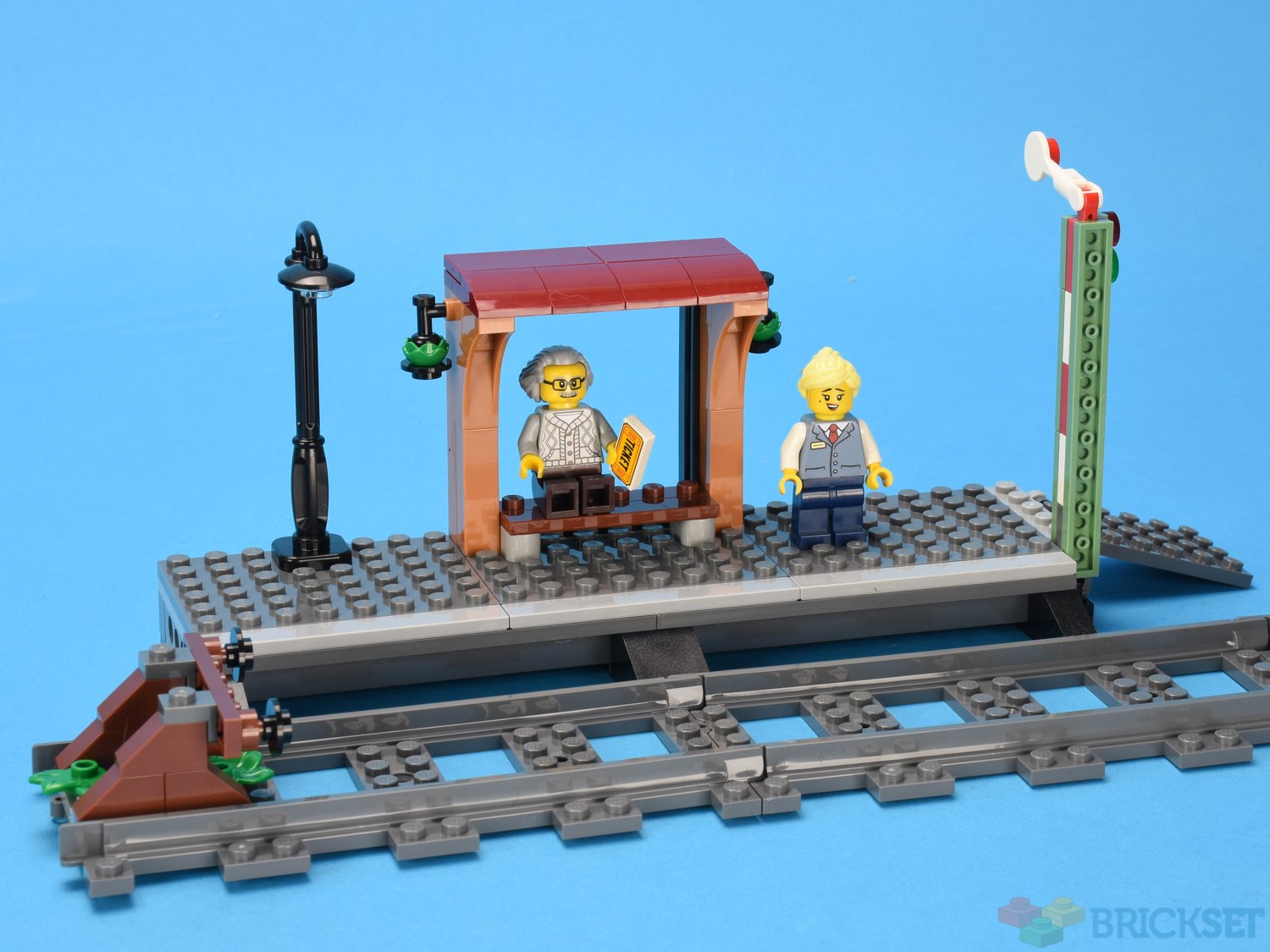

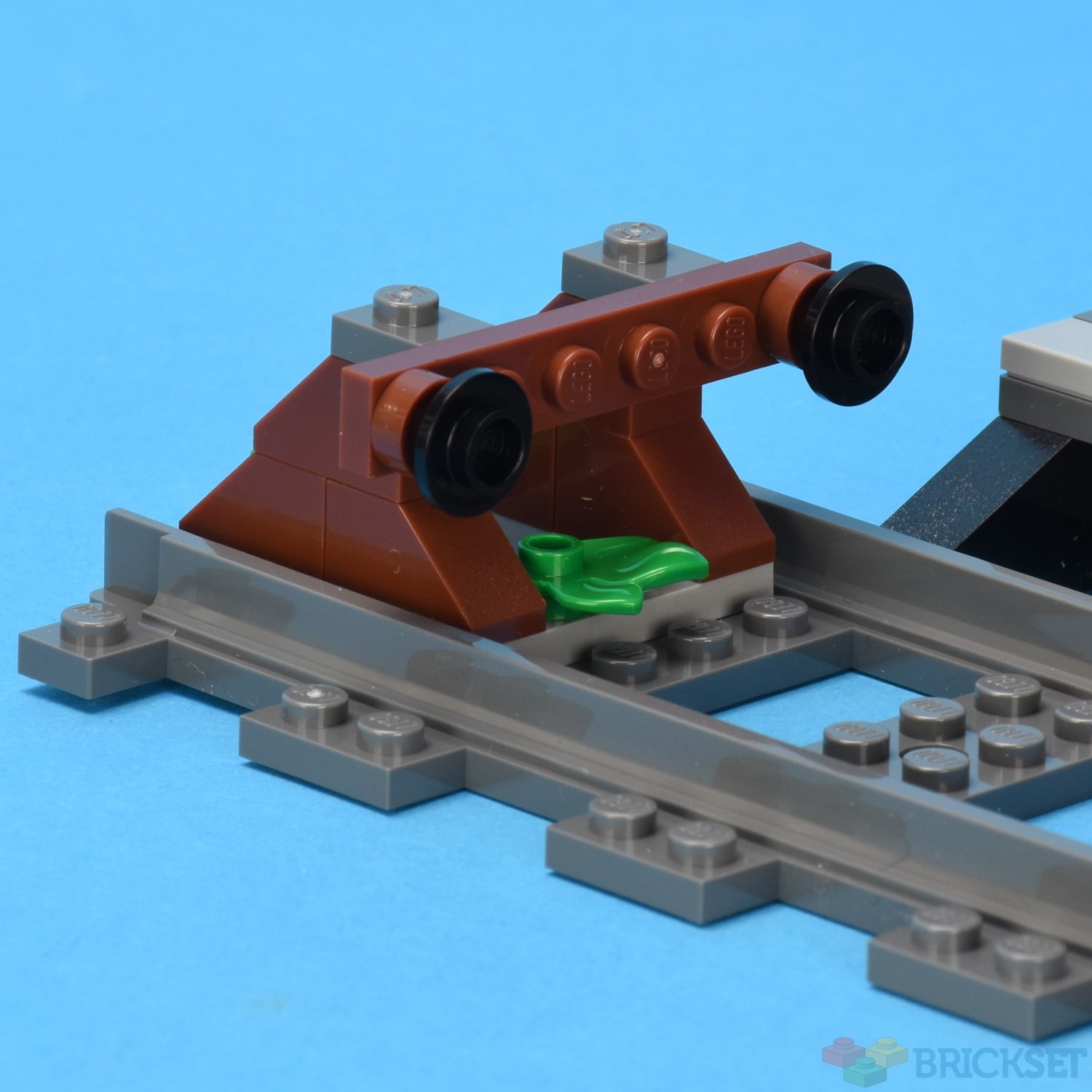
At the end of the track is an end-of-line buffer stop. These items are a critical safety feature on train networks. Two weeks ago, such a concrete stop block prevented a Wellington commuter train from sliding down a steep slope into nearby homes in a real-world incident.
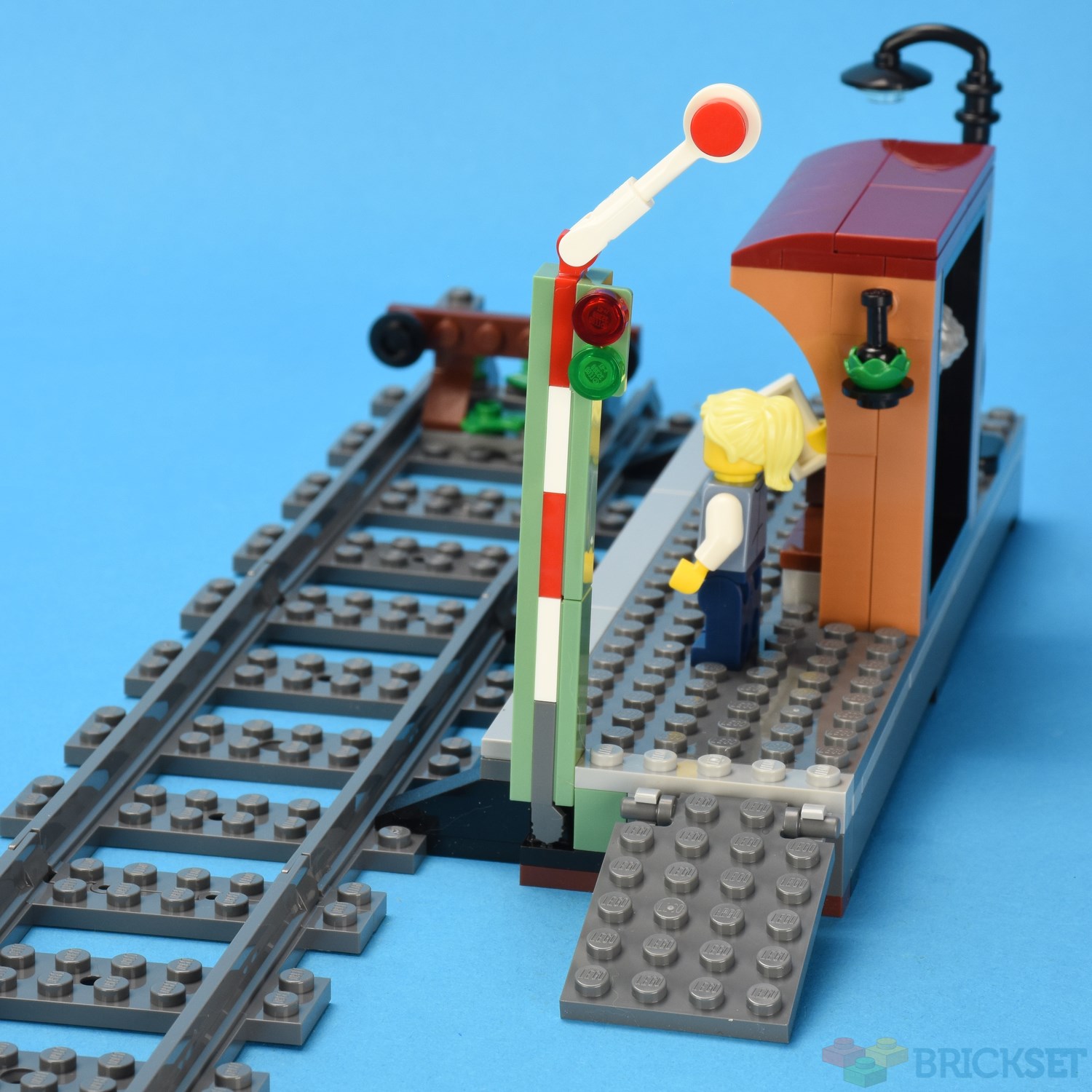
The antique train platform has a functioning old railway semaphore signal at the end of the platform.
Bag 2
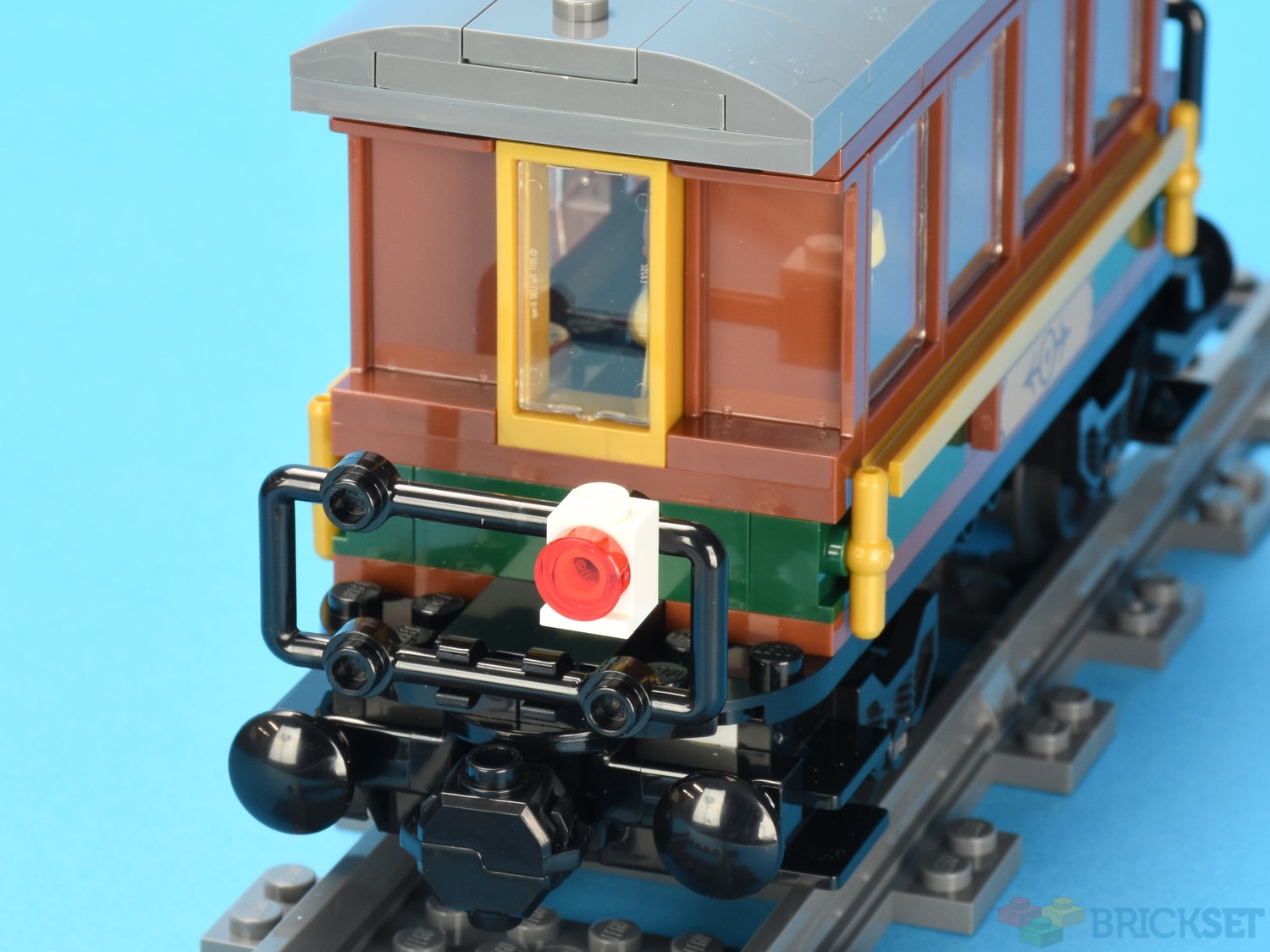
Bag 2 assembles the passenger carriage.
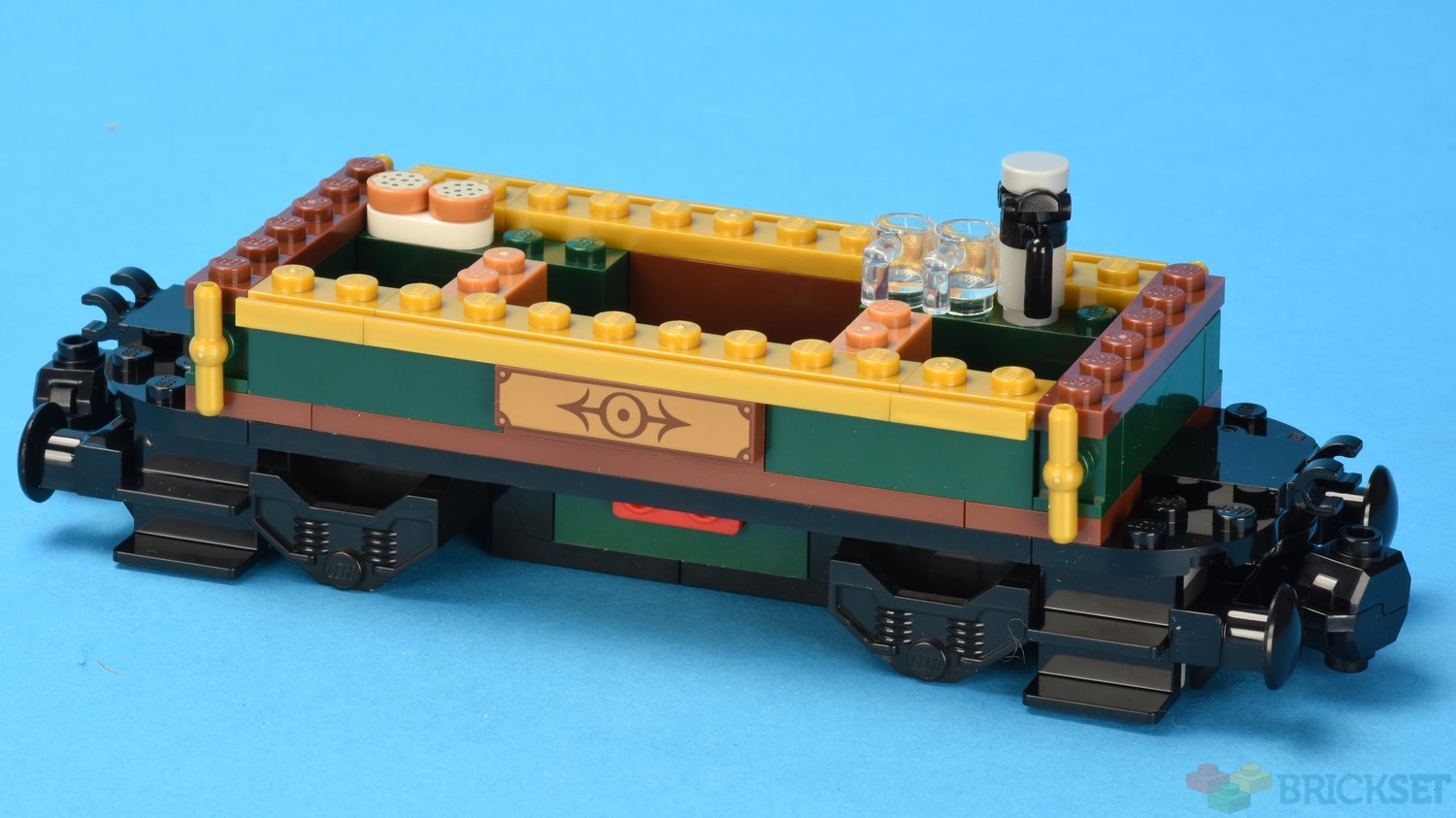
The carriage has some facilities for the passengers. At one end is a jug with lid and two mugs. A black minifigure roller skate has been repurposed as the spout of the jug.
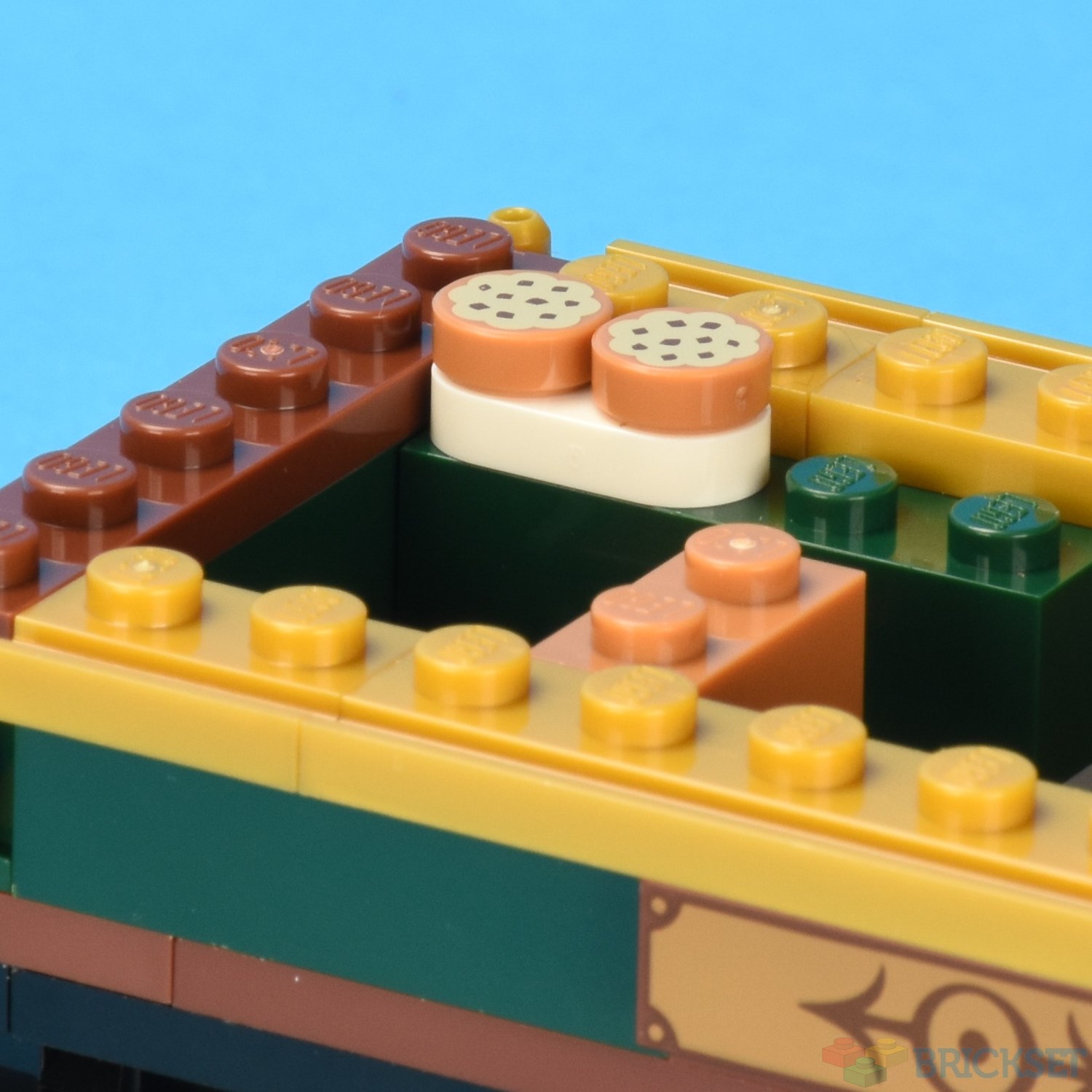
At the other end are some chocolate chip cookies.

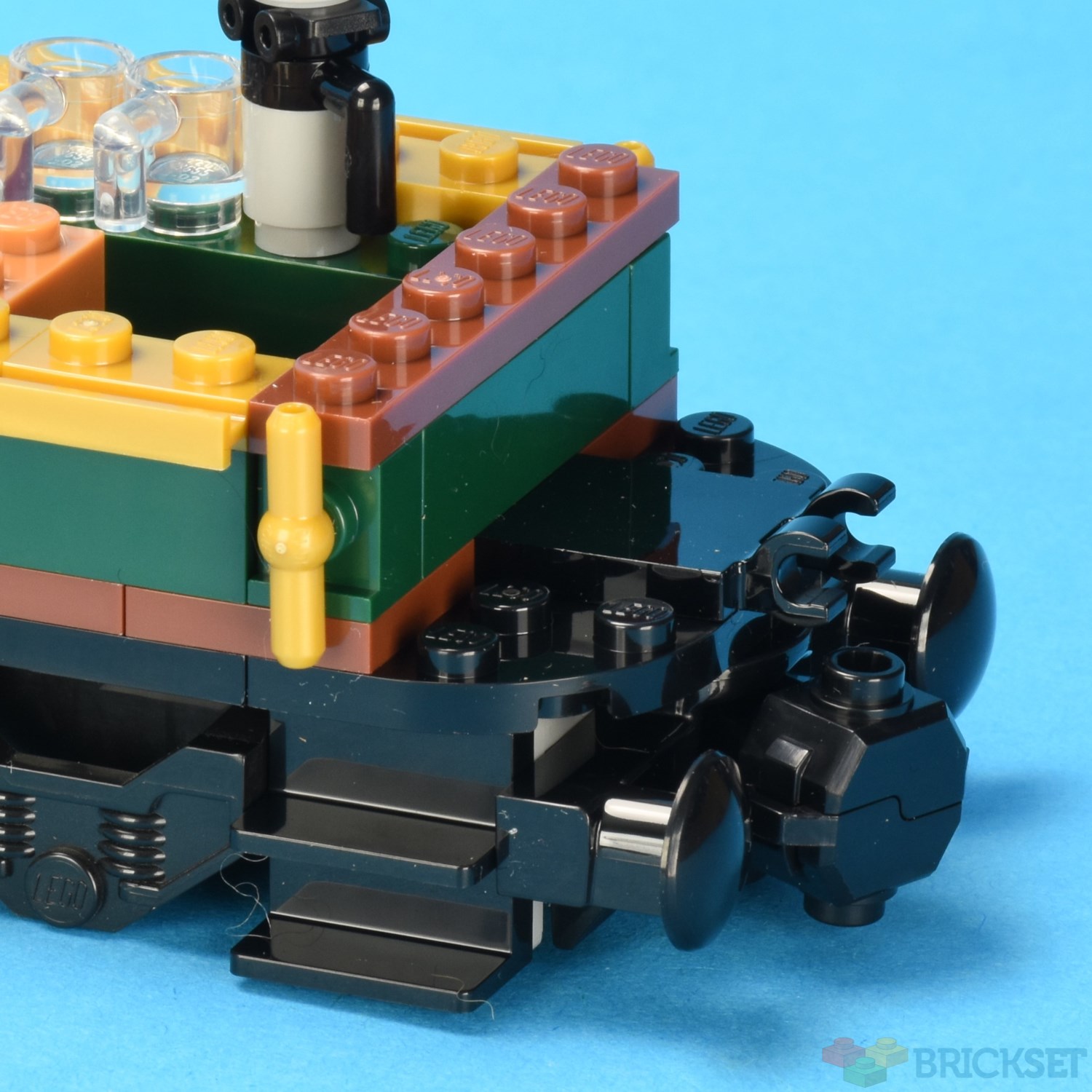
There are ladders at each corner of the carriages and a brass handle. Unfortunately, there is no obvious way that passengers can enter the carriage: it has no doors.
Bag 3
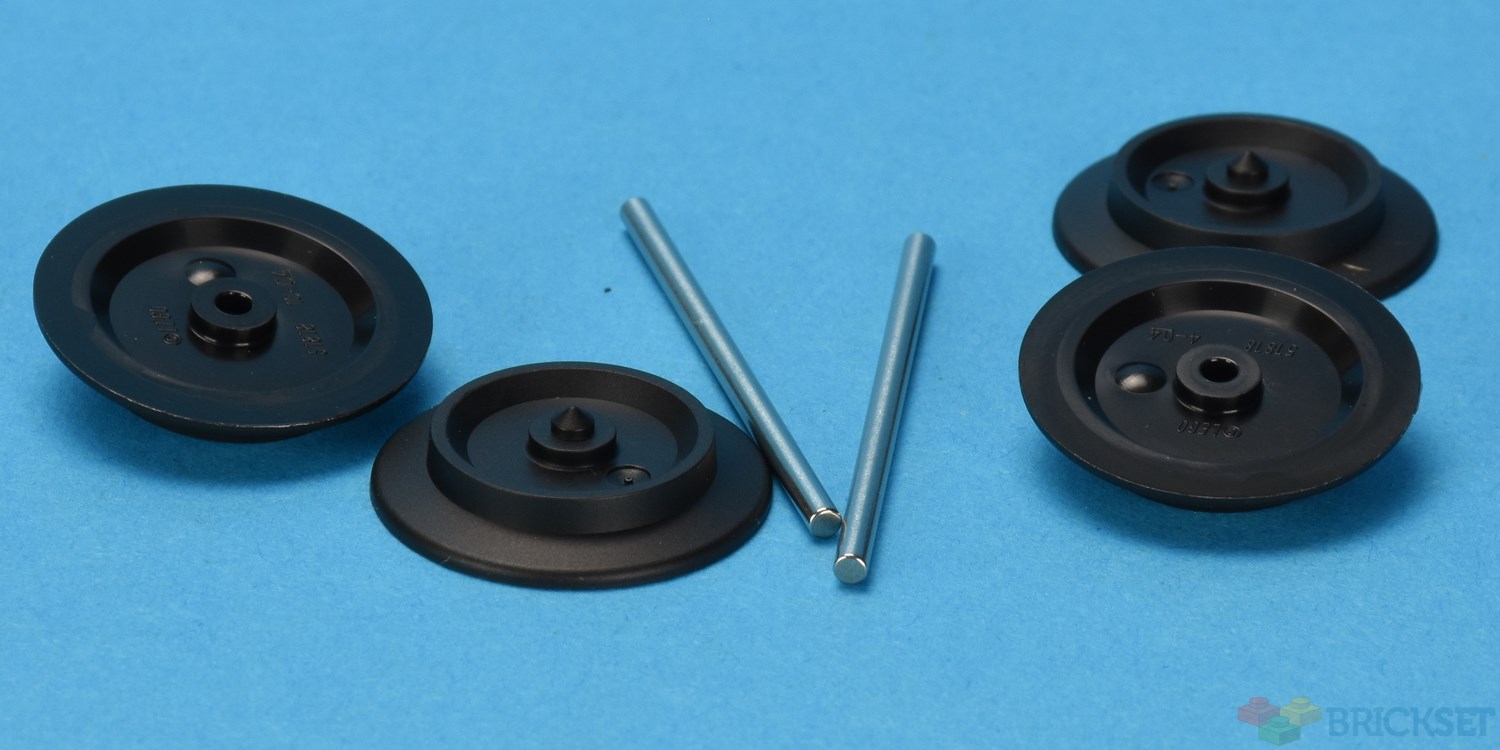
I am pleasantly surprised to see the return of metal axles for the carriage train wheels. Metal axles were last used on the tram in 60473 The City Tower (released in 2025), but they haven't been seen on a LEGO train since 2024 in 60423 Downtown Streetcar.
This one-minute YouTube Short from brickstudios compares the performance of the wheels using metal axles and the plastic wheels that have been used for the last seven years. It is obvious that the metal axle format is superior.
I hope that the return to using metal axles for train wheels is a permanent change.
There is seating for four passengers in the passenger carriage.
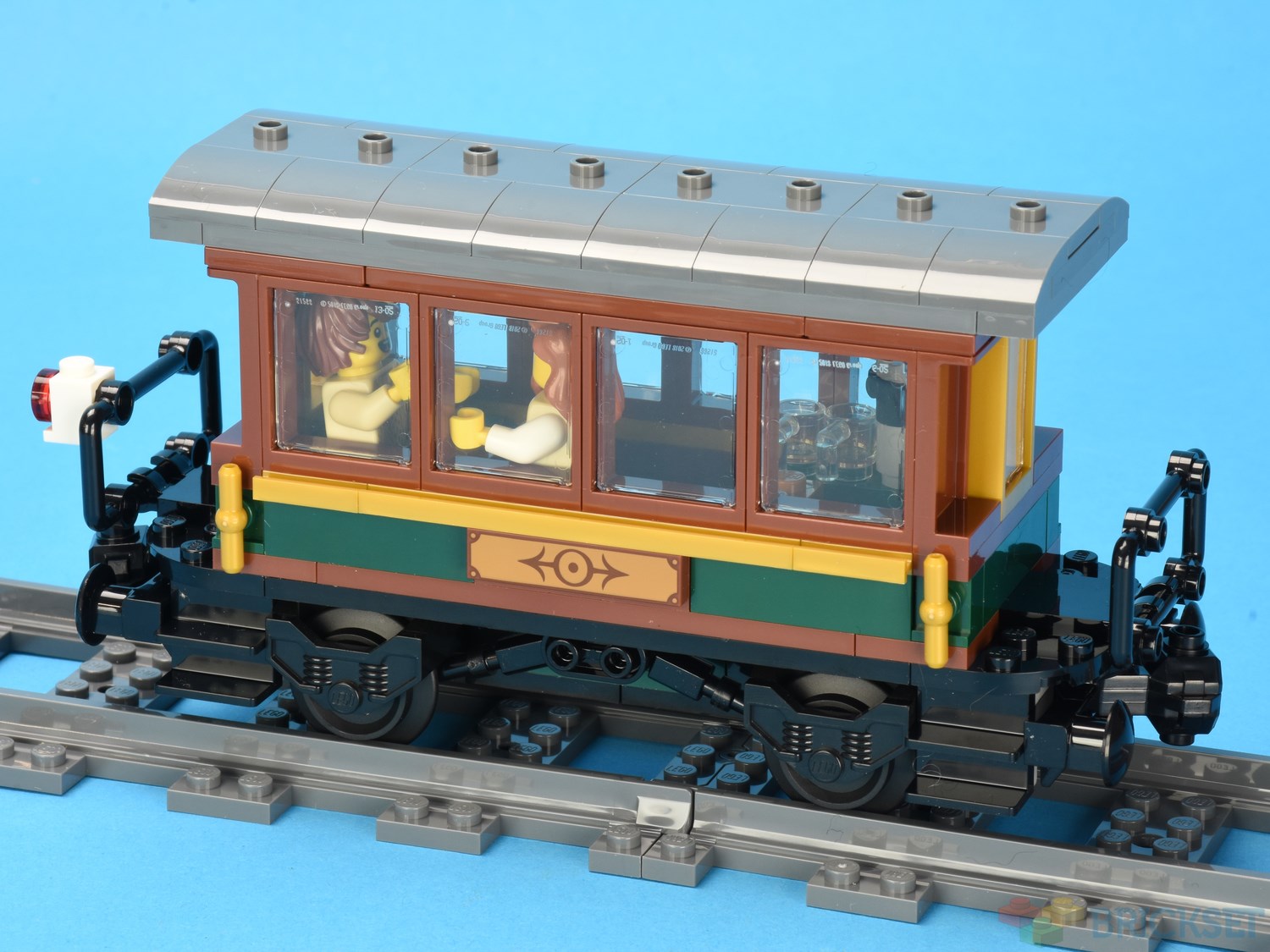
There is some neat detailing under the chassis of the carriage.

The passenger carriage has a red lantern attached to the handrail. The roof easily detaches to reveal the carriage interior.

Bag 4
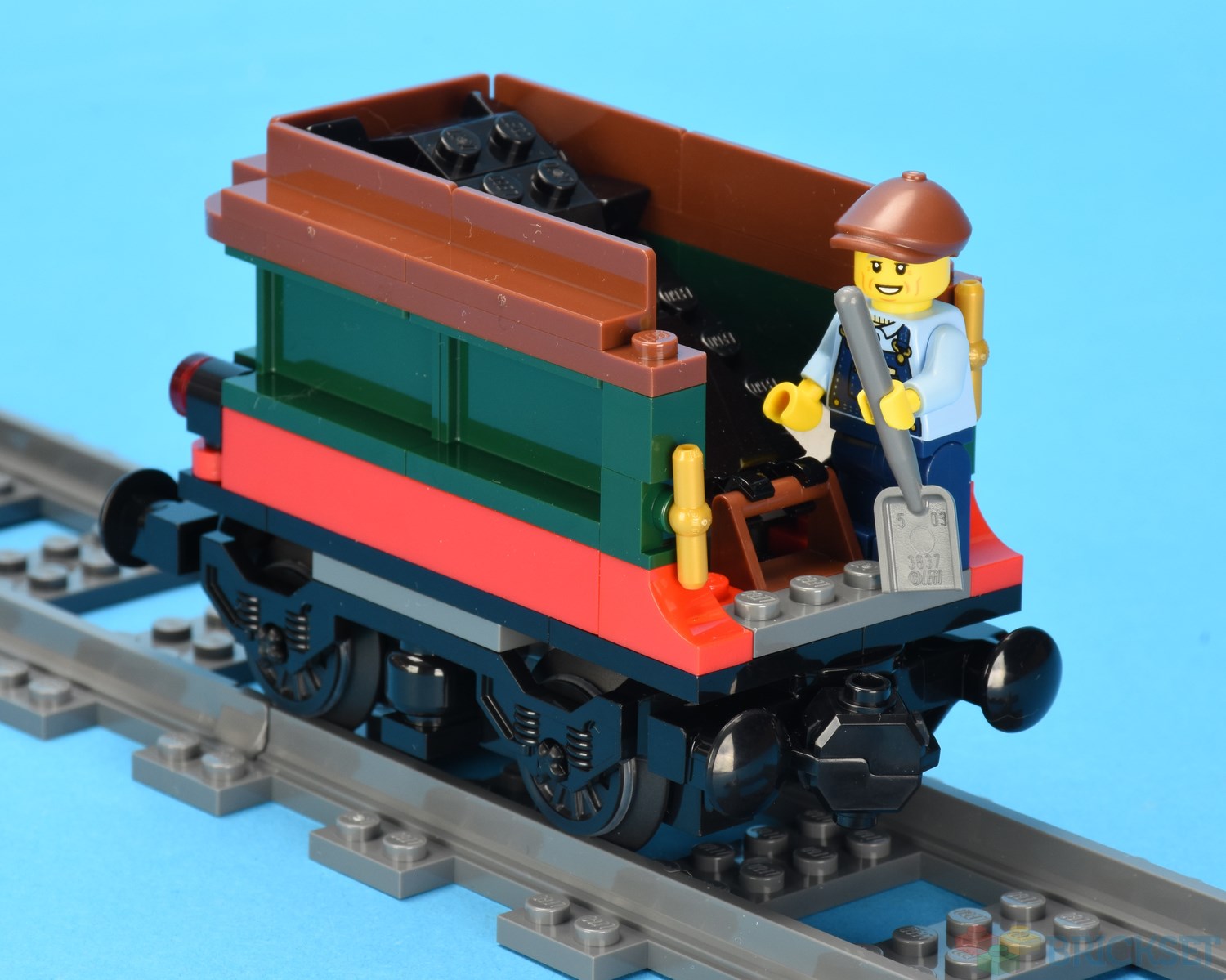
Bag 4 assembles the vintage steam train's coal tender. Our overworked engine driver is ready to shovel coal.
Bag 5
Bag 5 assembles the chassis of the vintage steam train.
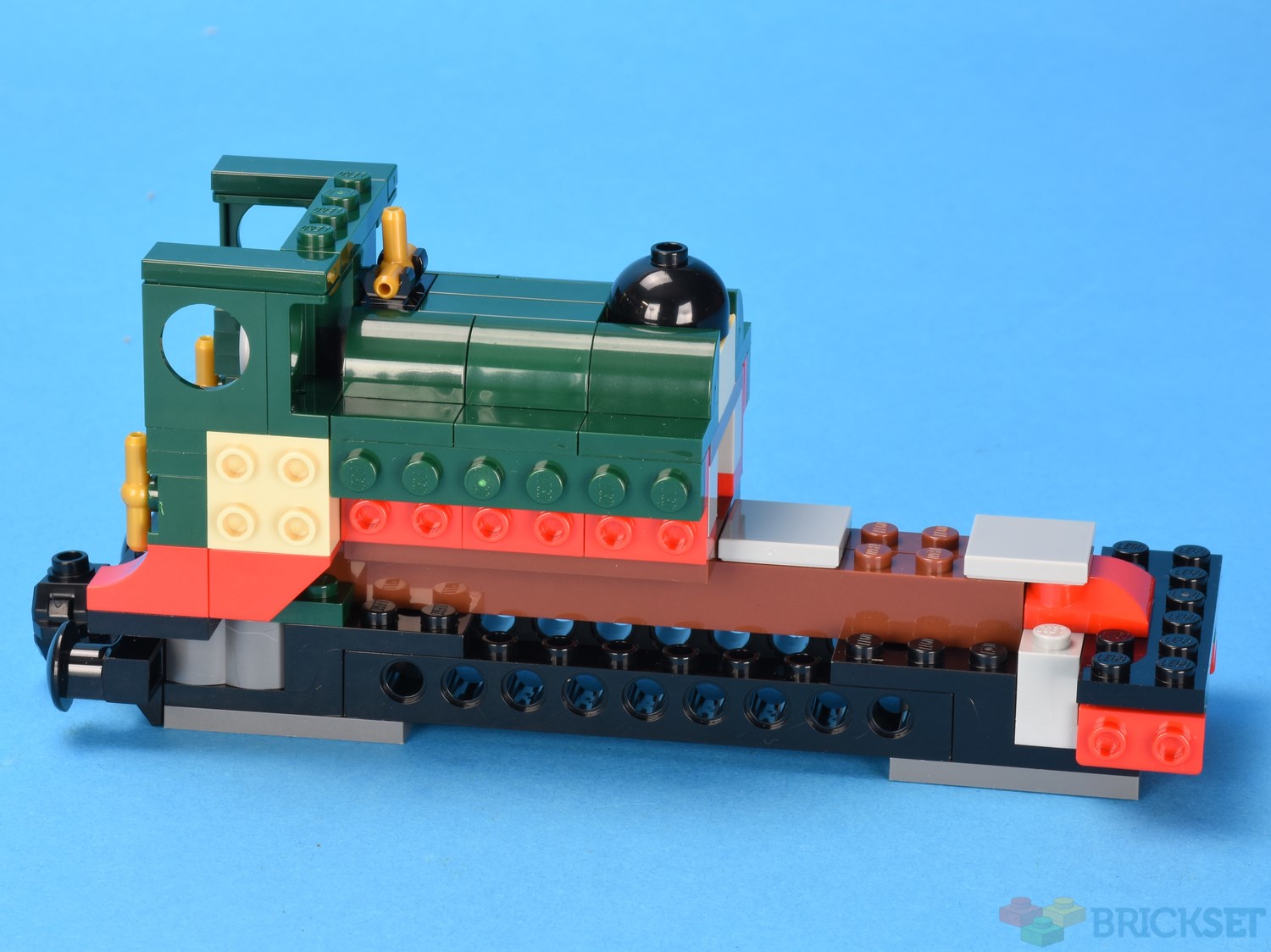
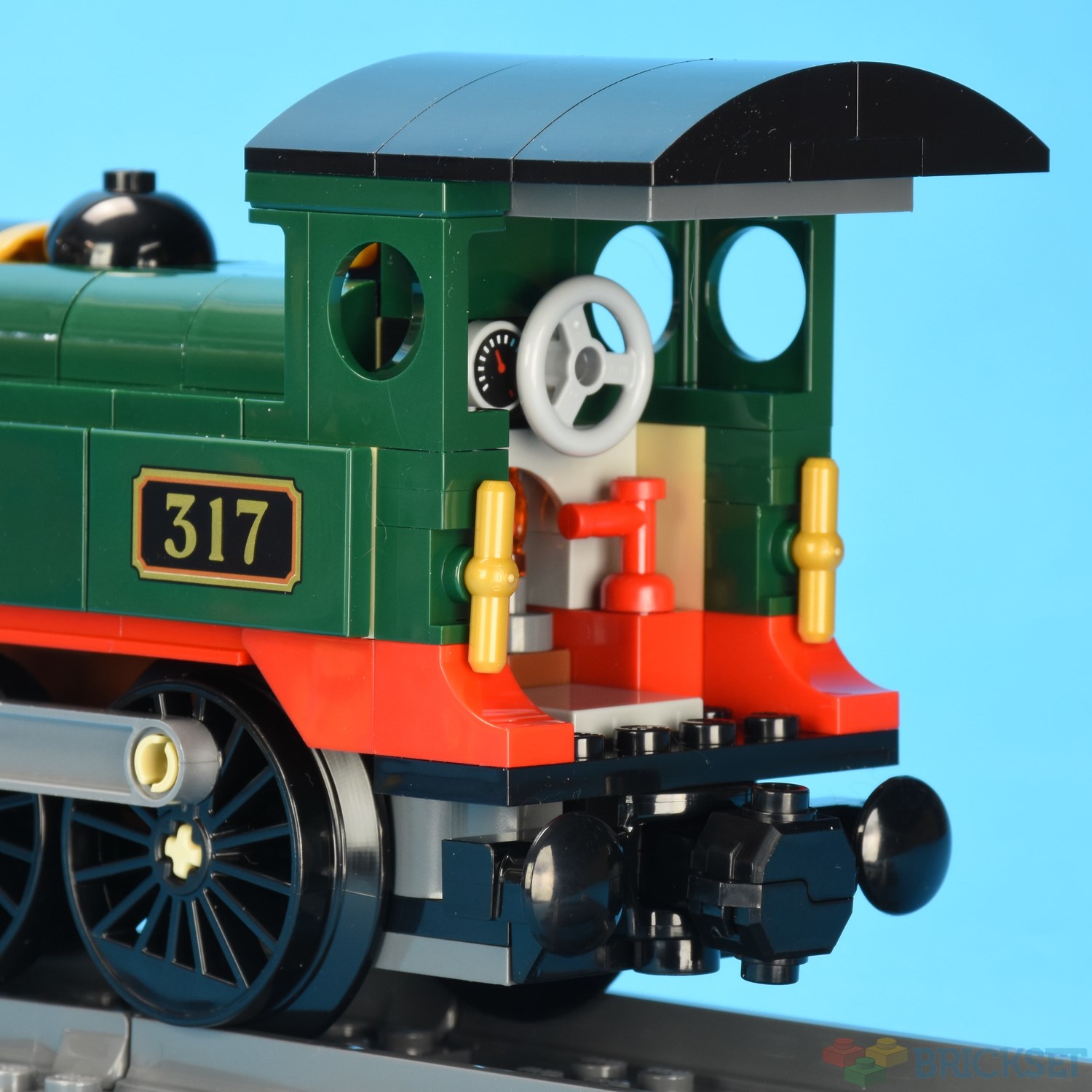
The earth green window panel with a round window has only been seen in one other set. They look fantastic used in this context.
You can see the engine's fire box and above it there is a printed pressure gauge and a control valve.

Bag 6
Bag 6 completes the vintage steam train.
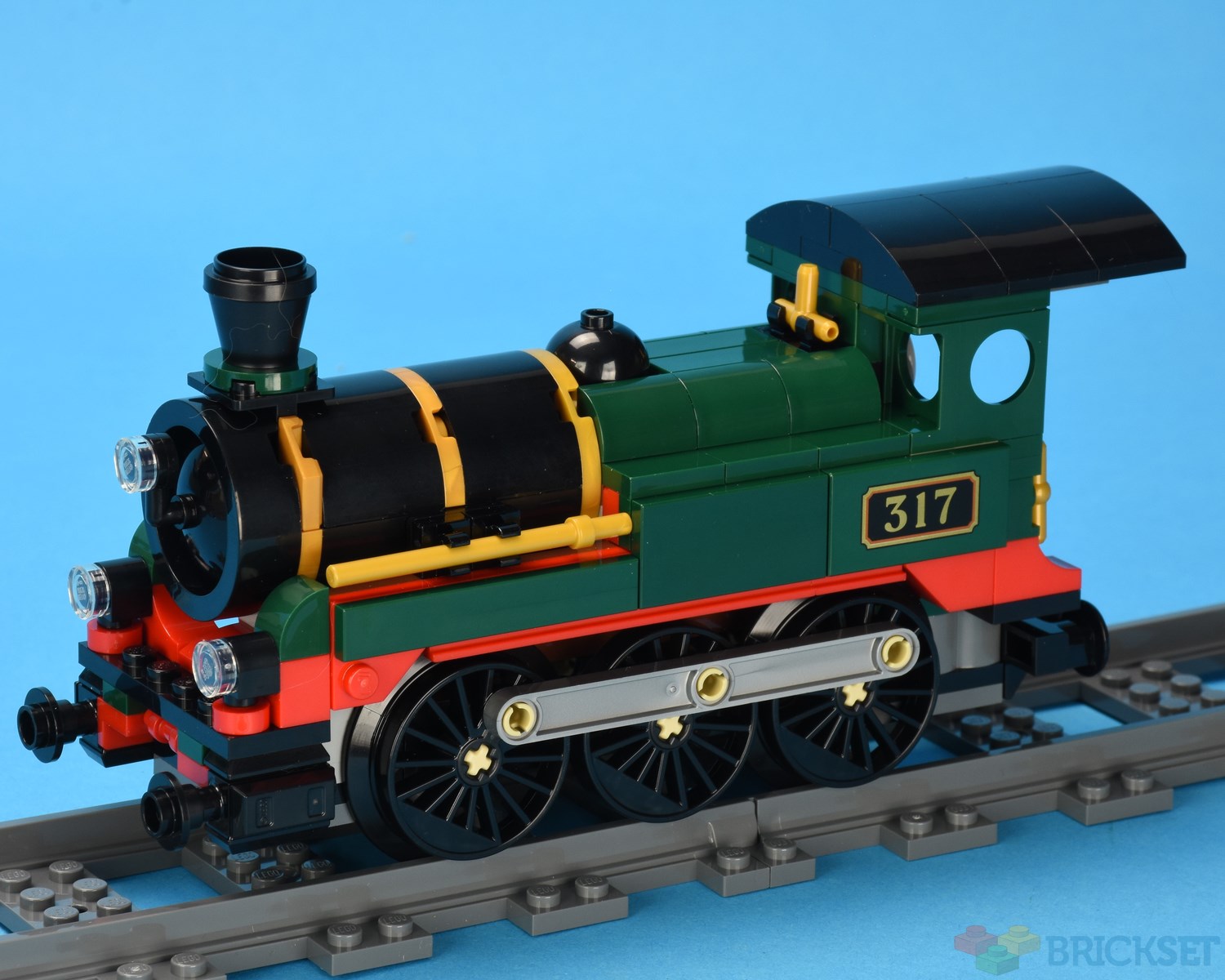
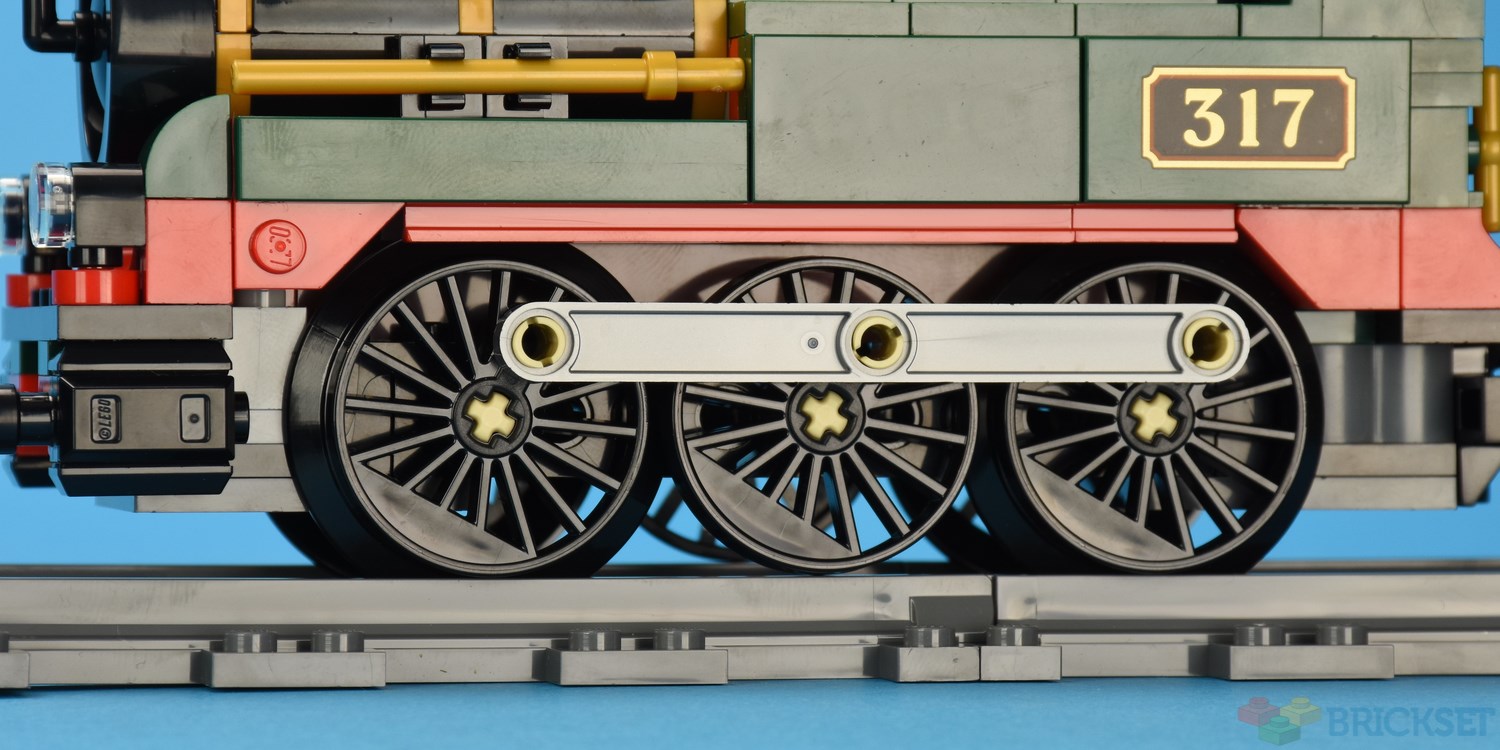
The Technic half wide beam is used as a coupling rod to connect the three driving wheels on each side of the engine. This makes the engine's widest point seven studs wide.
There are no connecting rods or pistons which would normally be found on a steam train. You can, however, see how the driving wheels are balanced.
The frictionless pins used to connect the driving wheels to the chassis and to link to the coupling rod are tan colour. Those Technic elements do not come in black or dark bluish grey, but this set would have looked better if they were.
Senior LEGO Designer Mark Stafford (AKA LEGO Nabii) has commented about LEGO having elements that are colour locked, "There are many reasons to colour lock or limit a part, both to do with reducing the complexity of production and the logistics of storage/packing."
More than any other theme, LEGO Technic elements tend to be available in a limited pallet of colours.
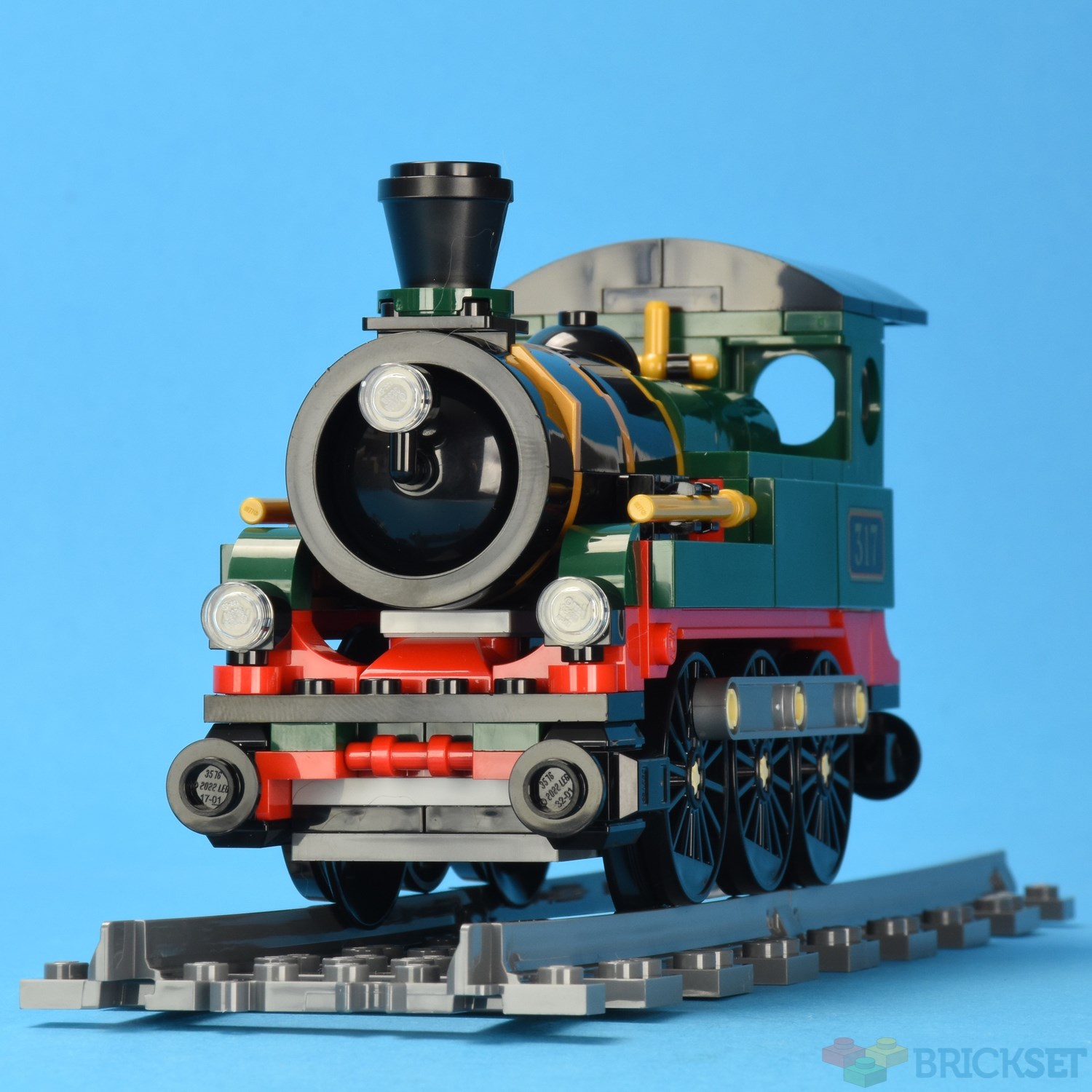
The vintage steam train uses a black flower pot for the first time as the engine's chimney.
The engine looks great with red running boards on each side.
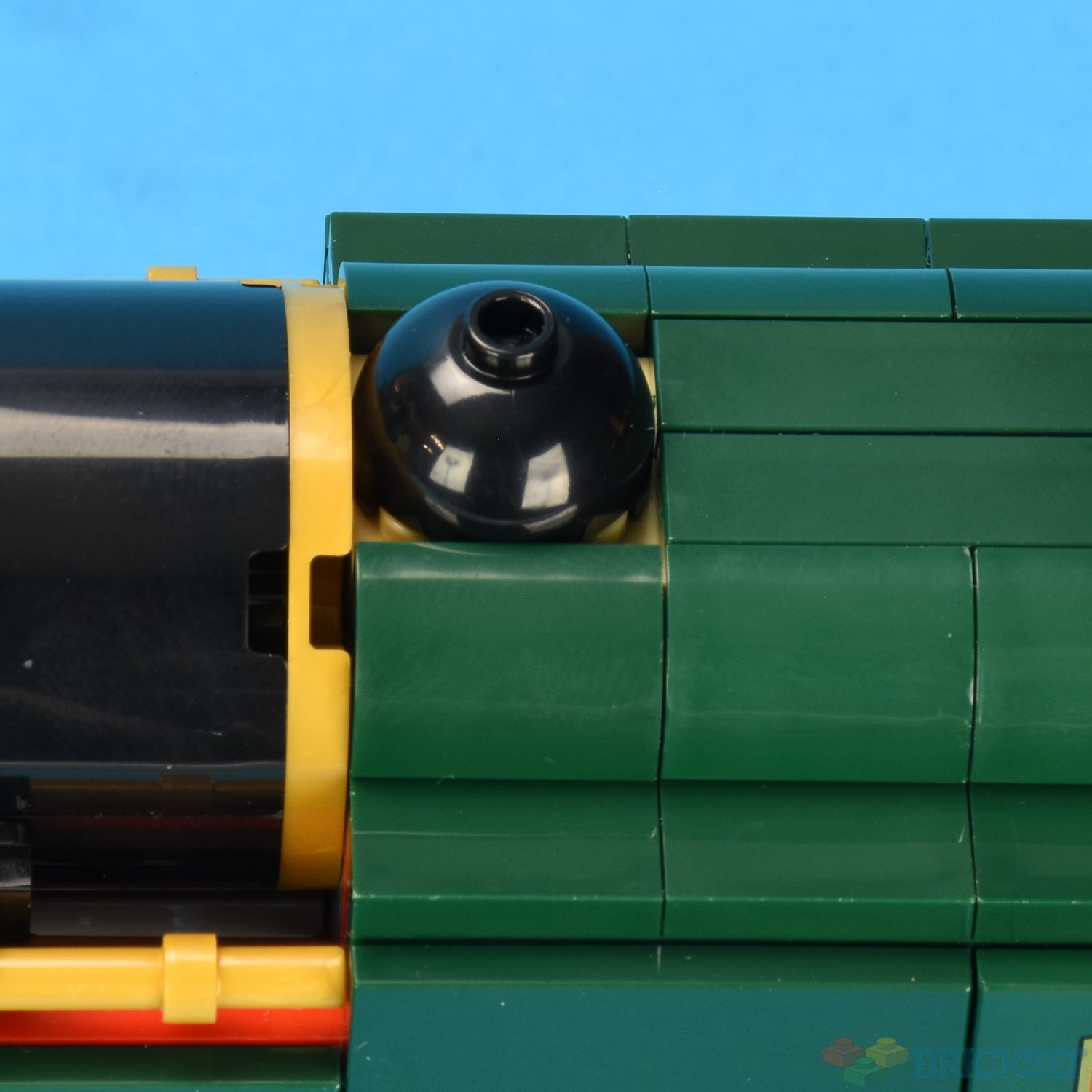
Steam engines often have a steam dome above the boiler. This antique steam engine has such a dome. There are, however, some gaps between the dome and the earth green tiles. A 2x2 earth green jumper plate would have solved this problem.
The completed model
The 60611 Vintage Steam Train is waiting at the platform ready to depart. All the passengers are aboard, and the engine driver is ready to release the brakes.
Whyte notation is the classification system most commonly used for steam locomotives. 60511 Antique Steam Train's engine would be classified as 0-6-0 meaning that it has no leading or trailing wheels but has six driving wheels. By omitting leading and trailing bogies, it maximises the tractive effort available to the engine and reduces the wheelbase.
This link takes you to an image showing the various types of steam locomotive and the corresponding Whyte notation.

60511 Vintage Steam Train does not swing wide of curved track like other LEGO steam trains, such as 10194 Emerald Night.
The train number 317 can be linked to the LEGO My Own Train series released in the early 2000s.
I have sourced a few real-world references to the train number 317 as well:
- North British Railway (NBR) 4-4-0 steam locomotive No. 317.
- London North Western Railway (LNWR) 0-4-2 317 class locomotive.
- Wainwright C-class locomotive 0-6-0 No. 31717

60511 Vintage Steam Train could easily be a hybrid of the above three locomotives.
Powered Up
In order to motorise the 60511 Vintage Steam Train, you will need to purchase these three Powered Up items.
What is not mentioned is that you will need at least sixteen curved track elements as well to make a complete loop. Unfortunately, you cannot purchase curved track elements separately and will need several supplementary packs to have enough pieces for a complete loop.
The tender carriage is the component that gets converted. You will need to go online to source the conversion instructions as they are not included in any of the four instruction booklets.
The image below is taken from the last page of booklet three. The QR code will take you to the online building instructions for the Powered Up conversion. The instructions can also be downloaded using this link.
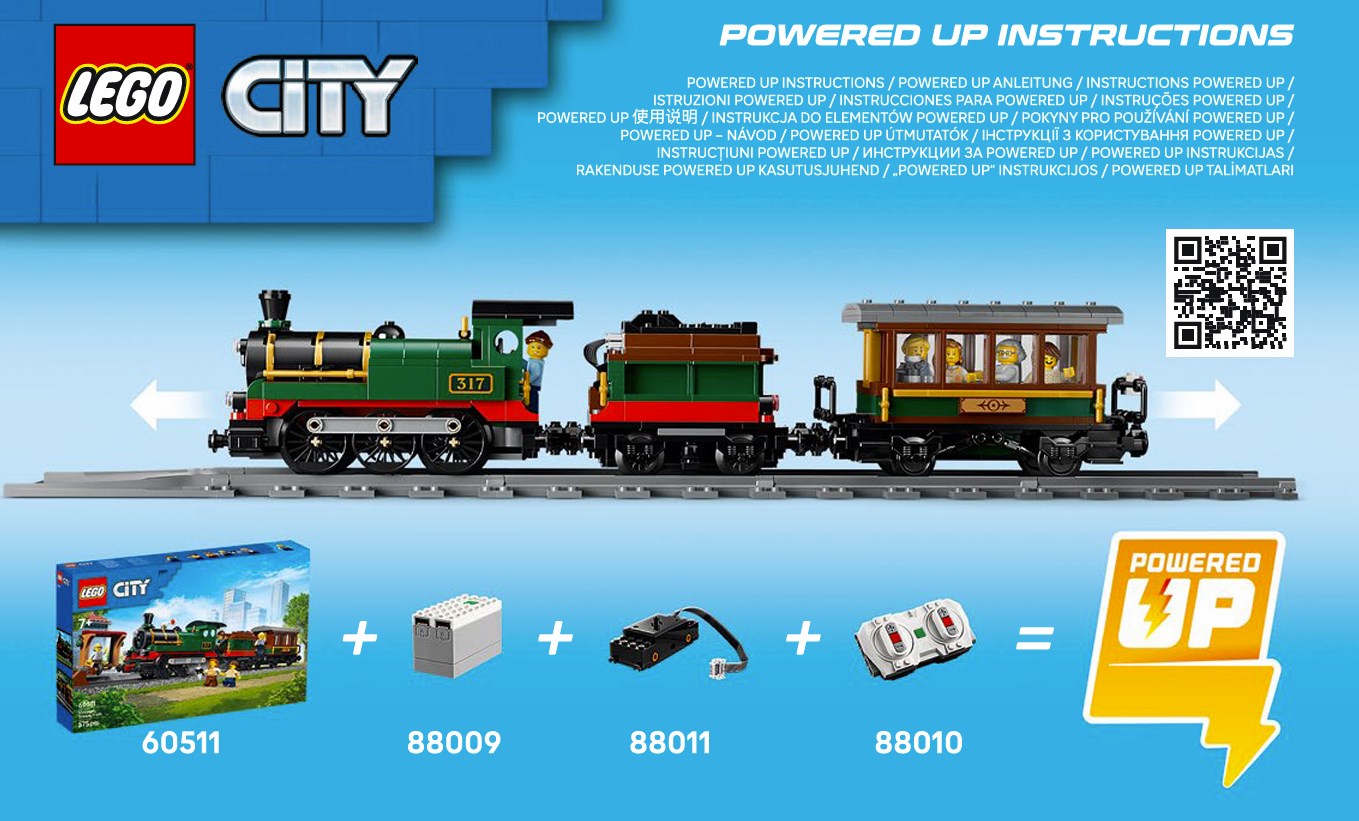
Powered Up conversion
The 88011 Train Motor replaces the tender carriage chassis and the black coal elements are attached to the top of the 88009 Powered Up Hub.
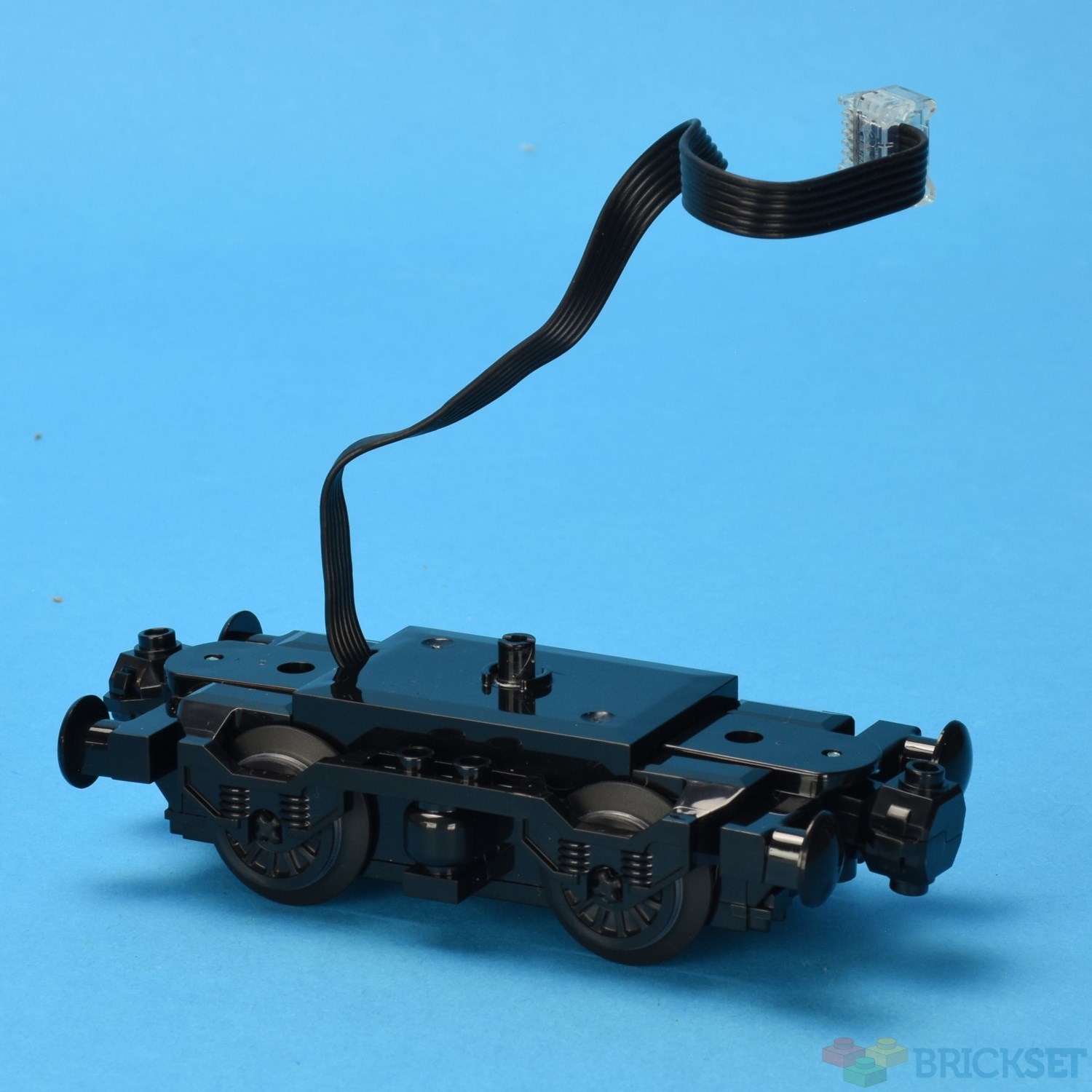
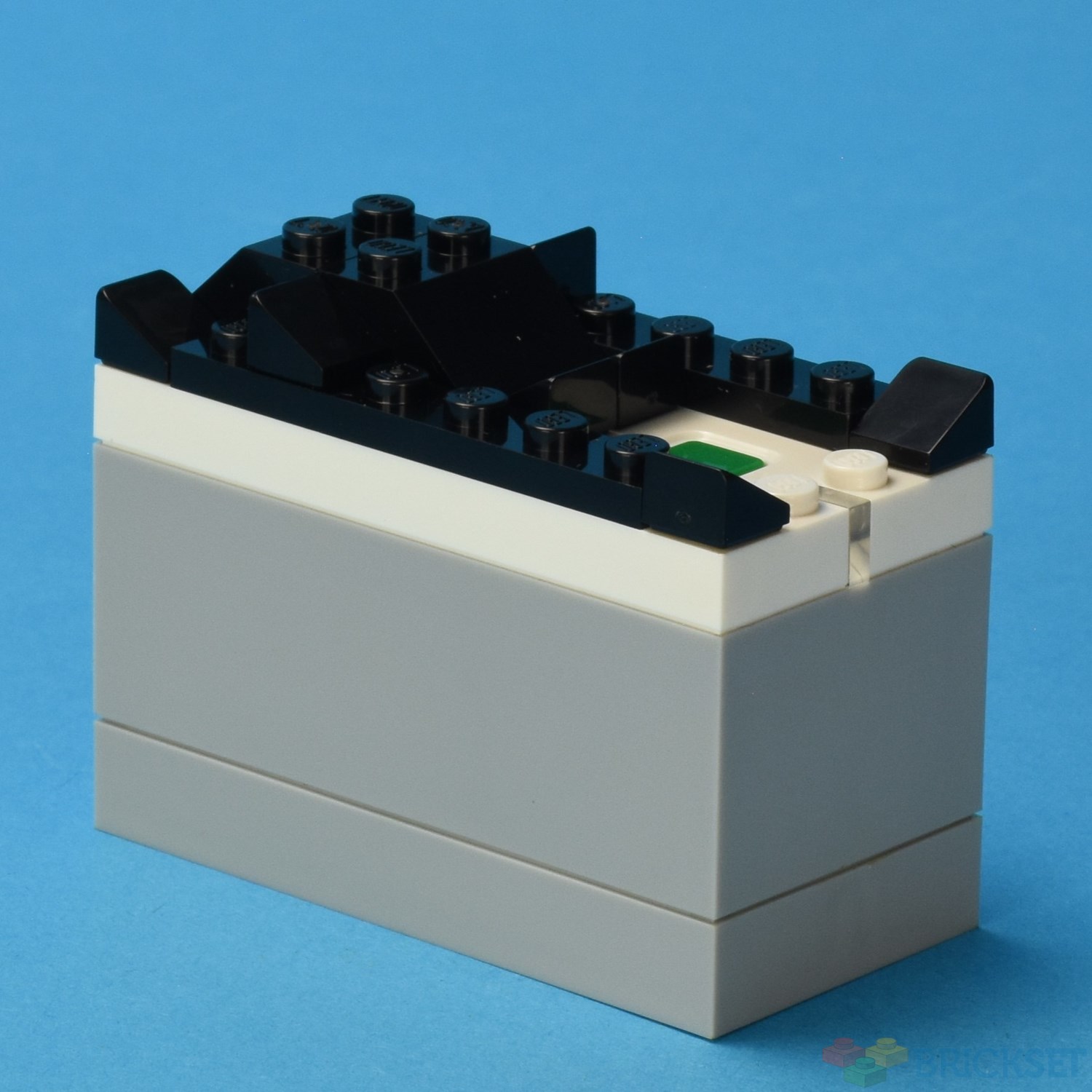
There are two subtle changes to the tender assembly:
- The reddish brown clamp is turned around, and
- The 1x2 reddish brown plate with rail is turned around so that the rail is on the exterior of the coal bunker.
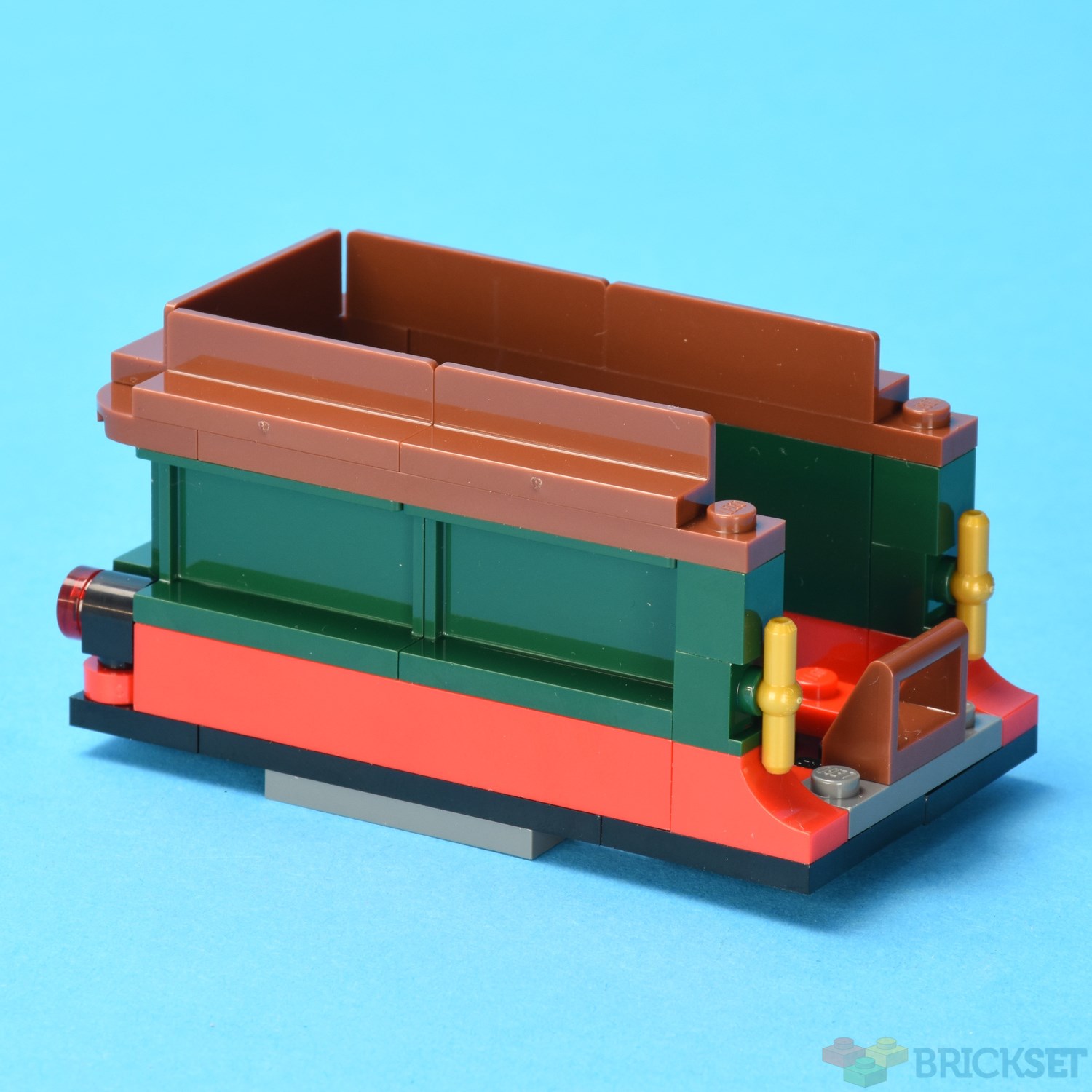
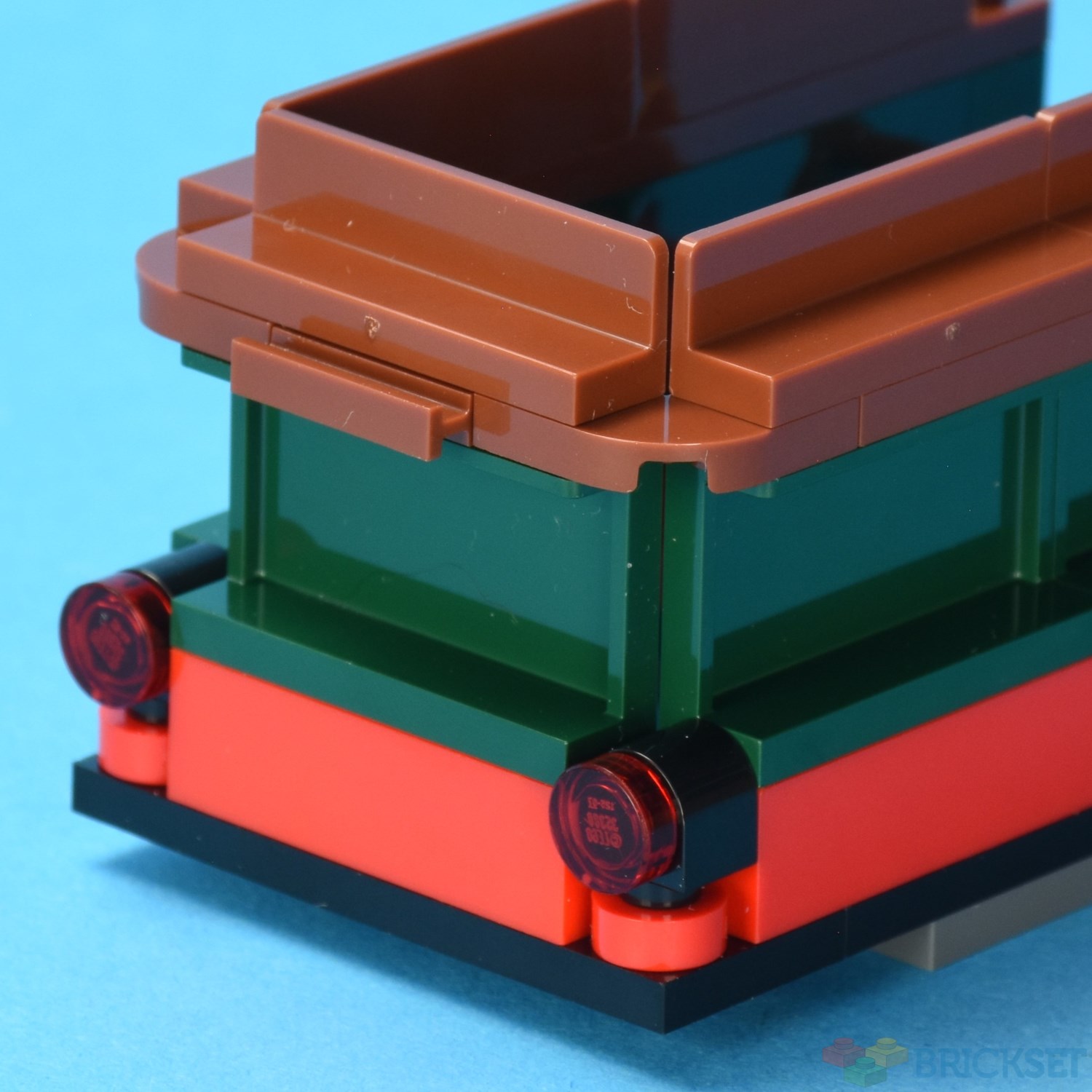
When the chassis is connected to the upper part, the centre pin of the 88011 Train Motor projects up into the coal bunker.
Be careful to ensure that the electric cable goes around the pin and does not get squashed as the Hub is placed in the coal bunker. The spare electric cable is folded up and sits behind the reddish brown clamp.

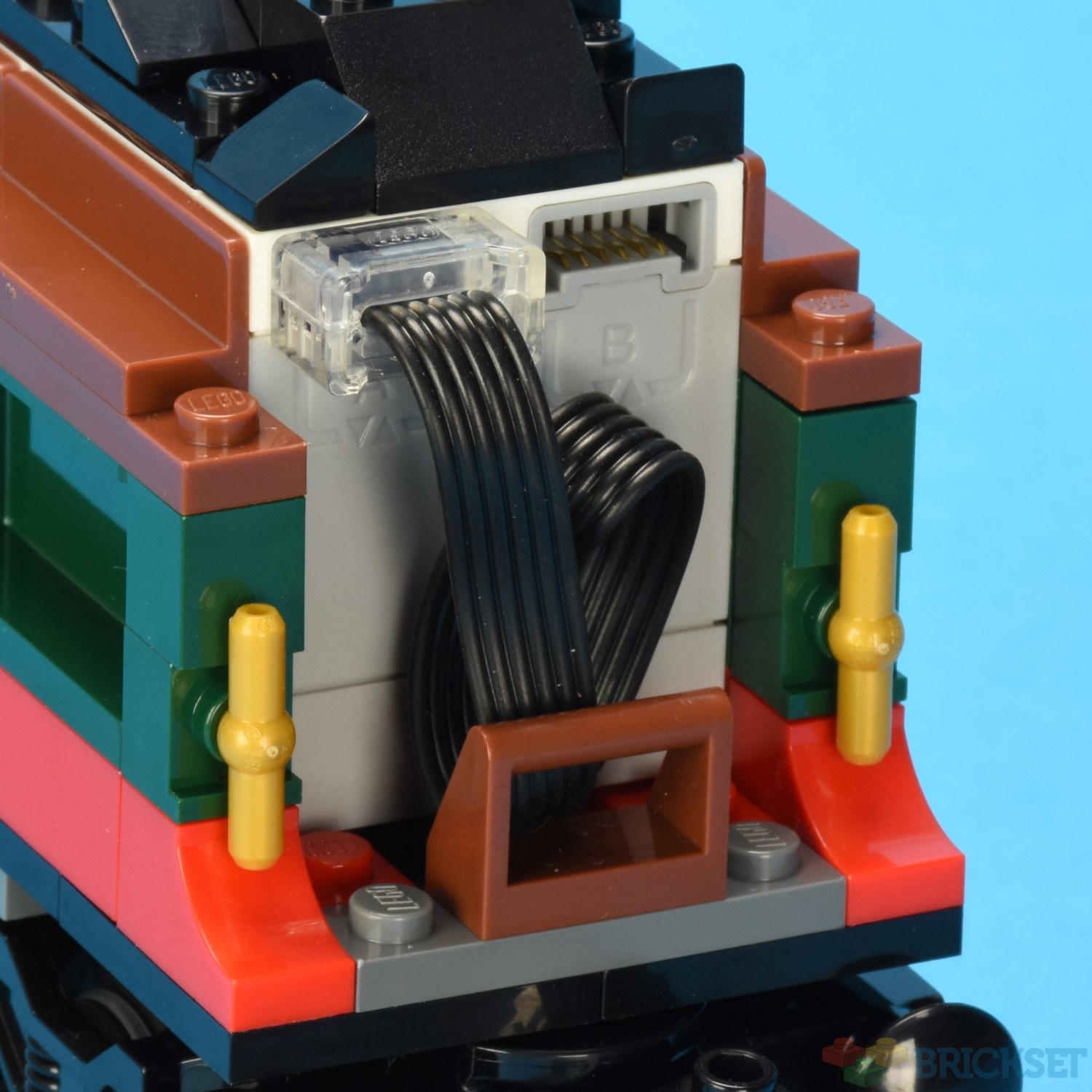
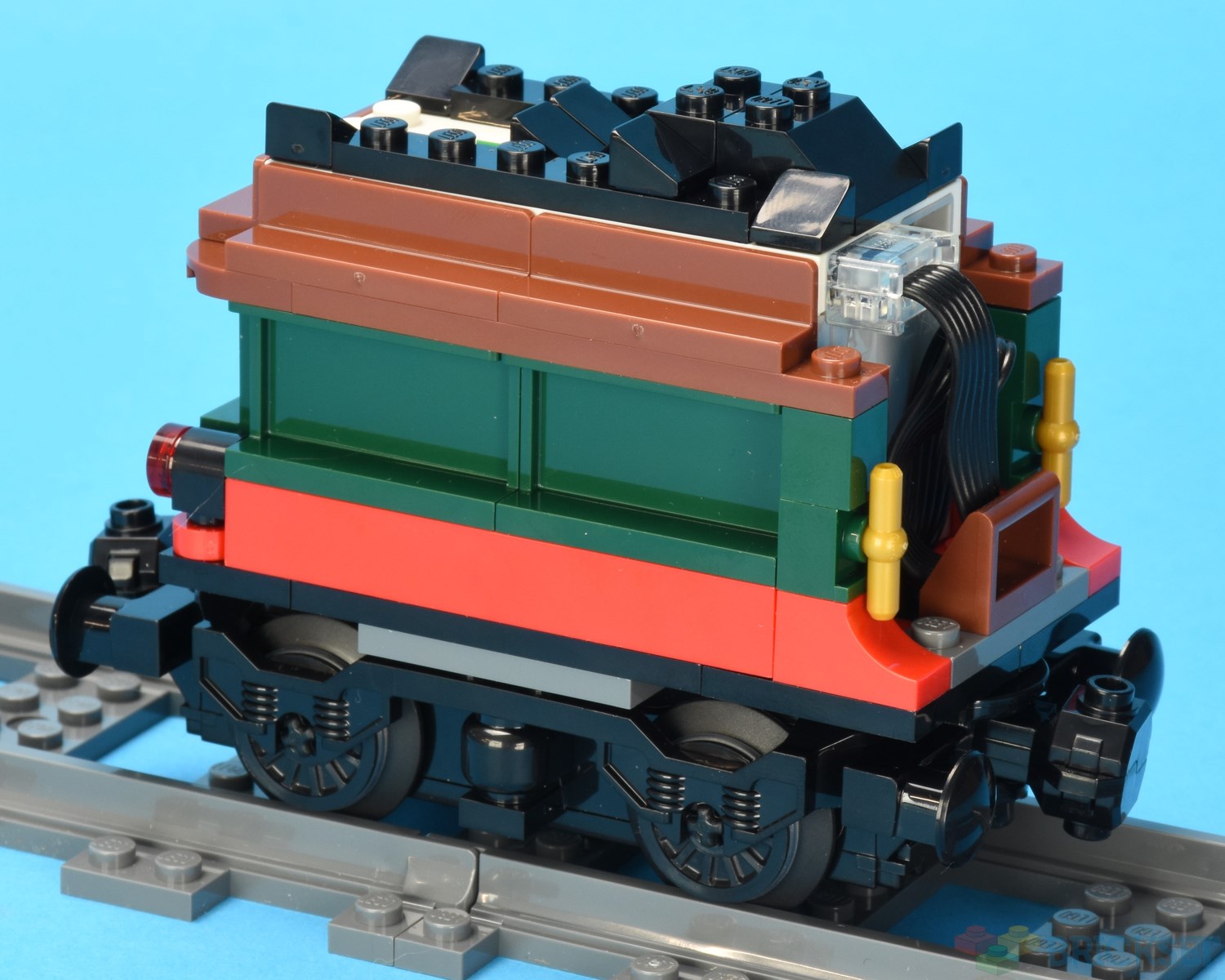
The completed Powered Up conversion. This one carriage can now run completely independently of the other components of the train. It is the Hub and Motor all in one unit.
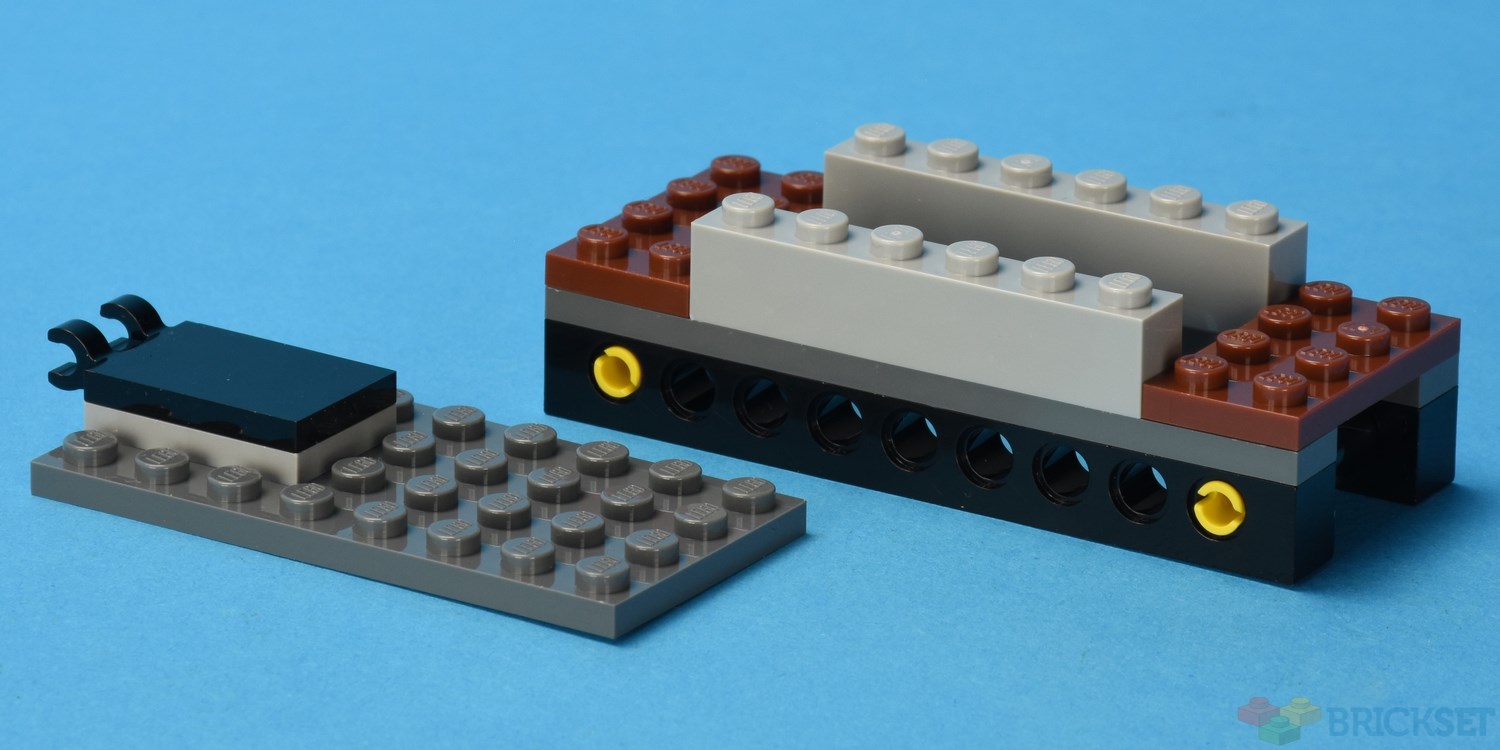
These parts are now redundant.
Powered Up operation
This one-and-a-half-minute video shows the 60511 Vintage Steam Train operating with Powered Up installed.
Overall opinion
60511 Vintage Steam Train is an attractive train that will enhance any LEGO City train layout.
By making the Powered Up components fit into the tender carriage (if you choose to motorise your train), it avoids the enormous stress imposed on the steam engine's drive wheels that are present in other LEGO steam engines.
With an engine that is only seven studs wide, with a short wheelbase and a compact chimney, this train will easily drive around the tight curves of the LEGO train track and fit under any bridges and tunnels with ease.
In order to keep costs down and make this set more attractive to purchasers, the LEGO Group have designed this set as Powered Up capable but have omitted these expensive items.
In addition, a complete loop of train track has not been included.
For these two reasons, I assess this set as not being fully self-contained: additional purchases are required to fulfil the play potential of this set.
This set retails for £79.99, $89.99, €89.99 which corresponds to 13.9p, 15.7c, 15.7c per piece.
Comparing this price per part data with 60506 Classic Beach Tram and 60509 Harbour Freight Train – both LEGO City train sets released this year with minimal track and no Powered Up components – 60511 Vintage Steam Train is thirty-five percent more expensive than the former and eighteen percent more expansive than the latter. If these savings flowed through, then 60511 Vintage Steam Train should be £20, $22.50, €22.50 cheaper than its current RRP.
In my opinion, there is no obvious reason why 60511 Vintage Steam Train is priced as it is. Having a fully printed part set with no stickers is not sufficient to account for the price disparity.
So, all in all, I like this set very much, despite the price and non-inclusion of track and Powered Up components, but I do think it is overpriced.
152 likes
73 comments on this article
I appreciate the review. Including all the extra information about trains is always appreciated. Bit disappointed with some of the design choices, like the lack of door on the passenger carriage, but understand the decision. The limited space for the Engineer is a bit of a misstep. Not a lot of room for him to work. Even 1 more stud would have made a difference.
This was a set I was quite excited about, always love a good steam engine. Price is a bit high, so will need to wait for a sale. Likely be getting each of the Trains this year, it is a good mix.
As not a train fan, this looks pretty vintage and the color scheme is nice.
Due to above fact, does anyone know what year the track type for this train started? I do have a late teens passenger train and would assume that track would work here, but I'd love a confirmation.
That is a very small carriage, it reminds me more of the tram from 10308.
All in all, as a train fan I can't help but be disappointed in this, maybe if I could get it for 30-40% off I would bite, but steam train sets rarely warm shelves.
I figured the 317 was a reference to Lego’s My Own Train line from 20 years ago
As for colour locked parts, thankfully alternate manufacturers like GoBricks produce all relevant parts in neutral colours like black, dark bluish grey etc.
Same goes for Mixel joints that are available in all kinds of colours one might need and not just in the LEGO colour locked variants.
Powered up and a loop of rails not included is a positive, almost every single train in the last years aside from some exceptions have been a very high priced set because of the extra electronics.
And this is already crazy priced for the size. 60423 Downtown Streetcar had the same price but much more and is still available.
Powered Up is not included with this set
Not a full circuit of train track
More expensive than simlar 2026 LEGO City trains
Two of these are +'s I'd say? Most train people have rails aplenty, and there is the €19.99 extra set for those that need it. I find this a clever way to make the entire set cheaper.
My main remark is the lack of a second wagon.
So why is the reviewer saying Lego hasn't released a city train with a full circle since 2022 when the 60470 which was released in 2025? Is it because of the rerailer that they don't consider it to be a full loop? Lego also just released the new 60508 in March of this year, also with a full loop of track with rerailer.
Very mixed feelings about this set....
For what it is I actually do think the engine looks pretty good! The absence of coupling rods could be explained as it having the cylinders inside the frame. Though kinda wonder what those ingot pieces are supposed to represent. Still, no big deal.
I'm a bit conflicted about it having a separate tender. Would be unusual fot just a C-coupler with no pilot truck, but not unheard of. And keeping in mind it is Lego we're talking about, I do think it doesn't look out of place. The bigger issue I have with it is that now literally 2/3 of the entire train is locomotive.....wouldn't it have been better if it had been a tank locomotive (I mean...it already seems to have water tanks on the sides?) with 2 passenger cars instead? Or maybe just a goods wagon for a mixed train? Even more so considering they won't do any separate car sets, even when that would be a perfect pocket money add-on for a set like this.
As for the passenger car, was at least one door really too much to ask for? Or at the least a proper suggestion of a door?
And yeah, that price just sucks. Also, I don't like how visible the hub is, and I can't help but feel it would already have been better if the sides of the tender would have ben just one plate higher, plus 2 pieces at the front to somewhat hide the connector. As it is, it really looks like a last minute afterthought.
I was looking forward to this set until the release. It reminds me of Emerald Night, and from that perspective, it is a budget set.
It would be nice if the power ups were cheaper, so it didn't feel annoying to buy separately.
I do feel that the train sets are really too expensive for what they contain, there's always something you wish there were more of, be it space or carriages, or accessories.
As I spent a lot of money on getting Emerald Night, along with moc-ing two extra carriages, this is an easy pass.
@dimc said:
"As not a train fan, this looks pretty vintage and the color scheme is nice.
Due to above fact, does anyone know what year the track type for this train started? I do have a late teens passenger train and would assume that track would work here, but I'd love a confirmation. "
This plastic track was released in 2006 but all standard Lego trains are compatible with all Lego track produced since trains were made in 1966.
change colour add cow catcher and change funnel, you could have train from BTTF
It's a better-looking winter holiday train than... the 10254 winter holiday train!
Being a steam locomotive fan, having missed out on the 10194 Emerald Night and not having been able to afford the 21344 Orient Express, I jumped on this immediately (albeit at quite a fair discount).
Excellent that the metal axle wheels are back, they make a huge difference to the friction any driving motor has to overcome. Converting 21344 to these type axles cost me a fair bit, but it runs so much better.
Despite this suspicious concentration of cardigans, it seems like an unpretentious set. It's not so massive as to dwarf all surrounding structures, and it's not so tiny as to suggest it's part of an amusement-park.
But dang man, that really is a lot of woolwear. Did Jon Richardson design this set?
@Crux said:
"Despite this suspicious concentration of cardigans, it seems like an unpretentious set. It's not so massive as to dwarf all surrounding structures, and it's not so tiny as to suggest it's part of an amusement-park.
But dang man, that really is a lot of woolwear. Did Jon Richardson design this set?"
Just, for consistency, ya know?
Reminds me of Emerald Night. Bought 2 sets and someone offered to buy one many years ago. It’s still in perfect condition. If you got Emerald Night, this is an easy pass.
@FlagsNZ
'More expensive than simlar 2026 LEGO City trains'
should say 'similar' not 'simlar'
:)
I like this train. Not sure if it'll fit in my city, but maybe I'll just build a depot with all the trains at it
I can see why this is more expensive than the Beach Tram, but the Harbor Freight Train should be the more expensive one out of the three.
@Crux said:
"Despite this suspicious concentration of cardigans, it seems like an unpretentious set. It's not so massive as to dwarf all surrounding structures, and it's not so tiny as to suggest it's part of an amusement-park.
But dang man, that really is a lot of woolwear. Did Jon Richardson design this set?"
Which cardigans?
A cardigan has buttons (or zip apparently) up the front, neither passenger is wearing a cardigan.
@gunther_schnitzel said:
" @Crux said:
"Despite this suspicious concentration of cardigans, it seems like an unpretentious set. It's not so massive as to dwarf all surrounding structures, and it's not so tiny as to suggest it's part of an amusement-park.
But dang man, that really is a lot of woolwear. Did Jon Richardson design this set?"
Which cardigans?
A cardigan has buttons (or zip apparently) up the front, neither passenger is wearing a cardigan.
"
The old man with the ticket begs to differ, he’s got buttons.
@FlagsNZ
The loco number of 317 refers to the My Own Train series of sets from 2001. Every engine in that series was numbered 317.
@dimc said:
"As not a train fan, this looks pretty vintage and the color scheme is nice.
Due to above fact, does anyone know what year the track type for this train started? I do have a late teens passenger train and would assume that track would work here, but I'd love a confirmation. "
12v only runs on 12v track with the third powered rail running down the center. 9v is only designed to run on metal-clad rails, but it can be hooked up to a 9v battery and run on any track. RC doesn’t work on any track, including RC (seriously, just avoid it unless you plan to switch to a different motor). 4.5v, PF, and PU will run on any of the various L-gauge track types.
@ulibu said:
"Uhm, yes, 40 USD, then we can talk. Just look how tiny this is. Obscene."
This is absolutely not a $40 set lmao
You could MAYBE argue for $60, but that's like the absolute bare minimum this would ever retail for and even that's pushing it.
It's a great little runner. We got 60198 just before it was discontinued, so used the loop of track and powered up components to motorise it. On the shelf my son compared it to 60508 & 60470 . Because it doesn't have the loop of track and powered up components its a good price even at full retail.
I agree a second carriage would have been better.
@FlagsNZ
Having built the set myself, I'd say the main weakness is that the locomotive should use axles instead of just technic pins, otherwise the coupling rods don’t really work except if the wheels rotate at the same speed: specifically see step 430 of the Orient Express for proper Wheel Quartering.
The coupling rods work 10x better after replacing the front and rear wheels' pins with 6L axles.
Is Albert Einstein conducting relativity time dilation experiments with this train?
Looks like TLG found a new way to rip-off kids and AFOL's by not including the P-Up motorisation and the track circle/ellipse to run the trains on. I wonder how they managed to include the super expensive magnetic buffers and metal axles without going bankrupt. Probably why they couldn't bother to add a door in an already shrunk down passenger car or put some effort in the platform details... because why should they if "only the bare minimum is good enough"? :(
@alLEGOry_HJB2810 said:
" @FlagsNZ
'More expensive than simlar 2026 LEGO City trains'
should say 'similar' not 'simlar'
:)
"
This comment reminds me of a famous quote taken from The King's Speach:
Lionel Logue: "You still stammered on the 'W'."
King George VI: "Well, I had to throw in a few so they knew it was me."
Those lines in the movie were taken from a diary entry of Lionel Logue and occured in real life.
Thanks, everyone, for your supportive comments.
@Murdoch17 : I have edited the review to add this detail regarding the 317 number reference. To have an "vintage" reference to something from the 2000s makes one feel really old!
I have also removed my erroneous comment on curved track. The curved track element is a new part from 2025 and so I missed it when searching using the old track element number.
https://brickset.com/sets/containing-part-6515853
@raven_za said:
" @FlagsNZ
Having built the set myself, I'd say the main weakness is that the locomotive should use axles instead of just technic pins, otherwise the coupling rods don’t really work except if the wheels rotate at the same speed: specifically see step 430 of the Orient Express for proper Wheel Quartering."
They won’t, because the inside rail on a curve is shorter than the outside rail. You can make them average out to the same number of rotations if you run a symmetrical figure-8…and none of the wheels ever slip on the tracks. This is why serious trainheads use non-train motors and motorize the steam drivers. It should also help cut down on derailments due to being shoved into the outside rail on curves.
Got it at 64€ in France with a great discount at launch: it's a little marvel on tracks :) I've been dreaming for this kind of train for years! I had the Powered Up stuff since the last Christmas Train didn't came with... I got a second one to get another passenger car and plan to switch the second steam engine to black instead of green and make it an old cargo train... maybe for my Adventurers... Will disassemble the 60337 Express Passenger Train to reuse the tracks and the second kit of Powered Up elements ;)
What's next ? Hope LEGO will release individual cars as they did in the 9V era, both for this 60511 Vintage Train and for the 60509 Harbour Freight Train (and upcoming ones). :D
@PurpleDave said:
" @raven_za said:
" @FlagsNZ
Having built the set myself, I'd say the main weakness is that the locomotive should use axles instead of just technic pins, otherwise the coupling rods don’t really work except if the wheels rotate at the same speed: specifically see step 430 of the Orient Express for proper Wheel Quartering."
They won’t, because the inside rail on a curve is shorter than the outside rail. You can make them average out to the same number of rotations if you run a symmetrical figure-8…and none of the wheels ever slip on the tracks. This is why serious trainheads use non-train motors and motorize the steam drivers. It should also help cut down on derailments due to being shoved into the outside rail on curves."
I should have been more specific, the front and rear wheels should manually rotate at the same speed. With pins, the coupling rod will get stuck at the 3 o'clock or 9 o'clock position if you only rotate the front or rear wheels. Replacing the pins with axles results in a smooth rotation where all 6 wheels rotate freely when you rotate 1.
I like it. It’s really pretty. I don’t have anywhere I can set up a full track at present so the optional extra expensive bits and bobs being absent doesn’t bother me.
Cool. I have motorized 75955 in the same way: It is still my favorite train, and at Christmas it runs around the Christmas tree.
We have 8-wide planes, we have 8-wide cars, but we still have 6-wide trains! And that's after 70 years, 112! TLG gives us 8-wide trains!
@gsom7 said:
"We have 8-wide planes, we have 8-wide cars, but we still have 6-wide trains! And that's after 70 years, 112 ! TLG gives us 8-wide trains!"
They once gave us a 10-wide train, and everyone complaind.....
(okay, probably for good reason, but still....)
And if even that's not big enough, BlueBrixx does 20-or-so wide trains!
@raven_za said:
"I should have been more specific, the front and rear wheels should manually rotate at the same speed. With pins, the coupling rod will get stuck at the 3 o'clock or 9 o'clock position if you only rotate the front or rear wheels. Replacing the pins with axles results in a smooth rotation where all 6 wheels rotate freely when you rotate 1."
Ah, forgot about that. I am not actually a trainhead, though I do occasionally hang out with a few. Or rather, going by the frequency with which we display on an individual basis, they hang out with me.
@gsom7 said:
"We have 8-wide planes, we have 8-wide cars, but we still have 6-wide trains! And that's after 70 years, 112! TLG gives us 8-wide trains!"
We can’t give you 8-wide, but would you settle for 10-wide? 76405?
Of course, it’s (L+1)-gauge, so it won’t actually run on any tracks known to man, but…
Love the in-depth review of this set, appreciate all the real world information. It's exciting that City is getting a steam engine set after years of all the modern ones. Since the engine is very British looking, I like how the passengers are all wearing sweaters to match the vibe. The buffers and the platform look great with the engine. The emerald color is a wonderful call back to the Emerald Night and just looks lovely.
I personally don't mind the set not including the power functions or a full loop of track since after all the Emerald Night didn't have them. Though most City train sets at least have more track but lately that isn't the case so again, not bothered.
Would love to get this set at a discount!
@FlagsNZ said:
"Thanks, everyone, for your supportive comments.
@Murdoch17 : I have edited the review to add this detail regarding the 317 number reference. To have an "vintage" reference to something from the 2000s makes one feel really old!
I have also removed my erroneous comment on curved track. The curved track element is a new part from 2025 and so I missed it when searching using the old track element number.
https://brickset.com/sets/containing-part-6515853
"
Hang on a second, I'm confused. Lego lists the curved track as design ID 2827 and the part number as 6515853 (2827 in color dark stone grey). Bricklink lists the design ID as 2827 and the part number as 53400. Either way you do it Bricklink says that part in Dark Bluish Grey or Dark Stone Grey in either number was used in 22 RC train sets since 2006. Which means the Brickset database is wrong because it lists the part as only being used in three sets since 2025 instead of the correct number of 22 sets since 2006. That's why you missed it.
@oldtodd33 said:
" @FlagsNZ said:
"Thanks, everyone, for your supportive comments.
@Murdoch17 : I have edited the review to add this detail regarding the 317 number reference. To have an "vintage" reference to something from the 2000s makes one feel really old!
I have also removed my erroneous comment on curved track. The curved track element is a new part from 2025 and so I missed it when searching using the old track element number.
https://brickset.com/sets/containing-part-6515853
"
Hang on a second, I'm confused. Lego lists the curved track as design ID 2827 and the part number as 6515853 (2827 in color dark stone grey). Bricklink lists the design ID as 2827 and the part number as 53400. Either way you do it Bricklink says that part in Dark Bluish Grey or Dark Stone Grey in either number was used in 22 RC train sets since 2006. Which means the Brickset database is wrong because it lists the part as only being used in three sets since 2025 instead of the correct number of 22 sets since 2006. That's why you missed it. "
I'm not 100% sure, but I think Brickset's info comes from TLG, which only lists the most recent mold. The molds should be functionally the same, but might have small differences.
@oldtodd33 said:
" @FlagsNZ said:
"Thanks, everyone, for your supportive comments.
@Murdoch17 : I have edited the review to add this detail regarding the 317 number reference. To have an "vintage" reference to something from the 2000s makes one feel really old!
I have also removed my erroneous comment on curved track. The curved track element is a new part from 2025 and so I missed it when searching using the old track element number.
https://brickset.com/sets/containing-part-6515853
"
Hang on a second, I'm confused. Lego lists the curved track as design ID 2827 and the part number as 6515853 (2827 in color dark stone grey). Bricklink lists the design ID as 2827 and the part number as 53400. Either way you do it Bricklink says that part in Dark Bluish Grey or Dark Stone Grey in either number was used in 22 RC train sets since 2006. Which means the Brickset database is wrong because it lists the part as only being used in three sets since 2025 instead of the correct number of 22 sets since 2006. That's why you missed it. "
I discuss the new curved track design in my review of the 10361 Holiday Express Train. You can see images of the difference in the design. The new track is compatible with existing designs.
https://brickset.com/article/125106/review-10361-part-2-holiday-express-train
Somehow looks so basic. And no proper doors on carriages!!!!! Do not normalise this as you did on vehicles. :o(
@560heliport said:
" @oldtodd33 said:
" @FlagsNZ said:
"Thanks, everyone, for your supportive comments.
@Murdoch17 : I have edited the review to add this detail regarding the 317 number reference. To have an "vintage" reference to something from the 2000s makes one feel really old!
I have also removed my erroneous comment on curved track. The curved track element is a new part from 2025 and so I missed it when searching using the old track element number.
https://brickset.com/sets/containing-part-6515853
"
Hang on a second, I'm confused. Lego lists the curved track as design ID 2827 and the part number as 6515853 (2827 in color dark stone grey). Bricklink lists the design ID as 2827 and the part number as 53400. Either way you do it Bricklink says that part in Dark Bluish Grey or Dark Stone Grey in either number was used in 22 RC train sets since 2006. Which means the Brickset database is wrong because it lists the part as only being used in three sets since 2025 instead of the correct number of 22 sets since 2006. That's why you missed it. "
I'm not 100% sure, but I think Brickset's info comes from TLG, which only lists the most recent mold. The molds should be functionally the same, but might have small differences. "
IIRC the mold difference is a slight change to the clip mechanism at each end of the track pieces, presumably to reduce stress or add strength. This is a minor change that TLG clearly don't consider notable enough to denote on PAB etc. as a "new" part (as it has no functional impact on current usage of the piece, or future compatibility with existing sets, unlike say the original 2x2 snot plate used in the UCS B-Wing which cannot be replicated with the newer version of that part). It's the sort of mold change that Bricklink used to care about trying to differentiate for each set inventory but now seems to be simplifying out from the catalogue with just a brief reference to different mold types on the main catalogue entry.
@FlagsNZ said:
" @oldtodd33 said:
" @FlagsNZ said:
"Thanks, everyone, for your supportive comments.
@Murdoch17 : I have edited the review to add this detail regarding the 317 number reference. To have an "vintage" reference to something from the 2000s makes one feel really old!
I have also removed my erroneous comment on curved track. The curved track element is a new part from 2025 and so I missed it when searching using the old track element number.
https://brickset.com/sets/containing-part-6515853
"
Hang on a second, I'm confused. Lego lists the curved track as design ID 2827 and the part number as 6515853 (2827 in color dark stone grey). Bricklink lists the design ID as 2827 and the part number as 53400. Either way you do it Bricklink says that part in Dark Bluish Grey or Dark Stone Grey in either number was used in 22 RC train sets since 2006. Which means the Brickset database is wrong because it lists the part as only being used in three sets since 2025 instead of the correct number of 22 sets since 2006. That's why you missed it. "
I discuss the new curved track design in my review of the 10361 Holiday Express Train. You can see images of the difference in the design. The new track is compatible with existing designs.
https://brickset.com/article/125106/review-10361-part-2-holiday-express-train"
It's NOT a new part though, it's a mold variation and is completely compatible with the previous track. Neither Lego nor Bricklink keep track of mold variations anymore and they both still use the SAME design ID number, 2827. This could be very confusing to the novice Lego person.
Although they predate the LEGO City branding, there have been minifig-scale steam trains in the past. E.g. 7722 and 7810.
@OneIsLit said:
"Although they predate the LEGO City branding, there have been minifig-scale steam trains in the past. E.g. 7722 and 7810. "
Became one of my favourite ever GWPs, 40370 LEGO Trains 40th Anniversary Set
@oldtodd33 said:
"It's NOT a new part though, it's a mold variation and is completely compatible with the previous track. Neither Lego nor Bricklink keep track of mold variations anymore and they both still use the SAME design ID number, 2827."
Bricklink only keeps track of functional mold differences…except they let the Sellers who don’t want to sort them out decide what is “functional”, and not the MOC-builders and set-constructors who need very specific variants because the other ones won’t work.
TLG, on the other hand, has been burned on this pyre, with the likes of 10179 and 79003. They usually retire the design ID number as soon as they make a change that’s more significant than where the gates are located. This ensures that they don’t end up accidentally switching to a new mold that _is_ functionally different, and breaks the design of a set that’s still in production.
"This could be very confusing to the novice Lego person. "
It’s probably rare that a fledgling AFOL gets introduced to the greater AFOLdom without at least some degree of confusion.
@PurpleDave said:
" @oldtodd33 said:
"It's NOT a new part though, it's a mold variation and is completely compatible with the previous track. Neither Lego nor Bricklink keep track of mold variations anymore and they both still use the SAME design ID number, 2827."
Bricklink only keeps track of functional mold differences…except they let the Sellers who don’t want to sort them out decide what is “functional”, and not the MOC-builders and set-constructors who need very specific variants because the other ones won’t work.
I am very aware of this as I like to make sure older sets have the correct variation of the part I'm replacing for one reason or another.
TLG, on the other hand, has been burned on this pyre, with the likes of 10179 and 79003 . They usually retire the design ID number as soon as they make a change that’s more significant than where the gates are located. This ensures that they don’t end up accidentally switching to a new mold that _is_ functionally different, and breaks the design of a set that’s still in production.
"This could be very confusing to the novice Lego person. "
It’s probably rare that a fledgling AFOL gets introduced to the greater AFOLdom without at least some degree of confusion."
It was confusing to me knowing Lego will make unwanted changes to a part and then I have to change my thinking and memory to account for this.
When I first saw this was a "new" part I freaked out thinking Lego made some design change I wasn't going to like. Since I don't currently own any of the three sets it effects (I do however own parts of 60470 ) I had no idea what to expect. Come to find out it's not any change that affects the building design or experience but a minor mold change that can only be seen from the bottom. It still took me a half an hour to see the differences and understand them enough to see this is only a mold variation and not a new part in the slightest.
I like it, but it looks like a less interesting version of 79111
The set is ok, not quite up to replacing the last Hogs-worth Express 76423 which provided two carriages and a station, but both suffered from not having a full track or powered-up. The secondary markets are a good place to get an old City train set with a full track and powered-up components (which are not always in stock) to use with these sets.
@560heliport said:
"I'm not 100% sure, but I think Brickset's info comes from TLG…"
This is true. It’s downloaded anew every night.
"…which only lists the most recent mold."
This is not true. I know at least one instance of mold variations that are being sold concurrently through OPAB. Also, prior to MABS, TLG would assign different design numbers to molds cut for ABS vs molds cut for polycarbonate vs molds cut for chromed parts, etc., because the tolerances were different enough that they couldn’t just use one mold for everything. And the different design numbers ensured they didn’t mix them up and produce a bunch of scrap parts. Bricklink doesn’t differentiate between these design numbers, though they did start tagging them to the part entries at some point.
"The molds should be functionally the same, but might have small differences. "
And this is a matter of much debate. Sellers say the variations aren’t functional, but Buyers disagree.
No comments about turning this into Thomas the Tank Engine?
How does driving the steam loco wheels with a motor stress them?
caboose?
@Modeltrainman said:
"How does driving the steam loco wheels with a motor stress them?"
Presumably if the drivers are driven by a motor the motor will be trying to turn the inside and outside wheels at different speeds in curves and it can't so that's where the stress comes from. On straights there will be no speed difference.
Still feels like decent deal. Crazy I know.
I am just happy we are getting trains again.
also lack of powered up features is a good thing imo.
The price is obvious - it will sell really well especialy for christmas.
@oldtodd33 said:
" @Modeltrainman said:
"How does driving the steam loco wheels with a motor stress them?"
Presumably if the drivers are driven by a motor the motor will be trying to turn the inside and outside wheels at different speeds in curves and it can't so that's where the stress comes from. On straights there will be no speed difference. "
If you take the Emerald Knight train engine as an example. It needed the former Power Functions XL (for extra-large) motor that was built into the engine cab where the fire box would have been. The drive train goes through a series of small bevel gears to drive the engine's axles.
Those drive wheels require red rubber bands on them to give them traction. All six wheels always rotate at the same rate even on the tight curves.
With this 60511 vintage steam engine Powered Up format, all those design compromises disappear by using the tender carriage as the driving power.
@dimc said:
"As not a train fan, this looks pretty vintage and the color scheme is nice.
Due to above fact, does anyone know what year the track type for this train started? I do have a late teens passenger train and would assume that track would work here, but I'd love a confirmation. "
All Lego tracks are the same size, from the start. You should be able to run this new train on all older tracks.
It just doesn't work for the older trains (before 2009) the other way around. These trains are either powered by a mid-rail (the really old ones from the 80-90's, or via the metal on the tracks itself (later period)
@Kiiranaux said:
"No comments about turning this into Thomas the Tank Engine?"
That's a fantastic idea!
@FlagsNZ said:
" @oldtodd33 said:
" @Modeltrainman said:
"How does driving the steam loco wheels with a motor stress them?"
Presumably if the drivers are driven by a motor the motor will be trying to turn the inside and outside wheels at different speeds in curves and it can't so that's where the stress comes from. On straights there will be no speed difference. "
If you take the Emerald Knight train engine as an example. It needed the former Power Functions XL (for extra-large) motor that was built into the engine cab where the fire box would have been. The drive train goes through a series of small bevel gears to drive the engine's axles.
Those drive wheels require red rubber bands on them to give them traction. All six wheels always rotate at the same rate even on the tight curves.
With this 60511 vintage steam engine Powered Up format, all those design compromises disappear by using the tender carriage as the driving power."
One of the major trainheads in my LUG explained this to me. The load-bearing section on a train wheel is called the “tire”, and it’s conical in shape. On a curve, the design of the wheel causes the wider part of the tire to ride on the outer rail, and the narrower part to ride in the inner rail. This allows both wheels to turn at the same rate and yet travel different distances without one of them having to slip. This is how real train wheels apparently work, but traction is less of an issue when the weights involved.
And it doesn’t matter which type of motor you use. They all have conical tires, and they all need rubber bands on the wheels for traction. 9v wheels just come with them pre-installed, and they’re not designed to be removed. I don’t think they even sold replacements.
The inside/outside issue is a problem regardless: even with a PF motor, as long as there is an axle, the inside and outside wheels will be forced to turn at the same speed.
The big win is not having small bevel gears in order to transfer the power, and not having to redesign the locomotive in order to fit and connect the motors and wiring: Adding a train motor and battery box to the existing design is almost trivial.
@PurpleDave said:
" @FlagsNZ said:
"Those drive wheels require red rubber bands on them to give them traction. All six wheels always rotate at the same rate even on the tight curves."
One of the major trainheads in my LUG explained this to me. The load-bearing section on a train wheel is called the “tire”, and it’s conical in shape. On a curve, the design of the wheel causes the wider part of the tire to ride on the outer rail, and the narrower part to ride in the inner rail. This allows both wheels to turn at the same rate and yet travel different distances without one of them having to slip. This is how real train wheels apparently work, but traction is less of an issue when the weights involved."
Actually, that doesn’t make sense. I’m going to have to pester him about that one. Due to the flanges being on the inside, this would force the outside wheel to ride in the outer, narrower, portion of the tire, while the inside wheel would ride in the wider inside portion. This then would make the inside wheel travel faster, while it also has a shorter distance.
Regardless, one trick he told me was to only put the traction bands on one side, so the other side can slip on the rail.
@PurpleDave said:
" @PurpleDave said:
" @FlagsNZ said:
"Those drive wheels require red rubber bands on them to give them traction. All six wheels always rotate at the same rate even on the tight curves."
One of the major trainheads in my LUG explained this to me. The load-bearing section on a train wheel is called the “tire”, and it’s conical in shape. On a curve, the design of the wheel causes the wider part of the tire to ride on the outer rail, and the narrower part to ride in the inner rail. This allows both wheels to turn at the same rate and yet travel different distances without one of them having to slip. This is how real train wheels apparently work, but traction is less of an issue when the weights involved."
Actually, that doesn’t make sense. I’m going to have to pester him about that one. Due to the flanges being on the inside, this would force the outside wheel to ride in the outer, narrower, portion of the tire, while the inside wheel would ride in the wider inside portion. This then would make the inside wheel travel faster, while it also has a shorter distance.
Regardless, one trick he told me was to only put the traction bands on one side, so the other side can slip on the rail."
https://www.youtube.com/watch?v=HeDuGWNTDPY
That said, this is how it works in reality, with much wider curves. With the extremely tight Lego curves (even compared to most model railways), the effect would be minimal, and the flanges have to do the heavy lifting to keep the train on track. Resulting in a lot of friction. And obviously even more so with bigger wheels (larger contact area on the flange) and with a longer (fixed) wheelbase.
As for traction bands only on one side, that's also a trick often used with model trains.
Now I only have very old (1970s) Lego train wheels, but those actually appear to be a tiny bit tapered in the wrong way! Though that might just be an optical illusion. Unfortunately can't find my caliper, and without it I just can't tell for sure.
@WizardOfOss said:
" @PurpleDave said:
" @PurpleDave said:
" @FlagsNZ said:
"Those drive wheels require red rubber bands on them to give them traction. All six wheels always rotate at the same rate even on the tight curves."
One of the major trainheads in my LUG explained this to me. The load-bearing section on a train wheel is called the “tire”, and it’s conical in shape. On a curve, the design of the wheel causes the wider part of the tire to ride on the outer rail, and the narrower part to ride in the inner rail. This allows both wheels to turn at the same rate and yet travel different distances without one of them having to slip. This is how real train wheels apparently work, but traction is less of an issue when the weights involved."
Actually, that doesn’t make sense. I’m going to have to pester him about that one. Due to the flanges being on the inside, this would force the outside wheel to ride in the outer, narrower, portion of the tire, while the inside wheel would ride in the wider inside portion. This then would make the inside wheel travel faster, while it also has a shorter distance.
Regardless, one trick he told me was to only put the traction bands on one side, so the other side can slip on the rail."
https://www.youtube.com/watch?v=HeDuGWNTDPY
That said, this is how it works in reality, with much wider curves. With the extremely tight Lego curves (even compared to most model railways), the effect would be minimal, and the flanges have to do the heavy lifting to keep the train on track. Resulting in a lot of friction. And obviously even more so with bigger wheels (larger contact area on the flange) and with a longer (fixed) wheelbase.
As for traction bands only on one side, that's also a trick often used with model trains.
Now I only have very old (1970s) Lego train wheels, but those actually appear to be a tiny bit tapered in the wrong way! Though that might just be an optical illusion. Unfortunately can't find my caliper, and without it I just can't tell for sure."
You're right, the old red train wheels are heavily tapered to the inside. I measured .630 inches on the outside and .573 inches on the inside. The 12 motor wheels on my 7755 appear to have the same taper but the non-powered wheels on my 7755 are flat at .610 inches inside and out. The 9V non-powered wheels appear to have a very slight taper of .010 inches to the outside.
Thanks for this review, Flags! Much enjoyed.
@PurpleDave said:
" @raven_za said:
"I should have been more specific, the front and rear wheels should manually rotate at the same speed. With pins, the coupling rod will get stuck at the 3 o'clock or 9 o'clock position if you only rotate the front or rear wheels. Replacing the pins with axles results in a smooth rotation where all 6 wheels rotate freely when you rotate 1."
Ah, forgot about that. I am not actually a trainhead, though I do occasionally hang out with a few. Or rather, going by the frequency with which we display on an individual basis, they hang out with me.
@gsom7 said:
"We have 8-wide planes, we have 8-wide cars, but we still have 6-wide trains! And that's after 70 years, 112! TLG gives us 8-wide trains!"
We can’t give you 8-wide, but would you settle for 10-wide? 76405?
Of course, it’s (L+1)-gauge, so it won’t actually run on any tracks known to man, but…"
71044 Disney Train is 8-wide.
Un vagón sin puertas?. No, gracias...
Bring back 9V with electrified railways!!! First warning!
@SeparatorGuyChallis said:
"change colour add cow catcher and change funnel, you could have train from BTTF"
"Where we're going, we don't need... tracks."
@jBXavier said:"Reminds me of Emerald Night. Bought 2 sets and someone offered to buy one many years ago. It’s still in perfect condition. If you got Emerald Night, this is an easy pass."
But 10194 came out more than fifteen years ago, though,so this may be an acceptable substitute if you missed it and can't find a copy on the secondary market.
@FlagsNZ said:"To have an "vintage" reference to something from the 2000s makes one feel really old!"
I feel you.
Great to see a return to metal axles. Would love to know how much better the roller coaster cars would run with metal axles.
@WizardOfOss said:
"https://www.youtube.com/watch?v=HeDuGWNTDPY
That said, this is how it works in reality, with much wider curves. With the extremely tight Lego curves (even compared to most model railways), the effect would be minimal, and the flanges have to do the heavy lifting to keep the train on track. Resulting in a lot of friction. And obviously even more so with bigger wheels (larger contact area on the flange) and with a longer (fixed) wheelbase."
Okay, that rings a bell. I don't know if it's the same video, but I remember him sending me a link to something that explained it in a way that did make sense at the time. So the taper on the wheels was not matched to the curve of the rails, and the result is it does fully slam into the flanges. But in that case, you end up back at the problem that a pusher design presses the lead bogeys into the outside rail, while the trailing bogeys get pulled into the inside rail. When you combine inertia with this, at high speeds, that's a lot of physics that just favors derailments.
"As for traction bands only on one side, that's also a trick often used with model trains."
And on a simple loop, keeping them only on the outside wheels should help force the engine to lean a bit more inward on the curves, which will help resist derailing the engine.
I would love to see a side-by-side photo of this with the 10254 winter holiday train, to compare sizes