Review: 77985 Dinosaur Fossils: Triceratops
Posted by CapnRex101,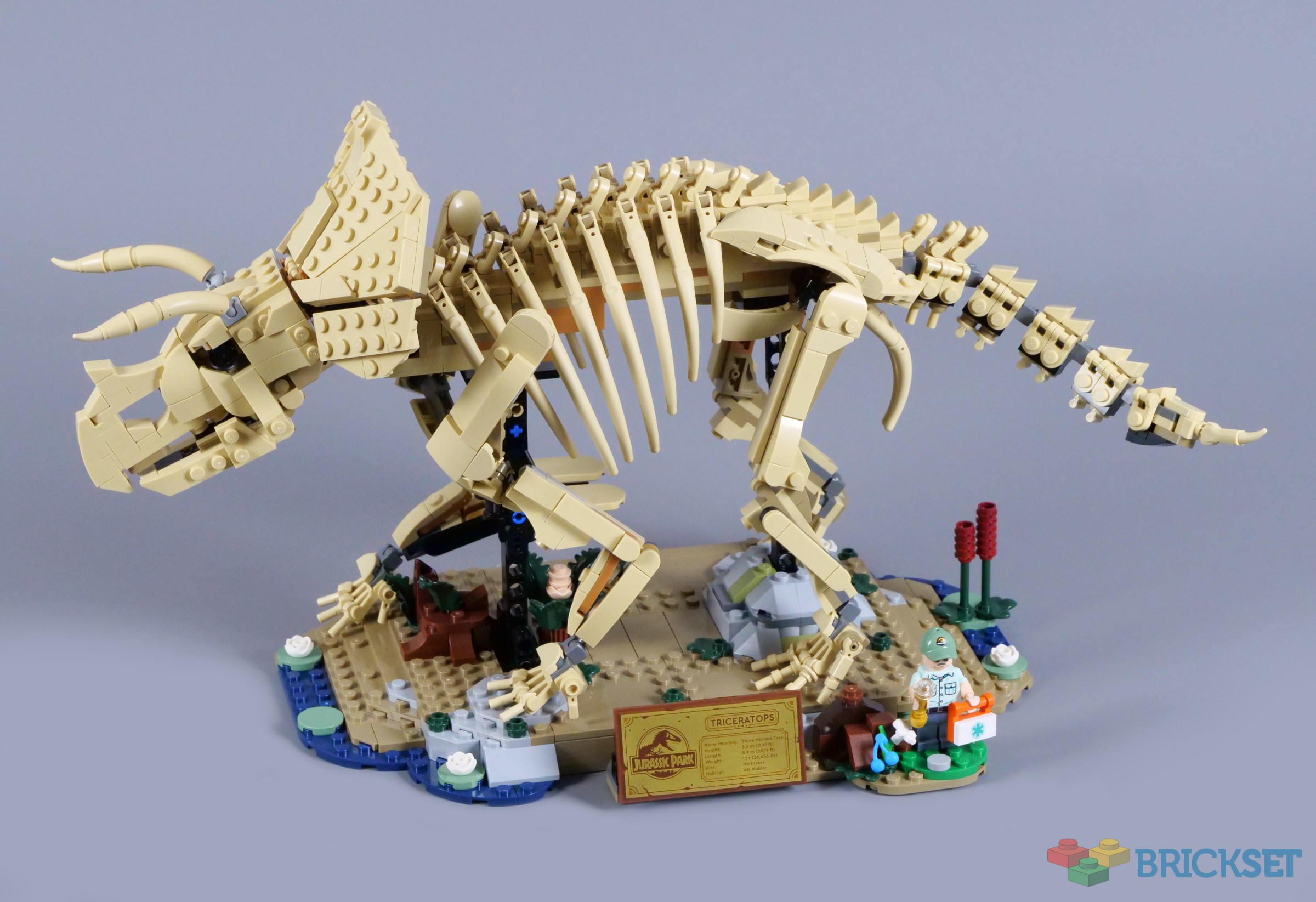
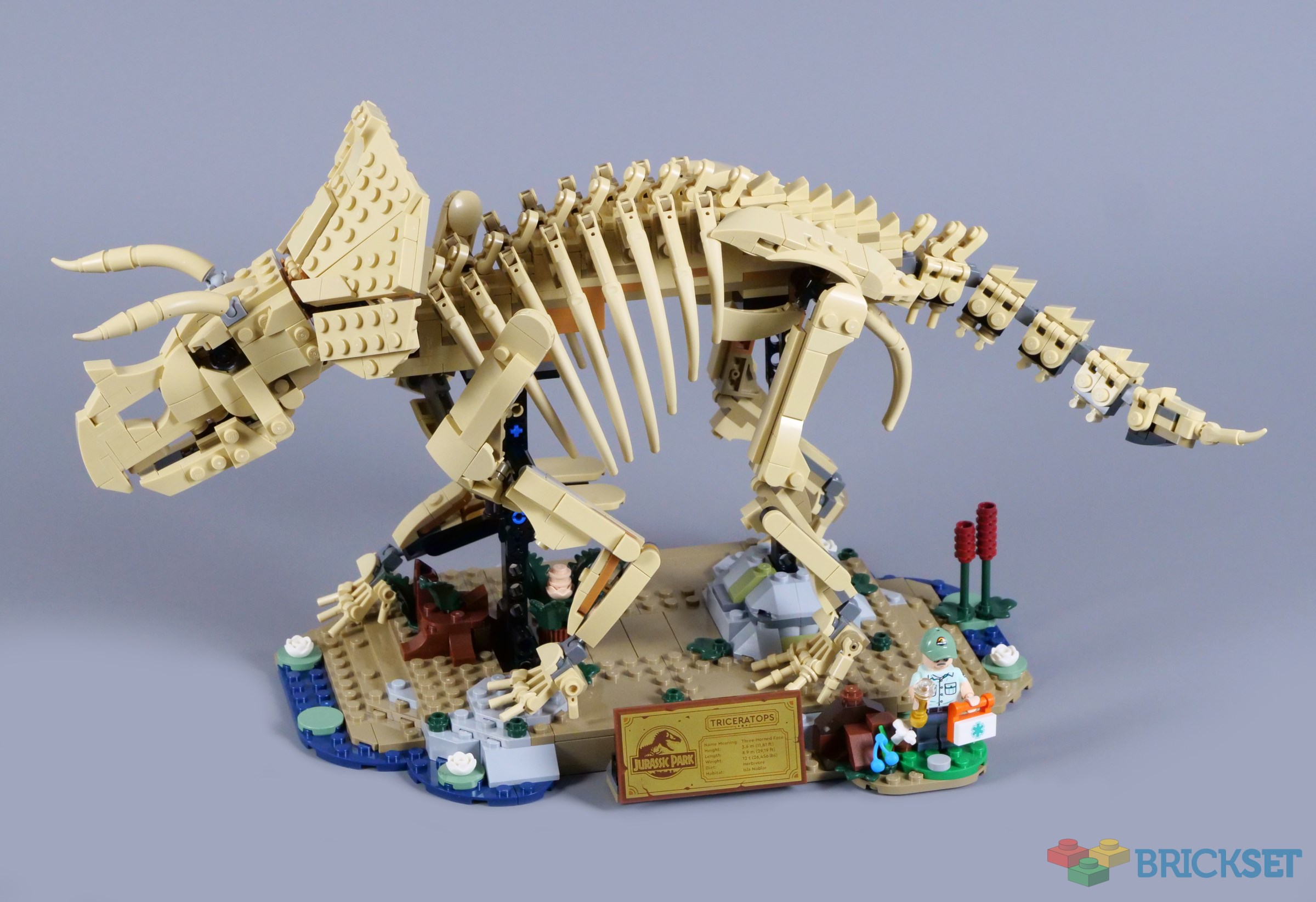
76968 Dinosaur Fossils: Tyrannosaurus rex was released to acclaim in 2025, thanks in part to its huge size. However, the smaller 77985 Dinosaur Fossils: Triceratops looks impressive too, as this model features incredibly authentic detail, even at its modest scale.
The designer has obviously paid close attention to real Triceratops fossils and the shape of individual bones and the model includes lots of articulated joints. However, I have encountered a substantial issue with one of those joints, which risks detracting from the entire set.
Summary
77985 Dinosaur Fossils: Triceratops, 1,154 pieces.
£89.99 / $109.99 / €99.99 | 7.8p, 9.5c, 8.7c per piece.
Buy at LEGO.com »
This rendition of the Triceratops looks fantastic, though the weak neck joint is annoying
- Exceptionally detailed and realistic skeleton
- Impressive articulation
- Appealing minifigure
- Manageable size for display
- Weak neck joint
The set was provided for review by LEGO. All opinions expressed are those of the author.
Minifigure
There have been quite a few Jurassic Park sets released in recent years, containing lots of the film's most prominent characters. The park's chief veterinarian, Dr. Gerry Harding, is relatively minor by comparison and only appears briefly in the classic film, looking after a sick Triceratops, which is doubtless why he was selected for inclusion here.

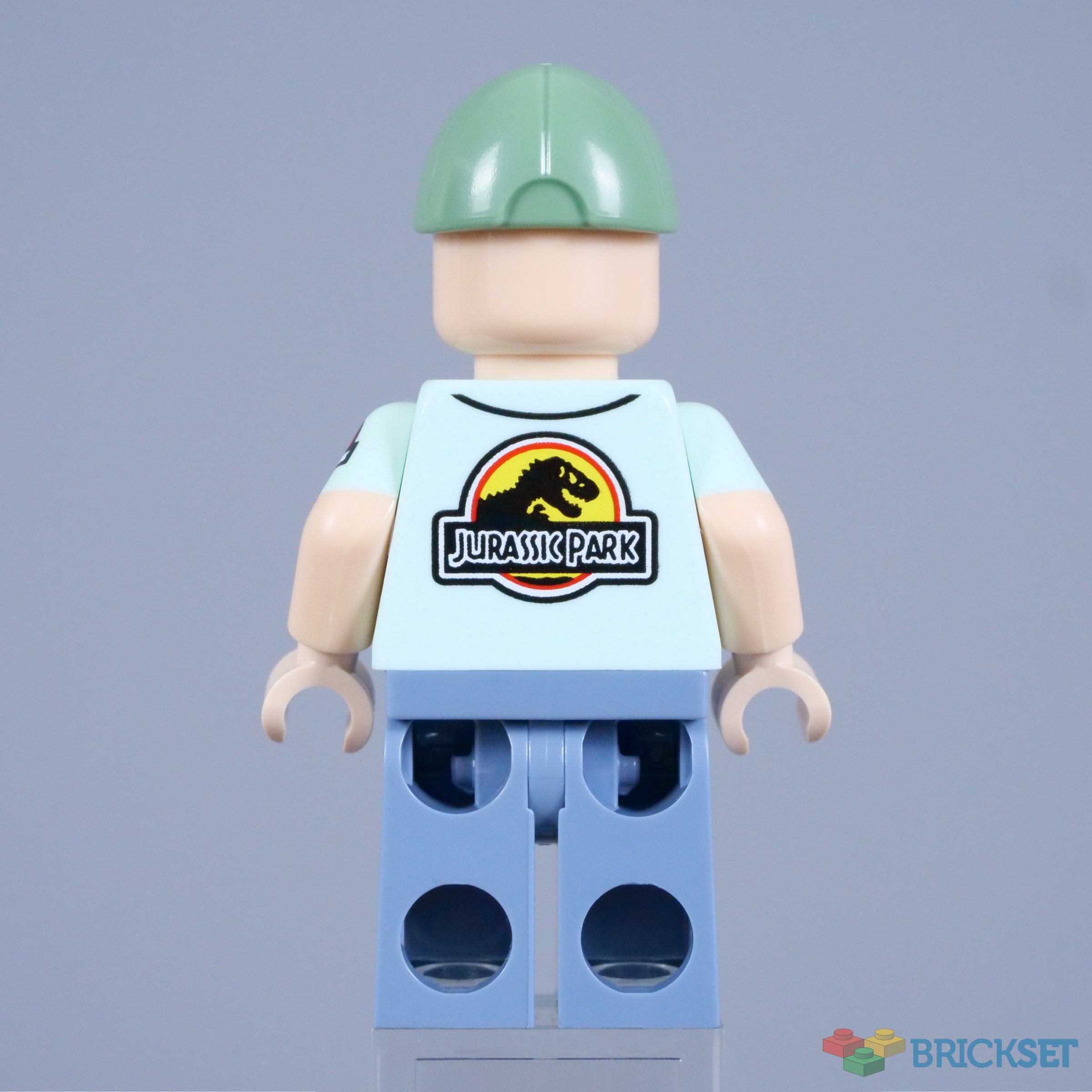
This minifigure looks superb, accurately dressed in a short-sleeved shirt and a sand green cap, displaying the Jurassic Park logo. The same logo is shown on the sleeve and back of the aqua shirt. Aqua is an interesting colour choice and I think there is a case to be made for tan or even dark tan instead, although this shade works.
Dr. Harding's head is excellent too, including his moustache and gold-rimmed sunglasses. The figure carries a printed medical case and a gold torch, or flashlight for American readers, which he hands to Dr. Sattler in the movie, so this is a nice detail.

The Completed Model
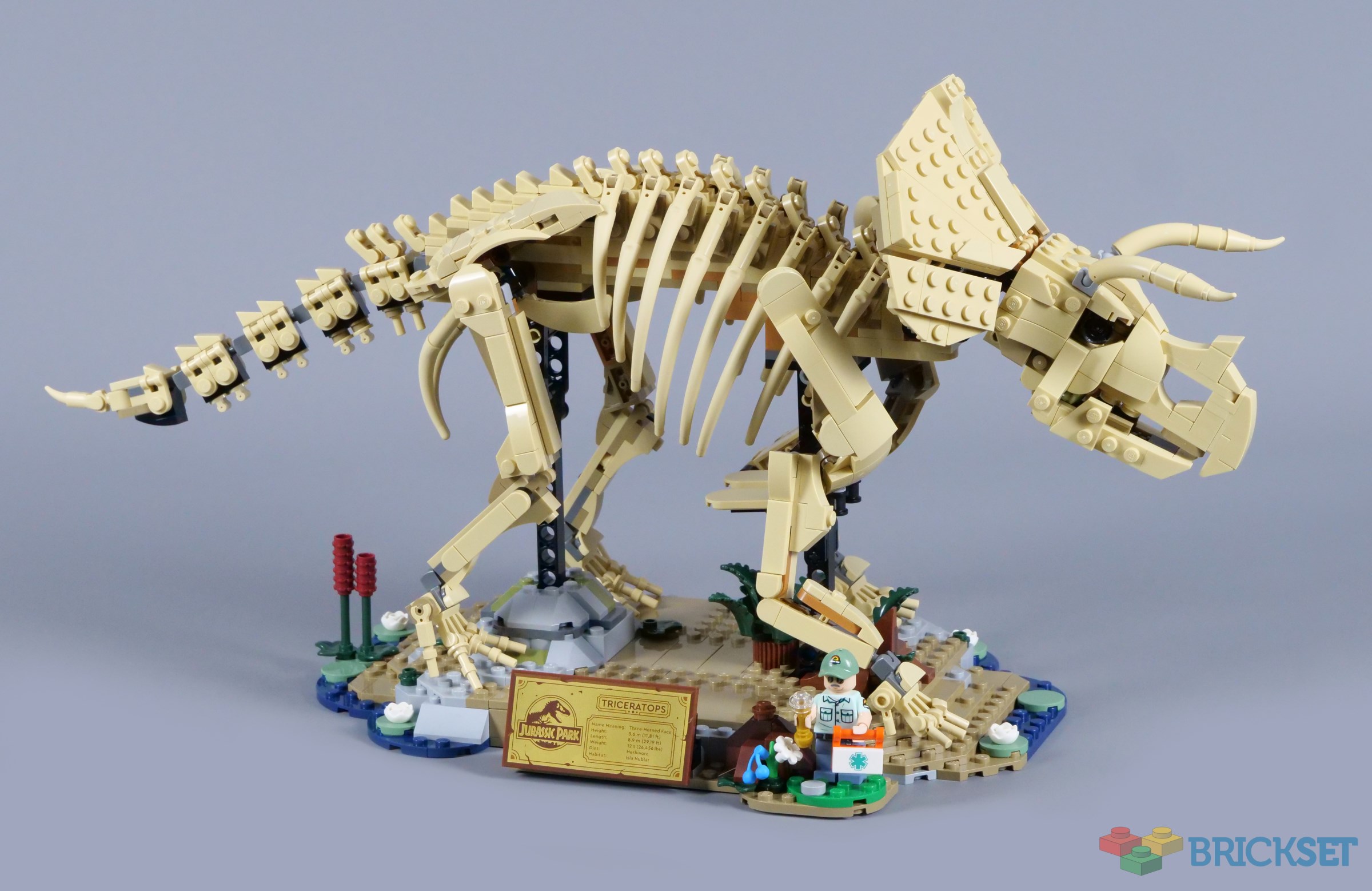
LEGO designers have seemingly settled on tan as the best colour for dinosaur skeletons and that certainly works for the Triceratops, which looks very realistic. I am pleased with its stance too, mounted on a Technic frame at exactly the right height, so the legs can be posed naturally underneath to create a sense of movement.
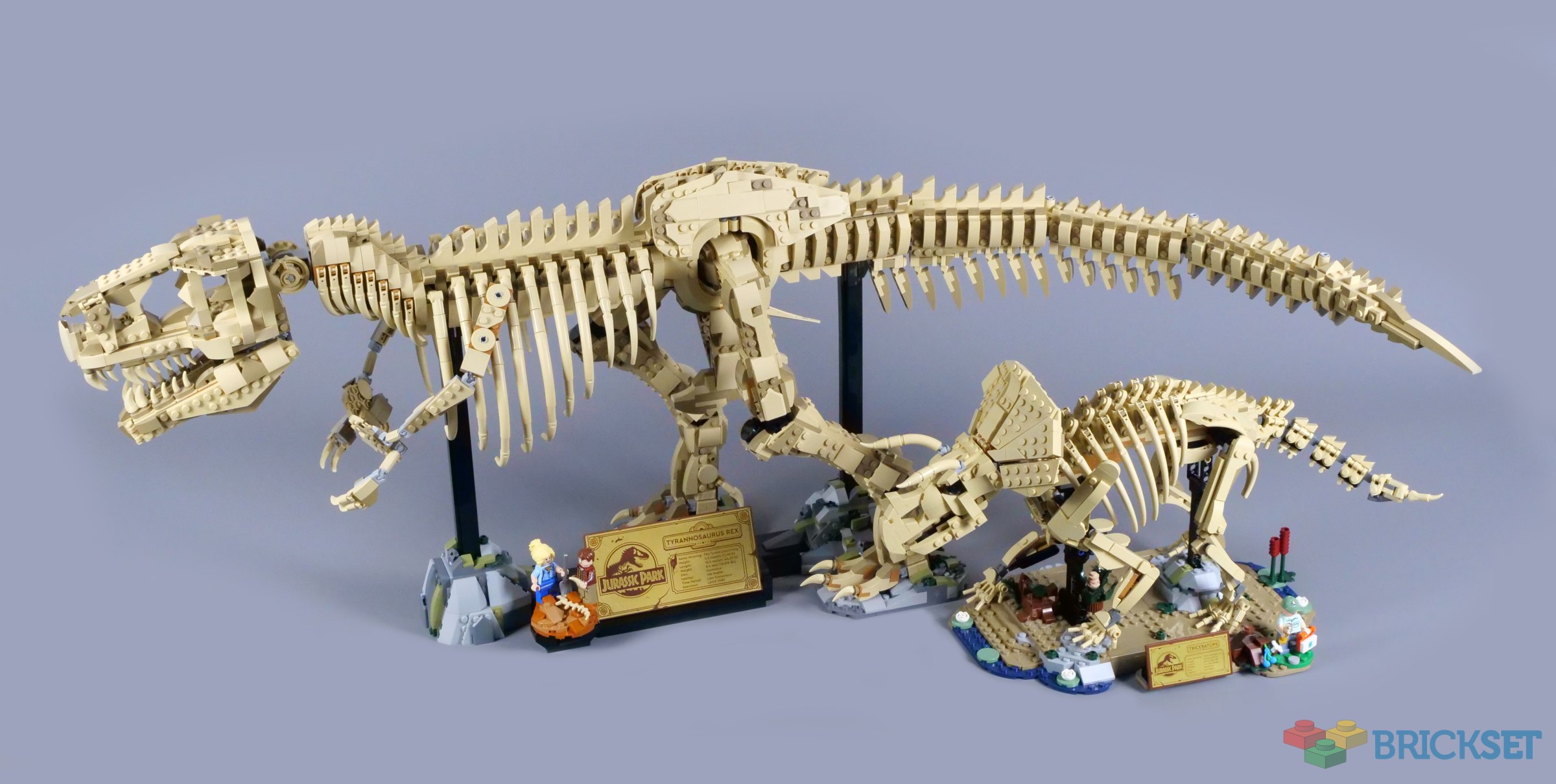
As you can see, the Triceratops is much smaller than 76968 Dinosaur Fossils: Tyrannosaurus rex. I was quite disappointed by their size difference when this model was unveiled, but I have changed my mind since. While the dinosaurs could have looked spectacular at the same scale, they would need a huge space for display and adhering to that scale would restrict options for future sets because only a few dinosaurs could justify such a large size and price.
Unlike the Tyrannosaurus rex fossil, which has its feet anchored to the base, the Triceratops is fully articulated. The model feels a little wobbly only attached to the Technic supports, although there is no risk of it actually collapsing and the articulation is effective. The legs in particular are extremely dynamic and interact well with the base, aided by the moveable toes.

A printed plaque is connected to the base, matching the style introduced with 76964 Dinosaur Fossils: T. rex Skull a couple of years ago. The metallic gold finish looks great, although I note that some data has been altered since 76969 Dinosaur Fossils: Triceratops Skull was released. Beside the plaque is space for Dr. Harding and the poisonous West Indian lilac, which caused the Triceratops' illness in the movie.
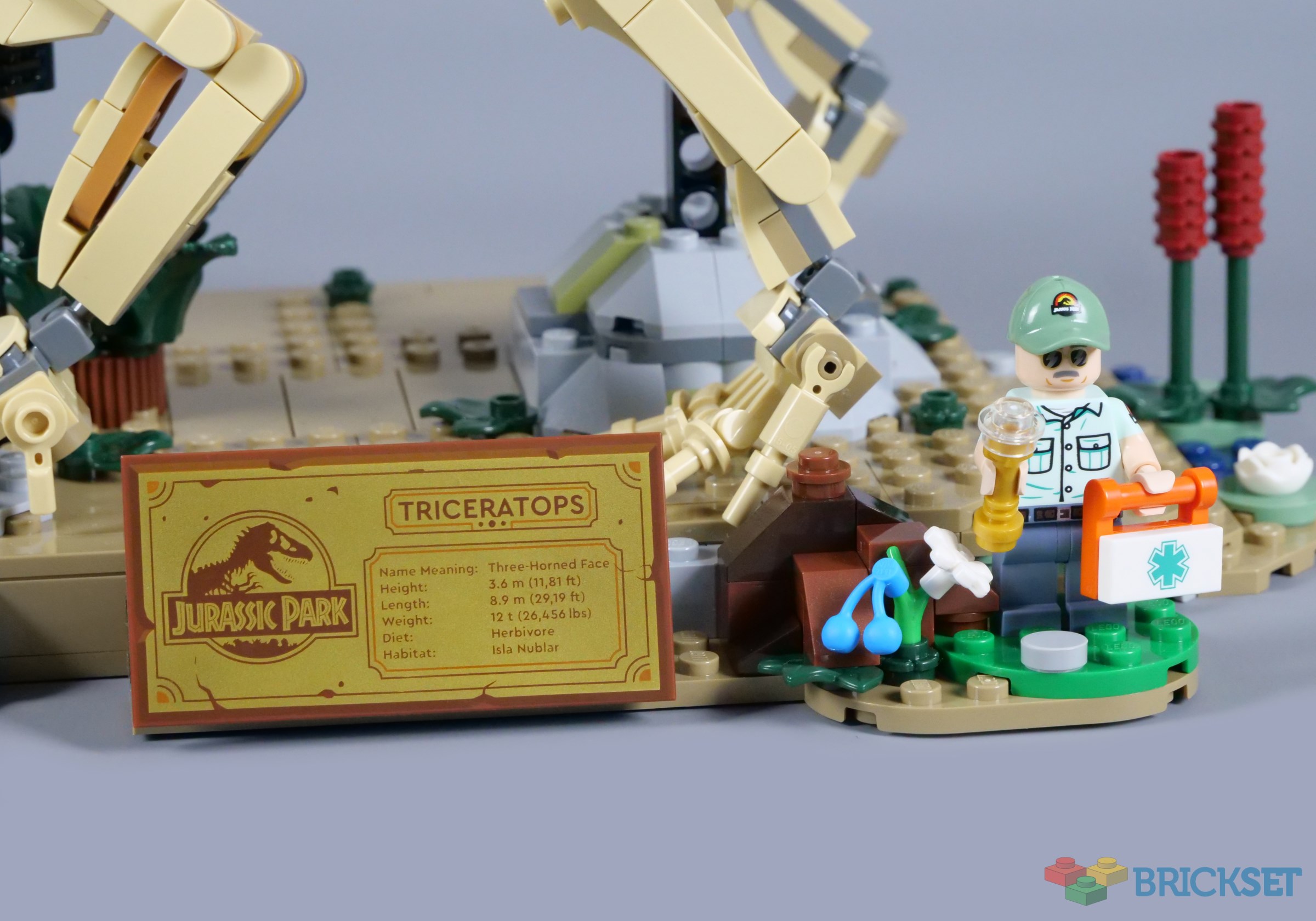
The plaque and minifigure stand are easily removable and can be attached on either side, only connected to the rest of the base via Technic axles. However, I think the base looks quite bland without the plaque and minifigure adding some colour, so I prefer to keep them together.

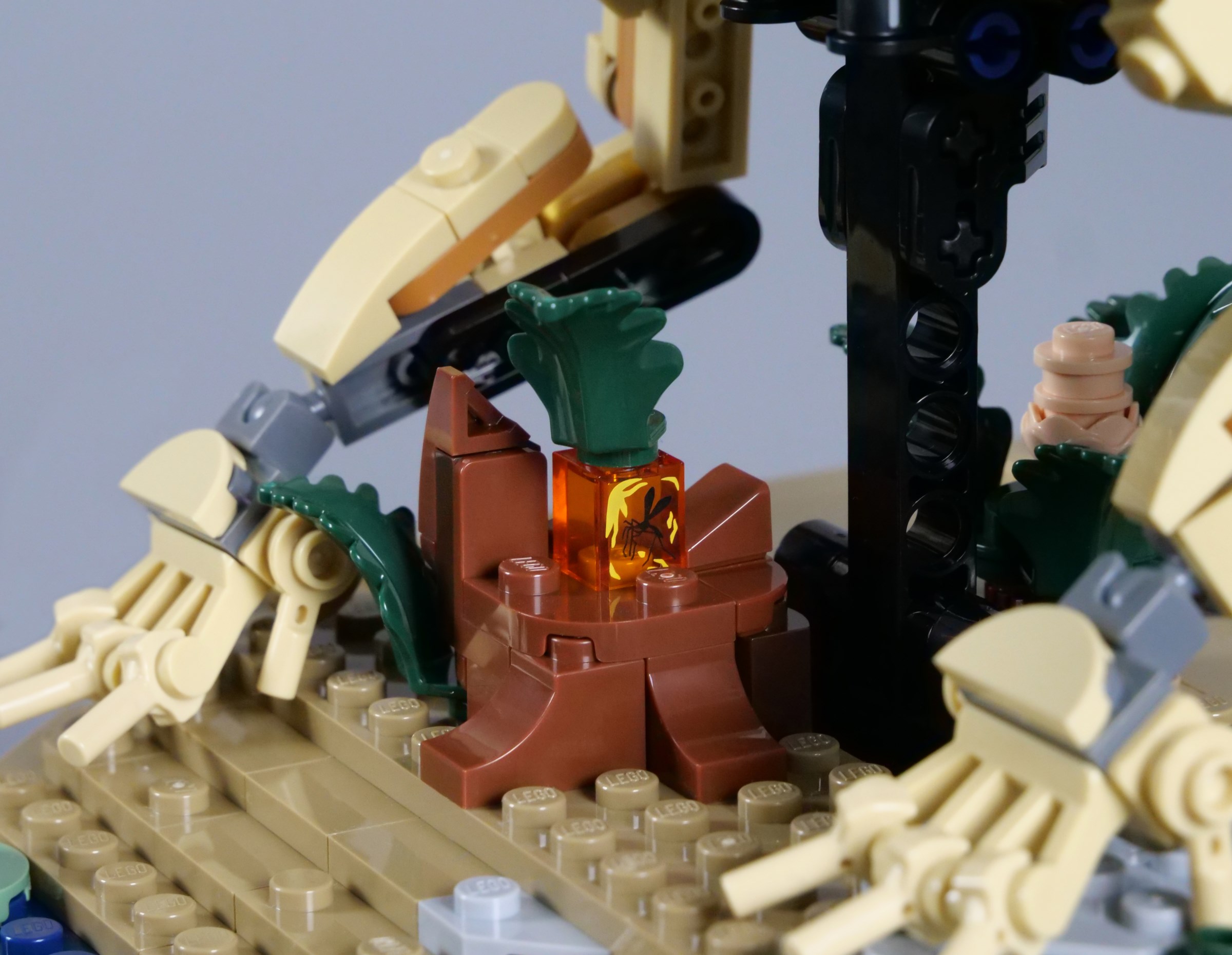
According to information in the building instructions, the base is supposed to imitate the North American wetlands where Triceratops lived. I wish there was a bit more texture on the surface, but there are still some details of note, including a printed mosquito in amber hidden inside the base of a tree, which you can lift with the leaf on top.
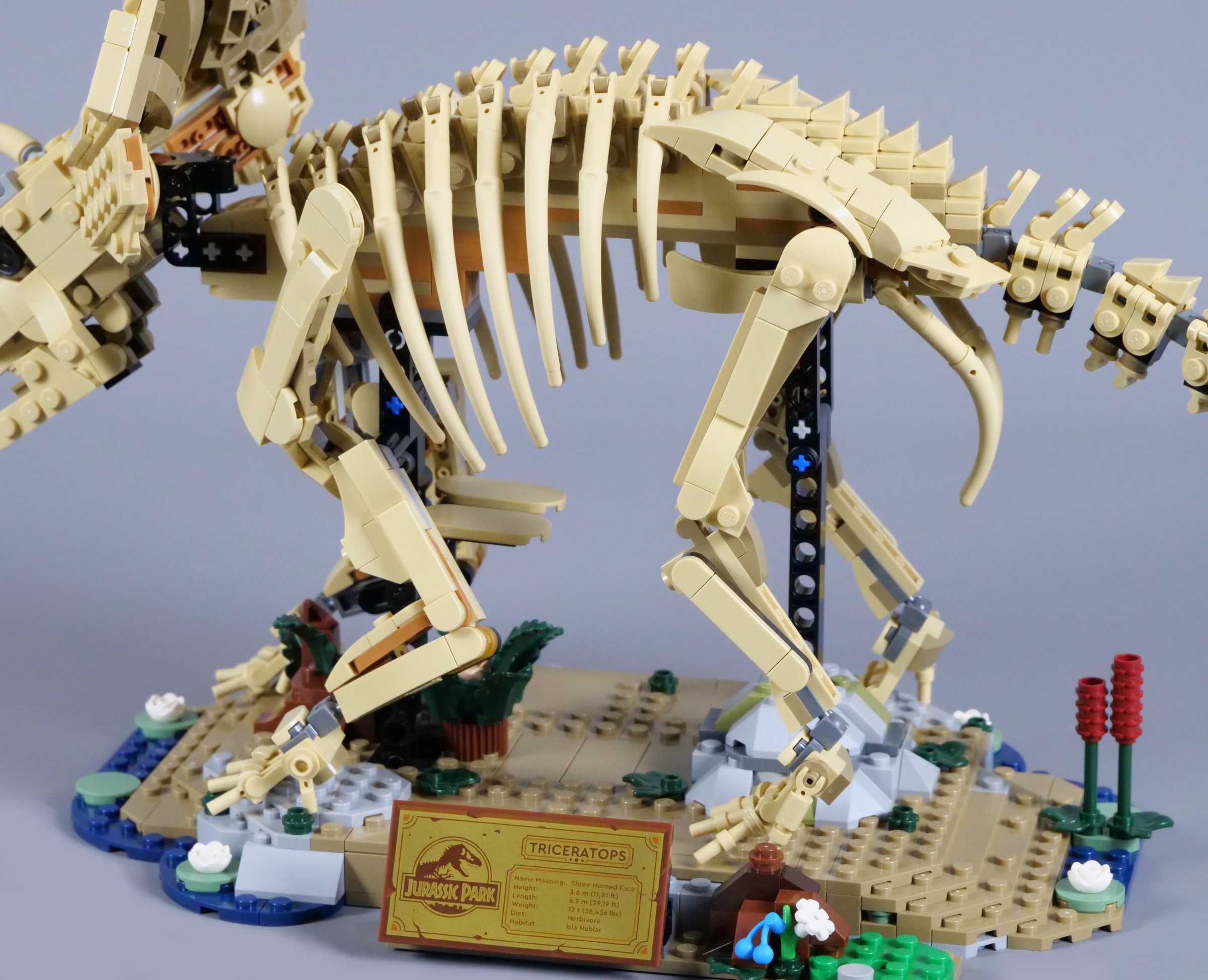
The legs do not support any weight, hence their intricate construction. The toes are perfect and even the separate ulna and radius are represented on the lower legs. Additionally, each bone is shaped accurately for its scale. The humerus is a good example, incorporating 1x3 inverted half arch bricks to recreate projections on the real bone.

I like the occasional use of dark tan and medium nougat parts to complement the tan elements, especially on the femurs, which might otherwise look quite bland. Also, the joints are integrated well and even the grey ball joints do not bother me, as they resemble the bolts typically used on skeletons displayed in museums.

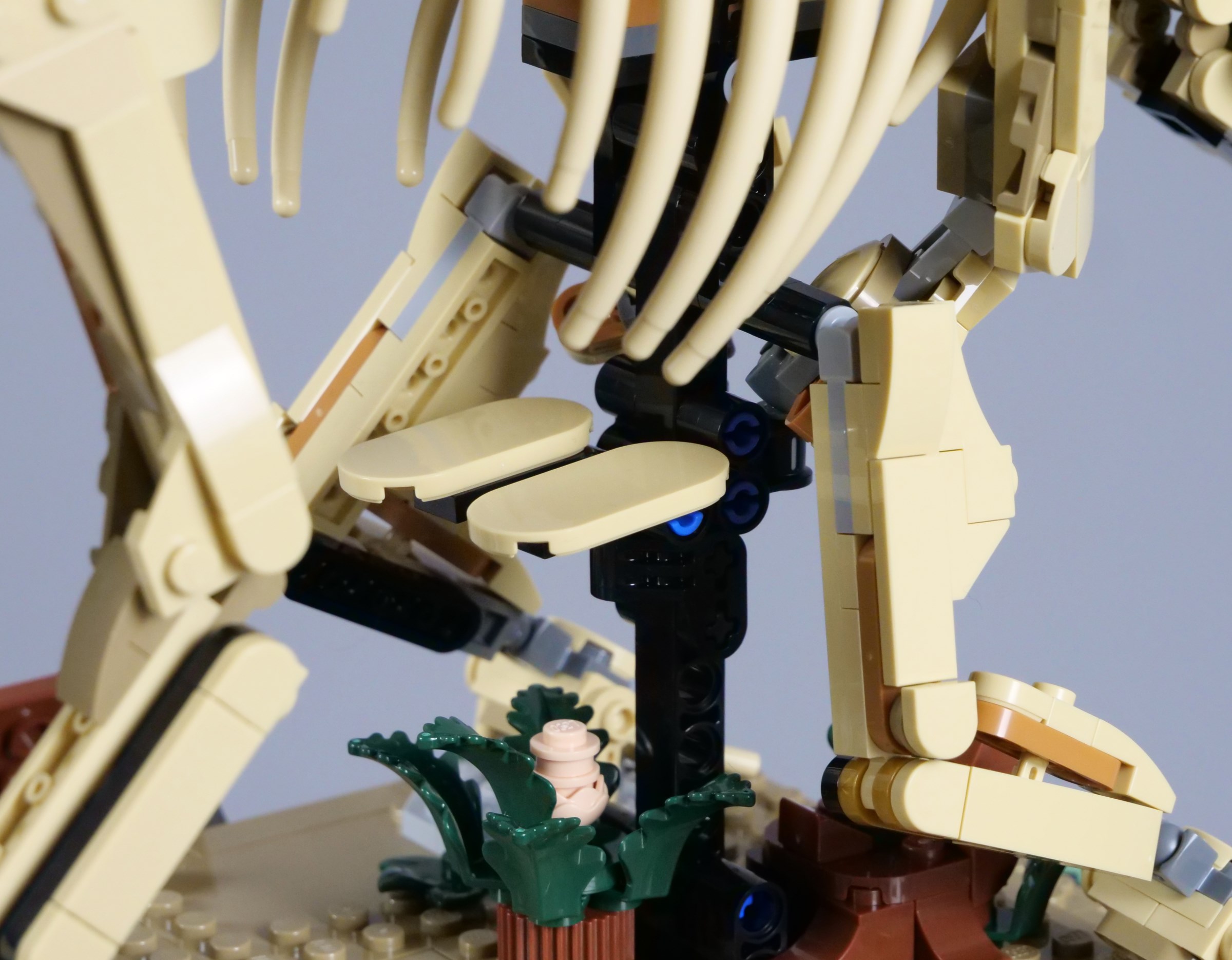
The only bones not actually connected to any others and instead mounted on the supports are part of the coracoid. Once again, their shape is quite realistic and I am impressed with how the designer has used the support structure to avoid the whole pectoral girdle becoming very bulky.

The scapulae are attached to ball joints, so you can alter their position as you wish against the ribcage. The ribcage itself is neatly designed, with each pair of ribs at a different angle, so they look completely natural. I worried that these would be easily knocked out of place, like in 76968 Dinosaur Fossils: Tyrannosaurus rex, but thankfully not because they are linked to bars on the spine, rather than studs.

In addition to the familiar horn or tail element used for a few ribs, plus the ischium beneath the Triceratops' tail, a longer piece has been produced for the bigger ribs. This has the potential to be very useful. The ilia, forming part of the dinosaur's hips, look superb as well, while the pubic bones make perfect use of the fin element introduced in 10366 Tropical Aquarium last year.
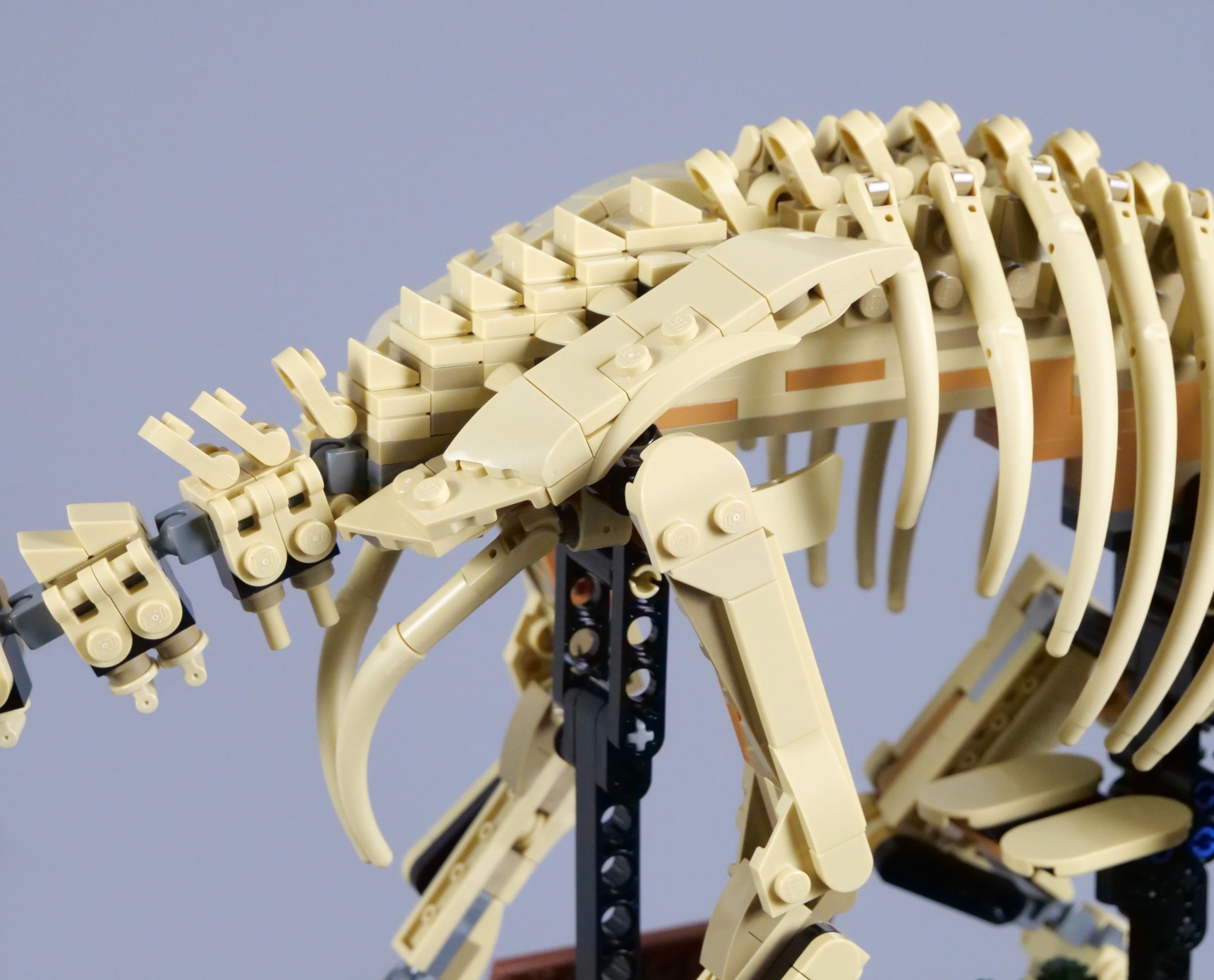

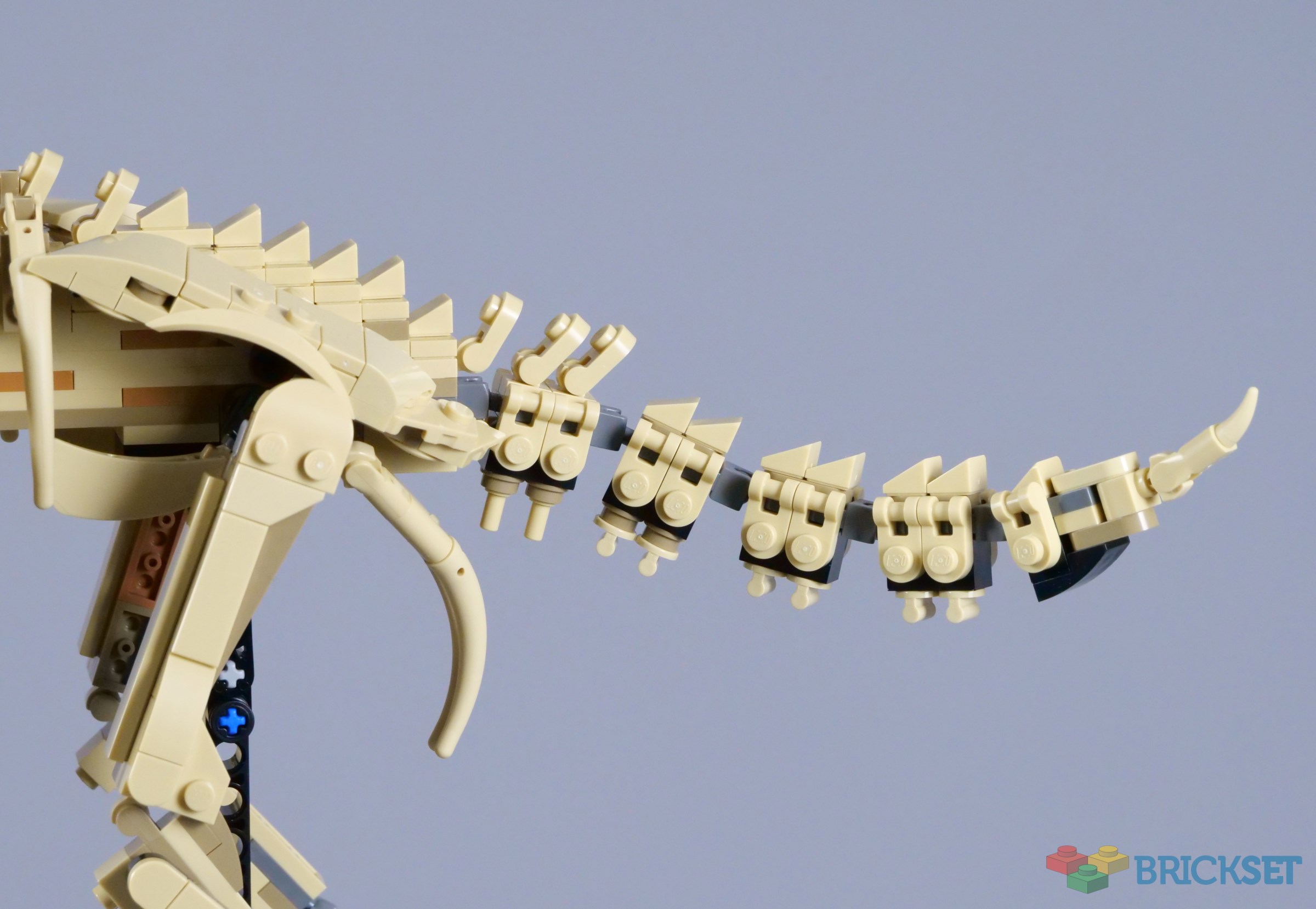
1x1 slopes and 1x1 rounded plates with bars form vertebrae down the length of the Triceratops' back and its tail. While the dinosaur should have many more vertebrae, I think this design looks reasonable for the scale and the texture along the sides and underside of the tail is effective.
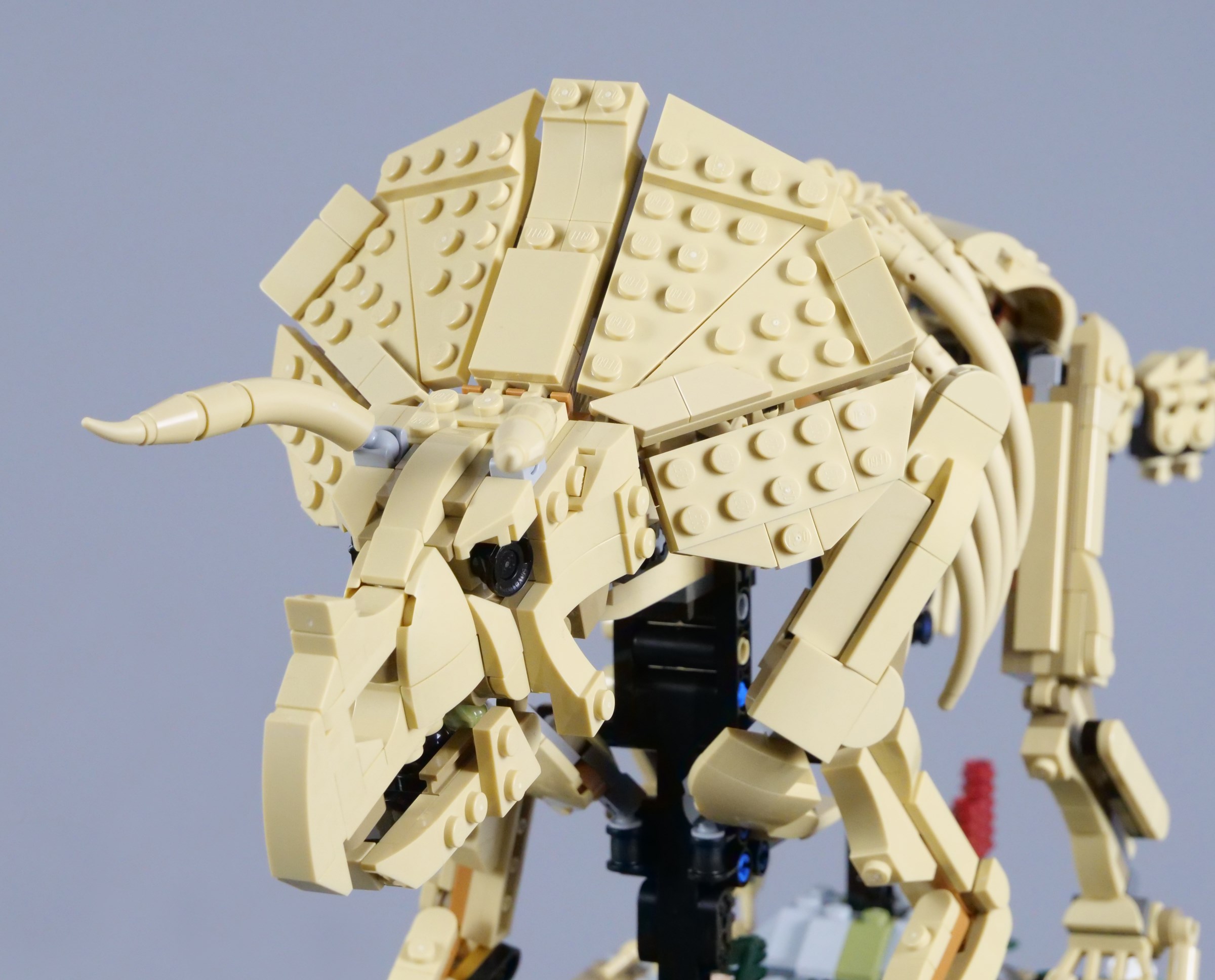
This version of the Triceratops' skull is much smaller than 76969 Dinosaur Fossils: Triceratops Skull, but still captures the overall shape well. The quadrate bones behind the jaw are perhaps more accurate here and the beak-like jaw looks excellent whether open or closed. Similarly, the all-important horns and frill are well proportioned, although the ball joints beneath the horns do look out of place.
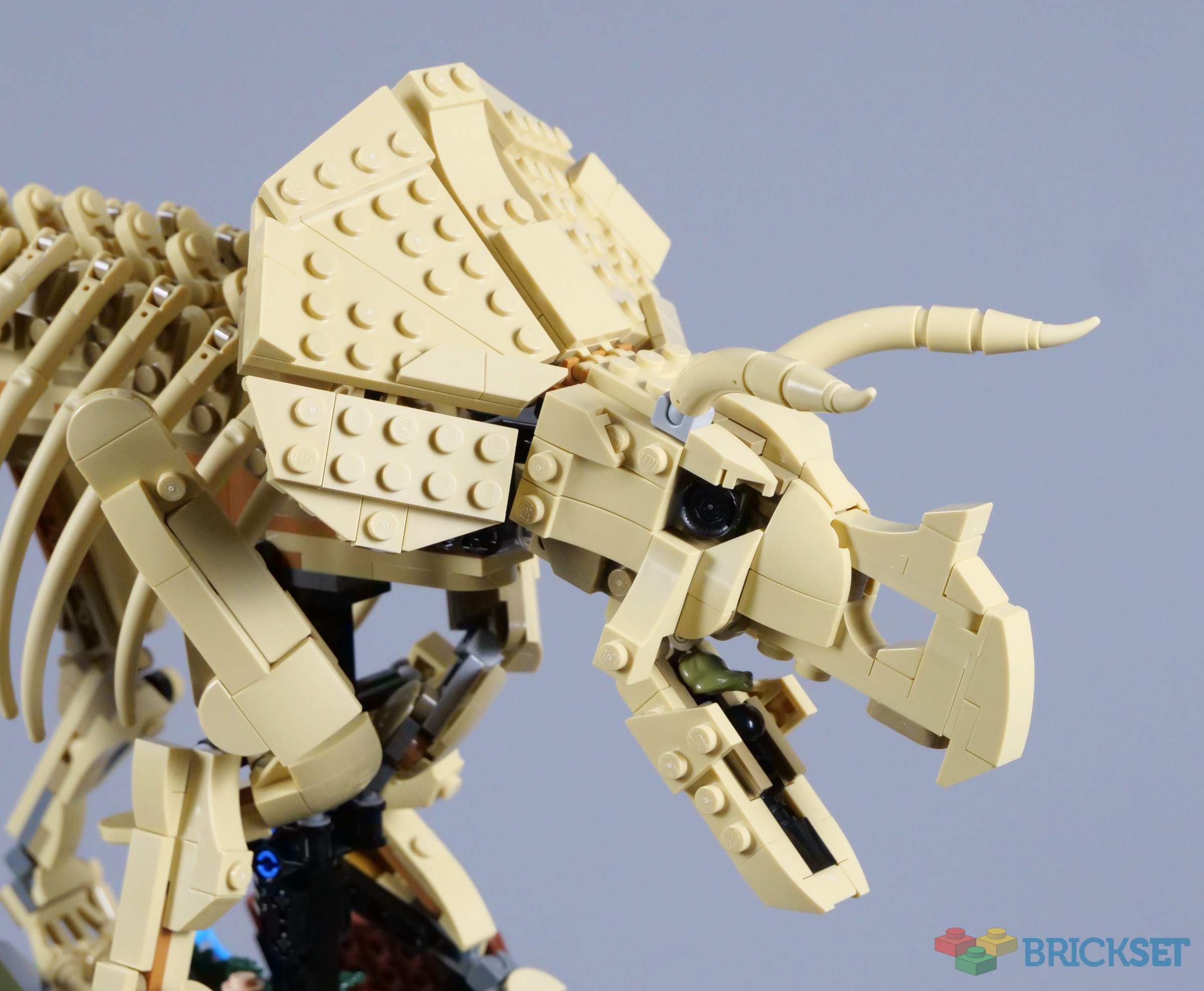
The skull is mounted on a large ball joint, which provides a good range of movement. However, while taking the photos for this review, the ball joint started to give way on my model, unable to support the full weight of the skull and gradually tilting down to the position below. This position looks alright, but it is still an annoying quality issue, especially since it happened so quickly.
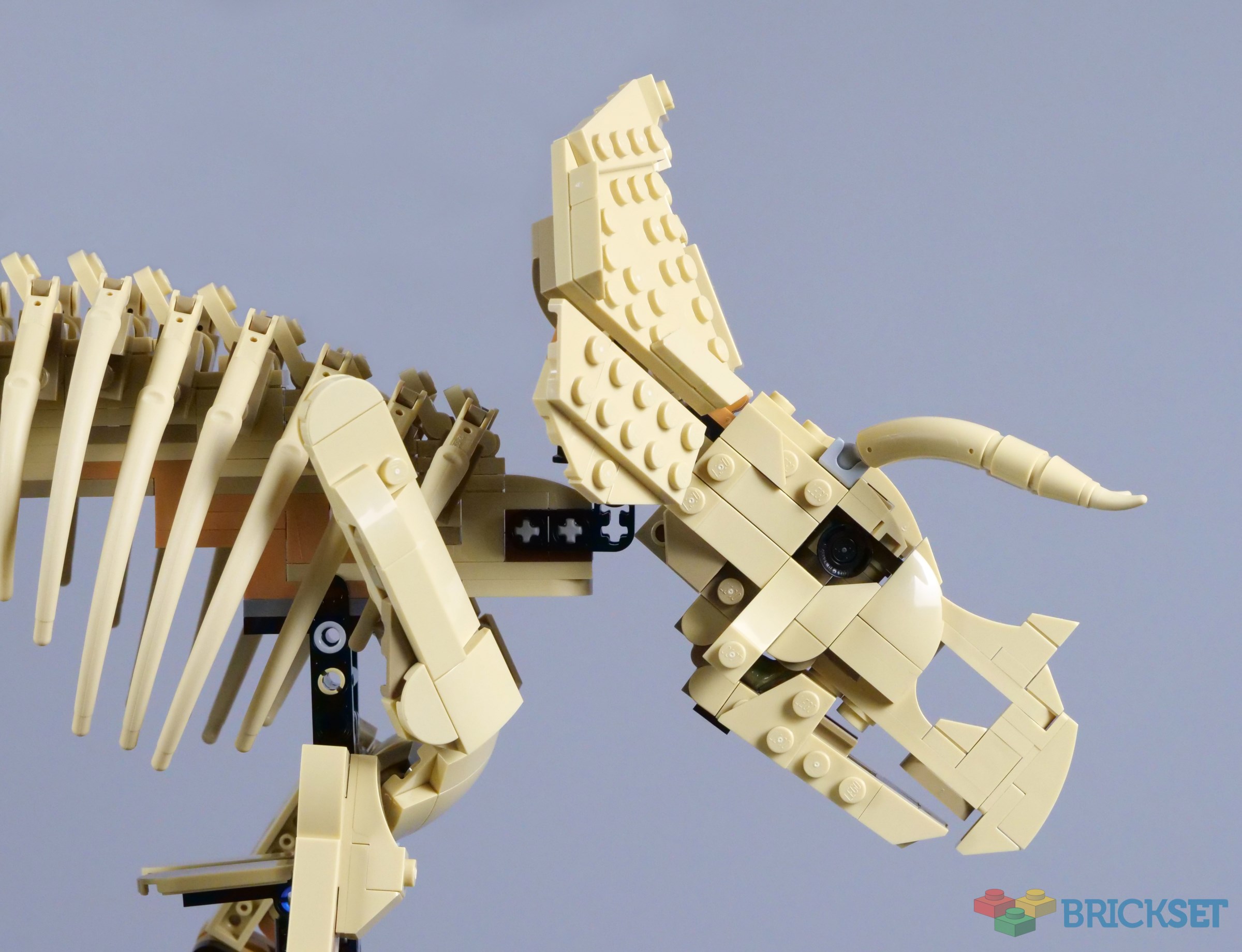
A frog is found in the Triceratops' mouth, in reference to the role of frog DNA in developing the dinosaurs for Jurassic Park. Frogs accordingly appear in many Jurassic World sets. Moreover, the eye sockets are cleverly designed with Black Panther ear elements inside. These replicate the sockets' round shape, while still giving the impression of depth, unlike the other Triceratops skull.
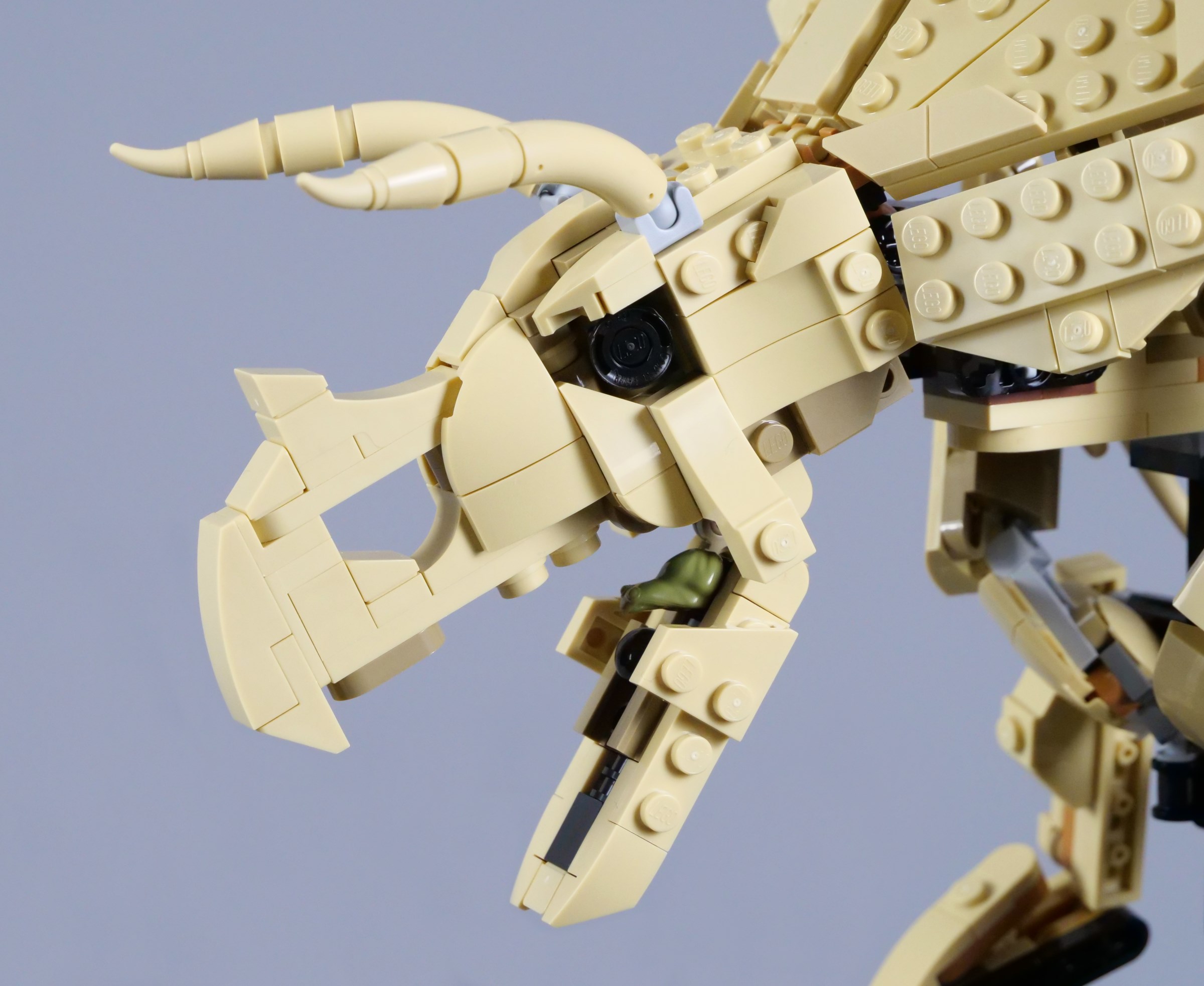
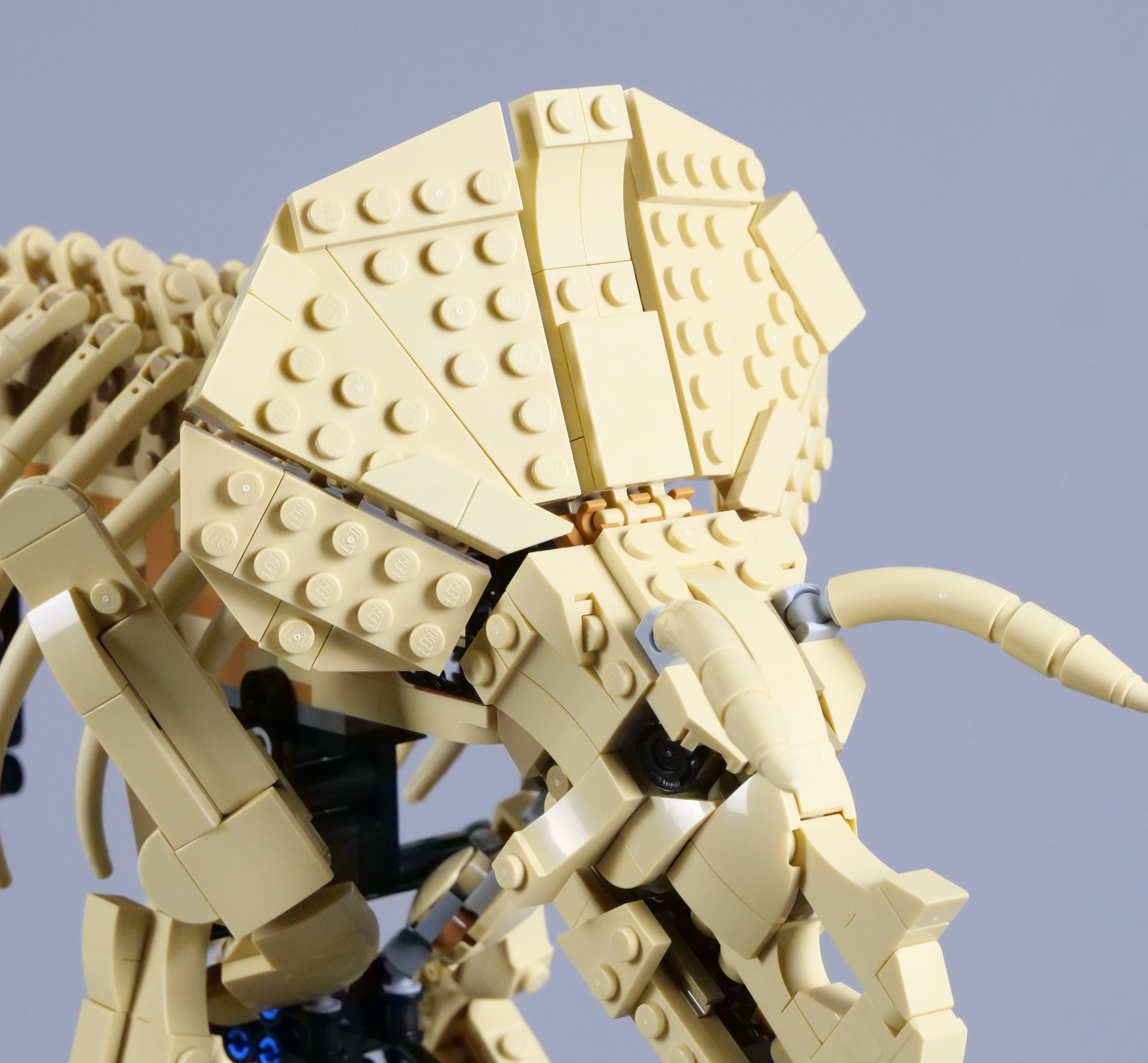
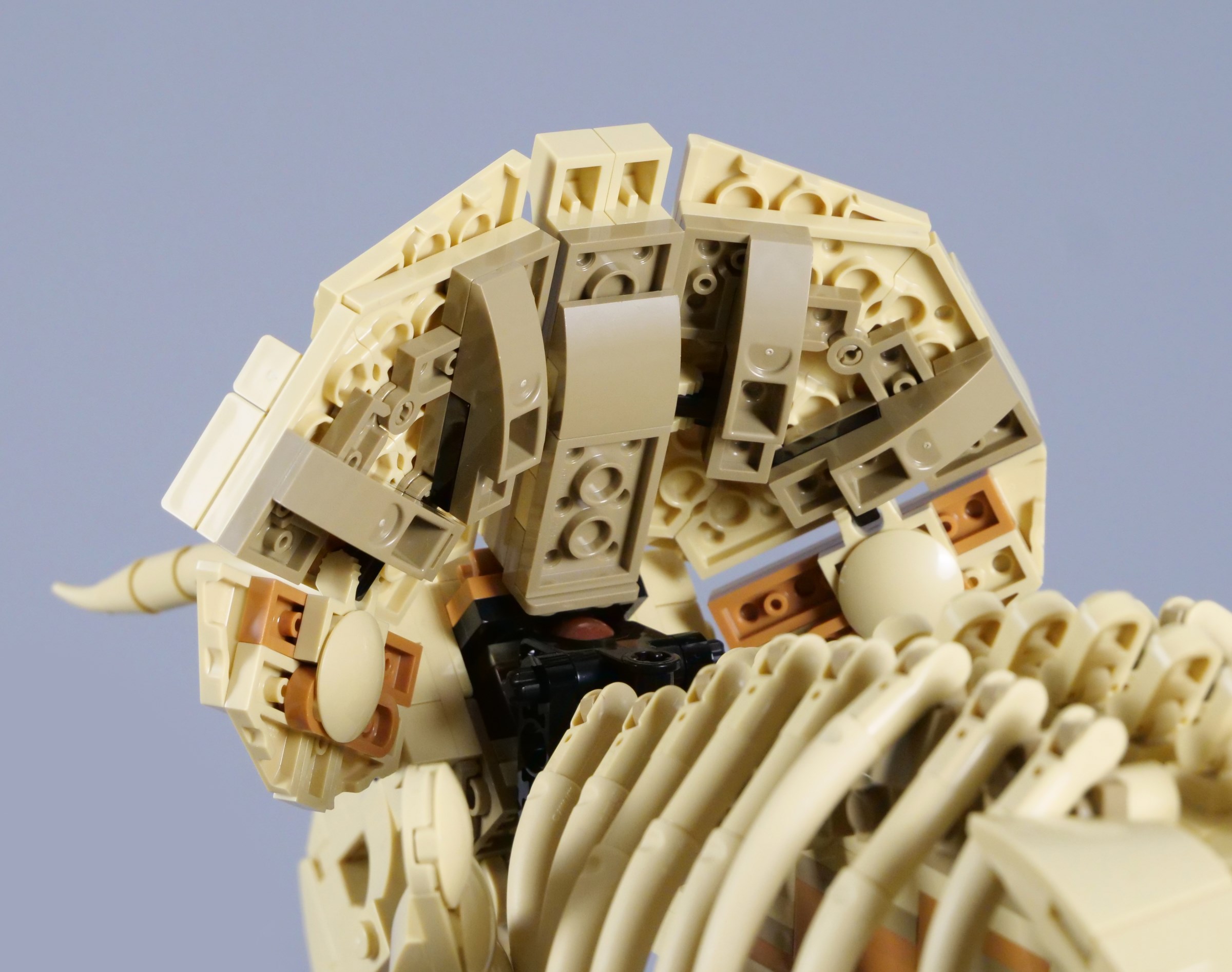
Even the frill has been improved to some degree, as it is now constructed in five segments, so the structure seems to curve in multiple directions. On the other hand, gaps between pieces of the frill are more obvious here and the points arranged around the edge, known as epoccipitals, are missing, but I think these are understandable compromises given the scale.
Overall
Scale is the defining feature of 77985 Dinosaur Fossils: Triceratops. While this model definitely lacks the exceptional presence and spectacle of 76968 Dinosaur Fossils: Tyrannosaurus rex, a smaller scale is perhaps more practical and this model is incredibly detailed for its size. The ribs and legs stand out in particular.
However, the weak neck joint is a remarkable issue, as this seems like a potential problem that should have been identified during development. Perhaps I have been unlucky with my specific model, but the skull feels like a significant weight for a single joint, so I think it should have been predictable. Otherwise, this is an outstanding model and £89.99, $109.99 or €99.99 feels like a fair price, though it would presumably be lower without the Jurassic World licence.
96 likes
30 comments on this article
Wouldn't be the first set to have a weak neck joint, Wall-E 21303 comes to mind...but at the least the plaque doesn't have any mistakes or typos on it.
Shame they are not better (as a dino kid this was obvious to me - although sizes are always debated by paleos) scaled to one another, unless thats a baby triceratops.
While I do appreciate LEGO making these fossil display sets outside of the playscale sub-theme, I do wonder if there is any plan at all behind them for a longer period than the typical 2-3 year lifespan. Because neither scale is consistent, nor is there any creativity in these considering that you can buy just the skulls from the same T-Rex and a larger sized Triceratops atow. Or do they really believe people just recognize a herbivore (Triceratops) and a carnivore (T-Rex)? Why not at least alternate between dino skulls and skeletons? Somehow all these "collections" end up being all over the place, even the fake flowers started to drift off in every directions and sizes.
It's really funny that Lego won't be able to print the plaque straight in 2026.
I am also wondering why the joints using the standard gray and therefore wrong color are not listed as negative.
@R0Sch said:
"While I do appreciate LEGO making these fossil display sets outside of the playscale sub-theme, I do wonder if there is any plan at all behind them for a longer period than the typical 2-3 year lifespan. Because neither scale is consistent, nor is there any creativity in these considering that you can buy just the skulls from the same T-Rex and a larger sized Triceratops atow. Or do they really believe people just recognize a herbivore (Triceratops) and a carnivore (T-Rex)? Why not at least alternate between dino skulls and skeletons? Somehow all these "collections" end up being all over the place, even the fake flowers started to drift off in every directions and sizes."
Lego just seems to shotgun ideas with very little consistency. Like the helmets/bust in Star Wars, like cmon pick a lane and stick to it for a while at least
I need this one. Triceratops is my favorite dinosaur.
I think it looks great and I prefer a smaller scale.
@johleth said:
"Wouldn't be the first set to have a weak neck joint, Wall-E 21303 comes to mind...but at the least the plaque doesn't have any mistakes or typos on it."
The dragon in my 21348 is constantly looking down, like he just told a joke and no one laughed. I keep meaning to replace some parts the strengthen it, but haven't gotten around to it yet.
So the data for the triceratops on this suggests a taller but less long creature than the skull. I'm not sure why that would have been changed, though I don't particularly follow palaeontology so maybe something was discovered recently.
This kit looks great, but owning both skulls I just can't really see how this is necessary for my collection. It's certainly better than the T-Rex (which I genuinely think looks terrible), but I'm not seeing anything that makes me go "yes, I need this!" above the skull or even Bandai's Plannosaurus kits.
My only complaint is the blue technic pins. In a set, so clearly intended for display, why do we keep having to suffer with the look being detracted from by these rogue dots of colour? I know its to supposedly to my building easier that we have the different coloured pins, but surely they could just use a scale element key on the instruction page like that do with technic axles etc?
@GrizBe said:
"I know its to supposedly to my building easier that we have the different coloured pins
"
Some pieces like ball joints are only made in one color for quality control purposes, as they would have to test the properties extensively for every new color. (Remember when brown and dark red bricks were weaker?) I assume Technic pins are the same.
This Triceratops is pretty close to minifig scale, whereas the Tyrannosaurus was too large. I skipped the rex, but I will definitely buy this one.
Remember when the ideas dinosaur fossils was three models for $60?
It's a nice set, but I really preferred the larger scale. This model is detailed but nowhere near as detailed as the large T. rex. I particularly dislike the weak-looking legs and the shrunken down skull, although I do appreciate that this frill has a bit more shape to it.
The T. rex is one of the most impressive LEGO sets ever to a dinosaur lover like me and this is a disappointing step backwards. I do think it's nice to offer a lower-priced skeleton so it's more accessible to people who don't want to drop $250 on a LEGO set, but in my opinion that's what the $40 skulls were for. I was really looking forward to a Triceratops at the same scale as the T. rex and I hope we see more dinosaurs at that larger size in the future.
@KingShark9500 said:
" @GrizBe said:
"I know its to supposedly to my building easier that we have the different coloured pins
"
Some pieces like ball joints are only made in one color for quality control purposes, as they would have to test the properties extensively for every new color. (Remember when brown and dark red bricks were weaker?) I assume Technic pins are the same.
"
I can assure you that it's not the reason they keep the pins and axles in rainbow colors. They even changed the plastic material of pins to make them softer a while back. And brittle brown and dark red was a quality mixture defect, they make other ball joint pieces in different colors all the time just not the Mixel ball joints for some reason. It's dumb, since here they would not bear any significant load and just look so much better in tan.
Having built the T. Rex it is massive and so impressive on display. I see no need to now get this far inferior set.
I just want Dr. Gerry Harding. Hopefully he isn't very expensive.
I want a dimetrodon.
Definitely wasn’t as fun building this compared to the T-Rex. Attaching and aligning the rib bones were a pain.
@KyloBen1012 said:
"
Lego just seems to shotgun ideas with very little consistency. Like the helmets/bust in Star Wars, like cmon pick a lane and stick to it for a while at least"
I've been very impressed that the Lunar New Year animals have been consistant for 11 years now. The Sheep from 2015 is not quite the same style, but 2016-2026 all look fantastic on a display shelf, and I'm reasonably hopeful they'll re-do the Sheep and finish up the set proper for 2027. So we know they -can- stick with something, but it does seem they have a hard time sometimes.
To be fair, the Star Wars Helmet Collection started in 2020. Six years (and counting) feels solidly into a while to me.
@Hiratha said:
"To be fair, the Star Wars Helmet Collection started in 2020. Six years (and counting) feels solidly into a while to me."
The recent Yoda helmet, though, is way out of scale.
@IgelCampus said:
"It's really funny that Lego won't be able to print the plaque straight in 2026.
I am also wondering why the joints using the standard gray and therefore wrong color are not listed as negative."
If you read the review, it says they look like the bolts holding skeletons together in museums
I am glad seeing minor caracters in sets, who would otherwise not represented in a minifig form. Compared to a manyth representation of a more major caracter.
@KyloBen1012 said:
"Shame they are not better (as a dino kid this was obvious to me - although sizes are always debated by paleos) scaled to one another, unless thats a baby triceratops. "
Tricops veal... yummy!
@gsmayes said:
"Remember when the ideas dinosaur fossils was three models for $60?"
21320 was cheaper, ttrue, but it also didn't introduce any new pieces or new molds.
why is it so small tho?
@Kripps said:
"Definitely wasn’t as fun building this compared to the T-Rex. Attaching and aligning the rib bones were a pain."
True, but once the ribs are attached and lined up, I think they are less susceptible to being knocked out of alignment than the ribs on the T. rex.
@Albus said:
" @IgelCampus said:
"It's really funny that Lego won't be able to print the plaque straight in 2026.
I am also wondering why the joints using the standard gray and therefore wrong color are not listed as negative."
If you read the review, it says they look like the bolts holding skeletons together in museums"
I have been countless times especially in the Naturkundemuseum with some of the most famous skeletons. None of them have such joints because usually they are connected with a thin wire construction around the bones.
The argument sounds reasonable but it isn't.
This is very low on my priority list. I kind of like it, but not enough to actually buy it, I think.
I prefer this scale to the T-Rex, though. That one doesn't interest me at all being so unnecessarily huge without actually looking that good, which is really obvious to my eyes in the comparison pic shown here. I especially dislike how stiff, straight, and boxy that looks. The transitions along the spine are terrible. And to me it looks somewhat unbalanced, like it's about to fall forward onto its face. This Triceratops on the other hand actually looks organic, balanced, and well-proportioned. Much better, despite a more manageable and affordable scale. Being more pose-able is also a big plus.
The weak neck ball-joint is disappointing. I wonder if they could have incorporated a spring or a rubber band hidden in there to partially support the weight so the ball-joint didn't have to do all the heavy lifting. There are easy ways to add friction to those joints, but customers should never have to do that for official designs to work properly.
These 4x2 rounded tiles are sternal plates, not coracoids, which are articulated with scapulae by ball joints.