LEGO Fails: Znap
Posted by SprinkleOtter,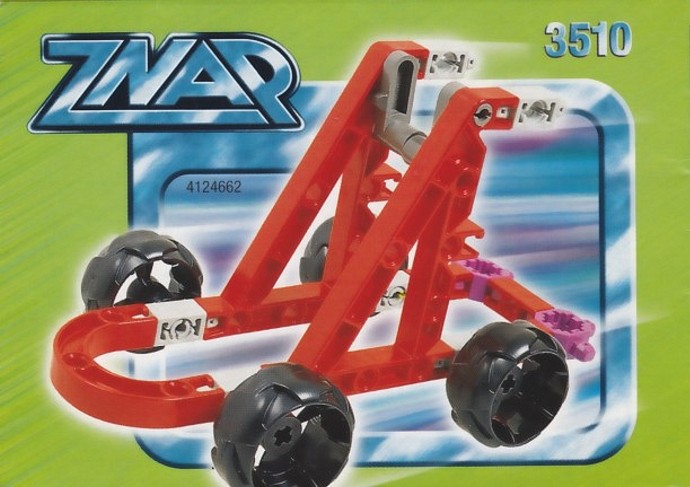
In its path to being the largest toy company in the world, LEGO has had its fair share of mishaps. In this series of articles, I will be taking a look into the themes that did not perform well, and see if they have any merits to them.
Today I be reviewing Znap, which yielded 19 sets in 1998 and 1999, and breaking down just what went wrong...
What happens when you knock off the competition? Znaps, that's what. Based on K'Nex with hollow parts to build large models quickly, Znap tried to combine Technic with K'Nex, and frankly got the worst of each. While K'Nex tried to create things that were difficult or impossible to create with LEGO parts, Znap just tried to create things that could be better created with either regular LEGO bricks or Technic parts.
Parts
 Znap had a decent variety of parts, from long beams to angled beams, tiny connectors to a motley of giant wheels. However what the pieces lacked was versatility; some of the largest beams only had six “Znap” connection points (though several more Technic connections were available, they were almost never used in the official sets).
Another problem with Znap was that the small connector pieces were color-coded like Technic pins and axles. Unlike Technic pins though, Znap connectors were readily visible in the finished model, meaning that red and black race cars had splotches of purple and grey. To top this all off, Znap parts were almost impossible to incorporate into regular builds, as most parts had only a few Technic connection points, and not at regular intervals.
There's a catalogue of Znap parts at BrickLink.
Sets
I have mixed feelings about these sets. On one hand, well… most of them look terrible. However given what the designers had to work with, I am impressed that a few of them are decent. Some of the large sets, like Super Constructor Set (also known as Ant) and Jeep do pique my interest.
Ant
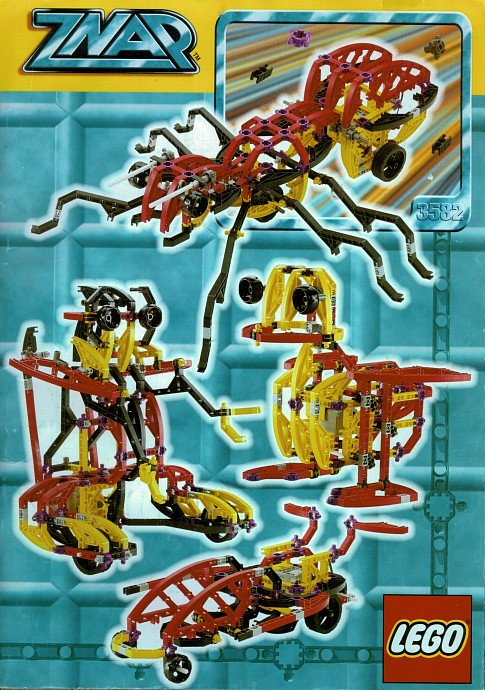 Ant fairly faithfully captures the shape of an ant, its legs appear to move when the wheels roll. The color scheme on Ant is also about as coordinated as could be done with Znap parts, consisting mainly of red, with a yellow underbelly and black legs (unfortunately, with spots of purple and light grey in between). Ant could be rebuilt into a bird, robot, or an attempt at a car.
Jeep
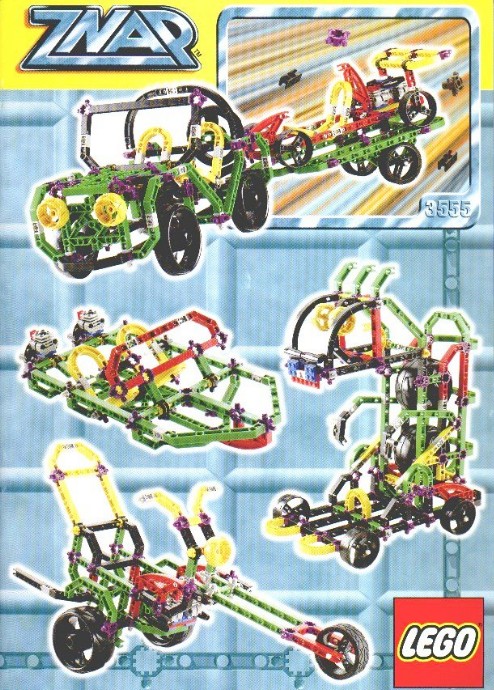 Jeep, though a multicolored mess, would actually look quite nice with proper colors; almost on par with Technic sets of the time. When it could though, Jeep tried to use different colored parts to its advantage, with yellow wheels for headlights, or yellow seats. Jeep had a matching green trailer, with what looks like a race car or buggy on it, complete with a two cylinder engine. Jeep could be rebuilt into a boat, motorcycle, or… umm… I give up. Whatever that model is.
Jet-Car
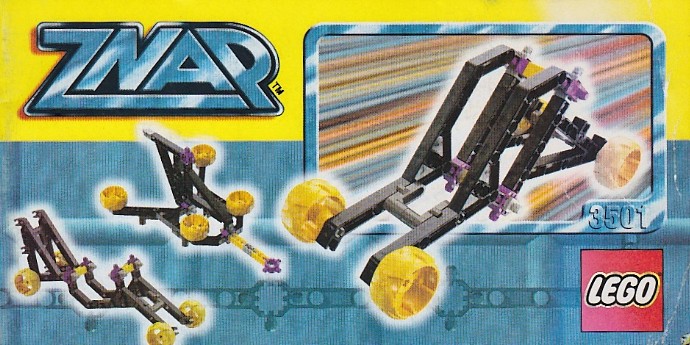 However, there were also sets like Jet-Car and Bi-Wing, that are uninspired. I understand that these sets were made with minimal pieces to be in a low price range, but the only resemblance Jet-Car has to a car is four wheels. The alternate models of this set only get worse, resembling no real or fantasy vehicles.
Bi-Wing
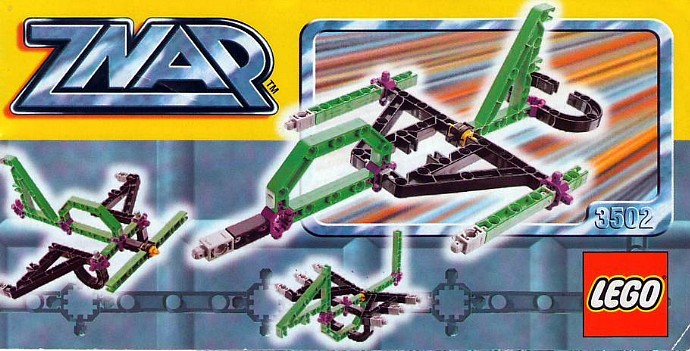 Bi-Wing appears to be a Sci-Fi fighter jet and is a fairly decent set. However I feel that the secondary model of this set, the propeller plane, is by far the stronger model. The third alternate model though, is again a toss up.
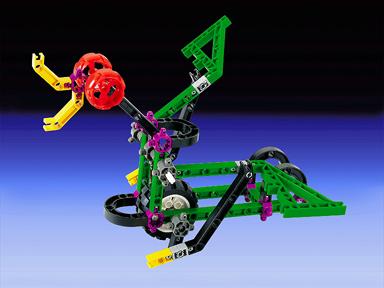 At the bottom of the barrel, there was one set that was too strange to be released, even for Znap: 3533 {unknown}. I think this set may have been an attempt at a tribute to the Classic LEGO Duck. However, I will let readers decide their own opinion of this set.
What went wrong
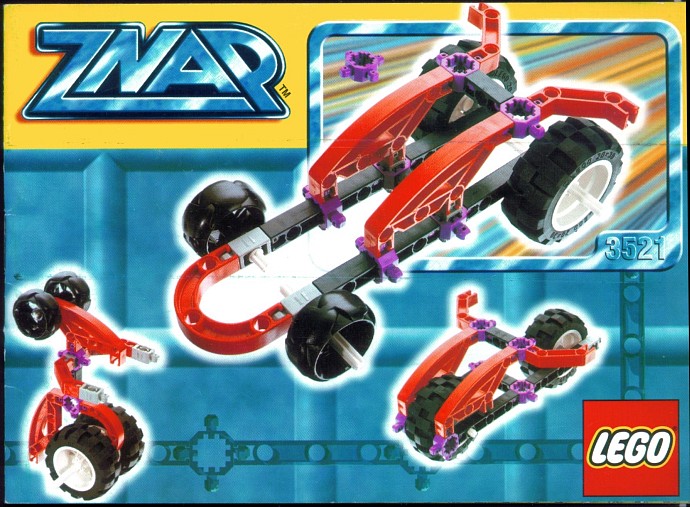 I feel that Znap focused too much on small sets with weak models, and did not give enough effort to large models, which is what the Znap system was designed for. Twelve out of twenty Znap sets contained less than forty parts. Larger sets could easily be motorized for large driving cars, but rarely were.
Models could even have been made larger than the sets released. Several promotional images show models several feet in height. However it would be difficult to acquire enough parts for models of this size, as even the largest Znap sets contain less than 300 parts each.
How it could have been better
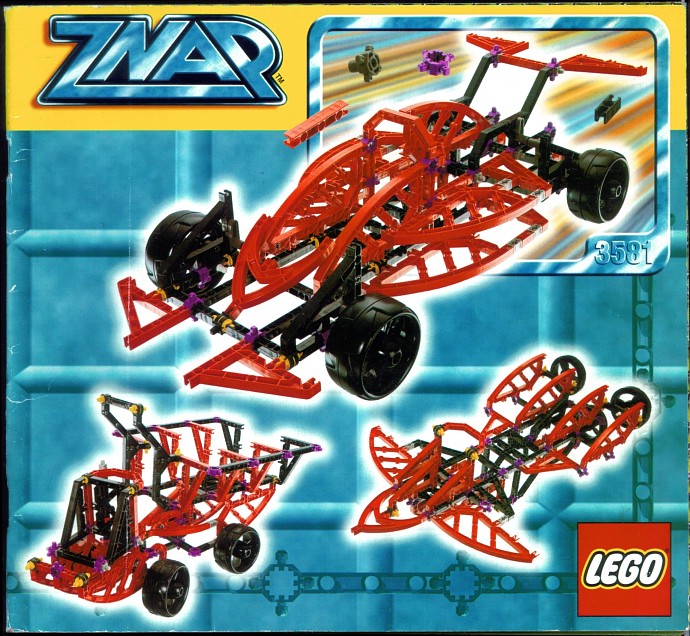 If Znap had focused more on large sets and parts packs, I feel like the theme would have performed better. Znaps could have also been used to make motorized or functional sets. Roller coasters seem like a prime candidate for Znaps, with the curves of Znap parts lending themselves readily to the twists and turns of a roller coaster.
However if you are interested in giving Znaps a try, good news! Given a complete lack in popularity for Znap, all of the sets are incredibly cheap - the large Red Formula 1 set is available new for ~$25, and the individual parts cost next to nothing.
If you are not convinced of how badly Znap failed, here is one last example: While visiting the LEGO Enfield office in 2007, I saw a large box of 3510: Promotional Set, with a sign saying "Please find me a good home." That's right, this set could not be given away...
52 likes
29 comments on this article
they did fail
Great article! Znap was definitely a huge miss but now I'm curious what untapped potential some of these elements might have when combined with system/technic pieces. Doing a cursory search I found this blog post but I'm sure that's just scratching the surface!
http://www.dagsbricks.com/2016/01/lego-techniques-znap.html?m=1
Nice idea for a series, and znap is just weird. I totally agree that the sets are too small. Maybe they could have made the pieces smaller?
Excellent review of a true misstep of a line. Still I aplaud lego for trying something new. Despite Znap being an obvious case of an unwanted renewel of lego from the late 90s and early 00s. I think that it might have had more potential if lego tried to make it mote integratable with system pieces. As if stands Znap might have been a bit too radically different to work as a lego theme.
Nice article thank you. There's a rich seam of other failures for future articles!
Thank you! Indeed there is... I'm debating whether or not an article on Galidor would be beating a dead horse...
Interesting article, looking forward to the next one (wonder if I ever ran into a Znap set without knowledge).
Excellent idea for a series. It would have been nice to have a closer look at the elements though. I've never come across them in the wild. A competition would be nice too to see what can be built nowadays with a few Znap elements.
Cool idea. There were so many controversial themes. Znap is actually not one of them, it was a failure all the way.
Good idea for a series! And now matter how dead the Galidor horse is you can't ignore it...
You say it could have been used for motorised sets. There were two sets that used the 9V Technic motor (in some Technic-to-Znap bracket). When Znap was dumped at bargain prices I picked up a stack of set 3552 as a cheap way of getting 9V motors.
The article could do with a bit of proofreading... lots of typos, missing words...
@Duq
It is true that Znap had two motorized sets, but their level of motorization was lacking. As far as I know, all they did was drive forward.
Shop @ Home should be the next fail article
Thanks for bringing this to my attention' wasn't aware that these were even made by Lego. This is just evidence of the era where Lego was seriously struggling and willing to attempt anything to survive. luckily for me the late 90s early 00s was (sort of) my second dark age...so I didn't miss much.
I like this article! I hope it becomes a series. Keep up the good work.
"Znap parts were almost impossible to incorporate into regular builds, as most parts had only a few Technic connection points, and not at regular intervals"
Waitwaitwait. Technic connection points at intevals not offered by standard Technic beams? That sounds super useful! *buys more znap*
"Set 3533 was insprired by the wooden Lego duck"
Looks more like a monster than a duck. Lol
Looking forward to the articles on Jack Stone and Belville.
Would be nice to put the year of release in the article (in the beginning), had to look it up since I wasn't around at that time.
Regarding galidor, I think it would be useful to show how NOT to do lego action figures. I often see comments how bionicle 'isn't lego' and how star wars fans 'discover' the buildable figures and only like the helmeted ones.
Please, just tell them about Galidor. These articles are read by many people. Tell them why it is a real case of not being buildable enough as compared to bionicle and other constraction and ccbs sets. And surprisingly the joint system is still used today but with brick adapters.
Go home LEGO, you were drunk...
I did the same as Duq- I bought some of the motorised sets when they were reduced to pennies as a way of getting Technic motors, and gave the Znap parts away. I do remember some clever people using them for building things like box girder bridges for big city/train layouts so I guess anything can be useful if you're creative enough...
Incidentally I recommend the book "Brick by Brick" by David Robertson for anyone who wants to read about how and why Lego produced so many epic fails in the dark days of the late 1990s/early 2000s and how it nearly destroyed the company...
Fun article. Onward to Galidor!
I actually really liked ZNAP when I was little. You could build huge models with not too many pieces, and because no one was buying it, it was dirt cheap. I got that large red racing car for £10, that was a good christmas.
I still have it all somewhere. Can't say its appeal lasted unfortunately.
I'll tell you one good thing that came out of ZNAP though - technic axles with stops.
This is a great idea for an article series; often failures are as instructive as successes...
Since I didn't like K'Nex (I wanted to, but it hurt my hands) I found it a bit sad that TLG were trying to do their own version with Znap - even the name seemed embarrassingly obvious. But then in 2000, our local toy shop discounted a couple of the big sets - Rota Beast and Red Formula One. One of those came with a motor, and on balance it was the right deal to pique my curiosity.
The funny thing is that I ended up getting really into it for a while - it was easy to put together and pleasant to work with on a tactile level, and it was a novelty to be able to make such big models without much financial outlay. I've had one or two other phases with it, but I never tried to combine it with Technic...
Weirdly, even though it came out at a point in my childhood when I was really into LEGO, Technic, and K'nex alike, I had no awareness of Znap until years after the fact. Was it not released in the United States? Weird if so, since K'nex is a US-based building toy.
Something that early Bionicle, Znap, and Galidor all have in common, incidentally, is that LEGO took an odd approach to marketing them. Instead of putting the LEGO logo boldly in the upper left corner of the box ahead of the theme name, it was shoved to the bottom of the box art. Perhaps this betrays the LEGO Group's lack of faith in their own brand strength, or perhaps an ignorant assumption that branding sets as LEGO first and (new brand) second would keep them from appealing to people outside the existing LEGO buying audience.
Today, either the LEGO brand has grown much stronger, or the LEGO Group has gained the confidence not to distance themselves from it even in their more far-flung themes like Bionicle. It warms my heart to see the LEGO logo back up top where it belongs!
As for the Znap products themselves, I have no problem with the color-coded parts. That's how K'nex always was in my childhood and it was never a problem for me. Frankly, it actually made things a bit easier for me when building because I could ignore color and focus strictly on shape, which was a far more important factor in that type of building. I can't really speak to the Znap building experience, though, because I've never actually played with the parts. The only interest I've ever had in Znap since discovering it was that the boat from the Mata Nui Online Game used Znap parts conspicuously.
^ Yes, I recall that boat, now that you mention it. It was good for a laugh seeing that when I played MNOG in 2007.
That "duck" looks more like a praying mantis if you ask Me.
As soon as I saw the picture I was 'oh yeah remember these' but that was probably because when they were around I worked for woolworths and we sold them. I vaguely think I bought one set. I had only just got back into lego then. I probably wouldn't have bought it for the fact I got staff discount.
I had one of these, the one pictured at the top of the article. I think it's the only LEGO set I've ever gotten rid of.
I just want to know what LEGO was thinking when they made that green duck thing, and Snaps in general. Ripping off K-nex was an awful move. Just because LEGO is one of the biggest toy company in the world, doesn't give them the right to rip off other company's. All in all, I think Snaps was a rare mistep for LEGO