Review: 42221 NASA Artemis Space Launch System Rocket
Posted by Huw,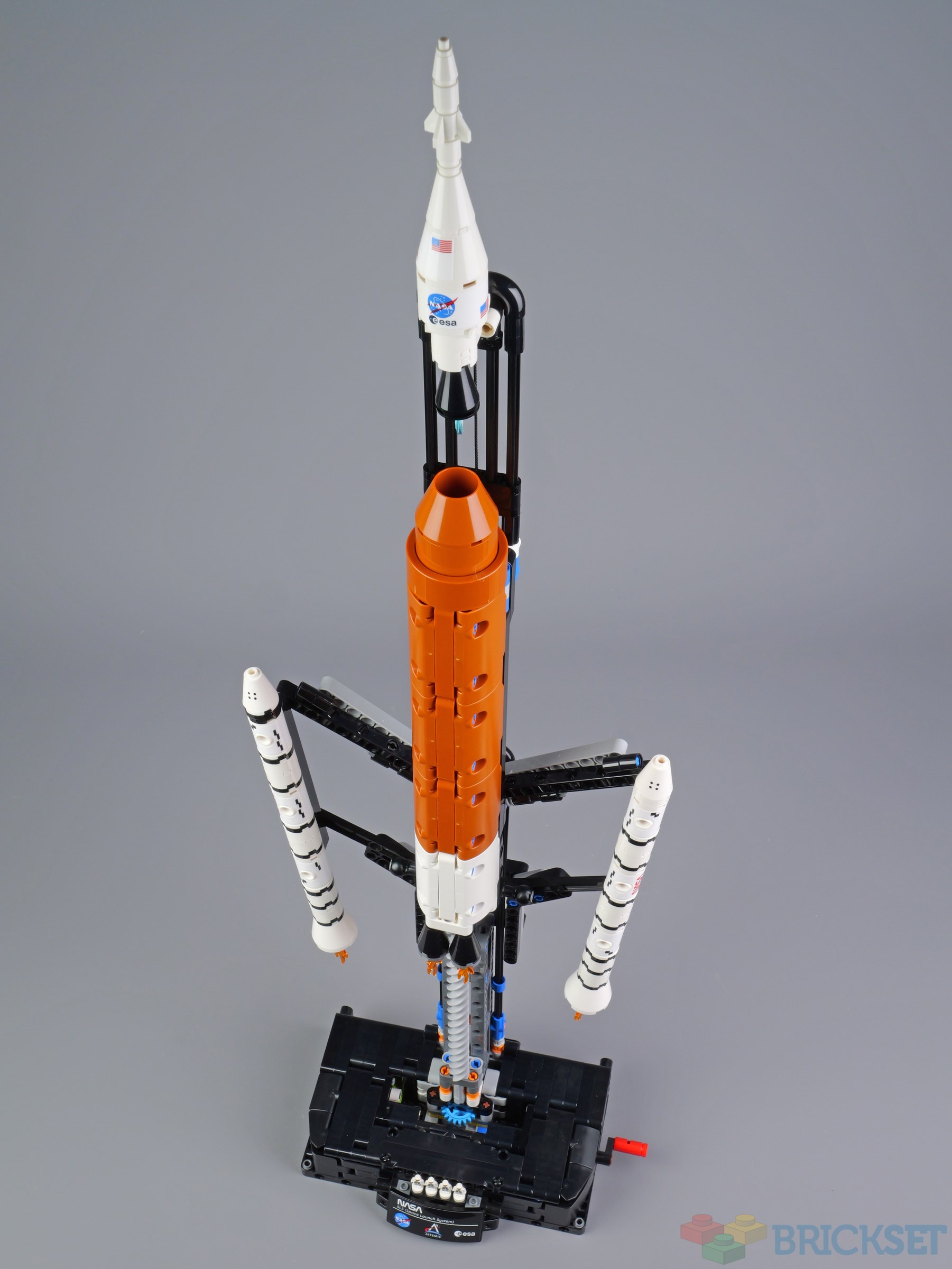
Among the plethora of wheeled vehicles in next year's Technic assortment there is one set without them that looks like it might be harbouring an interesting mechanism, one that does something other than provide steering or turn a fake engine.
Such sets are a rarity nowadays, so the release of 42221 NASA Artemis Space Launch System Rocket is cause for celebration.
Summary
42221 NASA Artemis Space Launch System Rocket, 632 pieces.
£54.99 / $59.99 / €59.99 | 8.7p / 9.5c / 9.5c per piece.
Buy at LEGO.com »
Something different that incorporates a decent mechanism
- It doesn't have wheels
- Introduces useful new pieces and a new colour of Technic beam
- Educational
- Gearbox is arguably over-engineered
The set was provided for review by LEGO. All opinions expressed are those of the author.
Stickers
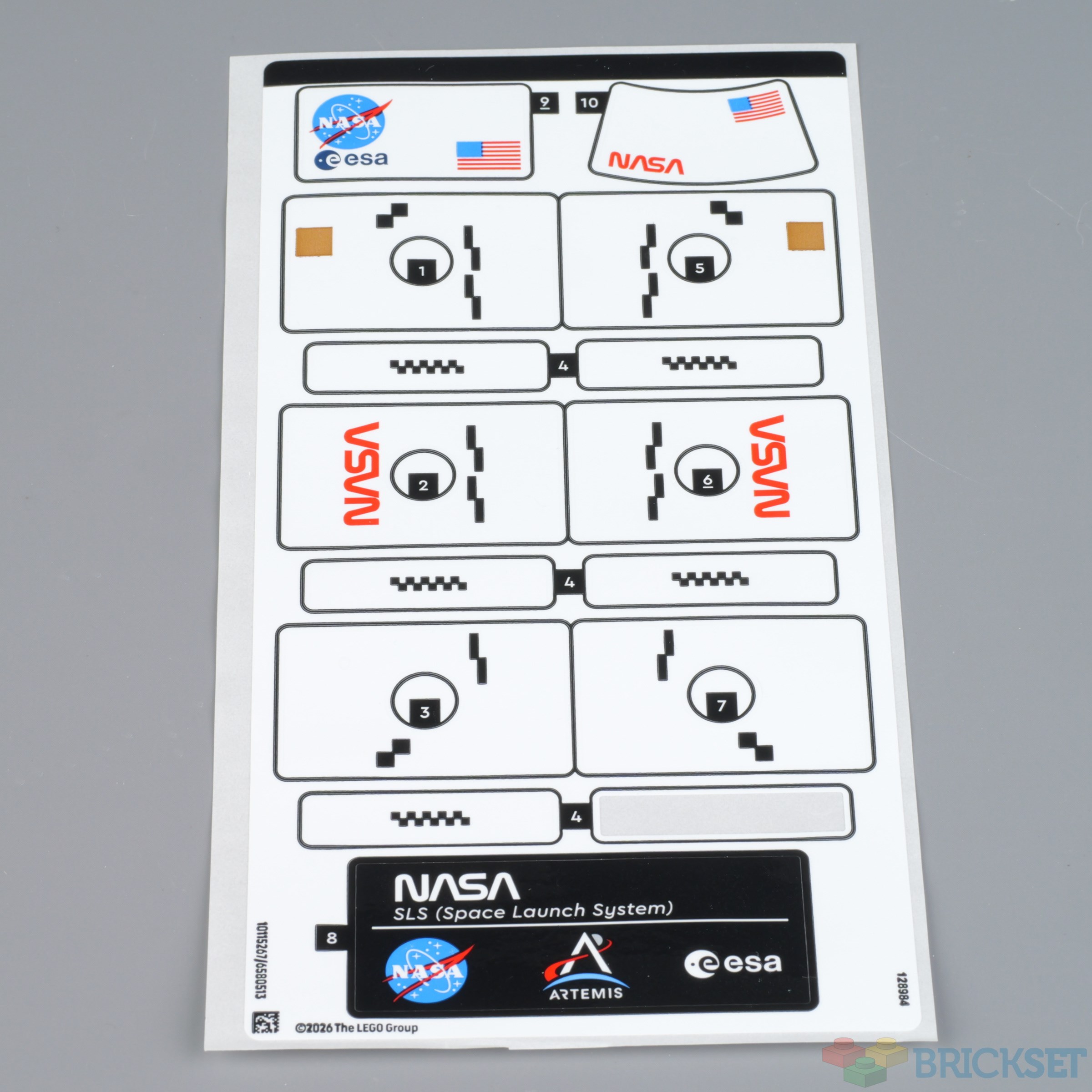
The small sticker sheet provides decals with the NASA logo, other small details on the rocket, and one for the plaque on the base.
Unfortunately, one of the #4 stickers had become detached in transit and affixed itself to the cover of the instruction manual, so I didn't apply any of the #4s to the model.
New parts
New Technic parts are always a cause for celebration, especially when they are functional rather than decorative.
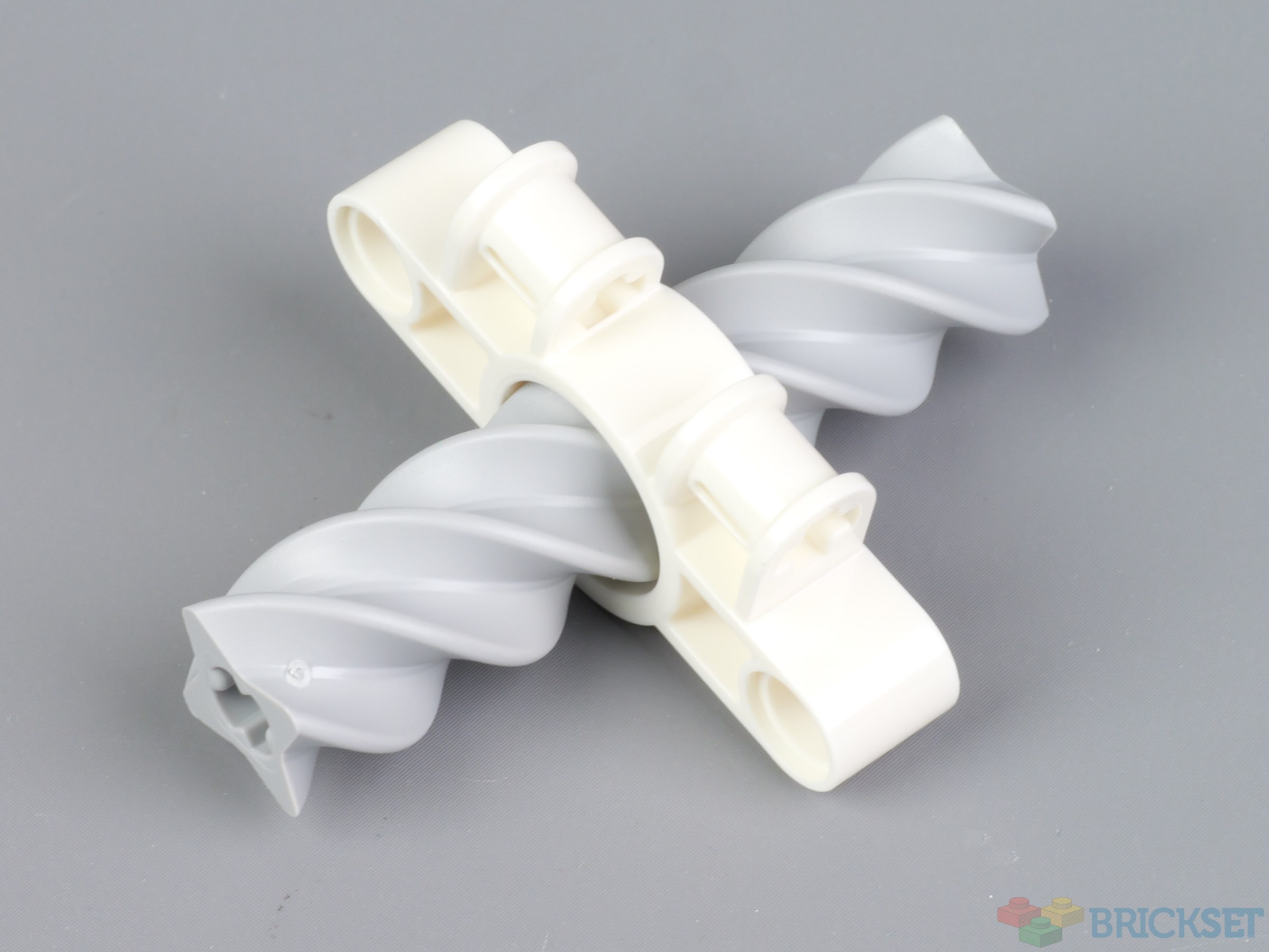
The 6-long worm gear, or 'fusilli gear' as it's known, has been around for a couple of years but has not appeared in a Technic set until now. Because the gear block that they work with is a System piece, a new element was needed to make them compatible with Technic, and this is it.
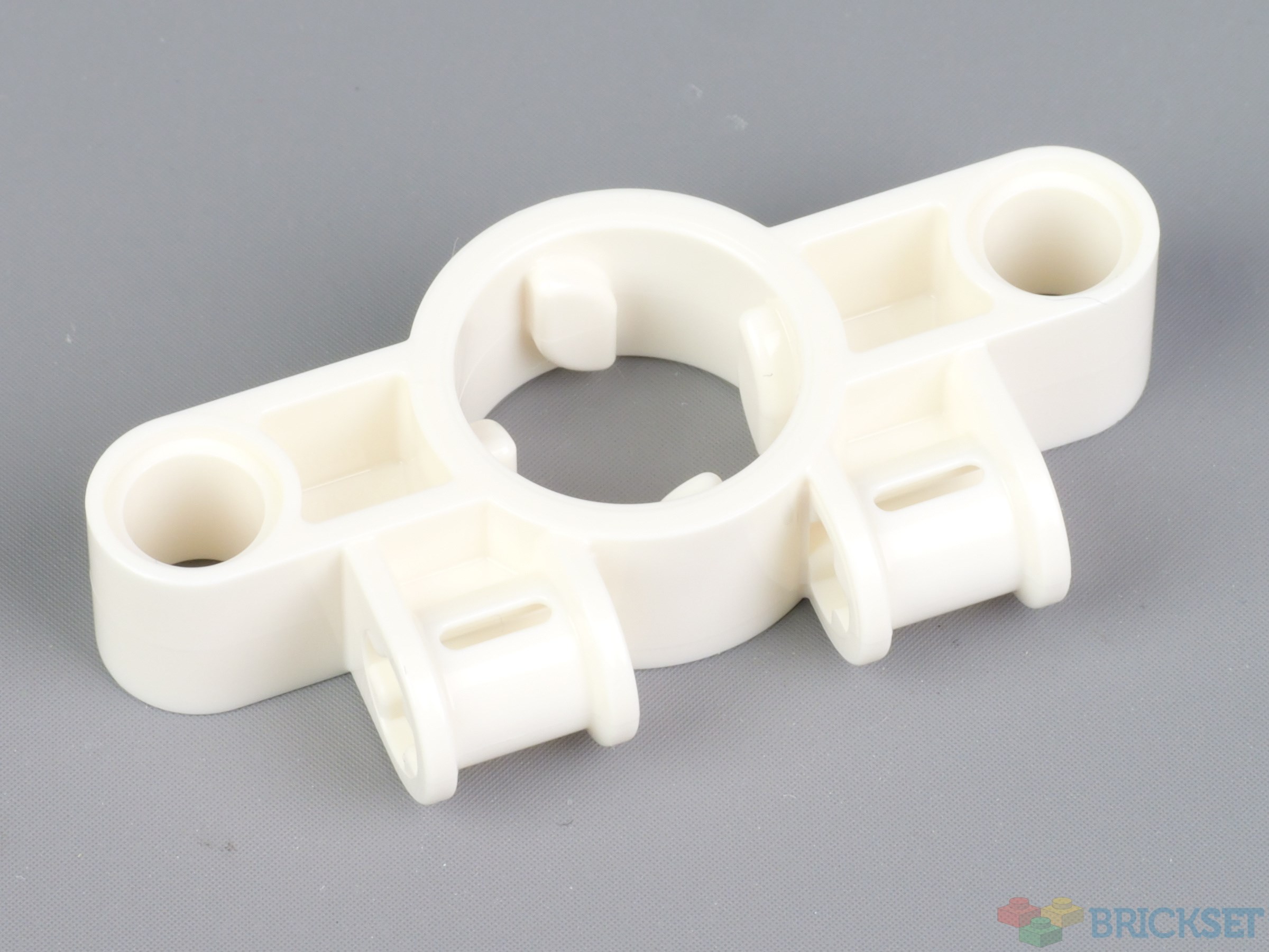
Also new in this set is a 2-wide, 3-long cylinder with axle holes in the ends and pin holes in the sides.
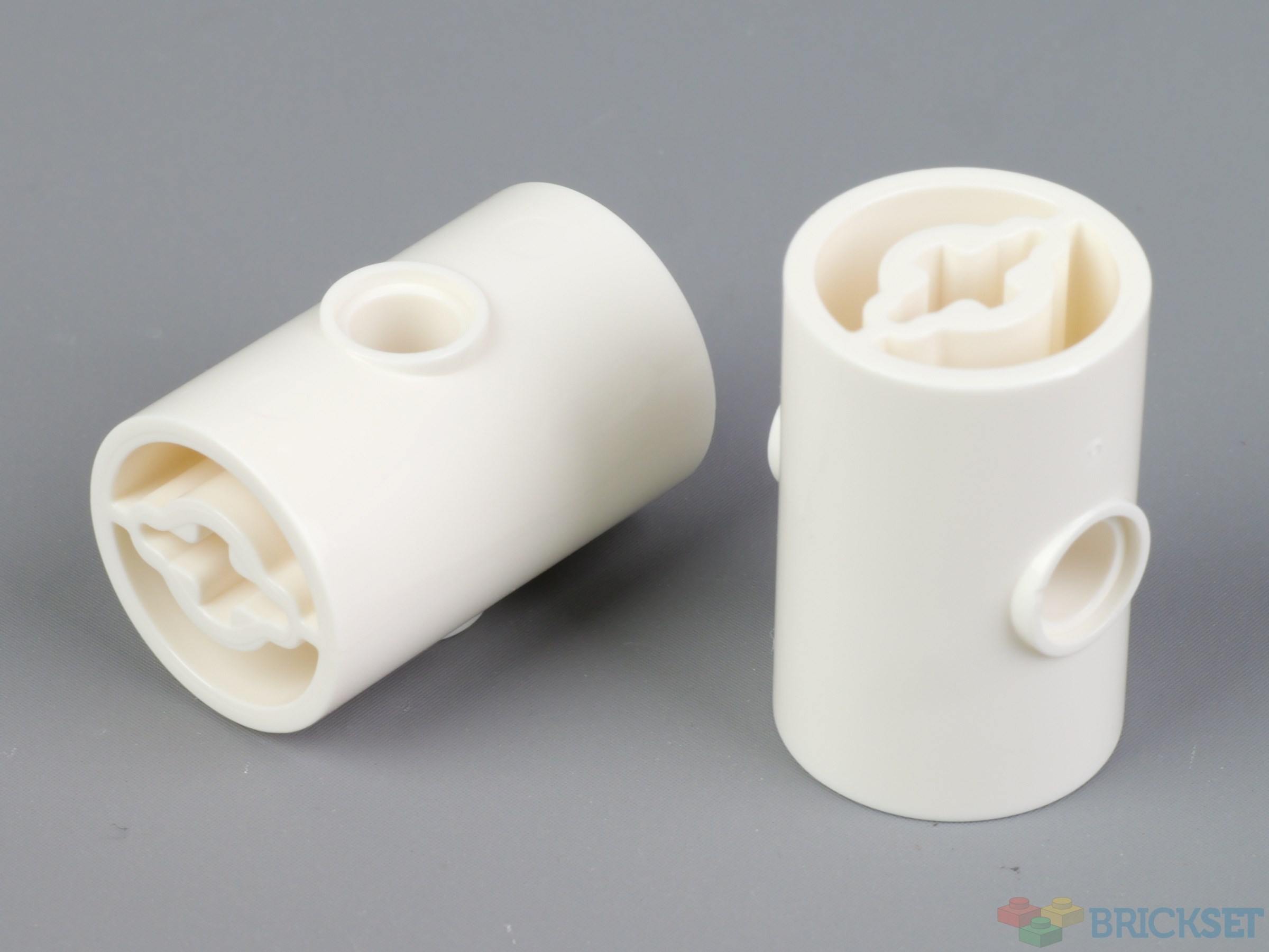
Also of interest are 7-long beams and 7x2x3 curved panels in dark orange.
Construction
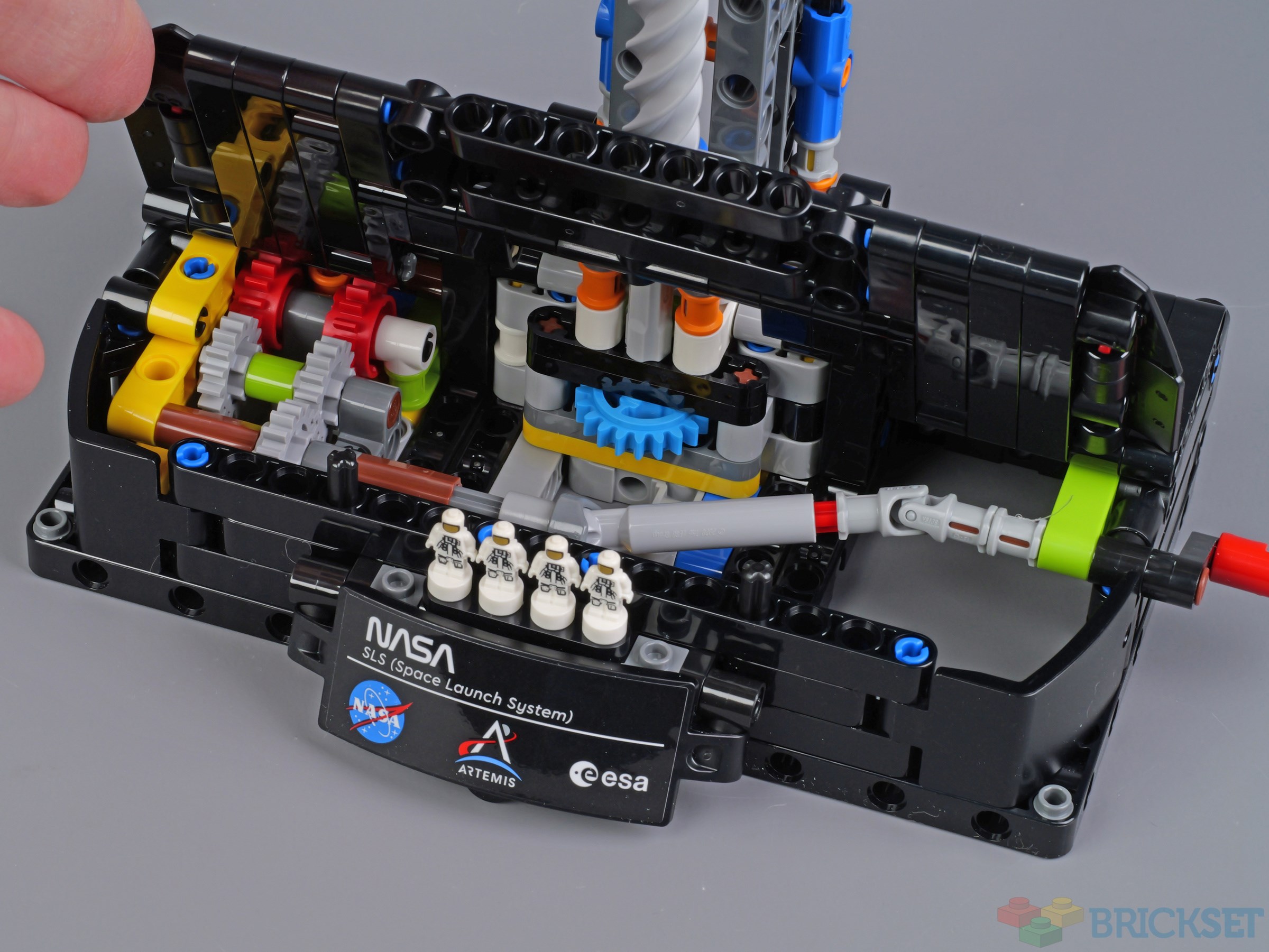
The 'launch pad' is built first and within it is a fairly complex gearbox, and I'm not quite sure why it needs to be as complicated as it is. Turning the handle on the right-hand side rotates the vertical yellow axle which facilitates launching the rocket.
It can be turned both ways to raise and lower the spacecraft and as far as I can see, the only function provided by all those gears is to engage a ratchet when raising it, which makes a clicking noise as you do so.
Still, at least it's not turning a fake engine...
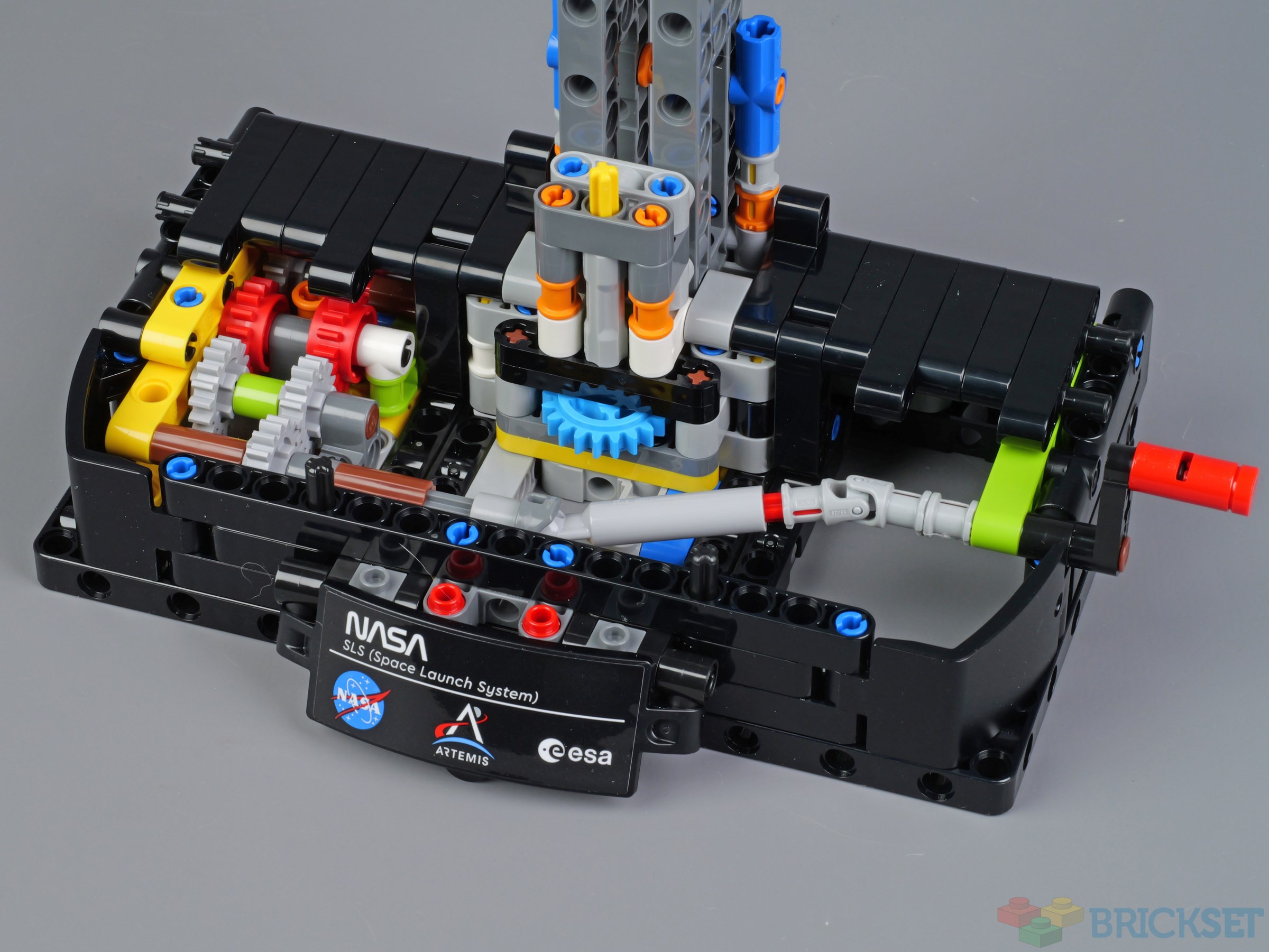
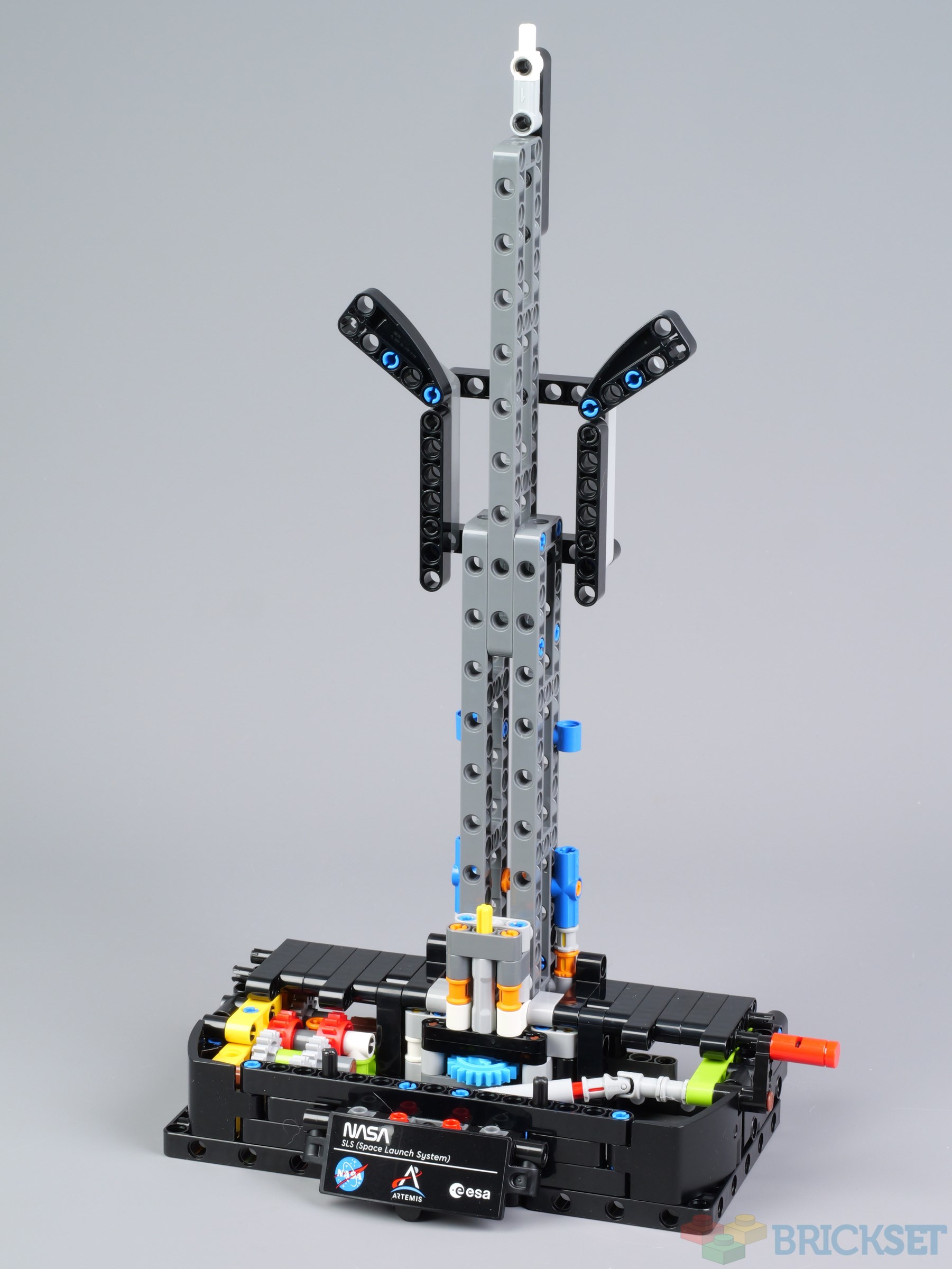
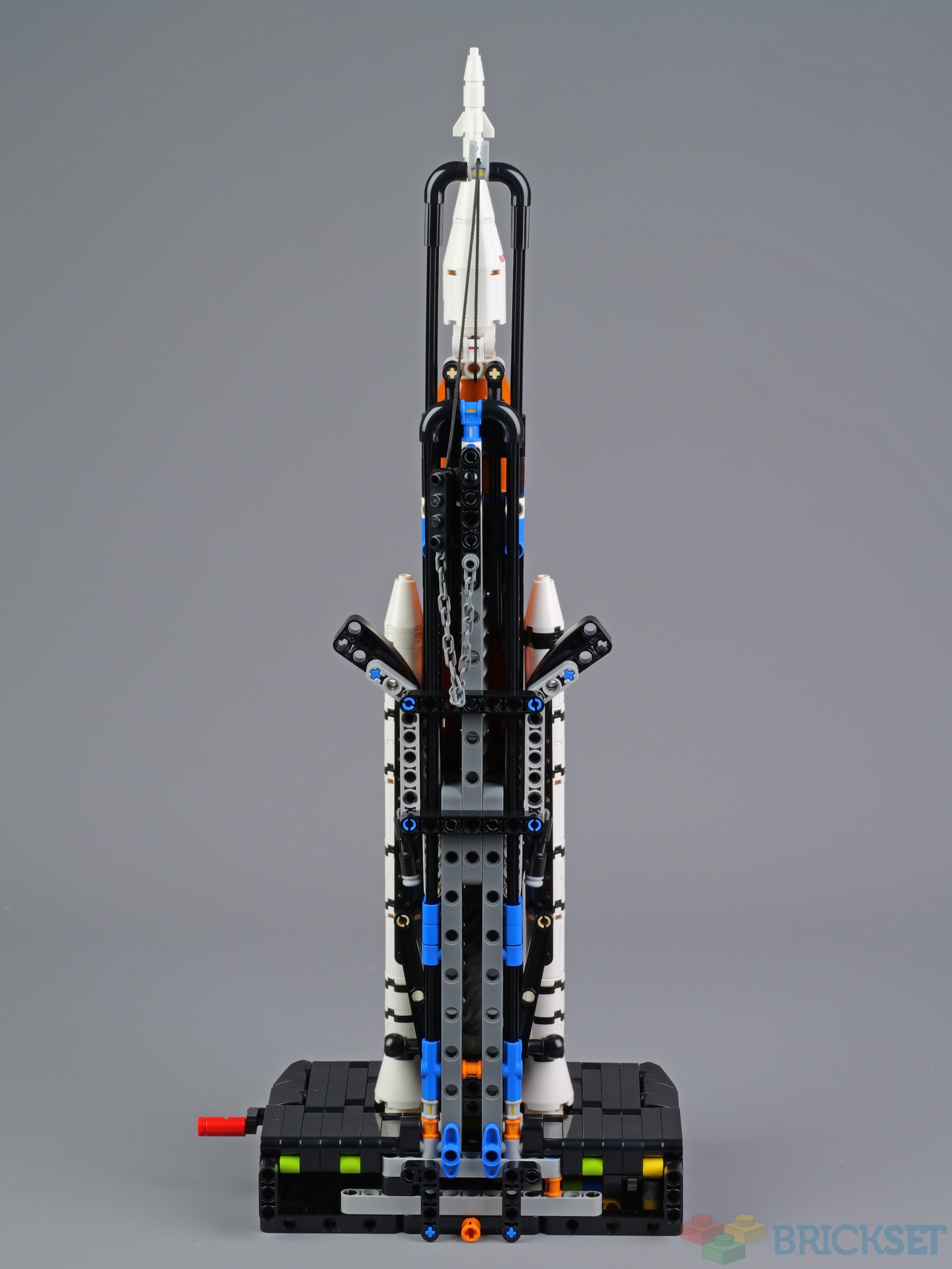
The launch tower provides support for the rocket, the wings to either side facilitate the ejection of the solid rocket boosters.
The completed model
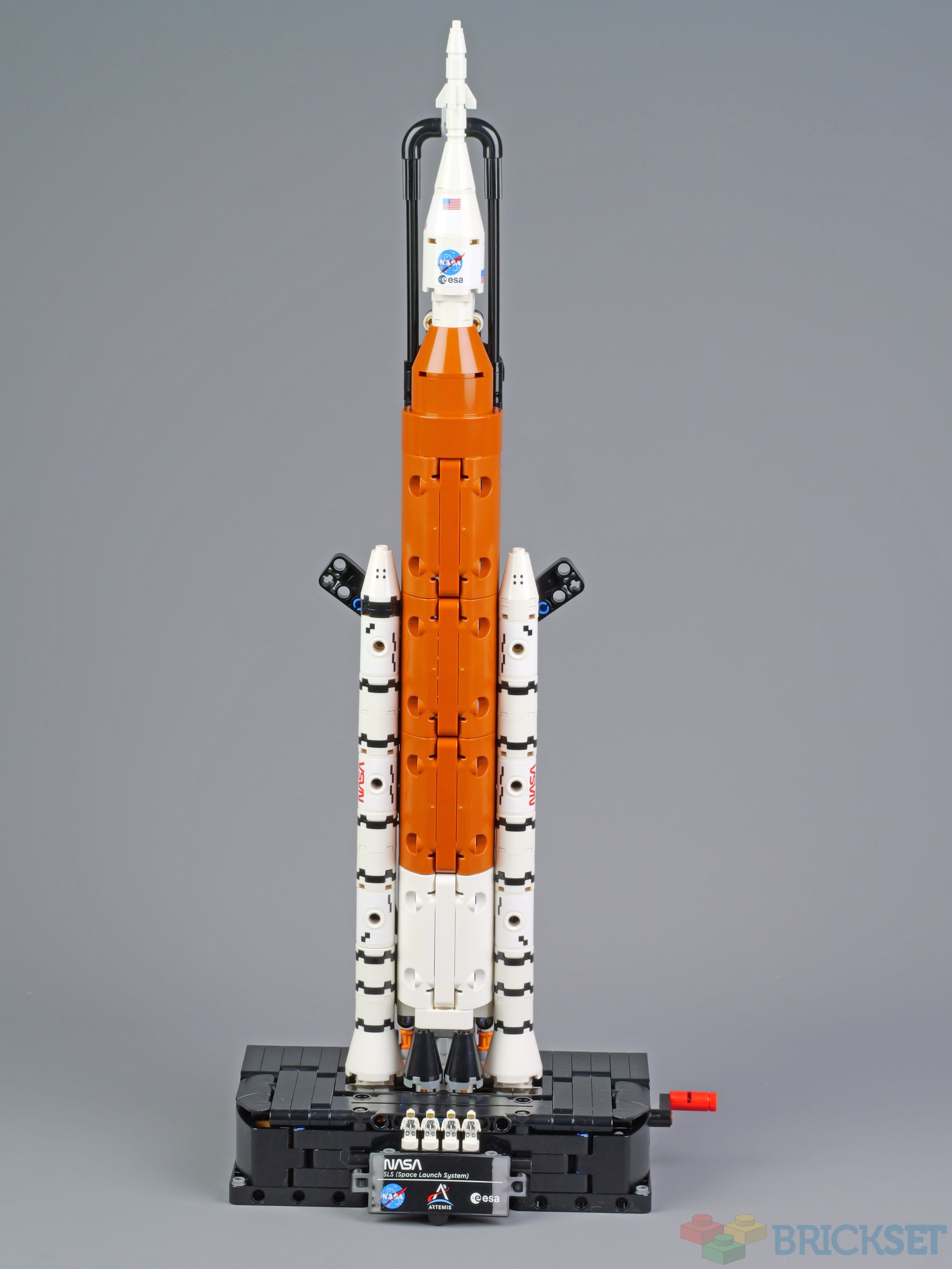
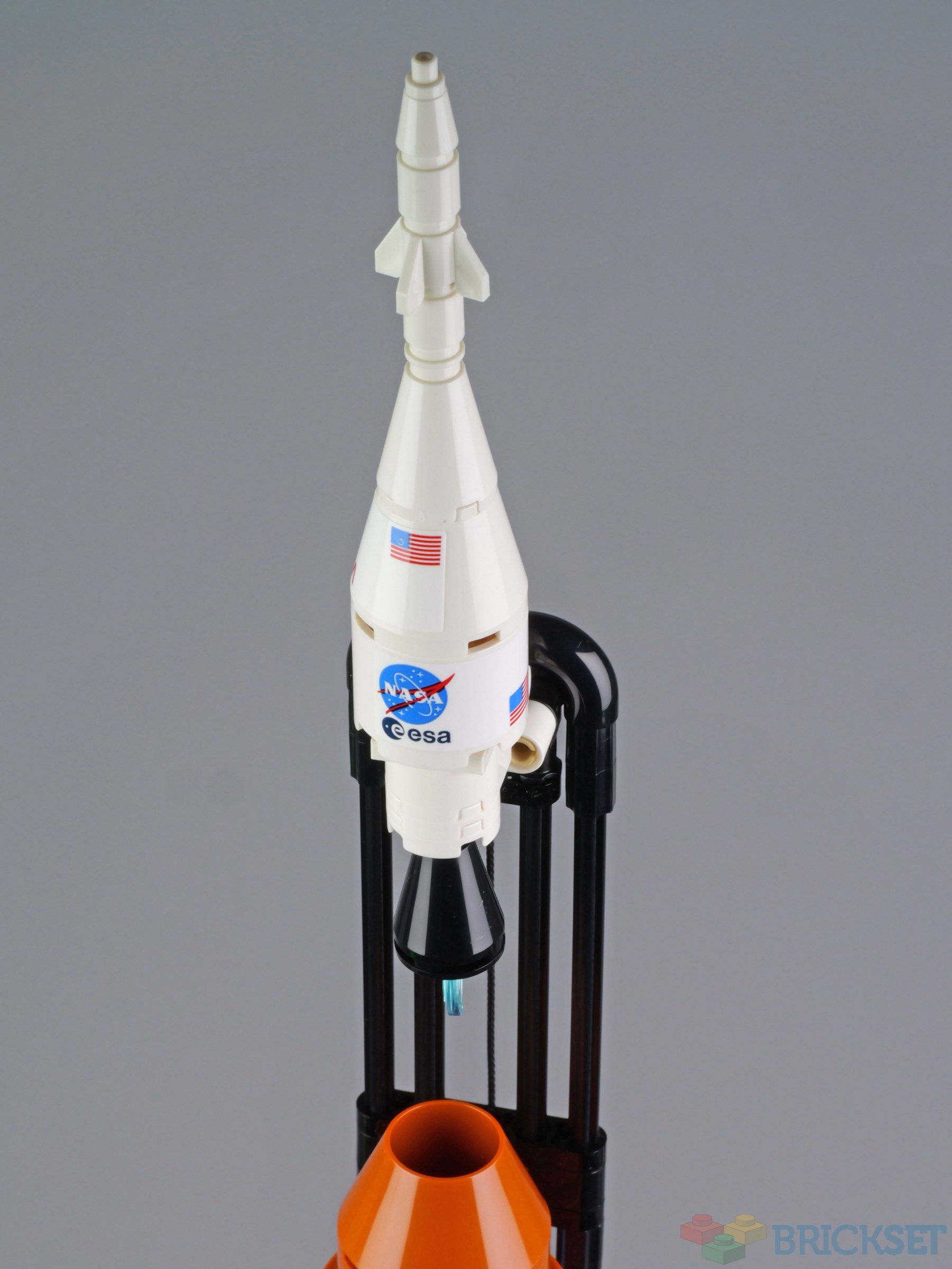
Before launch, the model stands 50cm tall, and the rocket looks pretty much like the real thing, as much so as can be expected with Technic. Stickers provide authentic details to Orion and the boosters, but it's a nuisance applying them to the latter because they go on the new 2x2 round pieces so have a hole in them to accommodate the pin hole on the side of the element. You therefore have to get them straight on the piece, and get the hole in them aligned around the pin hole.
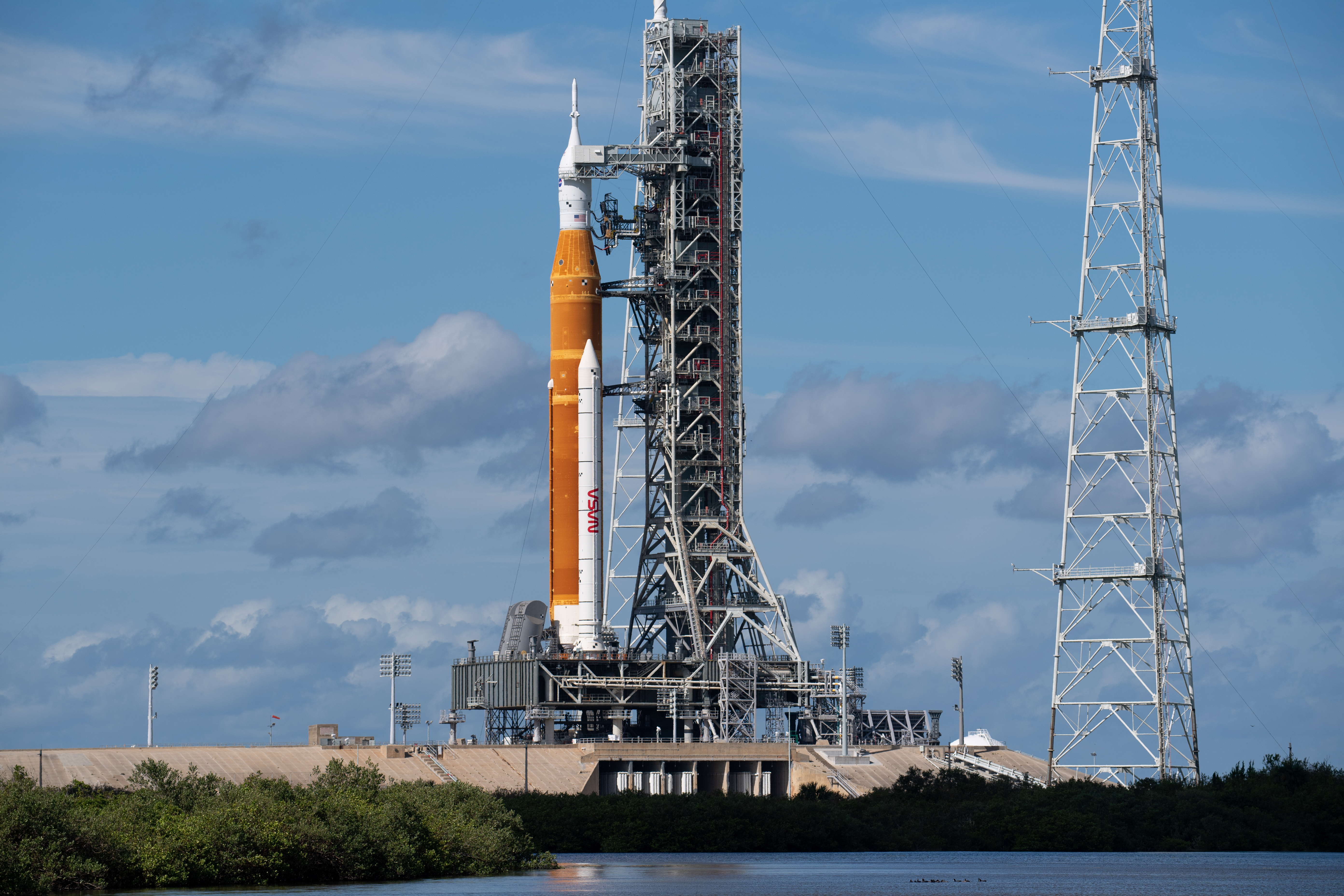
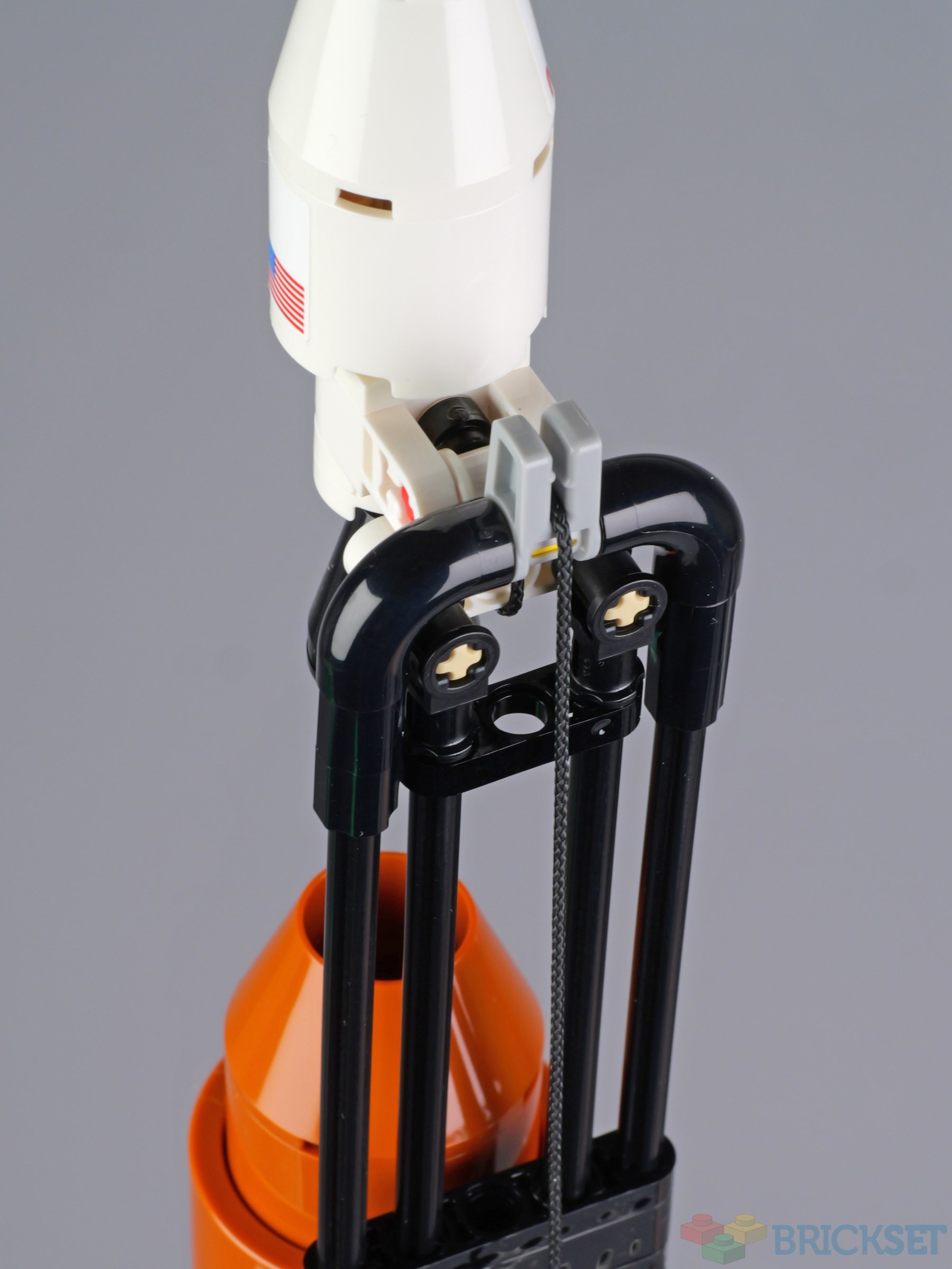
Note the chain and string dangling at the back that facilitate the second stage of the launch sequence, as you'll see below.
The base's cover is hinged to allow the mechanism to be viewed. Four trophy-fig astronauts stand above the information plaque.
Operation
The mechanism facilitates two stages of the launch: the jettison of the solid fuel boosters and the detachment of the Orion spacecraft (the white bit at the top).
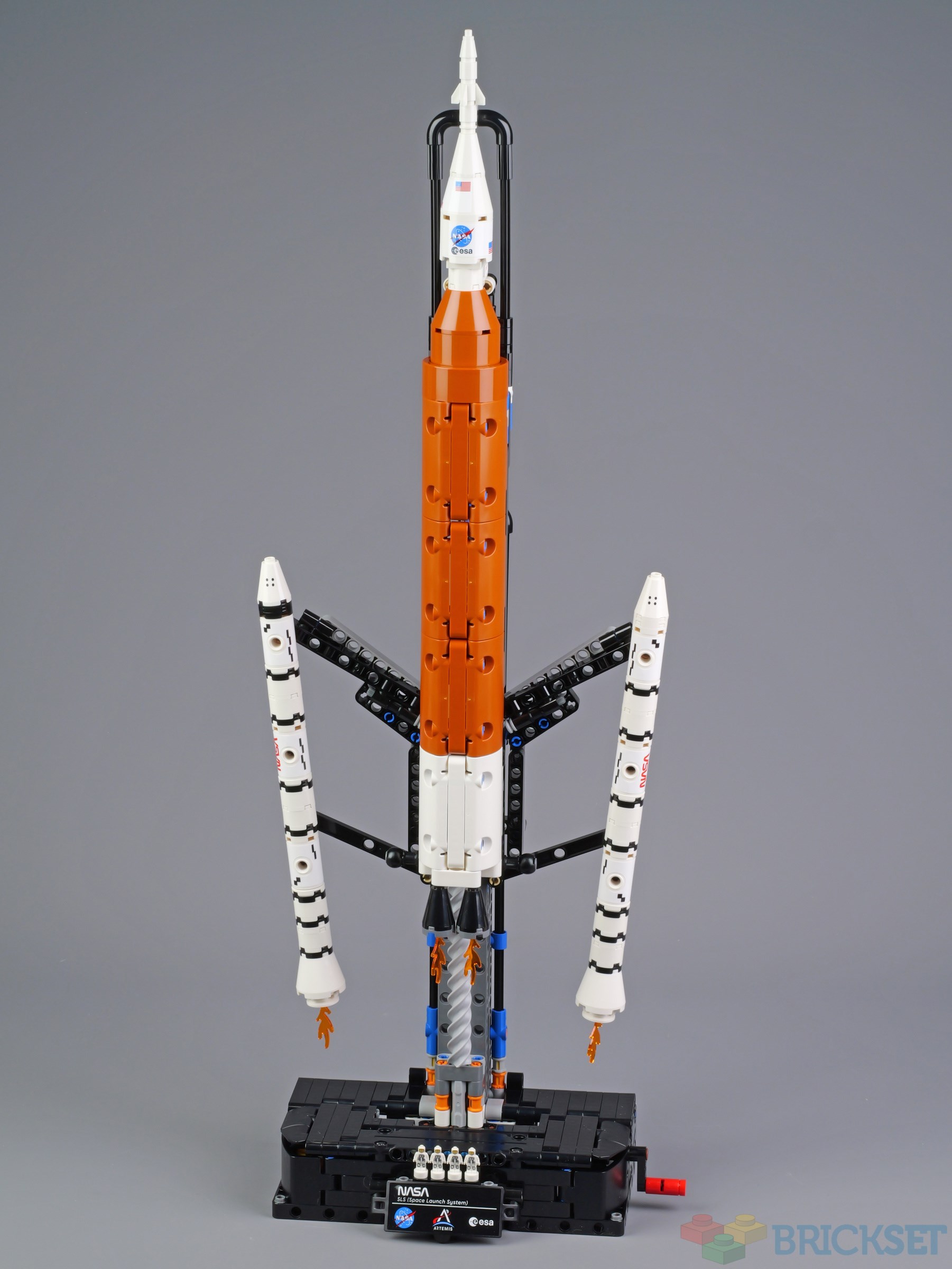
As the red lever is turned, the rocket rises up the worm gears. When the arms holding the boosters move above the wings on the tower, they move outwards, making it look like they've been jettisoned.
Then, as you continue to turn the lever, Orion accelerates upwards away from the dark orange core stage section. This is achieved with the help of the string and chain at the back.
When Orion is at its highest position, the model is about 70cm tall.
Verdict
When you assemble models of cars you know exactly what it is you're building and how it'll work: the suspension, steering, gearbox and so on. It's refreshing, therefore, to not know exactly what you're making when constructing this model, and how it's going to work when you've finished.
It harbours a clever, if somewhat over-engineered, mechanism, and it has considerable educational value, demonstrating how the SLS is launched.
You'll probably soon tire of operating it once you've done so a few times, but it's more exciting and rewarding than turning a steering wheel or opening a bonnet!
So, largely because of its novelty value, I do not hesitate to recommend it to the discerning Technic aficionado.
152 likes
48 comments on this article
Bored of the super cars too. Technic should always be like this.
It's an interesting mechanism, but I can't help but see it as the capsule escaping a rapid-unscheduled-dissassembly event too.
Hope we get more non-car Technic sets like this!
@xboxtravis7992 said:
"It's an interesting mechanism, but I can't help but see it as the capsule escaping a rapid-unscheduled-dissassembly event too. "
That’s one of the lessons they learned from the Challenger disaster. The previous three programs (Mercury, Gemini, Apollo) all featured nose-cone rockets that could lift the command module free of the stack in an emergency abort situation. The Space Shuttle had nothing, so once the clamps released the stack from the launch pad, your next opportunity to exit the craft was generally after landing on the runway a few states away.
@xboxtravis7992 said:
"It's an interesting mechanism, but I can't help but see it as the capsule escaping a rapid-unscheduled-dissassembly event too. "
In fairness, the sheer volume of times we’ve seen this recently due to SpaceX shenanigans means there’s a decent number of folks now whose only modern awareness of rocket takeoffs *is* rapid-unscheduled disassembly events.
@PurpleDave said:
" @xboxtravis7992 said:
"It's an interesting mechanism, but I can't help but see it as the capsule escaping a rapid-unscheduled-dissassembly event too. "
That’s one of the lessons they learned from the Challenger disaster. The previous three programs (Mercury, Gemini, Apollo) all featured nose-cone rockets that could lift the command module free of the stack in an emergency abort situation. The Space Shuttle had nothing, so once the clamps released the stack from the launch pad, your next opportunity to exit the craft was generally after landing on the runway a few states away."
Yes, and I have read a rather damning report recently on the reentry shield on the Orion capsule recently that makes me think that NASA is being pushed headlong into repeating all those mistakes again... but that's really a discussion for another place.
It's better than the "shred the crew capsule during an emergency event with chunks of flaming shrapnel" design of the Ares I at least.
While I like the idea/concept, I still believe this is a seriously missed opportunity to do a whole bunch of parts in trans-clear. Lego did Technic parts in transclear before (most recent was in 2020 60264) so why not now? - maybe their new transclear material has a propensity to bind itself with adjacent parts - I don't know?
Why is this important? Young kids may think that there is really a set of arms that separate the boosters - of course, a nearby adult can explain this away but still. It would also hide the mechanism a little bit and make this model more 'life-like'. IMO
That new part that goes with the fusili is fantastic! If you ever want to replicate models made by Fischer Technik (they have great robotic arms and lines of assembly), this will greatly help.
If I see this set on sale, I might get it and put it beside the MLP/LUT of my Saturn V. Otherwise, I will certainly be looking for this part on PaB.
@HOBBES said:
"While I like the idea/concept, I still believe this is a seriously missed opportunity to do a whole bunch of parts in trans-clear. Lego did Technic parts in transclear before (most recent was in 2020 60264) so why not now? - maybe their new transclear material has a propensity to bind itself with adjacent parts - I don't know?
Why is this important? Young kids may think that there is really a set of arms that separate the boosters - of course, a nearby adult can explain this away but still. It would also hide the mechanism a little bit and make this model more 'life-like'. IMO
That new part that goes with the fusili is fantastic! If you ever want to replicate models made by Fischer Technik (they have great robotic arms and lines of assembly), this will greatly help.
If I see this set on sale, I might get it and put it beside the MLP/LUT of my Saturn V. Otherwise, I will certainly be looking for this part on PaB."
I agree. Either clear or even trans light blue would have looked much better, unless this is supposed to represent a night time launch.
The nanofig aliens from the Minifigures Series 27 Imposter would work well as full-size aliens for the astronaut nanofigs.
@HOBBES:
MABS should behave similar to ABS, I’d think, other than the ability to produce it in transparent colors. One issue might be how many open frames it would take to make all those clear parts, and another might be whether or not ABS/MABS are suitable materials for specific components like pins and axles.
@Huw wrote:
"It can be turned both ways to raise and lower the spacecraft and as far as I can see, the only function provided by all those gears is to engage a ratchet when raising it, which makes a clicking noise as you do so."
I think it's probably a safety feature. The ratchet likely allows the gear train to skip if there's enough backforce, without breaking any parts. This isn't needed much on the cars, since they don't have long lever arms, but this set has pretty long lever arms used to separate the boosters from the main rocket. If you held them in place while turning the crank, you could probably break a tooth off one of the gears if the ratchet mechanism weren't there.
When I was a kid, I broke several gears by creating multiple gear reduction stages chained together, then putting a bit of backforce on the output. The torque got multiplied through the chain, and it was pretty easy to either crack off gear teeth, or break out the axle hole, somewhere in the geartrain.
Technic getting interesting again......
Needs to be encouraged.
I agree with Hobbes that clear pieces would have made it even better, but that's honestly all I could complain about. Well, and the stickers, but it is Technic after all, so it is kinda to be expected. But other than that, great set with a well executed and pretty unique function. Technic as Technic should be!
@HOBBES said:
"While I like the idea/concept, I still believe this is a seriously missed opportunity to do a whole bunch of parts in trans-clear. Lego did Technic parts in transclear before (most recent was in 2020 60264) so why not now? - maybe their new transclear material has a propensity to bind itself with adjacent parts - I don't know?
Why is this important? Young kids may think that there is really a set of arms that separate the boosters - of course, a nearby adult can explain this away but still. It would also hide the mechanism a little bit and make this model more 'life-like'. IMO
That new part that goes with the fusili is fantastic! If you ever want to replicate models made by Fischer Technik (they have great robotic arms and lines of assembly), this will greatly help.
If I see this set on sale, I might get it and put it beside the MLP/LUT of my Saturn V. Otherwise, I will certainly be looking for this part on PaB."
To be honest, I don't think kids (especially Technic-aged kids) will be confused by the use of black parts for the armature. And clear Technic (while it's neat when we get it) isn't exactly much subtler than black, since it reflects and refracts light in lots of directions due the many pinholes and similarly complex shapes. From an adult display perspective, if you put this against a black backdrop the black armature might even be be less visible overall than if you had a clear one.
@Kalking said:
" @xboxtravis7992 said:
"It's an interesting mechanism, but I can't help but see it as the capsule escaping a rapid-unscheduled-dissassembly event too. "
In fairness, the sheer volume of times we’ve seen this recently due to SpaceX shenanigans means there’s a decent number of folks now whose only modern awareness of rocket takeoffs *is* rapid-unscheduled disassembly events.
"
In fairness, the SpaceX's Falcon 9 system is amazingly reliable, and its booster is the first ever to be truly and fully reusable. It already accomplished around 577 missions in total, and in 2025 it is averaging about three missions a week. No one ever came close to this! The Starship system is in development stage, and mishaps are part and parcel of the rapid development philosophy of SpaceX.
And btw, while a single Artemis launch is projected to cost a staggering 4.1 billion dollars, a Starship launch, once the system is mature, is estimated to cost only $2 million to $10 million. When that comes about, the affordability of space launches would usher an era of unprecedented space missions.
This is such a clever, interesting set. Even as someone who’s not normally into Technic…
What color is the beam you mentioned?
This is quite cool. I was a bit skeptical that the mechanism would be quite simple (you can do amazing movements with just moving liftarms), but it looks genuinely well done. And it's finally something new again!
I also like the prominence of system parts in the side boosters. Reminds me of the old Discovery theme from 2003, and of what 70s-90s technic often did.
@CaptainRed said:
" @Kalking said:
" @xboxtravis7992 said:
"It's an interesting mechanism, but I can't help but see it as the capsule escaping a rapid-unscheduled-dissassembly event too. "
In fairness, the sheer volume of times we’ve seen this recently due to SpaceX shenanigans means there’s a decent number of folks now whose only modern awareness of rocket takeoffs *is* rapid-unscheduled disassembly events.
"
In fairness, the SpaceX's Falcon 9 system is amazingly reliable, and its booster is the first ever to be truly and fully reusable. It already accomplished around 577 missions in total, and in 2025 it is averaging about three missions a week. No one ever came close to this! The Starship system is in development stage, and mishaps are part and parcel of the rapid development philosophy of SpaceX.
And btw, while a single Artemis launch is projected to cost a staggering 4.1 billion dollars, a Starship launch, once the system is mature, is estimated to cost only $2 million to $10 million. When that comes about, the affordability of space launches would usher an era of unprecedented space missions."
I’m curious why you don’t consider the STS SRB to be the first reusable booster, given that they did recover and reuse them. The main tank was, of course, a total loss, but that’s because it was ejected so late it burned up on reentry.
@CaptainRed said:
" @Kalking said:
" @xboxtravis7992 said:
"It's an interesting mechanism, but I can't help but see it as the capsule escaping a rapid-unscheduled-dissassembly event too. "
In fairness, the sheer volume of times we’ve seen this recently due to SpaceX shenanigans means there’s a decent number of folks now whose only modern awareness of rocket takeoffs *is* rapid-unscheduled disassembly events.
"
In fairness, the SpaceX's Falcon 9 system is amazingly reliable, and its booster is the first ever to be truly and fully reusable. It already accomplished around 577 missions in total, and in 2025 it is averaging about three missions a week. No one ever came close to this! The Starship system is in development stage, and mishaps are part and parcel of the rapid development philosophy of SpaceX.
And btw, while a single Artemis launch is projected to cost a staggering 4.1 billion dollars, a Starship launch, once the system is mature, is estimated to cost only $2 million to $10 million. When that comes about, the affordability of space launches would usher an era of unprecedented space missions."
I like Falcon 9, it's an obvious candidate for a future LEGO set. Greatest rocket of all time contender maybe.
I like Starship more on paper than in practice... but "it's in development" this far into the program is starting to look like a flimsy excuse.
@Kalking said:
" @xboxtravis7992 said:
"It's an interesting mechanism, but I can't help but see it as the capsule escaping a rapid-unscheduled-dissassembly event too. "
In fairness, the sheer volume of times we’ve seen this recently due to SpaceX shenanigans means there’s a decent number of folks now whose only modern awareness of rocket takeoffs *is* rapid-unscheduled disassembly events.
"
I know your thoughts on Elon are why you call them shenanigans, but it’s ignorant to use that term or act like they’re messing around and just having problems all of the time. It’s a very successful program.
Aw, crap!
I think I need this!!
Looks like a giant syringe
@monkyby87 said:
" @Kalking said:
" @xboxtravis7992 said:
"It's an interesting mechanism, but I can't help but see it as the capsule escaping a rapid-unscheduled-dissassembly event too. "
In fairness, the sheer volume of times we’ve seen this recently due to SpaceX shenanigans means there’s a decent number of folks now whose only modern awareness of rocket takeoffs *is* rapid-unscheduled disassembly events.
"
I know your thoughts on Elon are why you call them shenanigans, but it’s ignorant to use that term or act like they’re messing around and just having problems all of the time. It’s a very successful program.
"
Well, I'll bite. Like I mentioned already; if the story was just Falcon 9/Heavy, it's a very successful program. Only what, two or three losses in flight in what is now nearly 500 flights? Three flights every week? Groundbreaking in reusability and setting records for how often a liquid fueled booster can fly again? It's an amazing vehicle, only the Soyuz family has a comparable flight record now and that thing looks like its held together by Cold War relics and duct tape in comparison to the Falcon 9.
The public focus though is increasingly on Starship, and while I know SpaceX advertised the program as "move fast and break things" it's looking concerning that this far into the program the mantra of "break things" is still a common occurrence, when Falcon 9 at a comparable point in flight history was already pretty stable and reliable. Furthermore, Starship is failing at strange points; such as on-pad pressure testing and not always in-flight failures (the amount of Falcon 9's to ever blow up on the pad is what, a grand total of one?)
My gut feeling, is SpaceX (probably under Elon's direction of "move fast and do it cheaper") cut a bit to much in the quality side, and when I see photos of Starbase that look hastily constructed with workers rushed to Texas in what amounts to garages; vs. the Falcon 9 plant in Hawthorne that looks like a very clean hi-tech facility... I think the problem is Starship works on paper but SpaceX wanted their cake and to eat it too by making it cheap. Anyone who has worked manufacturing knows you can pick two of three options, to do it well, to do it fast, to do it cheap; and with Starship it seems "fast and cheap" is eroding the core quality control of the program. I also suspect the move from California to Texas, meant that many senior SpaceX staff chose to stay in California on the Falcon 9 and engine production lines meaning only the most junior (i.e. fresh college grads with more mobility in life) followed the production of Starship to Texas (and its telling that the Raptor engine on Starship that is still coming from Hawthorne seems to be the most reliable component so far).
Add in crunch culture demanding to launch half-finished rockets (going against FAA norms all the time), and a company town that looks hastily constructed... my feeling is the mood in Starbase is less of the tech utopia people make it out to be and probably over-worked, over-stressed and people spread too thin on a very ambitious project. I'm not saying Starship won't work, but it may require a sacrifice in some of the core visions the C-Suite pushed down on the project; and until Musk is willing to let go of his vision of "big-fast-cheap" all working in unison he's going to end up with more rockets exploding and a machine that never will live up to its potential because he refuses to let go of the absurd process vision he had for it from the start... and since "big rocket" is going to draw media attention the workhorse Falcon 9 is fading into the pop-culture background as the public increasingly sees footage of Starship exploding in spectacular manner.
In the meantime, I'll toss out a few "Stainless Steel Goose" jokes on Starship's expense.
Although it would be nice to have the arms in clear rather than black, I believe the plastic used to make pieces translucent isn’t quite as durable as the opaque ABS plastic. In my nearly 50 years of Lego building experience, I’ve seen more translucent bricks crack or break than any other color (with the exception of the infamous and tragic brittle brown period and the accompanying dark red tragedy).
Although clear is fine for windows and those rods that hold flying minifigs, I don’t think it’s strong enough for the Technic pieces necessary here…not without their strength giving way after a while.
Reminds me that I really have to get around to building my copy of 8480 I bought used on eBay recently.
I'm not a huge fan of having sets on not-yet existing/used machines, it looks a bit too much like advertisement for me, even worse that the usual licensed sets. Although of course this set is splendid, especially with this overkill lift-off!
I agree as well that having a larger diversity in Technic sets would be expected: there are so many cool stuff out there, why cars "only"?! Really cool to have something substantial on the spatial side again (man, I love my Space shuttle 8480).
If you're interested in non-car Technic build, you can have a look at something different I've posted on LEGO Ideas and for free on Rebrickable: the nuclear reactor CROCUS.
I like Technic cars and trucks but it's good to see a unique set like this from time to time.
I don't know why people are being so mean about SpaceX. Sometimes their rockets don't explode at all, sometimes they remain safely on the ground. Sometimes they even remain on the ground without exploding, have you ever considered that?
Don't worry, Elon! I'LL protect you from these mean Inter Net Comments People. Maybe you'll notice me, and we can be friends, and you will give me your money! No, not a car, please and thank you.
"Move fast and break things" is such an incredibly bad philosophy.
" @gearwheel said:
When I was a kid, I broke several gears by creating multiple gear reduction stages chained together, then putting a bit of backforce on the output. The torque got multiplied through the chain, and it was pretty easy to either crack off gear teeth, or break out the axle hole, somewhere in the geartrain."
Even official sets can be susceptible to this: half the weight of 8852-1 "Robot" (the 1980s legally-distinct definitely-not-a-Transformer) goes through a 24-tooth gear which was easy to break by operating the transformation mechanism with the arms locked in place, and I lost at least one gear from my childhood collection that way.
@PurpleDave said:
" @CaptainRed said:
" @Kalking said:
" @xboxtravis7992 said:
"It's an interesting mechanism, but I can't help but see it as the capsule escaping a rapid-unscheduled-dissassembly event too. "
In fairness, the sheer volume of times we’ve seen this recently due to SpaceX shenanigans means there’s a decent number of folks now whose only modern awareness of rocket takeoffs *is* rapid-unscheduled disassembly events.
"
In fairness, the SpaceX's Falcon 9 system is amazingly reliable, and its booster is the first ever to be truly and fully reusable. It already accomplished around 577 missions in total, and in 2025 it is averaging about three missions a week. No one ever came close to this! The Starship system is in development stage, and mishaps are part and parcel of the rapid development philosophy of SpaceX.
And btw, while a single Artemis launch is projected to cost a staggering 4.1 billion dollars, a Starship launch, once the system is mature, is estimated to cost only $2 million to $10 million. When that comes about, the affordability of space launches would usher an era of unprecedented space missions."
I’m curious why you don’t consider the STS SRB to be the first reusable booster, given that they did recover and reuse them. The main tank was, of course, a total loss, but that’s because it was ejected so late it burned up on reentry."
In practice the STS SRB was only partially reusable. It was taken apart into segments after each flight, and it required extensive refurbishment. Many internal components, like the engines and the propellant system, were replaced every time. Likewise the shuttle itself required heavy refurbishment. Thus, it took month to a year for turnaround, which still ended up costing billions per launch. In comparison, the Falcon 9 booster's turnaround is days to weeks. It is fully reusable and doesn't require disassembly.
@DekoPuma said:
""Move fast and break things" is such an incredibly bad philosophy."
It depends. In this case (unmanned rocket) it is probably the best strategy. It is very difficult to find all the flaws on such a complex system as a rocket. A rocket will usually fail at the weakest point. They stuff their rocket with innumerable sensors and got actionable data very fast - the people working on those things do not get minimum salary (even assuming Elon is a cheapskate and those are not the best salaries in the field) - the cost of a rocket is probably less than paying a few teams of engineers for a couple of years (i.e. NASA). Technically, you would assume that, when the rocket lift off, everything has been properly calculated by the engineers and the rocket is 'perfect' on paper. After a flight/explosion, they figure the primary weak point and fix it, but then the next weak point will only reveal itself after the first one has been sorted. Rinse and repeat until the weak points (there will always be some) are not weak enough to compromise a flight to space and back.
@CaptainRed said:
" @PurpleDave said:
" @CaptainRed said:
" @Kalking said:
" @xboxtravis7992 said:
"It's an interesting mechanism, but I can't help but see it as the capsule escaping a rapid-unscheduled-dissassembly event too. "
In fairness, the sheer volume of times we’ve seen this recently due to SpaceX shenanigans means there’s a decent number of folks now whose only modern awareness of rocket takeoffs *is* rapid-unscheduled disassembly events.
"
In fairness, the SpaceX's Falcon 9 system is amazingly reliable, and its booster is the first ever to be truly and fully reusable. It already accomplished around 577 missions in total, and in 2025 it is averaging about three missions a week. No one ever came close to this! The Starship system is in development stage, and mishaps are part and parcel of the rapid development philosophy of SpaceX.
And btw, while a single Artemis launch is projected to cost a staggering 4.1 billion dollars, a Starship launch, once the system is mature, is estimated to cost only $2 million to $10 million. When that comes about, the affordability of space launches would usher an era of unprecedented space missions."
I’m curious why you don’t consider the STS SRB to be the first reusable booster, given that they did recover and reuse them. The main tank was, of course, a total loss, but that’s because it was ejected so late it burned up on reentry."
In practice the STS SRB was only partially reusable. It was taken apart into segments after each flight, and it required extensive refurbishment. Many internal components, like the engines and the propellant system, were replaced every time. Likewise the shuttle itself required heavy refurbishment. Thus, it took month to a year for turnaround, which still ended up costing billions per launch. In comparison, the Falcon 9 booster's turnaround is days to weeks. It is fully reusable and doesn't require disassembly."
If you’ve ever seen slo-mo footage of what happens to the exhaust nozzle when a rocket fires up, you might prefer to see those get swapped out after every use, too. Stress like that is going to cause it to crack sooner or later.
I was excited when this set was first revealed but I'm afraid that I just don't get it. While it's cool to see the different stages, I'm not sure there's a good or even interesting way to showcase that via Technic and the end result (at least to me) makes it seem that this all happens right away, back to back in the process. And it does seem way over done, from my non-Technic vantage.
Now if the tower arms could have been in trans clear, making them disappear, then maybe we'd have something there. Probably still wouldn't work for me, though. :o)
@xboxtravis7992 said:
"It's an interesting mechanism, but I can't help but see it as the capsule escaping a rapid-unscheduled-dissassembly event too. "
Especially since the launch escape system
Is still attached to the capsule!
@Rare_White_Ape said:
" @xboxtravis7992 said:
"It's an interesting mechanism, but I can't help but see it as the capsule escaping a rapid-unscheduled-dissassembly event too. "
Especially since the launch escape system
Is still attached to the capsule!"
That’s one thing that’s been bugging me about the Mercury/Gemini/Apollo missions. They did have this nose-mounted escape rocket, but what did they do with it when the launch was successful? Did they just eject it and let it go to waste, or did they use it to assist in separation between the capsule and the previous stage?
It costs millions each time a remote resupply craft is sent to the ISS, so I don't think Starship will ever cost less than billions,and we all know Artmis will cost 2x to 5x the latest $93 billion figure. So although glad to see something new in Technic and a great mechanism, cannot really support as there are much urgent world problems at the moment which the money could be spent on.
Even if I am no Technic guy, I like this set a lot, as a decent rendition of a space launcher and craft (as the space conquest fan I have always been) and also as a clever and well engineered set. And the fact that it might be a bit over engineered might proved interesting to people like me who are not used to Technic gearings and mechanisms but who might be in wonder to see such complex gear box do what it does. Thank you for the review. I will go and watch a video review to see that in action.
Can you give us a video of the function?
@PurpleDave said:
" @Rare_White_Ape said:
" @xboxtravis7992 said:
"It's an interesting mechanism, but I can't help but see it as the capsule escaping a rapid-unscheduled-dissassembly event too. "
Especially since the launch escape system
Is still attached to the capsule!"
That’s one thing that’s been bugging me about the Mercury/Gemini/Apollo missions. They did have this nose-mounted escape rocket, but what did they do with it when the launch was successful? Did they just eject it and let it go to waste, or did they use it to assist in separation between the capsule and the previous stage?"
Yes, it was ejected in flight; and wasn't used for anything in stage separation. On the Saturn V the launch escape system separated shortly after the second stage ignition.
@CaptainRed said:
" @Kalking said:
" @xboxtravis7992 said:
"It's an interesting mechanism, but I can't help but see it as the capsule escaping a rapid-unscheduled-dissassembly event too. "
In fairness, the sheer volume of times we’ve seen this recently due to SpaceX shenanigans means there’s a decent number of folks now whose only modern awareness of rocket takeoffs *is* rapid-unscheduled disassembly events.
"
In fairness, the SpaceX's Falcon 9 system is amazingly reliable, and its booster is the first ever to be truly and fully reusable. It already accomplished around 577 missions in total, and in 2025 it is averaging about three missions a week. No one ever came close to this! The Starship system is in development stage, and mishaps are part and parcel of the rapid development philosophy of SpaceX.
And btw, while a single Artemis launch is projected to cost a staggering 4.1 billion dollars, a Starship launch, once the system is mature, is estimated to cost only $2 million to $10 million. When that comes about, the affordability of space launches would usher an era of unprecedented space missions."
None of which truly matters, as human life is now and forever tied to the Earth, due to having evolved to the specific conditions present on it, and every launch contributes a massive amount to carbon emissions.
I've always found it somewhat comical watching videos of people championing further space exploration / colonization. They never talk about the biological challenges or human components, which is actually the hard part. In fact, they rarely even acknowledge it because they're either entirely clueless (which has always been the case from what little I have actually seen) or they must otherwise know it's hopeless.
This $2m figure for starship seems wildly unlikely to me, but that's not really relevant here. This is an interesting model of something that isn't a car, and for that I'm grateful! It looks really pretty good for the medium as well, and is definitely going on the list!
@PurpleDave said:
" @CaptainRed said:
" @PurpleDave said:
" @CaptainRed said:
" @Kalking said:
" @xboxtravis7992 said:
"It's an interesting mechanism, but I can't help but see it as the capsule escaping a rapid-unscheduled-dissassembly event too. "
In fairness, the sheer volume of times we’ve seen this recently due to SpaceX shenanigans means there’s a decent number of folks now whose only modern awareness of rocket takeoffs *is* rapid-unscheduled disassembly events.
"
In fairness, the SpaceX's Falcon 9 system is amazingly reliable, and its booster is the first ever to be truly and fully reusable. It already accomplished around 577 missions in total, and in 2025 it is averaging about three missions a week. No one ever came close to this! The Starship system is in development stage, and mishaps are part and parcel of the rapid development philosophy of SpaceX.
And btw, while a single Artemis launch is projected to cost a staggering 4.1 billion dollars, a Starship launch, once the system is mature, is estimated to cost only $2 million to $10 million. When that comes about, the affordability of space launches would usher an era of unprecedented space missions."
I’m curious why you don’t consider the STS SRB to be the first reusable booster, given that they did recover and reuse them. The main tank was, of course, a total loss, but that’s because it was ejected so late it burned up on reentry."
In practice the STS SRB was only partially reusable. It was taken apart into segments after each flight, and it required extensive refurbishment. Many internal components, like the engines and the propellant system, were replaced every time. Likewise the shuttle itself required heavy refurbishment. Thus, it took month to a year for turnaround, which still ended up costing billions per launch. In comparison, the Falcon 9 booster's turnaround is days to weeks. It is fully reusable and doesn't require disassembly."
If you’ve ever seen slo-mo footage of what happens to the exhaust nozzle when a rocket fires up, you might prefer to see those get swapped out after every use, too. Stress like that is going to cause it to crack sooner or later."
They were just responding to your question.
@Vesperas said:
" @CaptainRed said:
" @Kalking said:
" @xboxtravis7992 said:
"It's an interesting mechanism, but I can't help but see it as the capsule escaping a rapid-unscheduled-dissassembly event too. "
In fairness, the sheer volume of times we’ve seen this recently due to SpaceX shenanigans means there’s a decent number of folks now whose only modern awareness of rocket takeoffs *is* rapid-unscheduled disassembly events.
"
In fairness, the SpaceX's Falcon 9 system is amazingly reliable, and its booster is the first ever to be truly and fully reusable. It already accomplished around 577 missions in total, and in 2025 it is averaging about three missions a week. No one ever came close to this! The Starship system is in development stage, and mishaps are part and parcel of the rapid development philosophy of SpaceX.
And btw, while a single Artemis launch is projected to cost a staggering 4.1 billion dollars, a Starship launch, once the system is mature, is estimated to cost only $2 million to $10 million. When that comes about, the affordability of space launches would usher an era of unprecedented space missions."
None of which truly matters, as human life is now and forever tied to the Earth, due to having evolved to the specific conditions present on it, and every launch contributes a massive amount to carbon emissions.
I've always found it somewhat comical watching videos of people championing further space exploration / colonization. They never talk about the biological challenges or human components, which is actually the hard part. In fact, they rarely even acknowledge it because they're either entirely clueless (which has always been the case from what little I have actually seen) or they must otherwise know it's hopeless."
Man, go outside for a minute or something.
@monkyby87 said:
"They were just responding to your question. "
And I was just replying to their answer. That’s how conversations work.
@gearwheel said:
" @Huw wrote:
"It can be turned both ways to raise and lower the spacecraft and as far as I can see, the only function provided by all those gears is to engage a ratchet when raising it, which makes a clicking noise as you do so."
I think it's probably a safety feature. The ratchet likely allows the gear train to skip if there's enough backforce, without breaking any parts. This isn't needed much on the cars, since they don't have long lever arms, but this set has pretty long lever arms used to separate the boosters from the main rocket. If you held them in place while turning the crank, you could probably break a tooth off one of the gears if the ratchet mechanism weren't there."
I've been away so haven't been able to test it until now: The ratchet does not prevent 'over winding' at the top or bottom of the rocket's travel, so seems to serve no purpose other than to make a clicking noise.
Are those the same as the Saturn V astronauts on the base of the build?