New features: inflation and easy minifig browsing
Posted by Huw,
There's a lot of focus nowadays on the price of LEGO and how sets are apparently becoming more expensive. Sets are getting larger, and certainly cost more than the smaller ones available, say, 20 years ago, but is the product actually getting more expensive in real terms?
One way to make a judgement on that is to take inflation into account when comparing prices of old sets with new ones. To make it easy to do so, I have added original retail prices adjusted for inflation in the set listings and on detail pages.
Here's an example of where it's shown. 497 Galaxy Explorer cost $32 and £14.29 when released in 1979 which equates to $144 and £77 in today's money. Given the size of the 338-piece set, that seems expensive to me!
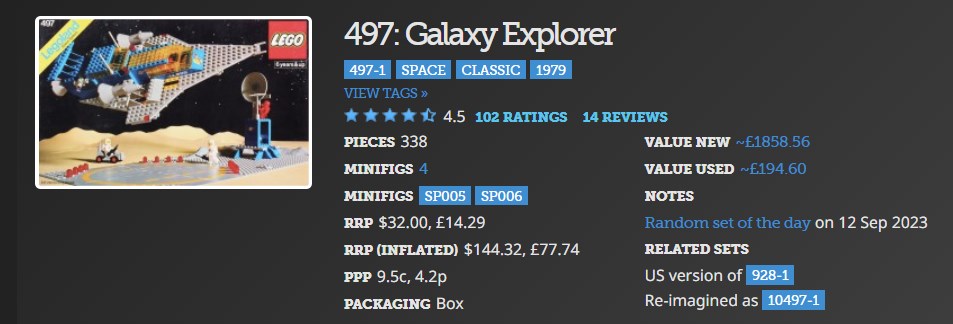
Obviously this information can only be shown when original RRPs are known. We have prices in USD and GBP for all retail sets released since 2007 and prices in USD for around half of them released before that.
Inflation figures have been obtained from InflationTool where it was easy to do so automatically, and checked against official sources at the Bank of England and the US bureau of labour statistics. There are some discrepancies, but it's close enough for our purposes.
The figures are shown on sets that were released more than five years ago, and I will add the inflated prices to the RSotD articles going forwards.
Thanks to Zytoep for adding the idea to our suggestion box, way back in 2022!
The other improvement I've made today is to add prev/next browsing links on minifig detail pages, which have been present on set detail pages for some time.

This was also the result of suggestions by AjaxAbacus and BS1122.
252 likes
81 comments on this article
These are both great improvements. Are there any plans to be able to sort by Inflation Adjusted RRP on the My Sets page?
Inflation in general is a poor metric of value that doesn't take into account consumer purchasing power. Cost of living and wages do not increase at the same rate of inflation - thus inflation almost always outpaces the amount of money consumers have. Take these extrapolated prices with a grain of salt.
Nice additions, thanks! It does put today's cost of Lego in perspective, though I think often people are comparing the cost of a set to what else they could buy with that money.
It would be great for a collaborative effort to identify typical retail prices for those sets where the info is missing, this could be from the likes of old Argos catalogues or even certain issues of Bricks N Pieces and would give some reasonable ballpark data points. There’s quite a lot of scans already online elsewhere which would help greatly, a labour of love for someone with time on their hands and unfortunately no I’m not able to volunteer at this stage!
@8lackmagic said:
"These are both great improvements. Are there any plans to be able to sort by Inflation Adjusted RRP on the My Sets page?"
Done
Nice additions!
As for the prices though, wouldn't it be an option to let users select their currency and either just show that, or at least first? Something like "€199.99 (£179.99, $199.99)", or maybe the other currencies as a mouseover?
And next level: maybe an automatic currency converter for users with other currencies than $/£/€? Obviously with the caveat that those won't be the exact prices (and even less so for historical prices considering ever changing exchange rates), but it gives a ballpark idea.
@KeithB said:
"Nice additions, thanks! It does put today's cost of Lego in perspective, though I think often people are comparing the cost of a set to what else they could buy with that money."
We can ask @Huw to do that! He can manually add how much three basic products you can buy for the set in this time.
For example London Bus 40953 - 85eggs/21l of milk/20kg bananas
I like the inflation addition. I think people's idea of value is still based on sets from 10+ years ago, and inflation has gone up quite a lot even since then.
Excellent, much needed addition, thanks. Hopefully it will reduce the number of daft "I know all about inflation but..." posts from people who clearly don't.
My 55p 1971 Legoland sets were always very expensive!
@Briczk said:
" @KeithB said:
"Nice additions, thanks! It does put today's cost of Lego in perspective, though I think often people are comparing the cost of a set to what else they could buy with that money."
We can ask @Huw to do that! He can manually add how much three basic products you can buy for the set in this time.
For example London Bus 40953 - 85eggs/21l of milk/20kg bananas"
Kgs of bananas is an excellent idea but I think fridges or TVs might be a more suitable unit of measurement for many of today's sets!
The price of bananas has been relatively stable since 1988, thus having reduced in real terms: https://www.ons.gov.uk/economy/inflationandpriceindices/timeseries/czmv . Lucky I didn't invest in them :-)
@WizardOfOss said:
"As for the prices though, wouldn't it be an option to let users select their currency and either just show that, or at least first? Something like "€199.99 (£179.99, $199.99)""
That's not a bad idea. It could show your currency first, based on your country. The main data set has prices in the three you quote and CAD. We have others but they are stashed away where it's difficult to get to them when lists are displayed.
Inflation adjusted PPP might also be nice because a lot of folk focus on that.
The function is very rudimentary since the function supposes the retail price comes from the year a set was first released, but most of the prices seem to me to come from the last day a set has been sold. This results in very whack calculations like 75978: Diagon Alley where it supposes the RRP of 449$ comes from 2020, not summer 2022. For most regular retail sets it would be easy to just set the year for the inflation calculation to the date it was last available, but for Diagon Alley the availability remained until 2025, which may still be useful but still skews the results quite a bit.
I do not really understand the need to calculate inflation, the resulting price never seems to match perceived reality and the old sets seem absurdly overpriced at the resulting numbers, even compared to the many absurd overpriced MSRPs of today. For example the 2018 TIE Fighter is said to be a 90$ set nowadays yet clearly we get a better value with todays sets than that and a similar TIE Fighter set would probably still have an MSRP of 70$ if released today.
Very interesting.
On the subject of original RRPs, I recently discovered a lot of my old childhood LEGO boxes in the attic at my parents' house. I thought that they had been thrown away decades ago, but apparently (luckily) not.
Some are still complete, of some only the front and/or back has been cut out and kept, but the most interesting thing is that some still have the original price sticker on them.
Will have to look up some of those old RRPs next time I'm there.
This is a fantastic addition to the site! seeing 71040 at the inflated price of $476 is sending me, LEGO is fundamentally expensive
The inflation feature is really an very good new feature. Congratulations, Thank you,
@Huw said:
" @8lackmagic said:
"These are both great improvements. Are there any plans to be able to sort by Inflation Adjusted RRP on the My Sets page?"
Done"
Thank-you! :-)
@Huw - it looks the "RRP (Inflated)" field in the Details box on set pages needs to be conditional so it only displays if a value is available (or, possibly, if the original RRP is available?). See 40527.
Is the inflation factor assessed from the release date/year or the retirement date/year of the set?
@CVilleBricks said:
"Is the inflation factor assessed from the release date/year or the retirement date/year of the set?"
According to the 2020 Diagon Alley set it is from release date despite that sets MSRP dating to July 2022-December 2025
@Anonym said:
" @CVilleBricks said:
"Is the inflation factor assessed from the release date/year or the retirement date/year of the set?"
According to the 2020 Diagon Alley set it is from release date despite that sets MSRP dating to July 2022-December 2025"
Is that an accurate time to add inflation factor? In most cases, the MSRP is static from launch to retirement, and inflation would benefit the consumer waiting to buy till right before retirement. I would think the retirement date is when you would want to apply the inflation factor. (I suppose this wouldn't be a big difference on many sets that have a 1-2 year shelf life, but for those like the Tower Bridge or MCS Falcon, the difference on when you applied inflation would be substantial.
@Huw said:
" @Briczk said:
" @KeithB said:
"Nice additions, thanks! It does put today's cost of Lego in perspective, though I think often people are comparing the cost of a set to what else they could buy with that money."
We can ask @Huw to do that! He can manually add how much three basic products you can buy for the set in this time.
For example London Bus 40953 - 85eggs/21l of milk/20kg bananas"
Kgs of bananas is an excellent idea but I think fridges or TVs might be a more suitable unit of measurement for many of today's sets!
The price of bananas has been relatively stable since 1988, thus having reduced in real terms: https://www.ons.gov.uk/economy/inflationandpriceindices/timeseries/czmv . Lucky I didn't invest in them :-)"
For the purpose of PPP, ‘The Economist’ magazine came up with the Big Mac Index. It’s a good that’s fairly consistent across geographies and time. I don’t know if historical Big Mac prices are readily available though - I imagine they are.
What a great site this is.
@sloopsjohng said:
" @Huw - it looks the "RRP (Inflated)" field in the Details box on set pages needs to be conditional so it only displays if a value is available (or, possibly, if the original RRP is available?). See 40527."
Fixed, thanks.
Original Retail Price:
Natural Inflation:
Big Orange Baby's "Hurt Feelings" Tax:
Big Orange Baby's "Diversionary War" Tax:
Post-Apocalyptic Worth In Potable Water/Human Life:
I like little details like this on this site.
On the fence about inflation adjusted prices though. Like Price per piece, there are just too many other variables at play. In 1971 we had the Gulden (Guilder), the British Pound was worth way more, the US Dollar way less. If we work out the inflation in Guilders, then divide it by 2,2 to get a Euro number, I'm fairly sure the number doesn't make sense when compared to the other currencies...
If we want to know if Lego is more expensive or not I guess something like Percentage Of Profit Per Set (POPPS) would be nice
@Anonym said:
" @CVilleBricks said:
"Is the inflation factor assessed from the release date/year or the retirement date/year of the set?"
According to the 2020 Diagon Alley set it is from release date despite that sets MSRP dating to July 2022-December 2025"
Thank you for pointing that out. It was based on launch date but I have recalculated the values to use the exit year if it's known, launch year if not.
At the moment the display of the numbers is still based on launch year, though, so it still displays on 75978 which launched >5 year ago, but the figures now look more reasonable, being based on exit year of 2025.
@AustinPowers said:
"Very interesting.
On the subject of original RRPs, I recently discovered a lot of my old childhood LEGO boxes in the attic at my parents' house. I thought that they had been thrown away decades ago, but apparently (luckily) not.
Some are still complete, of some only the front and/or back has been cut out and kept, but the most interesting thing is that some still have the original price sticker on them.
Will have to look up some of those old RRPs next time I'm there. "
I currently have a 6274 with box, and the price tag says $42.99 (USD). Guess it was on sale!
@dimc said:
" @AustinPowers said:
"Very interesting.
On the subject of original RRPs, I recently discovered a lot of my old childhood LEGO boxes in the attic at my parents' house. I thought that they had been thrown away decades ago, but apparently (luckily) not.
Some are still complete, of some only the front and/or back has been cut out and kept, but the most interesting thing is that some still have the original price sticker on them.
Will have to look up some of those old RRPs next time I'm there. "
I currently have a 6274 with box, and the price tag says $42.99 (USD). Guess it was on sale!"
I don't know where Brickset gets historic USD prices, but if it's from Lego catalogs, this may explain the discrepancy. I may be incorrect, but I seem to remember the US Lego catalogs listed a price that included shipping (and maybe tax?), whereas US stores listed pre-tax prices (with no shipping, natch). I could be making this up, though
@Norikins said:
"Inflation in general is a poor metric of value that doesn't take into account consumer purchasing power. Cost of living and wages do not increase at the same rate of inflation - thus inflation almost always outpaces the amount of money consumers have. Take these extrapolated prices with a grain of salt."
This. As much as inflation is often fun to consider in these discussions about modern pricing, it fails to accurate contextualize pricing in relation to wages (in the US, stagnant since the late 2000s) and the enormous raise in the cost of living as well. Obviously, I don't think there's an easy way to equate this into a simple number, as that's a much more interpretative and contextual thing, but I do wish there was a bit more pushback on inflation being used this way. However, most of the reason people want this is to throw out a "gotcha!" in online arguments, so I figure it'll do well for this purpose.
Regardless - I am not against intriguing new information being added into the database. It'll be interesting to look through sets and surmise...
@dimc said:
" @AustinPowers said:
"Very interesting.
On the subject of original RRPs, I recently discovered a lot of my old childhood LEGO boxes in the attic at my parents' house. I thought that they had been thrown away decades ago, but apparently (luckily) not.
Some are still complete, of some only the front and/or back has been cut out and kept, but the most interesting thing is that some still have the original price sticker on them.
Will have to look up some of those old RRPs next time I'm there. "
I currently have a 6274 with box, and the price tag says $42.99 (USD). Guess it was on sale!"
On the subject of discounts, when I was a kid the local brick and mortar toy stores typically didn't offer any discounts, so the price on the box should have been the RRP in most cases.
If you wanted discounts on toys (in Germany in the late Eighties and Nineties) you basically had to buy from SMDV, a discount retailer that only sold by mail-order catalogue. They had many toy brands on offer, like LEGO, Playmobil, Steiff, etc. as well as model railway brands like Fleischmann, Märklin etc.
They typically had discounts between 10 and 30 percent, depending on the product.
Luckily again I have kept most of the old catalogues. I can look up some of their prices for LEGO sets, likely over the weekend.
It's a shame so much euro data seems to be missing. And yes, I mean after the euro debuted of course.
At least it helps to put prices from ca 8 years ago into perspective.
@Binnekamp said:
"It's a shame so much euro data seems to be missing. And yes, I mean after the euro debuted of course.
At least it helps to put prices from ca 8 years ago into perspective."
I can't remember when we started gathering € prices but it was much later than 2007.
This is fantastic! Saves a lot of time of copying numbers to an external site to do the mandatory calculation.
I also love the idea that having these numbers right on the site will deeply bother a lot of folks who refuse to accept that LEGO has always been expensive and instead insist the phenomenon was introduced just a few years ago by mandate of Disney. "See, when I was a kid, $9.50 got you four vehicles, a dozen minifigs and a modular-sized building on a giant raised baseplate mm-hmm yep I remember it clear as day."
I don't know if @Huw did this on purpose but the set used (497) is a great example of why this is largely pointless.
The set has a flat baseplate which costs £8 now and a raised baseplate that Lego stop making because they cost too much to make. These are just 2 of the 338 parts and could easily cost £20 in today's money. Older sets tend to have less small parts so will look expensive when doing a simple comparison like this but compare it to a set of similar size rather than similar number of pieces and it will hold up a lot better.
Then you have the problem that's already been outlined around the usefulness of using any inflation figure and issues around different currencies. None of this comes anywhere near telling you what the average person could buy for an hours wage for example.
Almost all of Bricksets data is absolute, even data that could be misleading like price per piece is directly factual. I am not a big fan of this interpretive data, as it will lead to people using it as fact. The comment section of every new set will now see some people using it to justify almost any price.
@theJANG said:
"This is fantastic! Saves a lot of time of copying numbers to an external site to do the mandatory calculation.
I also love the idea that having these numbers right on the site will deeply bother a lot of folks who refuse to accept that LEGO has always been expensive and instead insist the phenomenon was introduced just a few years ago by mandate of Disney. "See, when I was a kid, $9.50 got you four vehicles, a dozen minifigs and a modular-sized building on a giant raised baseplate mm-hmm yep I remember it clear as day.""
Several contracts for the Hasbro Star Wars license are publicly available and confirm that Disney kept continually raising the percentage of their royalties with every contract renewal, you can not claim that to be untrue at least.
@TeaWeevil said:
" @dimc said:
" @AustinPowers said:
"Very interesting.
On the subject of original RRPs, I recently discovered a lot of my old childhood LEGO boxes in the attic at my parents' house. I thought that they had been thrown away decades ago, but apparently (luckily) not.
Some are still complete, of some only the front and/or back has been cut out and kept, but the most interesting thing is that some still have the original price sticker on them.
Will have to look up some of those old RRPs next time I'm there. "
I currently have a 6274 with box, and the price tag says $42.99 (USD). Guess it was on sale!"
I don't know where Brickset gets historic USD prices, but if it's from Lego catalogs, this may explain the discrepancy. I may be incorrect, but I seem to remember the US Lego catalogs listed a price that included shipping (and maybe tax?), whereas US stores listed pre-tax prices (with no shipping, natch). I could be making this up, though "
Mostly correct. US Shop At Home catalog quoted prices inclusive of shipping and handling, so they were always more expensive than MSRP. I recently dug out some old Shop At Home catalogs to compare them with my own records of retail price, and it looked like reasonably-sized sets would usually have a markup of around 10% or less. Smaller sets had a bigger percentage.
https://brickset.com/article/130175/random-set-of-the-day-briefcase-set
No sales tax was included. Sales tax is never included in the purchase price in the US; it's not like VAT. Sales tax wasn't even charged unless you were a resident of Connecticut, due to US supreme court decision which only permitted sales tax to be levied against purchases inside a state. (That decision was overturned in 2018.)
When they switched over to separate S&H, the calculation table for the full order was as follows:
Up to $20 = $2.50
$20.01–$50 = $4.50
$50.01–$75 = $6.50
$75.01–$125 = $8.50
$125+ = $10.00
Unfortunately, you can't just use that table and subtract, even for prices right at the conversion in 2000. Smaller sets had smaller markups. For example:
6626-2 was $2.50, became $1.99 (25%)
6579 was $5.50, became $4.99 (10%)
6473 was $38.50, became $34.99 (10%)
6096 was $55.00, became $49.99 (10%)
4561 was $139.00, became $129.99 (7%)
(apologies for the lameness of those sets; it was 2000)
@Huw
Can you please add a check-mark filter to the inflation RRP so that it does not show on our page if we don't use/need it? I really like to see just one factual price and not an imaginary number that does not factor country specific inflation, or RRP price adjustments during the set's lifespan or when it exited the market, other that what LEGO defines as EOL (which is not the last day of when a set leaves the general market).
Why does it matter how much a set would cost in today's money? If investors need this data they will use brickeconomy anyway. All this info will "help" do is jack up the prices of second hand sets that are retired even more than they already are.
@AllenSmith said:
" @TeaWeevil said:
" @dimc said:
" @AustinPowers said:
"Very interesting.
On the subject of original RRPs, I recently discovered a lot of my old childhood LEGO boxes in the attic at my parents' house. I thought that they had been thrown away decades ago, but apparently (luckily) not.
Some are still complete, of some only the front and/or back has been cut out and kept, but the most interesting thing is that some still have the original price sticker on them.
Will have to look up some of those old RRPs next time I'm there. "
I currently have a 6274 with box, and the price tag says $42.99 (USD). Guess it was on sale!"
I don't know where Brickset gets historic USD prices, but if it's from Lego catalogs, this may explain the discrepancy. I may be incorrect, but I seem to remember the US Lego catalogs listed a price that included shipping (and maybe tax?), whereas US stores listed pre-tax prices (with no shipping, natch). I could be making this up, though "
Mostly correct. US Shop At Home catalog quoted prices inclusive of shipping and handling, so they were always more expensive than MSRP. I recently dug out some old Shop At Home catalogs to compare them with my own records of retail price, and it looked like reasonably-sized sets would usually have a markup of around 10% or less. Smaller sets had a bigger percentage.
https://brickset.com/article/130175/random-set-of-the-day-briefcase-set
No sales tax was included. Sales tax is never included in the purchase price in the US; it's not like VAT. Sales tax wasn't even charged unless you were a resident of Connecticut, due to US supreme court decision which only permitted sales tax to be levied against purchases inside a state. (That decision was overturned in 2018.)
When they switched over to separate S&H, the calculation table for the full order was as follows:
Up to $20 = $2.50
$20.01–$50 = $4.50
$50.01–$75 = $6.50
$75.01–$125 = $8.50
$125+ = $10.00
Unfortunately, you can't just use that table and subtract, even for prices right at the conversion in 2000. Smaller sets had smaller markups. For example:
6626-2 was $2.50, became $1.99 (25%)
6579 was $5.50, became $4.99 (10%)
6473 was $38.50, became $34.99 (10%)
6096 was $55.00, became $49.99 (10%)
4561 was $139.00, became $129.99 (7%)
(apologies for the lameness of those sets; it was 2000)"
Oh that's right, I had completely forgotten about the change in sales tax. Thank you for doing the research based on my vague memory
Lego actually put up their own inflation calculator a few years ago, though it only works with certain themes, all of them Disney licenses. Just do a Google search for "mickey mouse inflation"
@R0Sch said:
" @Huw All this info will "help" do is jack up the prices of second hand sets that are retired even more than they already are."
I dream of Cafe Corner being 'jacked up' to £140!
It seems its addition has divided opinion...
@Huw said:
"It seems its addition has divided opinion..."
I think @ROSch suggestion make sense: A check box. You want it, you got it, enjoy! Don't want it? Done. Everybody happy as a cucumber.
Personally I don't care much - but don't mind seeing the info as a reference. I bought "overpriced" sets and I refused to buy "cheap/value" sets because, at the end, it all depends on what I like and what represents value to me specifically.
An interesting addition that got me thinking.
I'm mulling over whether differences in the price-to-part ratio between older sets and newer sets is an example of supply-side deflation. That is, where the price of something over time declines due to increases in production capacity, technological advancements, and lower production costs.
In this case I think an argument could be made that Lego parts/elements have actually experienced deflation in real terms over time, accepting that the term 'parts' is an imperfect measure as parts are not uniform so its more of an average metric.
I think that over time the value of sets versus the value of parts is becoming increasingly detached. That is, sets are holding their value in real terms, while the average value of parts is gradually declining as Lego produces more parts and the average number of parts in sets increases. You might call this part deflation.
This matters because all things being equal you would normally expect that at some point sets would become less valuable (impacting on what Lego can charge for them) if the parts that made them up gradually become more available and less valuable. However, Lego know this and have a solution - releasing a steady supply of new parts and colours over time to ensure that an oversupply of parts doesn't ultimately hurt demand. Licensing IPs for sets also helps to maintain their novelty and value.
That will work for a time, but I can't help thinking that there's a tipping point where the quantity of available parts in the world will start to impact on demand for sets. We clearly aren't there yet, as Lego has managed to increase demand by massively broadening its market, including adding a layer of much larger and more expensive sets targeting adults. But at some point I wonder if we might reach a point of saturation.
Also, while Lego had the exclusive right to produce Lego parts historically, there are now other companies that manufacture Lego-compatible parts now, often to quite a high quality standard, which may undermine Lego's competitive advantage. I know using these products might seem like sacrilege to core Lego fans, but economics tells us that when the price for one product rises and there is a substitute available that is cheaper, increases in price can drive more consumers to the substitute product.
Good idea, let's add PPP inflated too, to make things more complicated. PPP is another useless metric that tells zero about the value of a set. Not even the sets weight can be used reliably because minifigures, rubber wheels and electronics mess up the statistics. Old sets had fewer pieces because the elements were larger and the sets less complex. Now they are jam packed with 1x1 elements or pins that cost near nothing, but most people are judging by PPP as if it had real importance.
@HOBBES said:
" @Huw said:
"It seems its addition has divided opinion..."
I think @ROSch suggestion make sense: A check box. You want it, you got it, enjoy! Don't want it? Done. Everybody happy as a cucumber."
I'm on it...
How about the weight of sets NOT including the booklet instructions. The instructions for 6398 Central Precinct HQ are skinny by current standards.
Huw, you’re the last true DBA.
I salute your skill at data manipulation, sir.
@Huw said:
" @HOBBES said:
" @Huw said:
"It seems its addition has divided opinion..."
I think @ROSch suggestion make sense: A check box. You want it, you got it, enjoy! Don't want it? Done. Everybody happy as a cucumber."
I'm on it...
"
@HUW - We need to give you a raise!
@Norikins said:
"Inflation in general is a poor metric of value that doesn't take into account consumer purchasing power. Cost of living and wages do not increase at the same rate of inflation - thus inflation almost always outpaces the amount of money consumers have. Take these extrapolated prices with a grain of salt."
It's amazing to me how stubborn some folks are in refusing to acknowledge the reality of inflation. Inflation precisely is a measure of the purchasing power of the currency.
Yes, in the US wages have stagnated (more or less) for the past several decades. That's a bad thing to be sure - but they have stagnated in REAL terms, in other words they have remained more or less the same WHEN ADJUSTED FOR INFLATION, So as it happens, inflation is an excellent measure, at least in the US, because wages are more or less the same now as they were in the late 1970s and '80s.
You are of course correct that certain key costs - most notably housing, healthcare, and higher education - have risen way faster than inflation. Again, that's a bad thing, especially since wages have only kept pace with inflation. But in that case the problem isn't that Lego is more expensive than it used to be - the problem is that housing and healthcare are WAY more expensive than they used to be and wages have not grown in real terms to help everyone afford that.
Of course that's a much more nuanced and less satisfying explanation than, "I don't care what anyone says, Lego is more expensive than it ever was and it's too expensive because Lego is greedy." But the more nuanced explanation is also the true one. Lego is not more expensive on the whole - consumers in many countries have less disposable income after paying for necessities than they did decades ago. That's what's changed.
@Anonym said:
"I do not really understand the need to calculate inflation, the resulting price never seems to match perceived reality and the old sets seem absurdly overpriced at the resulting numbers, even compared to the many absurd overpriced MSRPs of today. For example the 2018 TIE Fighter is said to be a 90$ set nowadays yet clearly we get a better value with todays sets than that and a similar TIE Fighter set would probably still have an MSRP of 70$ if released today."
Your comment illustrates exactly why accounting for inflation is so important: precisely because "the resulting price never seems to match the perceived reality." What you and so many others can't seem to understand or accept is precisely that your "perceived reality" is simply wrong.
That's the point - "there's no way a set priced at $30 many years ago would really cost $120 today" - but the data on inflation tells us that Yes, in fact, that is how it works. There are many goods and services that were sold many years ago and are still sold today and we can see how their prices have increased with inflation. The data is right there - but so many folks simply refuse to acknowledge it. It's quite stunning actually.
Inflationary costs are obviously playing on a lot of peoples mind. Last weekend I was buying some small city car sets to play with my 5yr nephew when he visits and was looking at the prices and remembering the last time I bought a small Lego Town car in the late 80's and it only cost $3.50AUD (which was a lot back then!). A Google search later and I found that $3.50 from 1988 was equivalent to about $8.50 Aussieroos now.
But then I thought about the volume of what those few little town cars you could get in Australia back then (Lego was not big in the 80;s here) and looked at the new single City car sets that are about $15 now and what you get now definitely feels like better value for the volume. Especially when you think about how much more versatile the parts are now also to building other things.
In conclusion, yes Lego is expensive, but it always has been and thinking back to when my widowed mum with 5 kids got me my first Lego set at in 1982, it was a big big thing that at 7 I did not appreciate but now I can, though mum regrets as she lives with me and even though it's tough on a disability pension, my Lego collection takes up nearly half the house now :P
@AustinPowers said:
"Very interesting.
On the subject of original RRPs, I recently discovered a lot of my old childhood LEGO boxes in the attic at my parents' house. I thought that they had been thrown away decades ago, but apparently (luckily) not.
Some are still complete, of some only the front and/or back has been cut out and kept, but the most interesting thing is that some still have the original price sticker on them.
Will have to look up some of those old RRPs next time I'm there. "
I too have all of the boxes to my sets from the late 70's into the 80's and early 90's. Many or almost all of the sets across several themes still have the price stickers on them, and I have those original prices listed on my own personal inventory of my sets. A good example is set 542 which cost $3.42 or 956 which cost $34.99.
@TBOC said:
" @Norikins said:
"Inflation in general is a poor metric of value that doesn't take into account consumer purchasing power. Cost of living and wages do not increase at the same rate of inflation - thus inflation almost always outpaces the amount of money consumers have. Take these extrapolated prices with a grain of salt."
This. As much as inflation is often fun to consider in these discussions about modern pricing, it fails to accurate contextualize pricing in relation to wages (in the US, stagnant since the late 2000s) and the enormous raise in the cost of living as well. Obviously, I don't think there's an easy way to equate this into a simple number, as that's a much more interpretative and contextual thing, but I do wish there was a bit more pushback on inflation being used this way. However, most of the reason people want this is to throw out a "gotcha!" in online arguments, so I figure it'll do well for this purpose.
Regardless - I am not against intriguing new information being added into the database. It'll be interesting to look through sets and surmise..."
'This' to the 'This'... Its just another 'PPP' for the LEGO cheerleaders to justify the ever increasing prices of the sets, for not a lot back mind you.
@KeithB said:
"Nice additions, thanks! It does put today's cost of Lego in perspective, though I think often people are comparing the cost of a set to what else they could buy with that money."
More frequently, they compare the cost of a set today with the non-inflation-adjusted price of an older set of the same physical size, and complain about how the modern set with a much higher piece count has a higher MSRP several decades later. The only way that's going to stop is if TLG comes right out and publishes a breakdown of what it costs to mold parts of different sizes and complexity, and get them to market in a set. But they'd have to cover at least the past few decades, with and without inflation adjustments thrown in, to have any chance of getting that to stop.
Incredible update! Is it possible to have inflation adjusted prices within the data when doing "Download results as CSV" for your BrickLists?
@PurpleDave said:
" @KeithB said:
"Nice additions, thanks! It does put today's cost of Lego in perspective, though I think often people are comparing the cost of a set to what else they could buy with that money."
More frequently, they compare the cost of a set today with the non-inflation-adjusted price of an older set of the same physical size, and complain about how the modern set with a much higher piece count has a higher MSRP several decades later. The only way that's going to stop is if TLG comes right out and publishes a breakdown of what it costs to mold parts of different sizes and complexity, and get them to market in a set. But they'd have to cover at least the past few decades, with and without inflation adjustments thrown in, to have any chance of getting that to stop."
"Any" chance? Yeah, I suppose there's *a* chance that they'd stop if Lego did that, but I wouldn't hold my breath.
@TheOtherMike said:
" @PurpleDave said:
" @KeithB said:
"Nice additions, thanks! It does put today's cost of Lego in perspective, though I think often people are comparing the cost of a set to what else they could buy with that money."
More frequently, they compare the cost of a set today with the non-inflation-adjusted price of an older set of the same physical size, and complain about how the modern set with a much higher piece count has a higher MSRP several decades later. The only way that's going to stop is if TLG comes right out and publishes a breakdown of what it costs to mold parts of different sizes and complexity, and get them to market in a set. But they'd have to cover at least the past few decades, with and without inflation adjustments thrown in, to have any chance of getting that to stop."
"Any" chance? Yeah, I suppose there's *a* chance that they'd stop if Lego did that, but I wouldn't hold my breath."
I said "chance", not "guarantee".
It seems to quite readily demonstrate that sets these days are massively more expensive than what they were years ago, especially when you take into consideration average wages and the overall buying power people had then versus now.
For example, with an adjusted RRP of $47, the value of 1788 - Treasure Chest (released in 1995) just completely blows 75647 - Gum-Gum Fruit out of the water in terms of what you actually get. Even if the cost of Gum-Gum Fruit was lowered by $20, I still don't think it can compete in terms of value.
Personally, I've never really bought into the price per part metric. It has never really made sense to me unless you're comparing sets released the same or within a few years of each other.
This is always extremely weird to me as a discussion because, well, all my childhood Lego was from picking up boxes of loose parts at jumble sales or as general hand-me-downs. Kits were expensive. The whole once-Lego-was-affordable-now-it-isn’t seems bizarre because… when exactly. Certainly wasn’t in the 90s.
@madforLEGO said:
" @TBOC said:
" @Norikins said:
"Inflation in general is a poor metric of value that doesn't take into account consumer purchasing power. Cost of living and wages do not increase at the same rate of inflation - thus inflation almost always outpaces the amount of money consumers have. Take these extrapolated prices with a grain of salt."
This. As much as inflation is often fun to consider in these discussions about modern pricing, it fails to accurate contextualize pricing in relation to wages (in the US, stagnant since the late 2000s) and the enormous raise in the cost of living as well. Obviously, I don't think there's an easy way to equate this into a simple number, as that's a much more interpretative and contextual thing, but I do wish there was a bit more pushback on inflation being used this way. However, most of the reason people want this is to throw out a "gotcha!" in online arguments, so I figure it'll do well for this purpose.
Regardless - I am not against intriguing new information being added into the database. It'll be interesting to look through sets and surmise..."
'This' to the 'This'... Its just another 'PPP' for the LEGO cheerleaders to justify the ever increasing prices of the sets, for not a lot back mind you. "
No, it's a reminder that you're just asserting that Lego is more expensive now than it was back in the old days, when that isn't actually true. The fact that it feels true doesn't magically make it so.
@Vesperas said:
"It seems to quite readily demonstrate that sets these days are massively more expensive than what they were years ago, especially when you take into consideration average wages and the overall buying power people had then versus now.
For example, with an adjusted RRP of $47, the value of 1788 - Treasure Chest (released in 1995) just completely blows 75647 - Gum-Gum Fruit out of the water in terms of what you actually get. "
I'm sorry, but this is just complete nonsense - you're comparing these two sets based on a tenuous link of "pirate/seas" theme, and you're asserting that the older set gives you much more, when that's just your subjective view. I happen to agree with you on that, actually, but that's because I'm in my 50s and grew up with Lego, and 1788 speaks much more to me as something I like and would enjoy. But that doesn't mean 1788 - with an inflation-adjusted ppp of 30 cents! - offers better value for everyone. Your and my personal preference for what type of Lego set appeals to us has absolutely, positively nothing to do with the question of whether Lego is more expensive today. I don't know why folks are so incapable of distinguishing between their own personal preferences and these unsupported objective claims. And while we're at it, I also don't get why so many AFOLs seem so invested in being so needlessly and gratuitously negative about a toy and a hobby.
@tmtomh said:
" @Vesperas said:
"It seems to quite readily demonstrate that sets these days are massively more expensive than what they were years ago, especially when you take into consideration average wages and the overall buying power people had then versus now.
For example, with an adjusted RRP of $47, the value of 1788 - Treasure Chest (released in 1995) just completely blows 75647 - Gum-Gum Fruit out of the water in terms of what you actually get. "
I'm sorry, but this is just complete nonsense - you're comparing these two sets based on a tenuous link of "pirate/seas" theme, and you're asserting that the older set gives you much more, when that's just your subjective view. I happen to agree with you on that, actually, but that's because I'm in my 50s and grew up with Lego, and 1788 speaks much more to me as something I like and would enjoy. But that doesn't mean 1788 - with an inflation-adjusted ppp of 30 cents! - offers better value for everyone. Your and my personal preference for what type of Lego set appeals to us has absolutely, positively nothing to do with the question of whether Lego is more expensive today. I don't know why folks are so incapable of distinguishing between their own personal preferences and these unsupported objective claims. And while we're at it, I also don't get why so many AFOLs seem so invested in being so needlessly and gratuitously negative about a toy and a hobby."
I'm looking at it as someone without any investment in the One Piece franchise, comparing a set recently announced, to one arbitrarily from ~30 years ago of approximate cost and theme. My assessment comes from looking at what is actually provided. Treasure Chest is the clear winner in every conceivable way unless you have some attachment to One Piece or are someone who doesn't care about the set at all and are just looking to part it out for something else.
1) I asked my daughter which she liked more (either or) and she agreed, and 2) taking the price difference into account, you could mod Treasure Chest to modernize it and make it undeniably superior at equal cost. There's nothing to really debate about it.
@Vesperas said:
" @tmtomh said:
" @Vesperas said:
"It seems to quite readily demonstrate that sets these days are massively more expensive than what they were years ago, especially when you take into consideration average wages and the overall buying power people had then versus now.
For example, with an adjusted RRP of $47, the value of 1788 - Treasure Chest (released in 1995) just completely blows 75647 - Gum-Gum Fruit out of the water in terms of what you actually get. "
I'm sorry, but this is just complete nonsense - you're comparing these two sets based on a tenuous link of "pirate/seas" theme, and you're asserting that the older set gives you much more, when that's just your subjective view. I happen to agree with you on that, actually, but that's because I'm in my 50s and grew up with Lego, and 1788 speaks much more to me as something I like and would enjoy. But that doesn't mean 1788 - with an inflation-adjusted ppp of 30 cents! - offers better value for everyone. Your and my personal preference for what type of Lego set appeals to us has absolutely, positively nothing to do with the question of whether Lego is more expensive today. I don't know why folks are so incapable of distinguishing between their own personal preferences and these unsupported objective claims. And while we're at it, I also don't get why so many AFOLs seem so invested in being so needlessly and gratuitously negative about a toy and a hobby."
I'm looking at it as someone without any investment in the One Piece franchise, comparing a set recently announced, to one arbitrarily from ~30 years ago of approximate cost and theme. My assessment comes from looking at what is actually provided. Treasure Chest is the clear winner in every conceivable way unless you have some attachment to One Piece or are someone who doesn't care about the set at all and are just looking to part it out for something else.
I asked my daughter which she liked more and she even agreed. I'm not sure what there is to debate about it. "
The “attachment to One Piece” seems like an extremely key aspect of being interested and finding value in a One Piece set, though, doesn’t it? Otherwise all the little references will mean next to nothing to you. I don’t expect to be interested in kits for themes I’m not interested in, and they will never compare favourably to a kit for a theme I am interested in when I’m assessing its value to me.
But it doesn’t say very much about the kit.
@Vesperas said:
"It seems to quite readily demonstrate that sets these days are massively more expensive than what they were years ago, especially when you take into consideration average wages and the overall buying power people had then versus now."
It says precisely the opposite. Say you took a Hot Wheels die-cast car and ran it through this with an original MSRP of $X, giving us an adjusted MSRP of $Y, and we compared that to a modern MSRP of $Z. If Y was lower than Z, it would show us that the price of a Hot Wheels had risen faster than inflation. If Y was greater than Z, it would show that the relative cost of a Hot Wheels had actually gone down over time, but what we're seeing is that cost has more than halved in that time.
"For example, with an adjusted RRP of $47, the value of 1788 - Treasure Chest (released in 1995) just completely blows 75647 - Gum-Gum Fruit out of the water in terms of what you actually get. Even if the cost of Gum-Gum Fruit was lowered by $20, I still don't think it can compete in terms of value."
And that is a wholly subjective call. To a One Piece fan, that fruit probably makes your set look like something designed for preschoolers.
"Personally, I've never really bought into the price per part metric. It has never really made sense to me unless you're comparing sets released the same or within a few years of each other."
Just because you don't believe in a thing doesn't make it not true. Price per piece works so well as a metric because piece count is entirely objective, and PPP has remained so stable over half a century. Yes, that basically shows it's a sliding scale, but it shows that sets are getting less expensive, not more as so many in this hobby are claiming.
@PurpleDave said:
" @Vesperas said:
"It seems to quite readily demonstrate that sets these days are massively more expensive than what they were years ago, especially when you take into consideration average wages and the overall buying power people had then versus now."
It says precisely the opposite. Say you took a Hot Wheels die-cast car and ran it through this with an original MSRP of $X, giving us an adjusted MSRP of $Y, and we compared that to a modern MSRP of $Z. If Y was lower than Z, it would show us that the price of a Hot Wheels had risen faster than inflation. If Y was greater than Z, it would show that the relative cost of a Hot Wheels had actually gone down over time, but what we're seeing is that cost has more than halved in that time.
"For example, with an adjusted RRP of $47, the value of 1788 - Treasure Chest (released in 1995) just completely blows 75647 - Gum-Gum Fruit out of the water in terms of what you actually get. Even if the cost of Gum-Gum Fruit was lowered by $20, I still don't think it can compete in terms of value."
And that is a wholly subjective call. To a One Piece fan, that fruit probably makes your set look like something designed for preschoolers.
"Personally, I've never really bought into the price per part metric. It has never really made sense to me unless you're comparing sets released the same or within a few years of each other."
Just because you don't believe in a thing doesn't make it not true. Price per piece works so well as a metric because piece count is entirely objective, and PPP has remained so stable over half a century. Yes, that basically shows it's a sliding scale, but it shows that sets are getting less expensive, not more as so many in this hobby are claiming."
This is a bunch of nonsense.
It has double the minifigures, a canoe, a baseplate, accessories, play features such as a hidden compartment with gold, mostly printed parts, a crocodile, a palm tree and a working cannon. This is before you take into account that, even when adjusted for inflation, you still have an additional $23 to modify it as you please to achieve cost parity. In fact, if you spent that $23 on small parts like bricks, plates and slopes for modifying the set with landscaping, you'll undoubtedly even end up with a higher part count.
For the sake of a quick, arbitrary comparison, you could buy the Treasure Chest set at the adjusted $47 and an additional 575 brand new dark bluish gray masonry bricks at 4c each on Bricklink, leading to a total part count well above that of the One Piece set, on top of everything else.
Furthermore, if you took the One Piece association away by replacing the two minifigures with two, similar, generic minifigures like you'd see in one of the Bricklink Designer sets, this discussion immediately ends--whatever perceived value you're proposing it has practically evaporates into nothing by comparison.
Price per piece is, and has always been, a terrible measure of value. If it were that simple the Classic Brick sets would sell better than the licensed themed sets, which is the complete opposite of reality. Furthermore, price differences in parts can be massively different and even unpredictable--so much so that it renders the whole price per part system of weighing value to be utter garbage when comparing two sets with equal part counts.
A new, black 1x12 plate starts around 5 cents on Bricklink, while a 1x12 plate in dark brown starts around $3 on Bricklink.
The price per part logic simply has no way to accommodate this distortion in part value, even when comparing the exact same part, rendering it objectively useless. This is before you even compare highly desirable specialized parts, like raised baseplates or unique parts in highly sought after sets, like the light bluish gray door in Corner Cafe.
There's no way to foresee the value of any particular part in advance because it usually comes down to how rare it is, which is entirely dependent on where (which set) and how often LEGO decides to use it.
@Vesperas: If you're so intent on comparing a set from 1995 and a set from this year, then why don't you compare sets that have a less tenuous connection then both being about pirates? 1788 was meant to be played with, 75647 is meant to be displayed and looked at. A much better comparison would be 1786 and 60479, both of which are play sets themed around police transport vans. They even have a similar number of pieces. If we had price data for the former, it'd be a perfect comparison.
@Vesperas said:
"This is a bunch of nonsense."
Okay, so try this on for size. I grew up on the minifigure. I remember when the Pirates theme was introduced, and wanted several sets from that theme. I don't even remember this Treasure Chest set existing, which means I probably never desired it. I'm not a One Piece fan, either, but at least that giant fruit got my attention.
"It has double the minifigures, a canoe, a baseplate, accessories, play features such as a hidden compartment with gold, mostly printed parts, a crocodile, a palm tree and a working cannon."
So you're saying it's just a generic parts pack. That's a fair assessment. Except the cannon _didn't_ fire. Not in the US, at least. I had 6245, which came out six years earlier, and they still had the working plunger, but the spring had been left out.
"For the sake of a quick, arbitrary comparison, you could buy the Treasure Chest set at the adjusted $47 and an additional 575 brand new dark bluish gray masonry bricks at 4c each on Bricklink, leading to a total part count well above that of the One Piece set, on top of everything else."
Now you're buying parts below cost, which is cheating. Also, I have no interest in those parts.
"Furthermore, if you took the One Piece association away by replacing the two minifigures with two, similar, generic minifigures like you'd see in one of the Bricklink Designer sets, this discussion immediately ends--whatever perceived value you're proposing it has practically evaporates into nothing by comparison."
I mean, I wouldn't even pay five cents per piece for a Batman set that only includes generic minifigs, so that's a flawed argument.
"Price per piece is, and has always been, a terrible measure of value. If it were that simple the Classic Brick sets would sell better than the licensed themed sets, which is the complete opposite of reality. Furthermore, price differences in parts can be massively different and even unpredictable--so much so that it renders the whole price per part system of weighing value to be utter garbage when comparing two sets with equal part counts."
Okay, so ~25 years ago, there was a bulk tub that was already priced at an absurdly low PPP, and then it got discounted. Several of my club's charter members were buying multiple copies of that set. One of them still talks about stopping at K-Mart to buy them every payday. The thing is, a box of generic bricks doesn't hold much appeal, so the PPP needs to be unprofitably low before it's going to draw interest away from sets that are actually targeted at AFOLs. You can see the proof of that in aftermarket set prices. Or the fact that convention vendors don't stock up on bulk packs.
But you're right. PPP is a terrible measure of value. All that really matters is if you like the set enough to pay the price that's being asked (and ironically, some of the people who rail against PPP the loudest have the most trouble with this concept). PPP is, however, a good measure of whether a set is overpriced, provided you account for stuff that skews the metric, like dinosaurs, bigfigs, and one-off part designs that will be scrapped the instant the set is officially retired.
"A new, black 1x12 plate starts around 5 cents on Bricklink, while a 1x12 plate in dark brown starts around $3 on Bricklink."
And now you're back into aftermarket part prices, which is always an unfair comparison for new set prices. LEGO set prices need to account for production costs, which mean nothing to AFOLs.
@Hiratha said:
"This is always extremely weird to me as a discussion because, well, all my childhood Lego was from picking up boxes of loose parts at jumble sales or as general hand-me-downs. Kits were expensive. The whole once-Lego-was-affordable-now-it-isn’t seems bizarre because… when exactly. Certainly wasn’t in the 90s."
Never. The answer is they were never "affordable". They've always been a premium product. In January 1981, US federal minimum wage was raised to $3.35/hr. To buy a $50 set (which was frequently the flagship set of any less prominent theme of the day) with that wage, you needed two fulltime days of pre-tax pay to hand over to the cashier. Things get a little more complicated these days, as about half of US states have set minimum wages that are higher than the current federal floor, and that's not even accounting for local effective minimum wages. My state just raised minimum to $13.73 this year, at which point that same $50 set would only require four hours pre-tax pay to purchase. But at the same time, $200 has become a fairly common pricepoint, and that puts us right back at two full days' pay.
@TheOtherMike said:
" @Vesperas : If you're so intent on comparing a set from 1995 and a set from this year, then why don't you compare sets that have a less tenuous connection then both being about pirates? 1788 was meant to be played with, 75647 is meant to be displayed and looked at. A much better comparison would be 1786 and 60479 , both of which are play sets themed around police transport vans. They even have a similar number of pieces. If we had price data for the former, it'd be a perfect comparison."
1786 Jailbreak Joe cost $16.50, having just looked it up in the LEGO Shop at Home catalogue for Winter 1995, so I have added that information to the database.
@Vesperas said:
" @tmtomh said:
" @Vesperas said:
"It seems to quite readily demonstrate that sets these days are massively more expensive than what they were years ago, especially when you take into consideration average wages and the overall buying power people had then versus now.
For example, with an adjusted RRP of $47, the value of 1788 - Treasure Chest (released in 1995) just completely blows 75647 - Gum-Gum Fruit out of the water in terms of what you actually get. "
I'm sorry, but this is just complete nonsense - you're comparing these two sets based on a tenuous link of "pirate/seas" theme, and you're asserting that the older set gives you much more, when that's just your subjective view. I happen to agree with you on that, actually, but that's because I'm in my 50s and grew up with Lego, and 1788 speaks much more to me as something I like and would enjoy. But that doesn't mean 1788 - with an inflation-adjusted ppp of 30 cents! - offers better value for everyone. Your and my personal preference for what type of Lego set appeals to us has absolutely, positively nothing to do with the question of whether Lego is more expensive today. I don't know why folks are so incapable of distinguishing between their own personal preferences and these unsupported objective claims. And while we're at it, I also don't get why so many AFOLs seem so invested in being so needlessly and gratuitously negative about a toy and a hobby."
I'm looking at it as someone without any investment in the One Piece franchise, comparing a set recently announced, to one arbitrarily from ~30 years ago of approximate cost and theme. My assessment comes from looking at what is actually provided. Treasure Chest is the clear winner in every conceivable way unless you have some attachment to One Piece or are someone who doesn't care about the set at all and are just looking to part it out for something else.
1) I asked my daughter which she liked more (either or) and she agreed, and 2) taking the price difference into account, you could mod Treasure Chest to modernize it and make it undeniably superior at equal cost. There's nothing to really debate about it. "
Exactly - if someone has no investment in the theme/franchise then the One Piece set has little to no appeal to them and might not even make any sense. But - and I'm kind of stunned this even has to be spelled out - that's not in any way, shape, or form a supportable objective claim about how expensive Lego is or value for money. And for the 2nd time, I personally agree with you, and now your daughter - I would take a modernized 1788 over the Once Piece set. But that's our subjective preferences and for you and me it's based on our age and generation. Theme preference and expensive/value-for-money are not the same thing. And you know it - you (like many other AFOLs) simply refuse to acknowledge it.
@CapnRex101 said:
" @TheOtherMike said:
" @Vesperas : If you're so intent on comparing a set from 1995 and a set from this year, then why don't you compare sets that have a less tenuous connection then both being about pirates? 1788 was meant to be played with, 75647 is meant to be displayed and looked at. A much better comparison would be 1786 and 60479 , both of which are play sets themed around police transport vans. They even have a similar number of pieces. If we had price data for the former, it'd be a perfect comparison."
1786 Jailbreak Joe cost $16.50, having just looked it up in the LEGO Shop at Home catalogue for Winter 1995, so I have added that information to the database."
The thing is, Shop at Home prices back then had the shipping factored into the cost.
“If this One Piece kit wasn’t a One Piece kit, it wouldn’t be very good!”
Well, yeah. Because then it would just be an assortment of parts. The old Pirates kit would also be bad if you removed everything Piratey about it.
@PurpleDave
Thanks for the supporting data! I try not to let it irritate me too much but, well, it does. Affordable is relative to income.
@Hiratha said:
" @PurpleDave
Thanks for the supporting data! I try not to let it irritate me too much but, well, it does. Affordable is relative to income. "
I've been fighting this fight for nearly a quarter century. At that time, I ran the numbers on Star Wars sets (ignoring obvious outliers like the Droid Developer Kit and the minifig 3-packs) and City sets and proved that City sets cost more ($0.105/pc) than the "overpriced" SW sets ($0.095/pc).
I'm not sure why so many people are unable to understand this.
1) Creative Brick Boxes have a lot of parts and are usually priced extremely well. Does that mean they're more desirable or represent better value than play sets in the eyes of most people? The answer is obviously, no.
2) Compare 10333 (8.4c per piece) versus 11373 (13c per piece). Despite the large difference in price per part and 10333 representing a much better value, the praise for 11373 indicates it's still a highly desirable set. In fact, based on what I've seen, it seems like many people don't even really care about the helmet. They just want the minifigure. However, priced at over $400, 10333 is clearly too expensive for many people to justify despite including the same minifigure and allegedly representing a much better value. In this case, the number of pieces and price per piece are fully irrelevant, indicating that LEGO sets are just too expensive.
3) Expense is the cost of something at the time of purchase. No full-time employee spent an entire paycheck on a single LEGO set in 1995. Even if you made minimum wage, you could still afford the largest, most expensive set in a single paycheck if you really wanted it.
There were also numerous, high quality sets anyone could readily afford within one hour of work making minimum wage in 1995. Based on data from the U.S. Bureau of Labor Statistics, the median net pay (or take home pay) in the state I live was $13 per hour in 1995. In 2025, it was $20 per hour. Sure, people are making more but at 113% inflation, they don't have anywhere near the same level of buying power.
Just because a set has more pieces doesn't mean it's cheaper or magically more affordable.
As for value... I maintain that determining value based purely on piece counts is garbage.
I can readily declare this because I have a daughter and I was once a kid myself. Comically enough, despite having numerous, newer sets of her own that she wanted or showed interest in (a few of which that are larger and more expensive), her favorite set ended up being my old scuffed up 6949 - Robo-Guardian that I pieced back together after retrieving my old sets from my parents attic. She's 13 years old now and her LEGO collection hasn't seen the light of day for awhile but she still has that thing sitting proudly on her dresser.
As for determining the physical value of a set based on the number of pieces...
1) Go to LEGO.com.
2) Go to Bricks & Pieces.
Do the parts all cost the same?
No? Well, now that we've established that the number of parts doesn't tell us much of anything and that attempting to establish the value of a set based strictly on how many parts it has is absolute nonsense, ending PurpleDave's quarter of century fight in all of three seconds (whew, that was hard!), maybe we can look at what does...
There are obviously several trends, e.g., transparent parts being more expensive than their non-transparent counterparts, but it looks like the most expensive parts tend to be functional, specialized and printed parts, assemblies with moving parts (like minifigure scale horses) but above all, large parts.
None of which is surprising. If you don't get it, just look at Duplo.
So, if LEGO charges $11 (!) for a 32x32 baseplate right now, how much do you think you'd have to spend for a raised, printed, 32x32 baseplate like what you see in Fire Breathing Fortress if it was offered right now direct from LEGO?
$40? $50?
Suddenly, the newer, high piece count sets padded with 1x1 plates, tiles and cheese slopes worth a few cents each don't seem all that amazing from a value perspective. This is especially true when you realize those part counts are inflated by plate stacking to create bricks. If you don't believe it, feel free to take a look at book one, step 63 of the aforementioned 10333, where you're instructed to stack three, medium nougat 1x2 plates to create a 1x2 medium nougat brick, despite 1x2 medium nougat bricks appearing elsewhere in the same exact set (another thing PurpleDave was wrong about, having claimed before that it's not a thing and never happens).
Facetious comments aside, whether someone would rather have a bunch of plates, bricks and slopes to create their own foundation or a single, huge baseplate is bound to be subjective but it's blatantly obvious that large, specialized and printed pieces cost more and have more inherent value than individual, smaller, generic pieces. Anyone that argues otherwise is detached from reality. I also think it's a big part of why LEGO has moved away from them. Unlike smaller parts, large, specialized parts are more difficult to reuse. I'm sure it's far more cost effective for LEGO to push large quantities of smaller parts because they can just roll over whatever didn't sell into the sets for next year, like you see LEGO doing constantly these days (Haunted House -> Natural History Museum).
However, for consumers, the value of these generic parts is bound to be lower because they're more common, have less resale value and are really only useful in large enough quantities to actually build something. The raised baseplate isn't as versatile, but it doesn't have to be--it's still undeniably a lot more valuable (and desirable) than a green 6x6 plate.
As for subjective value tied to franchises--this isn't worth considering, which is why my comparison is perfectly fair. Just because a fan of One Piece perceives the One Piece set as having more value doesn't mean it objectively has more value as a LEGO set. That concept of value is entirely pointless to even discuss because it doesn't matter what it costs, how many parts it has or anything logical. The only thing that really matters to those people is that it's associated with One Piece. Netflix could slap a One Piece sticker on a banana and I'm sure there would be some One Piece fans that would spend $100 on it, just like there are Star Wars fan that are willing to spend $1,000 USD on a Boba Fett minifigure because it has slightly different printing on the arms compared to the other, $3 one.
Finally, I also don't buy into the "display versus play" argument in this case either. There's no reason you can't just as easily display Treasure Chest or any other older, set. If it has play features, minifigures or areas that are only accessible for viewing via interacting or removing something to access, it's a play set. The bottom-line is, LEGO is still a toy and inherently designed around being played with--it's in the name of the company.
You can "but this" and "but that," remove resale value from the equation and cherry pick your counter-arguments all you want but the reality is still the same.
@R0Sch said:
" @Huw
Can you please add a check-mark filter to the inflation RRP so that it does not show on our page if we don't use/need it? I really like to see just one factual price and not an imaginary number that does not factor country specific inflation, or RRP price adjustments during the set's lifespan or when it exited the market, other that what LEGO defines as EOL (which is not the last day of when a set leaves the general market).
Why does it matter how much a set would cost in today's money? If investors need this data they will use brickeconomy anyway. All this info will "help" do is jack up the prices of second hand sets that are retired even more than they already are."
https://brickset.com/profile/listpreferences
@Vesperas said:
"Just because a set has more pieces doesn't mean it's cheaper or magically more affordable."
Nobody said it was. But many people conflate that with being overpriced, when all it means is that it sits outside of their price range.
"There are obviously several trends, e.g., transparent parts being more expensive than their non-transparent counterparts, but it looks like the most expensive parts tend to be functional, specialized and printed parts, assemblies with moving parts (like minifigure scale horses) but above all, large parts."
With the switch to MABS, transparent parts should end up priced the same as opaque. And I've regularly stated that you have to pay attention to outlier parts that throw off PPP, but are easier to identify than things that mess with price per weight.
But part of what affects OPAB pricing is mold costs, which is why the 1x5 plate cost more than a 1x8 plate last I checked.
"None of which is surprising. If you don't get it, just look at Duplo."
Again, mold costs. Duplo parts might also be one-up molds, meaning each part has to cover the full cost of the cycle time required to mold them, where a multi-shot mold splits the costs.
"If you don't believe it, feel free to take a look at book one, step 63 of the aforementioned 10333, where you're instructed to stack three, medium nougat 1x2 plates to create a 1x2 medium nougat brick, despite 1x2 medium nougat bricks appearing elsewhere in the same exact set (another thing PurpleDave was wrong about, having claimed before that it's not a thing and never happens)."
Cite your source, because I've never said that in my life. I've said they're not _supposed_ to do that, which is not at all the same thing as saying it never happens.
"The raised baseplate isn't as versatile, but it doesn't have to be--it's still undeniably a lot more valuable (and desirable) than a green 6x6 plate."
Subjective value. I haven't used a raised baseplate in a MOC in over 20 years. Aside from crater plates, I have zero interest in obtaining them. I can do things with a green 6x6 plate, though.
"There's no reason you can't just as easily display Treasure Chest or any other older, set."
I couldn't do that. I couldn't 20 years ago, and I certainly couldn't today.
"You can "but this" and "but that," remove resale value from the equation and cherry pick your counter-arguments all you want but the reality is still the same."
And the reality is I'm not sure what you're even trying to say at this moment.
It's fine. I'll just leave it with this:
6285 - Black Seas Barracuda - Released in 1989 - RRP $110.
10040 - Black Seas Barracuda - Released in 2002 - RRP $90.
Whether LEGO became cheaper to produce or the set is just priced more aggressively is conjecture but it doesn't really matter. From the perspective of the buyer, 10040 is undeniably the better value, indicating LEGO did, indeed, become cheaper between 1989 and 2002.
It sure skyrocketed from there though... Given that inflation is a cumulative increase year after year and it clearly had no effect on the set pricing between 1989 to 2002, based on that "LEGO is becoming cheaper" trajectory, Black Seas Barracuda should cost somewhere around $60 today, whereupon the question becomes:
If LEGO has become cheaper and piece count is a valid indicator of value, why is the roughly GWP-sized, 482 piece, 75647 Gum-Gum Fruit approximately the same cost as the proposed, massive, 902 piece, 10040 Black Seas Barracuda re-released today?
In fact, why is the cost and piece count of 2x Gum-Gum Fruits even close to the inflated cost of a single 10040 Black Seas Barracuda from 24 years ago? If LEGO had actually gotten cheaper and sets these days were objectively better value relative to price, it shouldn't even be close--those two Gum-Gum Fruit sets should represent a sizable and blatant increase in value over Black Seas Barracuda, which simply isn't the case.
Despite the monetary cost and piece counts being relative, Black Seas Barracuda somehow manages to also have far more play features, more minifigures, a row boat, animals, numerous accessories, cloth sails, strings, printed parts and occupies significantly more physical space to boot.
It doesn't make sense.
The reality of it is that LEGO had become more affordable years ago but it has since skyrocketed, especially in the last few years, and widespread inflation has only highlighted that point. This should come as a surprise to no one.
For this reason, it's no longer really accurate to proclaim it's less expensive now than it was. If anything, it's more expensive than ever, hence my initial comparison between Treasure Chest and Gum-Gum Fruit. Comparing sets using arbitrary inflation numbers while ignoring buying power relative to increases in income and/or also establishing prices on a per part basis simply isn't a valid method of measuring value, nor is estimating value based purely on piece counts. A cheese slope and a 16x16 plate are not equal in cost, resale value or use value.
The end.