Bricks On Display 2.0
Posted by Huw,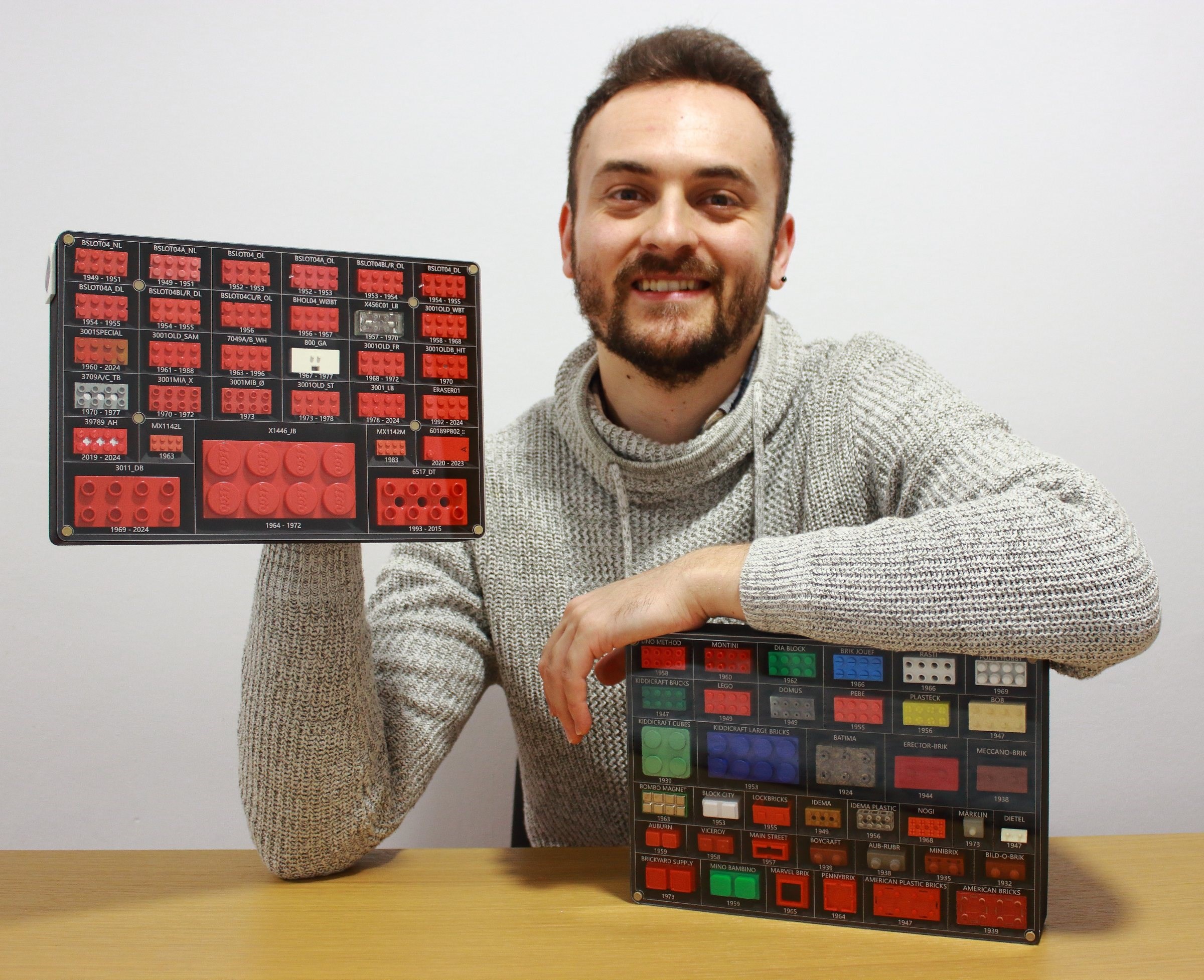
This article has been contributed by Carlos José Baragaño Móner:
Hello again! After the publication of my first article Bricks on Display: a collection of interlocking building bricks, I decided to continue the historical research on bricks, which has since become my main hobby.
I would like to express my gratitude for the wide reach that article received; despite its impact, my initial intention was simply to build a box with old pieces to hang on the wall of my home.
Over the years, however, I have developed several displays, each focused on a specific theme and featuring various modifications, both in assembly and in functionality.
For this reason, and on an occasional basis, I will be presenting these articles in collaboration with Brickset.
The “Bricks on Display 2.0” presented below is, in fact, the first one I started back in 2010, although I have added new pieces year after year (with many still left to include) and have altered its layout and form countless times. I consider it the most complex of all, not so much because of its design, but because of its content.
Accurately determining the dates or arranging the pieces in chronological order proved particularly challenging; I even contacted LEGO and consulted for their historical archives, and many of the bricks weren't dated either. For this reason, I understand that discrepancies may arise among readers, although the sources used are, today, the most reliable available.

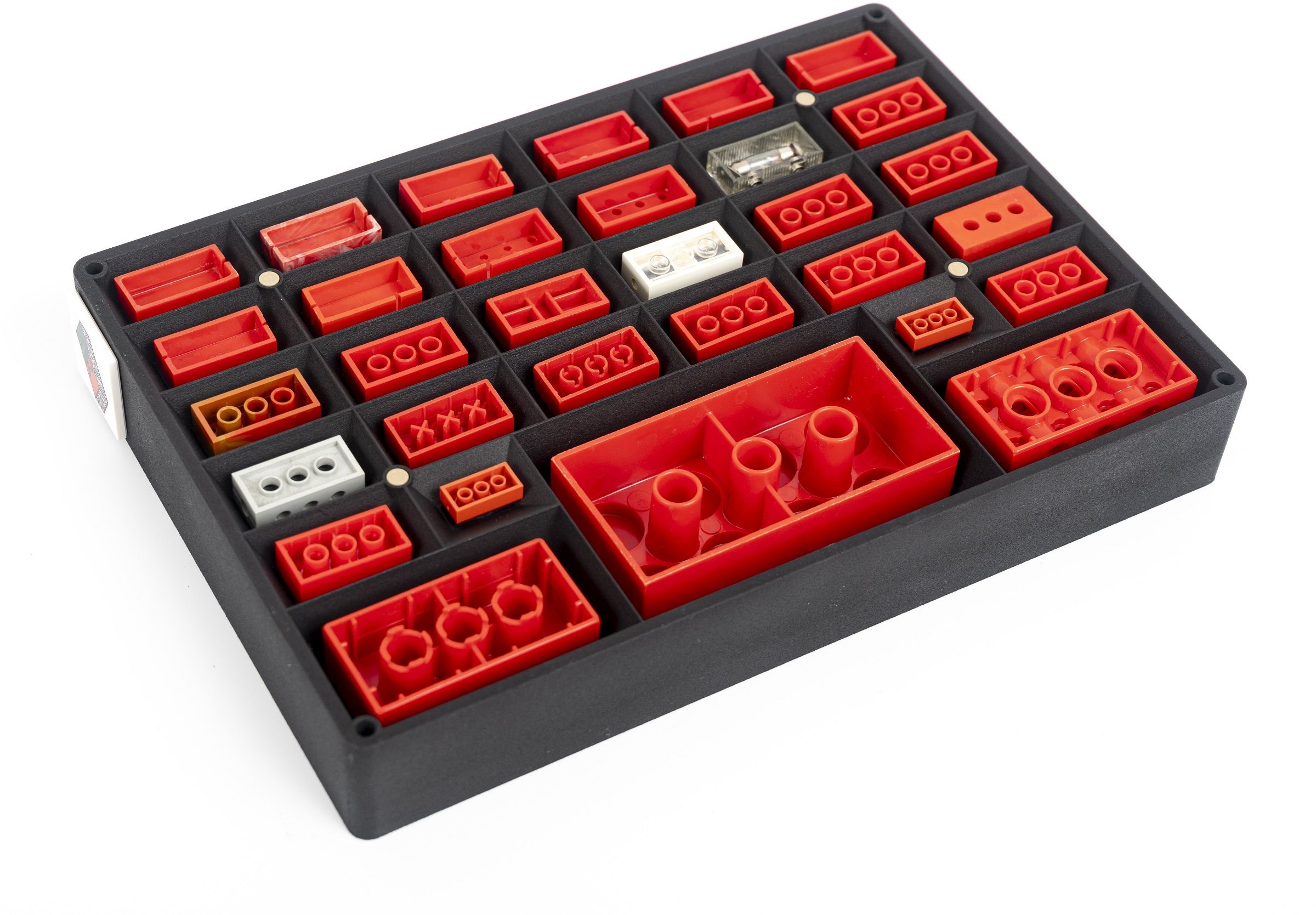

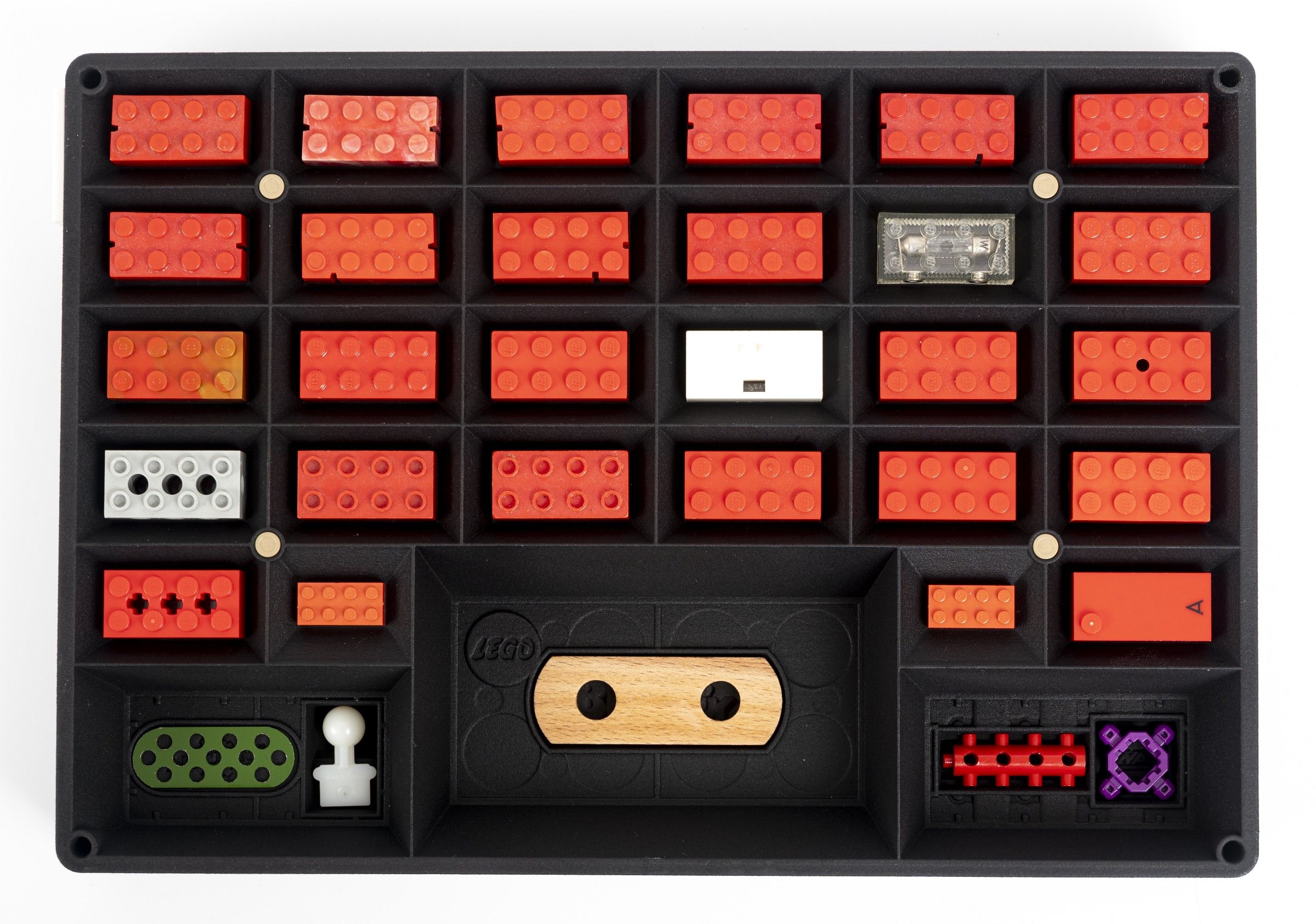
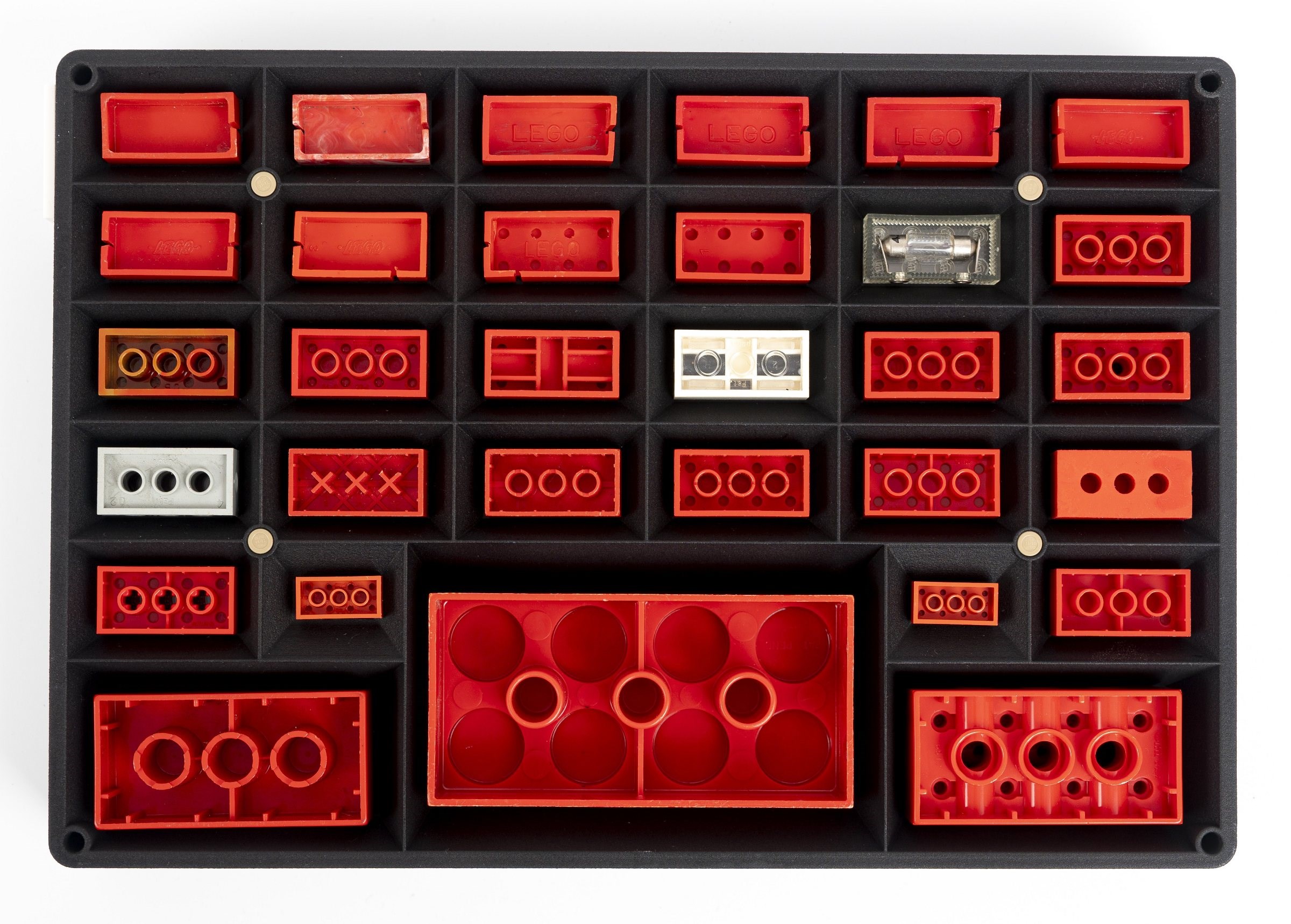
The distinctive —and challenging— aspect of this “Bricks on Display 2.0” (in addition to what has already been mentioned) lies in my aim to showcase exclusively red 2×4 bricks, which in my view best represent the LEGO 2×4 brick, although in some cases it was not possible to maintain this restriction.
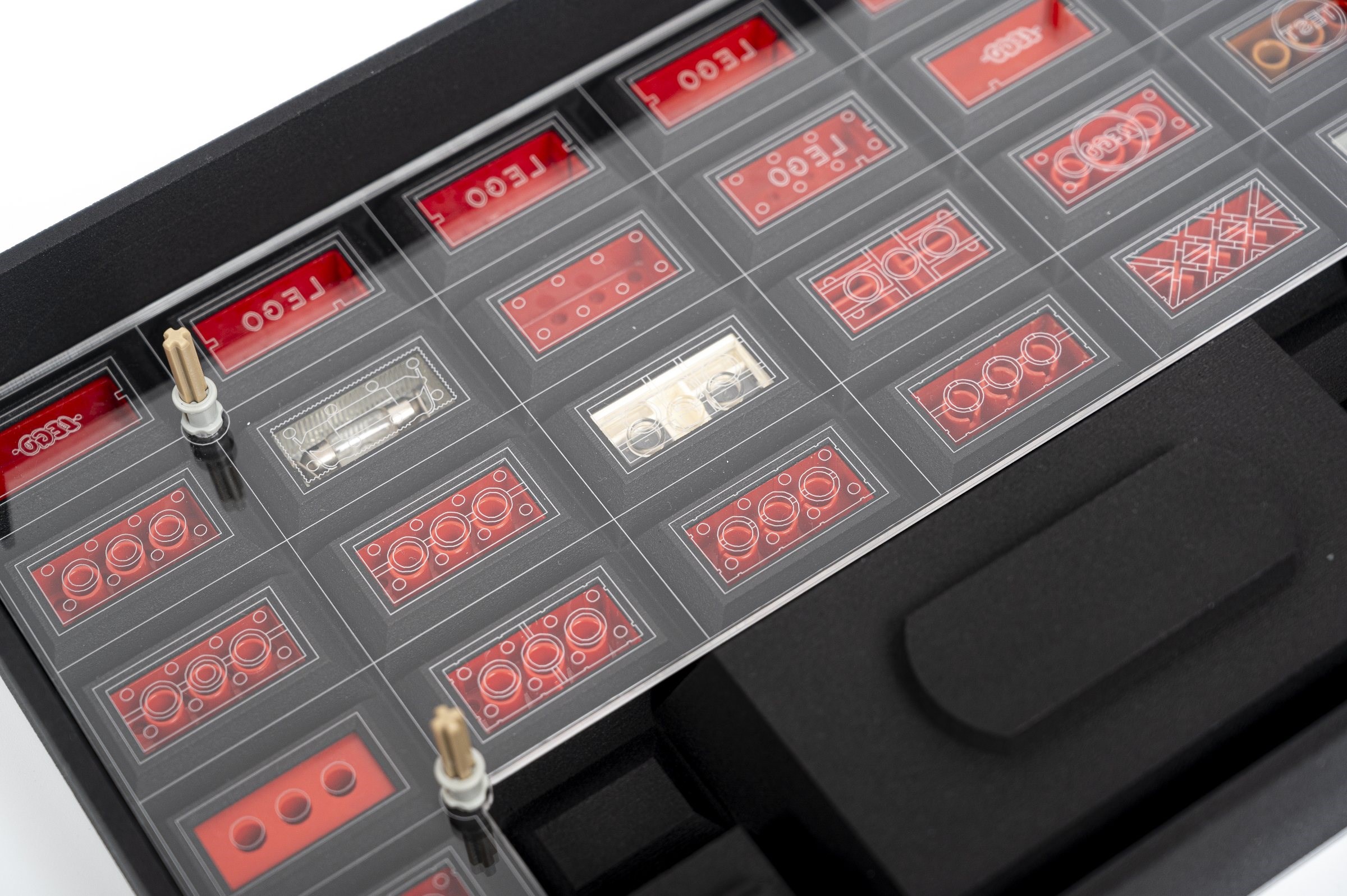
I also wanted the back of the display to reveal the imprint or interlocking system characteristic of each piece, thereby illustrating its constructive evolution. To achieve this, I designed an acrylic transparent base that required meticulous work on tolerances and visual descriptions of the different interlocking types.
Furthermore, I wished to preserve the same shape as the first display (I explained at the time that its size/shape was determined by the printer’s build volume; over time, this printing process has become more accessible and widespread, and even LEGO has recently used it in set 10361 and in several limited promotional pieces).
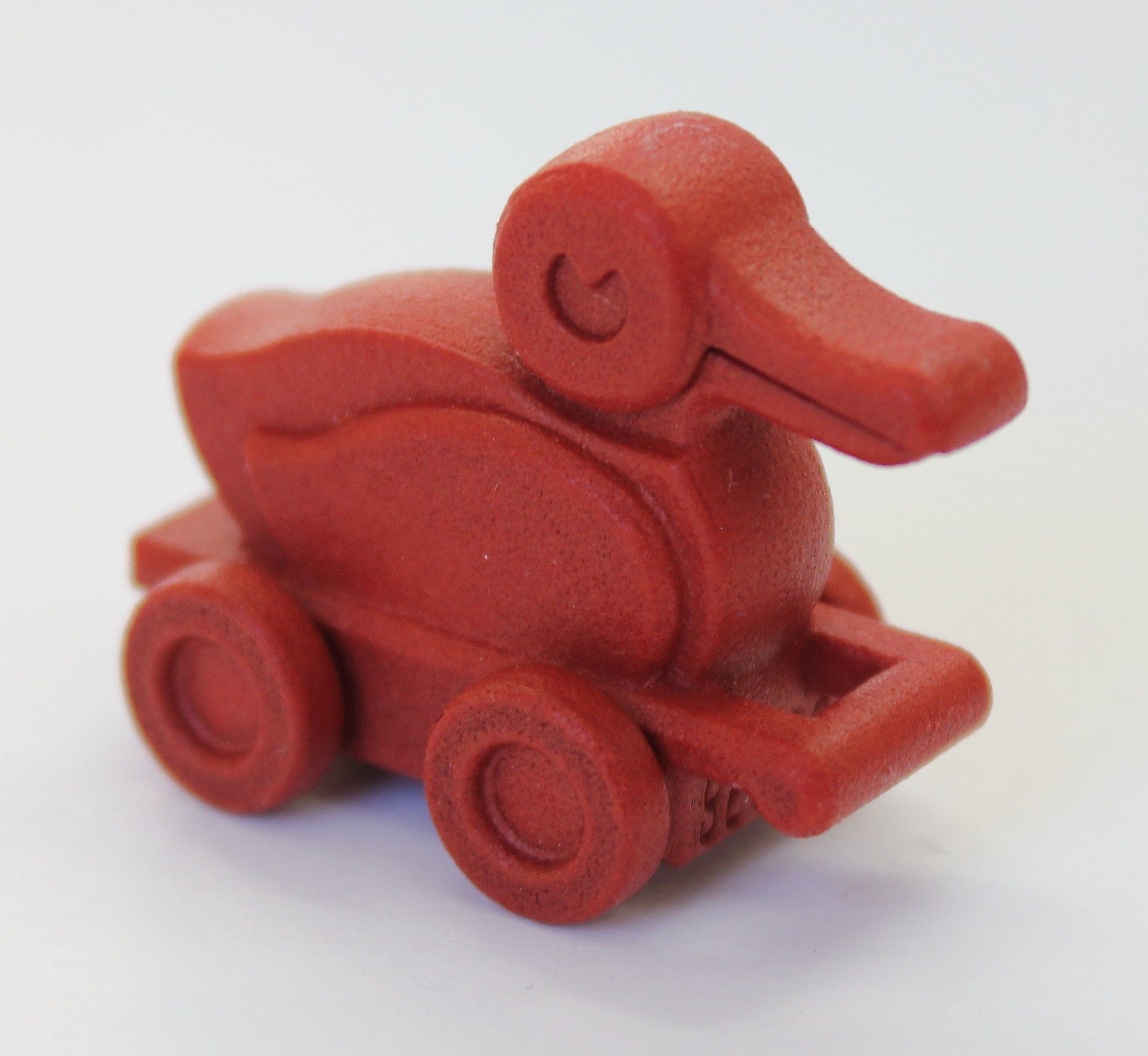
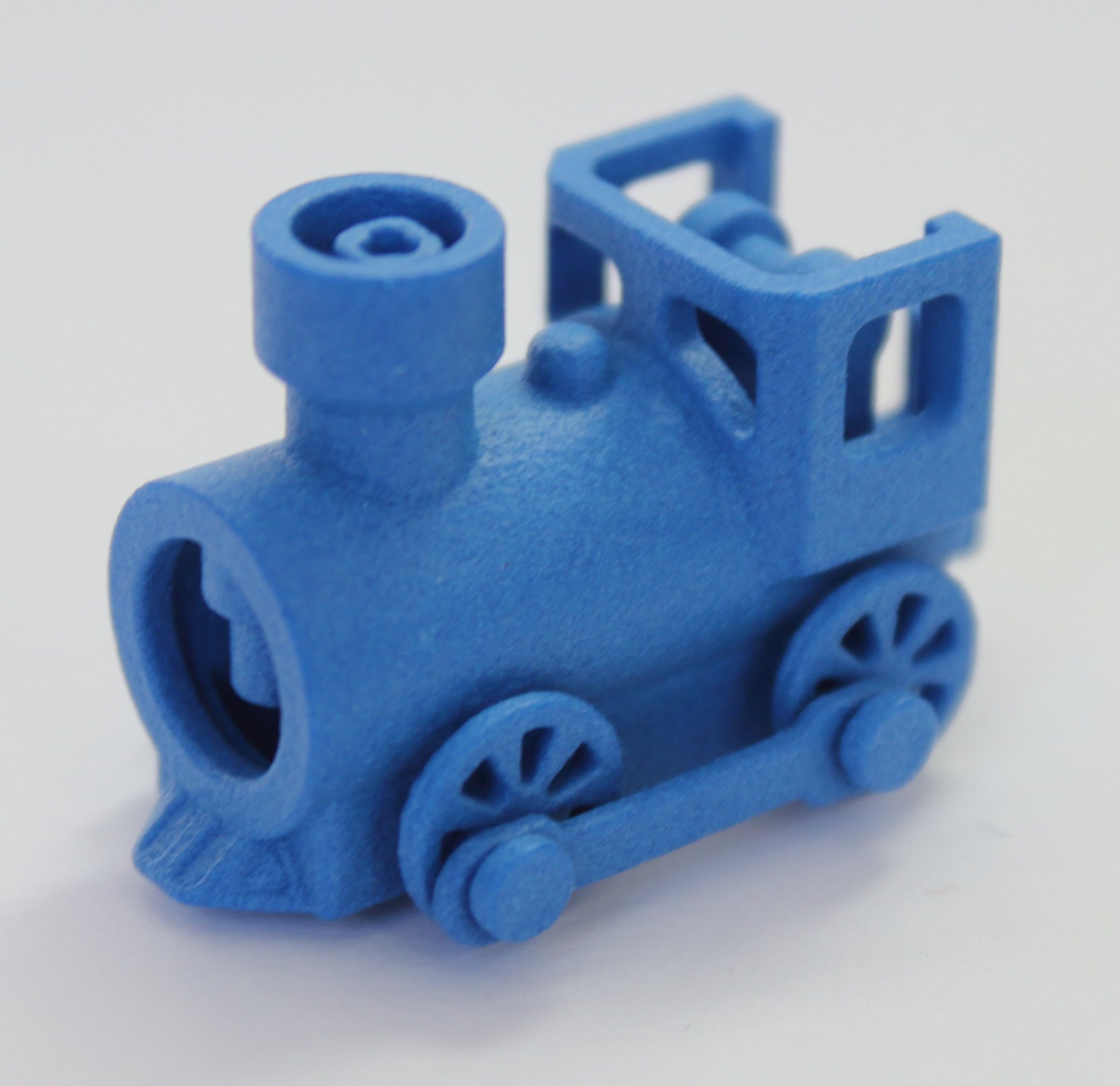
On this occasion, I did not opt primarily for an artistic composition: the pieces are arranged by date, in response to the request made by many readers after the first article. The nomenclature used corresponds to the official Bricklink terminology.
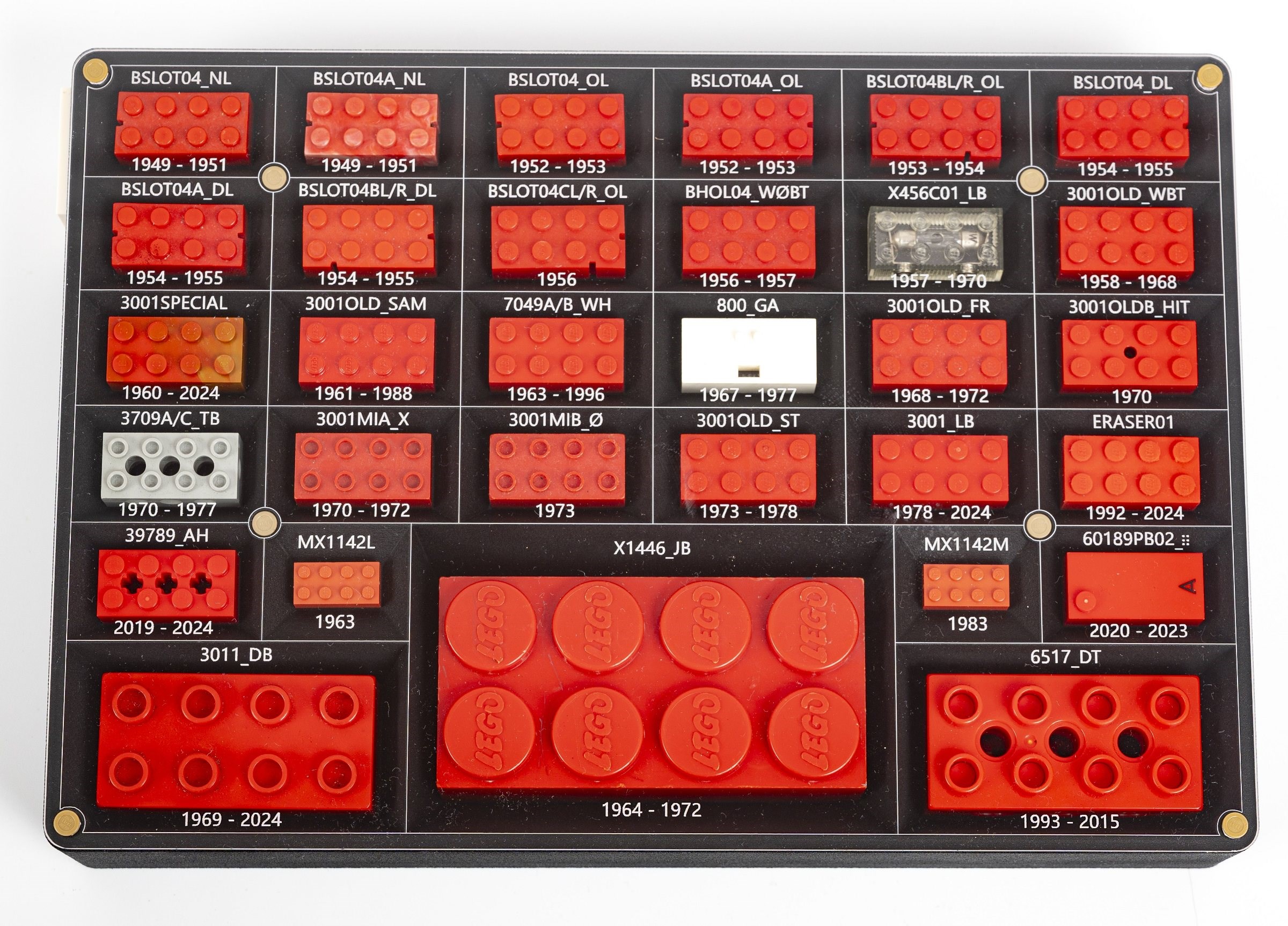
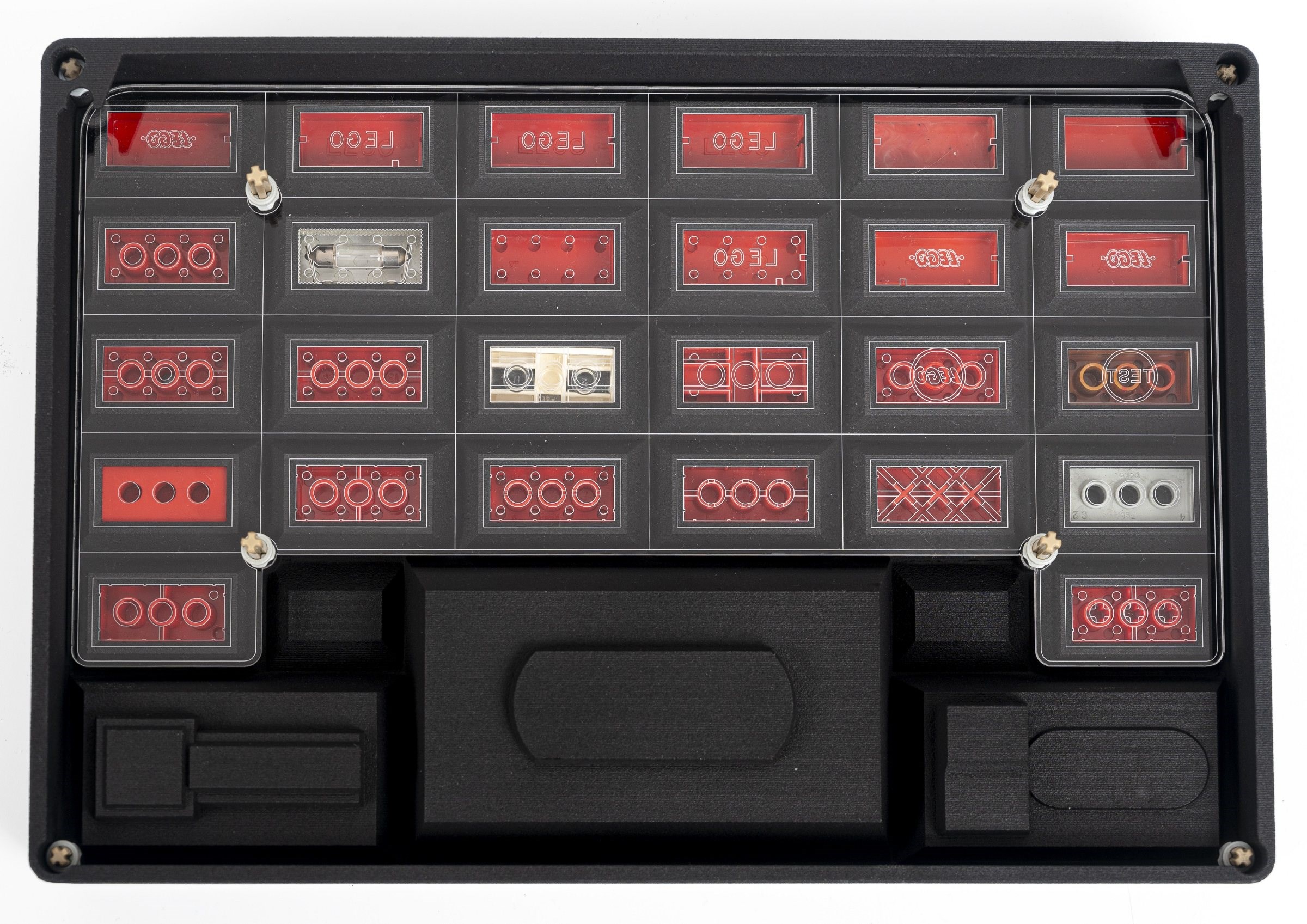
BRICKS ON DISPLAY 2.0
This display, despite sharing certain similarities with the first one, has been a far more personal project. In the end, everything leads back to LEGO: for me, the evolution of the brick up to the modern model defines the essence of the brand and represents the pursuit of the perfect product.
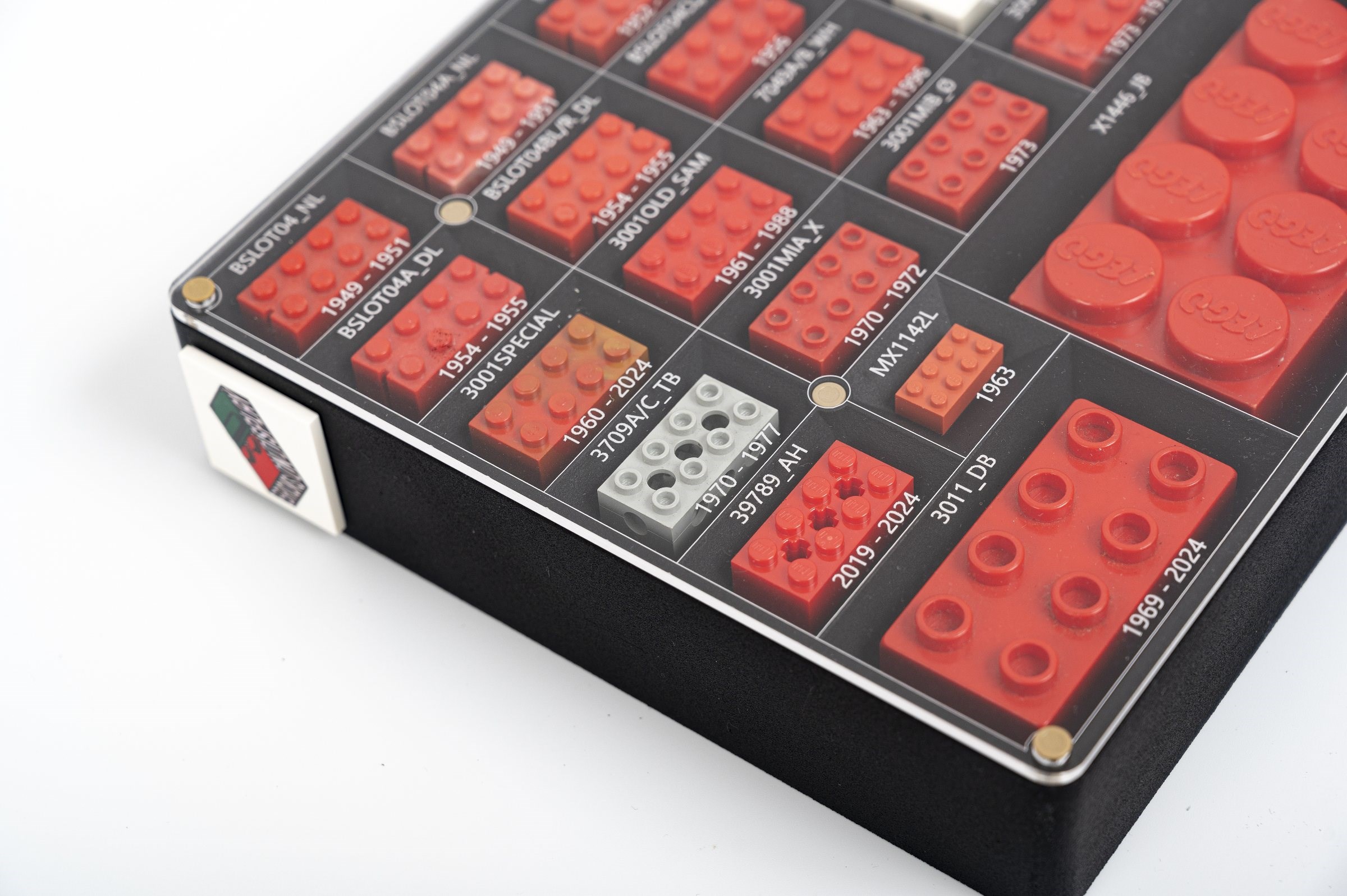
As an explanation of the manufacturing processes, I continued using SLS 3D printing (with dimensions of 280×190×40mm), as well as laser cutting and engraving for the acrylic covers. As mentioned earlier, I kept the shape of the casing from the previous display and added the bricks one by one, arranging them in historical order and using Bricklink’s official nomenclature.
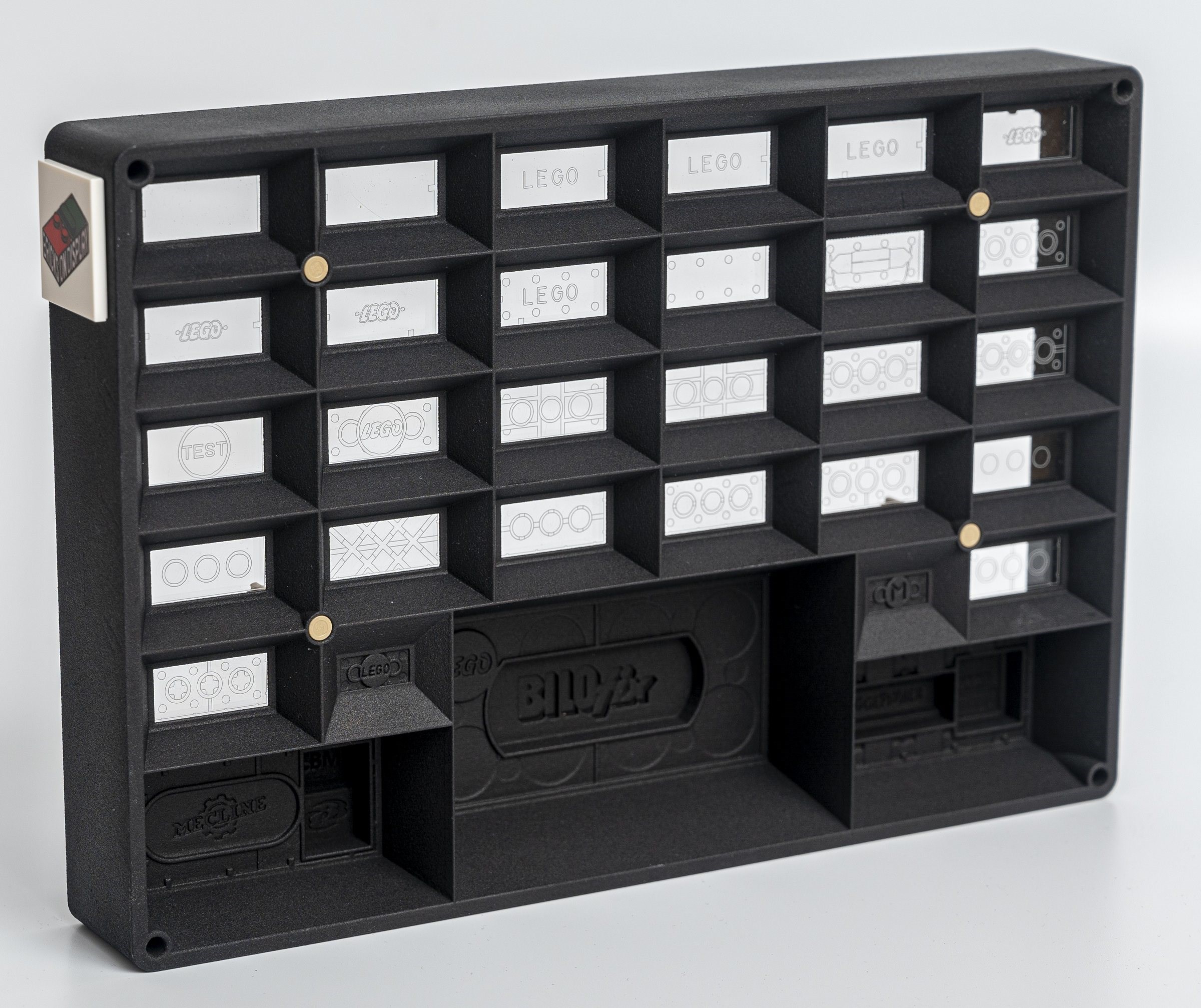
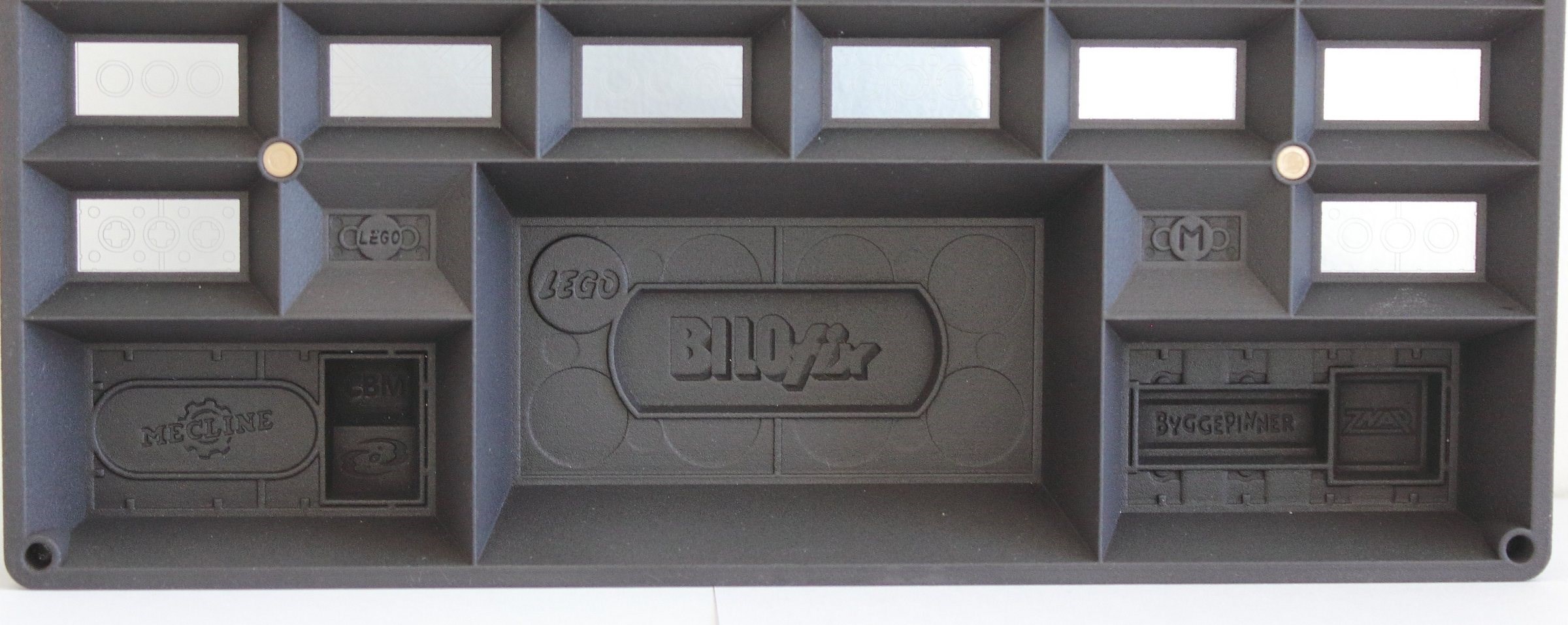
I also engraved on the inner cover the imprint of each brick, or a distinctive feature in cases where several pieces were similar. For the bricks or sets that function as easter eggs—just like in the previous display—this one also works as a puzzle: each cavity includes a logo or imprint that helps position the corresponding easter egg or brick.
I removed the inner base that previously simulated the extruded 2×4 brick connection so that the imprints of the pieces can be seen when rotating the display, although it can still be hung on the wall just like the earlier version.

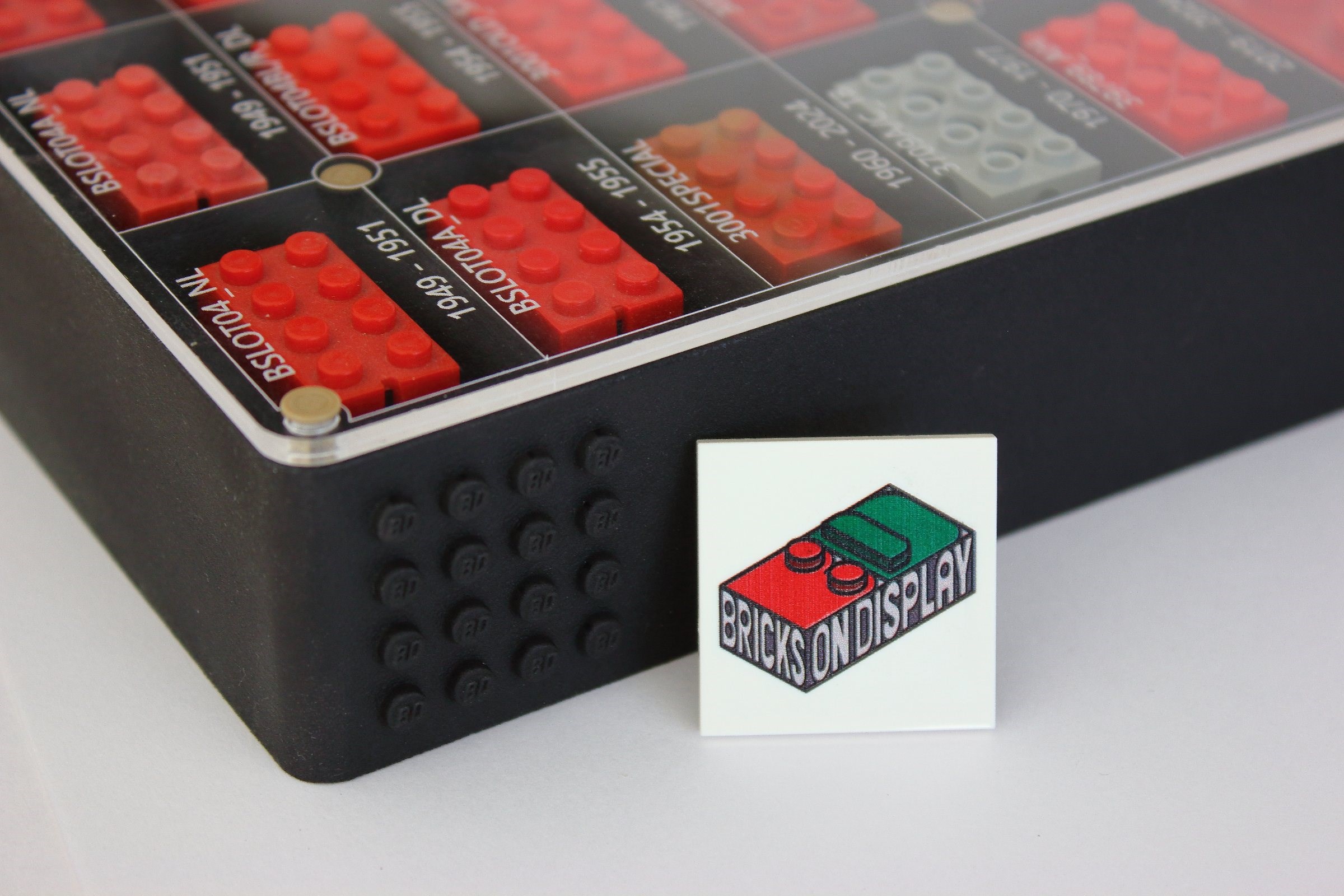
On the top cover, I have continued using laser-cut and laser-engraved acrylic, where the name of each piece and its production period are displayed, while also preserving the fastening system based on modified axles and bushes. I have also added to this display a printed logo on a tile, designed to attach across several studs featuring my logo on one side.
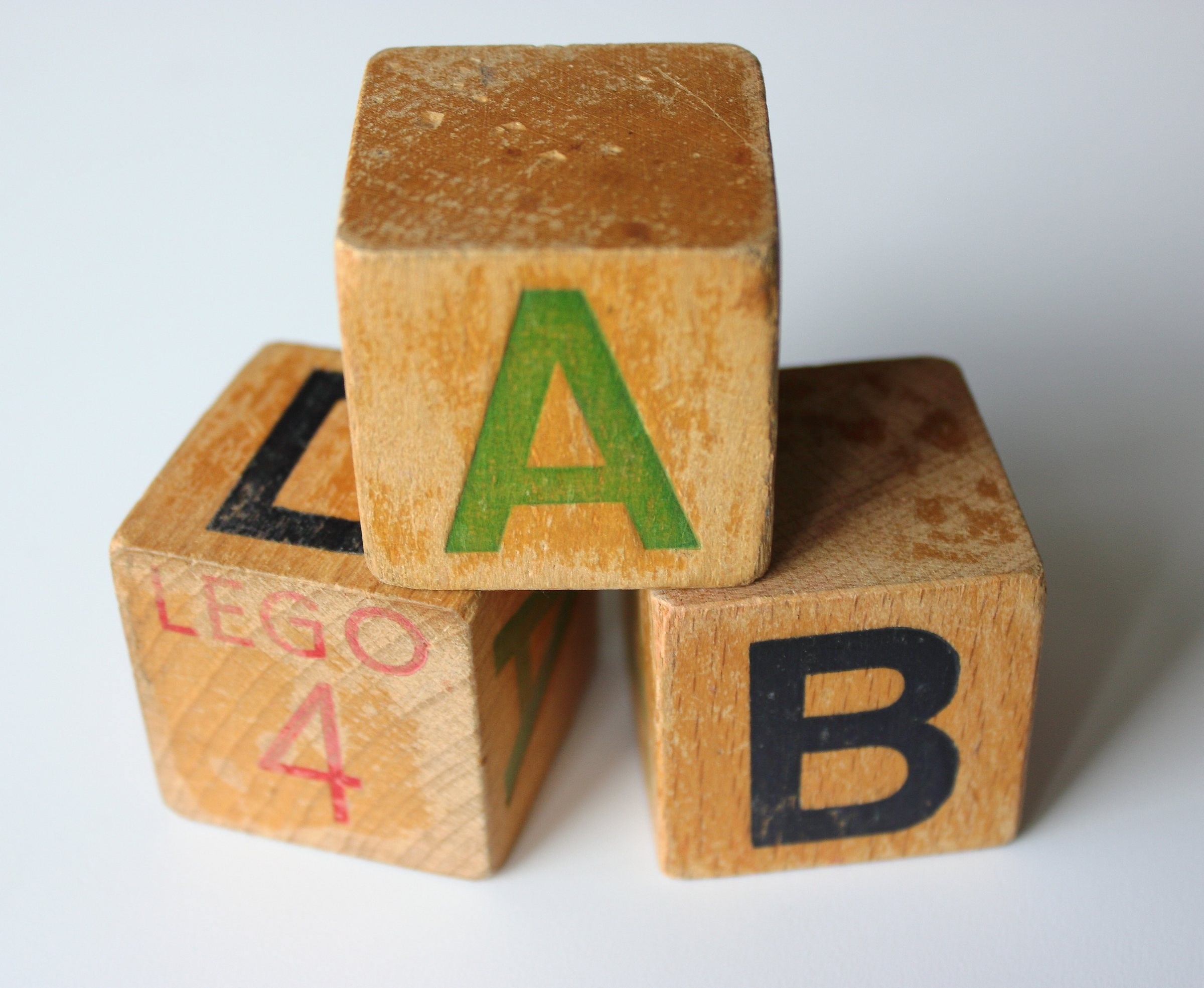
LEGO’s early history traces a path from simple wooden toys to the birth of the modern plastic brick, shaped by family decisions, factory fires, and a growing ambition to innovate. In 1932, in the small town of Billund, Denmark, Ole Kirk Christiansen began crafting wooden toys in his carpentry workshop to survive the economic crisis. Two years later, in 1934, he gave his company the name LEGO, derived from leg Godt (“play well”), a motto that reflected his commitment to quality and careful craftsmanship.
The reliance on wood also brought serious challenges. Several fires destroyed the factory over the years, forcing Ole Kirk and his family to rebuild and reconsider the direction of the business. After World War II, as high-quality wood became harder to obtain and new materials emerged, LEGO began exploring plastic. In 1947, the company acquired its first injection-molding machine and examined the interlocking toys made by Kiddicraft, whose concept of studded bricks inspired LEGO’s earliest plastic experiments.
By the late 1940s, the first prototypes appeared, still imperfect but pointing toward a new future. The breakthrough came in 1958, when Godtfred Kirk Christiansen patented the internal tube-and-stud system that gave the bricks their stability. With that innovation, the red 2×4 brick was born—the moment LEGO left wooden toys behind and entered the era of the modular construction system that would redefine creative play around the world.
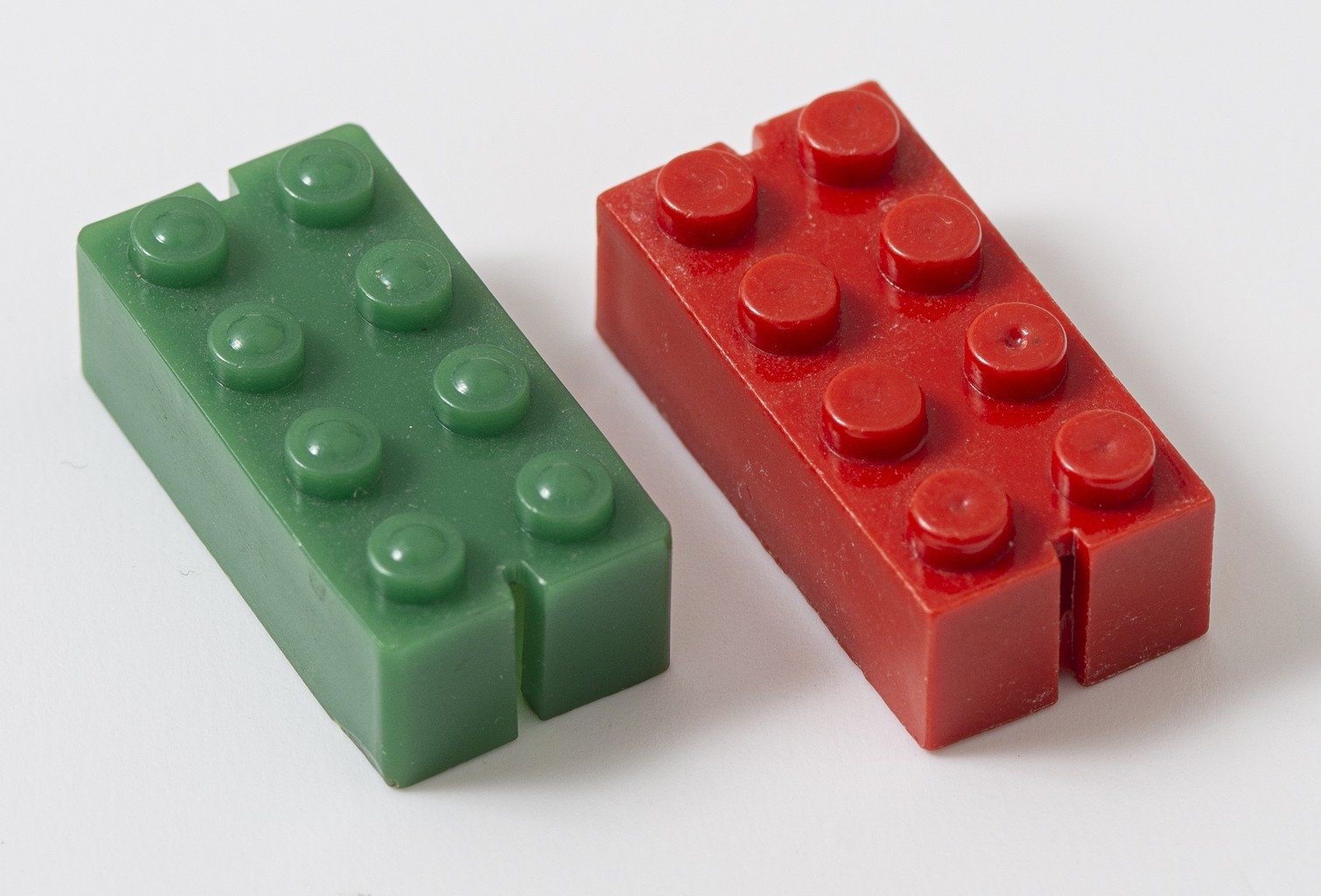
As in the previous display, this one includes a few Easter eggs, such as the following:
MECLINE 1952–1956
Mecline is a Norwegian metal construction system manufactured between 1952 and 1956 by Strømberg, based on enameled perforated plates in colors such as green, red, or blue. These pieces, featuring a regular matrix of holes compatible with Meccano-type screws and with the BYGGEPINNER system, formed part of a metal product line independent from LEGO.
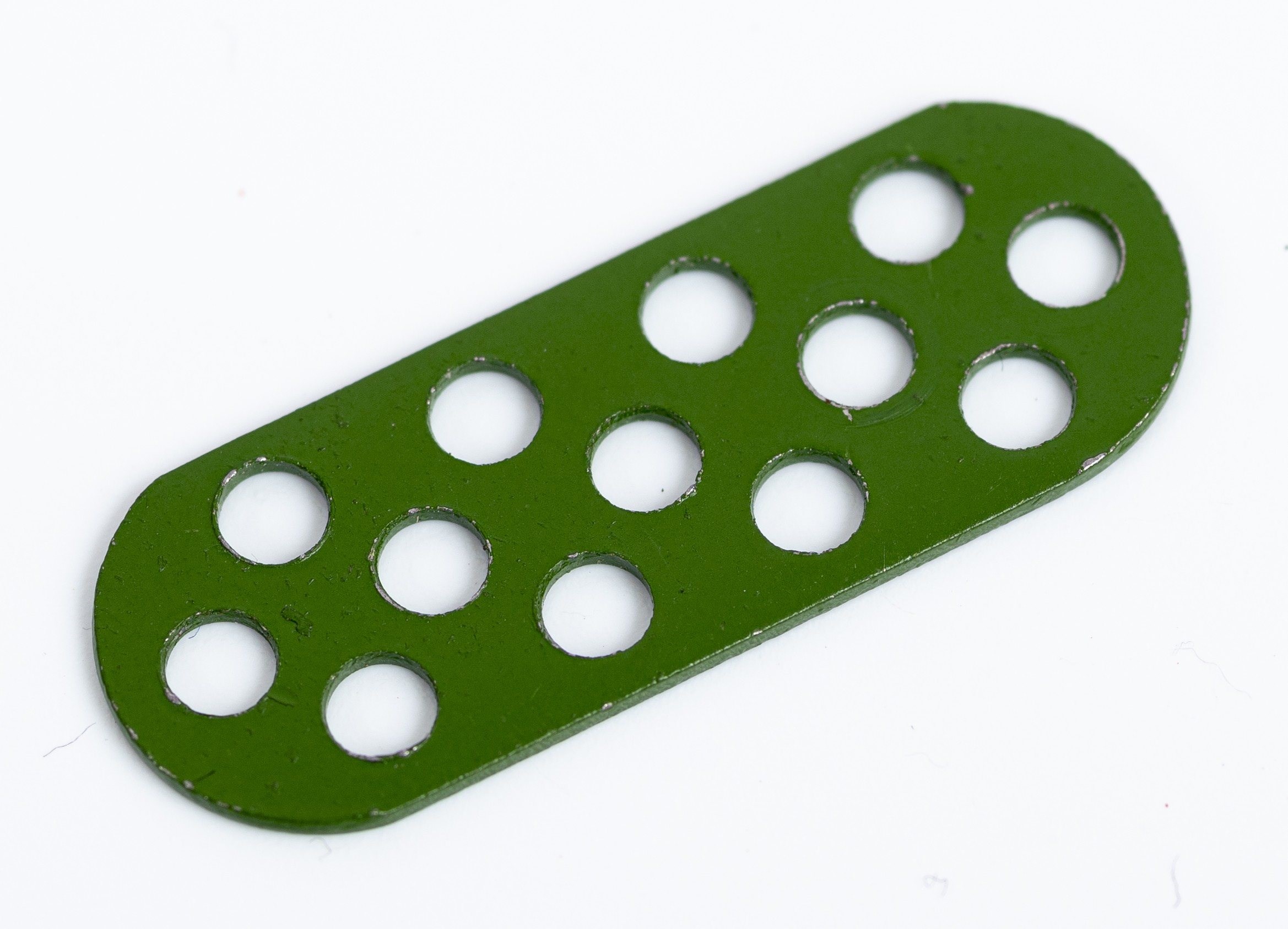
The Mecline range coexisted with Strømberg’s licensed production of LEGO toys, but without sharing molds, materials, or purpose, representing a parallel path in children’s technical construction. Origin and Manufacturer: Svein Strømberg & Co. A/S, Oslo (Norway).
BYGGEPINNER 1953–1956
Byggepinner is a Norwegian plastic construction system manufactured between 1953 and 1956 by Strømberg too, based on colored rods that fit by pressure into perforated connectors. It allowed the creation of lightweight structures and simple models during Strømberg’s transition from metal and wood to plastic, in parallel with its period as a LEGO licensee.
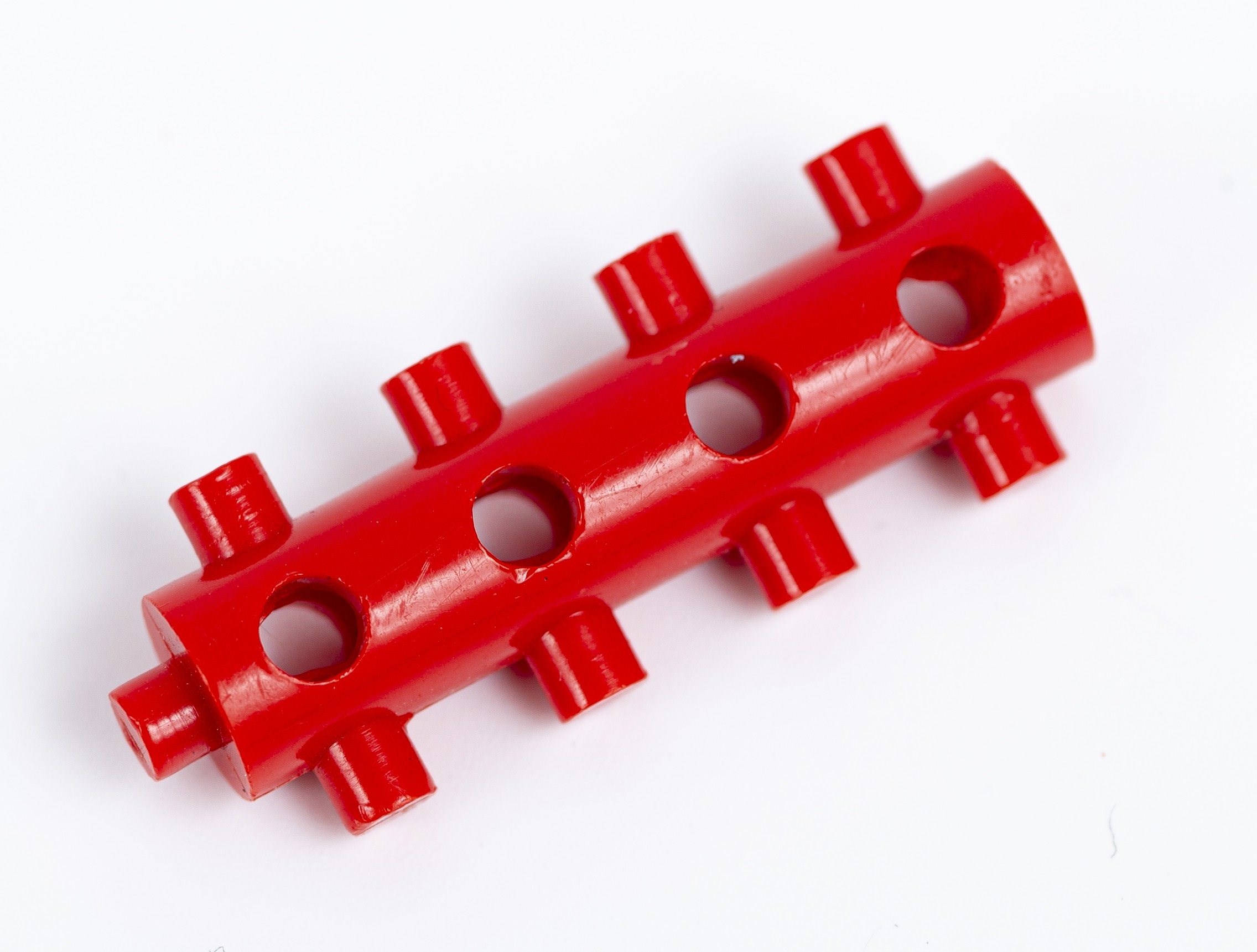
Although it coexisted with LEGO production in the same factory, Byggepinner did not share molds or compatibility and remained an independent system within the landscape of Norwegian plastic toys of the 1950s. Origin and Manufacturer: Svein Strømberg & Co. A/S, Oslo (Norway).
BILOFIX 1959–1969
Bilofix is a wooden construction system created by Johannes Christiansen and produced between 1959 and 1969, based on rods and perforated blocks that connect by pressure to form simple mechanical models. Although it was not designed by LEGO, the company distributed and promoted it in schools and Nordic markets, making it a direct precursor to the technical approach that would decades later lead to LEGO Technic.
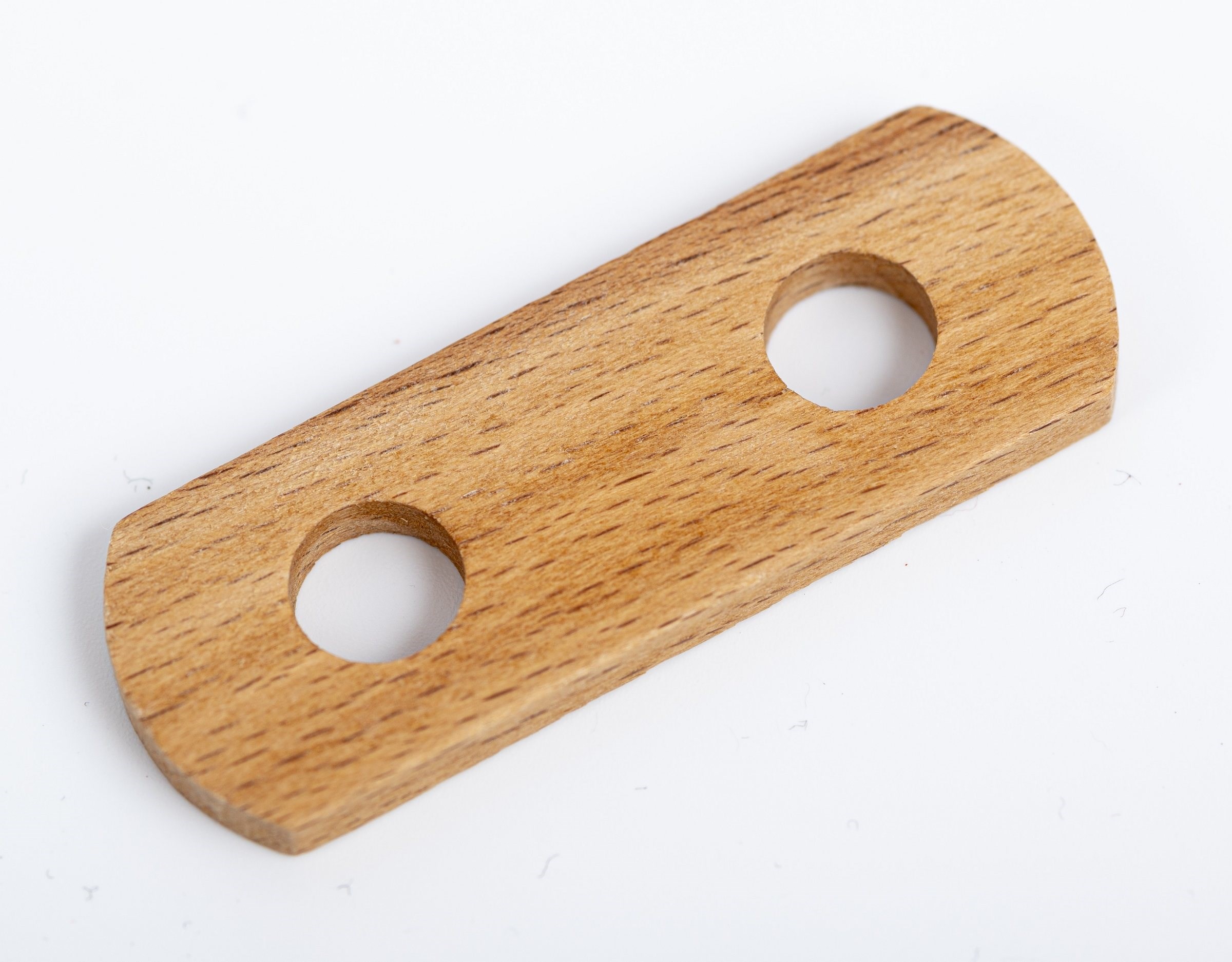
Born as an independent project within the Christiansen family, Bilofix inherited the tradition of wooden toys and acted as a bridge between those classic systems and LEGO’s future mechanical concepts. Origin: Denmark. Creator: Johannes Christiansen (brother of Godtfred Kirk Christiansen, LEGO’s managing director).
ZNAP 1998–1999
ZNAP is a plastic construction system released by LEGO between 1998 and 1999, based on hollow beams and quick-snap connectors used to create large, lightweight, triangulated structures. Conceived as a parallel and independent experiment from Technic (like K’Nex), it offered a volumetric approach inspired by space-frame structures, but its distinct aesthetic caused confusion and sales remained limited.

Despite its structural innovation, ZNAP had a very short commercial life and was discontinued after only two years, remaining one of LEGO’s most short-lived attempts to explore alternative building systems. Origin: Billund, Denmark. Manufacturer: LEGO System A/S.
BIONICLE 2001–2010 / 2015–2016
BIONICLE is an action-figure line launched by LEGO in 2001, based on Technic pieces and exclusive elements that allow the creation of articulated characters with a biomechanical aesthetic. Its extensive narrative—spread through comics, books, and films—turned it into a cultural phenomenon and one of the pillars that helped LEGO’s financial recovery in the early 2000s.
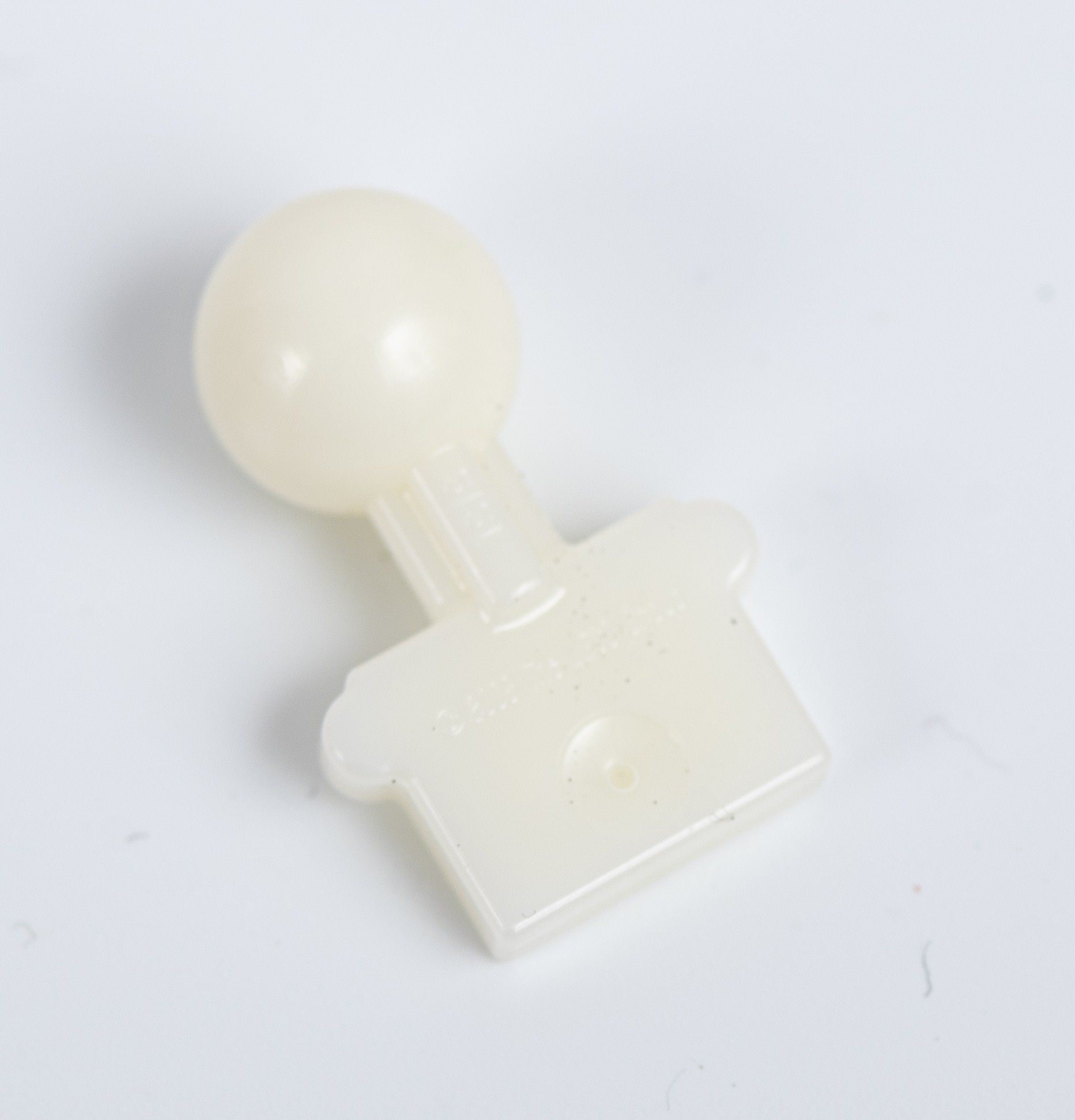
After its cancellation in 2010 and a brief reboot between 2015 and 2016, BIONICLE remained the line that inaugurated the modern era of LEGO action figures and one of the most influential in the company’s history. Origin: Billund, Denmark. Manufacturer: LEGO System A/S.
I “completed” this Display in 2022, and since then I have acquired several additional interesting pieces which I will include in the display in the future; the parts are those shown below:
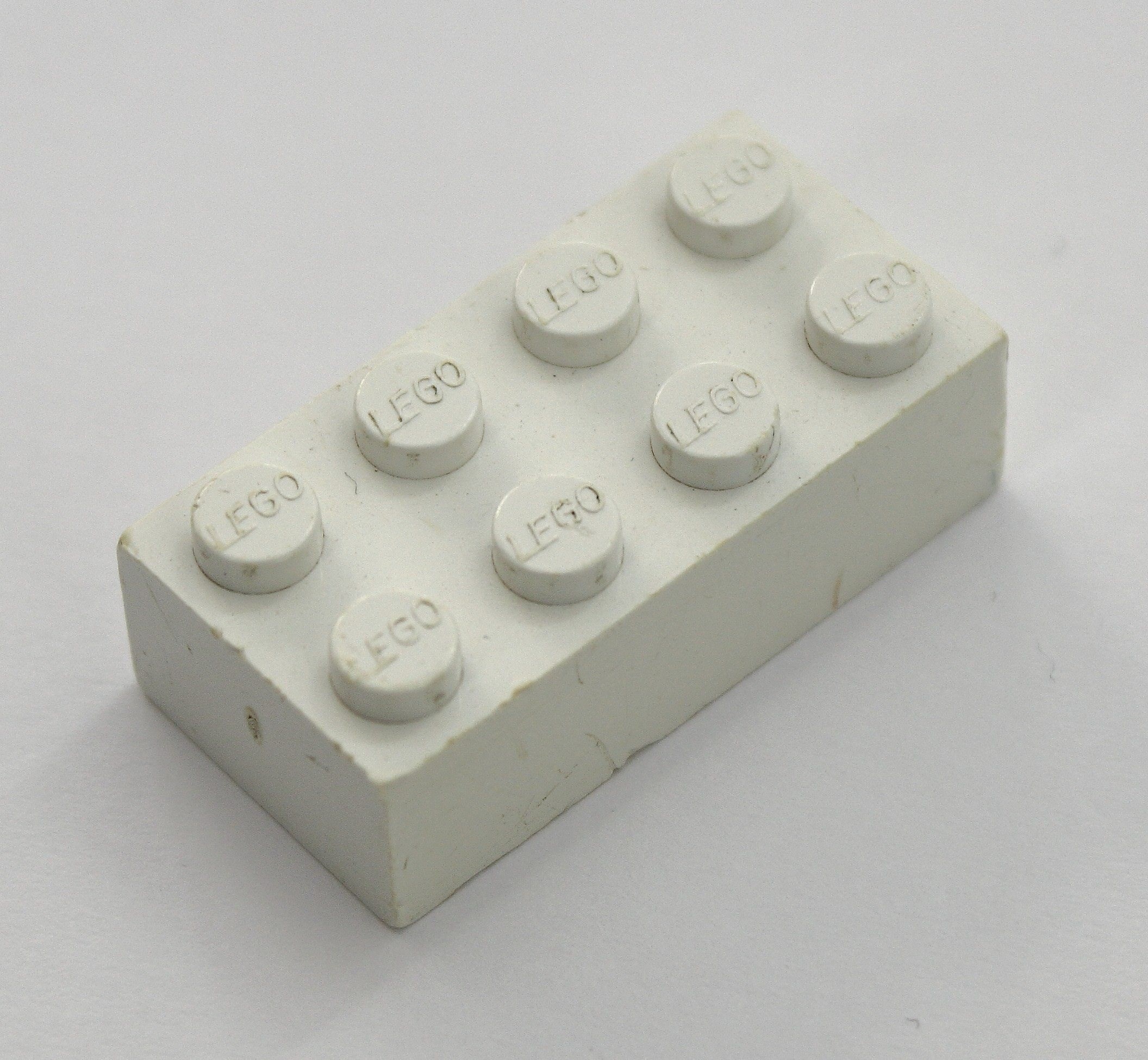
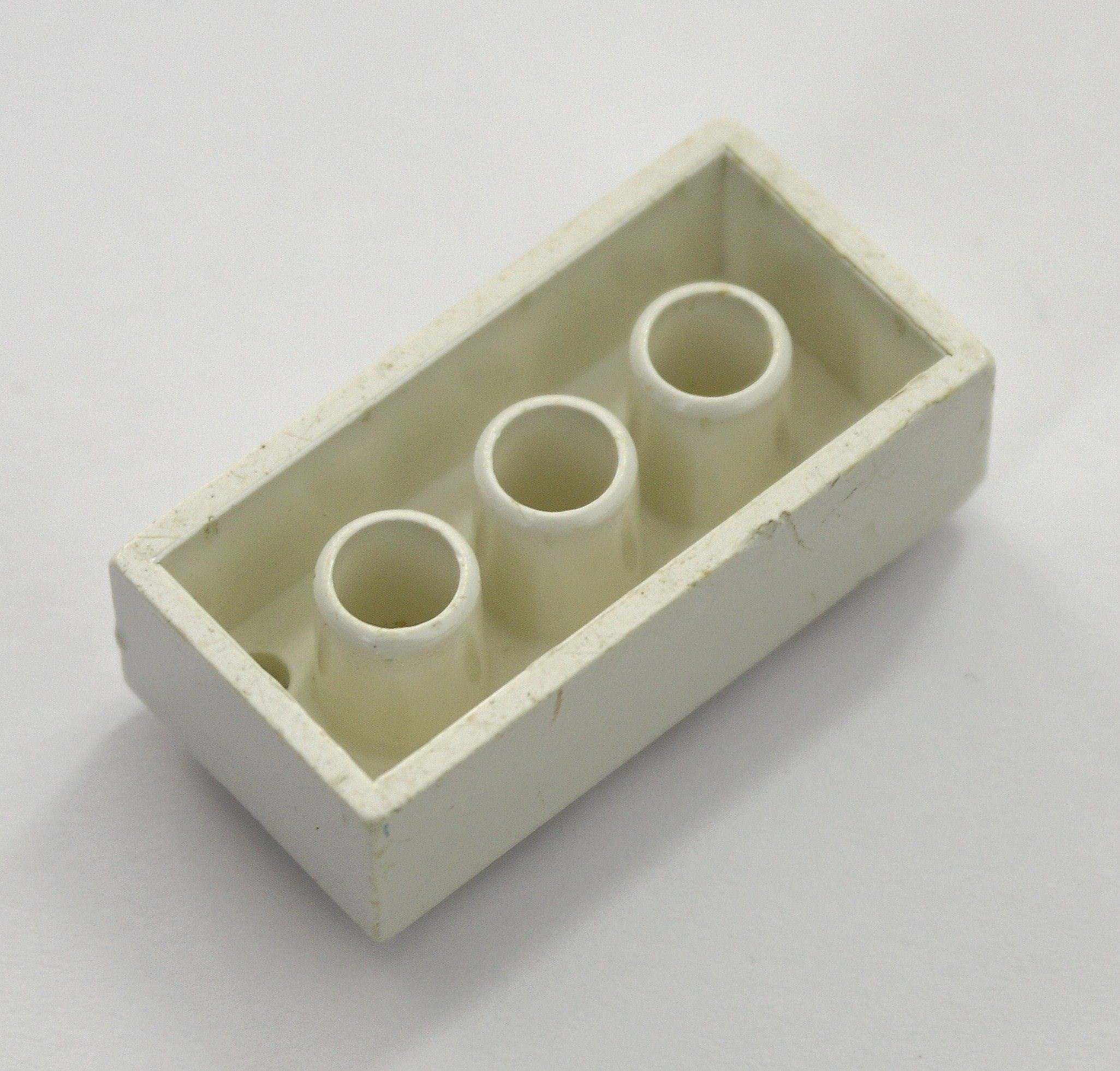
3001 1963–1965
Brick 2x4 with horizontal Lego logo: produced between 1963 and 1965, belongs to the early years of ABS and is distinguished by having the LEGO logo “Narrow O” horizontal on studs molded parallel to the long side of the brick.
This orientation, inherited from pre-acetate molds, together with lower studs and a rigid, glossy finish, makes it an extremely rare transitional variant. After the standardization of the perpendicular logo in 1965, these bricks disappeared, marking the end of the brief adjustment period following the material change. Origin: LEGO System A/S – Billund, Denmark. Manufacturer: LEGO Group.
SCALA 1997–2001
Scala is a line of dolls and accessories produced by LEGO between 1997 and 2001, combining construction elements with articulated figures, furniture, and decorative pieces that were only partially compatible with the LEGO system. It revived an earlier experiment from 1979–1980, but its aesthetic and “fashion-doll” focus did not align with the brand’s core identity, leading to its discontinuation in 2001. Origin: Billund, Denmark. Manufacturer: LEGO System A/S.
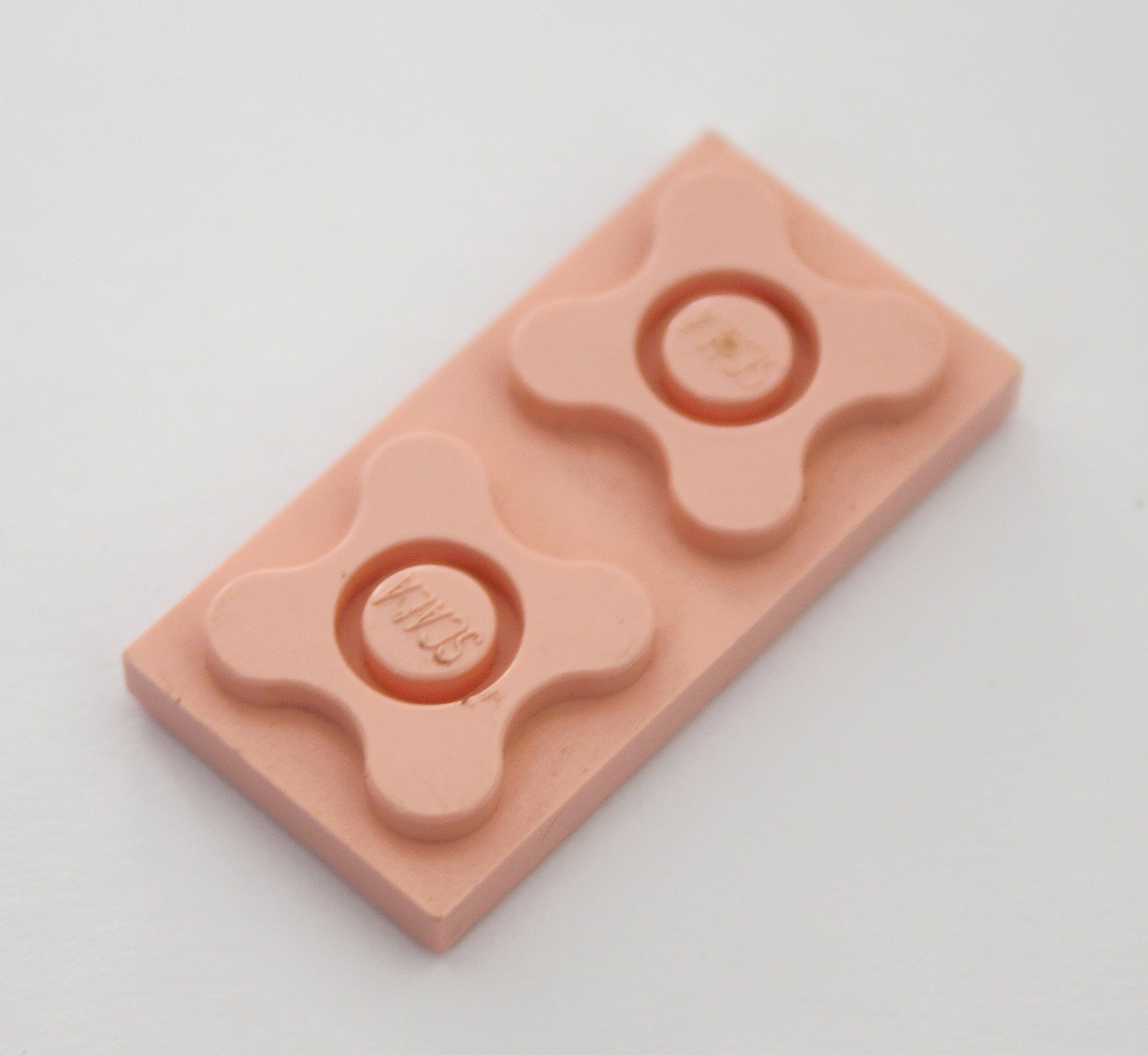
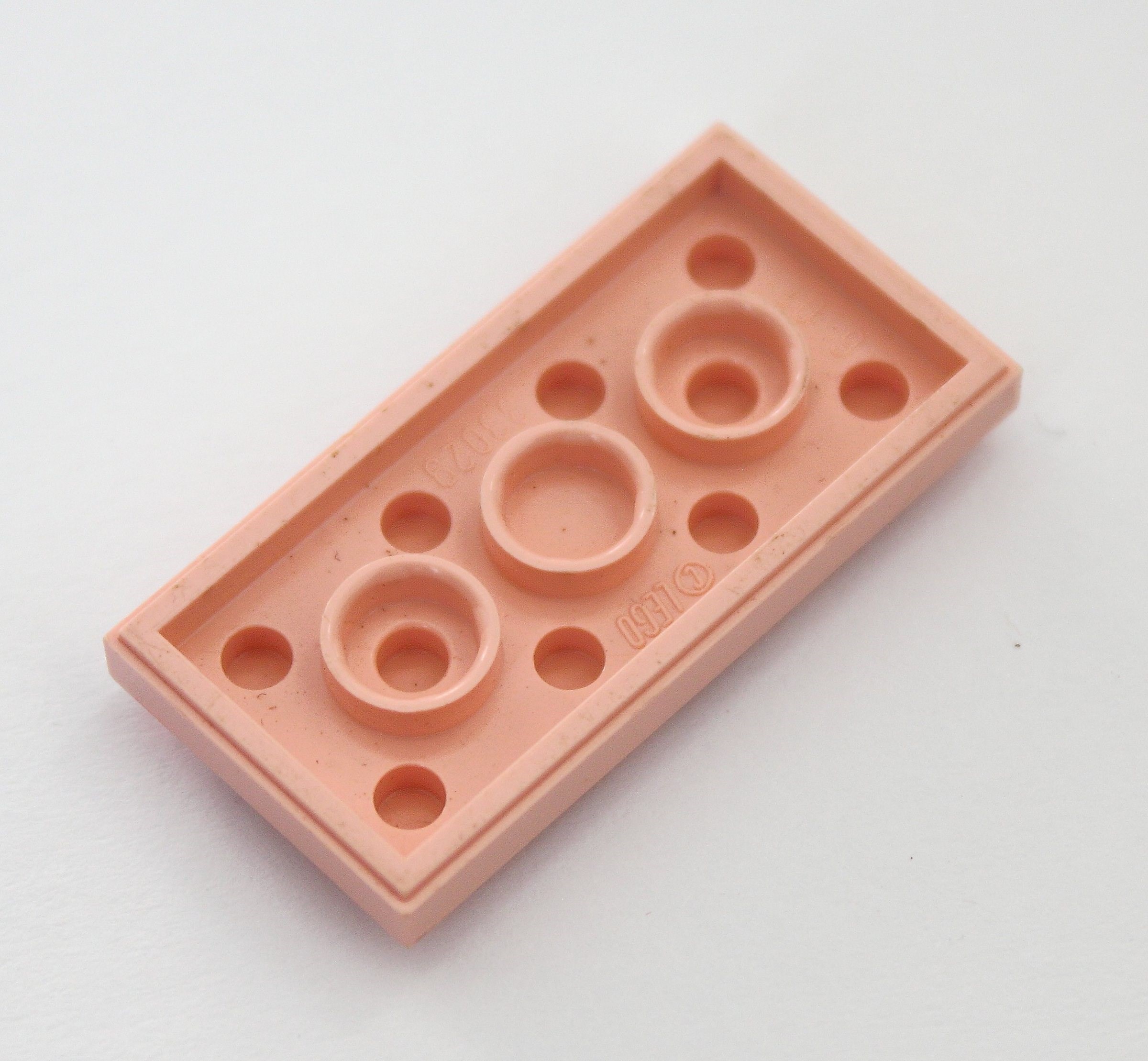
LEGO Primo 1995–2005
LEGO Primo was a construction system for babies released by LEGO between 1995 and 2005, based on very large, rounded, and safe pieces designed for early sensory and motor play.
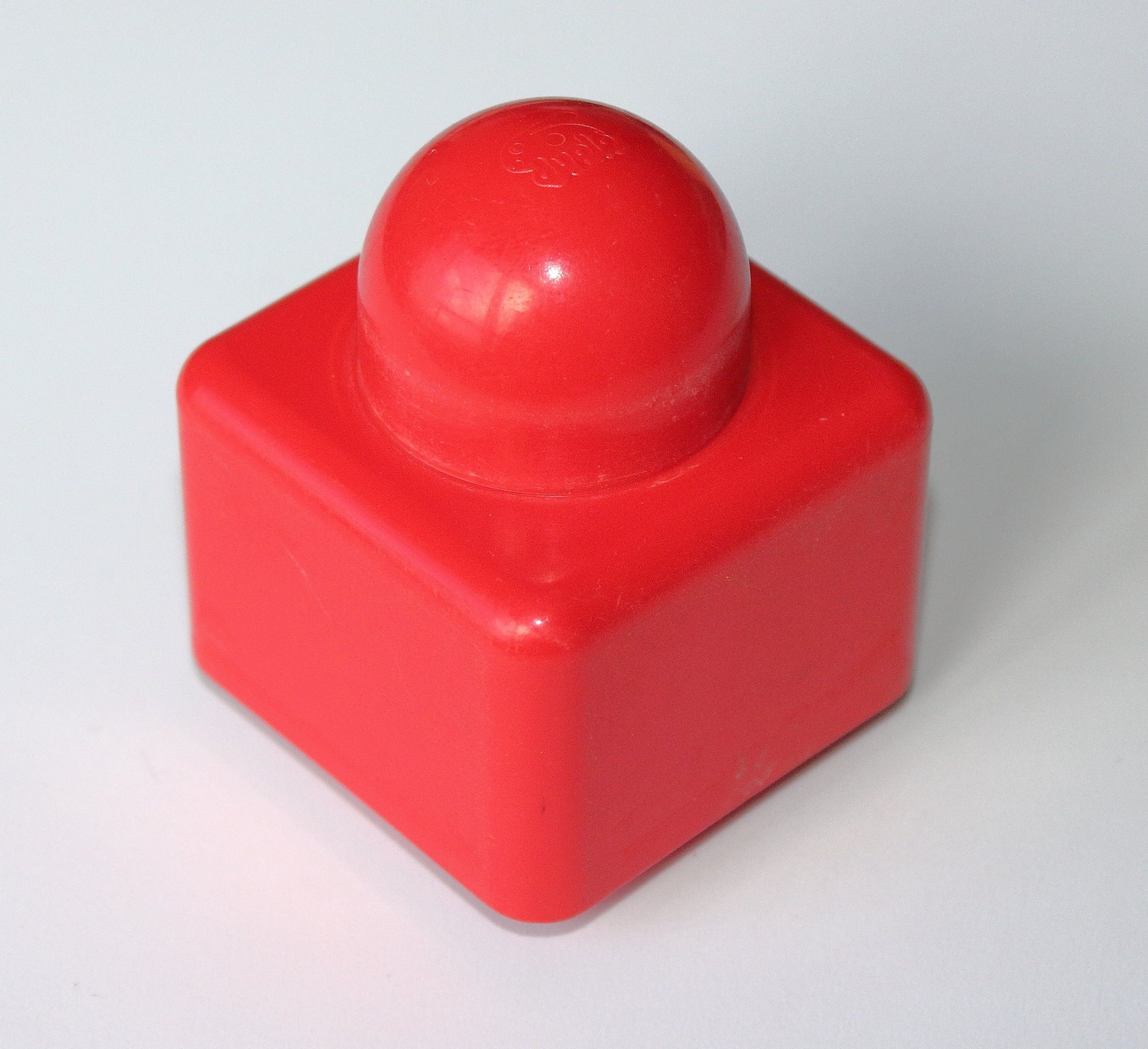
Conceived as a pos-DUPLO experiment aimed at children too young for standard bricks, it offered simple stacking elements, rattles, bath toys, and basic figures, but its oversized format made it incompatible with the rest of the LEGO systems, including DUPLO and System. Origin: Billund, Denmark. Manufacturer: LEGO System A/S.
LEGO Quatro 2004–2006
LEGO Quatro was a construction system released by LEGO between 2004 and 2006, built around extra-large bricks designed for toddlers who were still too young for DUPLO. Using oversized elements with soft edges and simple clutch power, it allowed children to create big, stable shapes while developing early motor skills.
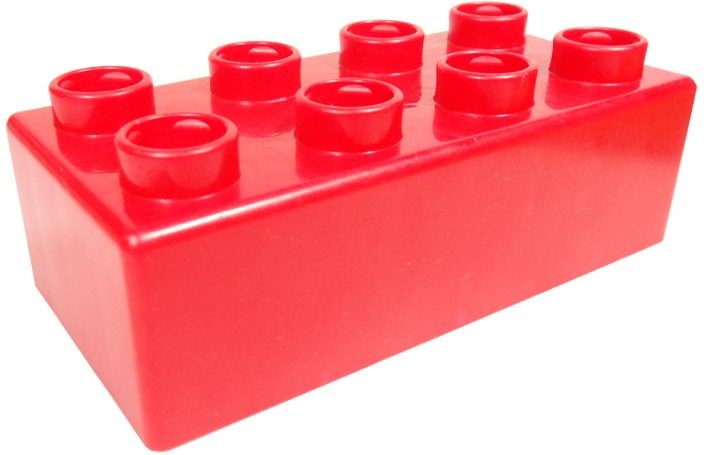
Conceived as a transitional experiment between LEGO Baby/Primo and DUPLO, it offered a scaled-up building experience that remained fully compatible with the smaller systems, yet its unusual proportions and limited set variety made it difficult to position within the broader LEGO ecosystem. Origin: Billund, Denmark. Manufacturer: LEGO System A/S.
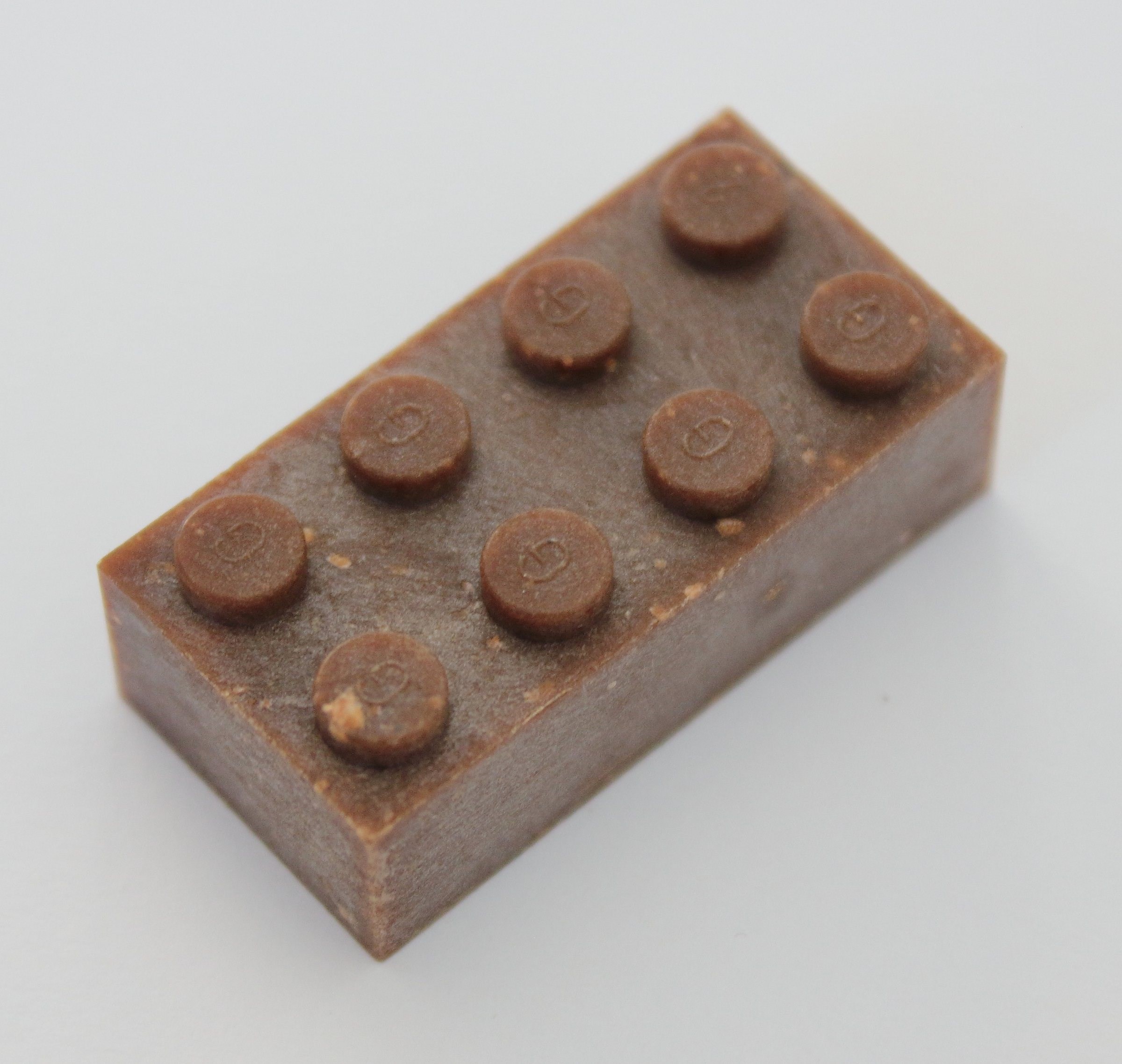
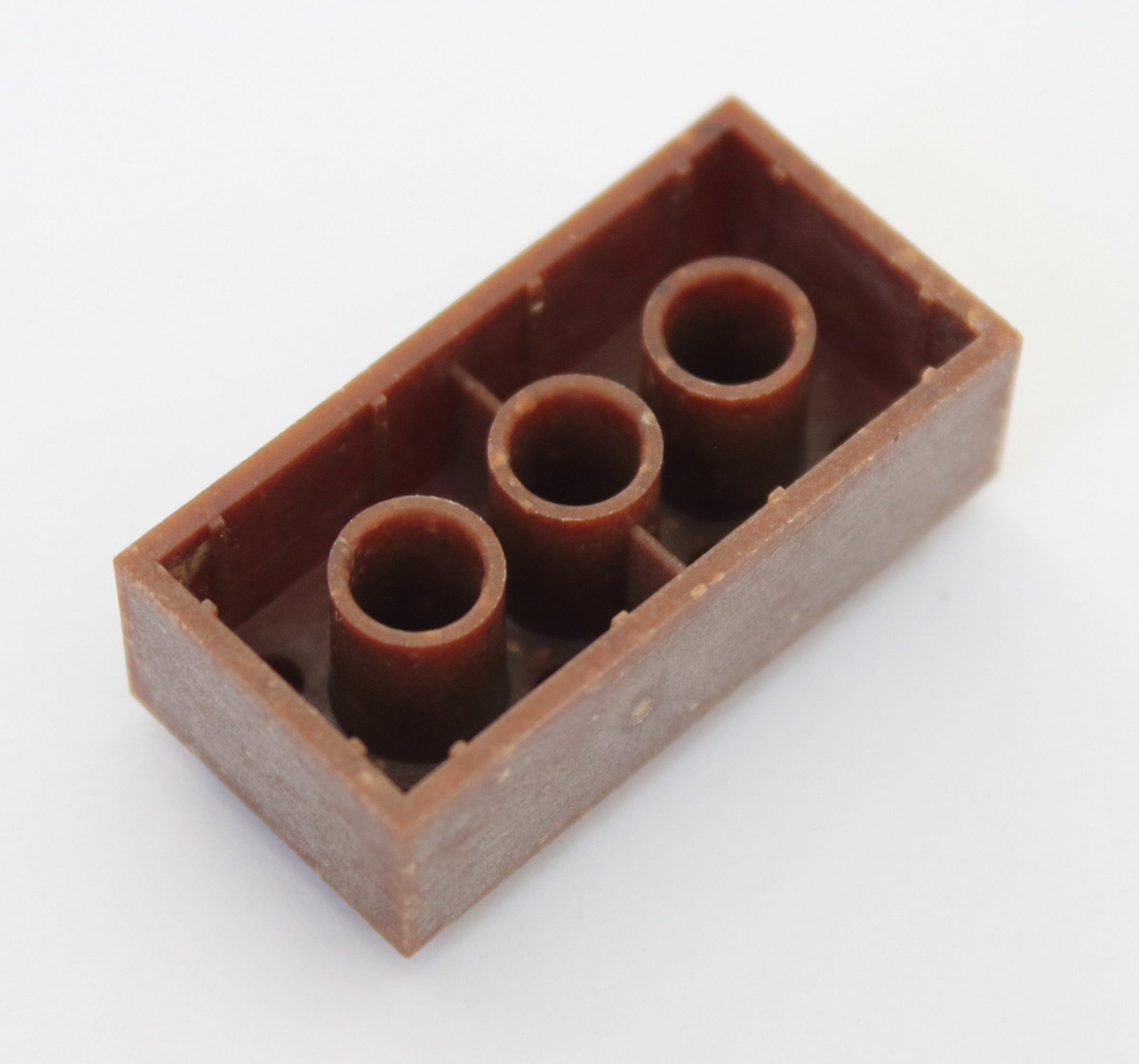
RECYCLED MATERIAL 2018–2026
Between 2018 and 2026, LEGO developed multiple prototypes of the 2×4 brick using recycled plastics as part of its sustainability program. In addition to the well-known recycled PET brick (2020–2021), experimental versions were produced in recycled polypropylene, recycled polyethylene, and hybrid blends with recovered fibres. All prototypes maintained the exact dimensions of the classic 2×4 brick and aimed to match the strength of traditional ABS.
Ultimately, LEGO halted these developments because none of the recycled materials achieved the durability, thermal stability, or consistency required for mass production. In 2023, LEGO announced it would abandon the use of recycled PET and other recycled plastics for bricks, although research into alternative sustainable materials continues. Origin: Billund, Denmark. Manufacturer: LEGO System A/S.
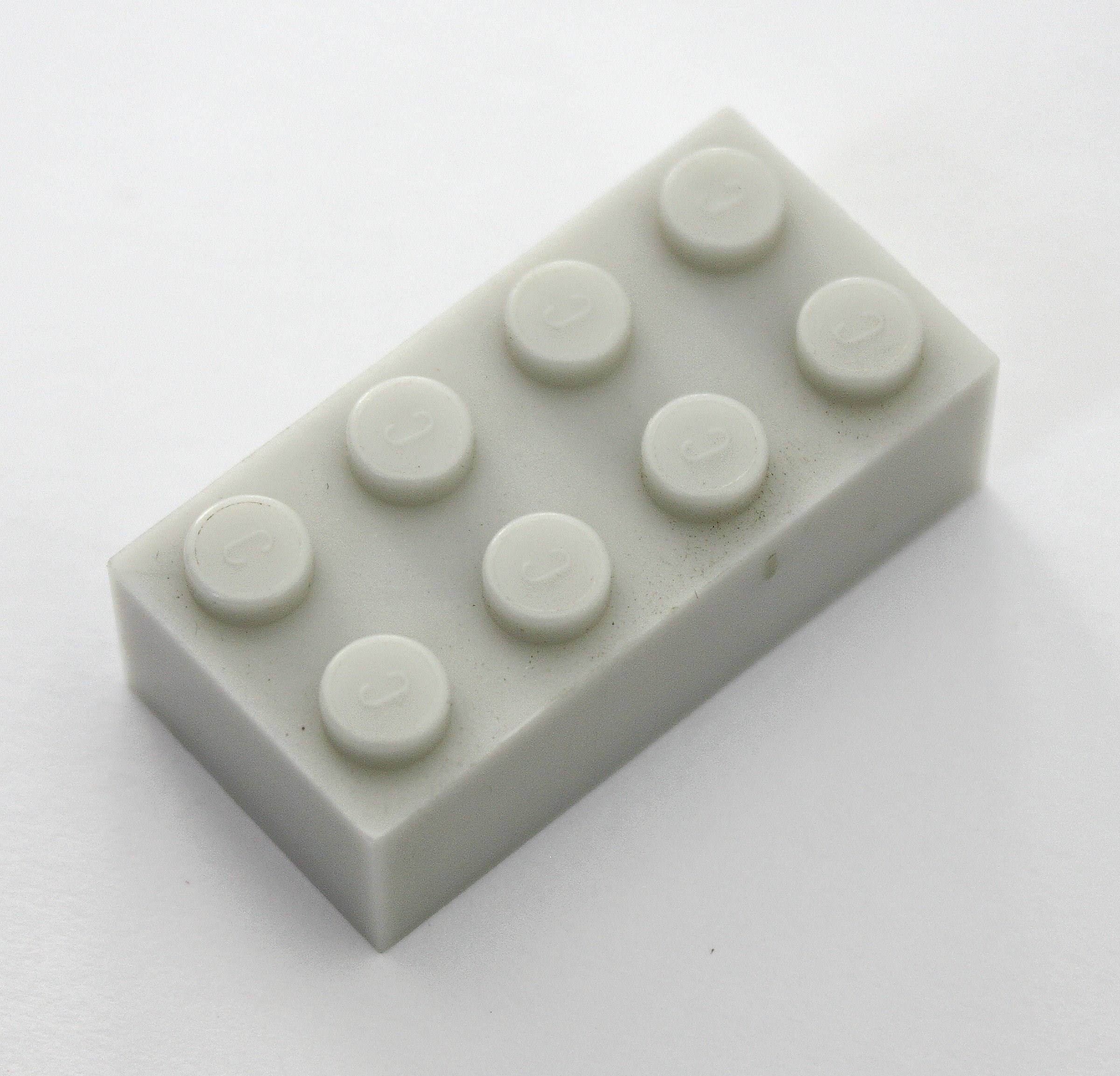
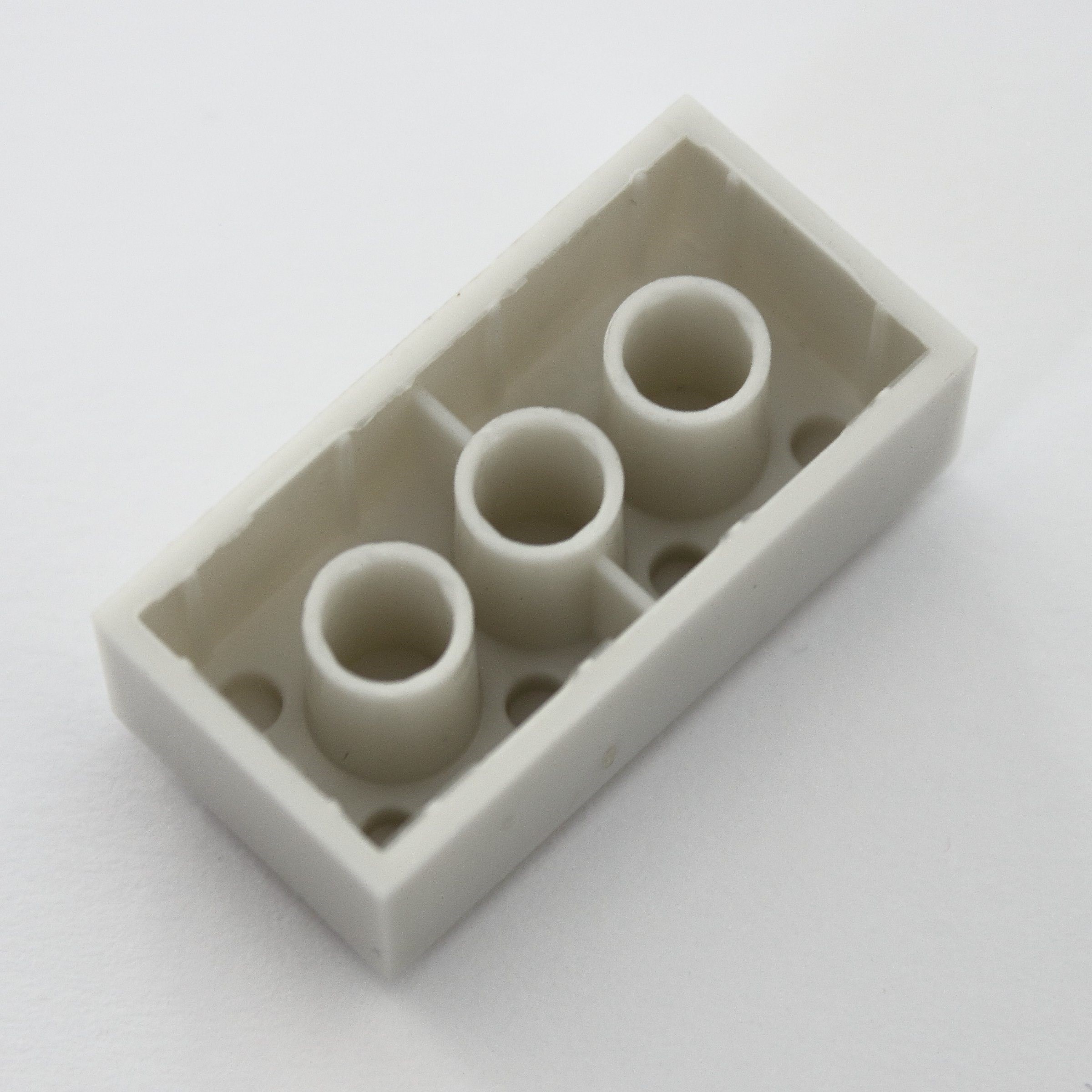
SMART BRICK 2026
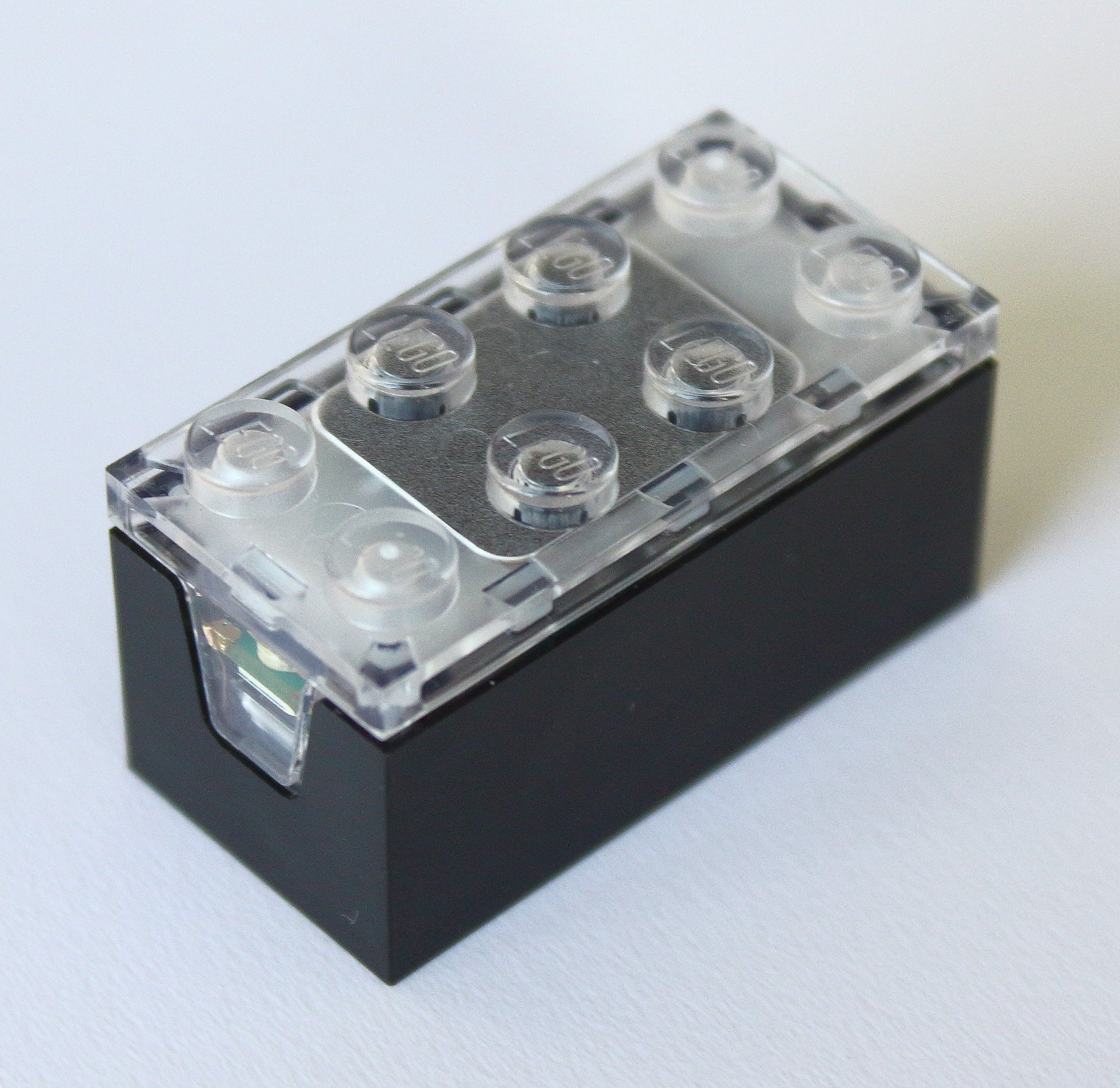
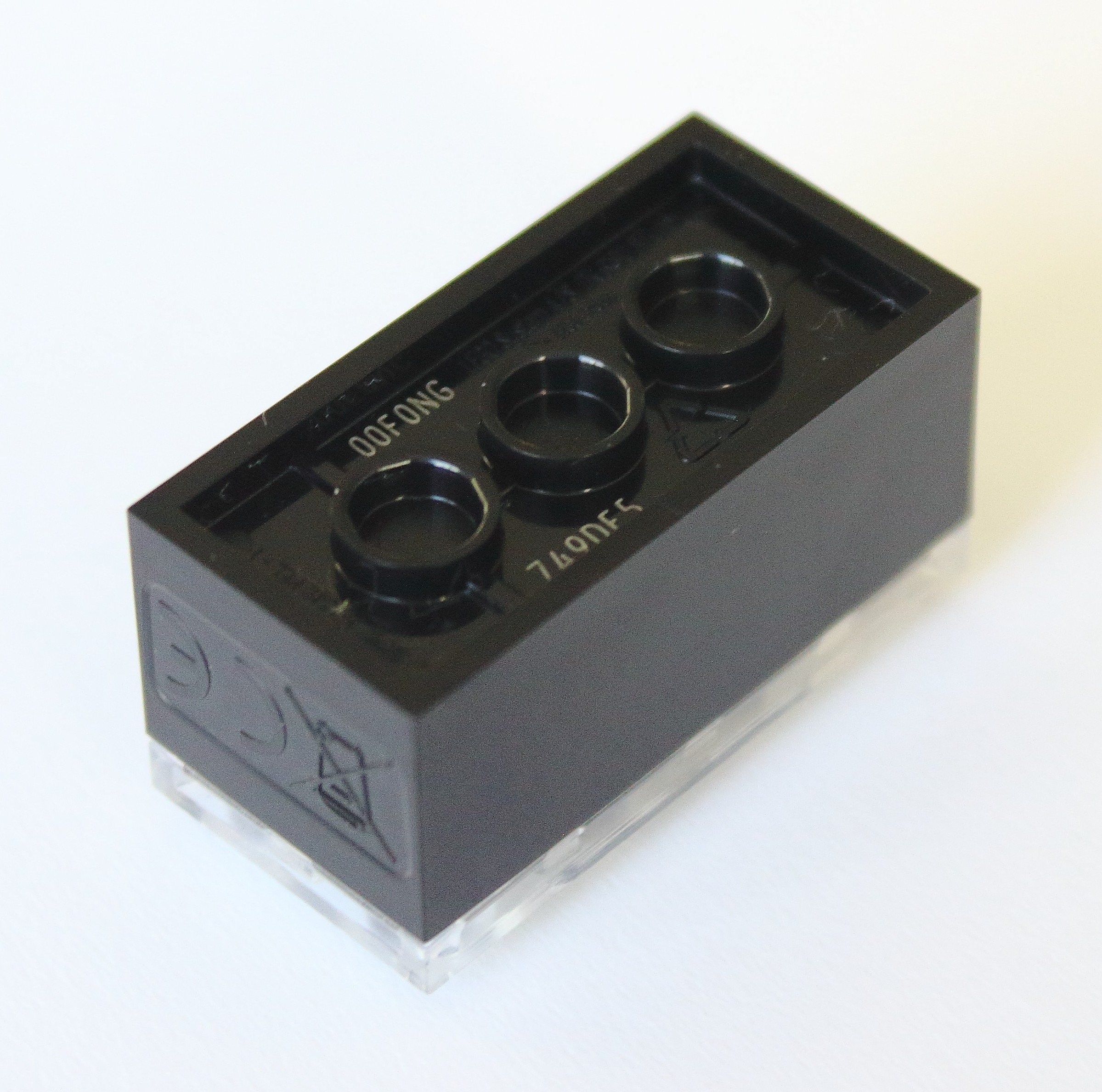
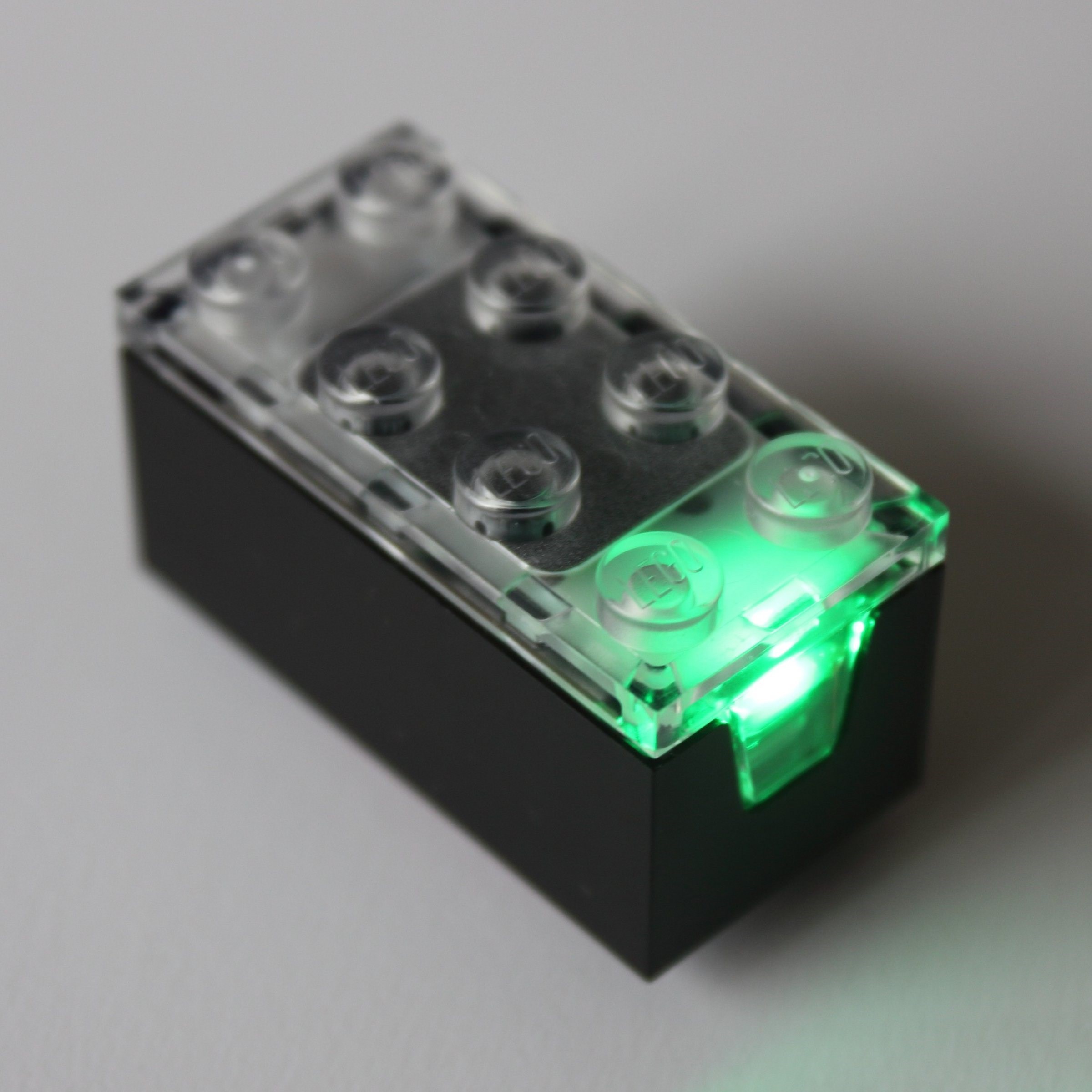
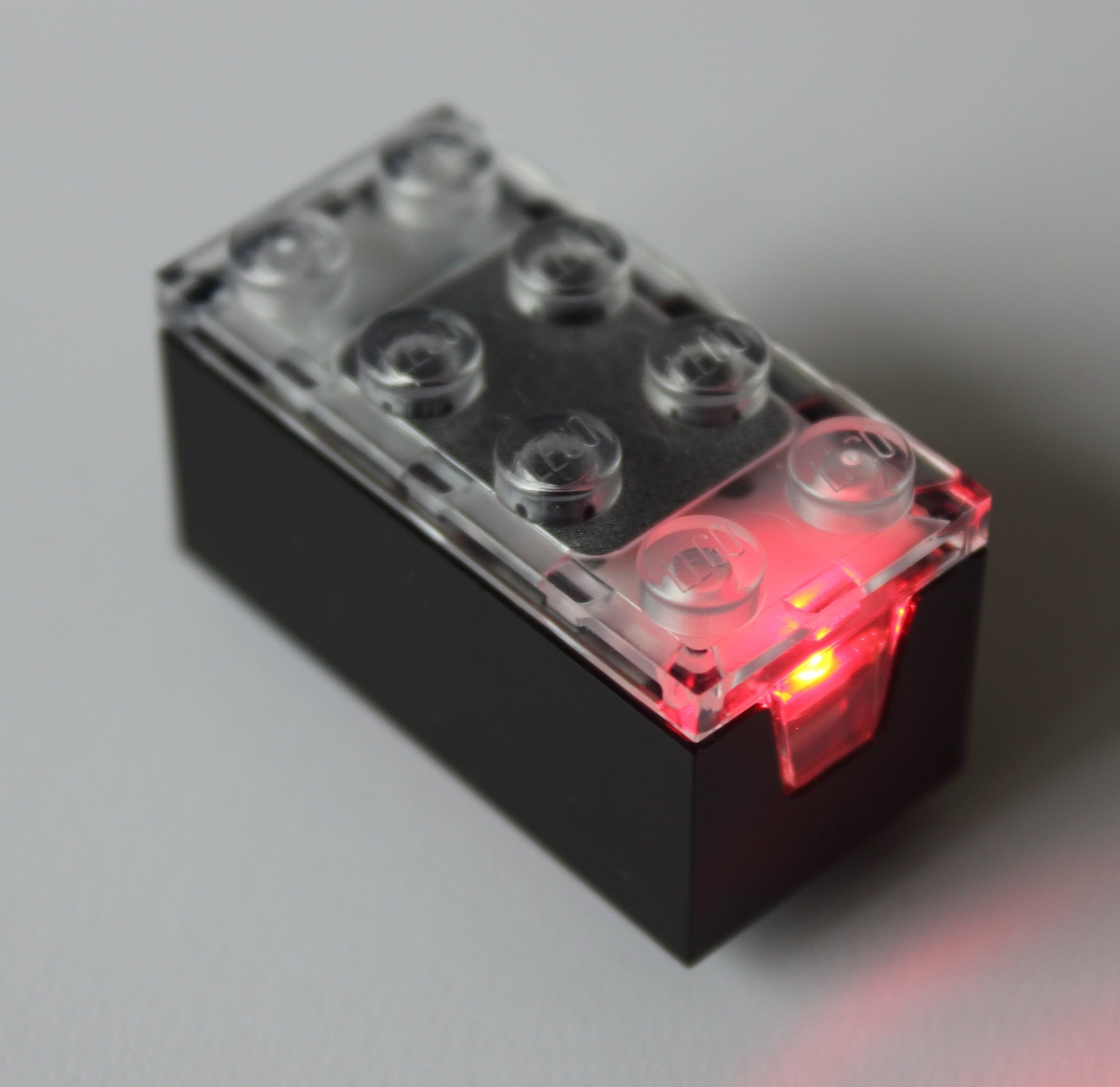
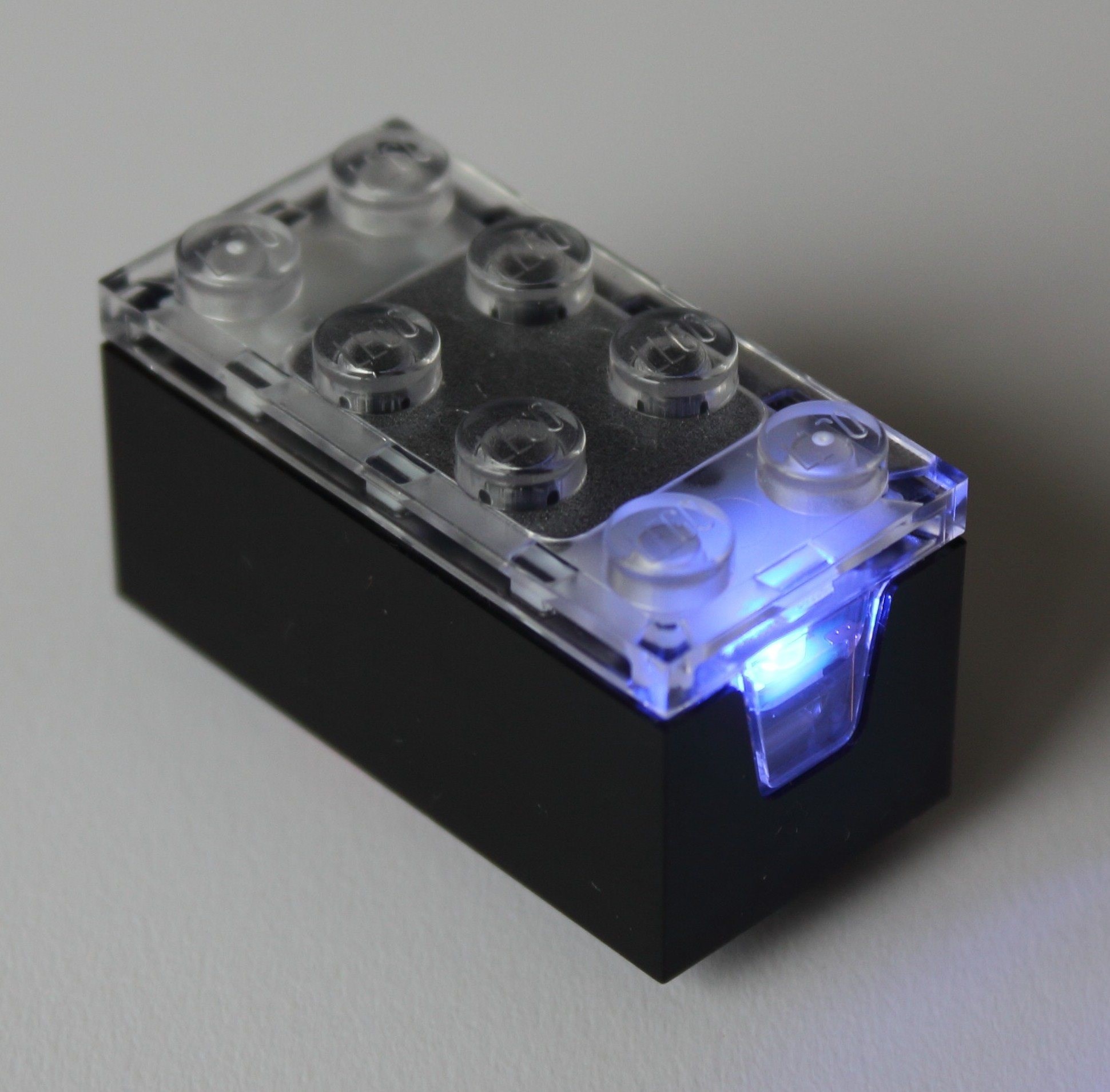
The Smart Brick 2×4: produced since 2026, is the first LEGO brick with integrated sensors, sound, and tactile response in a format fully compatible with the classic system. Its miniaturized microelectronics allow builds to react to movement or pressure without cables, screens, or apps, while preserving mostly the geometry of the standard brick.
Presented at CES 2026, this Smart Brick inaugurates the LEGO SMART Play system, a new era of interactive physical play that combines invisible technology with traditional creativity, with applications in themed sets and educational contexts. Origin: Billund, Denmark. Manufacturer: LEGO System A/S.

Finally, as always, I would like to thank everyone that has made this project possible (Aina y Blai, family, friends, Lego, sellers… and many more), and I would like to give again a special shoutout to Brickset, for as always, allowing me to exhibit my work.
Just as Lego did so many years back when they developed the Brick, I will continue to look for ways in which to improve the “Bricks on Display” with every single piece I discover each day. And I still dream of working for them someday; in the meantime, I will continue with the historical research on LEGO/NON-Lego bricks.

On the other hand, after completing the first display I met—and eventually formed a genuine “friendship” with—several collectors with whom I have also collaborated on this project, and to whom I am equally grateful for their involvement. I am aware that many more brick variations exist and that I have left some out, but the differences were so minimal that I did not consider it necessary to include them.
Even so, as mentioned earlier, my intention is to complete this display in a few years, incorporating many more pieces (some of which I already have and others I am still trying to obtain).
If anyone is interested in learning more about the display, contributing more pieces or making a comment, please contact me on Instagram or Facebook.
At the moment I don't have in mind to commercialise the “Bricks on Display 2.0” piece, but as the other, If anyone is interested, I could consider making several/few copies (despite the fact that they would have a high price, Although I've found a way to make the display more economical, some of the pieces, due to their oddity or age, are very expensive.) In any case, don't hesitate to contact me.
This article continues in Part 2, where I will describe and explain each piece included in this display. There, I showcase the evolution of the iconic 4x2 brick, examining its design changes over time.
106 likes
40 comments on this article
Interesting. Had a few Byggepinner 'bricks' (or maybe knock off copies) in the early 60s. Had no idea what they were or where they'd come from!
I came across a YouTube video a few months ago about Byggepinner that also mentions Mecline: https://www.youtube.com/watch?v=Z6h6yvgfOQs As I commented on the video, " You know a Lego product's obscure when Bricklink doesn't even list it."
@sjr60 said:"Interesting. Had a few Byggepinner bricks (or maybe knock off copies) in the early 60s. Had no idea what they were or where they'd come from!"
The video I linked to mentions knockoffs, so that might have been what you had.
That Bionicle “element” is actually a fit gauge for socket joints. It would have been used to determine if the socket joints met spec, or needed to be rejected. I found some in a bin of used parts, and another guy in my LUG grabbed _all_ of them before explaining to me what they were.
Missing 45003 foam bricks
@TheOtherMike said:
"I came across a YouTube video a few months ago about Byggepinner that also mentions Mecline: https://www.youtube.com/watch?v=Z6h6yvgfOQs As I commented on the video, " You know a Lego product's obscure when Bricklink doesn't even list it."
@sjr60 said:"Interesting. Had a few Byggepinner bricks (or maybe knock off copies) in the early 60s. Had no idea what they were or where they'd come from!"
The video I linked to mentions knockoffs, so that might have been what you had."
Yes, very likely. I don't even remember any box... most likely a bag from a local corner shop!
You think you can preach Znap to us? You think you know the ancient magic? We were there when it was written...
You forgot the LEGO Dacta large soft bricks. I have 100 2x2's. 25 each of Blue, Yellow, Red and Green.
Congratulations on amassing an impressive collection of pieces! I love your presentation.
Primo is fully system-compatible, top and bottom. See my demo here:
https://www.youtube.com/watch?v=xs2wconfJjw
You have a few white whales to chase (or are they red whales?):
• Soft bricks
• EU Jumbo
• Olo
• Storage bricks (they do stack top and bottom, and have several different element styles, so one can make a good argument that they are a building system)
Missed your article from 2023, very fascinating!
@PurpleDave said:
"That Bionicle “element” is actually a fit gauge for socket joints. It would have been used to determine if the socket joints met spec, or needed to be rejected. I found some in a bin of used parts, and another guy in my LUG grabbed _all_ of them before explaining to me what they were."
I wondered what that was!
@AllenSmith said:
"Congratulations on amassing an impressive collection of pieces! I love your presentation.
Primo is fully system-compatible, top and bottom. See my demo here:
https://www.youtube.com/watch?v=xs2wconfJjw
You have a few white whales to chase (or are they red whales?):
• Soft bricks
• EU Jumbo
• Olo
• Storage bricks (they do stack top and bottom, and have several different element styles, so one can make a good argument that they are a building system)"
Well, at least 6313287 is out, since it’s not compatible with itself.
@TheOtherMike said:
" @PurpleDave said:
"That Bionicle “element” is actually a fit gauge for socket joints. It would have been used to determine if the socket joints met spec, or needed to be rejected. I found some in a bin of used parts, and another guy in my LUG grabbed _all_ of them before explaining to me what they were."
I wondered what that was!"
So did I, which is why I asked him. If I’d asked a little earlier, I would have demanded at least a couple for helping him dig through the pile to find them all.
Excellent article. Thank you.
@PurpleDave said:
" @AllenSmith said:
"Congratulations on amassing an impressive collection of pieces! I love your presentation.
Primo is fully system-compatible, top and bottom. See my demo here:
https://www.youtube.com/watch?v=xs2wconfJjw
You have a few white whales to chase (or are they red whales?):
• Soft bricks
• EU Jumbo
• Olo
• Storage bricks (they do stack top and bottom, and have several different element styles, so one can make a good argument that they are a building system)"
Well, at least 6313287 is out, since it’s not compatible with itself.
@TheOtherMike said:
" @PurpleDave said:
"That Bionicle “element” is actually a fit gauge for socket joints. It would have been used to determine if the socket joints met spec, or needed to be rejected. I found some in a bin of used parts, and another guy in my LUG grabbed _all_ of them before explaining to me what they were."
I wondered what that was!"
So did I, which is why I asked him. If I’d asked a little earlier, I would have demanded at least a couple for helping him dig through the pile to find them all."
Why did he grab them all anyway? Are they worth their weight in gold or what?
In any case that guy seems kind of like an a***ole for behaving like that.
Interesting stuff here. Didn't even know about half of these other interlocking historic brands. Although, if you're a true collector you should have included other brands bricks like MEGA, CaDA, COBI etc. Or do you have a third display box with more contemporary brands?
@AustinPowers said:
" @PurpleDave said:
" @AllenSmith said:
"Congratulations on amassing an impressive collection of pieces! I love your presentation.
Primo is fully system-compatible, top and bottom. See my demo here:
https://www.youtube.com/watch?v=xs2wconfJjw
You have a few white whales to chase (or are they red whales?):
• Soft bricks
• EU Jumbo
• Olo
• Storage bricks (they do stack top and bottom, and have several different element styles, so one can make a good argument that they are a building system)"
Well, at least 6313287 is out, since it’s not compatible with itself.
@TheOtherMike said:
" @PurpleDave said:
"That Bionicle “element” is actually a fit gauge for socket joints. It would have been used to determine if the socket joints met spec, or needed to be rejected. I found some in a bin of used parts, and another guy in my LUG grabbed _all_ of them before explaining to me what they were."
I wondered what that was!"
So did I, which is why I asked him. If I’d asked a little earlier, I would have demanded at least a couple for helping him dig through the pile to find them all."
Why did he grab them all anyway? Are they worth their weight in gold or what?
In any case that guy seems kind of like an a***ole for behaving like that. "
They probably *are* worth a lot, given that they would seem to be only used in-house and were never put in any sets. It'd probably be hard to find a way to MOC with them.
@PurpleDave said:
"That Bionicle “element” is actually a fit gauge for socket joints. It would have been used to determine if the socket joints met spec, or needed to be rejected. I found some in a bin of used parts, and another guy in my LUG grabbed _all_ of them before explaining to me what they were."
They are re-selling them online for a lot of money...
@leocnasc said:
"Missing 45003 foam bricks"
hahaha, it doesn't fit on the display, it's huge ;)
@StudMuffin24 said:
"You think you can preach Znap to us? You think you know the ancient magic? We were there when it was written..."
It's not that old either, the piece with the bulb yes, there were less people there hahah
@AllanSmith said:
"You forgot the LEGO Dacta large soft bricks. I have 100 2x2's. 25 each of Blue, Yellow, Red and Green."
its pieces are very large, hopefully if we could print bases where they can be added, although the idea is not to put everything that simulates the 4x2 brick, I really want to add more (if there are any missing) from the evolution of the 4x2 brick, let's see where I find any space to place them
@AllenSmith said:
"Congratulations on amassing an impressive collection of pieces! I love your presentation.
Primo is fully system-compatible, top and bottom. See my demo here:
https://www.youtube.com/watch?v=xs2wconfJjw
You have a few white whales to chase (or are they red whales?):
• Soft bricks
• EU Jumbo
• Olo
• Storage bricks (they do stack top and bottom, and have several different element styles, so one can make a good argument that they are a building system)"
Yes, I already have the ones that fit, others I'm looking for, like the OLOs in red, we'll see how the display turns out in a while
@CC said:
"Missed your article from 2023, very fascinating!"
thank you :), I have more prepared for the future
@R0Sch said:
"Interesting stuff here. Didn't even know about half of these other interlocking historic brands. Although, if you're a true collector you should have included other brands bricks like MEGA, CaDA, COBI etc. Or do you have a third display box with more contemporary brands?"
more to come ;)
Today I learned that what we called "Pino Mágico" in Brazil was actually a Norwegian toy (Byggepinner). I played a lot with these during my childhood.
@Anthrax442 said:
"Today I learned that what we called "Pino Mágico" in Brazil was actually a Norwegian toy (Byggepinner). I played a lot with these during my childhood."
And still being produced. Who'd have thought that a pretty unversatile building toy would still be going.
@AustinPowers said:
"Why did he grab them all anyway? Are they worth their weight in gold or what?"
They’re plastic, so they don’t weigh very much. Partly, I know he wanted one of each for himself (they came in at least three colors, and with axles of different lengths), and the rest he probably wanted as trade bait. He has some overly ambitious desires. On the low end, I know he wanted to collect every shape and color of macaroni brick, and every shape and color of cape, both of which he might have given up on by now. And he wants to collect a full Bohrok swarm (that’s eight each in six colors, plus however many Bohrok Va, and a set of six Bohrok Kal, and all of the requisite Krana to fill them all). And he wants to collect every dragon, which even if he came from inherited wealth is a near-impossible task. Like, if they put a picture of a dragon model in a book, he wants the book, and to build a copy of the model depicted. And there’s a whole range of plush dragons that were sold through the LEGOLAND parks that the fan community has almost zero documentation of. Oh, and that one employee gift that was a Ninjago set (he also wants the gingerbread Advent calendar because he wants every Advent calendar). And that’s not even addressing the fact that there are several “life size” dragon sculptures throughout the LEGOLAND park system and the LEGO Stores. So you can see how something that would rarely hit the public market, and would appeal to at least one group of collectors, would be desirable.
"In any case that guy seems kind of like an a***ole for behaving like that."
Why, because I’ve never once hinted to him that I might like a few? If I’d said something at the time, even though he was the only one buying parts, and the loss would potentially set him back on his impossibly ambitious goals, I’m sure he would have given them to me at no charge. He’s hooked me up with other parts when they’re difficult to obtain, and many times when I’ve been examining an odd looking part he’s asked if I had any plans to obtain it before claiming it for his own (which, considering he knows I prefer to only buy New parts is far more than I’d expect from most people).
@TheOtherMike said:
"They probably *are* worth a lot, given that they would seem to be only used in-house and were never put in any sets. It'd probably be hard to find a way to MOC with them."
As a fit gauge, the ball is not going to be the exact same size as a production part, so these would probably be really floppy in a standard socket connection.
@Bricks_on_Display said:
"They are re-selling them online for a lot of money..."
Eh. Unless I need to buy some to complete a MOC, I don’t really pay much attention to resale value. Besides, I’ve got stuff in my collection that would outsell the fit gauges. I have the first known complete collection of Krana. That includes the White Metal and Sterling Silver chase elements. And it includes a full set of eight chromed Krana, and a full set of eight _unchromed_ plastic Krana. I have a yellow prototype Hau that was forwarded to me by the Bionicle design team. I didn’t even remember it existed, but the guy in my LUG pointed out I somehow ended up with a prototype model of a Sand Tarakava (poor thing is lost somewhere in a box in my condo). And that’s not even getting into mundane stuff like hating bought multiple copies of both Target cubes, or owning a handful of SDCC minifigs. Plus I’ve picked up a few Q elements and misprint minifig heads when they were priced really low. Oh, we did also run across some minifig test prints once, but I think it was just torsos and heads. I was mildly interested in them, but would have much preferred getting a set of legs to go with them, so I ended up passing on those as well.
@PurpleDave
There are plushie dragons at Legoland? I am abruptly terribly bereft. I want one.
@PurpleDave said:"I know he wanted to collect every shape and color of macaroni brick, and every shape and color of cape, both of which he might have given up on by now."
I once started trying to collect every color of 2x4 brick (getting the gold one in 4105-2 put the idea in my head) but gave up on that fairly quickly.
Poor ZNAP will forever be forgotten in the attics of children together with the likes of Jack Stone and Galidor. :)
Does anyone remember CONSTRUX from Mattel formerly under Fisher Price? Had so much fun during my childhood with that system. I remember getting the 6460 Space set from the flea market and building huge bases and then playing with LEGO on them. Later had the huge 15543 Crane Truck too. But after getting a few small Universal Technic sets though, there was no better substitute for building toys.
@PurpleDave: ok, maybe the guy is not an a**..., but the more you describe about him the more it sounds as if he's got several screws loose somewhere.
I mean, liking to collect stuff, all fine and well, but, what you describe borders on the clinically obsessive.
@Hiratha said:
" @PurpleDave
There are plushie dragons at Legoland? I am abruptly terribly bereft. I want one."
There have been, yes. Someone I know from BW Chicago brought a few to the last BW Expo held on Metro Detroit, and I dragged that guy over to see them (I get a somewhat perverse amount of pleasure point out all the dragons he _doesn’t_ own yet). But the thing is, _NOBODY_ has been cataloging them, so I think you can find some listings on BL, but none of them matched the ones we saw at the BW Expo. They’re mostly plush versions of Ollie (the proper dragon), but there might have been at least one of Brickley (the sea serpent).
@TheOtherMike said:
" @PurpleDave said:"I know he wanted to collect every shape and color of macaroni brick, and every shape and color of cape, both of which he might have given up on by now."
I once started trying to collect every color of 2x4 brick (getting the gold one in 4105-2 put the idea in my head) but gave up on that fairly quickly."
I told this guy I once considered trying to collect every LEGO shark they ever made, did a quick bit of mental math, and scrapped that idea. I do try to get every frog element. I think right now I’m technically only missing stuff that might not be released yet, like black. I _do_ own old dark-grey and trans-green, with whatever sets I got them in, but I should pick up extras of both at some point for the lineup. And I have one each in custom gold-chrome and silver-chrome (used the latter as a hood ornament on my zombie hearse). There’s a guy in my club who does “lost-wax” metal castings, so they wouldn’t have LEGO-precision anti-studs, but I could have him make me some metal castings if I really want to. Dunno how expensive those would be, though.
@AustinPowers said:
" @PurpleDave: ok, maybe the guy is not an a**..., but the more you describe about him the more it sounds as if he's got several screws loose somewhere.
I mean, liking to collect stuff, all fine and well, but, what you describe borders on the clinically obsessive. "
Have you met this hobby? How many people chase after every possible wiped or non-wiped monofig? Or every possible Classic Spaceman? Or the guy who does the castings collects every color of 5-point crystal. _And_ does “monofig habitats”. And Bionicle had this all built right in with collecting masks (technically so did Throwbots and Robo-Riders, but the disc packs were nearly impossible to find if you didn’t live near a LEGOLAND or LEGO Store). And another new recruit to my club has been burning through purchases of vintage sets _AND_ wants to do exactly what this article is about. There are people who collect every set in a given theme, or every minifig in the same (including rare, expensive, and difficult to locate variants like Smooth Hair Leia). Obsession is baked right in and sprinkled on top for good measure.
But it could be worse. We could be stamp-collecting. Can’t really do anything with them except try to sell them for a profit, and have you checked the price on an Inverted Jenny lately? If I sold my everything, I still couldn’t afford one of those.
@PurpleDave: no, apparently I have not met this hobby yet.
I have met people who collect stuff (funnily enough I did collect stamps as a kid, but not for value, only for the often beautiful artwork and for the fun of knowing that I have some weird stamps from exotic countries for example).
But I have never met an obsessive collector. If something is unobtainable or very hard to get, then one simply finds something else.
@R0Sch said:
"Poor ZNAP will forever be forgotten in the attics of children together with the likes of Jack Stone and Galidor. :)
Does anyone remember CONSTRUX from Mattel formerly under Fisher Price? Had so much fun during my childhood with that system. I remember getting the 6460 Space set from the flea market and building huge bases and then playing with LEGO on them. Later had the huge 15543 Crane Truck too. But after getting a few small Universal Technic sets though, there was no better substitute for building toys."
I had https://www.retrorescue.com/photos/construx/6225%20(1).jpg and had a lot of fun with it, but some of the beams ended up cracking at the ends.. My brother had https://www.retrorescue.com/photos/construx/6330%20(1).jpg.
@AustinPowers said:
" @PurpleDave: no, apparently I have not met this hobby yet.
I have met people who collect stuff (funnily enough I did collect stamps as a kid, but not for value, only for the often beautiful artwork and for the fun of knowing that I have some weird stamps from exotic countries for example).
But I have never met an obsessive collector. If something is unobtainable or very hard to get, then one simply finds something else. "
Clearly you have not met this hobby. I remember early years at Brickworld Chicago where one person’s “display” basically consisted of two banquet tables covered in baseplates and large plates stuffed full of ranks of Castle minifigs. They weren’t fighting, or displayed on terrain. They were just being shown off. I think there was at least half a baseplate full of lizardmen that were basically just the 2006 Killer Croc minifig. I’m not saying I’m any better. Besides the first known complete Krana collection, just my display collection of Batman stuff consists of over 400 unique minifigs.
@PurpleDave: wow.
In any case I prefer my kind of collecting, which is far more relaxing. Like my slowly growing collection of monofigs or Classic Spacemen. I am always happy to find new ones (or parts thereof), but if some remain unobtainable (or extremely hard to find and/or expensive) then so be it. Doesn't bother me, just as it doesn't bother me if someone else has an item that I don't.
Anyway, happy collecting!
I'd love for you to 3d print copies of these as sets to hang on your wall. I'd totally buy a few.
@strangewayes said:
"I'd love for you to 3d print copies of these as sets to hang on your wall. I'd totally buy a few."
Just the cases or the contents as well? Because 3D-printing the contents isn’t going to turn out that well. In a lot of cases, the visible differences between two of these parts will have detail that’s too fine to capture with any 3D printer type I’m aware of, except maybe a liquid resin printer.
@strangewayes said:
"I'd love for you to 3d print copies of these as sets to hang on your wall. I'd totally buy a few."
It's obviously possible, the printed base is made to be fixed to the wall, that's how I have it at home, but that type of printing is very expensive (the one that is suitable for its size and surface appearance, is not resin); I don't know if people would be interested at that price. FDM printing is cheaper, but the surface finish and hardness are awful, although I have some samples that aren't bad...
@AustinPowers said:
" @PurpleDave : no, apparently I have not met this hobby yet.
I have met people who collect stuff (funnily enough I did collect stamps as a kid, but not for value, only for the often beautiful artwork and for the fun of knowing that I have some weird stamps from exotic countries for example).
But I have never met an obsessive collector. If something is unobtainable or very hard to get, then one simply finds something else. "
I think that's a healthy perspective.
While obsessive collectors have basically existed forever, collecting just about everything (insects, butterflies, rocks, cars, even leaves), I do think that the commercialization of it seen in game and toy companies such as LEGO, or stuff like baseball cards and Pokemon borders on exploitation. Even so, I also still believe there's some value in it from an educational and historical perspective, as this Bricks On Display article readily demonstrates. However, when people begin behaving like Gollum around LEGO parts, it's probably safe to say that it's moved into the realm of being unhealthy.
I guess the distinction lies in what the motivation is. If it's actually about money (which it almost certainly was, and usually is when it comes to LEGO), I can't help but think of Ebenezer Scrooge myself, so I don't think your comment was unreasonable.
Regardless, in the grand scheme of collecting things, LEGO will always be on the smaller side. The aforementioned stamp collections are obviously a huge step up, as are coins. Some collections, like those that involve ancient or medieval armor and weapons, fine musical instruments, fine art or specific taxonomy collections are just in a different league entirely.
First of all, thank you for the article @Bricks_on_Display. It was an interesting read.
I've noticed that you refer to them as brick 2x4 or 2×4 brick, but at the end of the article and in a reply/comment you've switched to 4x2 brick. I'm not used to the latter and am just curious: do you normally use both?
@R0Sch said:
"Does anyone remember CONSTRUX from Mattel formerly under Fisher Price?"
I remember it fondly. Although before you mentioned it, those memories were very dormant. Thanks for bringing it up!