Review: 42232 Koenigsegg Sadair's Spear Megacar
Posted by Huw,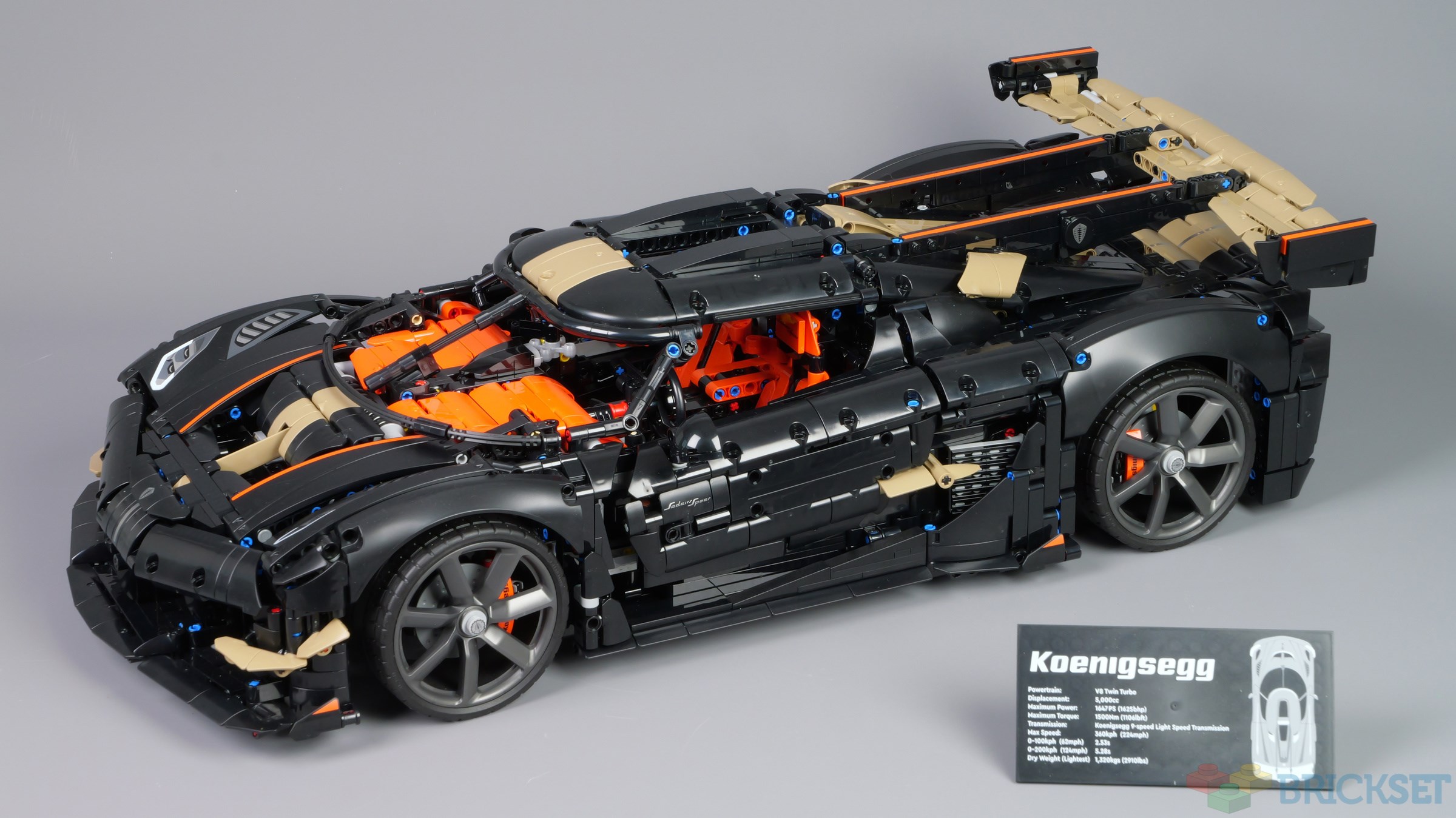
42232 Koenigsegg Sadair's Spear Megacar is the sixth in the series of Technic Ultimate Cars that began in 2016 with 42056 Porsche 911 GT3 RS.
Each one has improved on its predecessors, and this is the most sophisticated yet. The car's 9-speed transmission and Triplex suspension have been replicated faithfully, as has the vehicle's intriguingly-named 'ghost-mode' party trick.
Summary
42232 Koenigsegg Sadair's Spear Megacar, 4,104 pieces.
£399.99 / $449.99 / €449.99 | 9.7p, 11.0c, 11.0c per piece.
Buy at LEGO.com »
The best Technic Ultimate Car yet
- All decorated parts printed
- Authentic mechanisms
- Cleverly implemented 'ghost mode'
- A long but rewarding build
- Black livery is a bit boring
- Just another Technic car among dozens
The set was provided for review by LEGO. All opinions expressed are those of the author.
The prototype
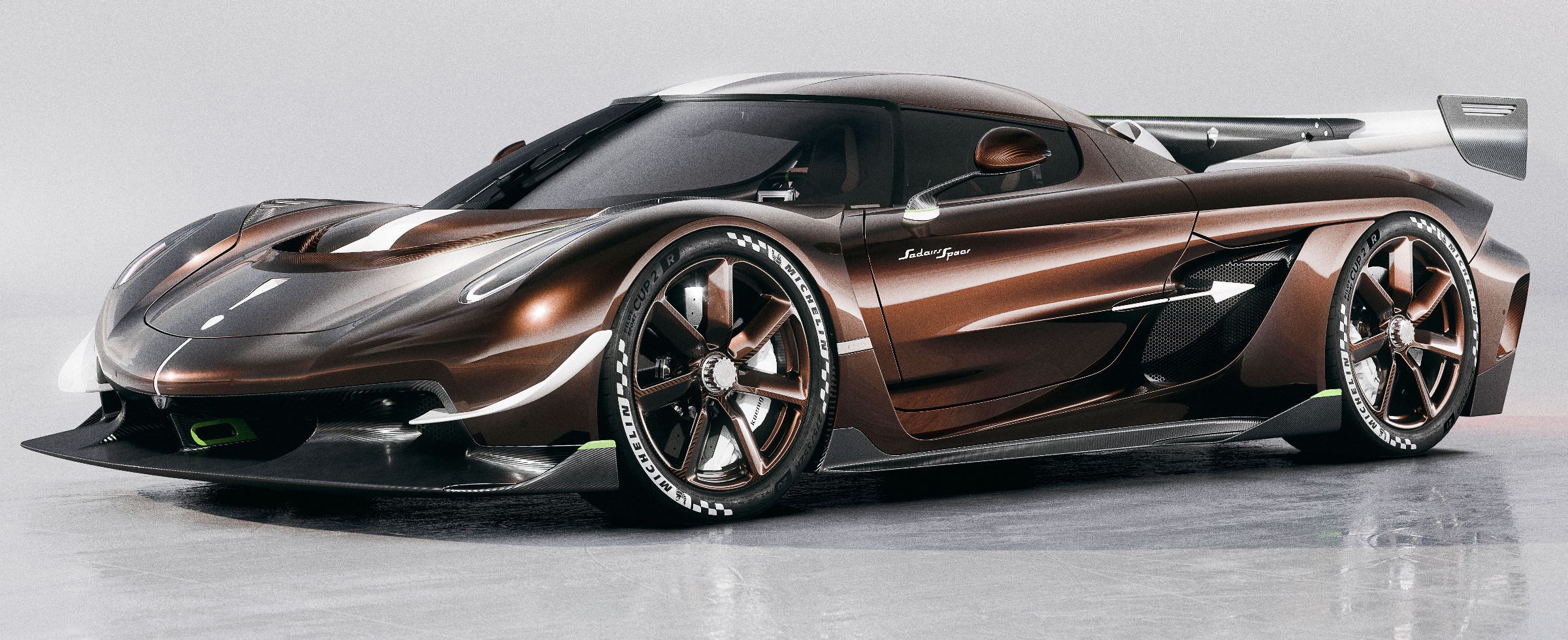
Koenigsegg Sadair's Spear, named after the racehorse the Swedish company's founder's father used to ride, is a road-legal supercar that'll set you back a cool £3.8 million. Just 30 were made, and all have been sold already, so you'll have to make do with the 1:8 scale LEGO version costing a fraction of that.
The completed model
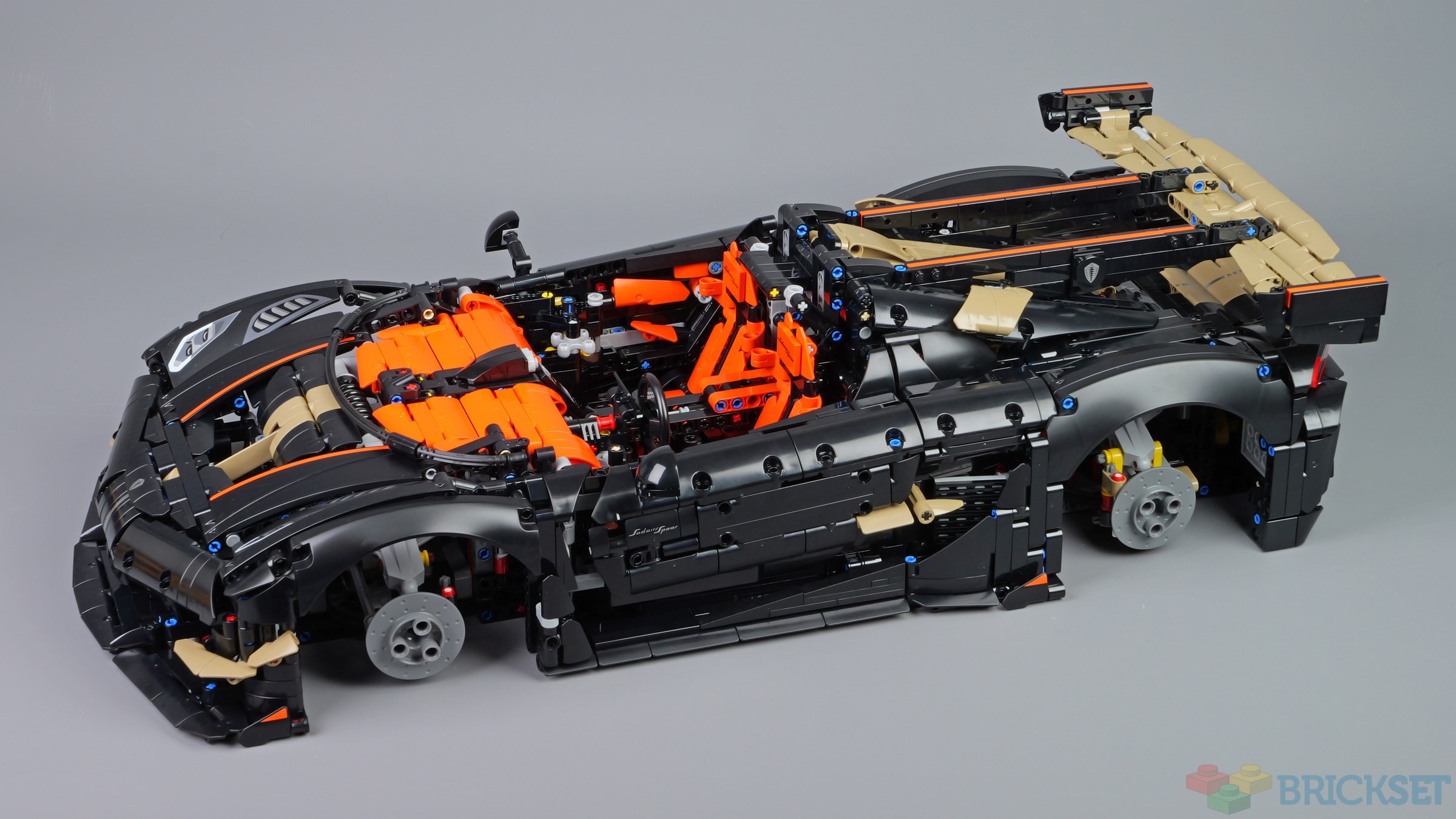
Up until now, Technic Ultimate Cars have replicated the livery of a real-life example, but the introduction in the instructions explains that in this case LEGO experimented with colours that have been used on Koenigsegg cars before to come up with a new unique livery, one that differentiated it from other models in the collection.
The result is a predominately black vehicle with dark tan highlights and a reddish-orange interior. Black would not have been my first choice given its ubiquity, but it doesn't look too bad. Presumably, the budget did not stretch to creating a new colour and all the parts needed to replicate the livery of the one above and, let's face it, a brown car would look awful anyway.
At 1:8 scale it's pretty much the same size as others in the series, 59cm long by 24cm wide, excluding the wing mirrors. All decorated parts in the set are printed, which includes logos, branding and orange stripes.
In terms of functionality, the model has the aforementioned 9-speed gearbox, front- and rear-suspension, and steering via the steering wheel, plus opening doors, bonnet, and rear clamshell (what we in the UK might call the boot.)
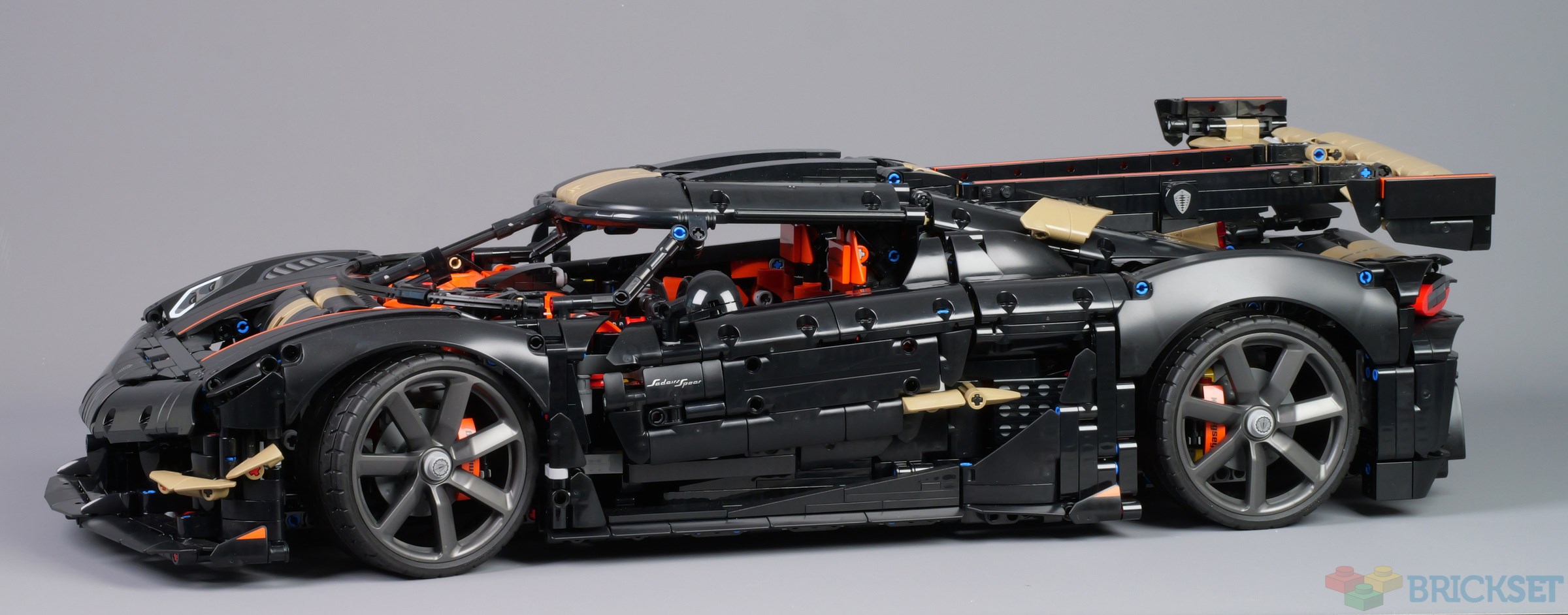
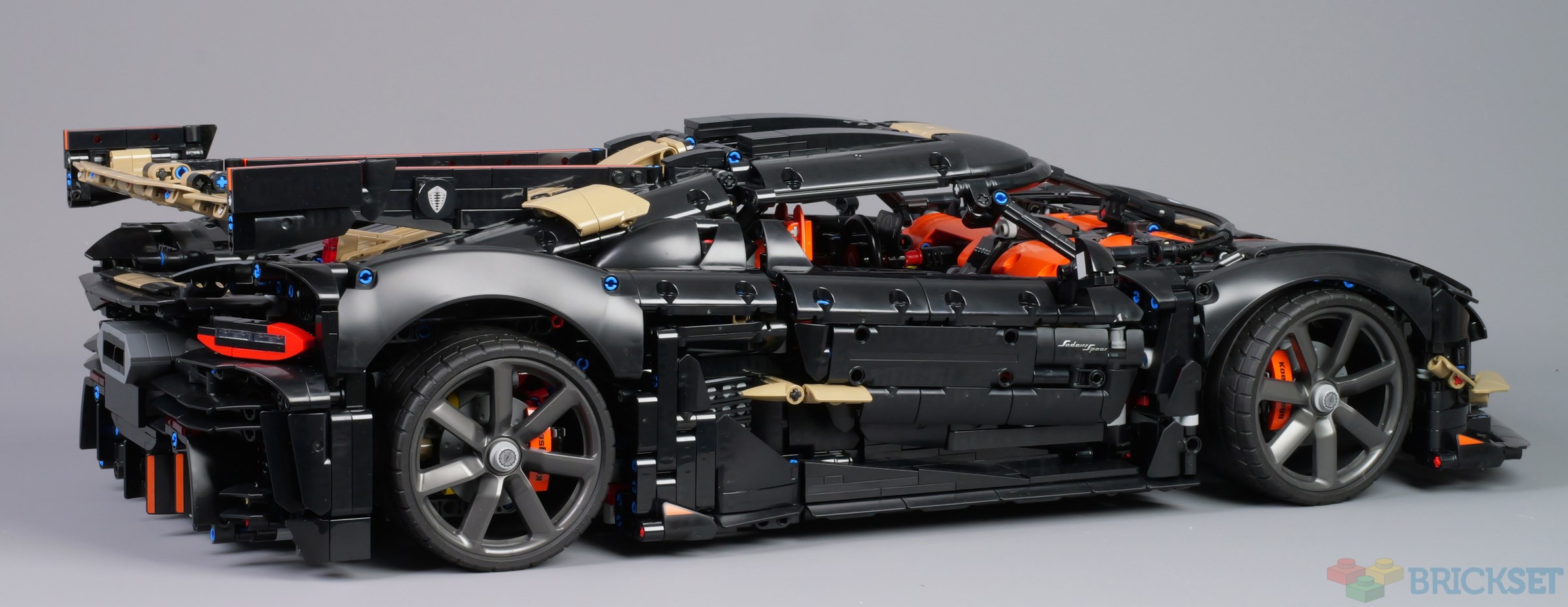
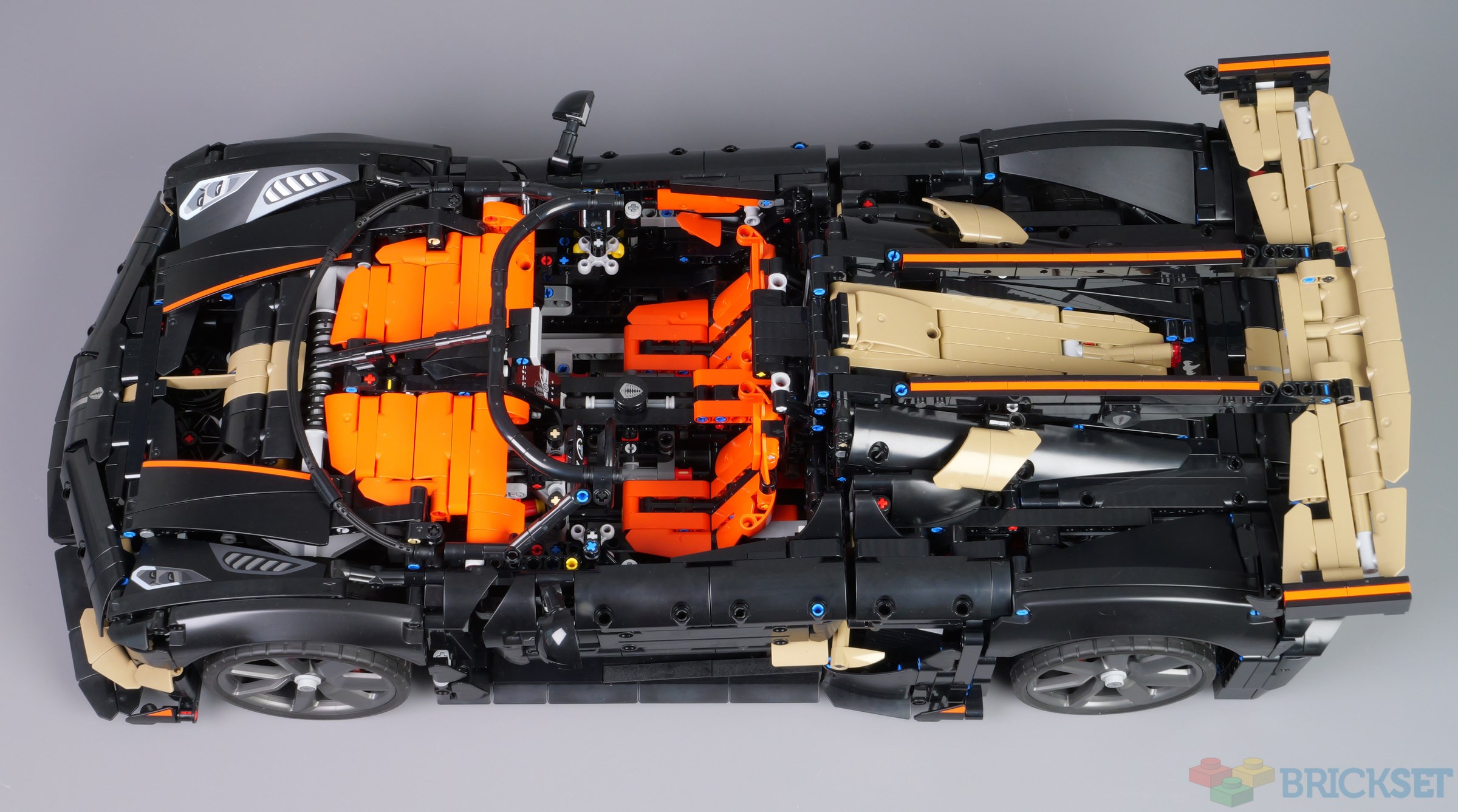
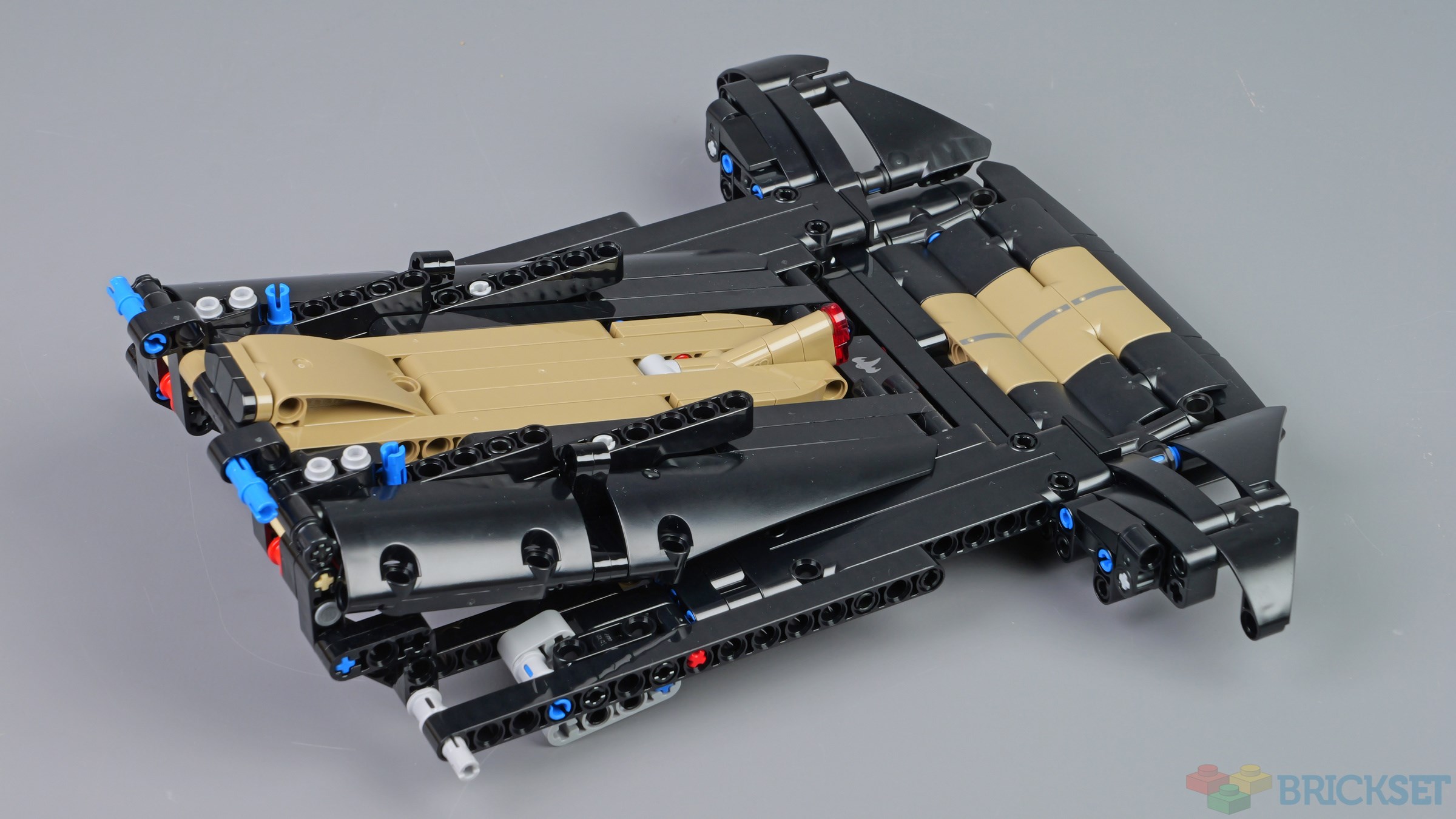
The real car does not have a removable roof, but the model does, which is handy for admiring the interior and operating the gearbox.
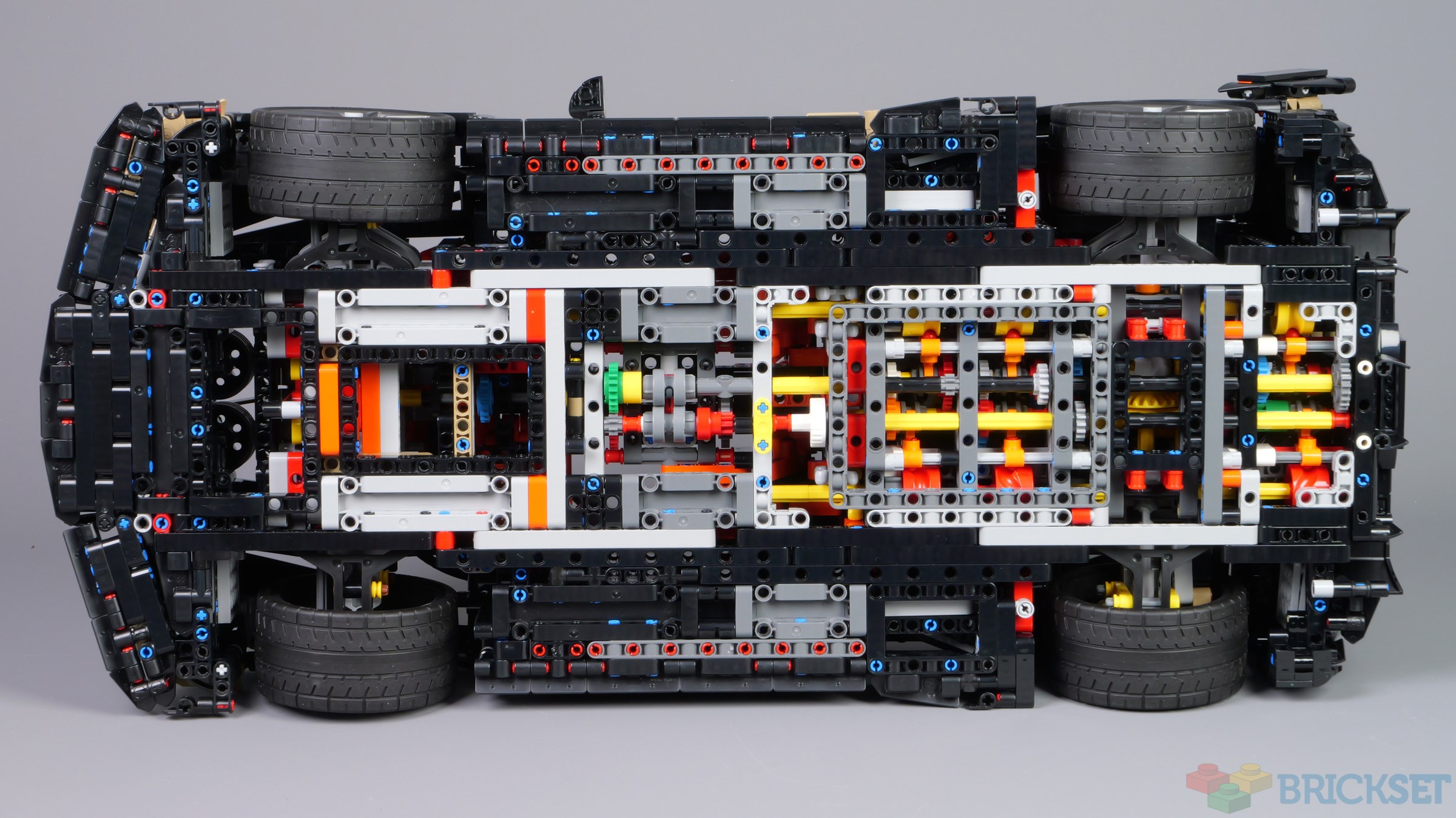
Unlike some in the Technic Ultimate Car series, the gearbox is visible from underneath.
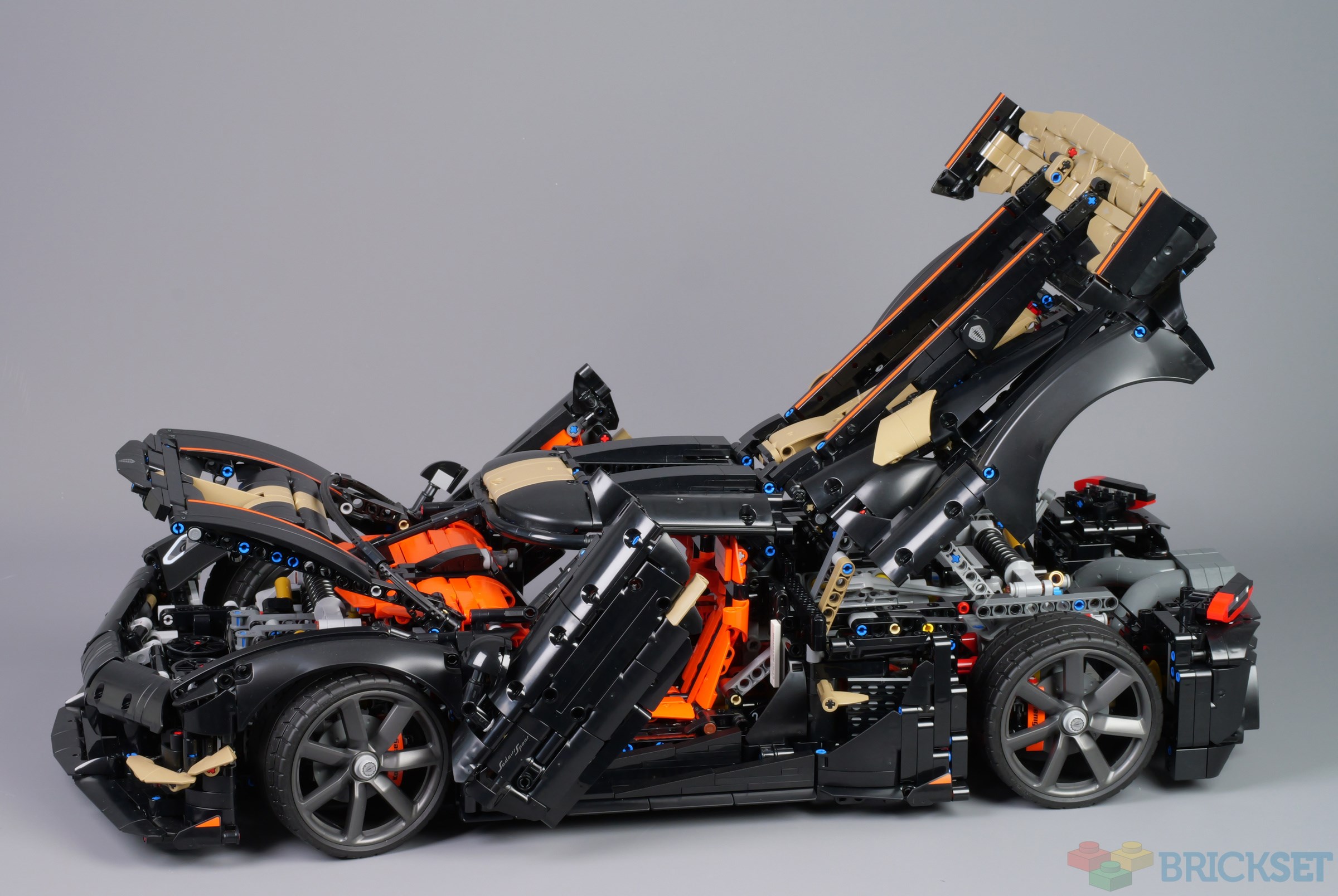
The real car has a party trick called ghost-mode, named after the manufacturer's association with the Swedish Air Force's Ghost Squadron emblem (its factory occupies a former air force base). Its primary purpose is theatrical, demonstrating the car's unique bodywork and Koenigsegg's engineering.
It's activated by lifting the rear clamshell (boot). As it is raised, thanks to clever linkage inside the chassis, the dihedral synchro-helix doors open, the wing mirrors fold in, and the bonnet opens.
Unfortunately, they have to be lowered and closed separately manually.
Despite being predominately black, it actually looks quite colourful from some angles, thanks to the bright interior and stripes on the bodywork.
As always, the curves of the bodywork are approximated using existing Technic panels and shells, and generally the designer has done a good job, although there are a few unsightly gaps in places, particularly noticeable above the backs of the front wheel arches. The titanium metallic wheel hubs are new, and differ between left and right.
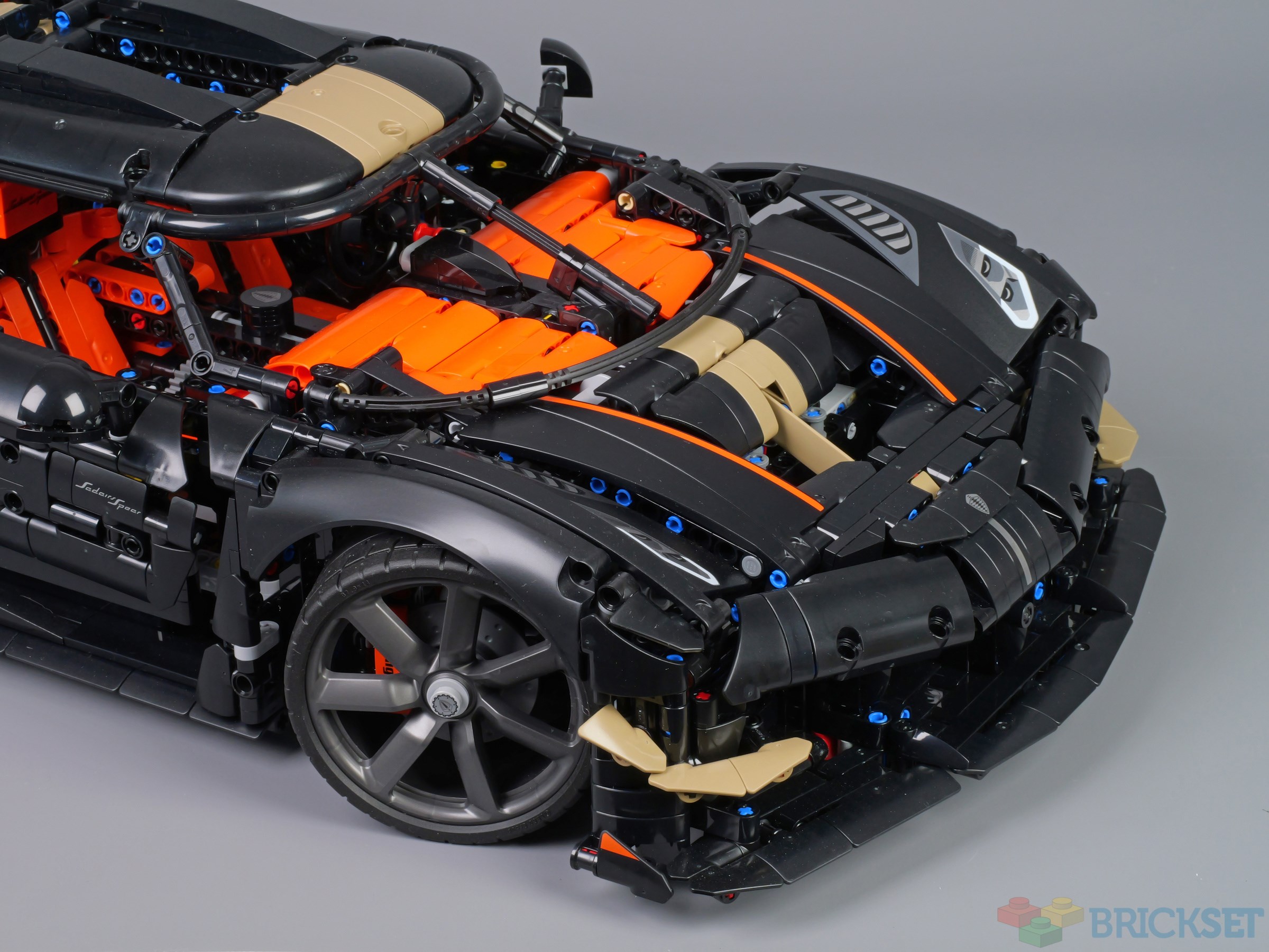
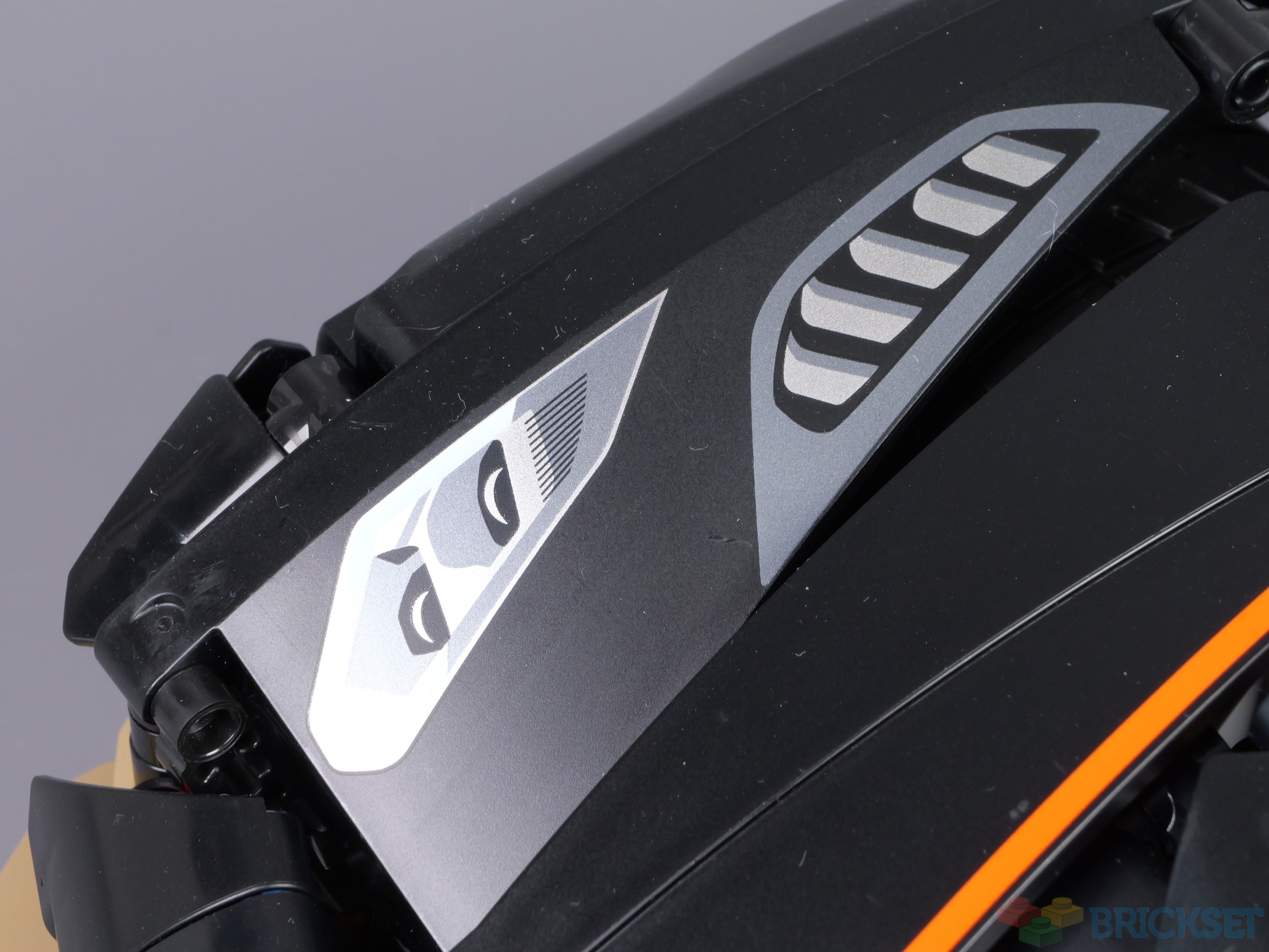
The headlights and front air intakes are printed on panels.
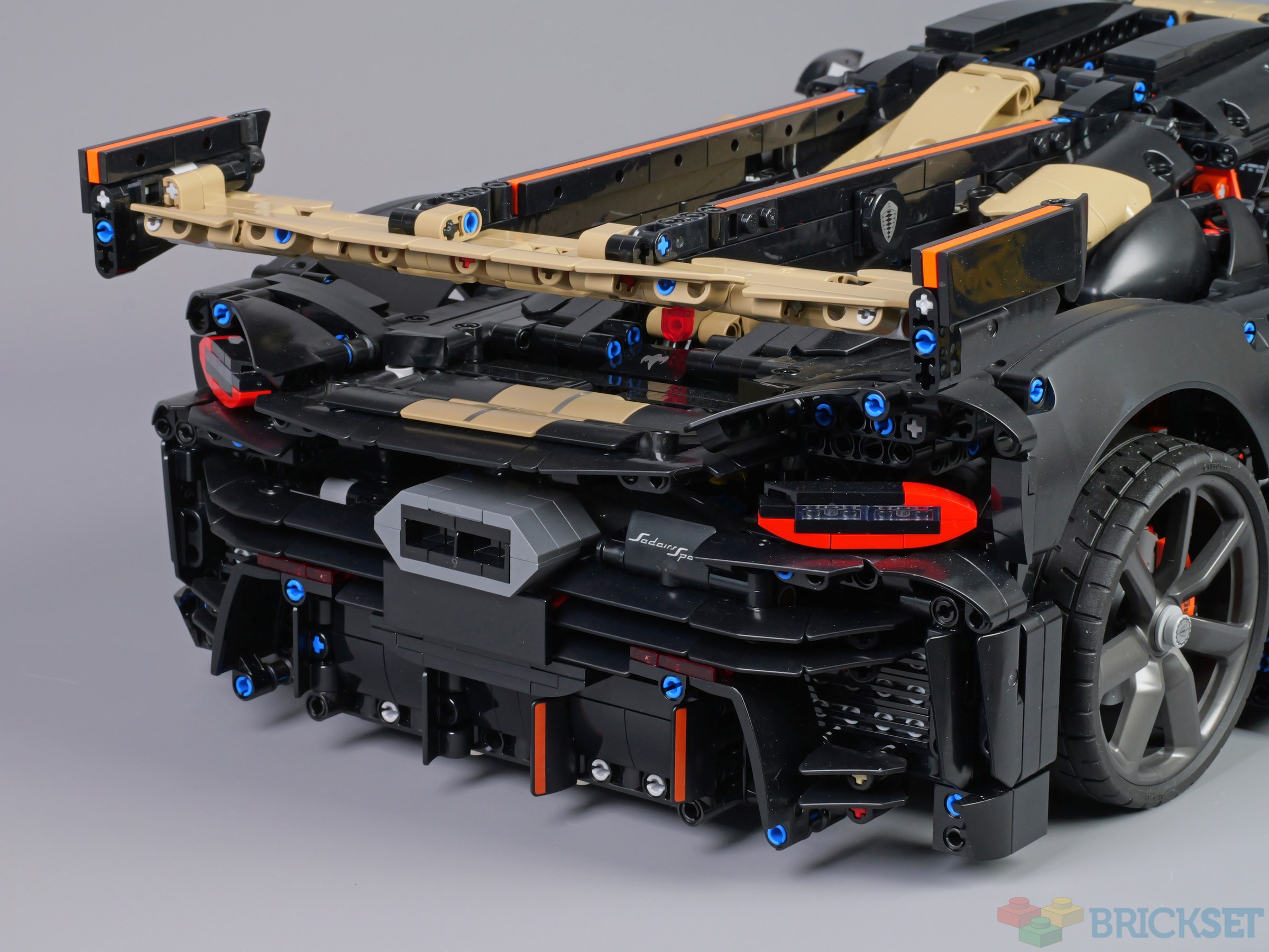
In contrast, the rear lights are brick-built and look very good.
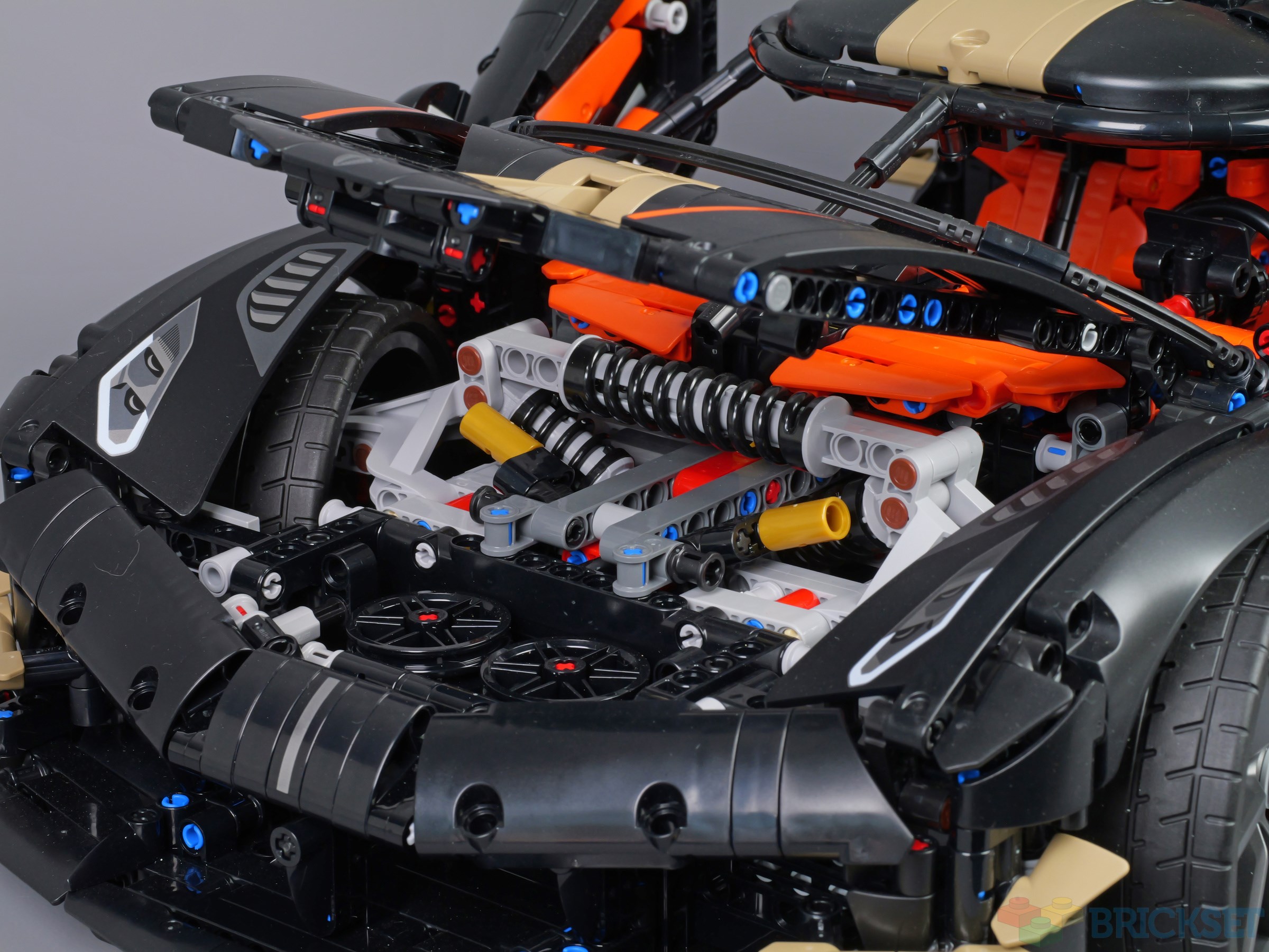
I don't know what you'd see if you lifted the bonnet on the real car but here you can see that the front suspension occupies most of the space. There's a picture of the front axle assembly in the construction section below that shows the Triplex suspension arrangement better.
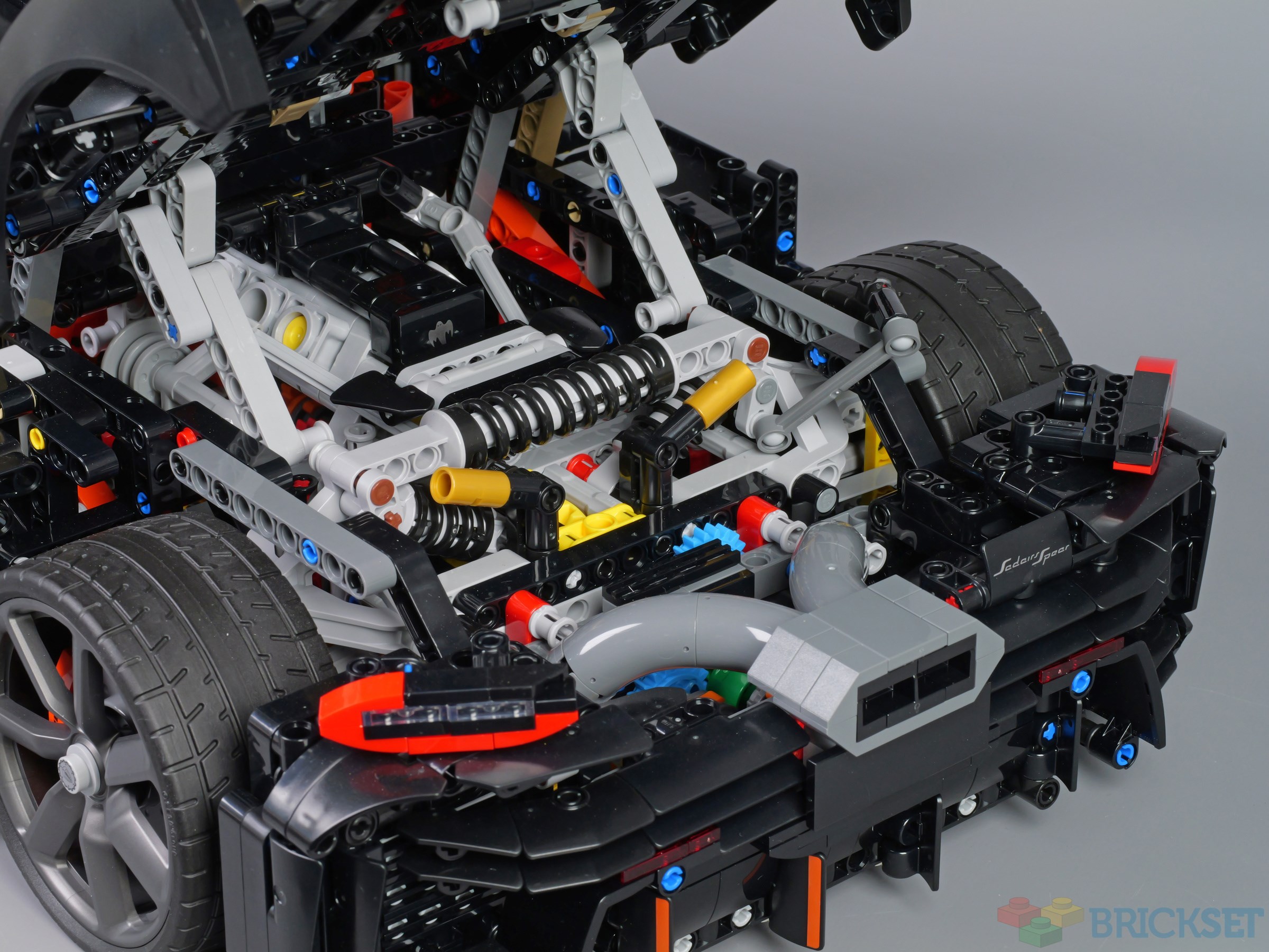
Lifting the rear clamshell reveals the 5-litre V8 engine and rear suspension.
The gearbox is operated using two paddles on either side of the steering wheel, and a sliding R/N/D control between the seats. Pulling one towards you shifts up, pulling the other shifts down. It does not stop when you get to 1 and 9, so you can go straight from 1st to 9th if you're not careful!
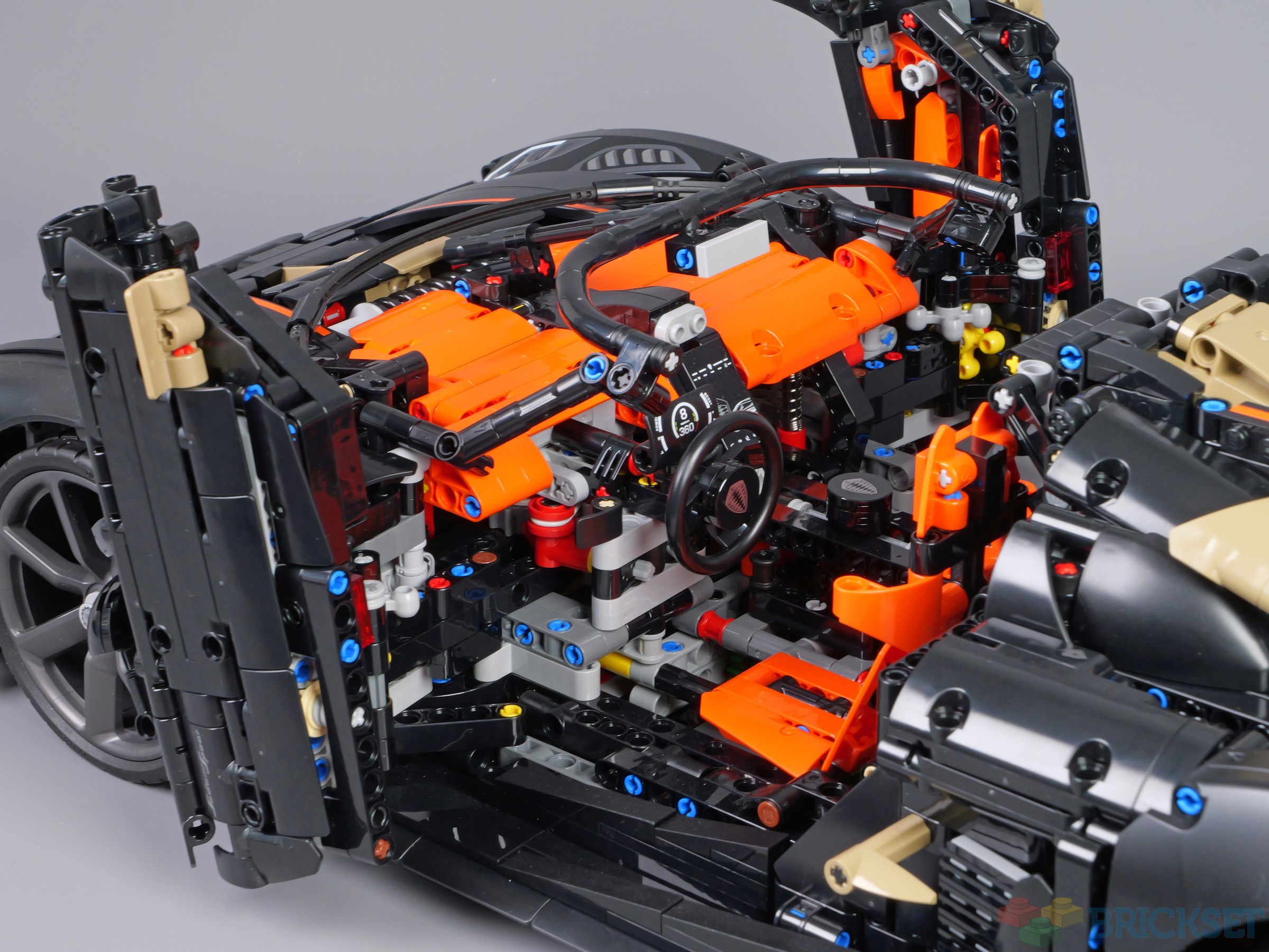
Unlike previous Technic Ultimate Cars it's possible to see which gear is selected thanks to a disc behind the driver's seat. But, in common with them, the difference between gears is imperceptible, manifesting itself as a miniscule difference in the speed the cylinders in the engine raise and lower as you push it along the floor. However, as always, it's nice to know that the model incorporates the gearbox, and we'd probably complain if it didn't...
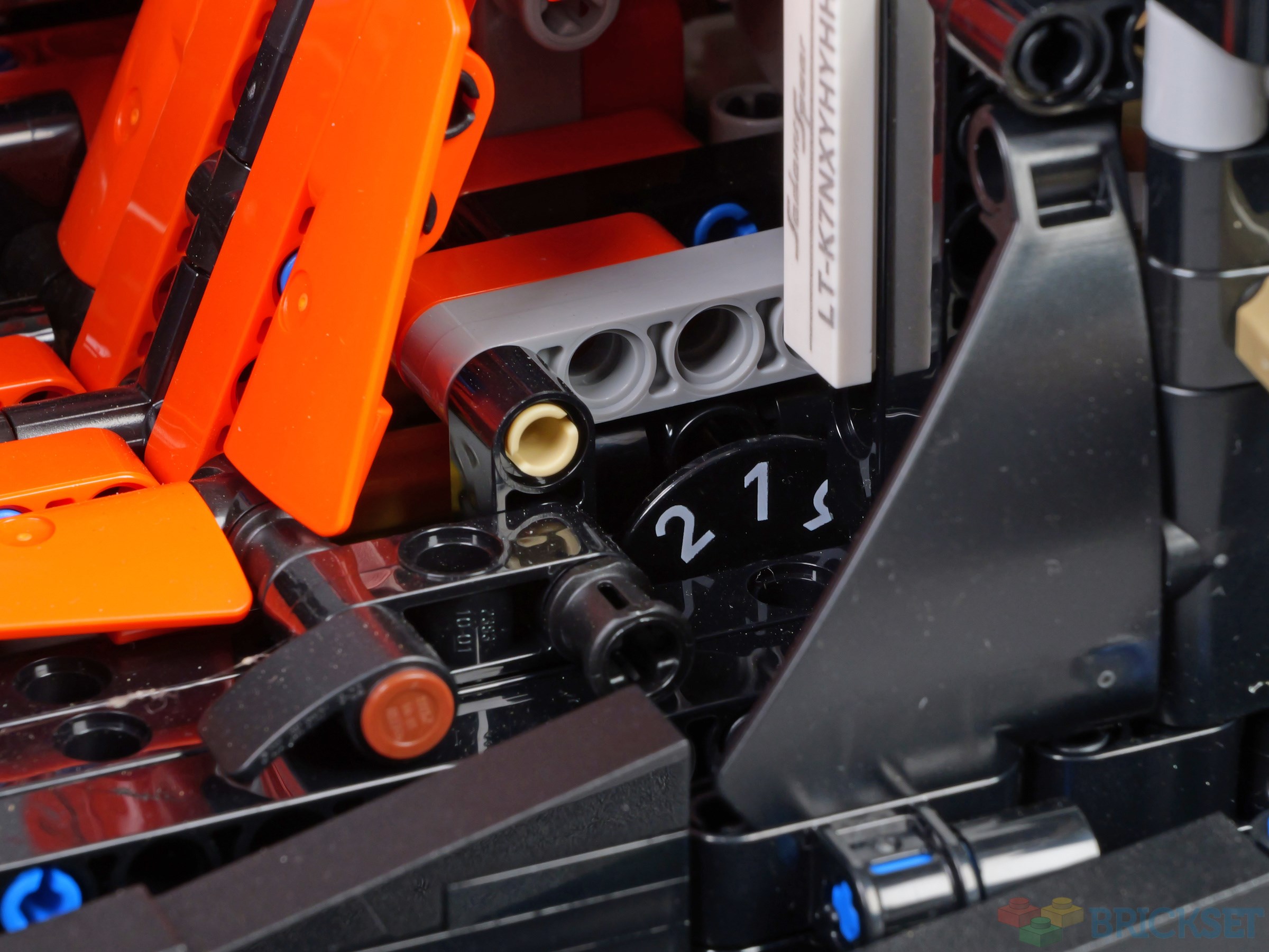
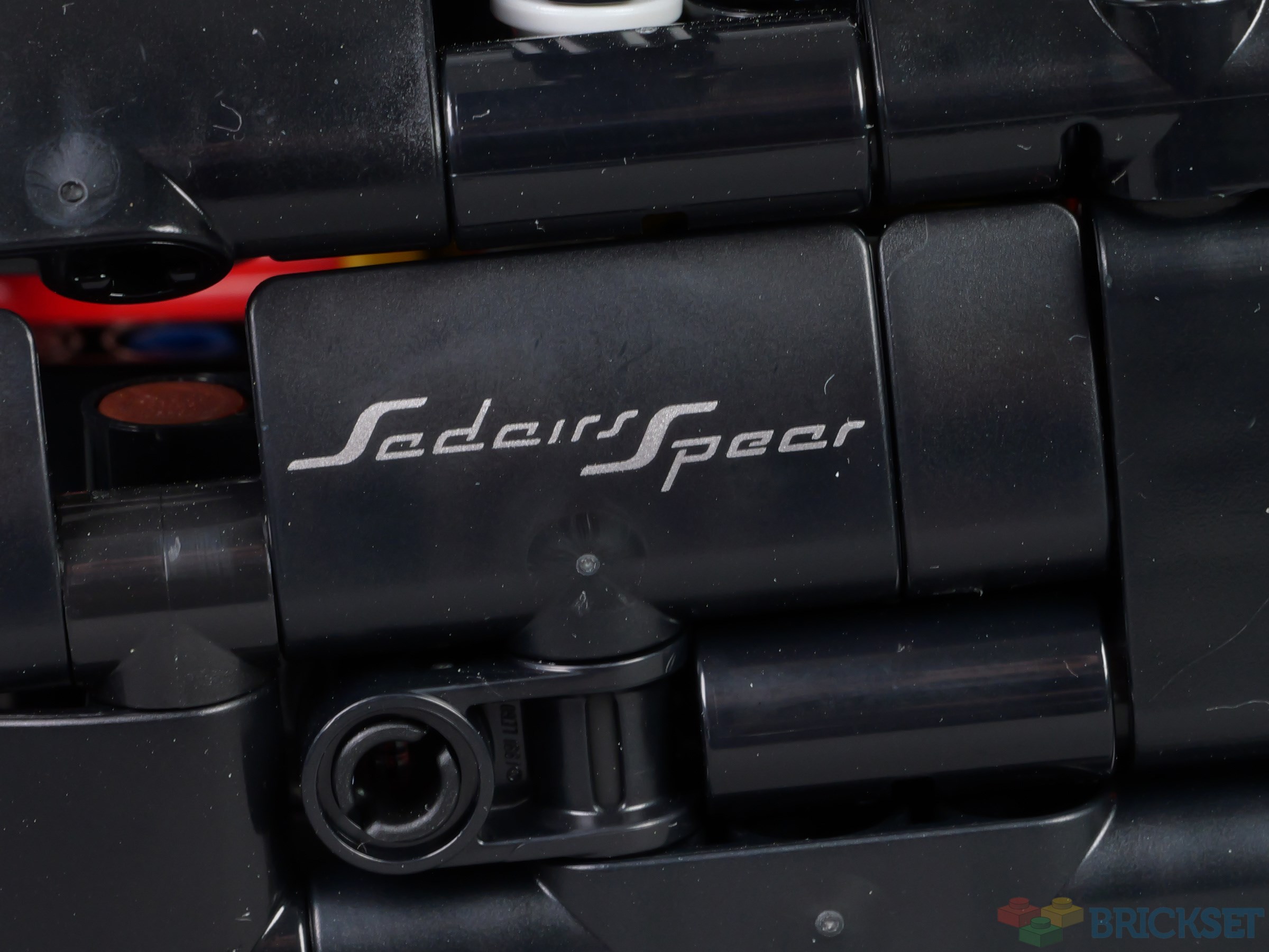
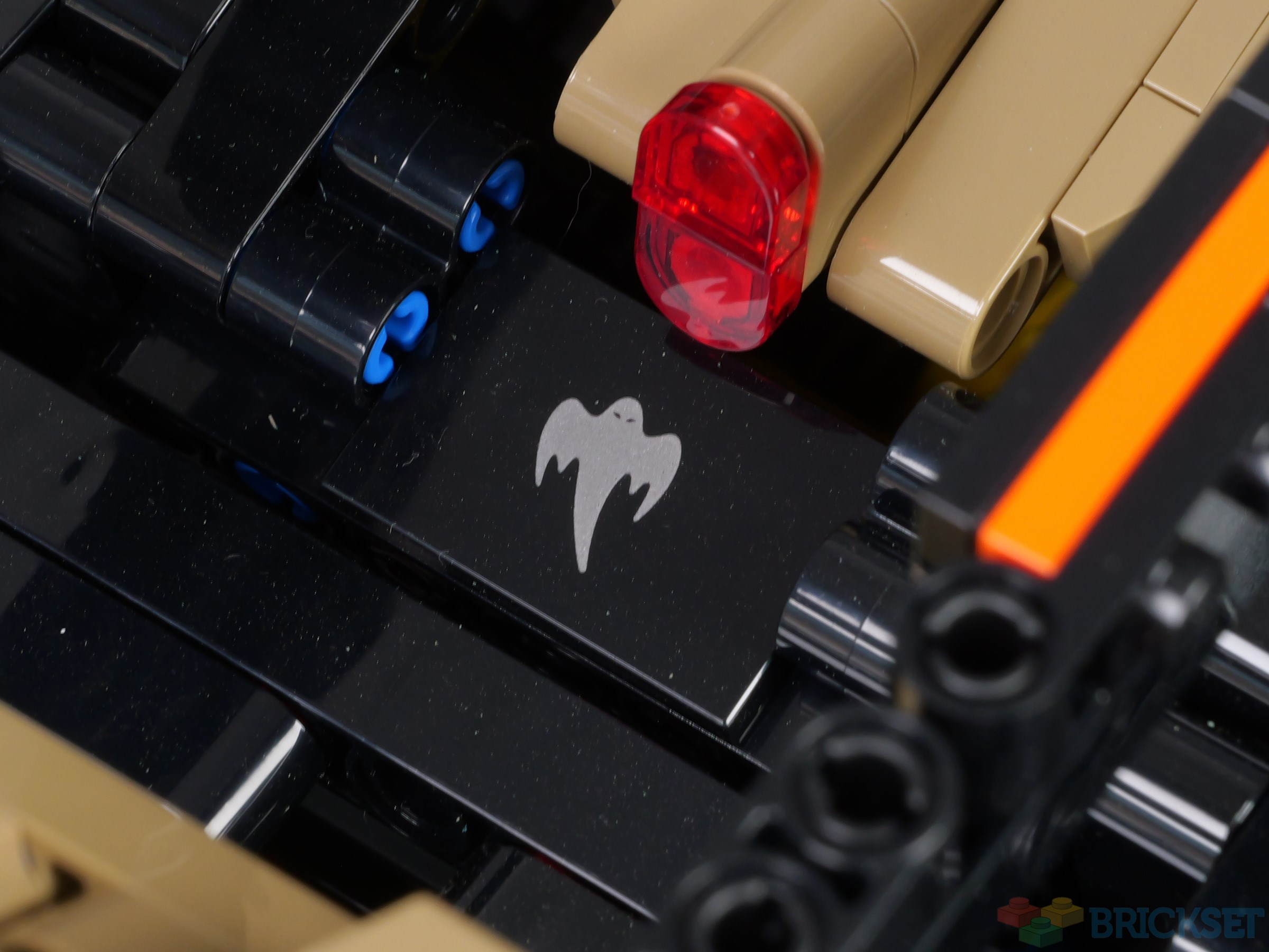
As I said before, all decorated parts are printed, including panels with the car's name and a ghost symbol. It seems that, despite the car's name having an apostrophe in Sadair's, it is not present on the car's logos.
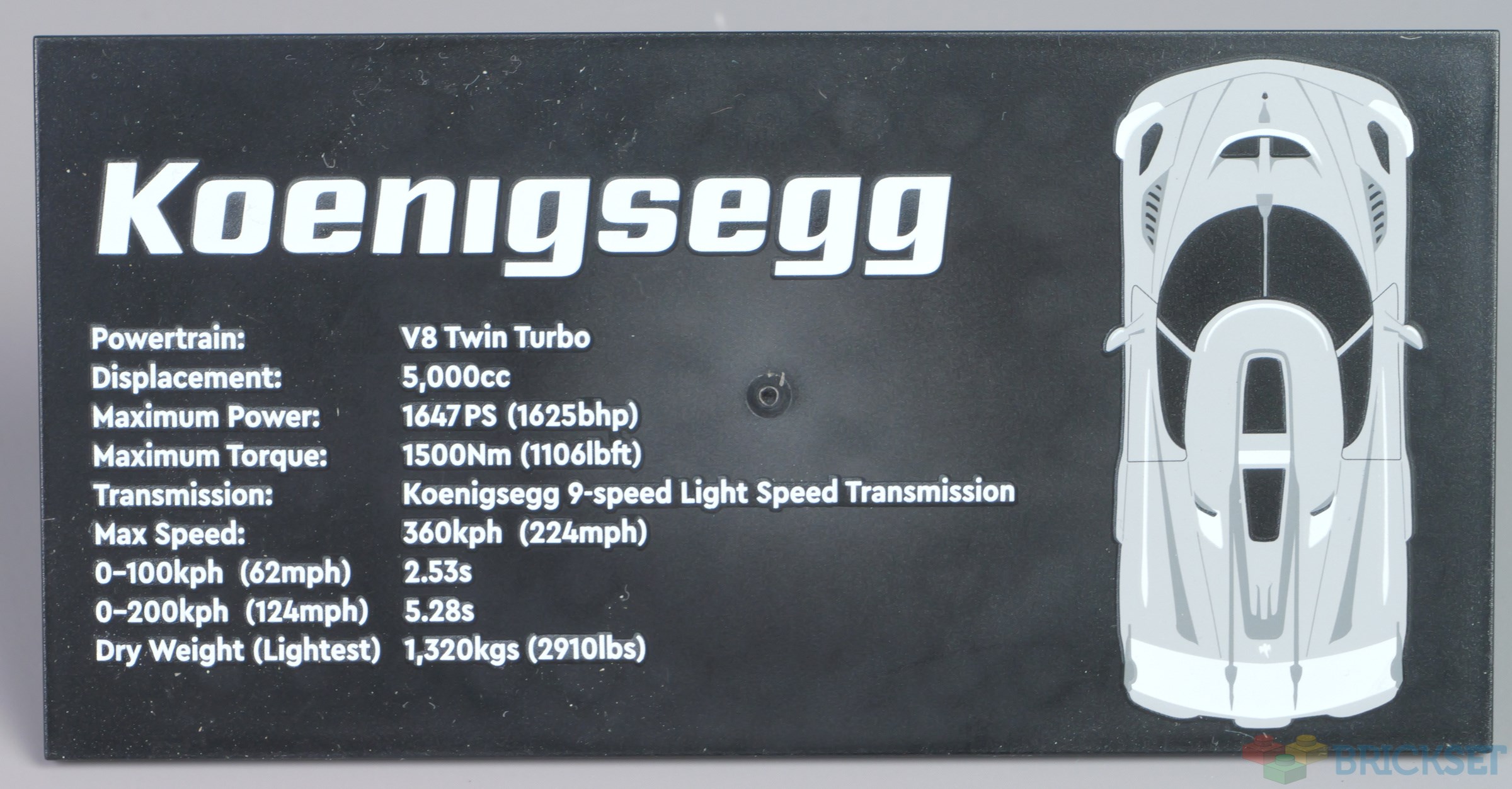
The vehicle is accompanied by a display plaque that shows pertinent details about it which matches those of the previous three Technic Ultimate Cars.
Packaging and instructions
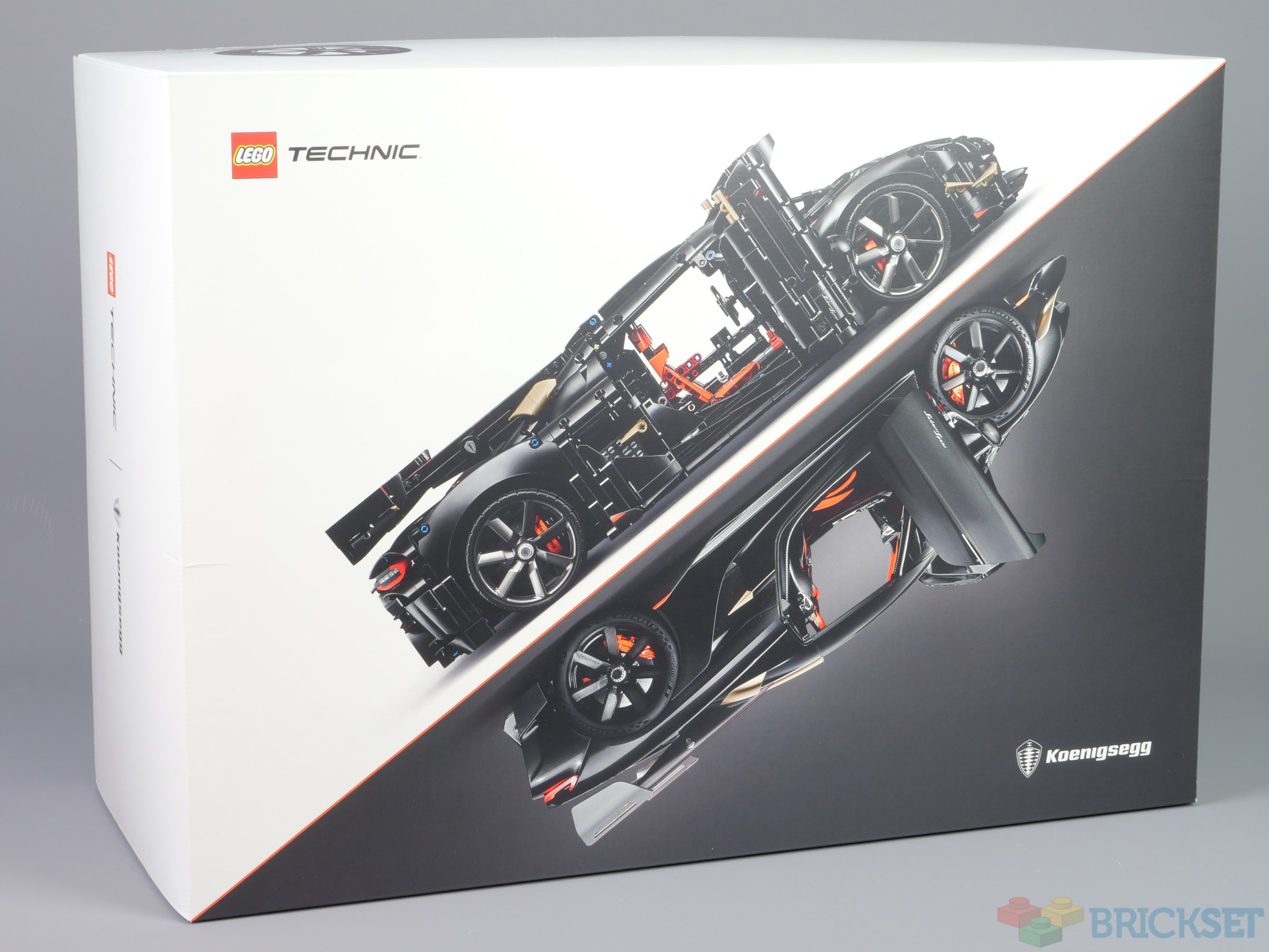
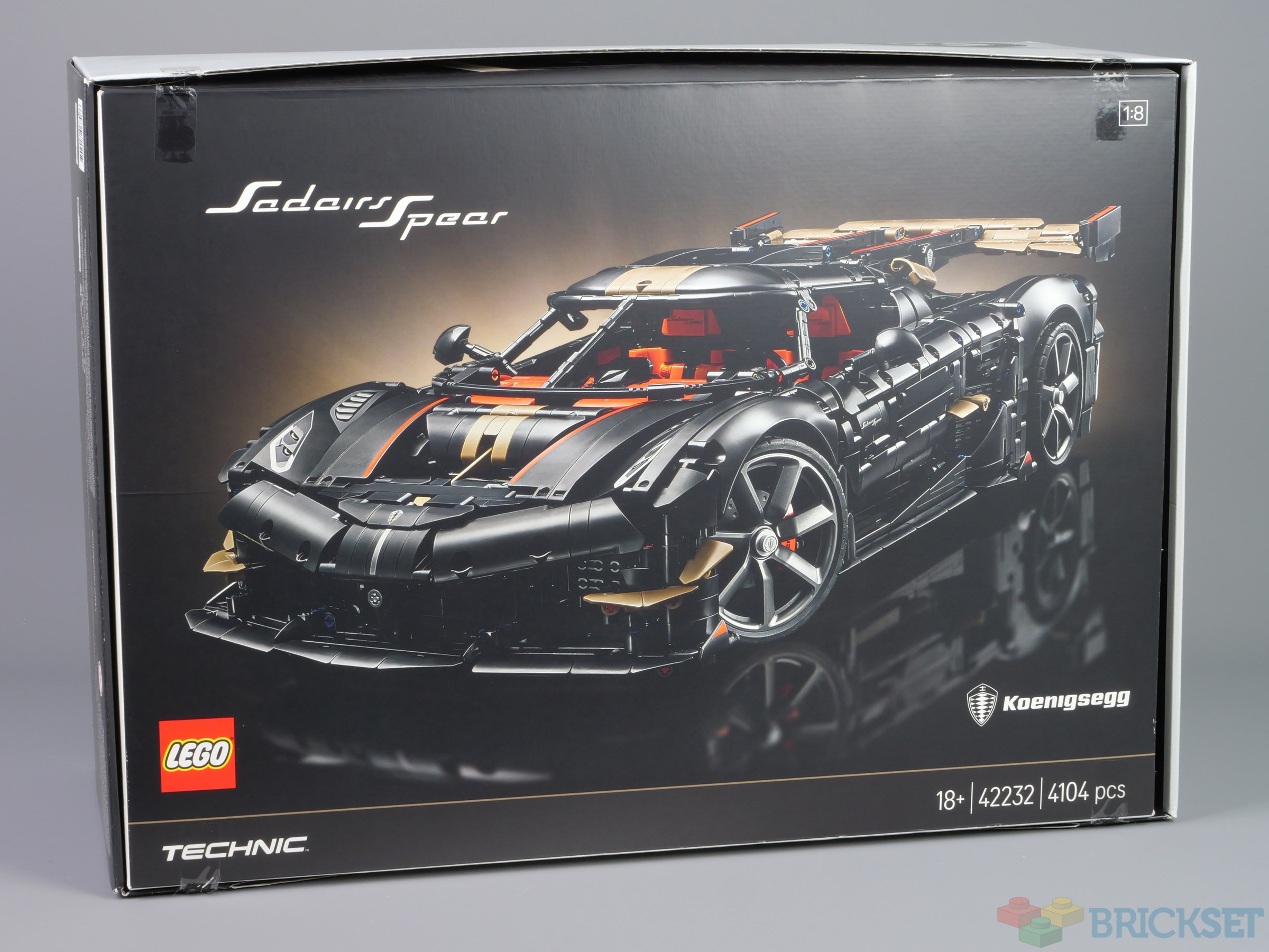
Previous Technic Ultimate Cars have come in premium packaging and this one is no different, although it's not quite as premium as some. The front of the box shows a side view of the model in the white section with an equivalent view of the real vehicle below it. What would normally be shown on the front of the box is on the back.
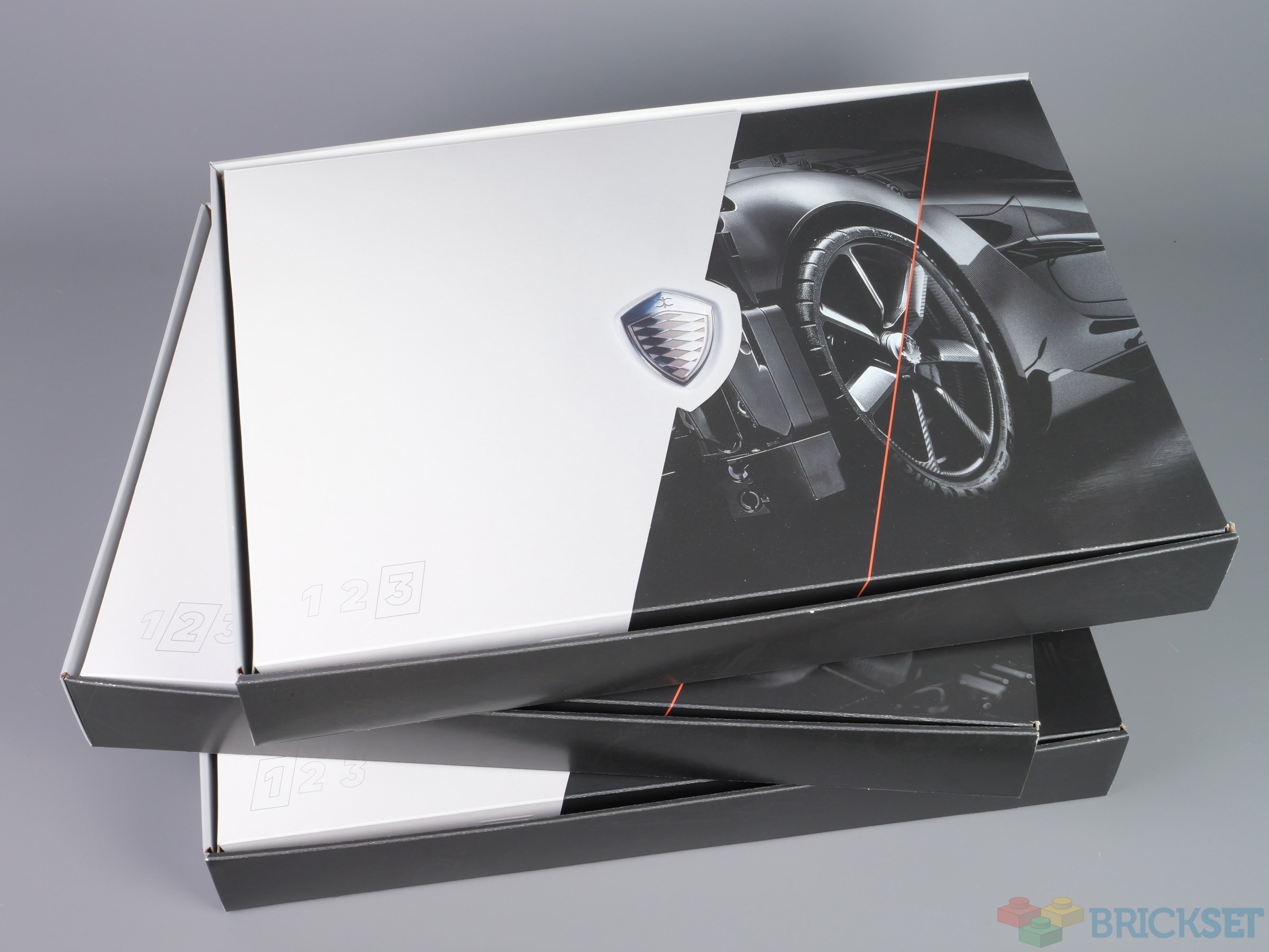
Inside, parts bags are distributed between three shallower boxes, which prevents you being overwhelmed by all 30 of them at once. The bottom of the box has indents to hold the two instruction manuals in place.
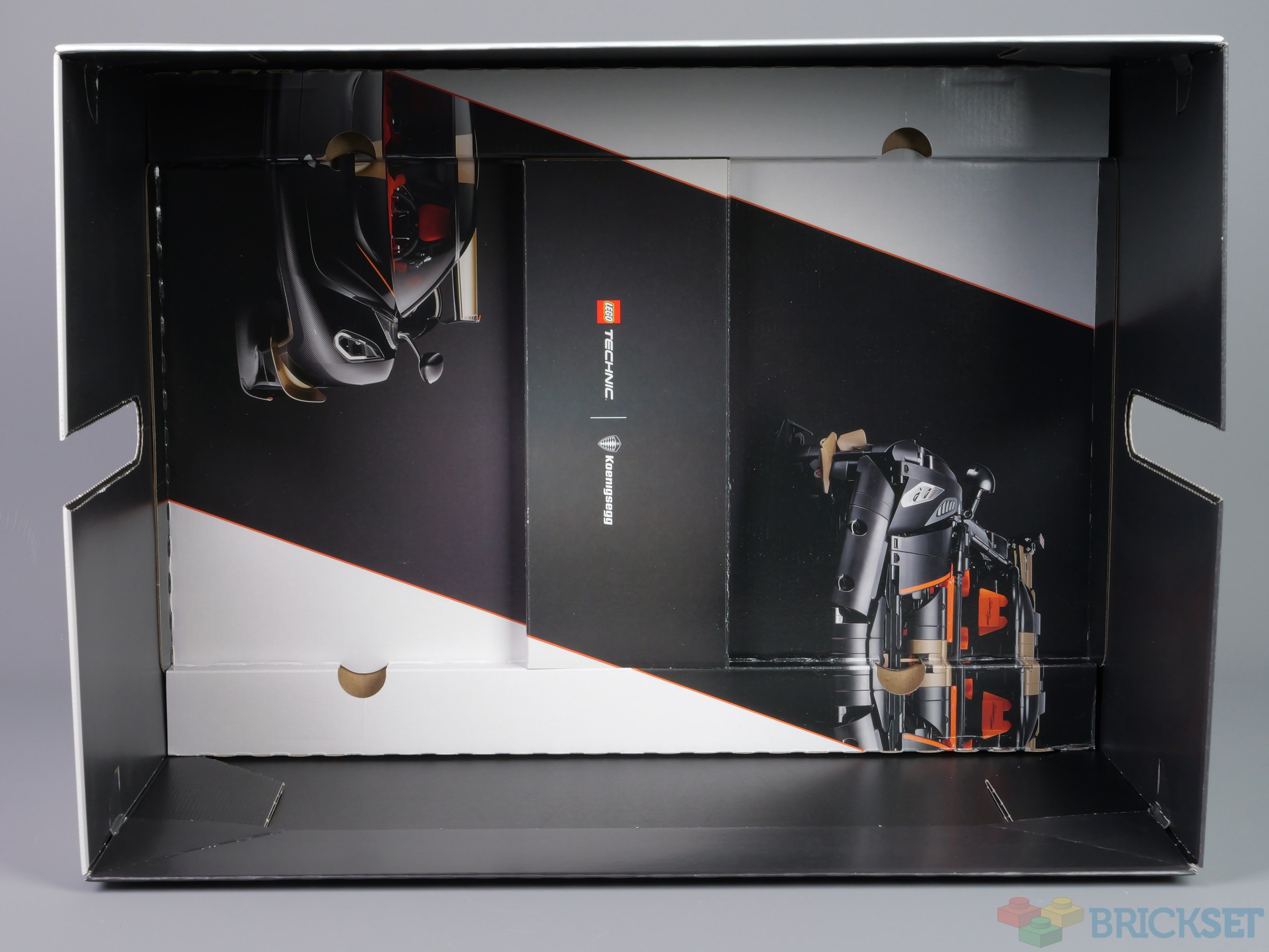
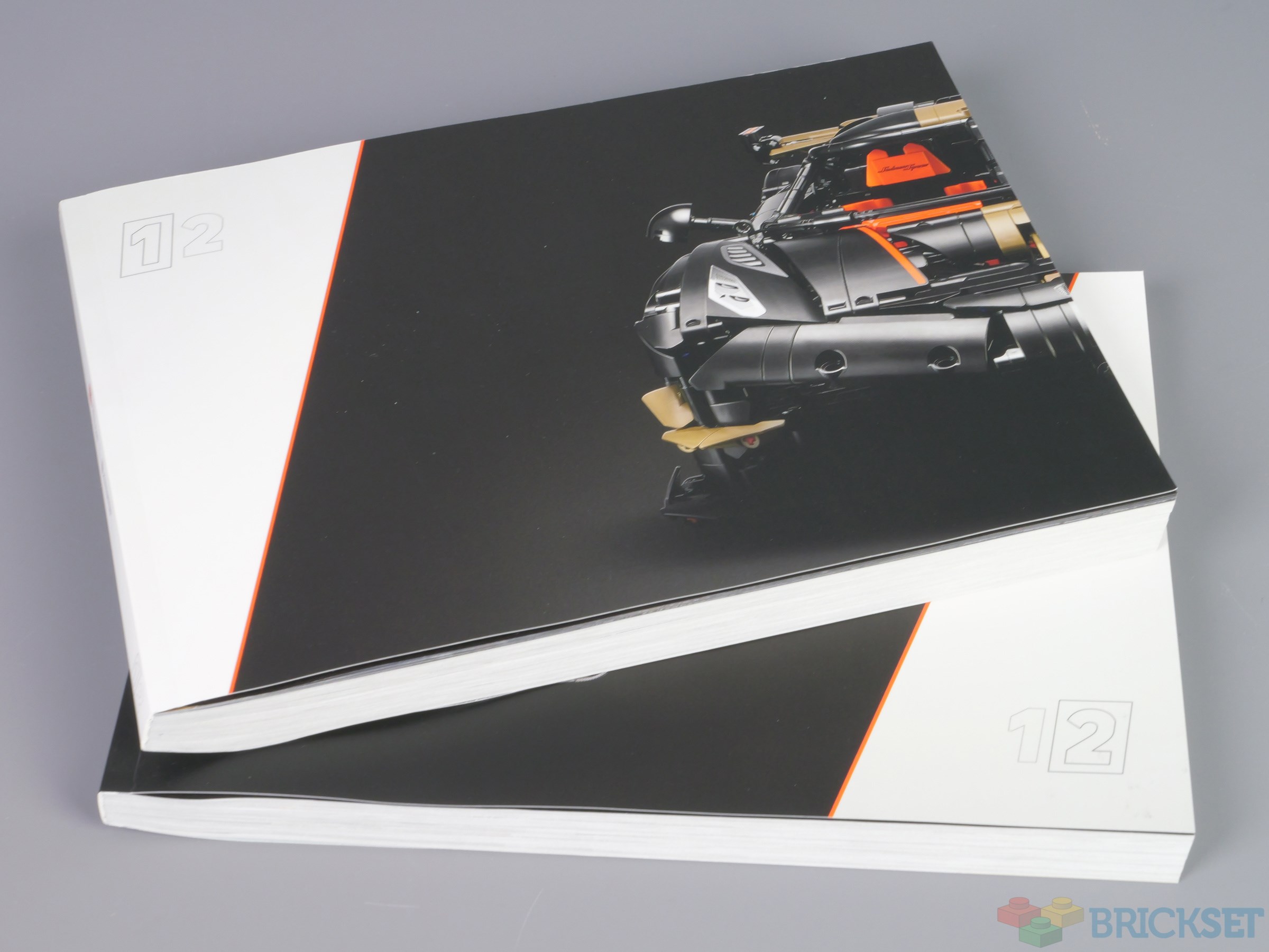
Each book comprises about 500 pages and overall there are 1,171 instruction steps.
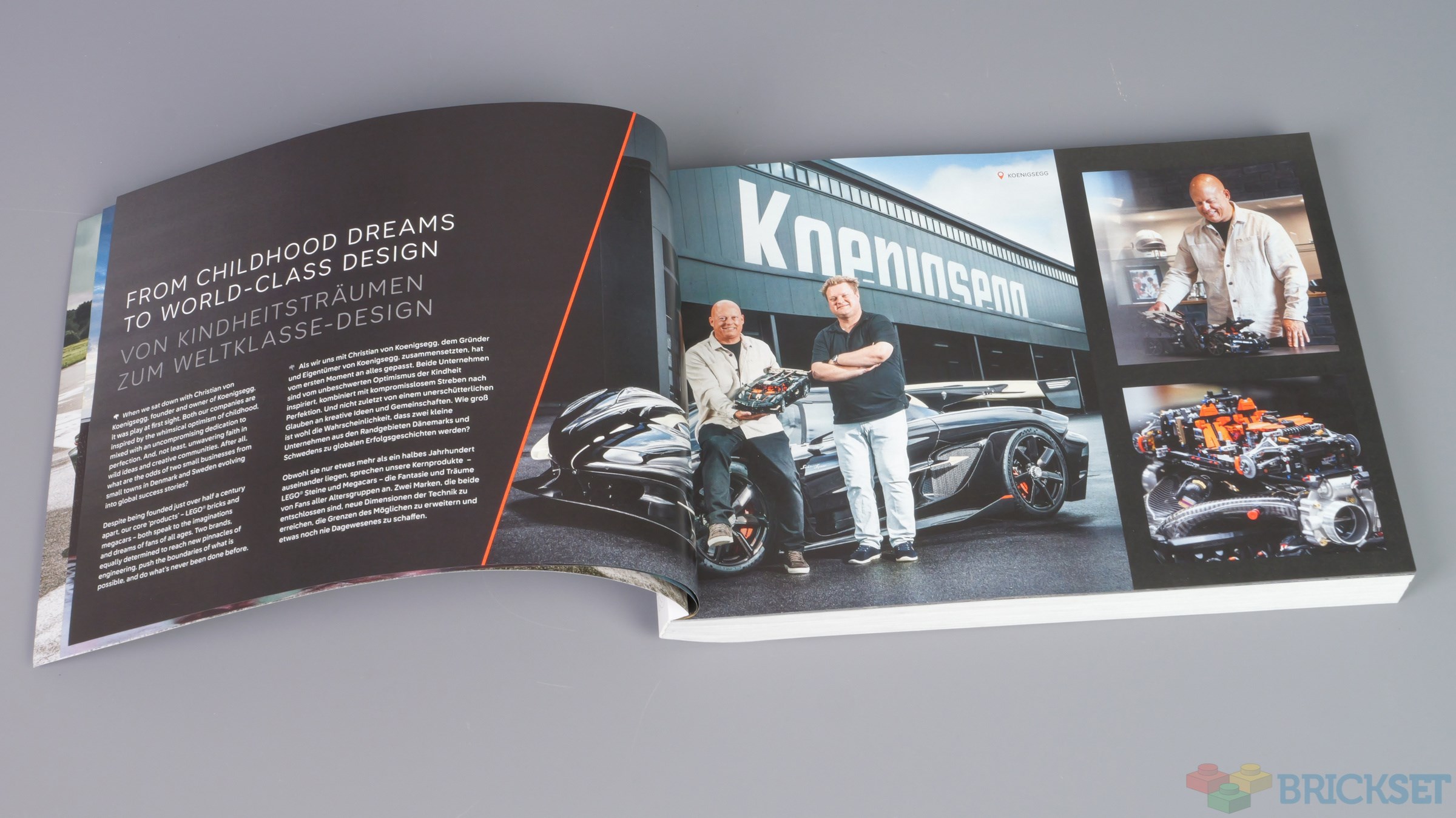
As has become customary for this type of set, the first manual contains a wealth of information about Koenigsegg, the real car, the design process, and so on. If you're interested in all that but don't intend to buy the set, you can download the instructions from LEGO.com
Construction
As you might expect with a model of this size and complexity, it takes a long time to build, and requires concentration throughout the process. I estimate I must have spent around 12 to 15 hours over the course of a week. I did not rush it because I knew I would not have a review ready for the embargo date (it arrived just a few days before), so I took my time and savoured it.
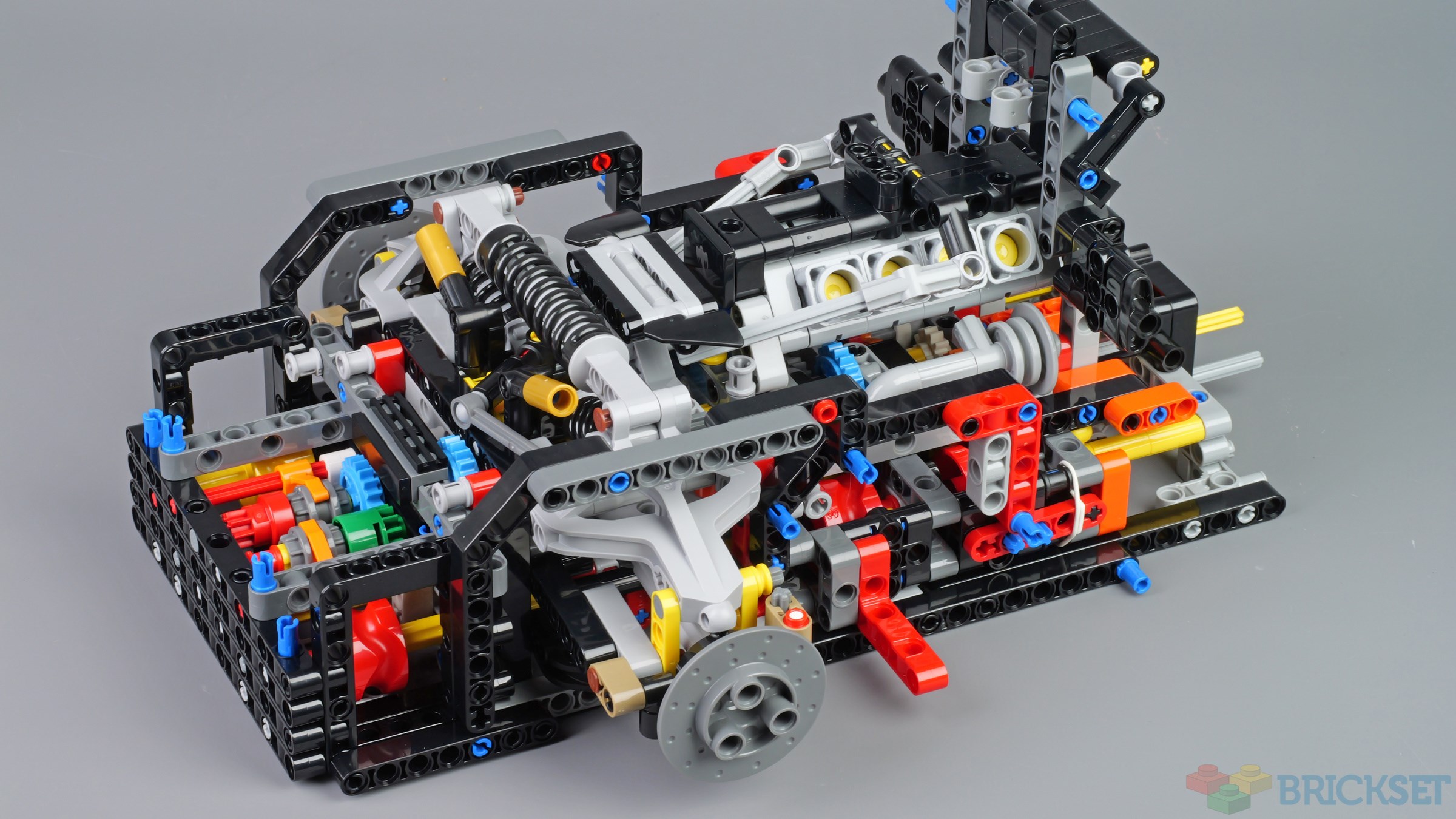
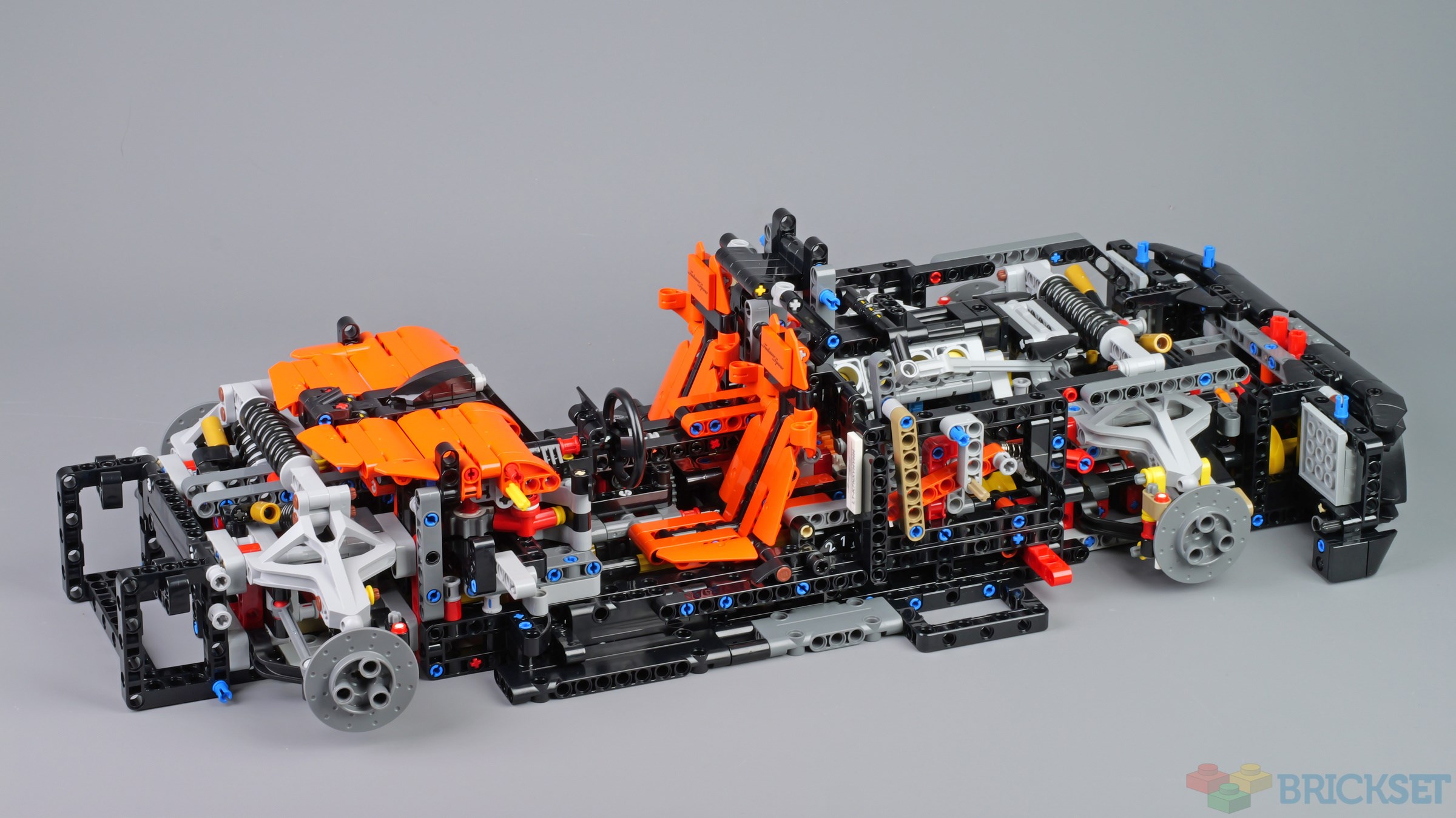
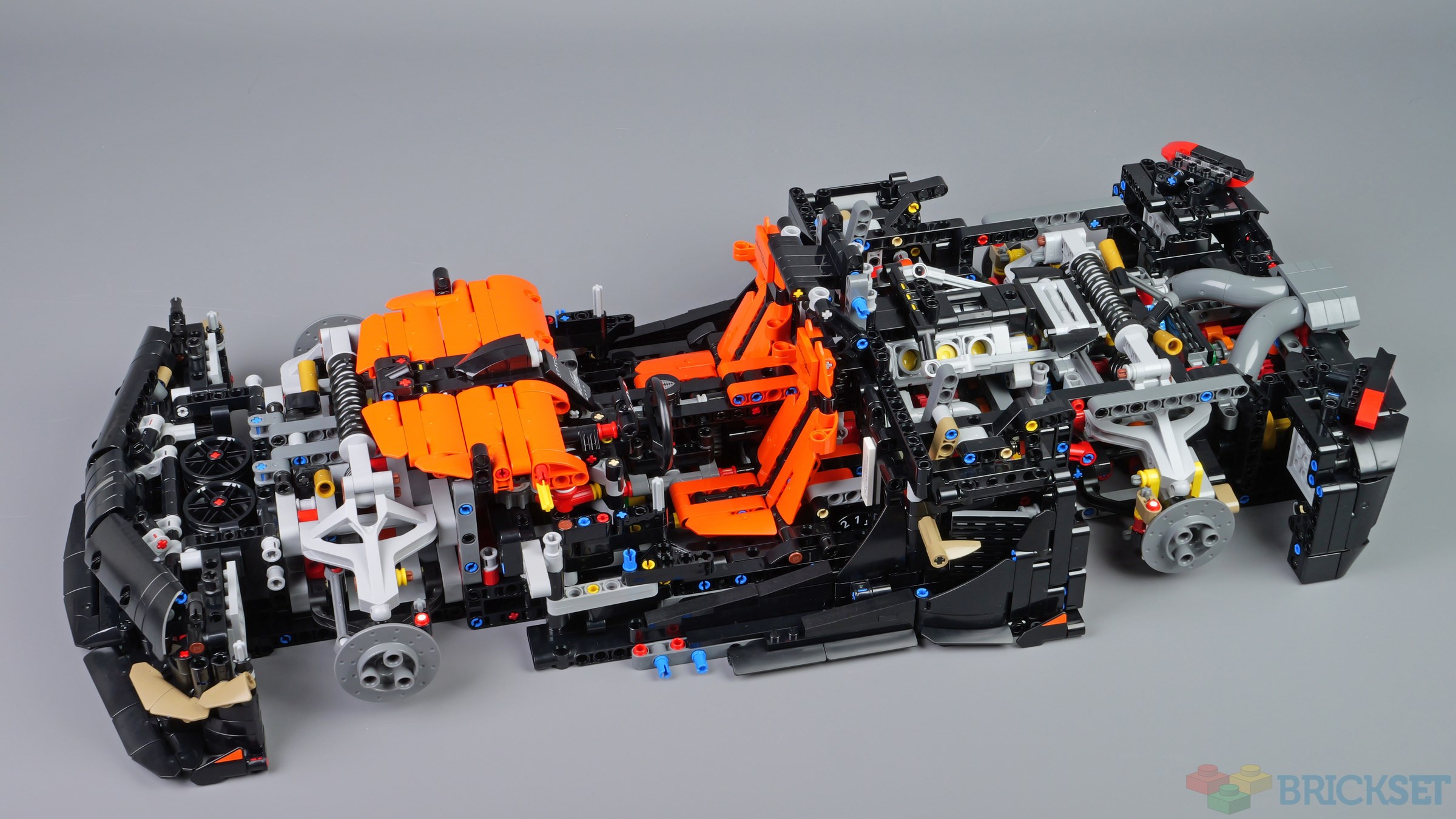
Construction begins with the gearbox, and you will not be surprised to learn that this is the most demanding part of the build, although it was never overwhelming due to the way it's been designed in short sections and split across several bags, giving you checkpoints during the process.
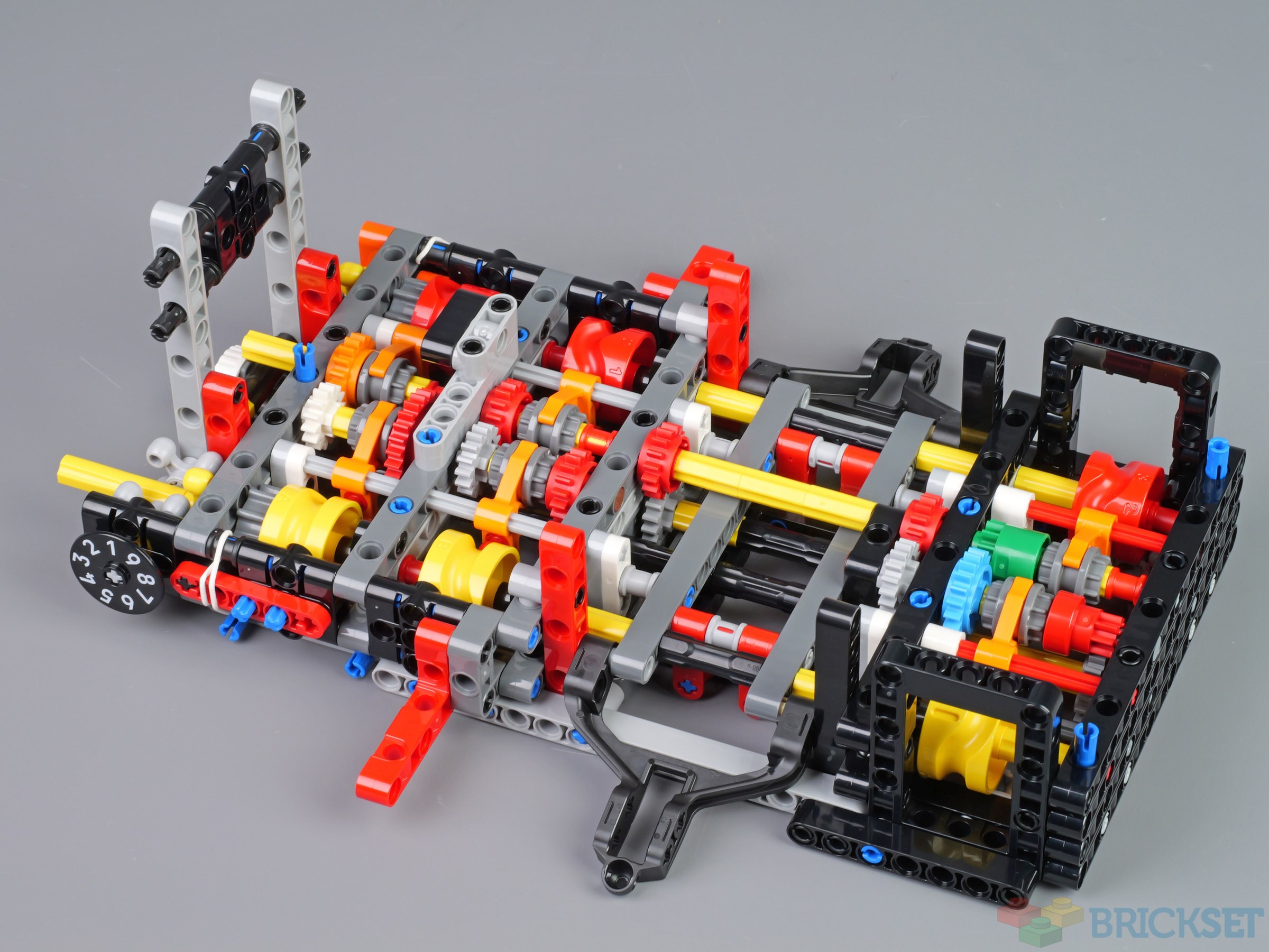
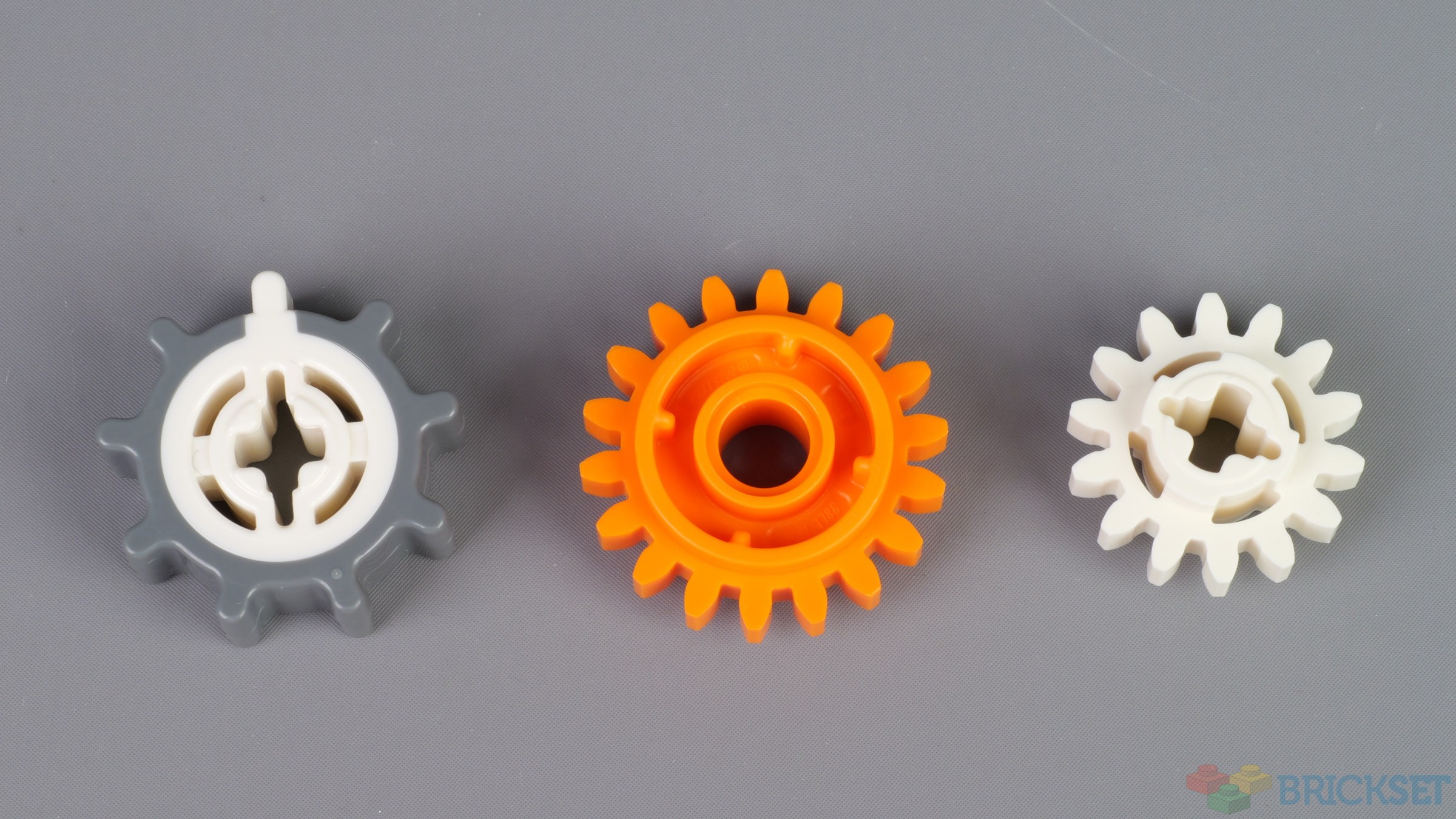
The 9-speed gearbox is the most complicated yet to feature in a Technic Ultimate Car and a number of new pieces were needed to facilitate it, including, from left to right, a 9-tooth stepper gear, an 18-tooth gear with clutch on both sides and a 14-tooth gear.
There are more that I didn't photograph, so head on over to New Elementary for a complete overview of all the new parts and recolours in the set.
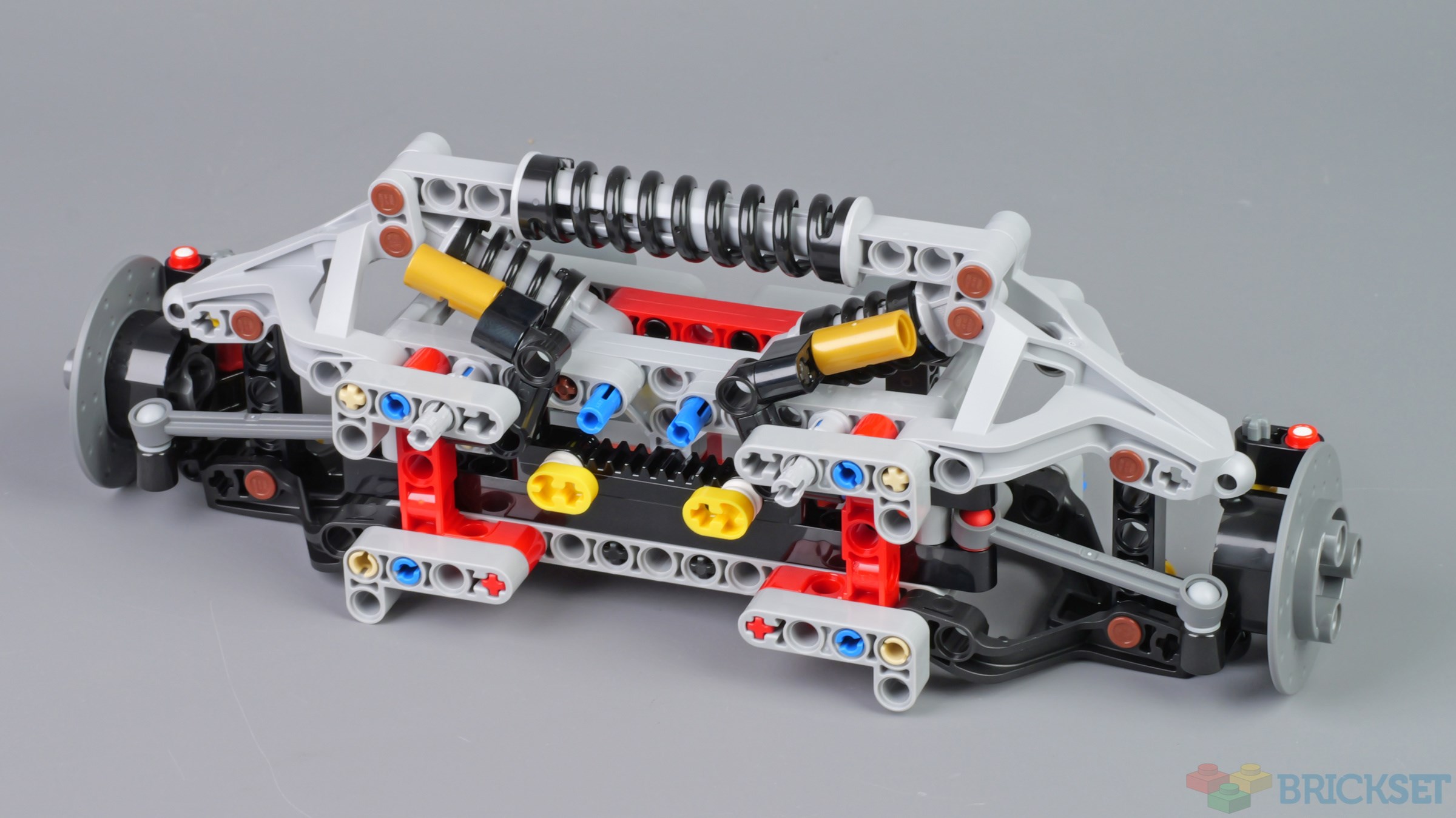
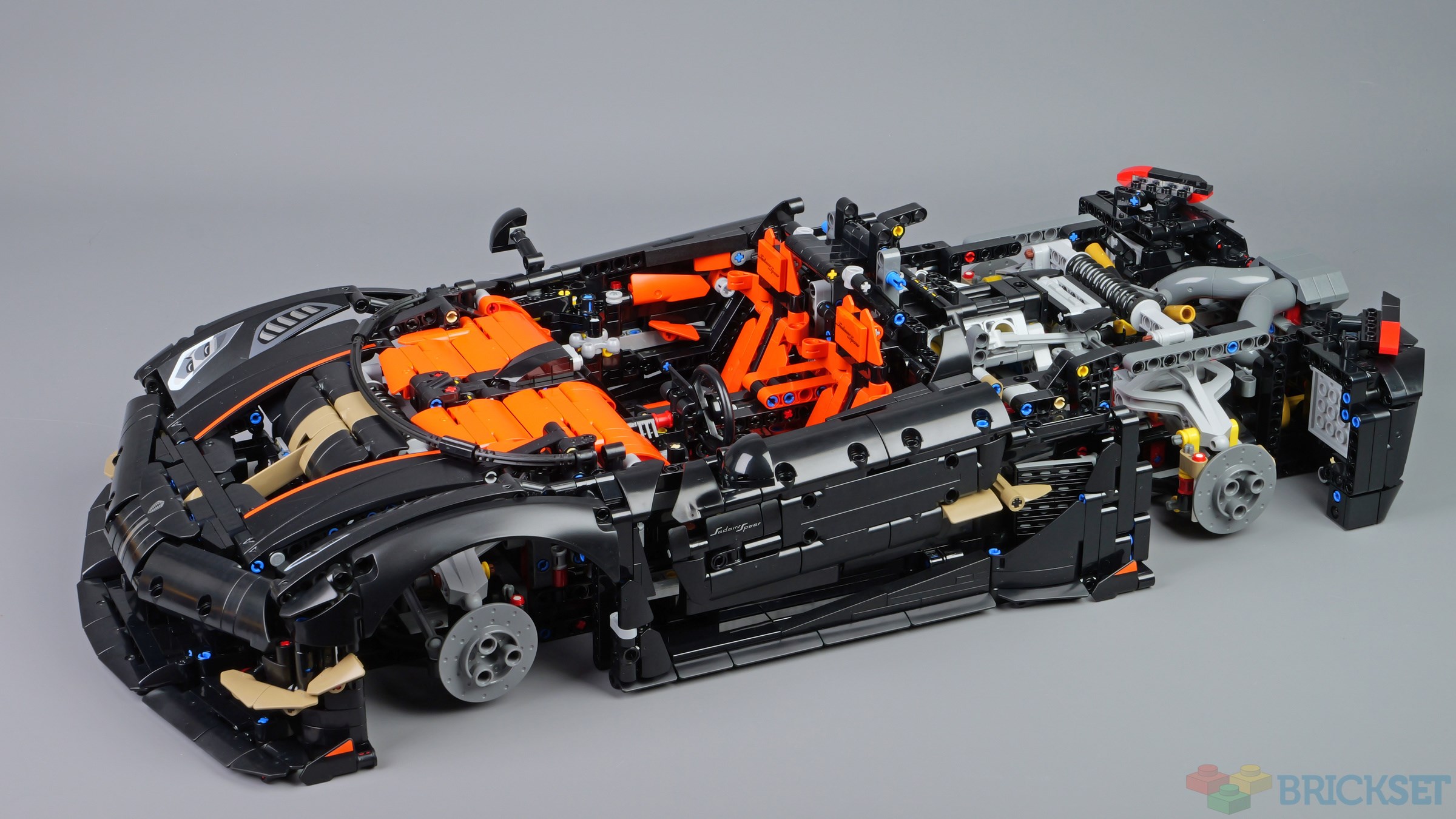
The other noteworthy sub-assembly in the model is the front axle which incorporates the Triplex suspension arrangement. The third 'Triplex' damper links the suspension across the axle for improved stability. Again, new pieces were required to implement it in LEGO form.
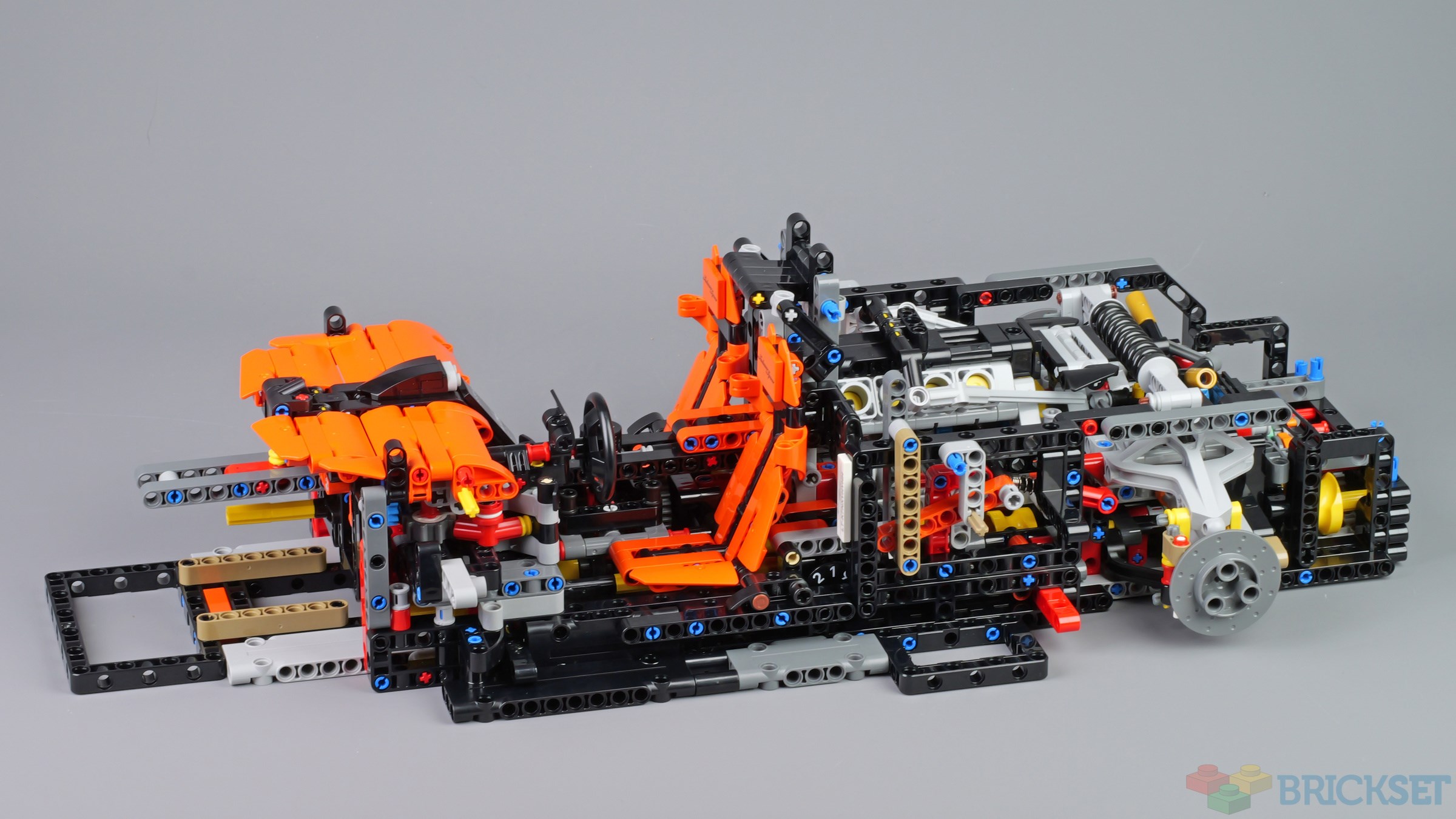
Here's how the car comes together:
Verdict
The model lives up to its premise as the ultimate Technic car, incorporating the most complex LEGO gearbox assembly yet, authentic Triplex suspension, doors that open the same way as they do on the real car, and a cleverly implemented 'ghost mode'. In fact, everything you would expect to find in such a model is present and correct.
I was not over-enamoured by the black livery when I first saw pictures, but it definitely looks better in the ABS, thanks to the dark tan accents and bright orange interior. One downside of the black, though, is that Technic builders generally have far too many black parts already, so it's not a particularly good parts pack.
Overall, then, a great model, the best Technic Ultimate Car yet, but I can't help but feel slightly underwhelmed: I think it's because there are so many large Technic cars nowadays, so it does not feel quite as special as the Porsche did when it was released 10 years ago.
Surprisingly, the price of the Technic Ultimate Cars has not risen since 2020, so from that point of view, $449.99, £399.99, €449.99 seems fair. I think we can be sure that, like its predecessors, it'll be reduced by at least 20% at Amazon before too long, making it even better value.
If you're looking for a lengthy and challenging build that yields an impressively-sized, great-looking model packed with authentic features and mechanisms, you need look no further.
51 likes
16 comments on this article
I think the technic features of this car are good, but man, why such an ugly livery with sand and orange parts
Black looks dull. If it were any other color...
It is my humble opinion, bordering on fact, that cars are stupid, boring and overrated, especially within LEGO, and particularly within Technic.
That said, I just really like this thing. And for some reason, that colour-scheme really works for me. I don't need to be contrarian here, I just like what I like, and I might try to build this thing in minifigure-scale. It does make me all the more sad that metallic bronze was retired because dang, that would've been pretty striking.
I mean, obviously, at this price I don't want this set. For that kind of money, I could get hit by a real car. That too, would be pretty striking.
As a Lego fan, Koenigsegg employee, and someone with insight behind the launch and participation at The Aurora event where I had the responsibility for the 1:1 scale model, this will be the first buy in this series of technic cars.
Some small corrections: 30 cars, not 25, that was changed.
And on the color… missed chance to share the picture of the first customer car. Because this specification is an exact copy of the first customer car. It isn’t actually black, but clear coated carbon fiber. Though it would not be possible for Lego to replicate this, and at distance, clear carbon looks more black than grey.
The sand Lego pieces are meant to replicate the champagne accents of the customer car. And the orange details are also perfectly accurate.
The fact it replicates one specific car makes it even cooler imo
Printed headlights. That’s a NO
@Brickmasterboy, thanks for your input.
I was not able to find a picture of one in the livery you describe. Do you have one?
@Gus_teXeda said:
"Printed headlights. That’s a NO"
They were running low on shields.
@Huw said:
" @Brickmasterboy , thanks for your input.
I was not able to find a picture of one in the livery you describe. Do you have one?"
Thank you for a nice review :)
In case you are present on instagram, there has been various posts with this car recent weeks, alternatively Lego’s own article contain a couple of side by side images. I do have own images… but they are not up to professional standards.
https://www.lego.com/en-us/aboutus/news/2026/june/lego-technic-koenigsegg-sadair-s-spear?locale=en-us
Note there is a Dropbox link in the press release with stills and videos. I presume the content there would fit this article the best
The roof of the actual car is also removable, though I am uncertain whether or not it was possible to store it in the front trunk as on the majority of other Koenigsegg models.
Further enhances the array of realistic features
Wonder what kind of BIONICLE you could make with all these Technic parts.
As with every Technic set ever, absolutely ruined by the blue/red/yellow parts sticking out like a sore thumb.
Impressive just as the ones that came before, but justb like those, sets I would love to build, but wouldn't care to own. Maybe I should look into Lego rentals?
(though kinda worried about getting it in one huge bag with 4104 pieces....)
The addition of the ghost mode feature and the triple suspension make me a slight bit more excited for it than normal. It reminds me of how cool the opening headlights on the 1994 Supercar were on top of all the other functions it packed.
It's not enough to make me completely like it though. The colors don't work for my eyes and it feels just as similar to other licensed supercars as usual. But at least it has that extra layer for a special function.
@Lego_lord said:
"Black looks dull. If it were any other color..."
I hate to say it, but this is the top reason I'm still considering the P1 over it. My last Technic Supercar was 8448 and I'm finally considering a new one, but I agree, it needs something to make it pop. Anyone got any thoughts on 42172 vs. this one? Any killer feature this one has that the P1 doesn't? I'm aware of Ghost Mode which is fine, but I don't consider it a must-have.
I really like black cars and even though I'm not a big fan of Technic, I really like the model. But considering my experience with the awful gray color mismatch of 10262 Aston Martin and again with the even worse black color mismatch of 21323 Grand Piano, never again will I purchase any LEGO set that is all or mainly all one color, especially black... I thought it was really, really bad. For that reason among others, I have drastically reduced my purchases over the past few years.
IMHO it's not fair counting black color as negative thing here. I do like it, maybe rims could be more silver. Great thing that there is gear indicator and additional functions as ghost mode always welcome.
What bothers me in such expensive car for adults are those BLUE PINS! And it bothers me even more that TLG play with lights on photos in post production and dim those pins to hide it. That is false advertising...