High Tech LEGO Projects
Posted by Huw,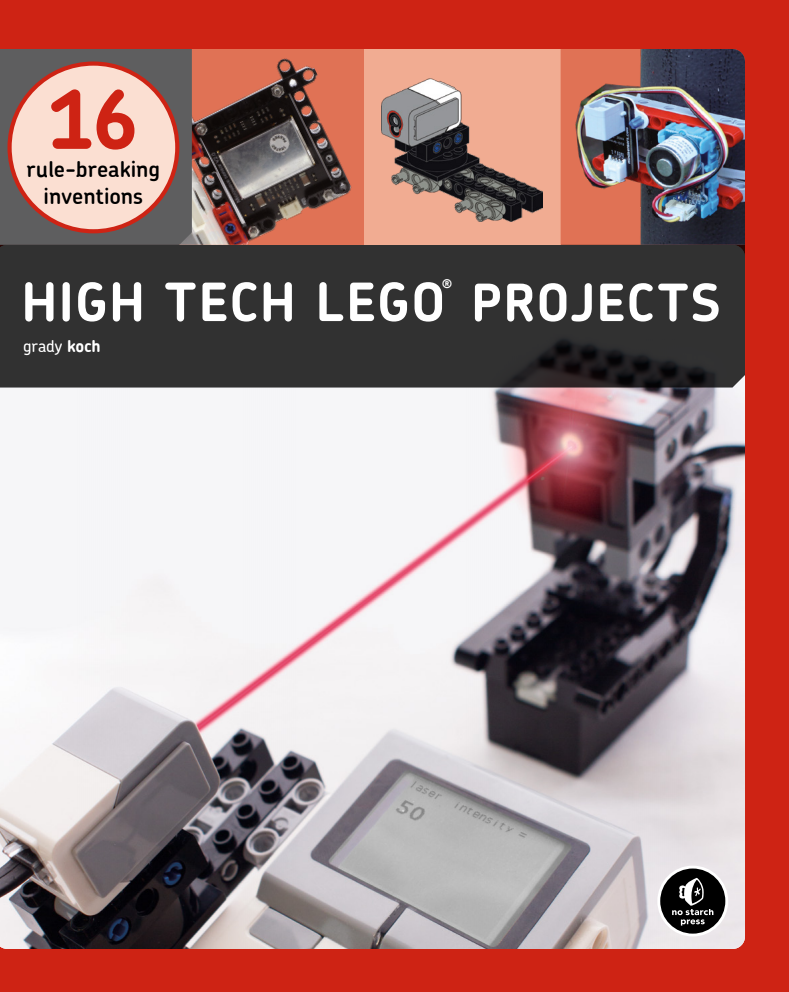
High Tech LEGO Projects by Grady Koch has just been published by No Starch Press.
It features 16 projects that put Mindstorms EV3 to practical real-world use by combining it with non-LEGO components, for example cameras, lasers, and thermometers. Although EV3 has been superceded now by Spike Prime and Robot Inventor, there's still a lot of life in yet, especially as it's more 'hackable' than its replacements.
If you don't wince at the idea of cutting and modifying LEGO pieces and want to take your EV3 to the next level, this book is for you.
The projects include a 'critter cam', a laser security fence, Morse code transmitters, a motion-sensing radar, and a laser light show.
Each chapter explains what you're building, what it'll be useful for, what pieces you need and where to get them, how to build and program it, and finally how to test and use it. It's all clear, concise and easy to follow.
The biggest hurdle to overcome will be gathering the required bits and pieces together, particularly if you're starting afresh without a stock of resistors and electronics tools.
However, if you dabble in electronics already, and can wield a soldering iron competently, you won't have any problems.
.png)
.png)
.png)
It's not a book that will appeal to everyone, but it will find an audience: hackers and tinkerers already dabbling with electronics that are looking to extend the life of their EV3 and do more with it than what's shown on the box.
INGENIOUS DEVICES THAT BREAK THE LEGO RULES
High Tech LEGO hijacks the MINDSTORMS EV3 revolution, showing you how to build creative technical inventions with practical applications. You’ll learn to build a dynamic array of working devices for outdoor research, home security, spycraft, and more.
Among the book’s 16 fascinating projects you’ll find a motion-activated animal cam, a Morse code transmitter, a laser security fence, a motion-sensing radar detector, an automated insect trapper, and a heat-seeking infrared cannon. Welcome to a whole new world of building!
Every project brings together science, mechanics, electronics, optics, and software to create complex instruments for studying and measuring the world around you, all while maintaining the playfulness of LEGO. Each easy-to-follow model combines illustrated instructions with step-by-step guidance on the engineering methods at play.
As you build, you’ll learn:
- “Illegal” modding techniques (that may include drilling, cutting and soldering — Shh!)
- Different ways to work with diode laser modules
- Tricks for modifying EV3 sensors and motors
- The joy of hacking LEGO light bricks to make a flickering fireplace
- How to use MINDSTORMS to build your own contraptions!
Experiment on your own, and expand on your finished creations. Make a few adjustments so the Critter Cam triggers an alarm to scare away pests, or modify the Doppler radar to detect flammable gases. The possibilities are endless!
It's available from Amazon.com ($22), Amazon.co.uk (£19.99), and directly from No Starch Press.
34 likes
3 comments on this article
I hope this will get a PoweredUp/Spike/Robot follow up soon. I think the new platform is even better hackable, as the basic Technic motors already allow absolute positioning, the blue tooth protocol is vastly improved and the sensors are better. Only thing I haven't found yet: a Arduino board definition to write C++ for the Robot Creator hub.
I like the examples shown as extending the use of mindstorms outside the classroom to real problems in the wider world. I like the old school of the 'triggered' infra-red sensor turning a motor to push the button on the camera, rather than have the camera directly connected to the laptop which would require a much more expensive camera. Hoping one day that TLG creates a dedicated small camera for mindstorms which can be mounted onto RC vehicles, trains, planes etc. I'm curious to find out if the infra-red sensor is sensitive enough to detect changes in the intensity of a laser beam as I would have thought that the sensor would just see through the laser and need a physicist to explain to me how this works? I hope that there are also examples with the gyro and colour sensor as these seem to have lots of potential.
@martiniman said:
"I hope this will get a PoweredUp/Spike/Robot follow up soon. I think the new platform is even better hackable, as the basic Technic motors already allow absolute positioning, the blue tooth protocol is vastly improved and the sensors are better. Only thing I haven't found yet: a Arduino board definition to write C++ for the Robot Creator hub."
Don’t know what “Robot Creator” is, but it’s probably more likely that an update would use the new Mindstorms Robot Inventor (51515), since that’s the successor to EV3. Spike is nearly identical to MRI in capability.