Blocks magazine archive: Becoming a LEGO professional
Posted by Huw,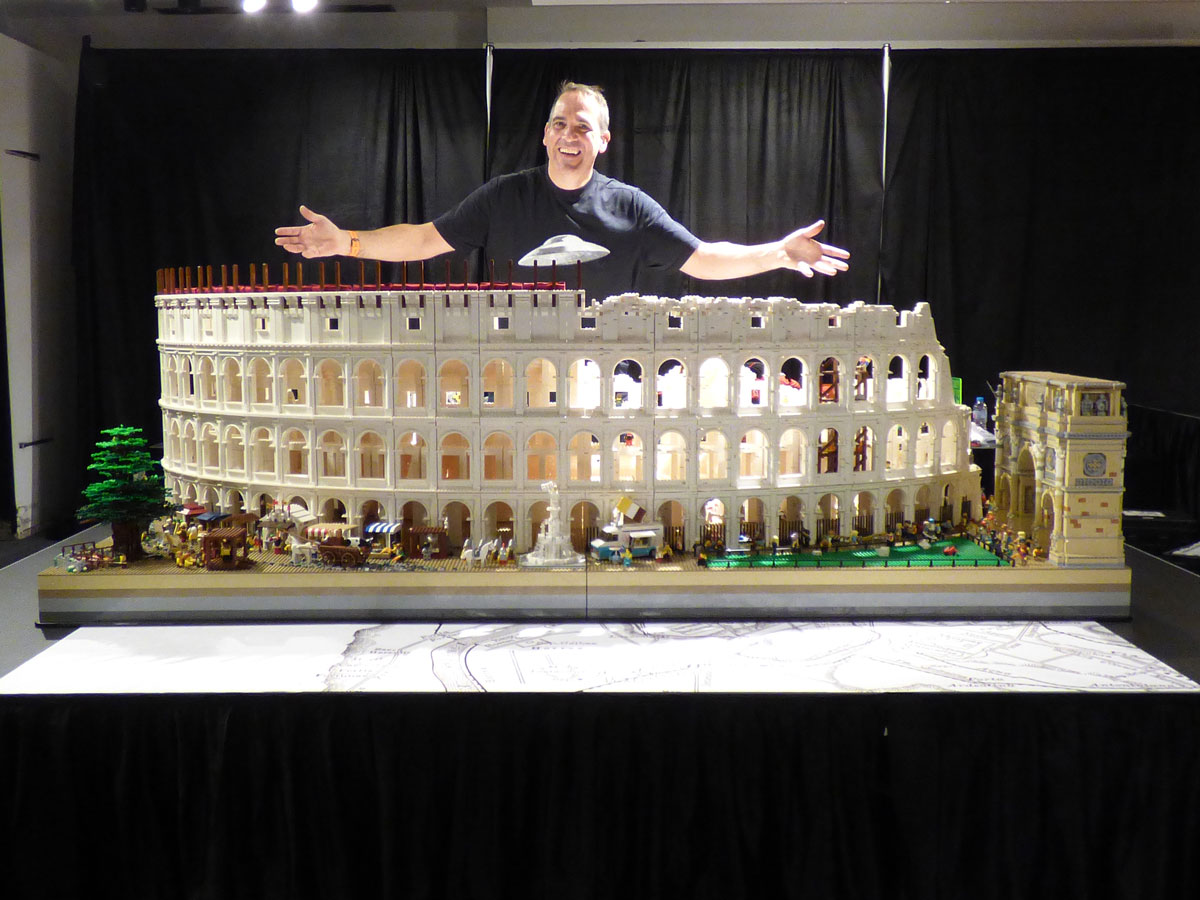
Blocks magazine is cranking open the door to the vault, with print subscribers now getting free access to the digital library of more than 80 issues – that’s over 9,000 pages – of LEGO features, reviews, build guides and more.
All the information on getting a Blocks subscription, including the extra subscriber benefits, is available here.
Each day this week Brickset is exclusively sharing one feature from the archive. In this interview feature from 2020, we find out what being a LEGO Certified Professional actually entails from the people who play with bricks for a living.
If you’re reading this magazine, chances are you’ve wondered what it’s like to work with LEGO for a living. Generally, the dream job involves uprooting to Billund and working for the LEGO Group directly. But that’s not the only way avid AFOLs can turn their hobby into a career. If you prefer being your own boss, there’s always the LEGO Certified Professionals (LCP) program.
Even if you’re not intimately familiar with the LCP program, you might have heard of one or two of its members. Probably the most famous name among the mix is Nathan Sawaya, the lawyer-turned-LEGO artist behind multiple touring brick exhibitions. His iconic sculptures, including a whole host of superhero characters, are a perfect example of what LCPs do.
As you can probably guess, LEGO Certified Professionals work with bricks in a professional capacity, whether for the LEGO Group, a third party client, or themselves. What sets them apart from other people doing the same thing is the official stamp of approval from the Danish company. They aren’t employees in the traditional sense – rather, they’re simply trusted business partners.
‘I envision LCPs as an extension of the Group,’ explains Robin Sather, the man who first brought the LCP program to life more than 15 years ago. ‘I see us doing things that the LEGO Group does not have a mandate for, and/or the resources to do. We bring the joy of LEGO to more people, in more places, and in more ways than the LEGO Group has the desire or ability to do so.’
Helene Techiert, Head of Market Integration and Engagement at the LEGO Group, echoes that sentiment. ‘LCPs are a valuable partner to us, and help us realise a lot of creative projects that we are not able to do ourselves,’ she says. ‘With 20 LCPs spread across the globe, it’s possible for us to work on local projects, with an LCP adding local relevance and authenticity to our marketing activities.’
To date, those local projects have included the likes of LEGO Masters, which has utilised the talents of LEGO Certified Professionals for each of its regional spin-offs, and the Rebuild the World advertising campaign, which required the building skills of three European LCPs. In China, meanwhile, Wei Wei Shannon Gluckman – the only current female LCP – is currently helping the company to increase its market presence through a series of hands-on workshops.
The LEGO Group hasn’t always had this wealth of dedicated builders to call upon, though. Rewind the clock by 15 years, and the LEGO Certified Professionals program was only just beginning to get off the ground, following months of collaboration between Robin and a couple of key figures from the LEGO Group’s community engagement team in the early 2000s.
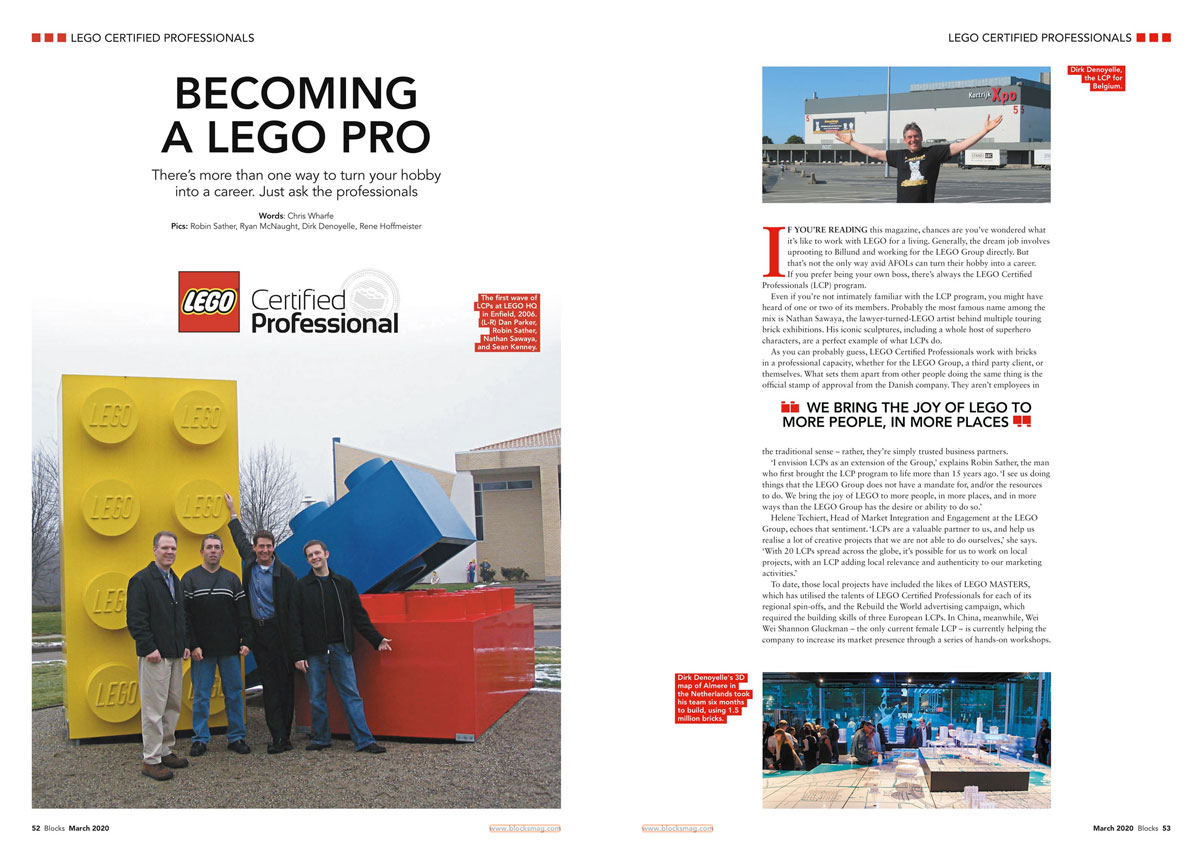
EARLY DAYS
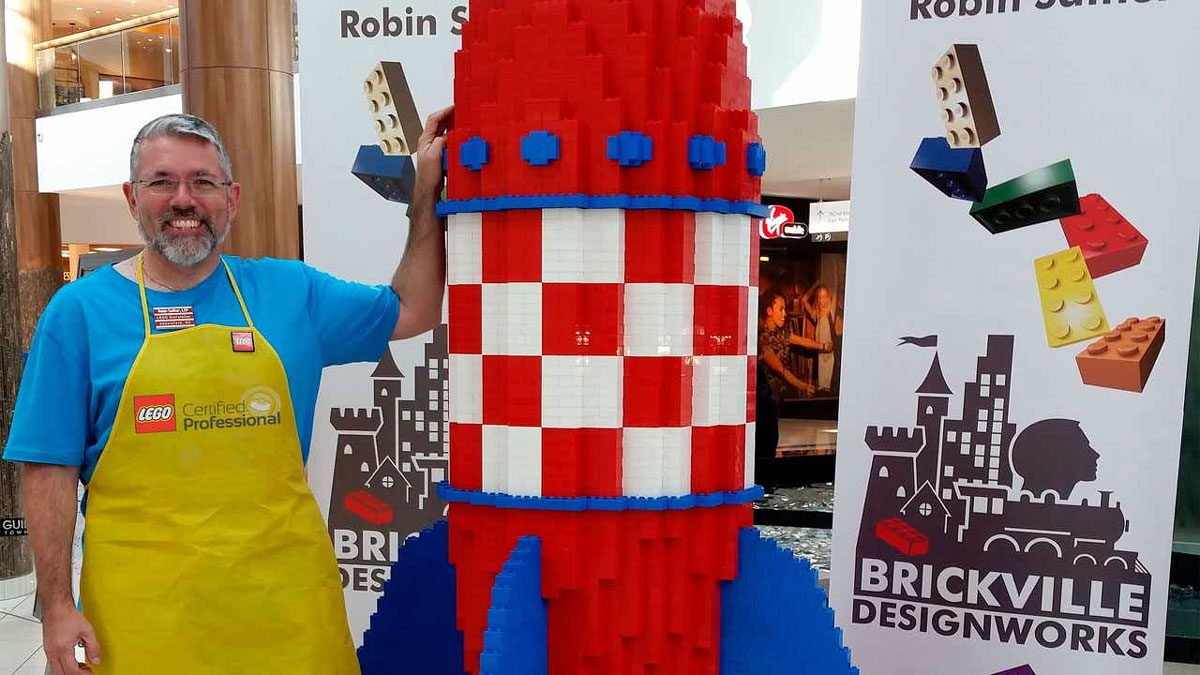
The story begins with the Vancouver LEGO Club, one of the early LEGO User Groups to emerge from Canada. Robin played a key role in establishing the club, and in its earliest days, focused on organising events for members to display their builds. But it turned out to be a double-edged sword: while his hobby allowed him some relief from his day job in IT consulting, it also ate into his spare time, and eventually his working hours.
‘I realized that something was going to have to change,’ he recalls. ‘Either I would have to cut back on my LEGO club activity, or I could find a way to monetise it, and make at least a partial living doing something LEGO-related. I chose to pursue the latter.’
Ultimately, it was the events Robin had spent so much time organising that provided the initial spark of an idea. ‘We would go to a shopping mall, and display our stuff, run a train layout, and not do much more, but people would be lined up out the door. The mall would see a huge bump in foot traffic. The management, and the merchants, would be ecstatic. I realised that malls, museums, family attractions, and other venues would pay money for these kinds of events. And that was the start of it for me.’
From there, Robin launched his company Brickville DesignWorks, along with two partners who have since bowed out. And as he began to grow the business – taking on commissions, exhibiting at public events, and even running kids’
WE ARE ALL ENTREPRENEURS, AND WITH THAT COMES ALL THE ASPECTS OF RUNNING A BUSINESS
‘It seemed like a big win for the LEGO Group to have me out doing this sort of thing, especially since it didn’t cost the company anything,’ he explains. ‘But I knew that TLG would have concerns about protecting its brand, and would always want to make sure that any public presentation of LEGO creations, bricks, and concepts lined up with the company’s core values and high level of quality.’
At the same time, Robin’s vision for this new era of collaboration yielded benefits for LUG members, too. ‘There was a lot to be gained by clubs getting some support from LEGO for events and activities, and also being able to communicate directly with the company. I envisioned having specific people put forth by the clubs, and then approved by TLG, to be LEGO ambassadors.
‘So, with all this in mind, I wrote up a white paper, detailing how a formal relationship between the LEGO Group and qualified entrepreneurs like me could be a win-win for everyone, as well as the public, who would have the opportunity for more LEGO love in more places, and more often.’
Robin pitched his white paper to community team members Jake McKee and Tormod Askildsen in February 2004, at Brickfest PDX in Portland, Oregon. ‘It was a great meeting, and both were excited at the ideas. So began several months of working together to create these new programs. It was 2005 before we were all ready to go.’

THE FINE PRINT
Robin couldn’t take on the mantle of LEGO Certified Professional all by himself, but only a handful of people were running LEGO businesses back in 2005. From those he pitched, three ended up joining him in the first wave of LCPs: Nathan Sawaya, Sean Kenney and Dan Parker. And the initial quartet quickly found that having an official link to the LEGO Group helped make their work more authoritative – just as it does for the 20 LCPs operating today.
‘Some have utilised the ‘LCP’ brand more than others,’ Robin explains. ‘Others have focused more on developing their own brand, but they’ve certainly still received a lot of benefit from having the LCP moniker. For me, it is definitely important. My clients want a ‘LEGO presence’ at their events, and for the many local and regional events that make up most of my activity, the LCP branding and tagging is really the only way to achieve that.’
While the LEGO Group has taken complete ownership of the program and streamlined it over the years, it’s not a case of simply including the branding on your business. Becoming a LEGO Certified Professional involves maintaining a close relationship with the Danish company, and in turn, adhering to its brand values.
‘We sign a lengthy contract, which includes guidelines and standards for how we should be running various business operations and model production, as well as the types of activities we undertake,’ Robin says. ‘It also lays out the areas of subject matter that are okay, maybe all right, and definitely a no-go. We also pay an annual licence fee, which surprises most people.’
That contract is over 80 pages long, and includes over a dozen appendices – so it’s not surprising to find that it can be restrictive. Dirk Denoyelle, a Belgian comedian who specialises in portrait sculptures, says it’s the one major downside of LCP recognition. ‘It’s very one-sided,’ he explains. ‘There is a lot of stuff that we are not allowed to do, which would not be so bad, if it weren’t for the fact that AFOLs don’t have those limitations.’
From the LEGO Group’s side, the contract is more of a template than a set of constraints. ‘LCPs have their own businesses and we are one of their many business partners,’ Helene explains. ‘The contract provides a framework for LCPs, and I’m merely a sparring partner to them. LCPs work with the local LEGO office, and here the collaboration is more project-specific. They are given briefs, and at times they are also involved in concept creation.’
For Robin, it simply circles back to that idea of giving authority to brick-based businesses. ‘LCPs, who agree to be trained and certified in LEGO standards, methodologies, and quality levels, bring their game to a higher level, and gain the blessing and credibility of the LEGO Group,’ he says. ‘It’s a win for both.’
A DREAM JOB
A common misconception surrounding LEGO Certified Professionals is that they spend their entire day building, but the reality is much different – largely due to the commercial aspect the role naturally entails.
‘We are all entrepreneurs,’ Robin says. ‘And with that comes all the aspects of running a business – marketing, accounting, personnel management, and general operations. Then there’s the ordering, receiving, and shipping of LEGO bricks, creations, and all the stuff that’s needed to run events, manage exhibits, and more. We have to do it all.’
Unless, of course, you have staff to help you. Rene Hoffmeister, the founder of German LEGO fan website 1000steine.de, became the first European LCP in 2008. And he’s since grown his operation to include a number of employees. ‘There is a lot of paperwork to do, as in every business, but I get a lot of help via my project manager,’ he says. ‘I also have an inventory manager, who keeps track of the materials, where they’re stored, what needs to be ordered and such.’
It’s not uncommon for an LCP to have their own staff, but not all choose to do so. ‘Some LCPs, like me, have stayed small, and prefer to be one-man operations,’ Robin explains. ‘Others have grown into major operations, with large, advanced model shops, lots of employees, and the ability to create massive and impressive pieces.’
LEGO CERTIFIED PROFESSIONALS
If you fall into the former camp, you might find the reality of being an LCP quite different to your expectations. ‘The first years are all about dreams coming true,’ Dirk acknowledges. ‘In my case the access to tonnes of bricks was not new, but the recognition and the ‘title’ really gave me a thrill.
‘Today, the day-to-day burdens of running a business, having not enough time for actual creativity and having to spend too much time solving issues of whatever nature, kind of lays a shadow on the brightness of the brick. But then again, when I do get a chance to build and create, it always gets me back on track.’
Dirk isn’t alone in that experience, however. ‘Like any job – and I’ve been an LCP for a while now – you go through peaks and troughs,’ says Ryan McNaught, the only LEGO Certified Professional in the southern hemisphere. ‘I still love LEGO, and I’m still learning about what the brick can do every day. Over the last few years since being involved with LEGO Masters, my relationship has changed a bit, in that I’m often more talking about LEGO than doing LEGO.’
When LCPs do get the opportunity to go hands-on with their bricks, it could take the form of anything from a huge commissioned build to a small make-and-take model – and everything in between. For LEGO Masters Australia, Ryan spent 1,000 hours designing and constructing a life-sized Honda Civic. Dirk has constructed dozens of brick portraits, including commissions for Ed Sheeran and the Dutch royal family. And Rene has broken several LEGO records, including the longest ship and largest bridge in the world – but it’s a decidedly different project that sticks out most in the German LCP’s mind.
‘The weirdest thing we’ve ever built was a working Star Wars-themed music box,’ he recalls. ‘We built a series of Star Wars landscapes on a large cylinder, with different towers at certain points. When rotating the cylinder, these towers pushed little levers, each playing a specific key on a real keyboard, which played the original Star Wars movie theme.’
FUTURE THINKING
The LEGO Certified Professionals program has come a long way since Robin’s initial pitch in 2004. With the addition of Graeme Dymond to the roster in late 2019, there are now 20 LCPs operating around the world. And that number will only continue to grow, in line with the needs of the LEGO Group.
‘We select LCPs when there is a demand from a local LEGO office,’ Helene explains. ‘It’s important to us that the local LEGO office is engaged and interested in an LCP and their unique talent. The connection to the LEGO Group is what makes the LCP program special, as they are the only professionals we engage with, as they fulfill our strict safety and quality requirements.
‘Safety is very important to us, and we therefore spend a lot of time talking about safety and best practices to learn what capabilities and safety understanding the person holds. The LCP title is personal, and we want to ensure that the energy and connection between the person and the local LEGO office is good, and that they understand and live by our brand values.’
It’s clear that the relationship between the LEGO Group and LEGO Certified Professionals is what underpins the entire program. And while it’s not without its restrictions, it does illustrate a viable – if mostly exclusive – way to make a living out of LEGO that doesn’t involve relocating to Denmark.
52 likes
8 comments on this article
Woah. That's it.
Dirk Denoyelle's "Bricks in the city" expo in Antwerp was wonderful! Bricks truly turned into art. And it gave us a perfect excuse to visit with the kids! ;)
Step 1: Be a millionaire.
It was cool to hear from Ryan McNaught after 3 seasons of LEGO Masters Australia. I enjoyed the show and enjoy the behind the scenes just as much. Nice interview!
Strange, from what I heard TLG is seriously cutting down the number of LCPs. Wonder why they are promoting it here.
Plus, reading how LCPs are restricted by the contract they sign, and how they have to pay a licence fee for basically generating free advertising for TLG makes this feel like a very unattractive proposition. No wonder there are only 20 LCPs worldwide. I am sure if the program was really attractive, there would be quite a few more.
Awesome to see Brickman up there! (Ryan McNaught). Aussie Aussie Aussie! Ive met him in person, great guy and he's also great on Lego Masters.
Interesting to see how other Certified Professionals got to where they are today, how they do things etc.
Why is Blocksmagazine promoting only PRINTED subscribers? I am a digital subscriber. And what I don't also like is that I have to wait for the printed subscribers to get their copy and first THEN they release the digital!
Why? my subscription is more cheap to produce, more environment friendly. Why is the promotion not applied for me as well?
@AustinPowers:
There has been a shift in global focus, and some blurring of information. The initial group of LCPs listed here were all based in the western hemisphere, and by the time I became aware of the program they had picked up a few more Americans who aren't mentioned in this article. That I can recall, the ranks also included Beth Weis and Adam Reed Tucker. There was someone in the UK at one point, but I can't say for sure if he predated Rene or not.
At some point, they stopped accepting new members in the US because the majority of LCPs were already based here, and they wanted more worldwide representation. Ironically, they've now lost the vast majority of American LCPs, leaving only Sawaya in the US, and they don't seem to be interested in bringing on more to cover a territory that's equal to western Europe in size.
I'd heard speculation years ago that the program was Sawaya's brainchild, as he had just been hired to work as a Master Model Builder in LLCA, spent nine months being trained into the position, got access to their proprietary software...and then quit to become one of the first LCPs where he was able to earn more money than he did as a lawyer. It's a bit weird to read that it was actually a Canadian who got it off the ground.
Anyways, there's a clear focus on building up a customer base in China, hence why the entire western hemisphere only has three, while China has three or four (depending on who you ask).
Regarding misinformation, at the time I first found the current LCP roster page, Wei Wei Shannon Gluckman was listed as the first and only female LCP. Neither claim was true, as Beth Weis was, years earlier, the first and only female LCP, but I think she left the program before Gluckman joined (which may have led to the confusion). And at the time I found the page, there was a third listed on the site based somewhere in Asia (I don't know who it was, but she has since been removed from the roster), so I can only assume that Gluckman's bio claiming she was the only female LCP was not immediately corrected when the third one joined.
When the program started, there was a lifetime fee, so paying in wasn't as big a factor as having to pony up cash on an annual basis. This may have been used to kinda push some members to exit the program, if they weren't making tons of money. They clearly stated at one point that they weren't interested in picking up any more members from the US, but at that time over half of the membership was based in the US. Now they're trying to find two new LCPs based in Mexico and Russia, but I don't know if that was the case when this article was published over 14 months ago.