LEGO as a teaching tool: does it actually work?
Posted by Huw,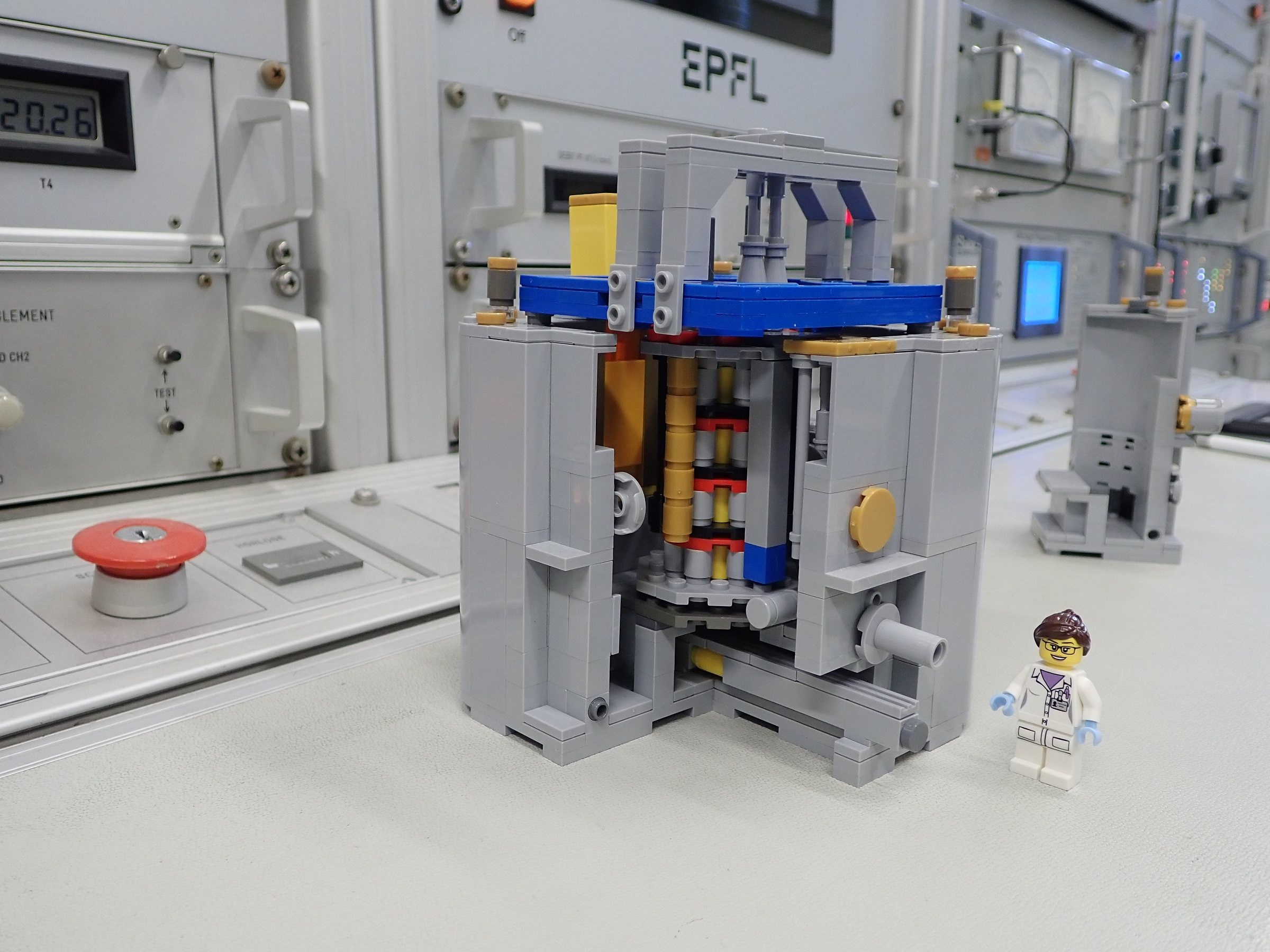
This article has been contributed by Vincent Lamirand, scientist and experimental research lead at the CROCUS nuclear reactor in Switzerland:
Like many here, I returned to LEGO after a long dark age, initially through building with our children. What I did not expect was that those bricks would eventually find their way into my professional life. I work at a university, in a field not often associated with LEGO.
That’s where this story begins.
A new model
I’m a nuclear physicist, specialising in radiation detection and reactor physics. As an academic, I split my time between research and teaching. On the research side, that means running experiments using our local teaching and research reactor, CROCUS, named after the mountain flower that grows here. On the teaching side, it means helping students understand how this remarkable machine actually works, from its mechanical structure to the fundamentals of nuclear fission.
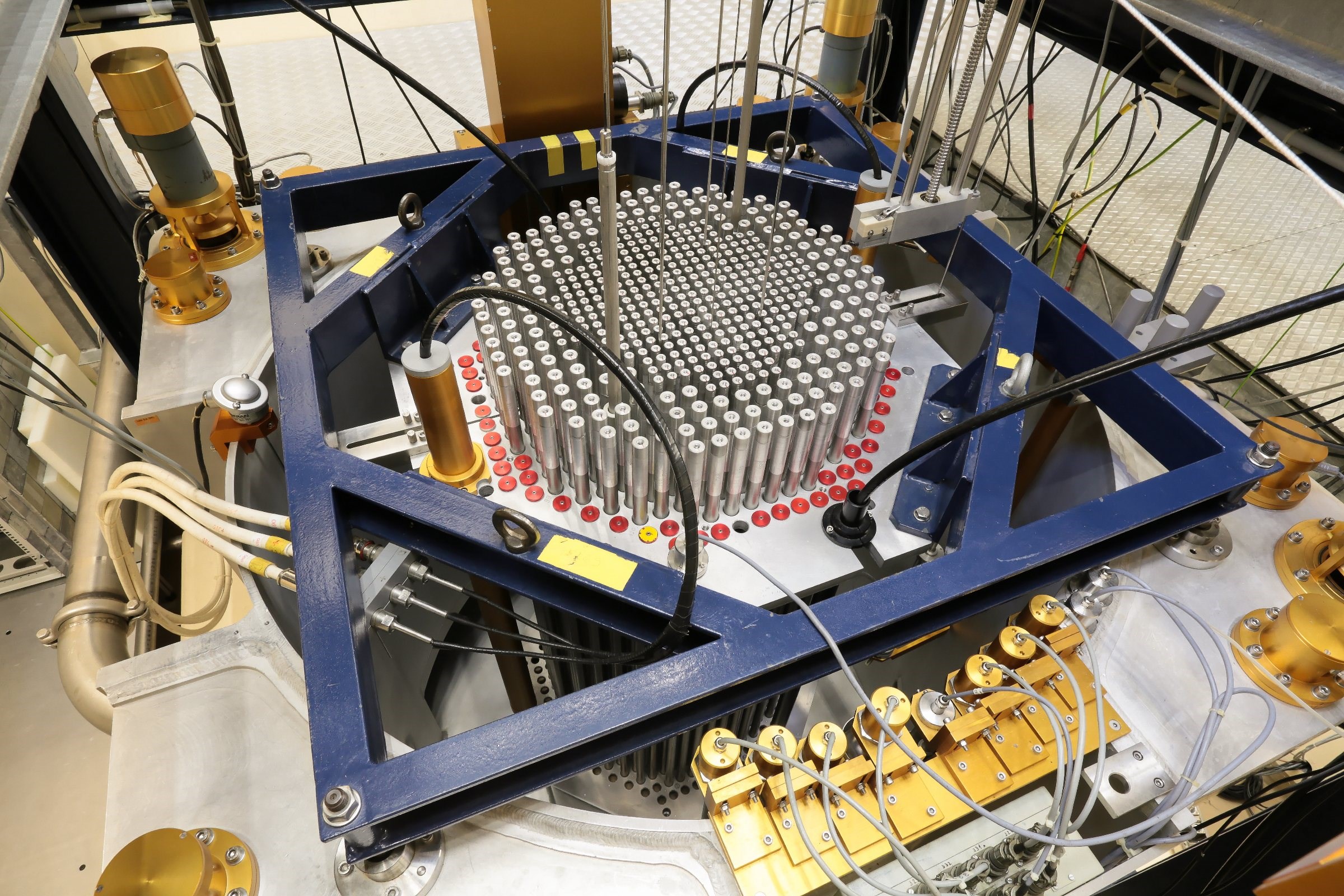
When my son received his first LEGO set 42164 Off-Road Race Buggy, I realised just how much the System had evolved since my childhood: Brickset, BrickLink, Studio – an entire ecosystem I had completely missed. It was quite a shock.
My old Technic sets were still at my parents’ house, and my brick collection was limited, so Studio quickly became the obvious choice. But to build what? My son was perfectly happy with his new sets, and there were already more on the way, much to my spouse’s mild concern. With virtually infinite parts available, the real question became: what would be meaningful to build? Something cool, certainly. But also useful. And perhaps… a little unusual.
A few years earlier, when I started in my current position, I had been tasked with restarting the experimental activities at our facility. I was fortunate to recruit a young engineer with exceptional mechanical modelling skills. Within three months, we had produced a complete digital model of CROCUS for new experimental projects.
To thank him for the intense work, I secured some modest funding to have the model 3D-printed at our workshop. Apart from limited simplifications (no actual fuel assemblies, of course), it was remarkably faithful. The printed model still stands in our facility today, and it is undeniably beautiful.
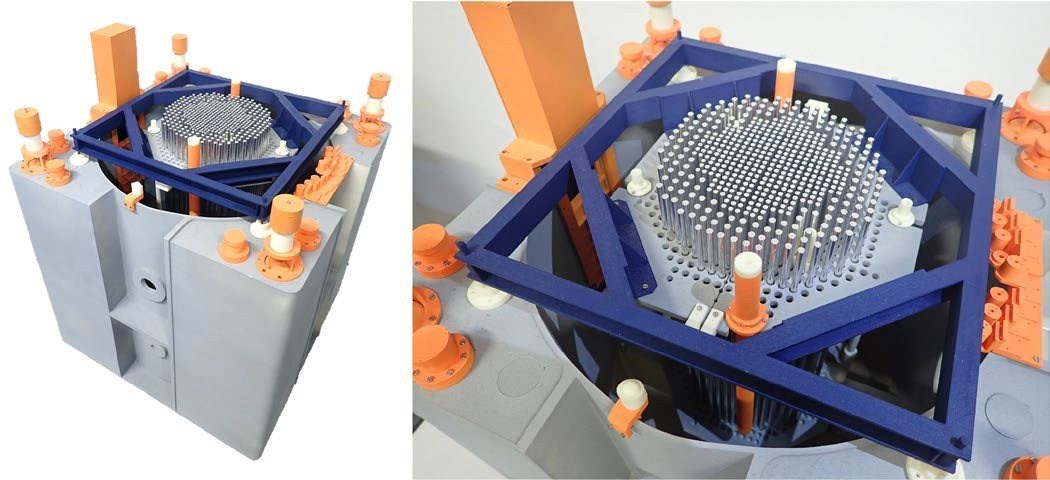
But it is mostly decorative.
The real reactor sits only a few metres away and is accessible to students and visitors. They can see it, walk around it, inspect it closely, and engage with it in ways that very few teaching reactors in the world allow.
And yet, something was missing.
What we needed was something complementary: a way to open it up, expose its internal logic, and let students handle and reassemble it without consequence, perhaps even with enjoyment.
A LEGO model
From idea to bricks
Once the idea was set, the design followed constraints familiar to anyone here: choose the scale, preserve the proportions, make it structurally sound.
But beyond that, accuracy mattered. I wanted to retain the essential systems and relationships inside the reactor, enough that a person could point at a section and think, “So that’s where fission actually happens.” If components could be removed, opened, or separated, even better. In educational terms, we call this affordance: the ability of an object to suggest how it can be used or understood.
After many iterations, and more than a few late evenings refining geometry in Studio, the design reached a workable state. We agreed on a simple arrangement: the design was my personal project, while the laboratory would fund the bricks for a test build. That idea eventually led to submitting the model to LEGO Ideas, but that came much later in the process.
The first physical version proved that Studio is optimistic about structural stability. A second iteration followed, mainly to improve robustness and refine some of the interactive features. I also sought input from a colleague specialised in pedagogy, particularly in learning through physical objects.
The build
So here it is. A completed model, with all features included.

To build a reactor, you need:
A vessel: Since this is a light water reactor, the real one is made of aluminium, so light bluish grey works well. CROCUS is somewhat special, as the core sits on a pedestal with additional safety features that we will see later.
A core made of fuel rods: Red and yellow represent the two types we use, inner and outer elements. There are 4 and 8 of each instead of 336 and nearly 180, but scaling compromises were necessary.
A start-up neutron source: it provides the initial neutrons, and moves through a pneumatic channel located beneath the pedestal to its position under the core.
…
That’s it, I did it again! I was about to tell you everything about it.
In short, every essential system is represented, enough to understand how it works and how the different components interact. More importantly, several parts can be moved or removed. The spillway, which controls the moderator level and therefore the reactor reactivity, can be adjusted. Entire assemblies, such as the core and its support frame, can be removed to simulate a core unloading.
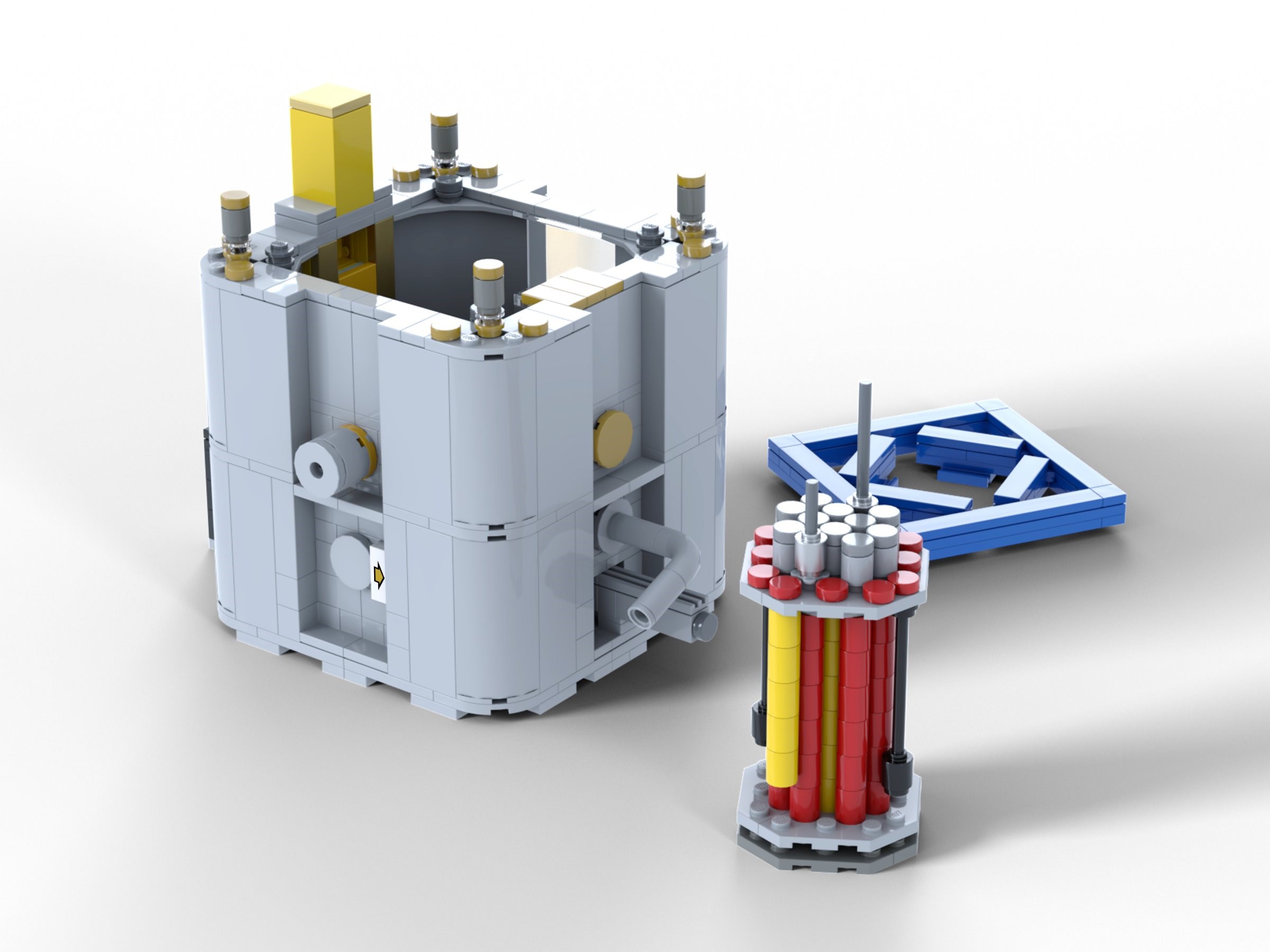
But the feature I like most, visible in the picture, is that a quarter of the vessel can be removed. This allows you to look inside and understand the internal layout, but also to manipulate one corner of the vessel where a distinctive safety feature of CROCUS is located, namely the expansion vases. The model has since followed the reactor's own evolution, adapting to reflect new experimental configurations as they are set up.
With a uniquely accessible reactor like CROCUS, what we really need is a way to reveal the hidden parts.
A bit of pedagogy
By the end of the design process, I was enthusiastic. I genuinely liked the model.
Which is nice. In my case, however, it was not enough.
For outreach, it would have been perfectly fine. A model to display during open days at the university before facility tours. Yes, you can visit us. But for teaching, especially for advanced students at Bachelor or Master level? For actually improving understanding? That is another matter entirely.
There was only one way to find out: use it in class and measure the results.
So we turned it into a small educational experiment. Something slightly different from our usual neutron counting.
We run several hands-on courses each year. Two formats seemed particularly suitable. A short introductory Bachelor course, with different groups coming in week after week. And an intensive Master course running one full morning per week over an entire semester.
For both courses, we alternated groups. Half of the sessions included the LEGO model. The others did not.
We then collected feedback through a short questionnaire assessing their understanding of the basic functioning of CROCUS. After that, I had the pleasure of doing something I deeply enjoy: applying a bit of statistical analysis. The experiment and its results were later formalised in a peer-reviewed conference paper, available here.
But before the numbers, there was something else.
Something I experienced first-hand.
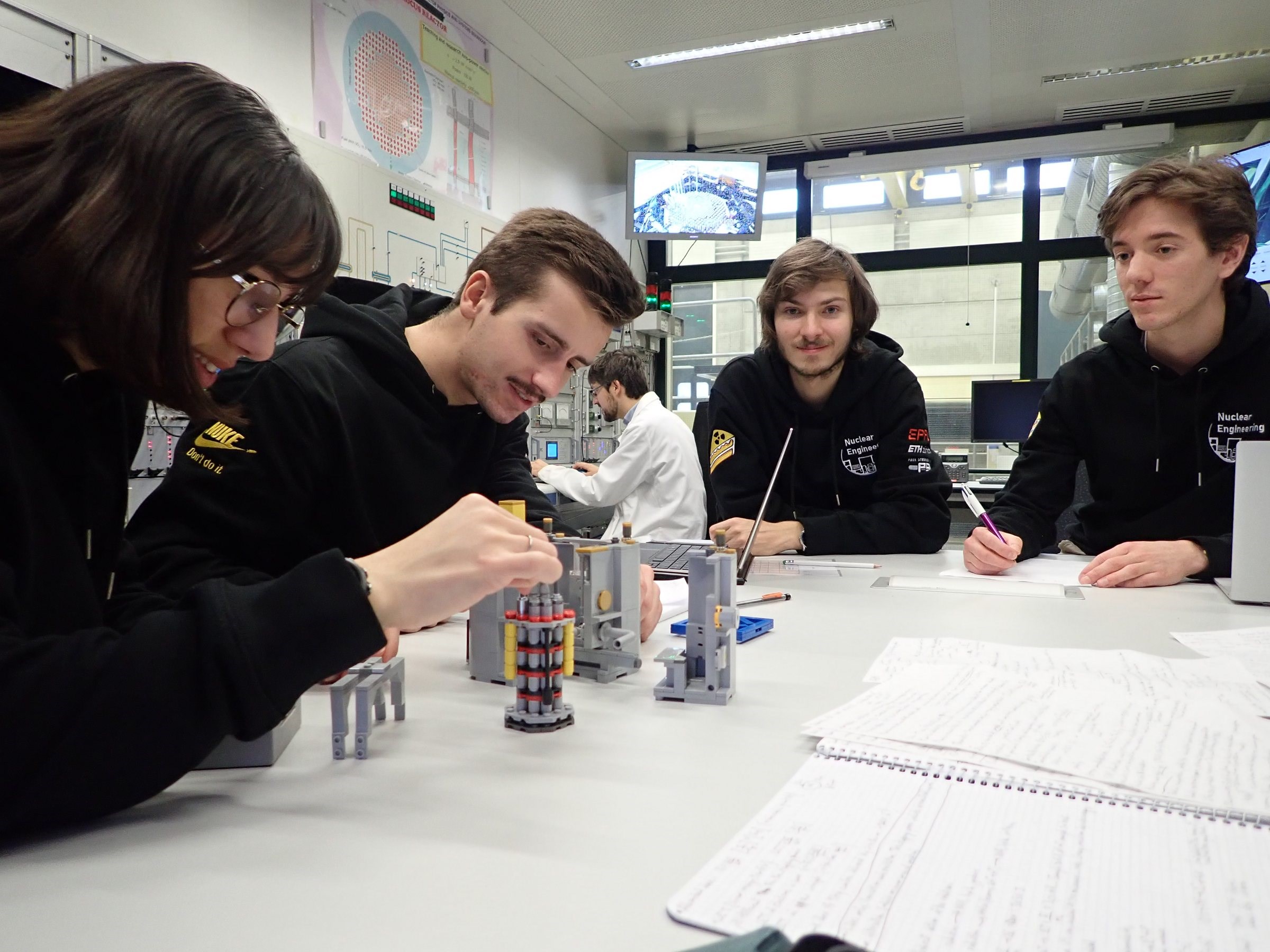
Picture a class of physics and nuclear engineering students. Let’s be honest, we are all nerds. You start by showing them the real reactor. The controlled access area. The security doors. The shielding. The vessel. The fuel elements in front of them. Then you take them to the control room and start the reactor with the operator.
It is impressive.
And then, while explaining the system, you casually pull out a LEGO model and say, “Let me show you.”
The look in their eyes.
You can probably imagine it.
The outcome
Now the results.
Let’s start with the less impressive ones.
At Bachelor level, in the second year, student performance is naturally quite heterogeneous. In any group, you have highly motivated students who immediately grasp the concepts, some who are only partially engaged, and others who are still struggling with the fundamentals.
Statistically speaking, the result was simple: no clear effect. Whatever influence the model may have had was lost in the variability of the cohort. The signal was buried in the noise.
That does not necessarily mean there is no effect at all. It means we need more data. More students, more sessions, more statistics. So we are continuing the study this year.
Now for the Master level.
Here, the situation was different. These students are already highly motivated, technically strong, and genuinely interested in the subject. I did not expect to see a measurable difference.
And yet, we did.
Students who attended sessions supported by the LEGO model showed an average increase of about 7 percent in correct answers. More interestingly, the proportion of what I classified as “terrible” answers decreased by roughly the same amount, nearly disappearing entirely.
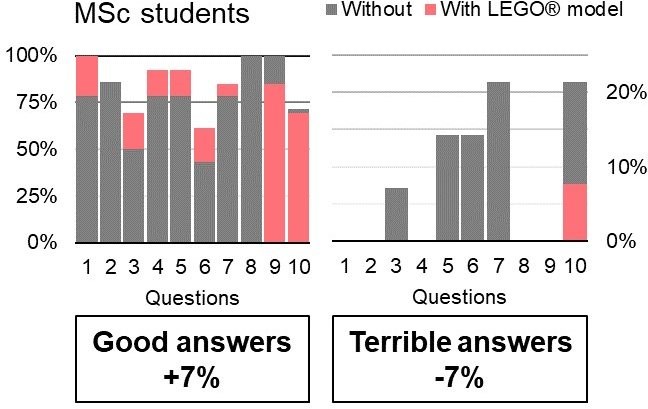
After running statistical tests, the conclusion was consistent: whichever way we analysed the data, the effect was positive.
At this level, that is not trivial.
The qualitative feedback was equally revealing. Both Bachelor and Master students frequently mentioned that the model helped them visualise the system and understand how the different components interact.
This is important, because the statistics tell us that something improved, but not why. The comments suggest that the model makes abstract structures more tangible and relationships easier to grasp.
From a teacher’s perspective, that matters.
And from the builder I have become, that feels like success.
Why this model works?
This LEGO model is unusual in one important way. It was designed by a teacher for a specific course that he teaches. From the very beginning, I had a clear objective in mind: what exactly should my students understand better at the end of the session?
The pedagogical goal was focused and well aligned with what LEGO does particularly well: helping to visualise complex systems.
One thing I quickly learned in my position is that, regardless of academic level, even excellent students can struggle to construct accurate mental images of complex technical systems. When it comes to a research reactor, even a relatively small and accessible one like CROCUS, the combination of geometry, materials, moderation, control systems and safety features can become overwhelming.
In that sense, I was working in a near best-case scenario: motivated students, a clearly identified difficulty, and a tool naturally suited to addressing it.
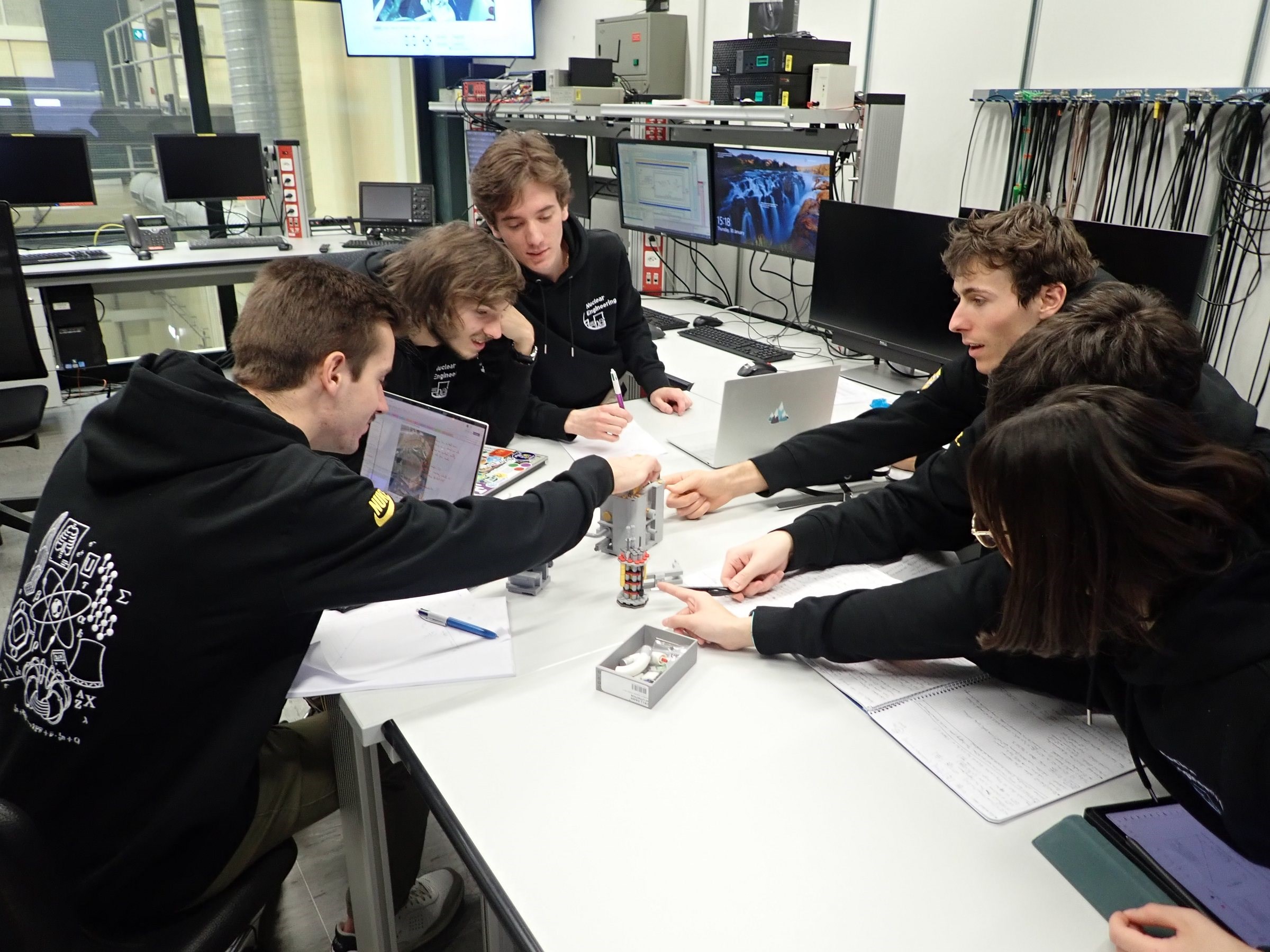
This kind of alignment is extremely difficult to achieve in a generic, one-size-fits-all educational set.
When reading discussions about recent LEGO Education products, including the recent review of the new LEGO Education Science kits here on Brickset, similar questions often arise. Is the topic sufficiently meaningful? What exactly is being learned? Does the model genuinely support understanding, or mainly engagement? Is the activity structured in a way that reinforces conceptual thinking?
These are fundamental questions.
Because I know that LEGO can be an extraordinarily powerful learning tool. And I did not need to build a reactor model to discover that. As a child, I learned the basics of mechanics from sets like 8880 Super Car with its gearbox, or 8854 Power Crane and its pneumatic systems. I learned by building, rebuilding, reading the instructions like blueprints, identifying parts, understanding how mechanisms interacted.
The learning did not come from being told what to think. It came from building and understanding the system.
Perhaps that is the key difference.
When LEGO models are designed with a precise conceptual goal, aligned with real learning objectives and allowing genuine manipulation and exploration, their educational value can be substantial.
So maybe the path forward is not simply to label products as “educational”, but to deepen the dialogue between designers and teachers. Builders know how to make machines. Educators know what kids and students struggle with, and what there is to learn. Somewhere between those two perspectives lies something very powerful.
A conclusion
When I began designing this model, I had a clear objective: to make nuclear reactors more accessible. And if I was going to attempt that, it made sense to start with the one I know best, our own reactor, CROCUS, with potential use in our activities.
At first, outreach was the obvious application. Classroom use was an open question. We now have an answer: it works. The measurable impact still deserves further study, and we are continuing to refine and expand the data, but the direction is clear.
Outreach, however, opened another door.
A student told me about LEGO Ideas, and shortly after I discovered Rebrickable. I decided to share the project in both places: submitted to LEGO Ideas and made freely available on Rebrickable, complete with building instructions and short explanatory notes introducing the basics of radiation detection and reactor physics.
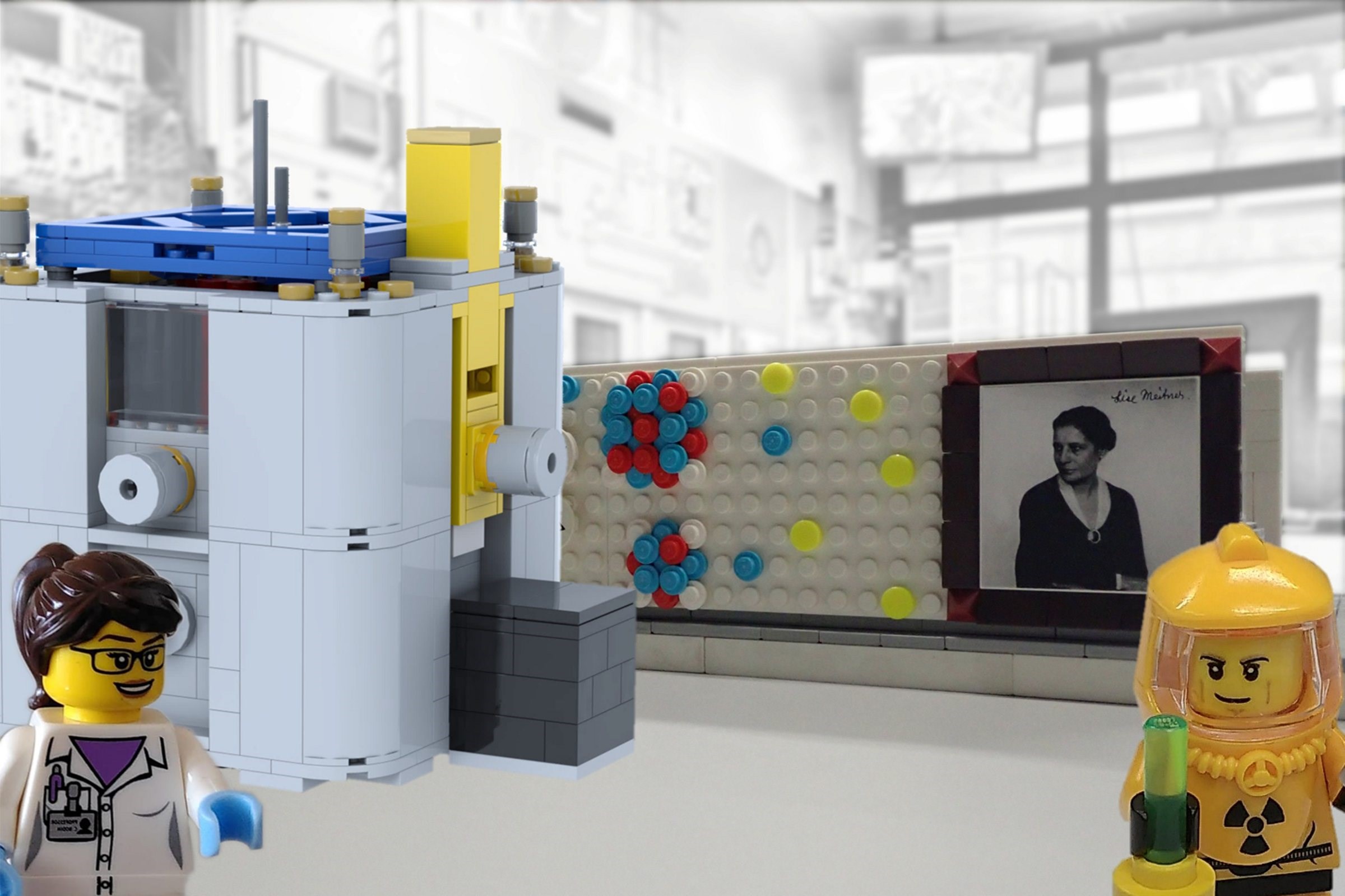
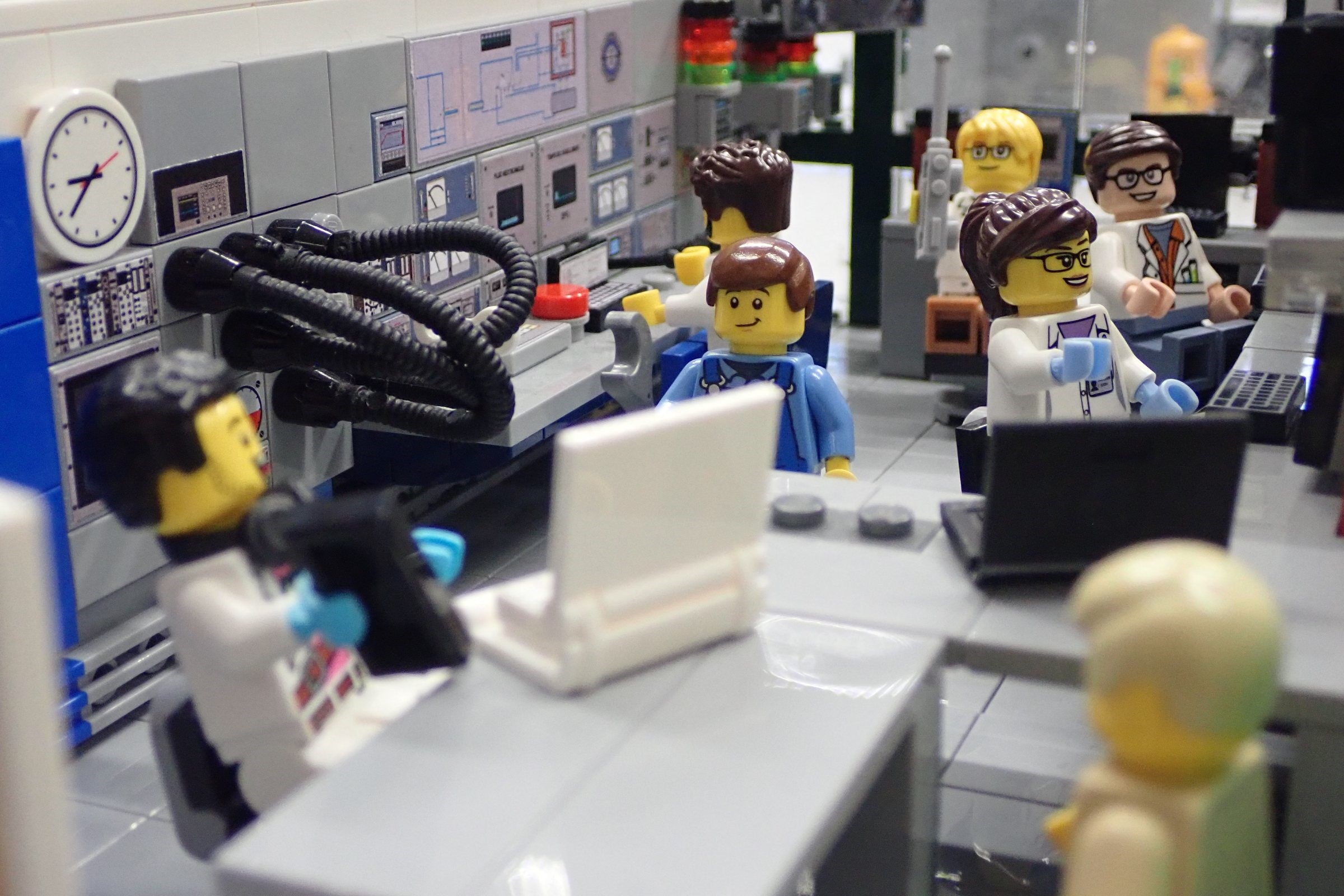
Because if learning through LEGO is powerful, learning through role-play can be even more so, I also designed a replica of our control room. It includes a small tribute portrait of Lise Meitner, one of the key figures in the discovery of nuclear fission, whose contribution was long under-recognised.
Fewer than 100 days remain to reach 5,000 supporters on LEGO Ideas.
If you believe LEGO can help us understand the real world as well as represent fictional ones, your vote would mean a great deal.
Are you in? Vote for it at LEGO Ideas here.
163 likes
62 comments on this article
This was an excellently written article and I very much enjoyed reading it! There really is something powerful about the educational potential of Legos; after all, I wouldn't be an Engineer today without the 3D visualization skills that Legos and Minecraft taught me. Yet I believe that there is much more to be said for your educational set design than the design of the current education wave.
Honestly, if I had to suggest a Lego education set idea, I would ask Lego to create a working counterweight trebuchet with some weight bricks. An accurate one that could be used in a Castle scene, to boot. People would legitimately want to build it and learn about physics simply by building and using it.
Thank you Vincent for such a fantastic article! Afterr reading, I headed straight over to Ideas to support it, and to Rebrickable to download your very impressive set of instructions. I've used Lego sets in prefessional contexts (10268-1 Vestas Wind Turbine, 10241-1 Maersk Triple-E, and 42004-1 Mini Backhoe Loader) but they were mostly to drive engagement in the various topics. I enjoyed how carefully you'd considered the learning outcomes that you wanted to achieve, and how you wanted the model to accomplishe these. I'd love to read more articles like this, and I wish you luck for yopur Ideas submission!
In many subjects, especially science and technology, models frequently help students to understand what is being taught. I don't think the fact that it is LEGO that helps, but that it is a model. I would imagine a 3D printed model would have the same effect as one built out of LEGO. Maybe you need a further group where an even more accurate 3D printed model is used instead of the LEGO model. I would imagine the results would be similar for both the groups with the model -once a model is accurate enough to get over the concepts, finer details / absolute accuracy doesn't matter so much.
This was a really interesting article on the use of Lego in an educational setting; I’d certainly enjoy learning about a topic like this! From my perspective, though, there’s two things that’d give me pause before using Lego in a broader educational context.
The first problem is that Lego is (for better or worse) an approximation of whatever subject matter it ends up recreating. That’s not necessarily a dealbreaker: for something like this it might actually be an advantage. But if you need to make a model that’s more accurate to reality I’m guessing Lego would be a poor choice of materials. I think I remember someone being castigated for using Lego in an architectural project, for example.
The second problem is that Lego is ultimately a commercial product, and that undermines the altruism beneath anything we (or the Lego Group) might want to teach using it. That’s why I’ve never really been on board with Lego’s educational products; the intentions might be good on the surface, but it ends up just feeling like a way to market Lego’s broader product offering to a captive audience.
Again, not deal breakers, but Lego in education is something I’d want to scrutinise very carefully before using on a wider basis in this way.
Nuke. Don’t do it.
@yodaloop said:
"This was an excellently written article and I very much enjoyed reading it! There really is something powerful about the educational potential of Legos"
I agreed with you until that point…
Always Lego, never Legos !
This is an excellent, unusual article. I put my vote on the Ideas entry, as it’s one of the more interesting and truly educational submissions I’ve seen in quite some time.
( — My partner also wishes to add this, which they assure me has amusing references that the physics-interested will understand:
My message for Vincent is that this is a nice "Standard Model" and it must be difficult to get the students to "SCRAM" once the class has ended. ;) — )
@CCC
I felt the article explained the reasoning pretty clearly - iteration, flexibility, the sheer wonder moment of “this is Lego!”, the ease of reconstruction and moving parts, reusable parts, experimenting with the specific educational potential of Lego in an academic setting, being able to design it independently instead of relying on a student with 3D modelling skills. Yes, modelling can be done in any medium, but this one works for the author for the reasons they explained.
Un superbe article très enrichissant et inspirant ! Merci
What a joy to read an article like this. Obviously, your field of work trained you to articulate your thoughts in a properly structured way and all the parts are presented in the right order - I truly enjoyed this read.
Not to belittle anyone, this kind of article should be mandatory reading with anyone developing/designing educational toys. As far as Lego is concerned and particularly for the Technic line, I sincerely believe there are many designers in there that do not enjoy their jobs as much as they should. Through the years, we have seen many very well designed sets - and some quite ingenious. However, in the most recent past, that line has morphed into something quite different. The variety is gone and it seems Lego discovered that a basic car at a certain price point is the ideal product to put to the market. It must be hard/difficult/depressing for Lego Technic designers to keep going as their employer asks them to produce the same rehash year after years.
The window for kids to play with Technic sets is fairly small (until they come back from their dark/grey ages). But the come back might never happen if the sets are not engaging and varied enough to create a lasting impression and fond memories. Lego should understand that their true very profitable mission is to 'form/train' AFOLs. There is very good money in toys for kids but there is tremendous amount of money in adults with large disposable income buying sets simply because they are neat - many still in the original box and never built. Besides, adults will tend to buy their kids what they remember as a great toy when they were young (provided this toy is still available in some form). It does not have to be complicated to be interesting. In fact, it is quite the opposite, if the mechanism is too complicated, you sometimes loose the 'student' in the process. Sets like 42082 have 'transmission boxes' that are a marvel of engineering/creativity but as you build it, you lose the sense of what part does what. The early sets were good at demonstrating a few simple concepts - good sets would have 4-5 of these easy concepts scattered around the model and the learning was just tremendous. None of these mechanisms were completely hidden and you could truly see them in action.
Well, this post is already ridiculously long, so I'll leave it at that. Sir, you have my vote and good luck with this project and any other you might decide to promote. Once again, a very satisfying read.
Highly interesting.
Finally something where LEGO and education actually form a sensible combination.
Fascinating article!
I directly voted for the project.
@yodaloop said:
"This was an excellently written article and I very much enjoyed reading it! There really is something powerful about the educational potential of Legos; after all, I wouldn't be an Engineer today without the 3D visualization skills that Legos and Minecraft taught me. Yet I believe that there is much more to be said for your educational set design than the design of the current education wave.
Honestly, if I had to suggest a Lego education set idea, I would ask Lego to create a working counterweight trebuchet with some weight bricks. An accurate one that could be used in a Castle scene, to boot. People would legitimately want to build it and learn about physics simply by building and using it."
Vincent here!
Thank you for your very kind feedback! Your trebuchet idea is a great example: a model that people would genuinely want to build, while learning physics almost incidentally. That balance between desirability and educational value is hard to strike, but when it works, it really works. That’s what I felt with 8880, and plenty of other great old Technics, as is commenting @HOBBES below. By the way, the trebuchet in 31120 is not bad for that purpose, at least our kids use it quite a bit, trying to aim with it (I’m preparing a review ;-) ).
@ZeroGravitas said:
"Thank you Vincent for such a fantastic article! Afterr reading, I headed straight over to Ideas to support it, and to Rebrickable to download your very impressive set of instructions. I've used Lego sets in prefessional contexts (10268-1 Vestas Wind Turbine, 10241-1 Maersk Triple-E, and 42004-1 Mini Backhoe Loader) but they were mostly to drive engagement in the various topics. I enjoyed how carefully you'd considered the learning outcomes that you wanted to achieve, and how you wanted the model to accomplishe these. I'd love to read more articles like this, and I wish you luck for yopur Ideas submission!"
Thank you so much, and thank you for voting and downloading the instructions! Great idea to use sets whenever useful, engagement is already a big step. In our case I honestly question if it’s not one of the main driver of the results.
@CCC said:
"In many subjects, especially science and technology, models frequently help students to understand what is being taught. I don't think the fact that it is LEGO that helps, but that it is a model. I would imagine a 3D printed model would have the same effect as one built out of LEGO. Maybe you need a further group where an even more accurate 3D printed model is used instead of the LEGO model. I would imagine the results would be similar for both the groups with the model -once a model is accurate enough to get over the concepts, finer details / absolute accuracy doesn't matter so much. "
That is a very fair point, and honestly one I asked myself early on. The 3D-printed model you see in the article actually exists (it sits in the control room, close to the students). But it is also static, “heavy”, and essentially untouchable. So the main point is probably that it is a faithful but fragile mock-up, not meant for manipulation and opening. We could have done another more practical version, simplified, adapted. But LEGO proved totally appropriate in the simplification process, i.e. keeping features. And it allows to adapt the level of manipulation as well. It can be disassembled, handed around, dropped without consequence, and rebuilt in minutes. I suspect the manipulability matters as much as the visual accuracy, if not more. That said, your suggestion of a controlled comparison is exactly the kind of experiment I would love to run in the future.
I should add that the control group was not without any model: the 3D-printed version was always available to all students. The comparison was therefore stricter than it might appear.
@Mister_Jonny said:
"This was a really interesting article on the use of Lego in an educational setting; I’d certainly enjoy learning about a topic like this! From my perspective, though, there’s two things that’d give me pause before using Lego in a broader educational context.
The first problem is that Lego is (for better or worse) an approximation of whatever subject matter it ends up recreating. That’s not necessarily a dealbreaker: for something like this it might actually be an advantage. But if you need to make a model that’s more accurate to reality I’m guessing Lego would be a poor choice of materials. I think I remember someone being castigated for using Lego in an architectural project, for example.
The second problem is that Lego is ultimately a commercial product, and that undermines the altruism beneath anything we (or the Lego Group) might want to teach using it. That’s why I’ve never really been on board with Lego’s educational products; the intentions might be good on the surface, but it ends up just feeling like a way to market Lego’s broader product offering to a captive audience.
Again, not deal breakers, but Lego in education is something I’d want to scrutinise very carefully before using on a wider basis in this way."
Thank you for your kind words! Both fair points. On approximation, you are right that LEGO cannot match the precision of dedicated models, but for my purpose, precision was not the goal. What mattered was that students could identify the components, understand their relationships, and manipulate them. A simplified model that affords exploration can outperform a highly accurate one that cannot be touched, like in the case of our 3D-printed one.
@Hiratha said:
"This is an excellent, unusual article. I put my vote on the Ideas entry, as it’s one of the more interesting and truly educational submissions I’ve seen in quite some time.
( — My partner also wishes to add this, which they assure me has amusing references that the physics-interested will understand:
My message for Vincent is that this is a nice "Standard Model" and it must be difficult to get the students to "SCRAM" once the class has ended. ;) — )
@CCC
I felt the article explained the reasoning pretty clearly - iteration, flexibility, the sheer wonder moment of “this is Lego!”, the ease of reconstruction and moving parts, reusable parts, experimenting with the specific educational potential of Lego in an academic setting, being able to design it independently instead of relying on a student with 3D modelling skills. Yes, modelling can be done in any medium, but this one works for the author for the reasons they explained."
Thank you for your very kind comment, and your vote! And please pass my appreciation to your partner, and tell him we’re working on adding a bit of symmetry possibly ;-) !
And you’re right, here it’s about getting the right modelling level, as I answered @CCC as well.
@Duesy said:
"Un superbe article très enrichissant et inspirant ! Merci"
Merci beaucoup pour le sympathique commentaire !
@HOBBES said:
"What a joy to read an article like this. Obviously, your field of work trained you to articulate your thoughts in a properly structured way and all the parts are presented in the right order - I truly enjoyed this read.
...
Well, this post is already ridiculously long, so I'll leave it at that. Sir, you have my vote and good luck with this project and any other you might decide to promote. Once again, a very satisfying read."
Thank you for your kind feedback and thoughtful comment, and for your vote!
You put your finger on something I find genuinely important. The sets that left a lasting impression were not necessarily the most complex ones, but those where the mechanisms were visible, understandable, and satisfying to operate. 8880 had that quality throughout, but also 8837 (pneumatics as well), 8422 (roller chain), or 8836 (flaps). The learning was almost a side effect of the pleasure of understanding how it worked. I suspect that is precisely what is missing in some recent directions; not ambition, but legibility. When a mechanism is too deeply buried to follow, the wonder disappears with it. The window you mention is real, and I agree that what fills it matters far beyond childhood.
On big set with brand and model names, well, I won’t start here. Let’s say my kids don’t have many recent Technic sets, nor me.
@AustinPowers said:
"Highly interesting.
Finally something where LEGO and education actually form a sensible combination. "
Thank you! And as @HOBBES and @yodaloop both noted, there is more to it than the subject matter alone. A good trebuchet in a medieval castle teaches physics just as well as a dedicated educational set, and probably more enjoyably.
@UProbeck said:
"Fascinating article!
I directly voted for the project. "
Thank you, and thank you for your vote!
Most definitely it IS a teaching tool.
From 3 years old on, he built Duplo to Lego Robotics.
My son learned to do basic coding with the Lego Robotics club he was in, in middle school.
Went to tournaments, did competitions performing basic functions and tasks with robots in the First Lego League.
Through the years building models with my help to start, then on his own he's learned spatial relationships, and sequential steps and then to Lego robotics.
Started in an Aerospace curriculum in high-school, but eventually switched paths. Nonetheless, Lego opened a world to him.
I recommend as teaching models for parents with their kids, 21309 NASA Apollo Saturn V, also one of the most underrated BL19007 Science Tower which has little builds and nods to experiments such as a steam engine, orrery, Mendel's cultivation experiment, double-slit Experiment, Schrödinger's Cat, an observatory, etc.
And of course the 42179 Planet Earth and Moon in Orbit.
Great article. Thanks for sharing! As an academic, I use LEGO in the classroom with my undergraduate and postgraduate taught students. I work in the social sciences (business and management, tourism), and find it useful for demonstrating and understanding abstract concepts such as ‘identity’ and ‘the future’. I did dabble with LEGO Serious Play but the sets are overpriced and I prefer to DIY with spare and second hand bricks, elements and figures.
Very nice building instructions with the explanatory notes. This would indeed make an awesome Ideas model!
Great to read from a Swiss university here at Brickset :-)
I think playing with LEGO a lot as a child gave me a greater spacial awareness and better understanding of the relationships between numbers. For instance, you have a strong physical representation that 2x4=8 through the classic LEGO brick.
From the article title, I wasn't expecting to see an article like this, but I quite enjoyed it! Side note: How many people had to look up the words "pedagogy" and "heterogeneous?" I didn't, but I'm a big word nerd.
@VilGoupil - thank you. What a fascinating and enjoyable article. I already believed that LEGO was a great teaching tool but you now give us a data driven backstop.
Prior to this, LEGO helped me learn so many other things like “there’s more than one grey”, “Batman sees with his forehead”, “marketing jobs aren’t for everyone”, “how not to use immersive”, and “illegal techniques only apply to us.” :o)
This was an amazing and inspiring article to read. You got my support. One comment/question: you said the paper you published was available "here," but I did not see a link to the actual paper. I would love to give it a read.
Cool article. I have presented courses at universities and for companies, and I have used Lego in some of my courses many times.
Obviously the Lego is just part of the facilitation, rather than becoming the main topic of the course, but it has always been awesome that I have managed to make my favourite toy a part of my actual job :)
Thanks for providing the data! It's much better then going off of vibes, like a lot of reactionary comments on the internet do.
The paper is glorious pure science with a sickening level of detail... all because of one little MOC. I applaud the dedication :)
@iabstract said:
"This was an amazing and inspiring article to read. You got my support. One comment/question: you said the paper you published was available "here," but I did not see a link to the actual paper. I would love to give it a read."
It's accessible on that page as a PDF, in the right-hand column under 'Article contents'.
Great article! Very interesting to see an actual small scale case study done on the subject for once, instead of pure conjecture or less direct studies on the subject. I fully agree with your conclusions as well
A really interesting article to read, thank you for sharing! I also voted for the Idea submission.
I particularly admire your testing the effectiveness, since so many comments / posts here are nothing more than vague opinions, it's great to see where Lego can be effective (or not!).
Great article. Thanks. I’ll definitely download and build the model.
I play with LEGO all the time: both building at home and participating in expos/events. I’m eagerly looking forward to a better understanding of a nuclear reactor. And it will likely end up on display somewhere in France in the future. I also teach with LEGO on a regular basis. I’m not at all surprised by the results and couldn’t agree more highly with your thoughts and conclusions. Leg godt!
@Rare_White_Ape said:
"Thanks for providing the data! It's much better then going off of vibes, like a lot of reactionary comments on the internet do.
The paper is glorious pure science with a sickening level of detail... all because of one little MOC. I applaud the dedication :)
@iabstract said:
"This was an amazing and inspiring article to read. You got my support. One comment/question: you said the paper you published was available "here," but I did not see a link to the actual paper. I would love to give it a read."
It's accessible on that page as a PDF, in the right-hand column under 'Article contents'."
It looks like the link has been fixed since I posted my comment. Thanks!
Thank you for a different and really well written article; the passion you have for your research AND teaching really comes across well. The fact that the model was made in LEGO really will help to engage in a way that another 3D model wouldn't manage; the ability to build and re-build, plus making it out of a material that the vast majority of students will have fond memories of, will surely reinforce this in their memories long after their time at university finishes! This is exactly the kind of STEM engagement that LEGO should be looking for and encouraging!
The engineer in me could not love this more. Thank you so much for sharing everything!
I've already previously made my critique of using LEGO for education in this review: https://brickset.com/article/129594/review-education-science-kits
To restate it here, it isn't necessarily potential--it's cost. In fact, LEGO themselves rolled out a set using the same show and tell approach to demonstrate how MRI machines functioned to children a few years back. The hospital I work at has one (because I requested it). :-)
The value of physical models and hands-on approaches to teaching isn't novel or new. This has been known for centuries and is extensively used in several branches of science, such as biology and medicine. Where I work, we even employ detailed and highly accurate anatomical models at the hospital level on a regular basis to assist in explaining various medical issues to patients.
LEGO isn't well suited for modeling natural, complex or organic systems, much less in an accurate manner. For example, the LEGO design team couldn't even replicate the Earth's elliptical orbit of the sun with 42179 properly. For this reason, I simply don't consider LEGO to be an accurate and cost effective medium for teaching beyond building approximate models of unique objects or systems designed by humans, such as the example presented in this article or the aforementioned MRI machine.
That said, I do think it's fantastic that you're going above and beyond for your students, and for that reason, I support it--even if it is somewhat forced as an educational tool.
@legoDad42 said:
"Most definitely it IS a teaching tool.
From 3 years old on, he built Duplo to Lego Robotics.
My son learned to do basic coding with the Lego Robotics club he was in, in middle school.
Went to tournaments, did competitions performing basic functions and tasks with robots in the First Lego League.
Through the years building models with my help to start, then on his own he's learned spatial relationships, and sequential steps and then to Lego robotics.
Started in an Aerospace curriculum in high-school, but eventually switched paths. Nonetheless, Lego opened a world to him."
Thank you for sharing this! Your son's journey is a great illustration of how early play with structured building can open unexpected doors. Some sets have that particular quality of making something abstract and enormous suddenly tangible and understandable.
@Timmy1971 said:
"Great article. Thanks for sharing! As an academic, I use LEGO in the classroom with my undergraduate and postgraduate taught students. I work in the social sciences (business and management, tourism), and find it useful for demonstrating and understanding abstract concepts such as ‘identity’ and ‘the future’. I did dabble with LEGO Serious Play but the sets are overpriced and I prefer to DIY with spare and second hand bricks, elements and figures."
Thank you! Very interesting, I had not thought of applying this kind of approach to social sciences, this is great you manage to anchor discussion on abstract concepts with a physical, manipulable model. I’d be happy to see/read that!
@greenhorn said:
"Very nice building instructions with the explanatory notes. This would indeed make an awesome Ideas model!
Great to read from a Swiss university here at Brickset :-)"
Thank you! And yes, Swiss university on Brickset, possibly a first. :-)
@artdog141305 said:
"I think playing with LEGO a lot as a child gave me a greater spacial awareness and better understanding of the relationships between numbers. For instance, you have a strong physical representation that 2x4=8 through the classic LEGO brick. "
That’s right, I just realized that while playing with our daughter last weekend, as she is into multiplication these days!
@TheOtherMike said:
"From the article title, I wasn't expecting to see an article like this, but I quite enjoyed it! Side note: How many people had to look up the words "pedagogy" and "heterogeneous?" I didn't, but I'm a big word nerd."
Ha! The right word for the right thing, that’s part of the job. ^^
@yellowcastle said:
" @VilGoupil - thank you. What a fascinating and enjoyable article. I already believed that LEGO was a great teaching tool but you now give us a data driven backstop.
Prior to this, LEGO helped me learn so many other things like “there’s more than one grey”, “Batman sees with his forehead”, “marketing jobs aren’t for everyone”, “how not to use immersive”, and “illegal techniques only apply to us.” :o)"
Thank you! "Data-driven backstop" is exactly what I aimed at providing, considering we had quite some doubts in the team. And the "grey topic" alone deserves its own peer-reviewed paper. :-)
@iabstract said:
"This was an amazing and inspiring article to read. You got my support. One comment/question: you said the paper you published was available "here," but I did not see a link to the actual paper. I would love to give it a read."
Thank you for you kind words, your vote, and for flagging it. I had sent an email to Huw when I first saw it, glad the link is now accessible. I hope you enjoy the paper!
@EvilTwin said:
"Cool article. I have presented courses at universities and for companies, and I have used Lego in some of my courses many times.
Obviously the Lego is just part of the facilitation, rather than becoming the main topic of the course, but it has always been awesome that I have managed to make my favourite toy a part of my actual job :)"
Thanks! Making your favourite toy part of your actual job is indeed a privilege. Presenting this work at a conference was definitely a peak in my career :-).
And I think you’re right, even generally, the LEGO is always facilitation, one way or another. This is the basis of what I understood from object-based learning (“trialogical learning” in my scientific paper).
@Rare_White_Ape said:
"Thanks for providing the data! It's much better then going off of vibes, like a lot of reactionary comments on the internet do.
The paper is glorious pure science with a sickening level of detail... all because of one little MOC. I applaud the dedication :)
@iabstract said:
"This was an amazing and inspiring article to read. You got my support. One comment/question: you said the paper you published was available "here," but I did not see a link to the actual paper. I would love to give it a read."
It's accessible on that page as a PDF, in the right-hand column under 'Article contents'."
"Sickening level of detail", I will take that as a compliment. ;-)
Thank you for pointing @iabstract to the paper, and for the kind words.
@Binnekamp said:
"Great article! Very interesting to see an actual small scale case study done on the subject for once, instead of pure conjecture or less direct studies on the subject. I fully agree with your conclusions as well"
Thank you! The lack of direct case studies on the subject particularly motivated the experiment… in addition to my own curiosity. Opinions are valuable, but data can “move mountains”, as we say in French.
@Brick_Master said:
"A really interesting article to read, thank you for sharing! I also voted for the Idea submission.
I particularly admire your testing the effectiveness, since so many comments / posts here are nothing more than vague opinions, it's great to see where Lego can be effective (or not!)."
Thank you for your nice comment and vote! And yes, "effective or not" was the honest question I wanted to answer. The Bachelor result was a useful reminder that enthusiasm is not the same as measurable impact.
@kelloucq said:
"Great article. Thanks. I’ll definitely download and build the model.
I play with LEGO all the time: both building at home and participating in expos/events. I’m eagerly looking forward to a better understanding of a nuclear reactor. And it will likely end up on display somewhere in France in the future. I also teach with LEGO on a regular basis. I’m not at all surprised by the results and couldn’t agree more highly with your thoughts and conclusions. Leg godt!"
Thanks a lot! Ravi que le modèle finisse potentiellement exposé quelque part en France, les instructions sont là pour ça. Leg godt!
@A_Stormtrooper said:
"Thank you for a different and really well written article; the passion you have for your research AND teaching really comes across well.
...
This is exactly the kind of STEM engagement that LEGO should be looking for and encouraging!"
Thank you for your kind words!
@MeganL said:
"The engineer in me could not love this more. Thank you so much for sharing everything!"
Thanks a lot! Really glad it resonates with you, and coming from a Brickset team member, that means a lot to me.
@Vesperas said:
"I've already previously made my critique of using LEGO for education in this review: https://brickset.com/article/129594/review-education-science-kits
...
That said, I do think it's fantastic that you're going above and beyond for your students, and for that reason, I support it--even if it is somewhat forced as an educational tool."
Thanks for your kind words and the detailed feedback! I read your comment in the Review as well. You raise a fair point on cost and scope. In my case, I think it is appropriate, but importantly, the pedagogical content is NOT building the reactor. The model comes fully built, for students to manipulate, open, and disassemble. The core remains the hands-on experiment with the real reactor, measurements, and data analysis. The LEGO model is a supplement, targeting a specific and common visualization issue. And it came much cheaper for the purpose at hand, especially with second-hand bricks.
@Hiratha said:
"My message for Vincent is that this is a nice "Standard Model" and it must be difficult to get the students to "SCRAM" once the class has ended. ;) — )"
Hahaha - If you wanted to recreate the spirit of Fermi's original SCRAM, perhaps you could use 71047
Let's hope the Brickset Effect helps make this a future Ideas set!
(Yes, I have also voted for it!)
@BrickAnomie said:
" @Hiratha said:
"My message for Vincent is that this is a nice "Standard Model" and it must be difficult to get the students to "SCRAM" once the class has ended. ;) — )"
Hahaha - If you wanted to recreate the spirit of Fermi's original SCRAM, perhaps you could use 71047 "
Ha, the set:71047 reference is perfect! Though I confess our safety blades and expansion vases are somewhat more reliable than a barbarian, an axe and a rope... I will see with our kids if they lend it to me. ;-)
@sklamb said:
"Let's hope the Brickset Effect helps make this a future Ideas set!
(Yes, I have also voted for it!)"
Thank you for voting! There's not much time left, so let's hope it holds!
Great article - thank you for putting this together so well.
@jsutton said:
"Great article - thank you for putting this together so well."
Thanks a lot!
I thought one of the terms for submissions to Ideas was that the instructions for the build were not available elsewhere or has that changed?
@sotwuser said:
"I thought one of the terms for submissions to Ideas was that the instructions for the build were not available elsewhere or has that changed?"
I went through the regulation, and I asked the LEGO Ideas team. As long as you don't make any financial gain, it's all good.
J'ai vu EPFL, j'ai voulu laisser un commentaire. Ça fait plaisir de voir notre pays représenté ici. Bravo pour l’article, et félicitations pour avoir intégré avec succès ces petites briques dans le processus, surtout au vu des résultats plus que positifs !
@christrax said:
"J'ai vu EPFL, j'ai voulu laisser un commentaire. Ça fait plaisir de voir notre pays représenté ici. Bravo pour l’article, et félicitations pour avoir intégré avec succès ces petites briques dans le processus, surtout au vu des résultats plus que positifs !"
Merci beaucoup ! Je suis en effet ravi des retours, c'est enthousiasmant.