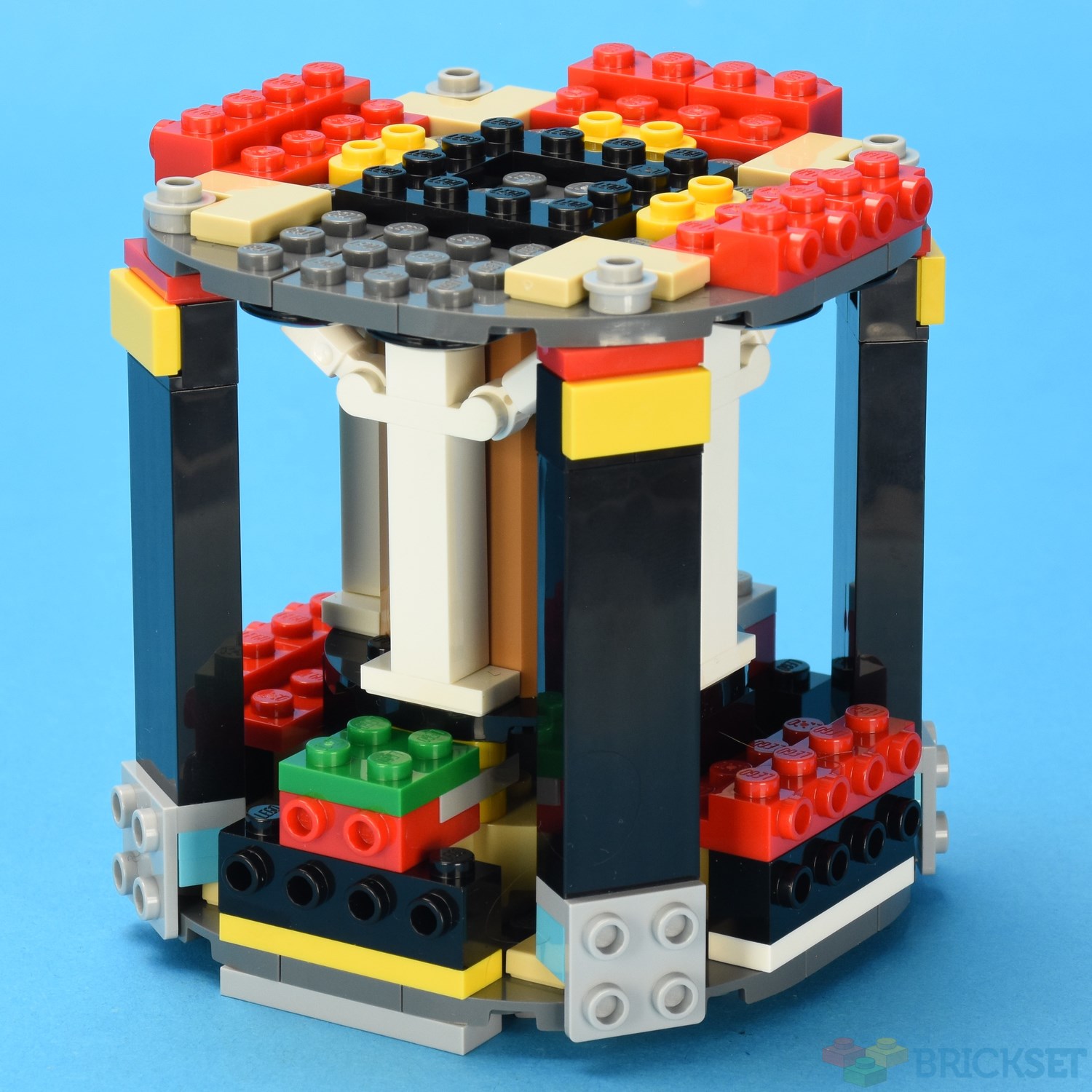
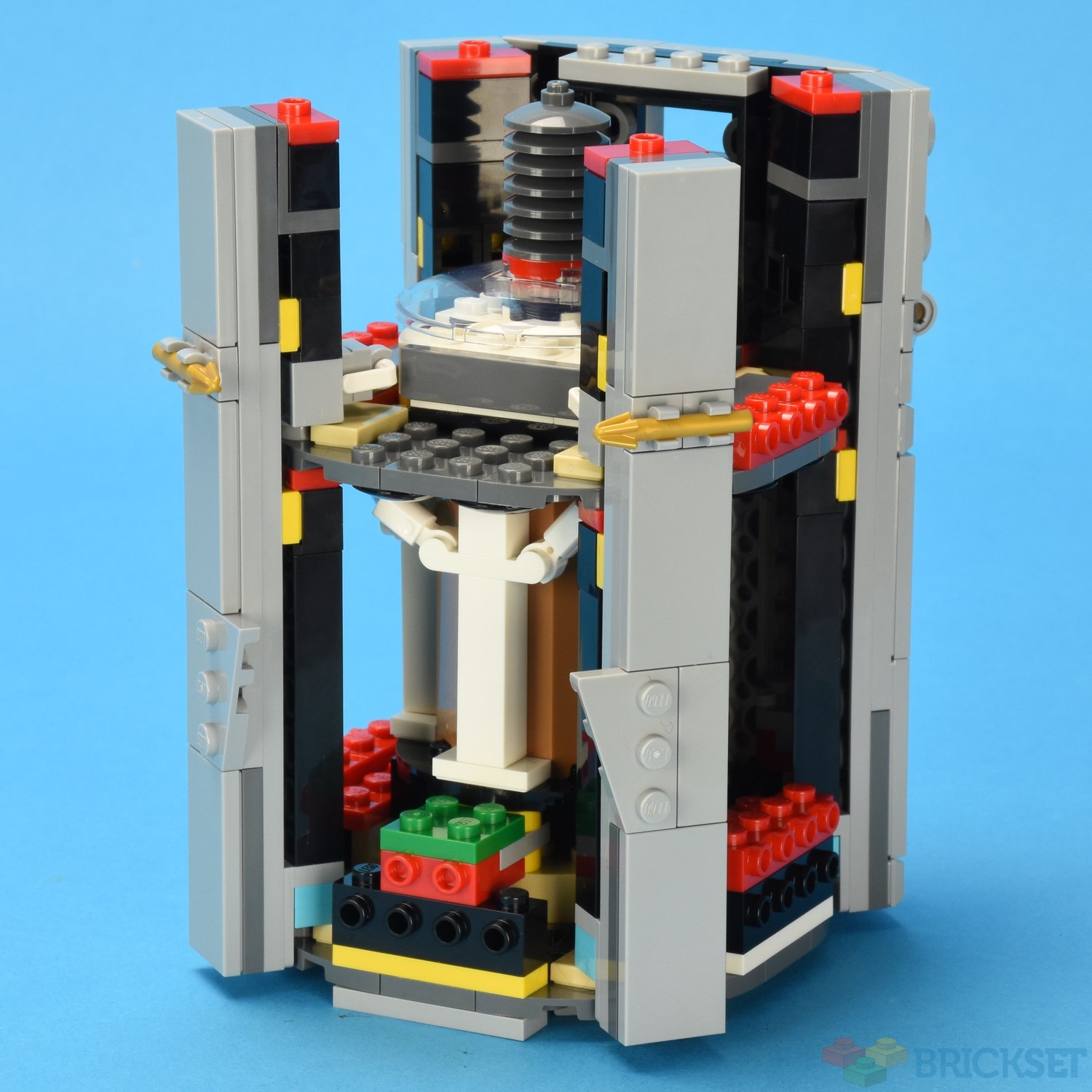
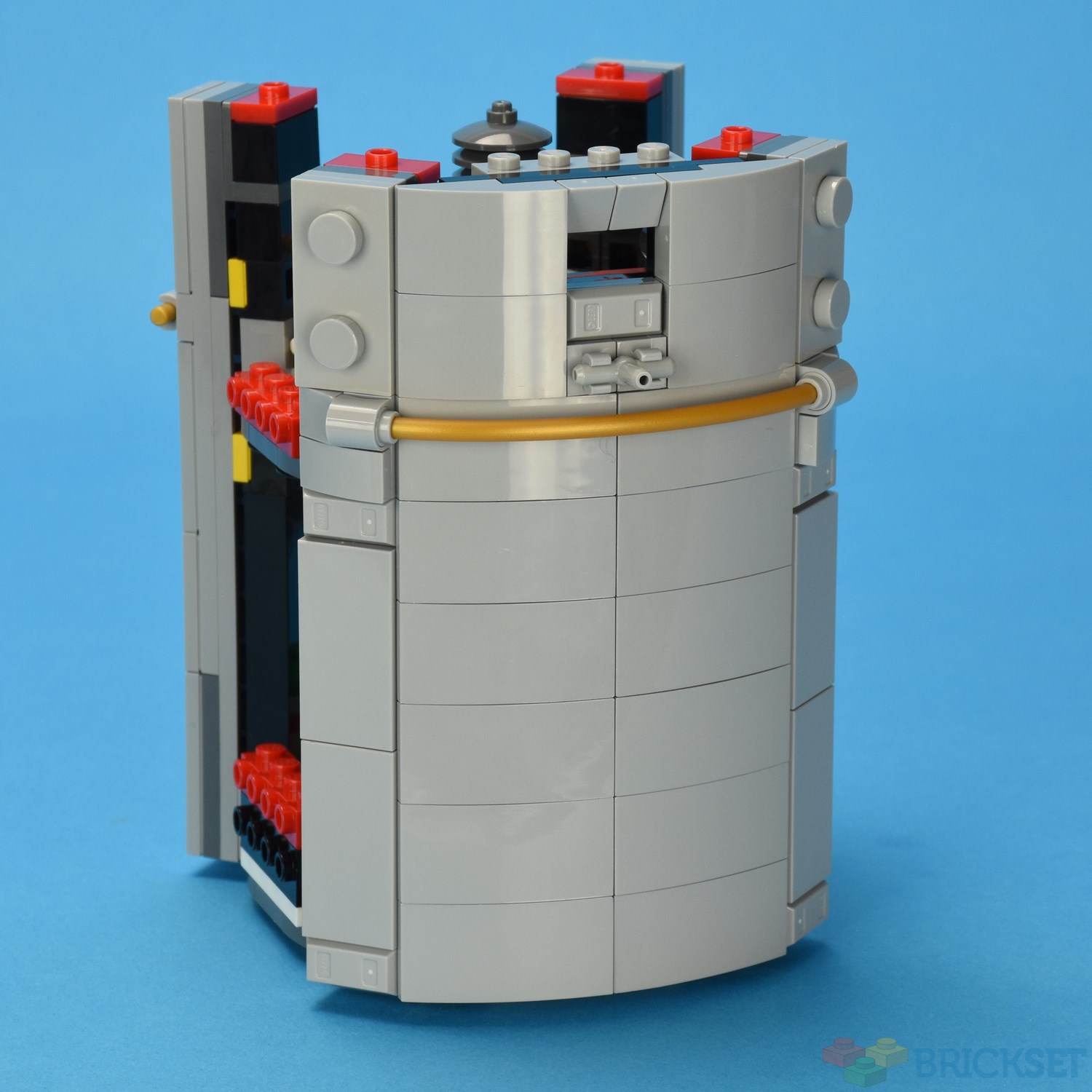
It looks like you're new around here, so we thought we'd let you know a bit about the site and what it has to offer.
Brickset is primarily a database of LEGO sets. We've been online since 2000 and are now a cornerstone of the online LEGO community: a resource used and trusted by LEGO fans around the world.
As well as virtually every LEGO set ever made, our database also contains information about minifigs, parts, colours, set inventories and much more. We also maintain comprehensive lists of discounts and new products at online LEGO retailers, making it easy to grab a bargain or bag the latest set.
Additionally, we publish news and comprehensive reviews of new products on our home page, making us a one-stop-shop for everything LEGO-related.
Over 300,000 people use the site to keep track of their LEGO collection, review and rate sets, post comments, maintain lists, and much more. So, sign up today to join us and start enjoying everything the site has to offer!
In case you missed them (like me), some exciting previous GWPs are back, available at LEGO.com this week:
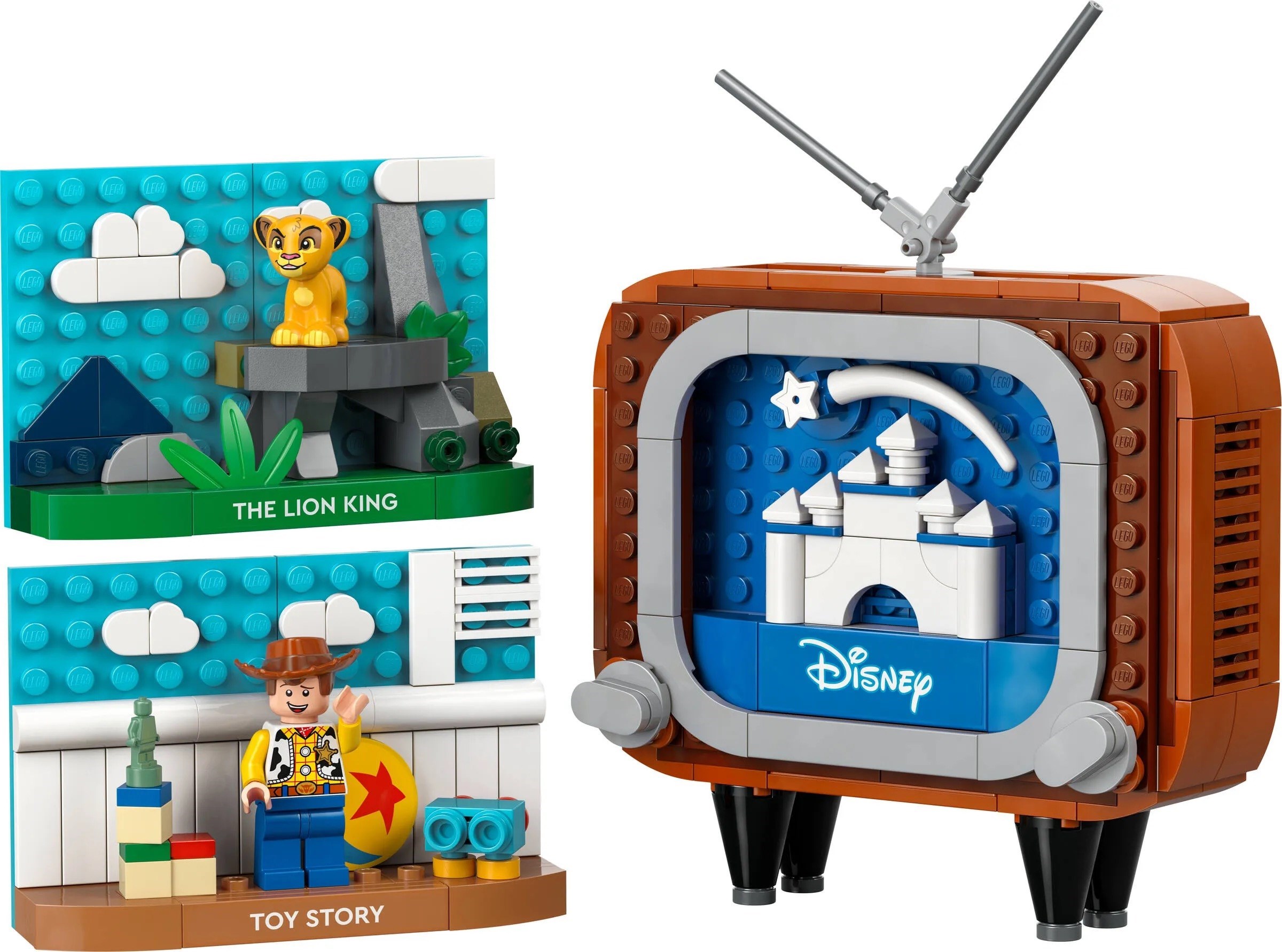
For UK/EU Insiders, 40774 Classic Animation Scenes is free when you spend in excess of £115 / €130 through July 16.
For US/CA Insiders, 40906 Restaurants of the World: Japan is free when you spend in excess of $180 / $235 CAD through July 23.
For AU/NZ customers, 40916 Floral Picture Frame is free when you spend in excess of $245 AUD / $265 NZD through July 23.
For all customers, 30731 Tom Nook and Flying Present is free when you spend in excess of £35 / $40 / €40 on Animal Crossing, Fortnite, Sonic the Hedgehog, Super Mario, The Legend of Zelda, or Minecraft through July 23.
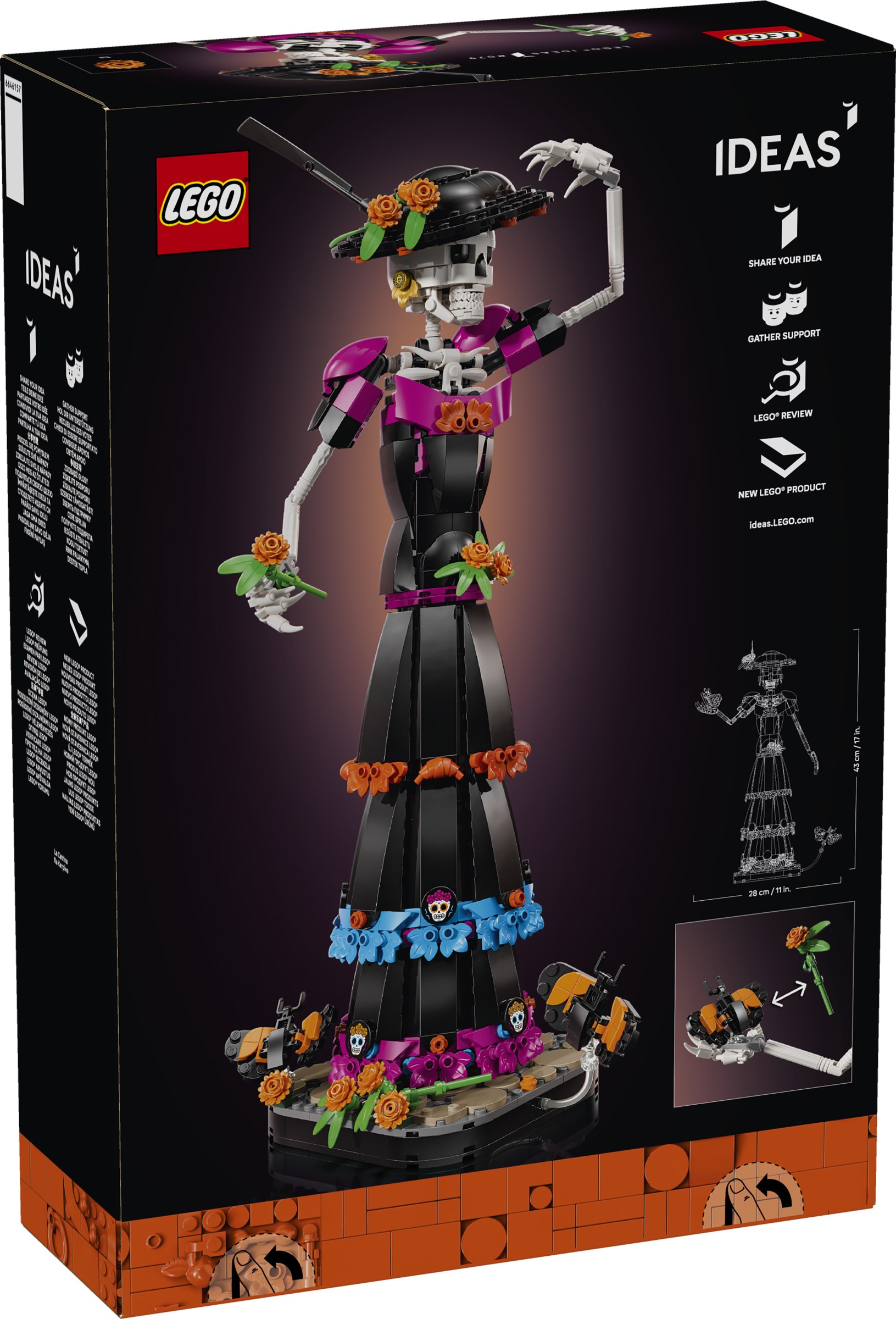
One of the most unusual and interesting Ideas projects ever to be chosen for production, in my opinion, has been announced, 21372 La Catrina! The press release follows:
21372 La Catrina
1,212 pieces, rated 18+
$139.99 / £109.99 / €119.99 Available at LEGO.com from 1st August
"Even in death, La Catrina smiles." Showcase Mexican culture’s enlightened perspective on the human condition with the LEGO Ideas La Catrina (21372) figurine. This building set is a great gift idea for adults that lets them create their own decoration for Day of the Dead celebrations.
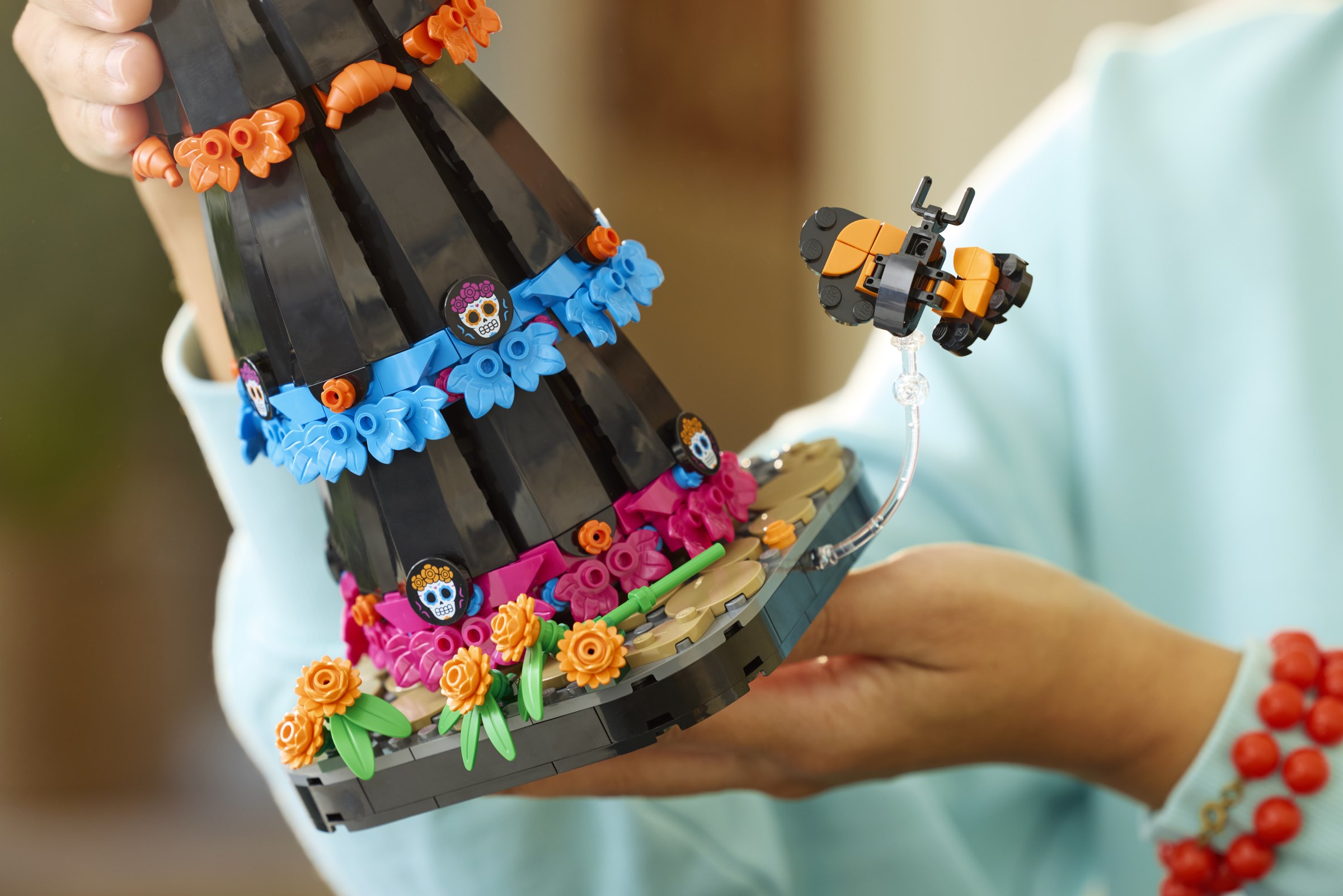
Display it all year round on a desk or shelf as a striking piece of room decor. Enjoy quality time building a meticulously detailed, elegantly clothed LEGO skeleton figure that embodies a unique combination of beauty and mortality. Attach brick-built marigolds and printed sugar skull decorations to her hat and dress. Place La Catrina on the base adorned with more marigolds and a brick-built monarch butterfly. Put the other butterfly in her hand and pose her head and arms to change up your display.
There is always discussion about the changes made to Ideas submissions when they become official sets and I expect that debate will be particularly fierce in this case, as the version made by yop1172 was a lot larger and more detailed. However, I think it was necessarily scaled down from being nearly a metre tall and the model looks beautiful, taking its scale into consideration.
What do you think though? Let us know in the comments and via our poll.
Today's random set is 70203 CHI Cragger, released during 2013. It's one of 58 Legends of Chima sets produced that year. It contains 65 pieces, and its retail price was US$14.99 / £10.99, which equates to about US$21 / £15 in today's money.
It's owned by 1,776 Brickset members. If you want to add it to your collection you should find it for sale at Brick Owl, BrickLink, where new ones sell for around $29.90, or eBay.
Today's random figure is sp085Space Skull, a Space figure that came in one set, 10192 Space Skulls, released during 2008.
Our members collectively own a total of 3,116 of them. If you'd like to buy one you should find it for sale at Brick Owl or BrickLink, where new ones sell for around $6.00.
The largest of this year's current crop of Creator 3-in-1 sets, 31388 Wild Animals: Family of Koalas gives us three unique animals from "down under", and adds to the "wild animals" theme-within-a-theme started earlier in the year by 31386 Wild Animals: Majestic Lion.
With a choice of a pair of koalas, kangaroos, or turtles, each with their own small section of scenery, this bright and colourful set focusses on Australia's distinctive wildlife, and there is one clear winner amongst the three!
Summary
31388 Wild Animals: Family of Koalas, 1,536 pieces. £99.99 / $129.99 / €119.99 | 6.5p, 8.5c, 7.8c per piece. Buy at LEGO.com »
Three vibrant and colourful display models, with the koalas winning out on accuracy and cuteness over two slightly more awkward animal designs.
Excellent display models
Cute and expressive koalas
Bright and colourful accompanying builds
Kangaroos and turtles less effective in their design
The set was provided for review by LEGO. All opinions expressed are those of the author.
Koalas
A quintessentially Australian animal, koalas have not really been represented before in brick-built form, although they have lately appeared as a single piece in a collectable minifigure, an excellent costumed minifigure, and as a Friends-style animal part in 42701 Koala Habitat & Care Centre.
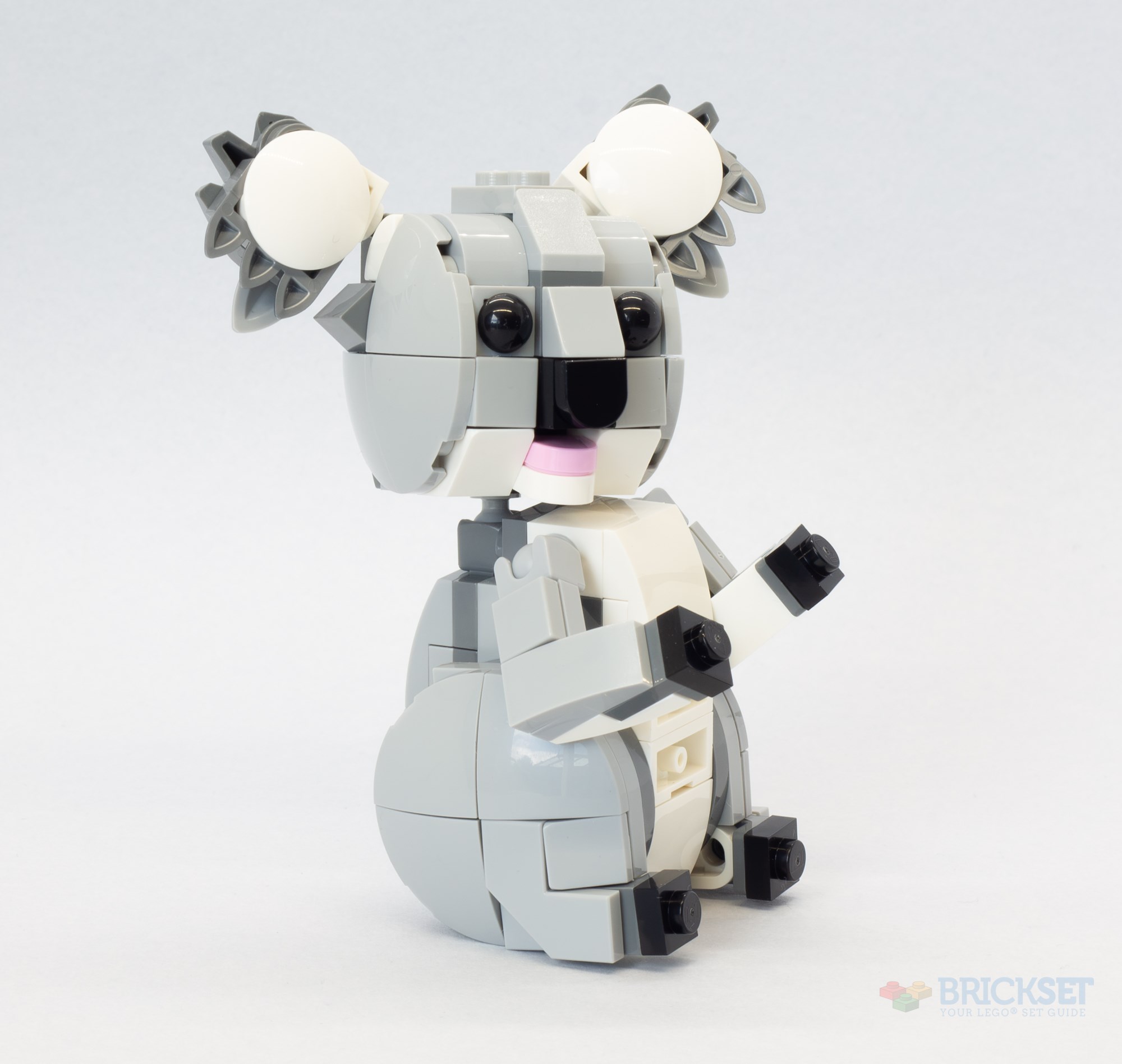
The koala family in this set consists of an adult and a joey. The joey is built first, and is somewhat cute although slightly blocky even at this scale. The head is attached via a ball joint and therefore has a wide range of movement, and each of the hind legs can rotate about their centre on Technic pins. The arms are have fixed elbows at 90 degrees and very square paws! The ears are suitably tufty with a combination of rock and teeth plates.
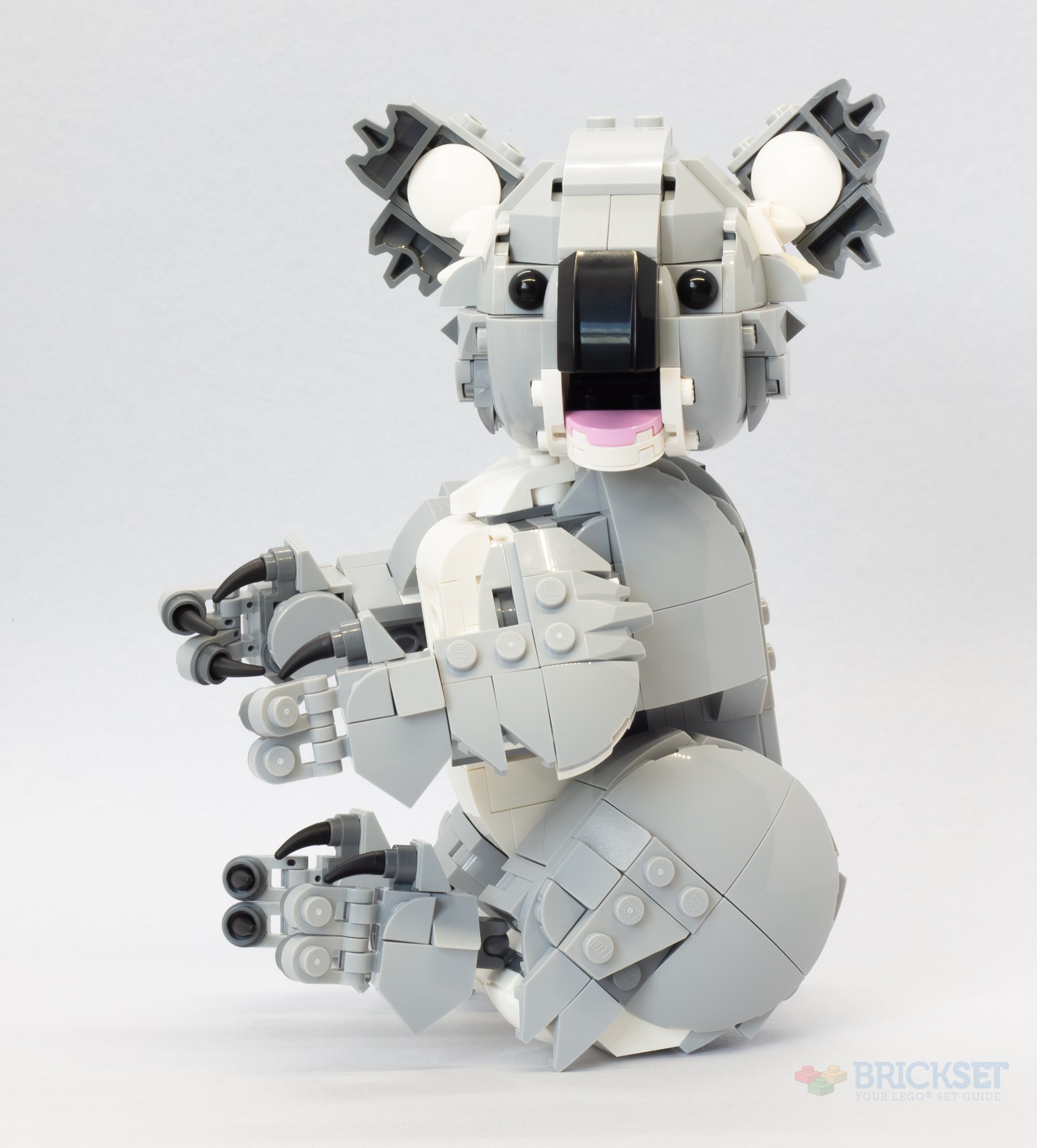
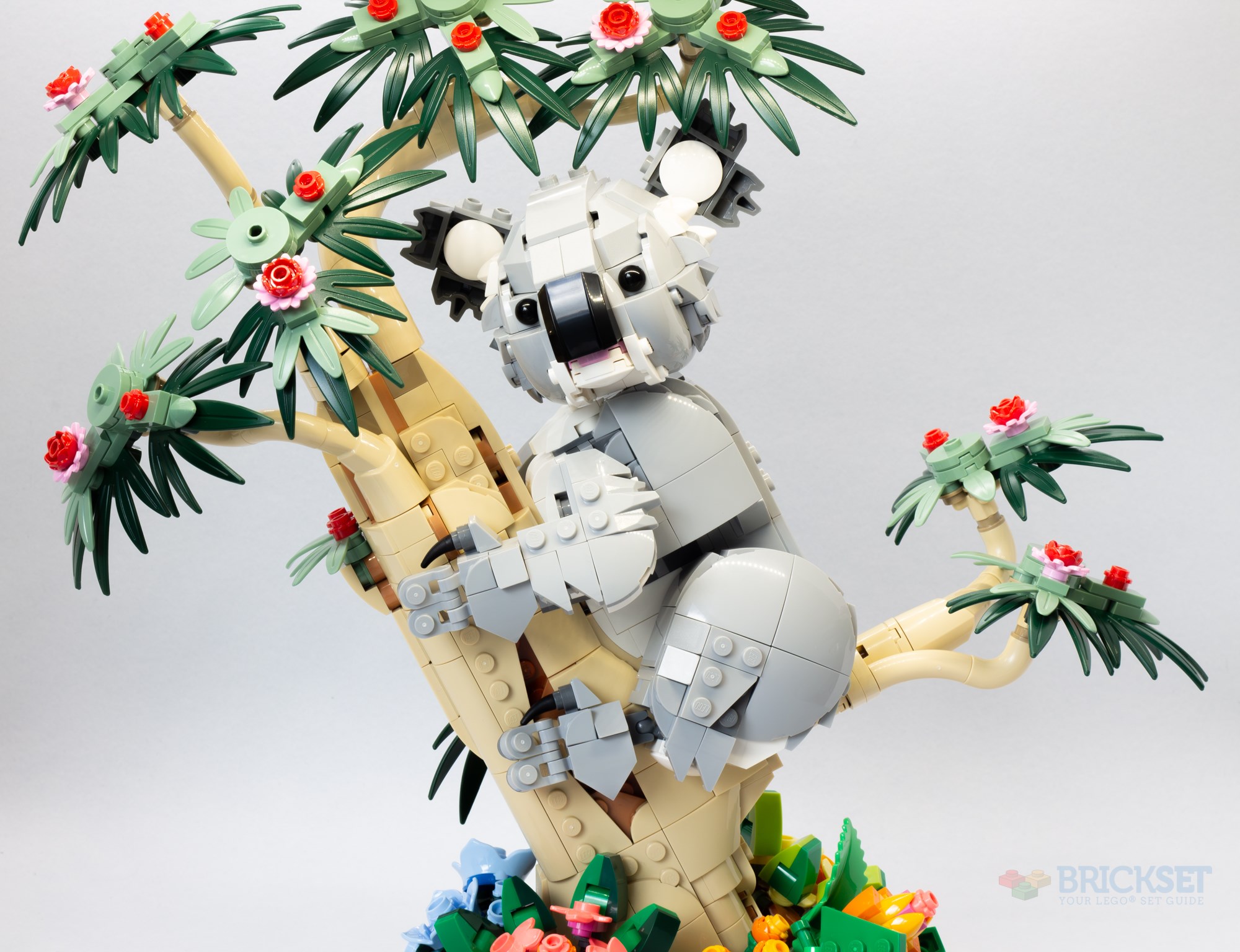
The adult koala naturally provides a greater opportunity for detail and accuracy, and looks excellent, particularly the head and face. The creature's front legs are once again fixed with a 90 degree elbow, but each has a pair of articulated claws on the hands, and plates and tiles are used to good effect for the fur that hangs off their limbs.
The design of the rear legs makes it hard for the koala to sit on the floor, but as we'll see later this is not their intended pose. The rear ankles are attached with ball joints and therefore have a wider range of motion than the forelegs.
The use of the large 2x2 curved slope for the koala's distinctive nose was a great choice, and combined with the round eyes, pink tongue, and tufty ears makes for an excellent build of the head.
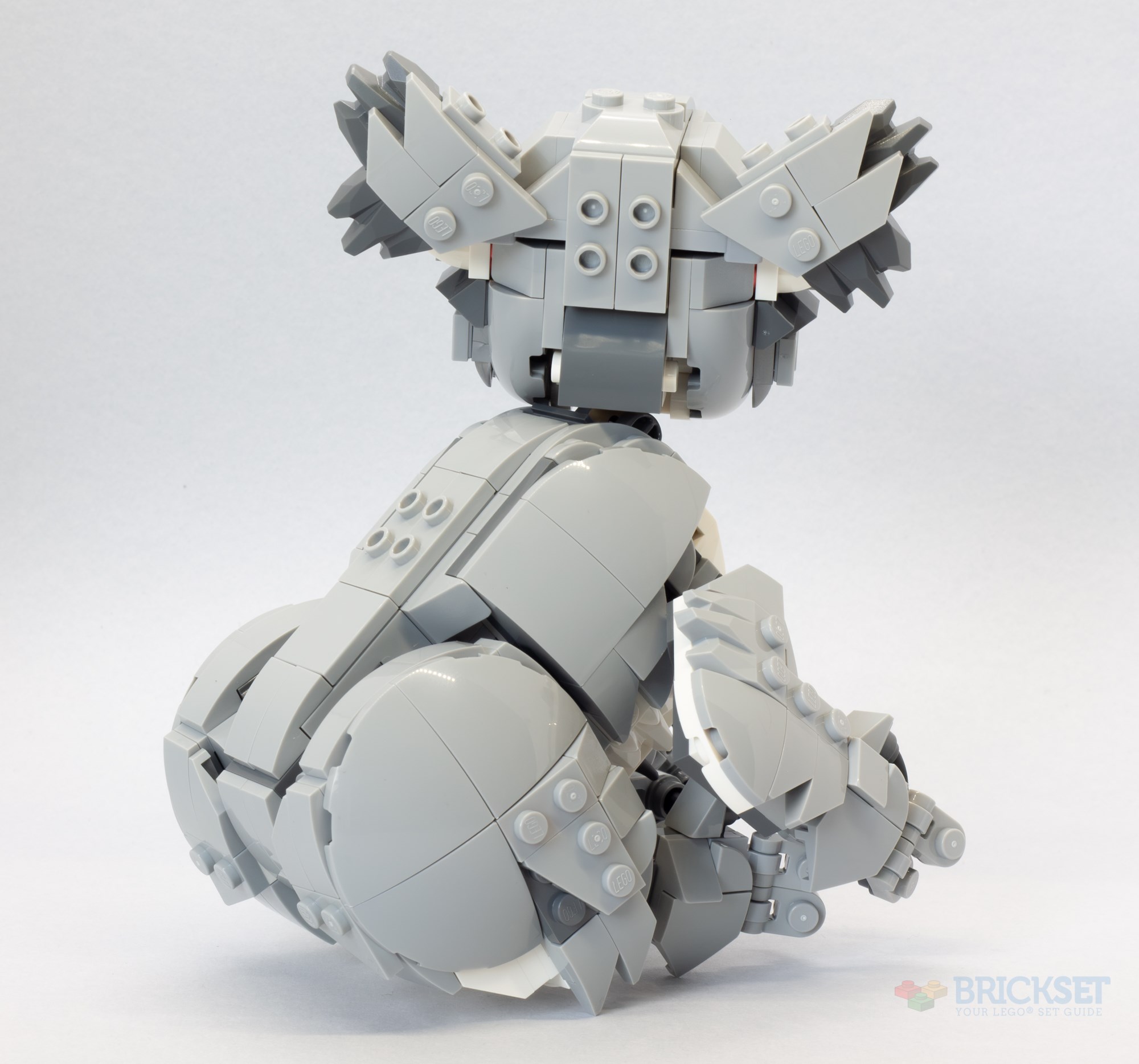
The only thing that lets the design of the head down, in my opinion, is the rather flat rear and four exposed hollow studs. This feels like an easy place to improve with a couple more rock plates or slope tiles, so I am not sure why it was left like this. The four studs on the koala's back, however, do play an important role, as we'll see in a moment.
Internally, the koala is made of a solid core with a small number of SNOT bricks providing attachment points for the body's fur. Unlike the wolf in 31393 Forest Animals: Grey Wolf, this koala has no hidden heart!
It does, however, have a tiny pink brain inside its head.
The adult koala has no pouch for its baby, but the joey is perhaps a bit big to be making use of one anyway.
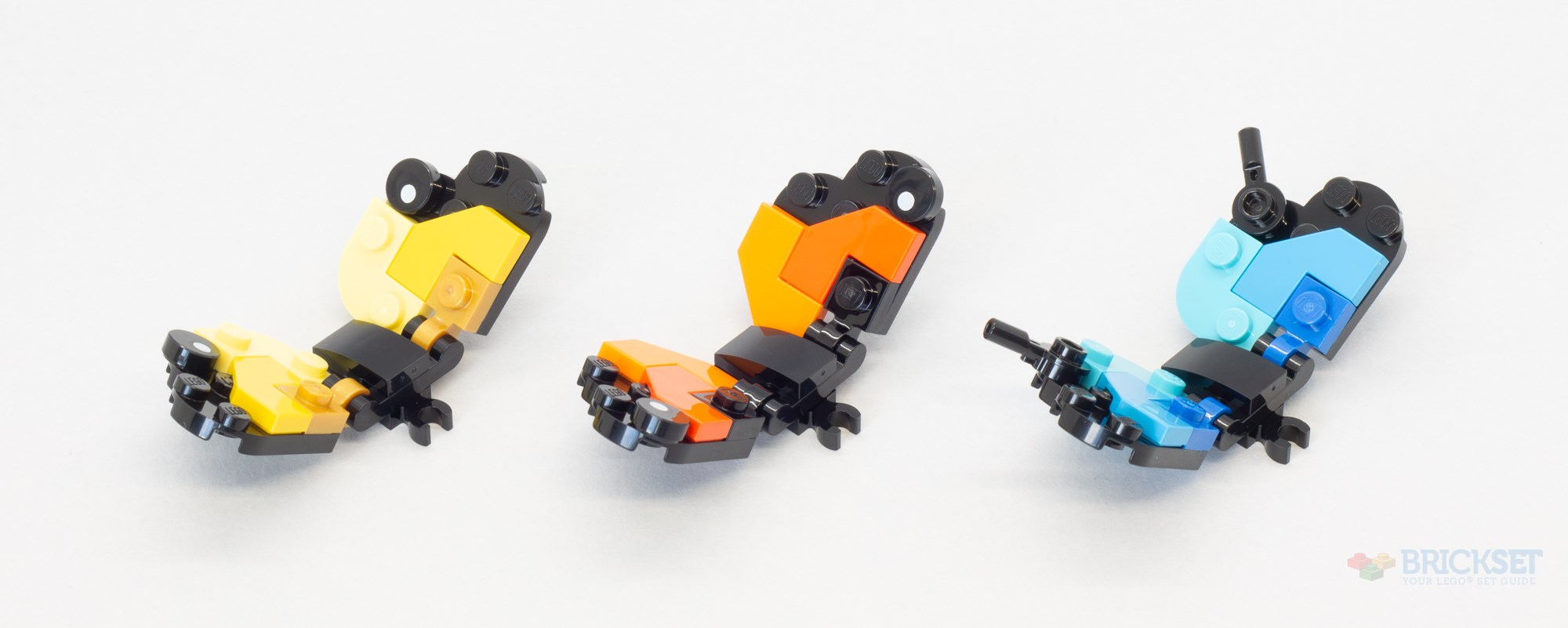
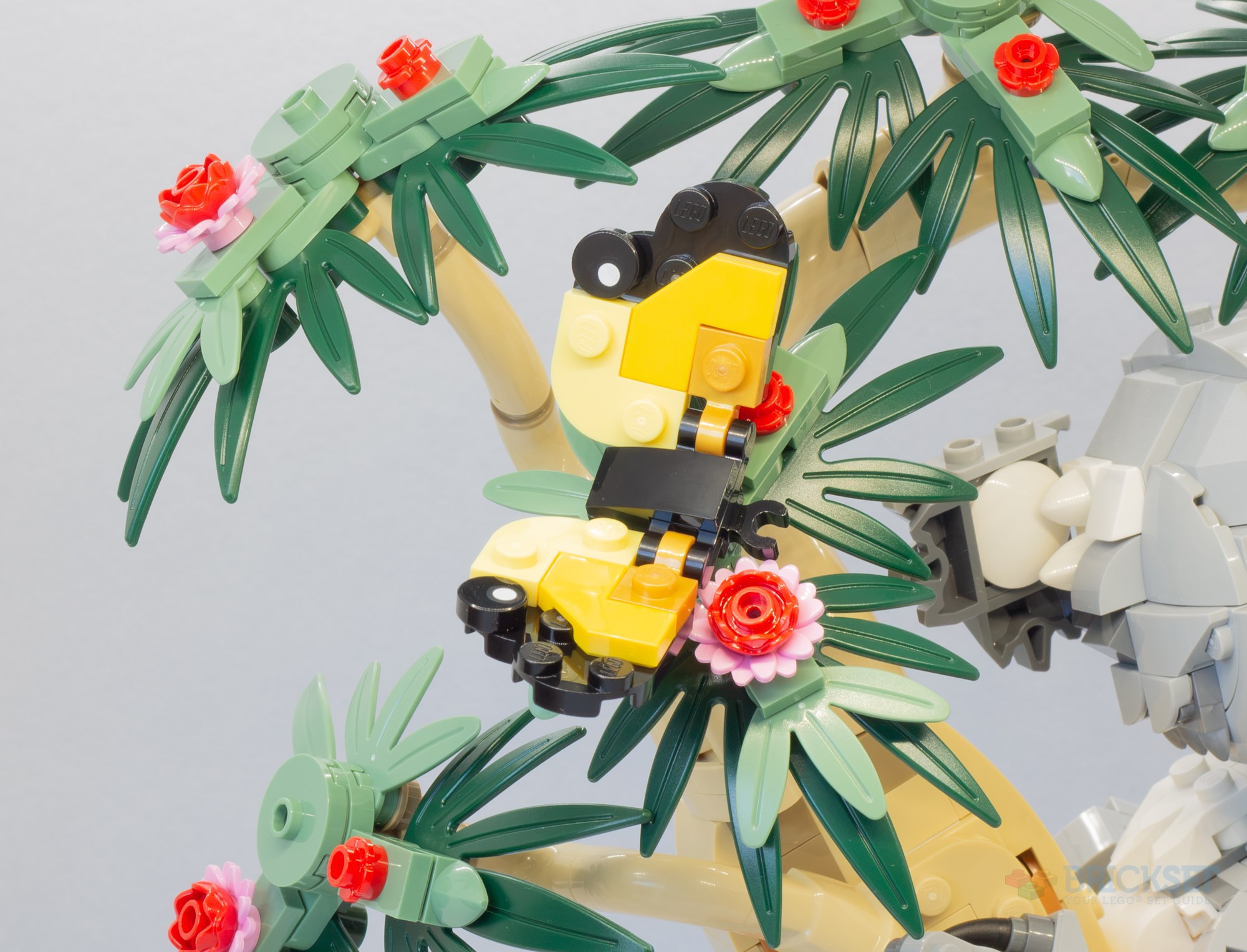
The two koalas are not the only creatures in the set—three brick-built butterflies are also constructed. Based on a pair of black heart tiles for the wings, they each look excellent in their respective colour schemes of yellow, orange, and blue.
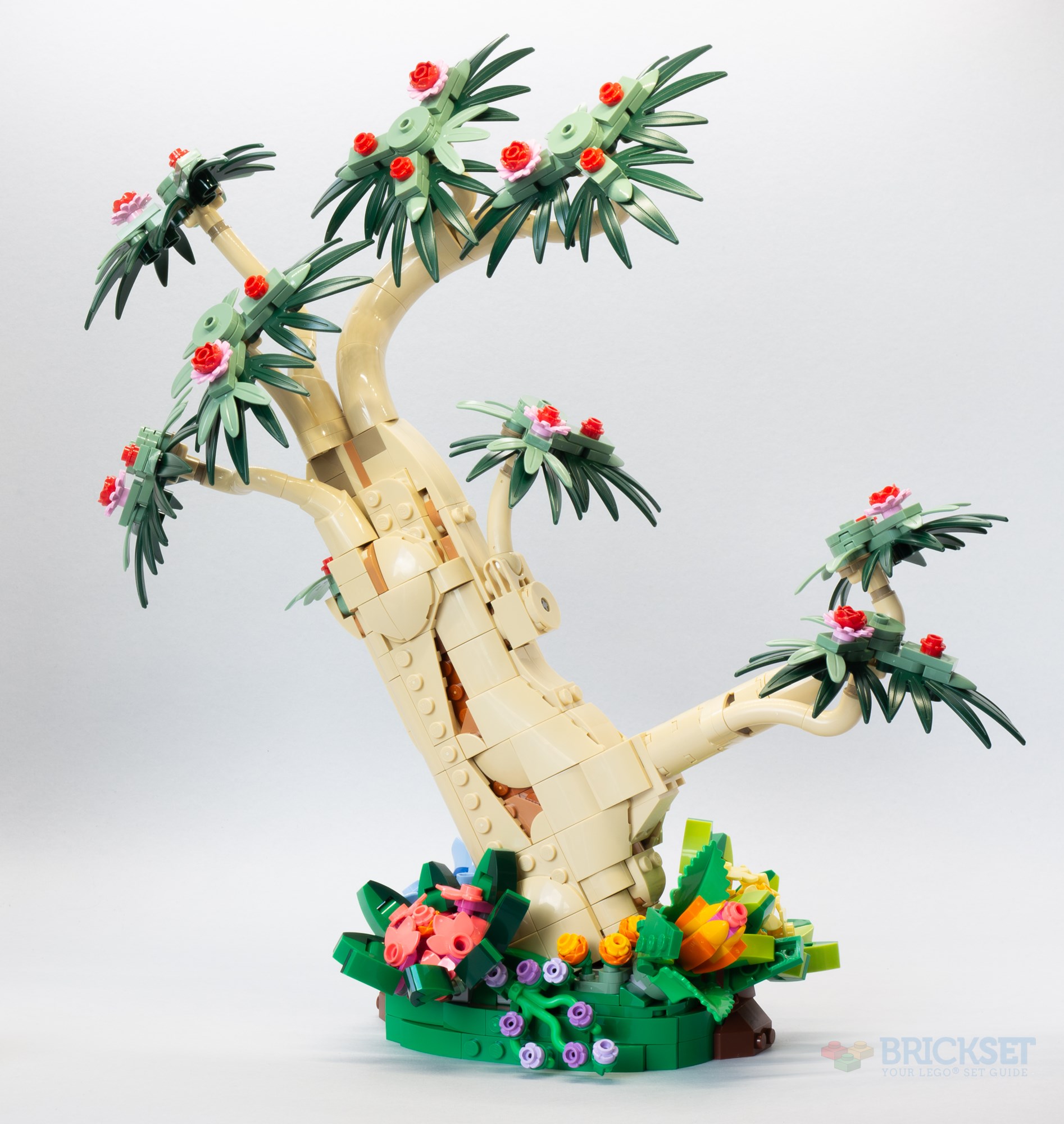
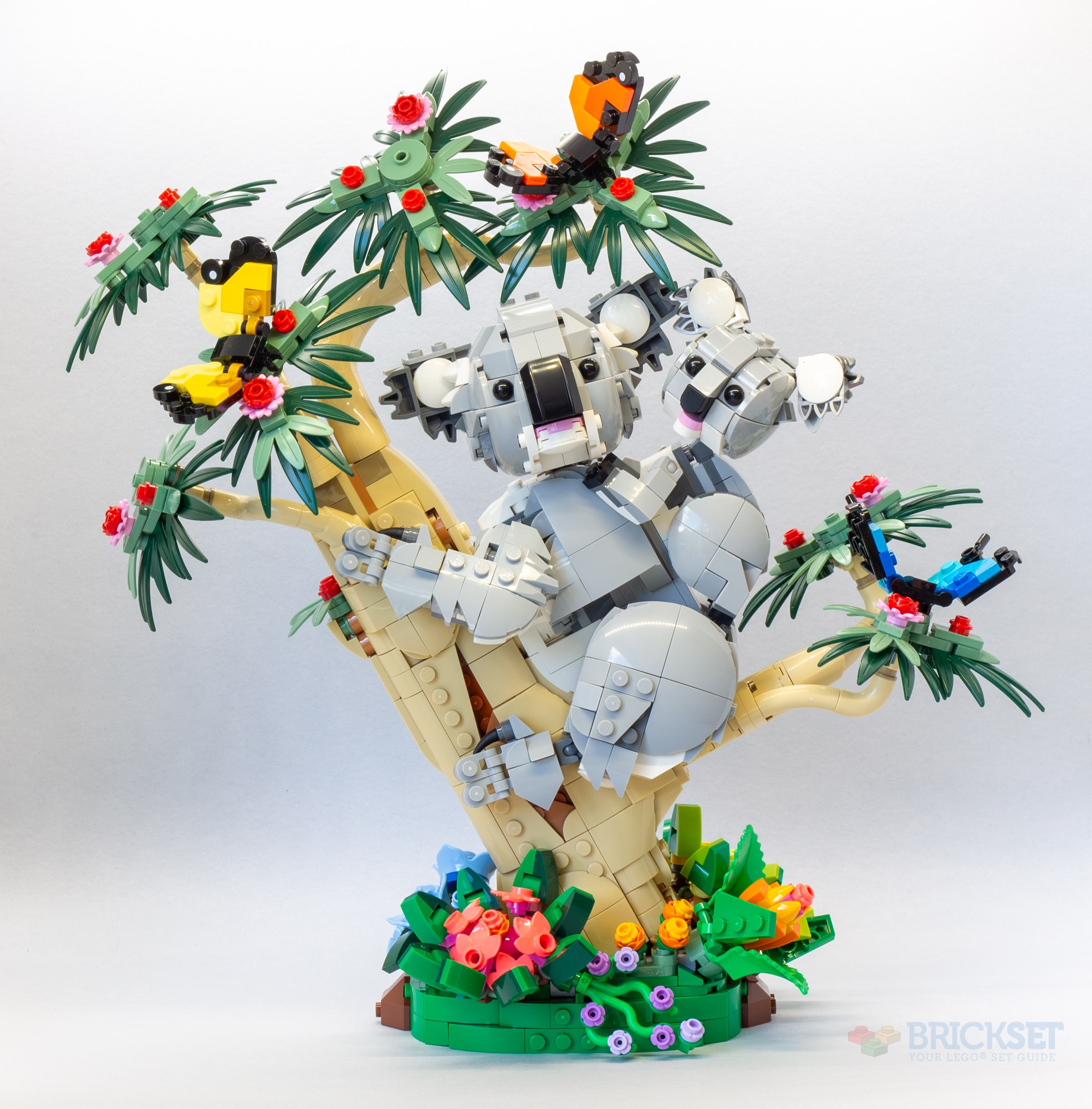
The remainder of the 1,500+ pieces are put towards the koala's eucalyptus tree, which is a thick tan trunk rising at an angle from a small patch of ground. Various macaroni pieces jut out at different angles, topped by leaves and small red flowers. Personally, I don't feel that it looks much like a eucalyptus tree, but I admit they are not my area of expertise!
The interior of the trunk is a solid construction of plates and bricks, hiding many pieces that will be used in the other two models as is common in the 3-in-1 sets. It's a very secure build.
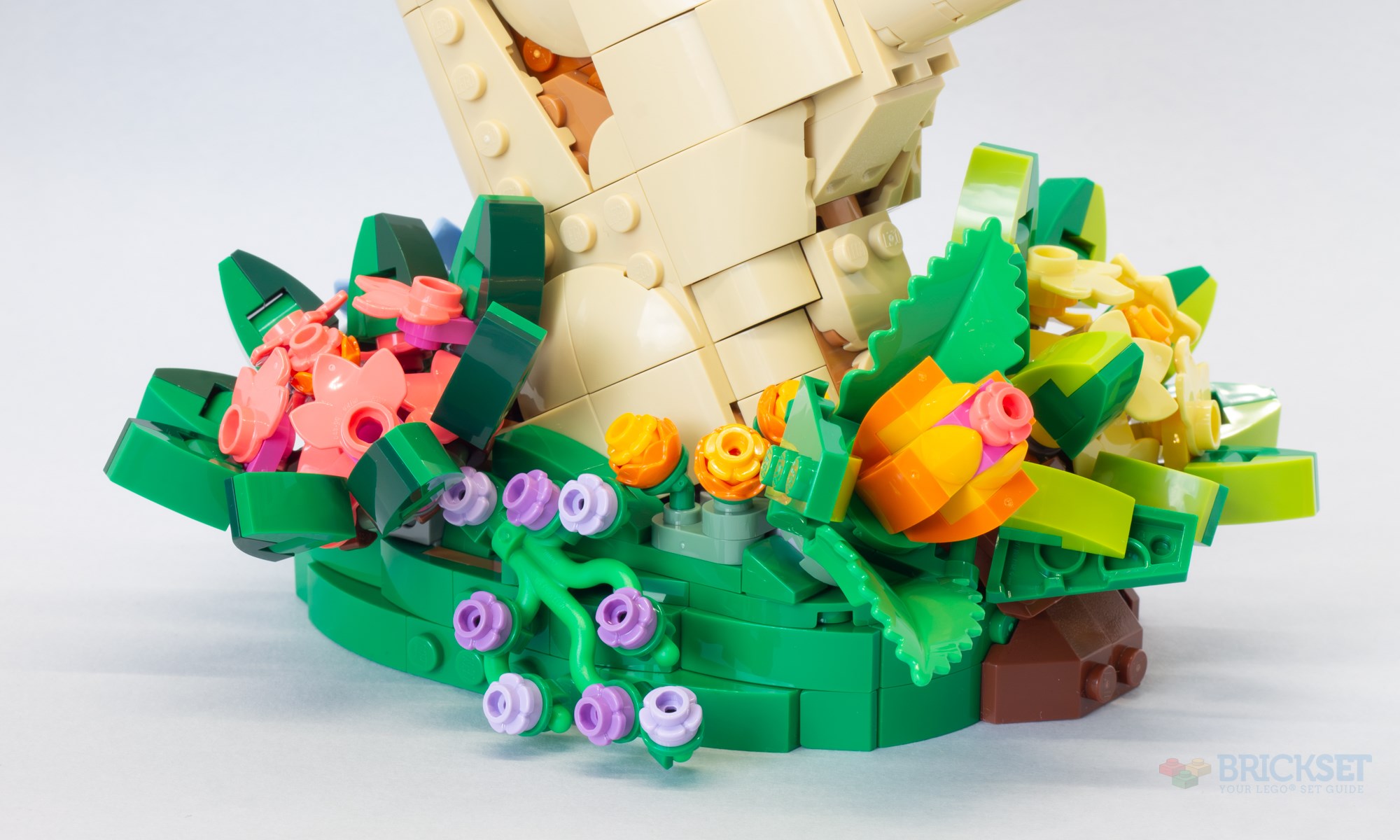
Half of the base of the tree is green, with a variety of brick-built flowers adoring it, which all look great with their bright colours contrasting the green ground and leaves.
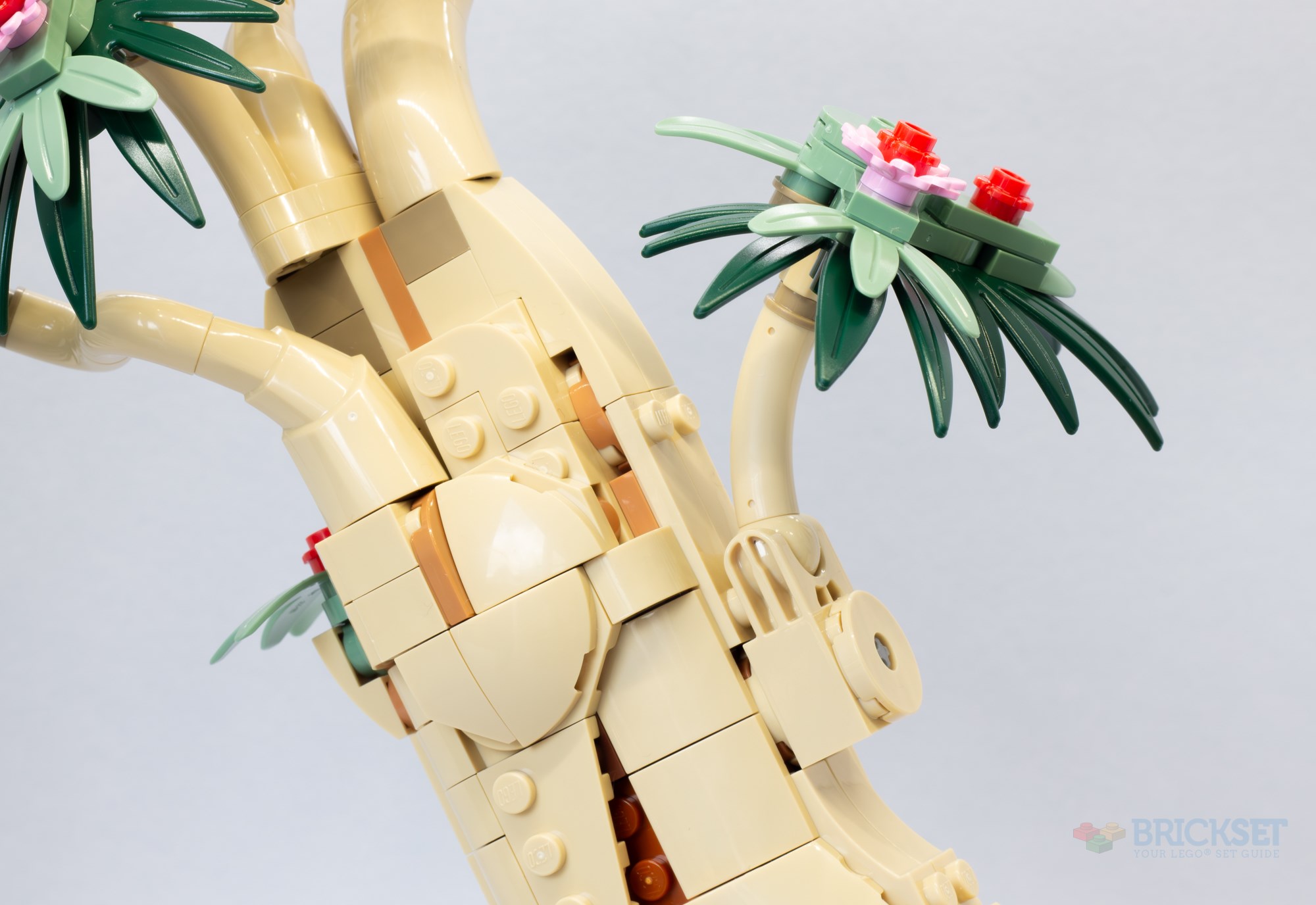
Around the other side, the base is brown, with fewer flowers. This is clearly intended to be the rear of the tree. An exposed brown axle has a purpose that we'll see in just a moment.
The branch that projects from the main body of the trunk can be removed, and stored on the rear of the tree using the axle above.
Beneath it, a longer grey axle was holding it in place, but instead becomes the anchor point for attaching the adult koala to the tree.
The axle slides into a hole in the koala's belly, and the creature's arms and legs can be positioned to hug the trunk, just like the real animals do. The space between the lower branch and the leaves above is just the right size for the koala to nestle in comfortably.
The joey can then be placed on the adult's back, attached via those four exposed studs, replicating the way koalas carry their young around the trees until they are old enough to climb for themselves.
Finally, the butterflies can be placed as you wish around the leaves of the tree.
The resulting model looks excellent. It is vibrant and fun, and would look fantastic on display.
Kangaroos
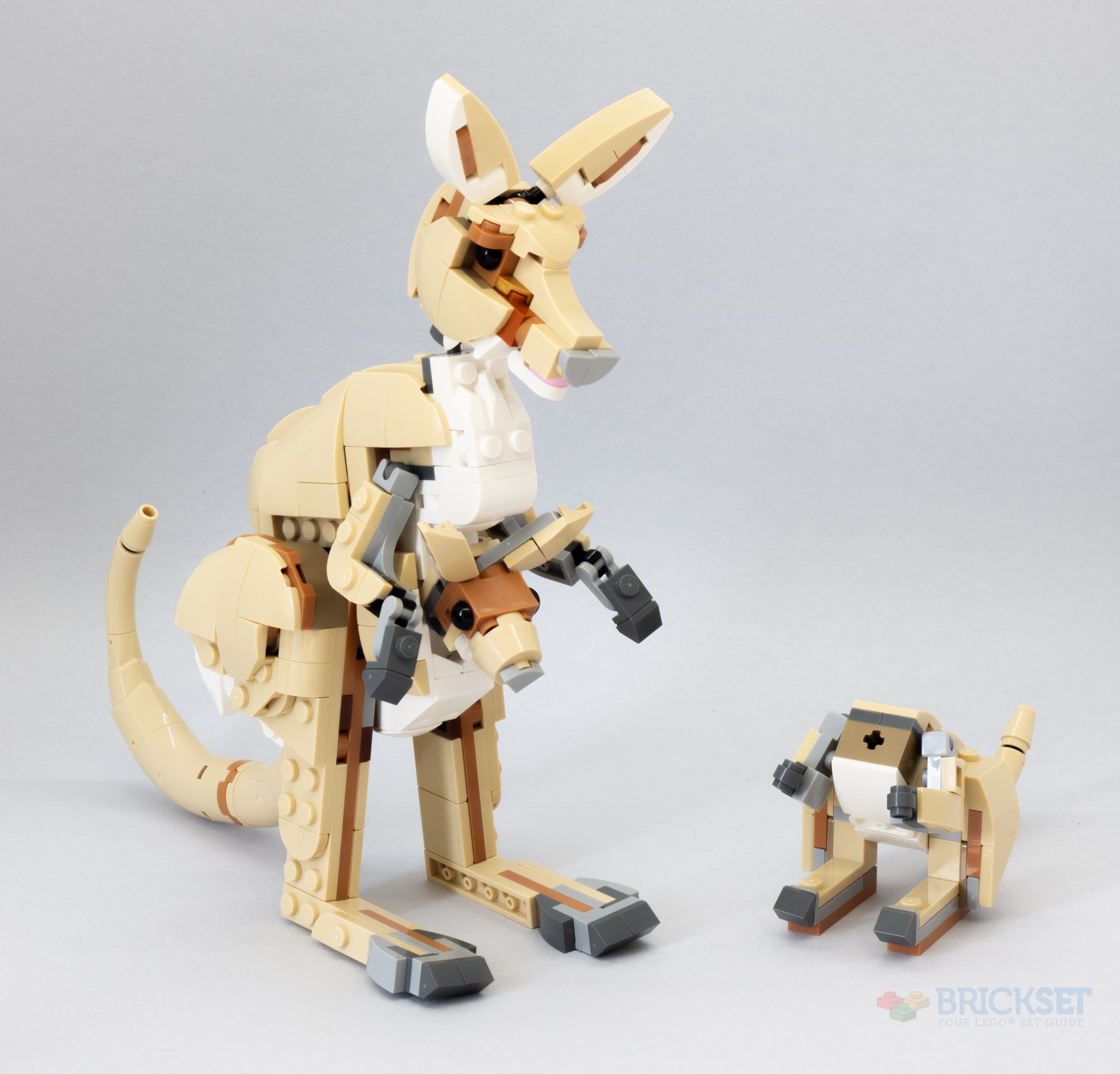
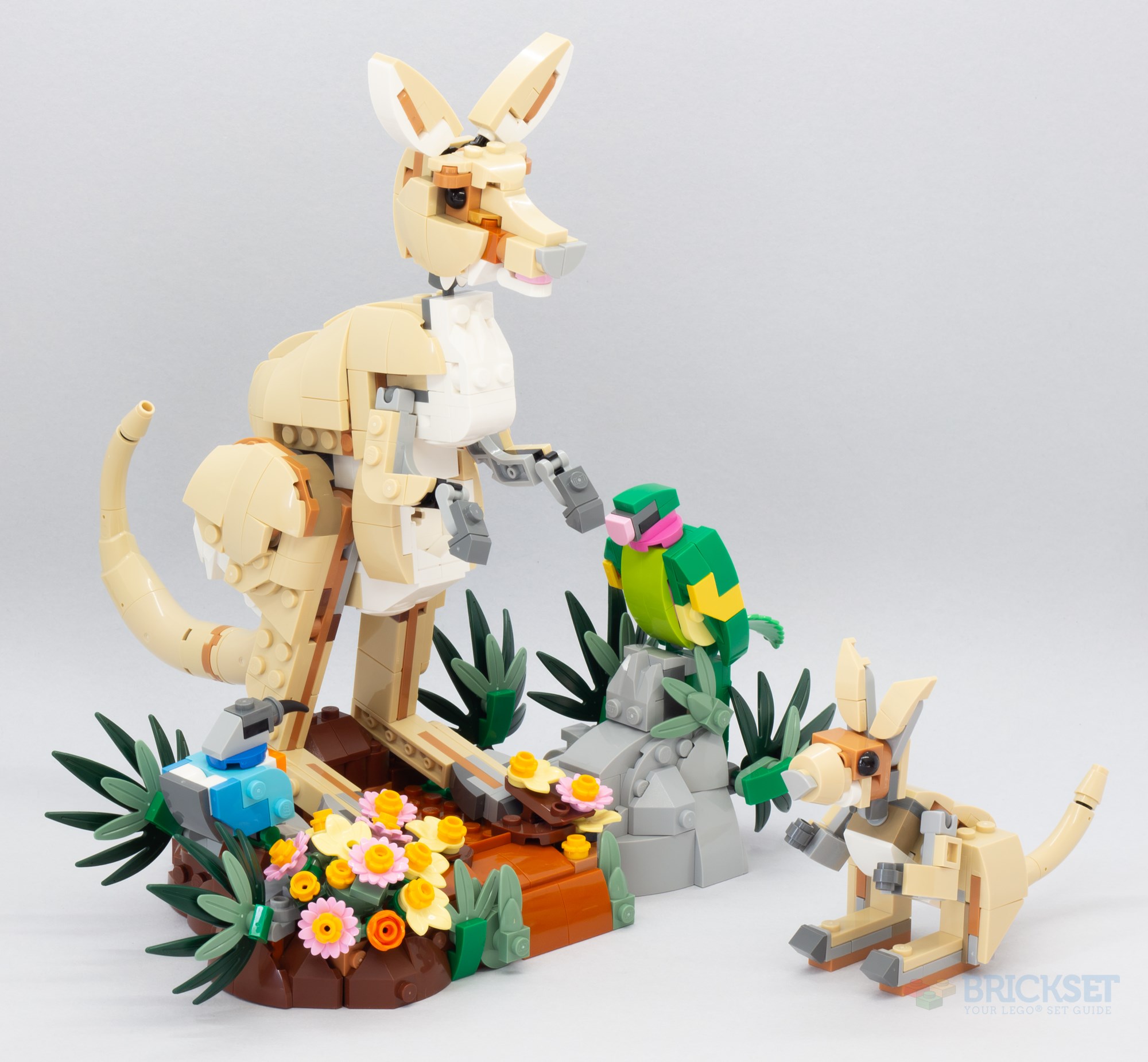
Another stereotypical Australian wild animal is the kangaroo, and the second build also provides two of these marsupials. I'm not completely sold on the design of the adult kangaroo, particularly the hind legs, which have a very abrupt transition from vertical to horizontal.
The kangaroo's body can rotate around its hips, and the front legs and head use ball joints for articulation, but the tail is fixed.
Once again, the creature's head is the most effective part of the design, although the dark grey neck joint is very noticeable. I like the shape of the tail, but it is a shame it has no movement to it, and the rear of the kangaroo looks disjointed, particularly around the hip and thigh area.
The joey does a fairly decent job with such few parts, but the grey joints are rather ugly. The baby has the same articulation points as the parent—fixed tail and elbows, hind legs that can rotate fully, and ball joints for the arms and head. The part used to represent the hands makes it look as if the joey has its fists up ready for a fight!
As a marsupial, kangaroos carry their young in a pouch, and unlike the koala model above, this has been accounted! A space is left open in the abdomen of the adult kangaroo to represent the pouch, with an axle hole at the rear. It looks rather odd when viewing the kangaroo from the front.
To put the joey in the pouch, however, you have to decapitate the poor thing! It looks fairly effective once the head has been connected into the rear of the pouch, but now you're left with a creepy headless baby kangaroo body.
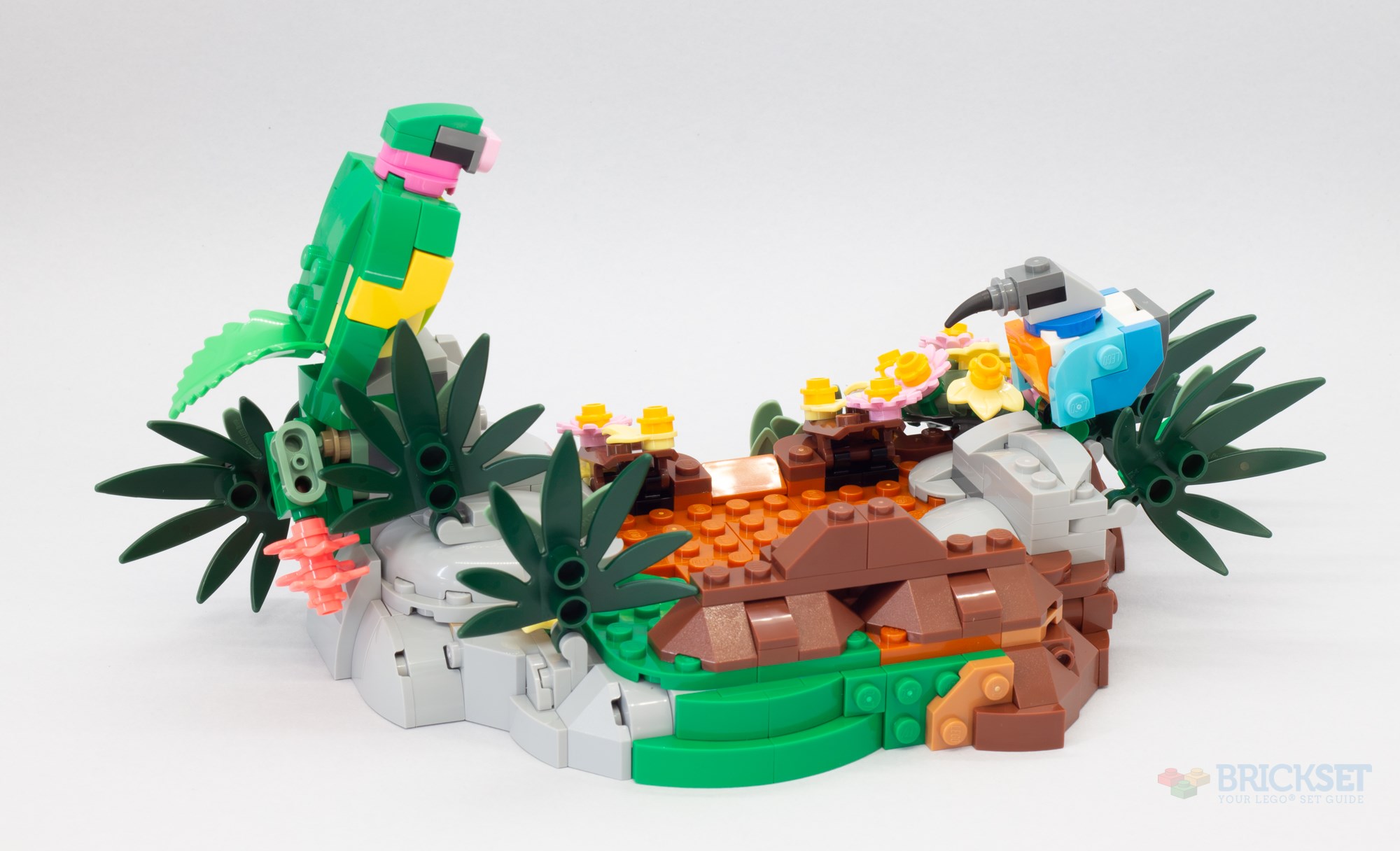
As with many of these 3-in-1 animal sets, a small amount of scenery is provided, both as an appreciated pop of colour and a way to make the display more interesting. This time, it comes in the form of a patch of dirt surrounded by flowers and foliage, and a small rock. I like the way the flowers have been repurposed from the primary build to produce a different style of flora.
A parrot perches on the top of the rock, and another smaller bird sits among the flowers on the other side of the dirt patch. The empty area in the centre is backed by a slightly higher wall at the rear, which has been designed for the adult kangaroo to sit with its hind legs resting at an angle.
The kangaroo's feet nestle beneath the flowers at the front, and it fits well in the gap designed for it. Altogether, the model looks better set up as a diorama than the animals do alone, as the pleasant foliage and scenery draws the eye away from some of the rather unsightly shapes of the kangaroos themselves.
Turtles
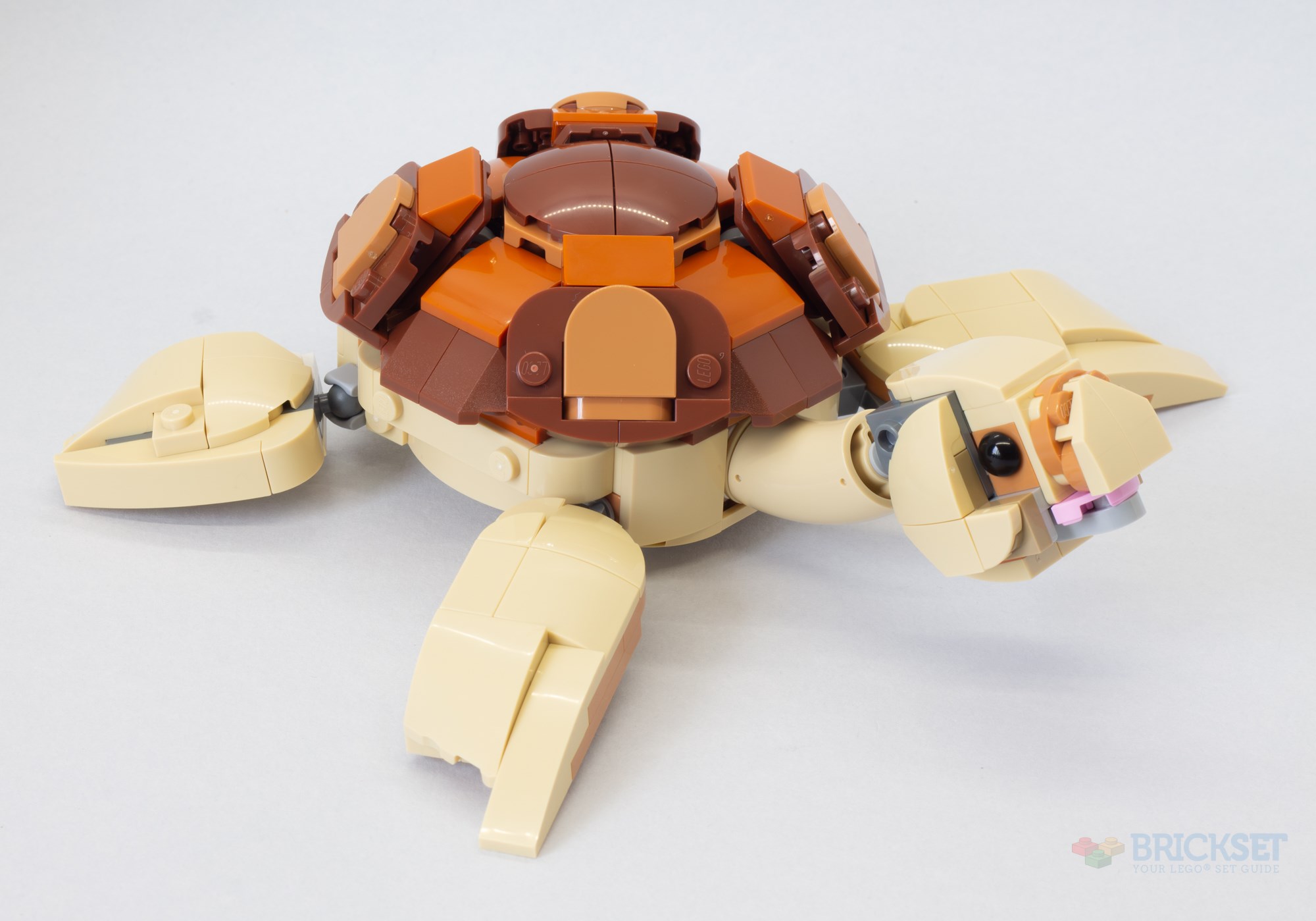
Finally, the last antipodean creature offered by the set is a pair of turtles. As before, we have a family consisting of a parent and a baby. The adult turtle's body is built around an octagonal shape, with flippers attached via ball joints at the corners and the head protruding on a thick macaroni piece. I know that real turtles have a somewhat blunt nose, but the head of this LEGO representation doesn't seem to work for me—the grey jaw, large flat tile at the front, and the dark grey bricks exposed at the rear look rather unsightly.
I do like the colouring of the shell, however, and it is cleverly constructed around a central core that fits on top of the base, using clips to hold some parts of the shell at an angle to the other to create the rough shape. It's not as smooth as a real turtle's shell would be, though, with some rather large gaps or differences in height between neighbouring sections.
On the turtle's underbelly, a single axle hole provides a connection point to attach to the scenery.
The baby turtle uses only a handful of parts, and is a little more square than its parent. The head is not articulated, and it has the same large flat nose, but I think it is a little bit cuter. Once again, the grey joints are somewhat out of place.
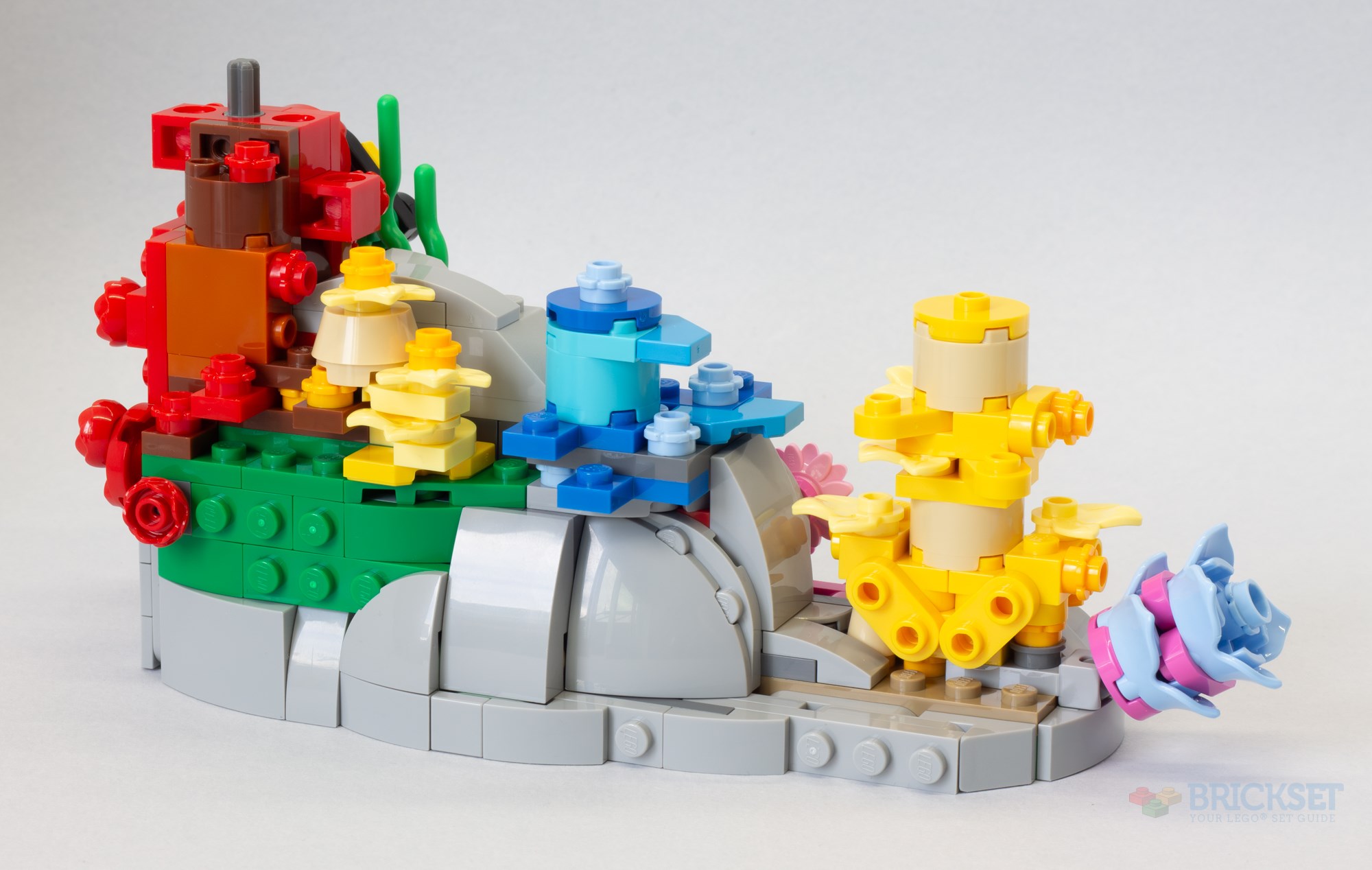
Being primarily aquatic animals, the scenery provided for our turtle family is a small patch of vibrant coral reef, accompanied by two bright fish. I love the colours and the overall design, particularly the simplicity of the fish, and the pearl hidden in the entrance to a cave in which lurks a hidden creature identified only by its eyes!
The various plants look excellent in their differing tones. The rear of the coral, while still a finished look, is clearly not designed to be visible when on display.
The axle protruding from the top of the red section is used to secure the adult turtle, while the baby perches on top of the yellow coral to the left. The resulting diorama is a bright and colourful display that adds a lot of interest to the bare models of the creatures themselves.
Verdict
With over 1,500 pieces, 31388 Wild Animals: Family of Koalas is a sizeable set, and with that comes a pretty decent amount of detail. The main attraction is clearly the koalas, which are an excellent representation of an Australian classic, and look fantastic on display on their tree with the vibrant flowers and butterflies. While slightly more colourful than the usual flora you'd expect to see in a koala's habitat out in the bush, the bright colours do make the set more attractive as a display model than something more accurate may be.
The kangaroos and the turtles do not have the same level of detail or attention to design as the koalas, and it's unusual for me to come across a 3-in-1 set where I have one clear favourite of the three provided models. That said, they still look good on display, and were still each an enjoyable build. Across all three models, the accompanying scenery is consistently excellent, adding colour and life, and elevating the displays beyond simple animal sculptures.
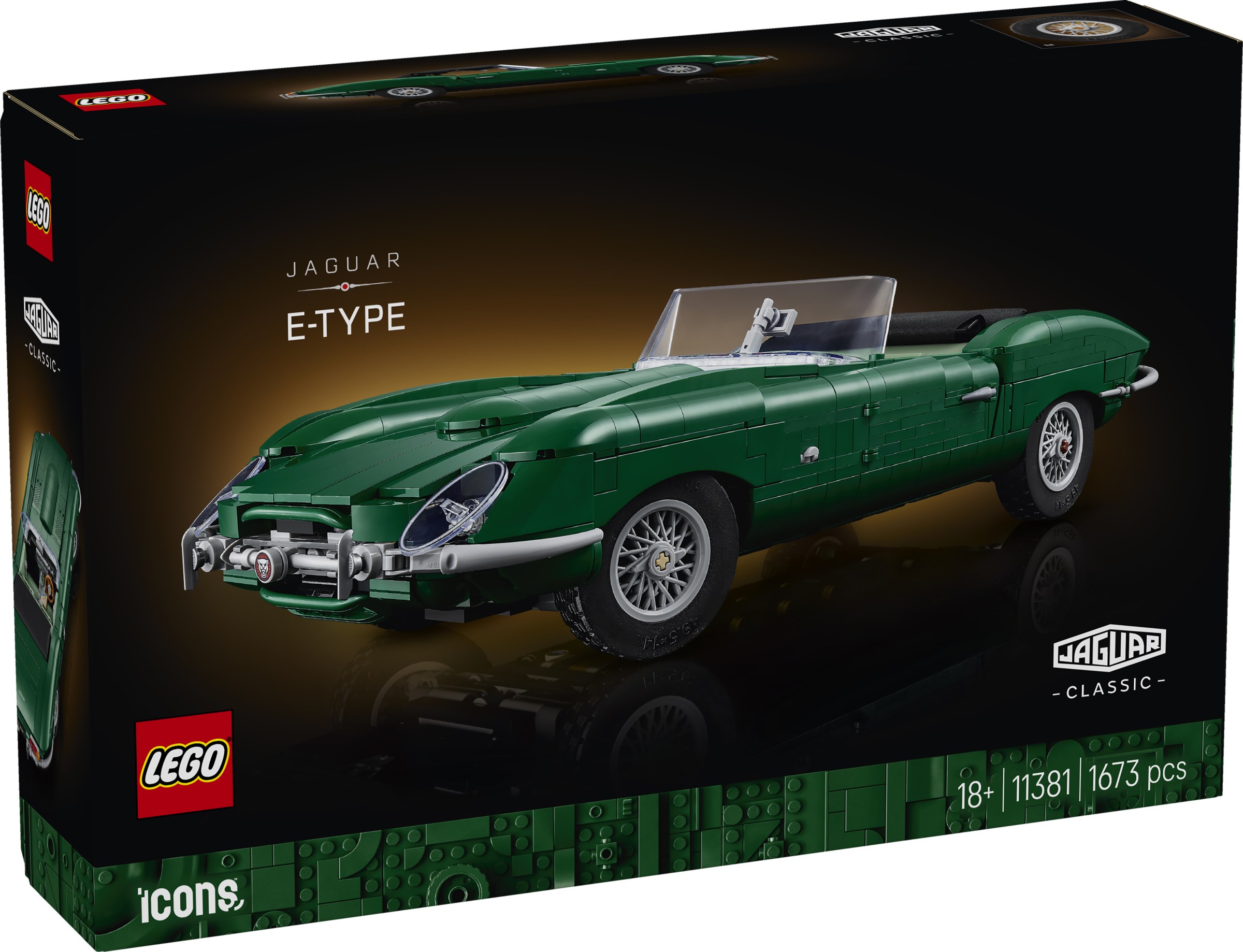
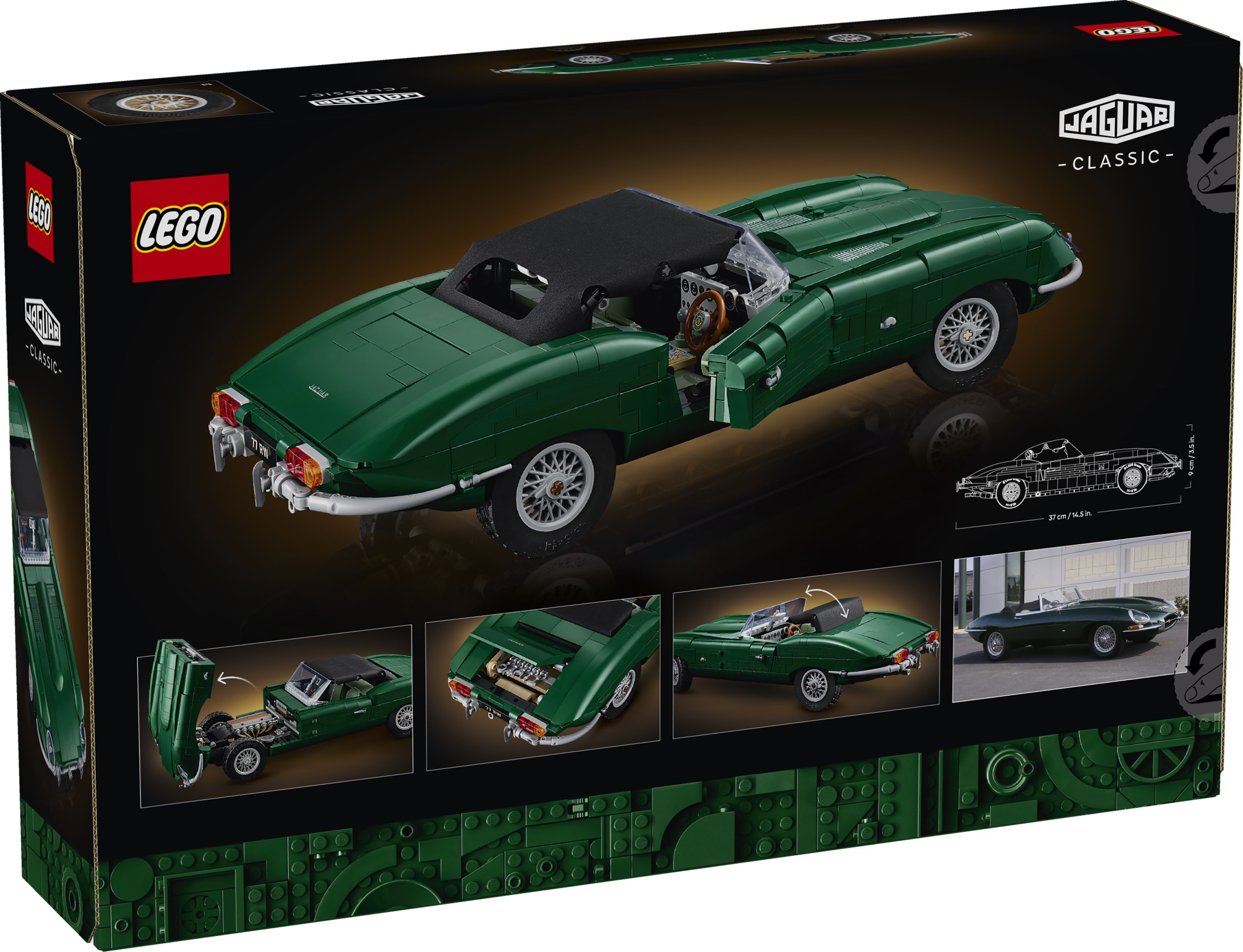
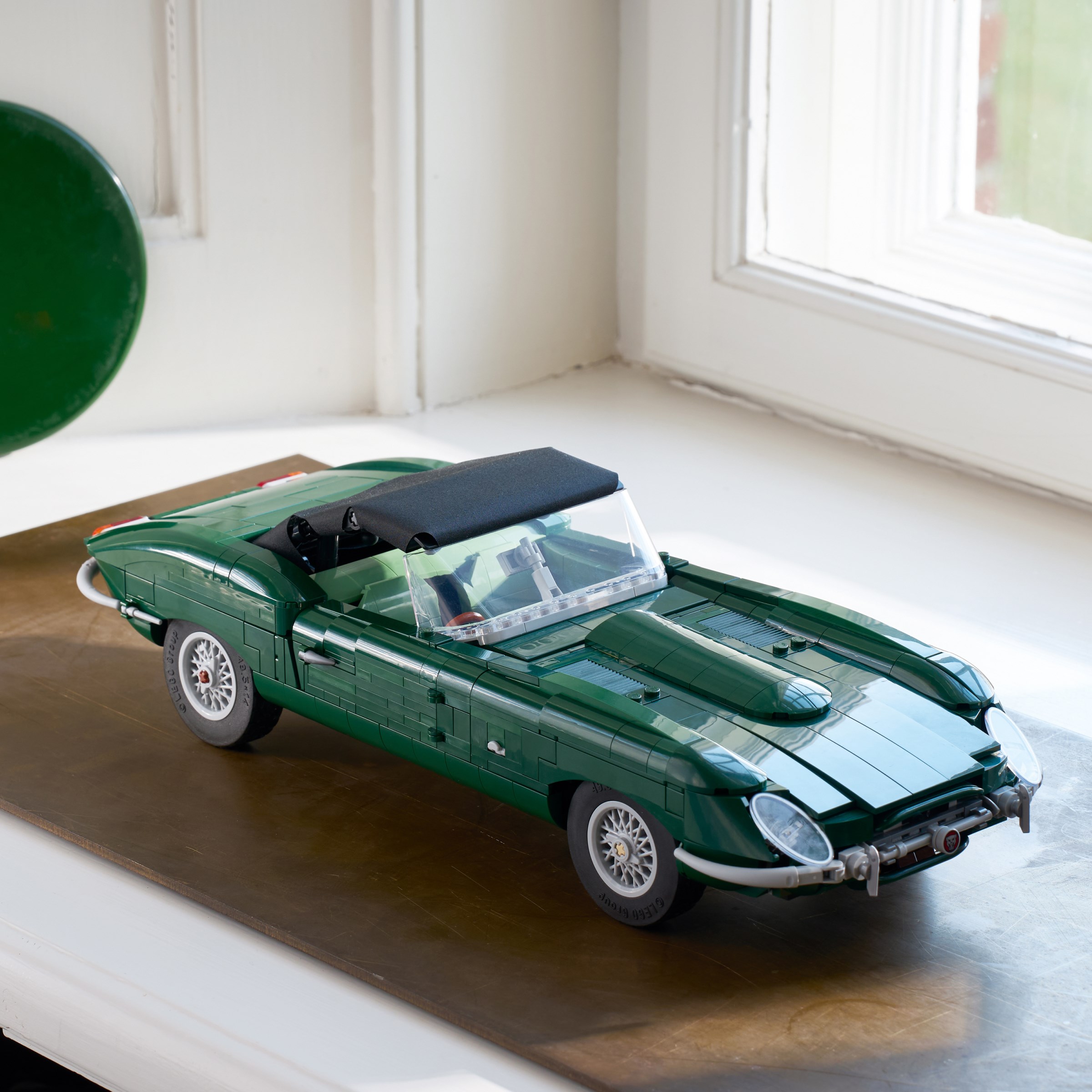
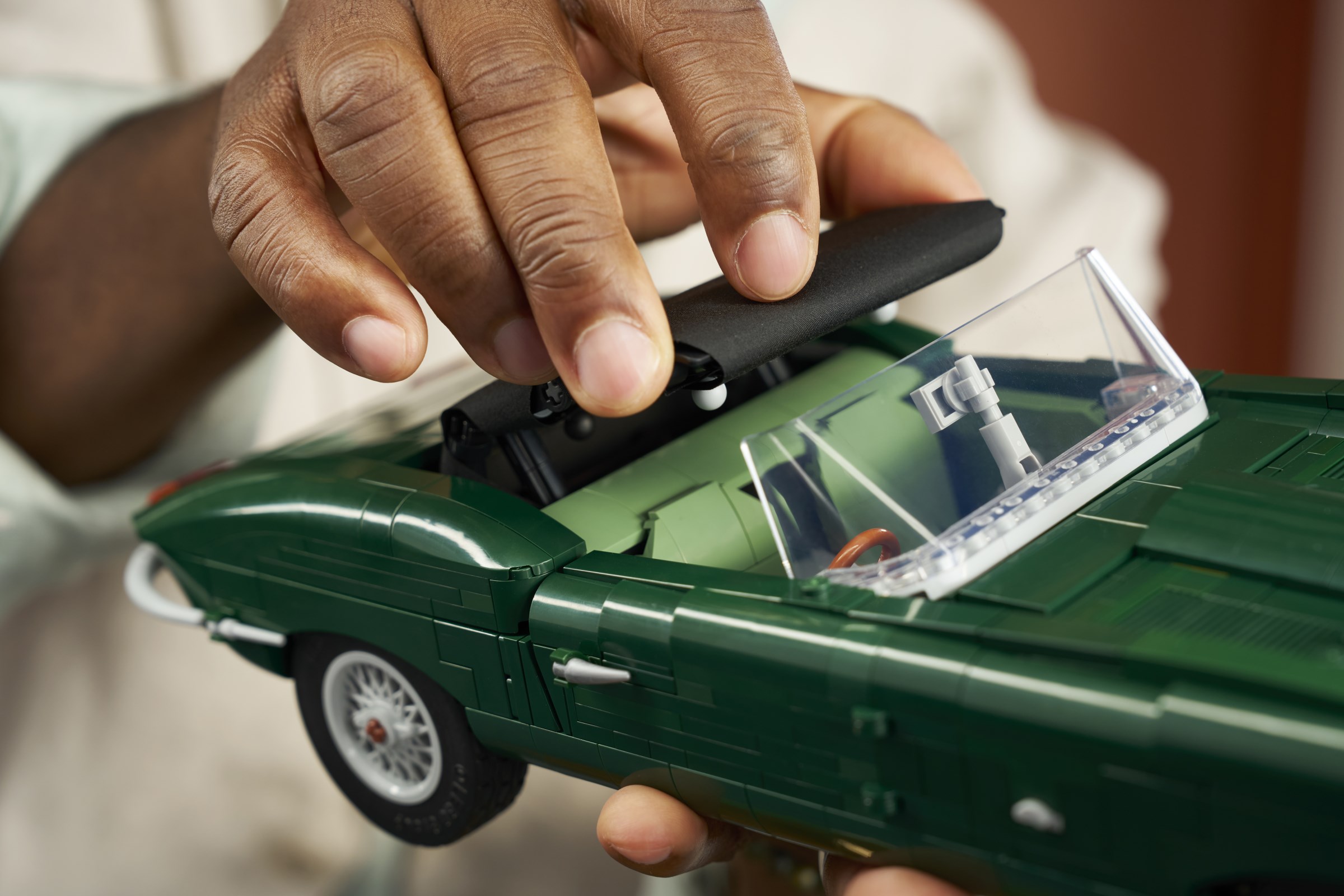
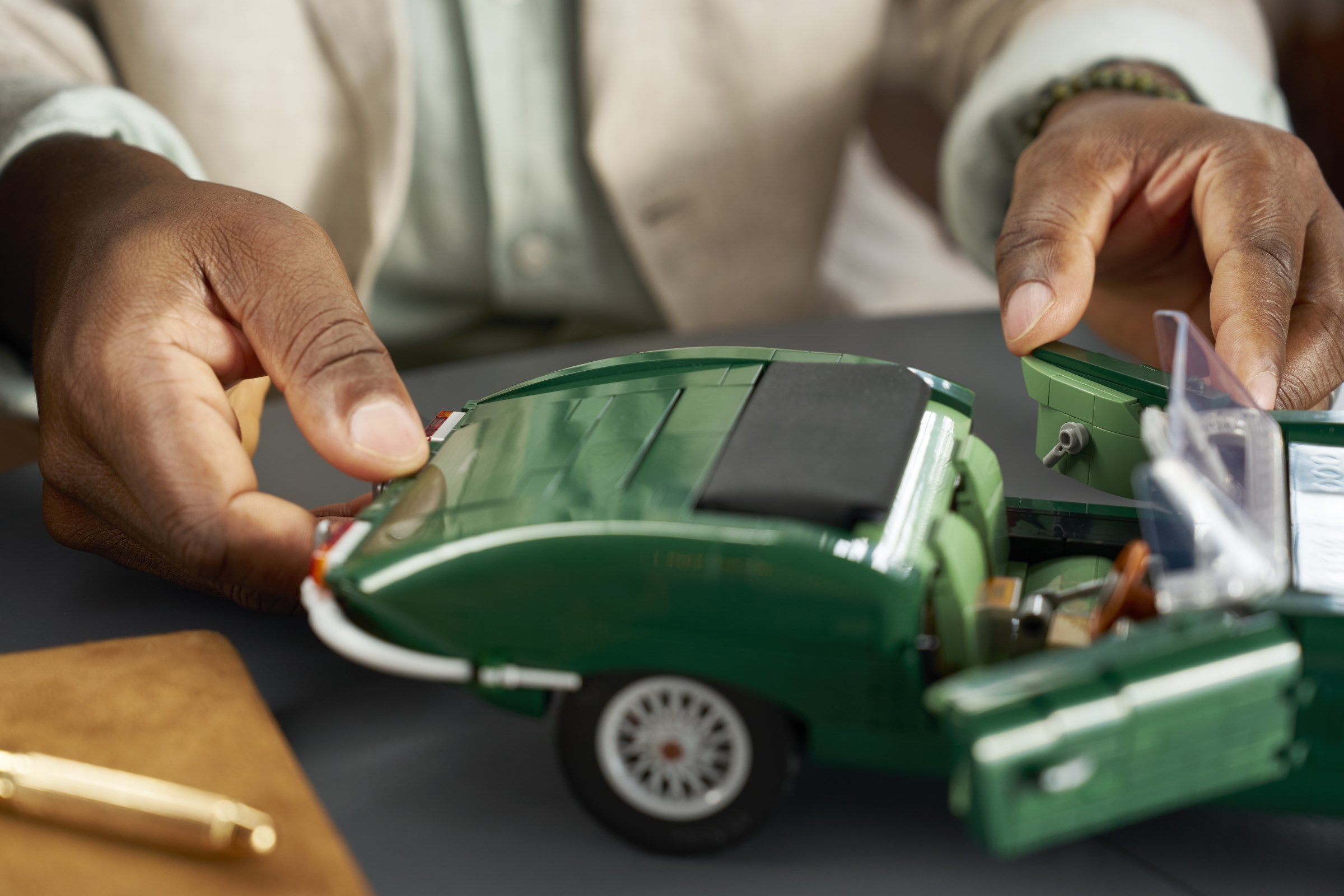
One of the most iconic cars ever produced, the classic Jaguar E-Type, has finally made its debut in LEGO form! The press release follows:
11381 Jaguar E-Type
1,673 pieces, rated 18+
$139.99 / £129.99 / €139.99 Available at LEGO.com from 1st August
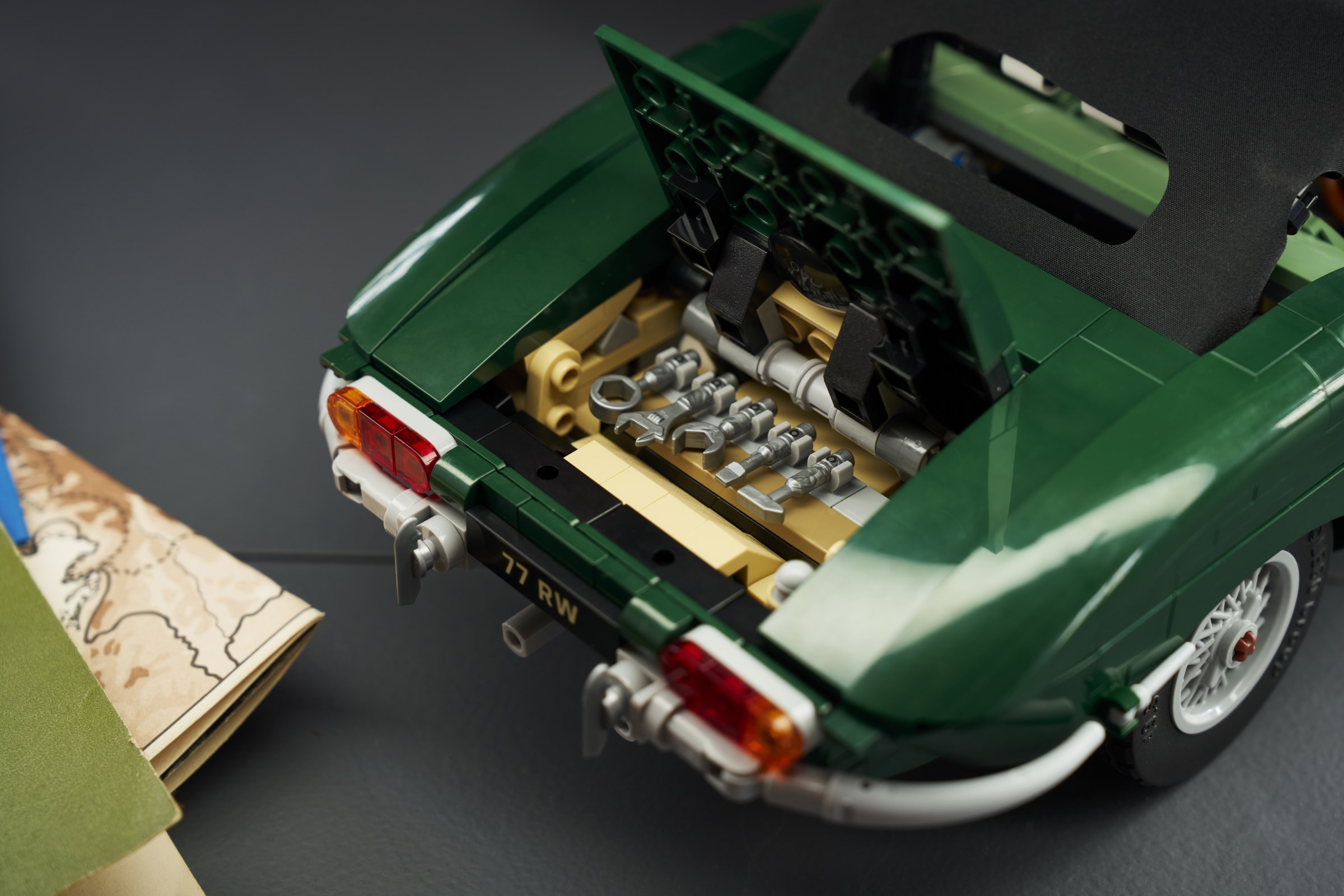
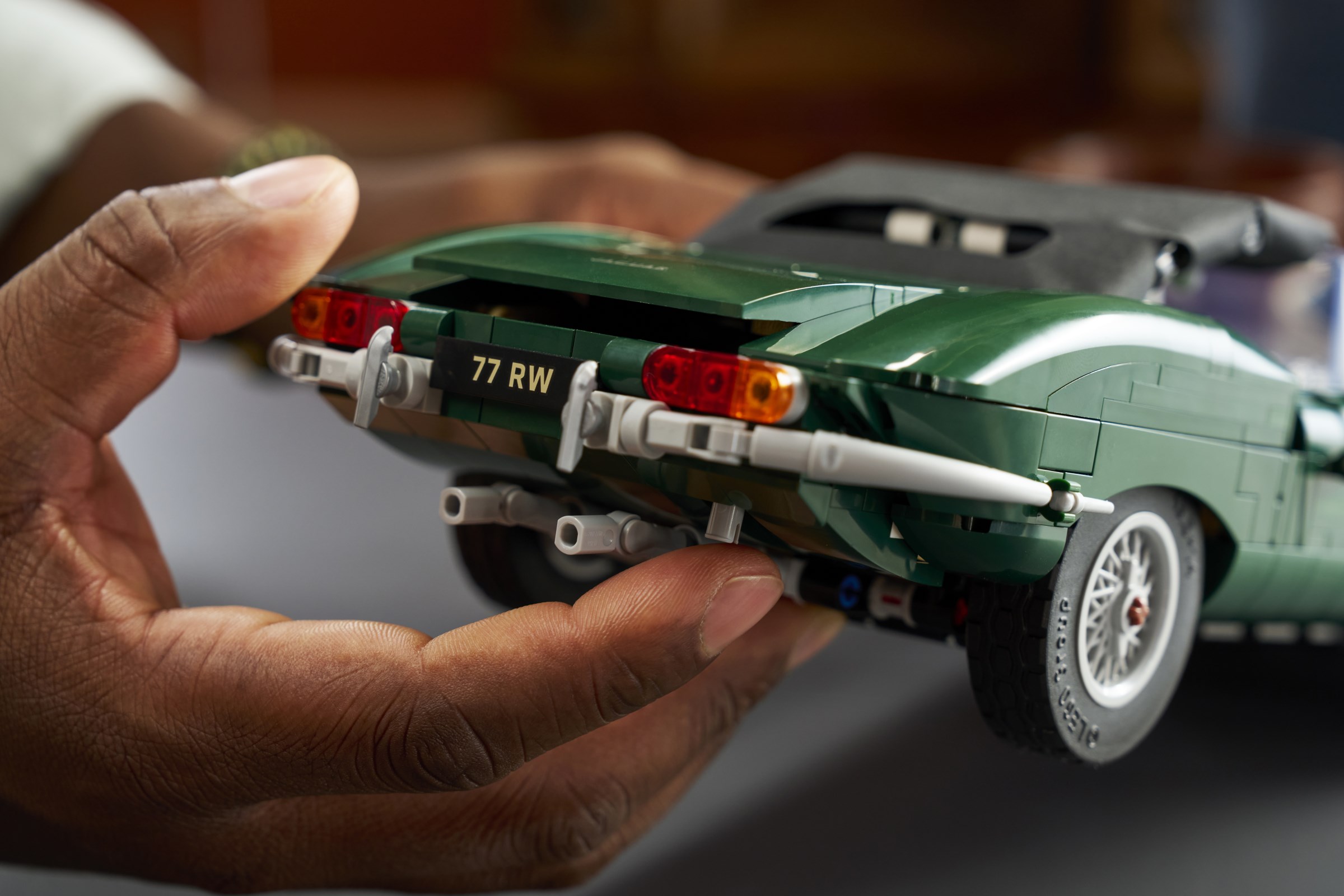
Celebrate a legend of British automotive design with the LEGO Icons Jaguar E-Type (11381), an authentic car model kit created for adult builders and collectors. This detailed replica, with a classic green body and wire-style alloys, faithfully recreates the sleek silhouette and elegant curves of the landmark 77 RW E-Type sports car.
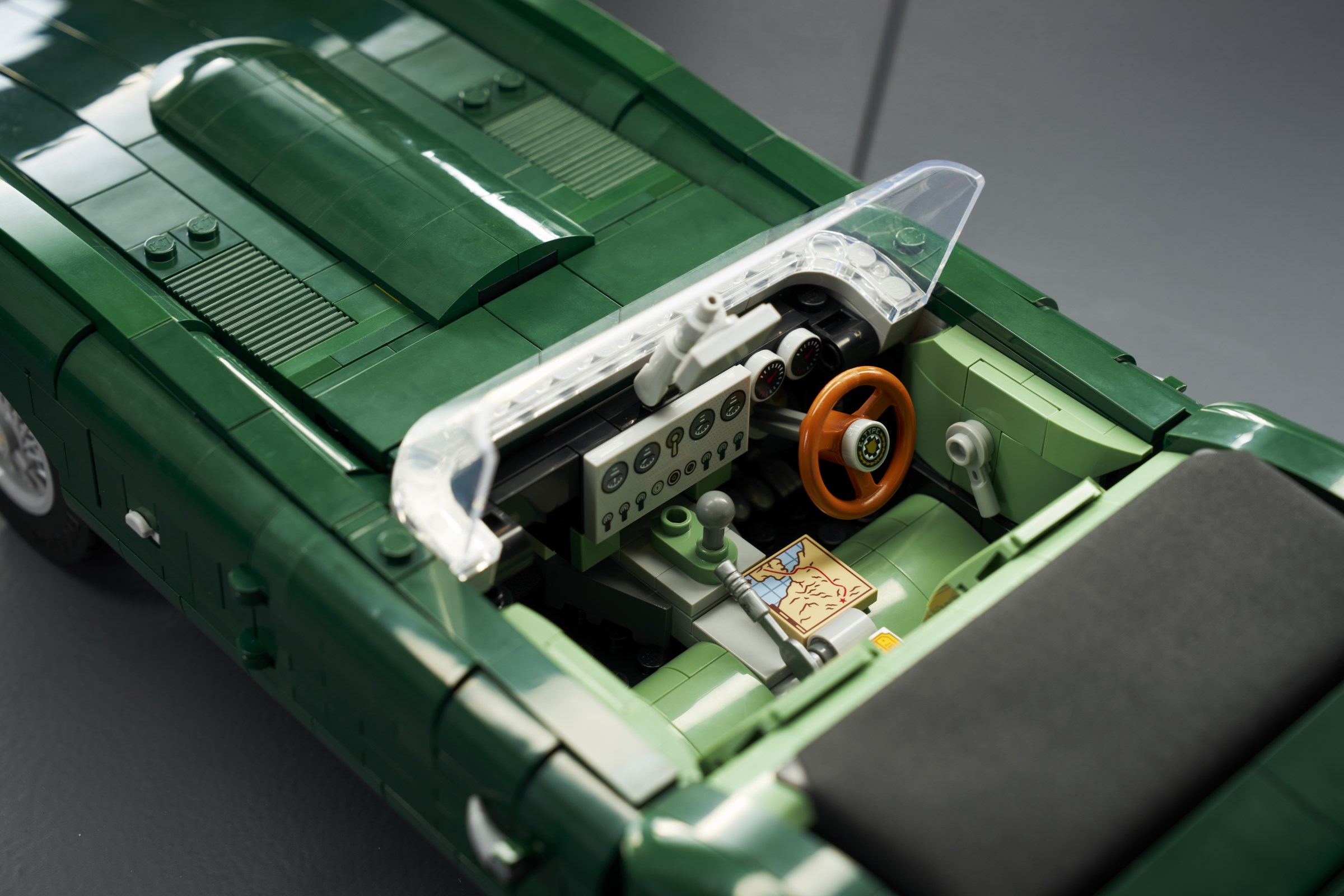
Lift the bonnet to reveal the famed inline-6 engine, then open the doors or fold back the textile roof to explore the cockpit with a detailed dashboard and working steering. The building set also includes a 5-piece toolkit that fits in the boot, which opens at the push of a button.
What do you think of the Jaguar E-Type? Let us know in the comments and via our poll.
The popular Winter Village series began in 2009 and a new seasonal collection has been created for 2026, similar in style to the Winter Village, named the Midnight Valley Collection! The press release for its first set follows:
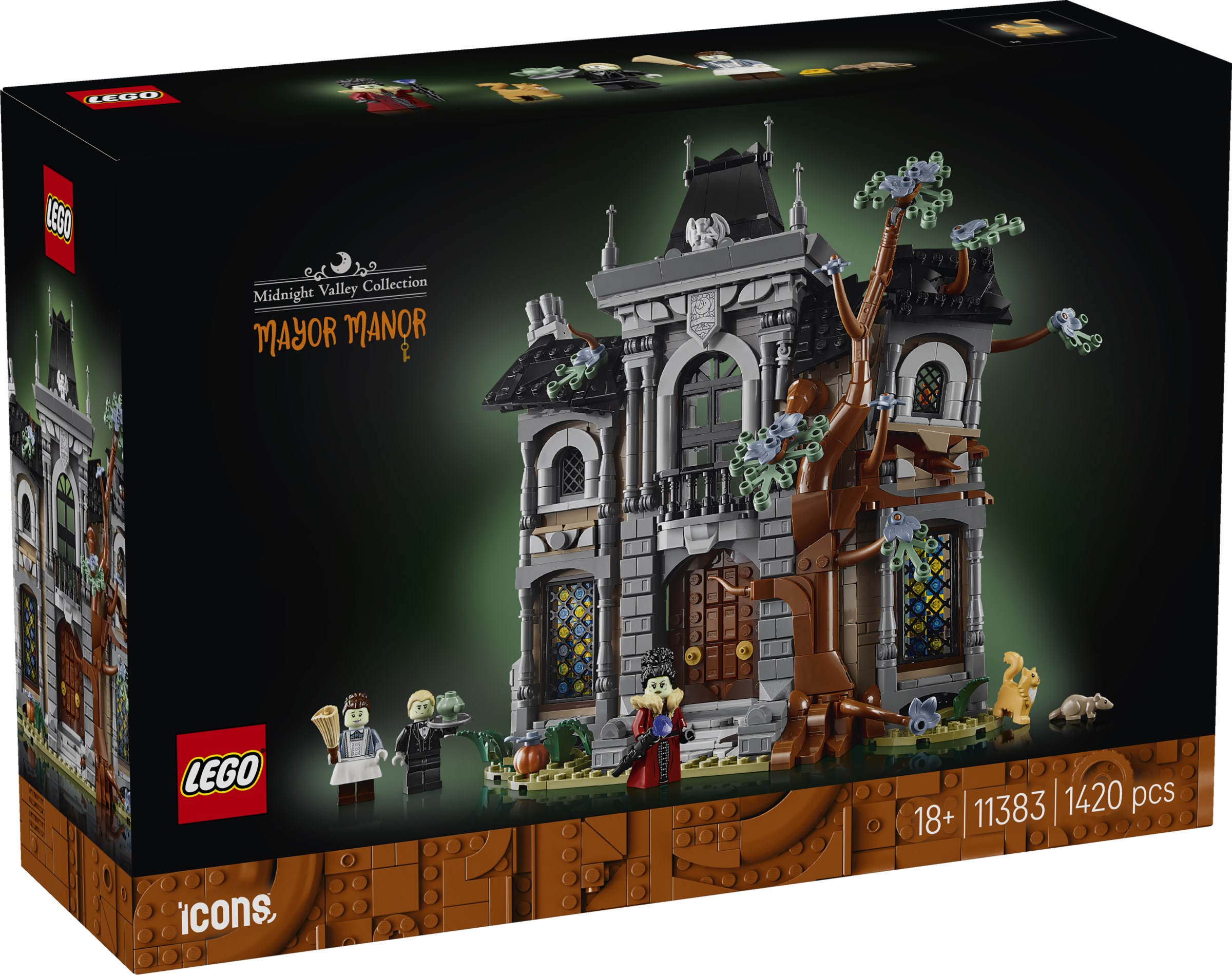
11383 Mayor Manor
1,420 pieces, rated 18+
$119.99 / £99.99 / €109.99 Available at LEGO.com from 1st September
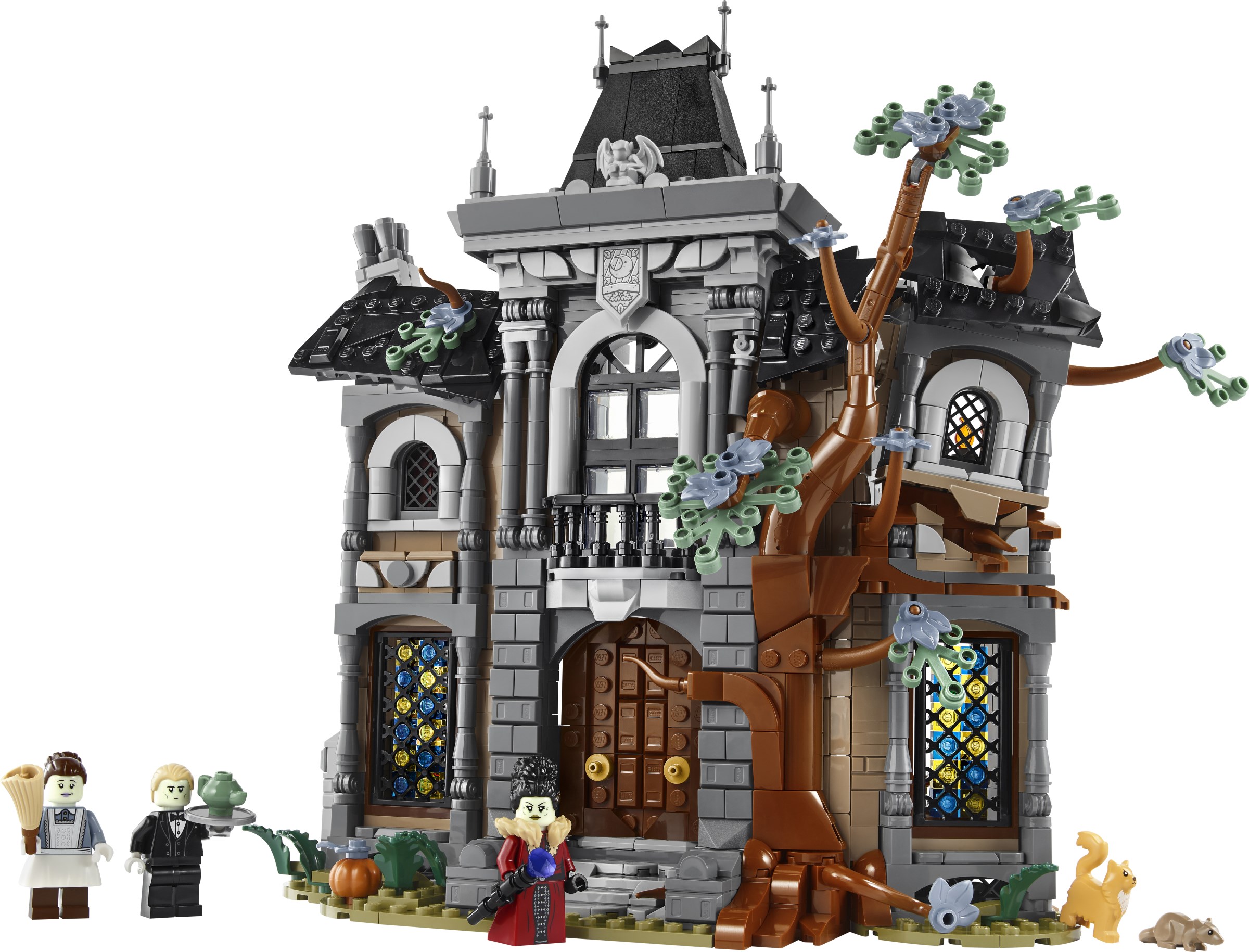
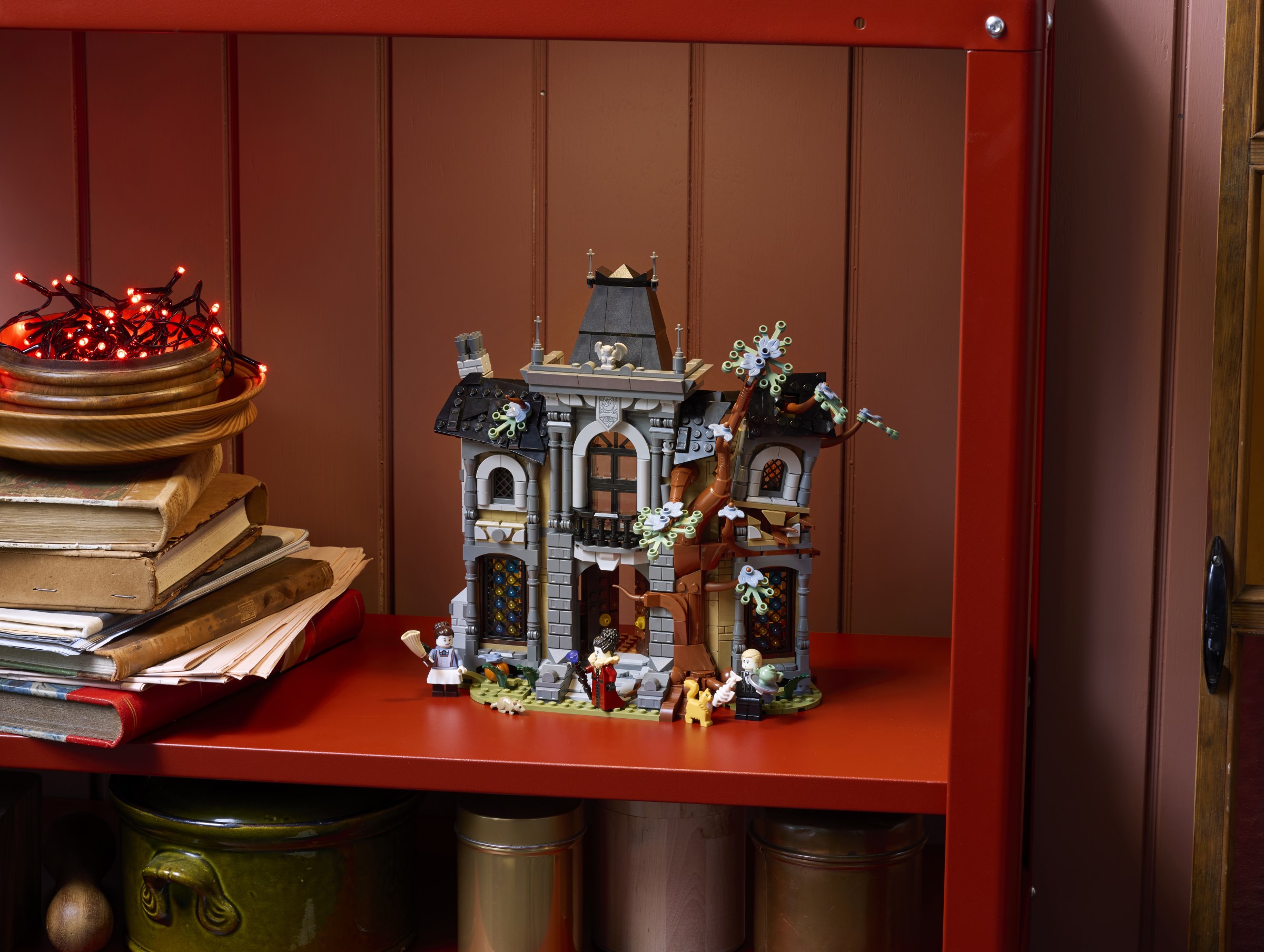
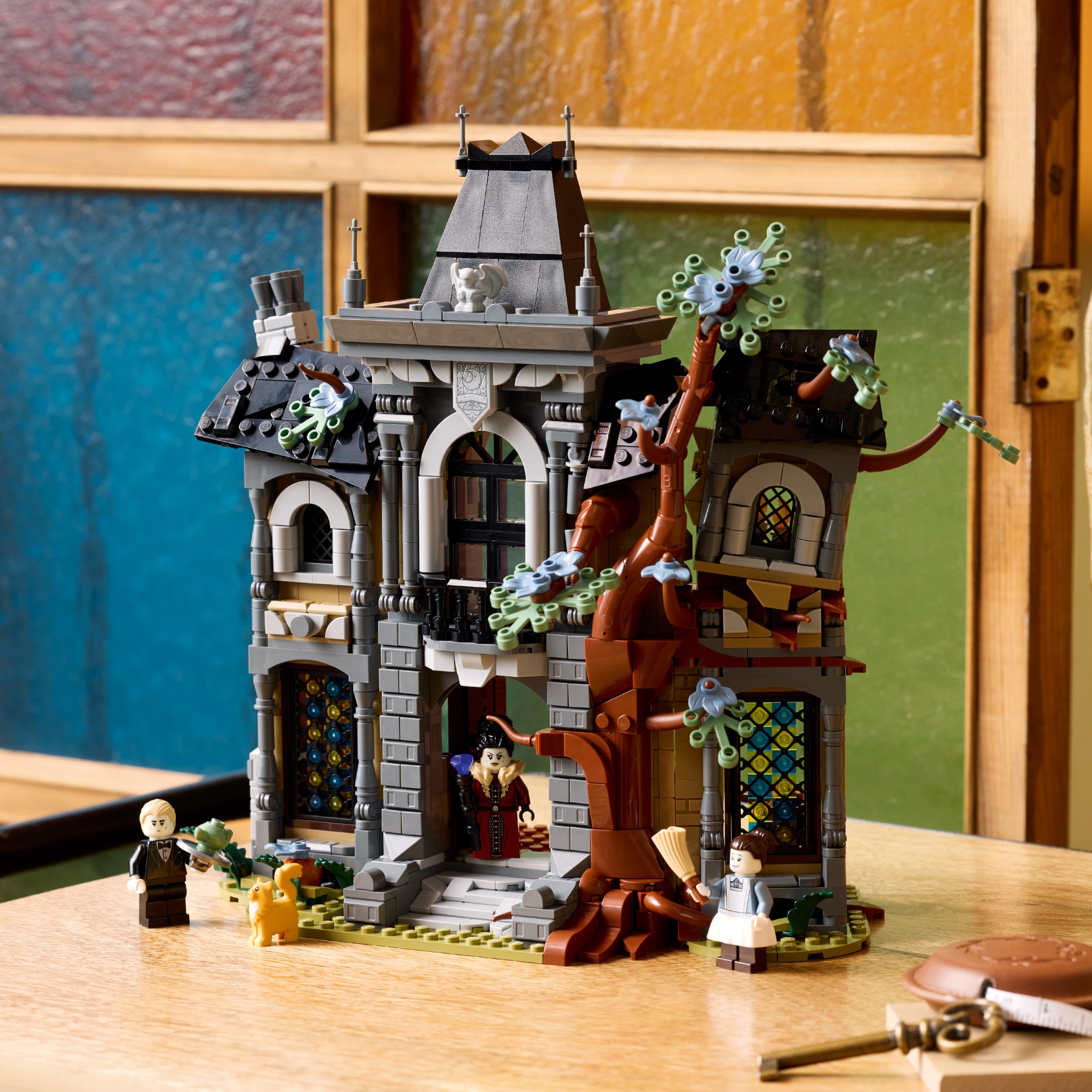
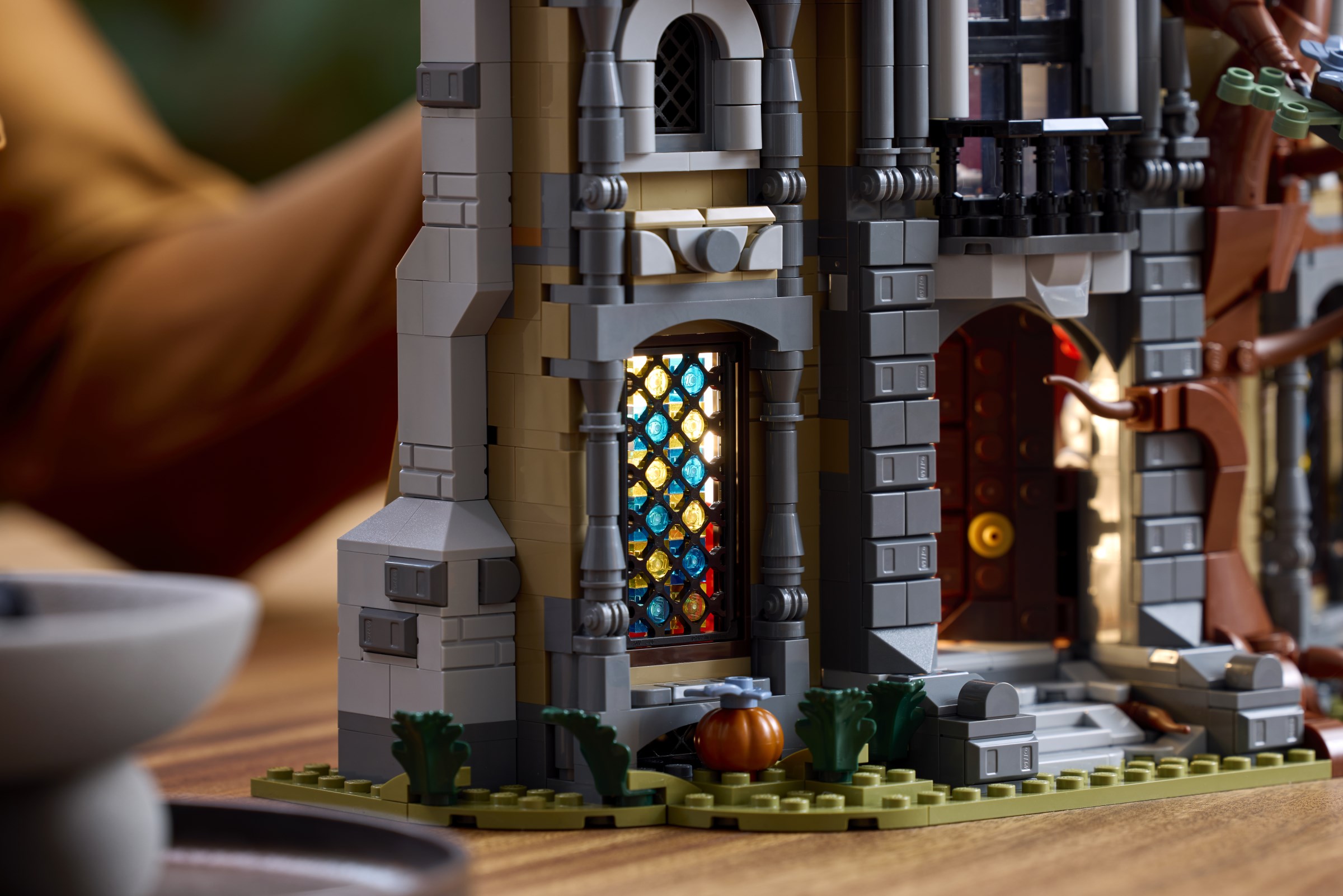
Welcome to a world of mystery with the LEGO Icons Mayor Manor (11383). This quirky mansion is the first from the Midnight Valley Collection – a series of collectable building sets designed for adults, where distorted and asymmetrical constructions create a haunting atmosphere.
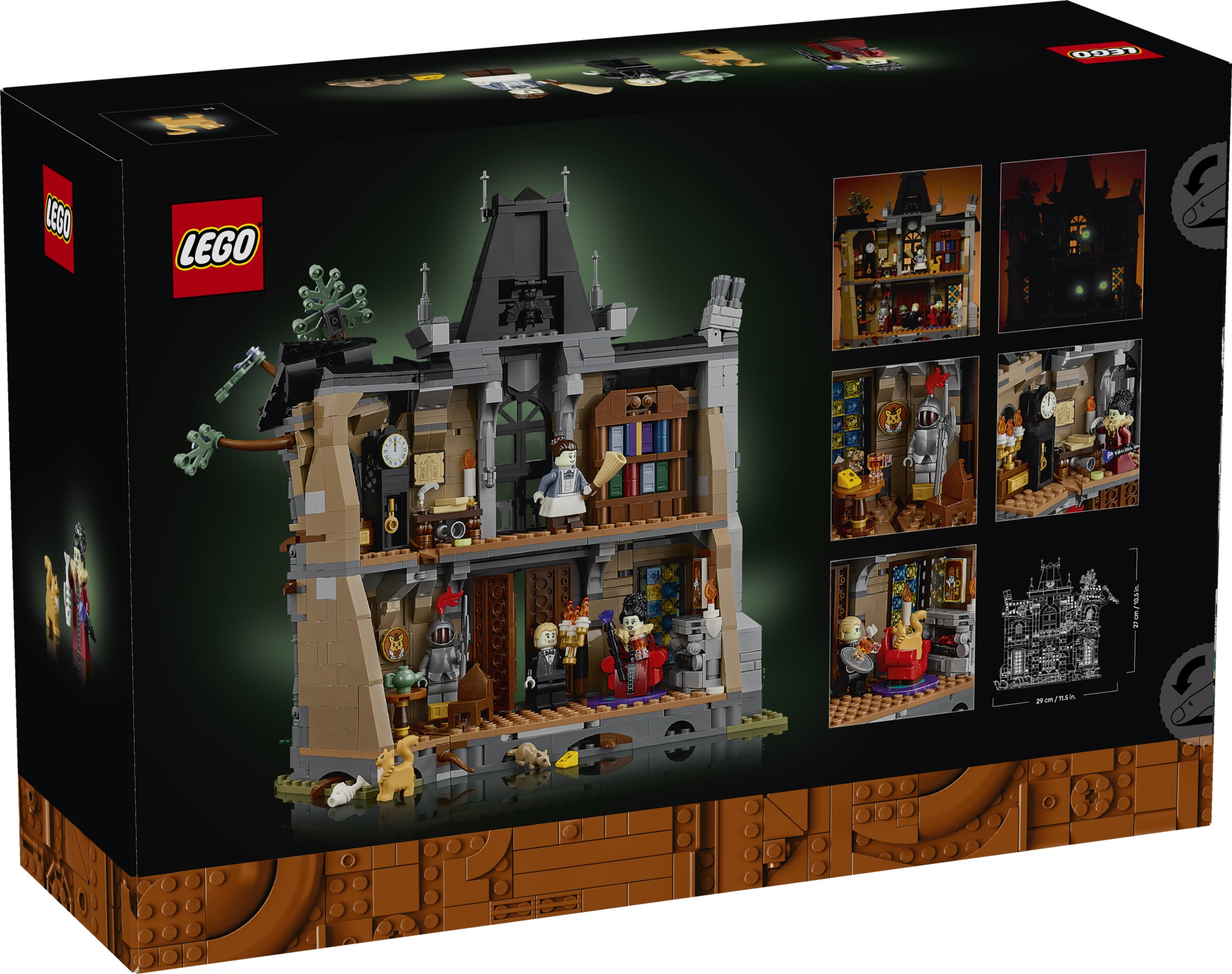
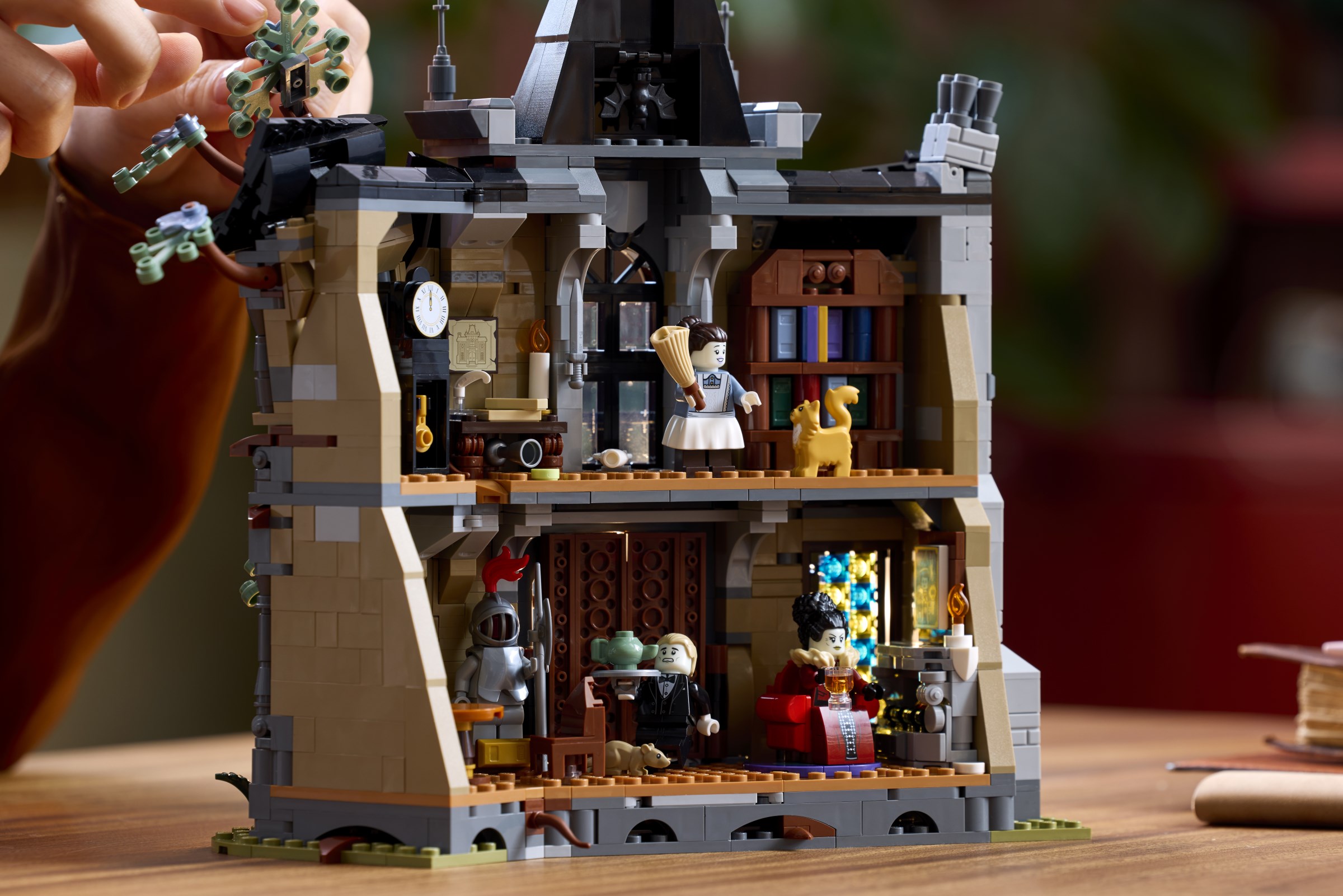
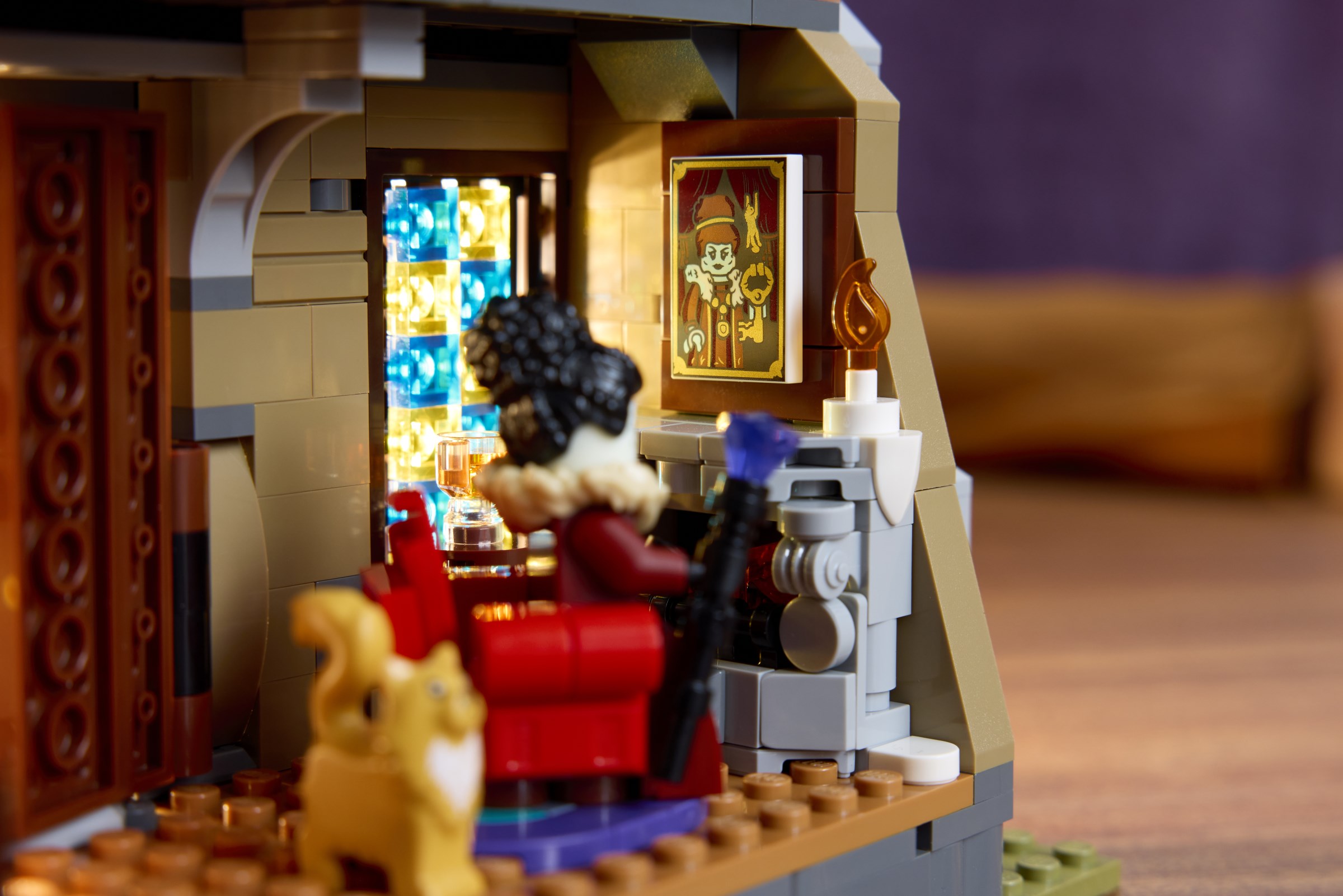
Immerse yourself in an engaging project as you craft intricate details across the manor’s crooked facade, complete with tilted angles, weathered textures and an old tree nestled comfortably into the brickwork. Explore the 2-storey interior with gothic décor and period-style furnishings.
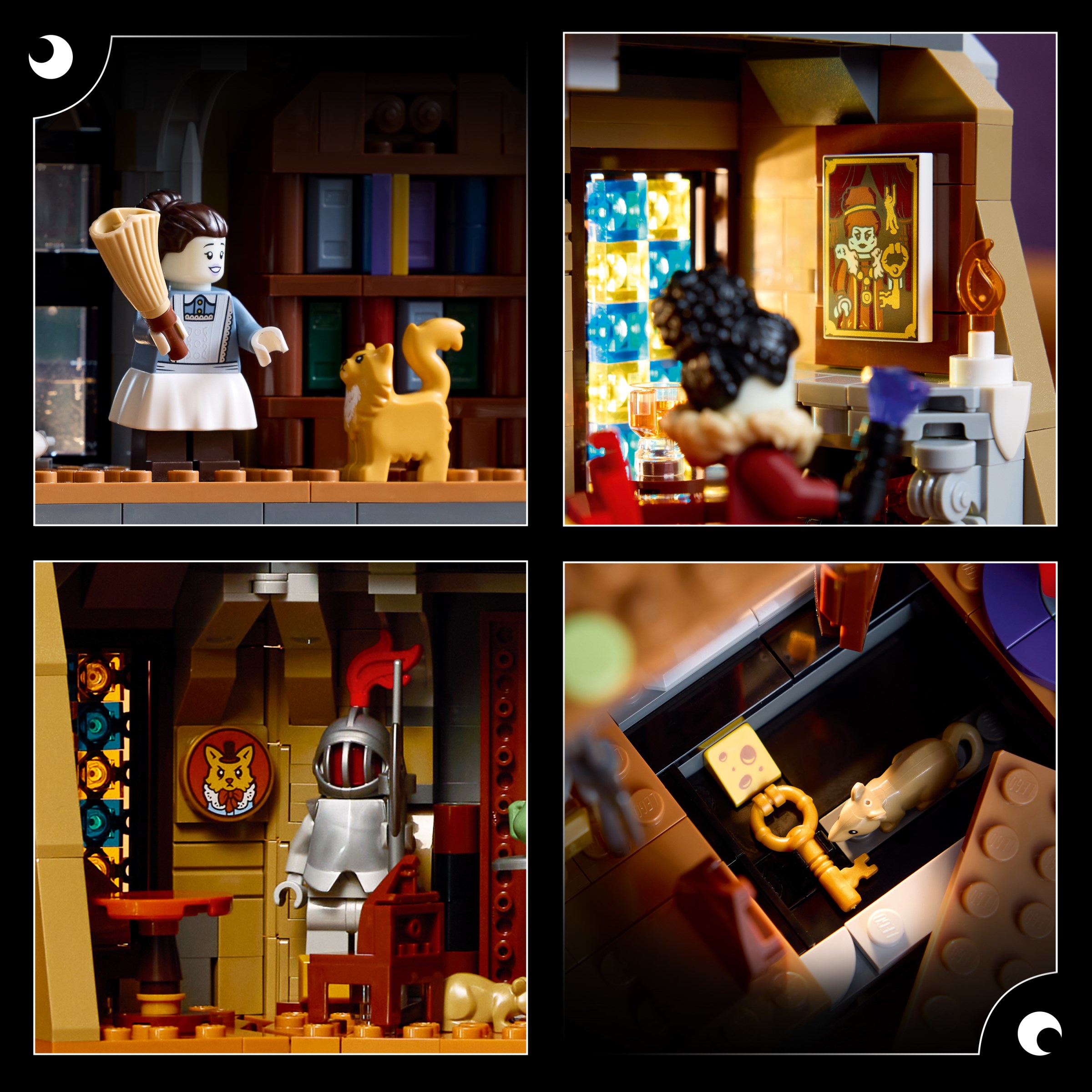
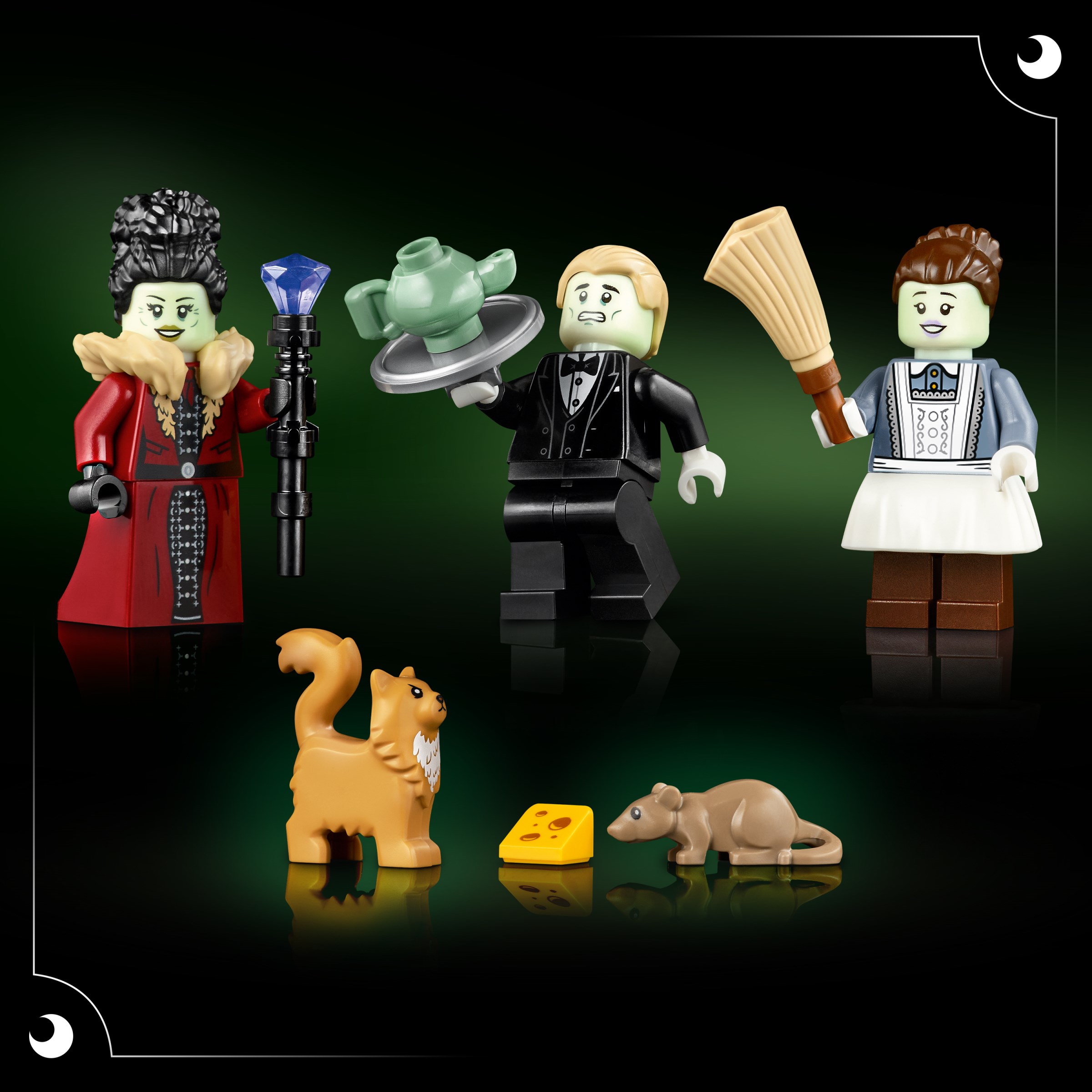
Discover a suit of armour, a fireplace and a grandfather clock eerily frozen at the stroke of midnight, alongside other details including a table and chairs, framed artwork and a bookshelf. Bring the scene to life with the 3 glow-in-the-dark characters, house cat and rat, then display your creation for all to enjoy.
I am looking forward to this collection, which has a great deal of promise. This model is certainly very detailed and there are plenty of options for other Hallowe'en-based sets in the future.
It is not clear whether this will replace the Winter Village Collection for this year or the future, but I assume not because Winter Village sets are mostly released at the start of October, rather than September.
What do you think of this set and the potential of the Midnight Valley Collection? Let us know in the comments.
Ask any person the name of a playwright and most of them would say Shakespeare, says Dr. Mario Livio, a senior scientist with the Hubble Space Telescope. Ask them the name of a scientist, most of them would say Einstein. Ask them the name of a telescope – they will say Hubble.
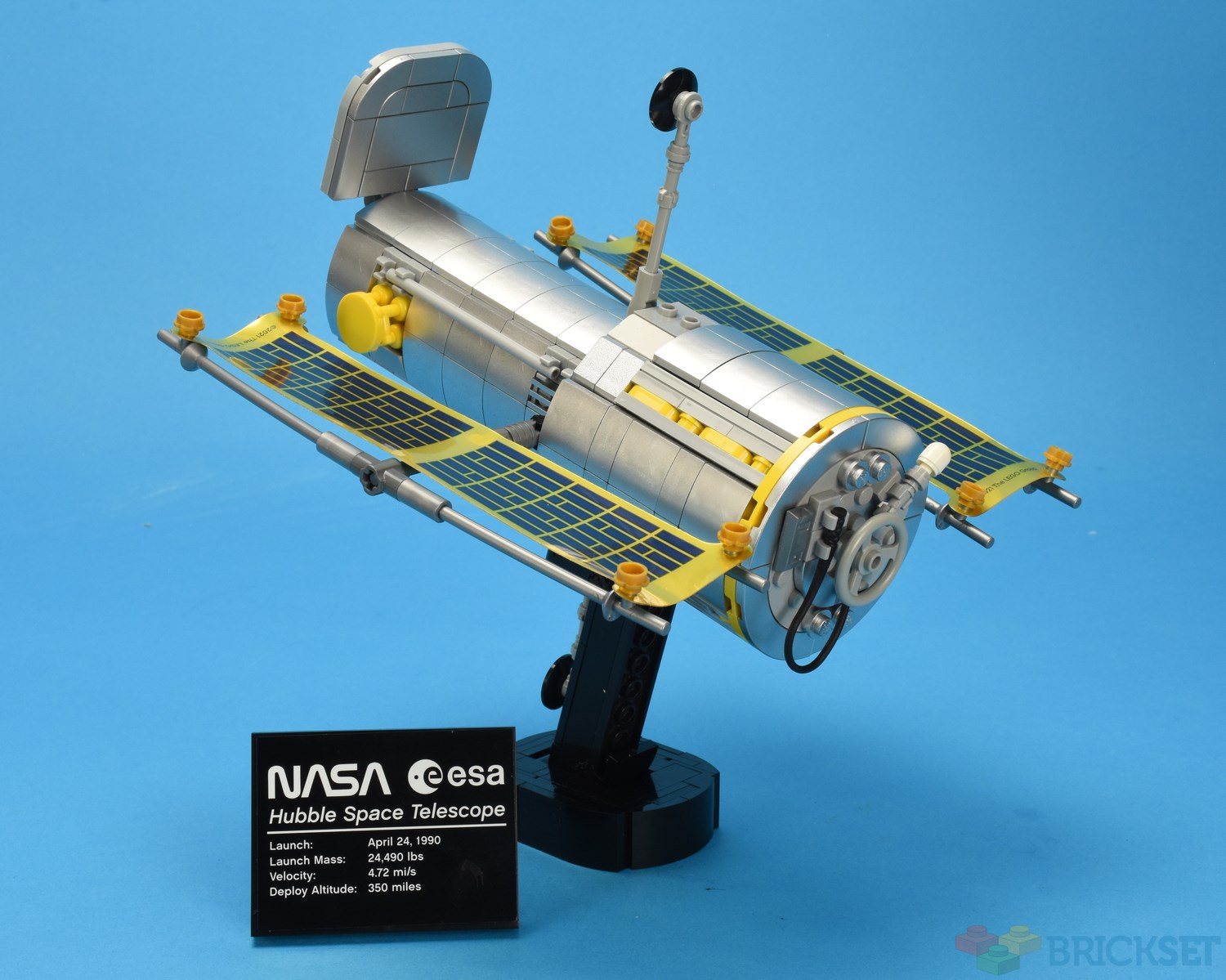
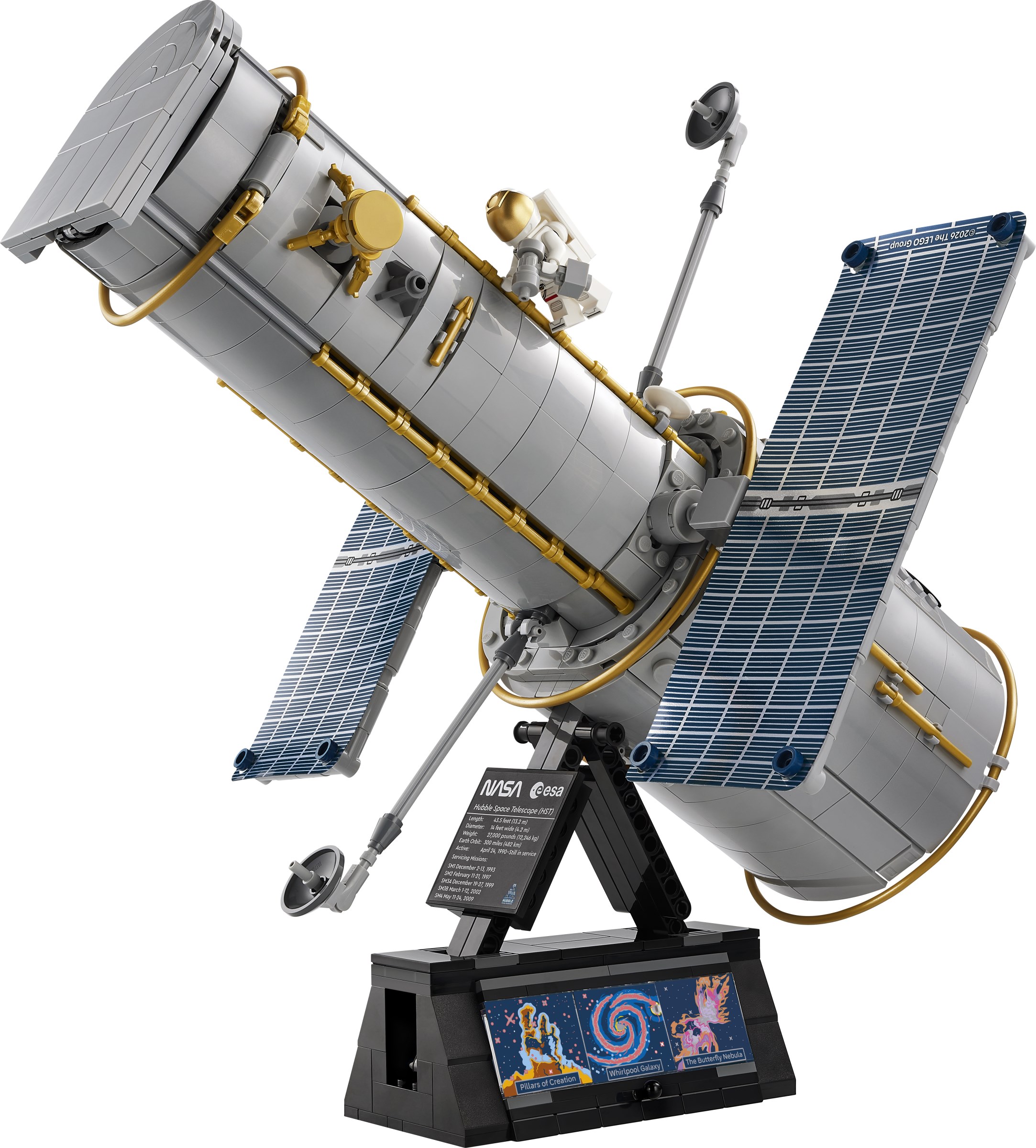
To celebrate the Hubble Space Telescope's longevity in service and the amazing role it has played in determining our place in the cosmos, LEGO is releasing this minifigure scale 11382 Hubble Space Telescope set.
Read on as I take you on a trip through the cosmos as I discuss this incredible set.
Summary
11382 Hubble Space Telescope, 1,252 pieces. £119.99 / $139.99 / €129.99 | 9.6p, 11.2c, 10.4c per piece. Buy at LEGO.com »
The Hubble Space Telescope has changed the way we view our place in the Universe. This LEGO set celebrates Hubble’s enduring legacy in our imagination
Accurate and detailed minifigure scale model
Error on the primary mirror
Celebrates a well-known space telescope that enjoys celebrity status
Stickers on an Icons set
Medium Stone Grey colour
Celebrating 35th anniversary one year late
The set was provided for review by LEGO. All opinions expressed are those of the author.
Credit: Original image by ISS / Nasa and LEGO model added by Jon-Paul Hansen
Matariki
As this article goes live, New Zealand is celebrating Matariki. Observing the rising of the Matariki cluster before sunrise in mid-winter signals the Maori new year and in recent years has been acknowledged as a bank (public) holiday.
Matariki is an open cluster of stars that is better known as the Pleiades or the Seven Sisters and is catalogued as Messier 45 (M45). This cluster sits in the zodiac constellation of Taurus.
Below is a Hubble Space Telescope (HST) image of this star cluster (the image has been rotated 180° as it would be seen from the Southern Hemisphere).
I'll comment further about Matariki at the end of this review.
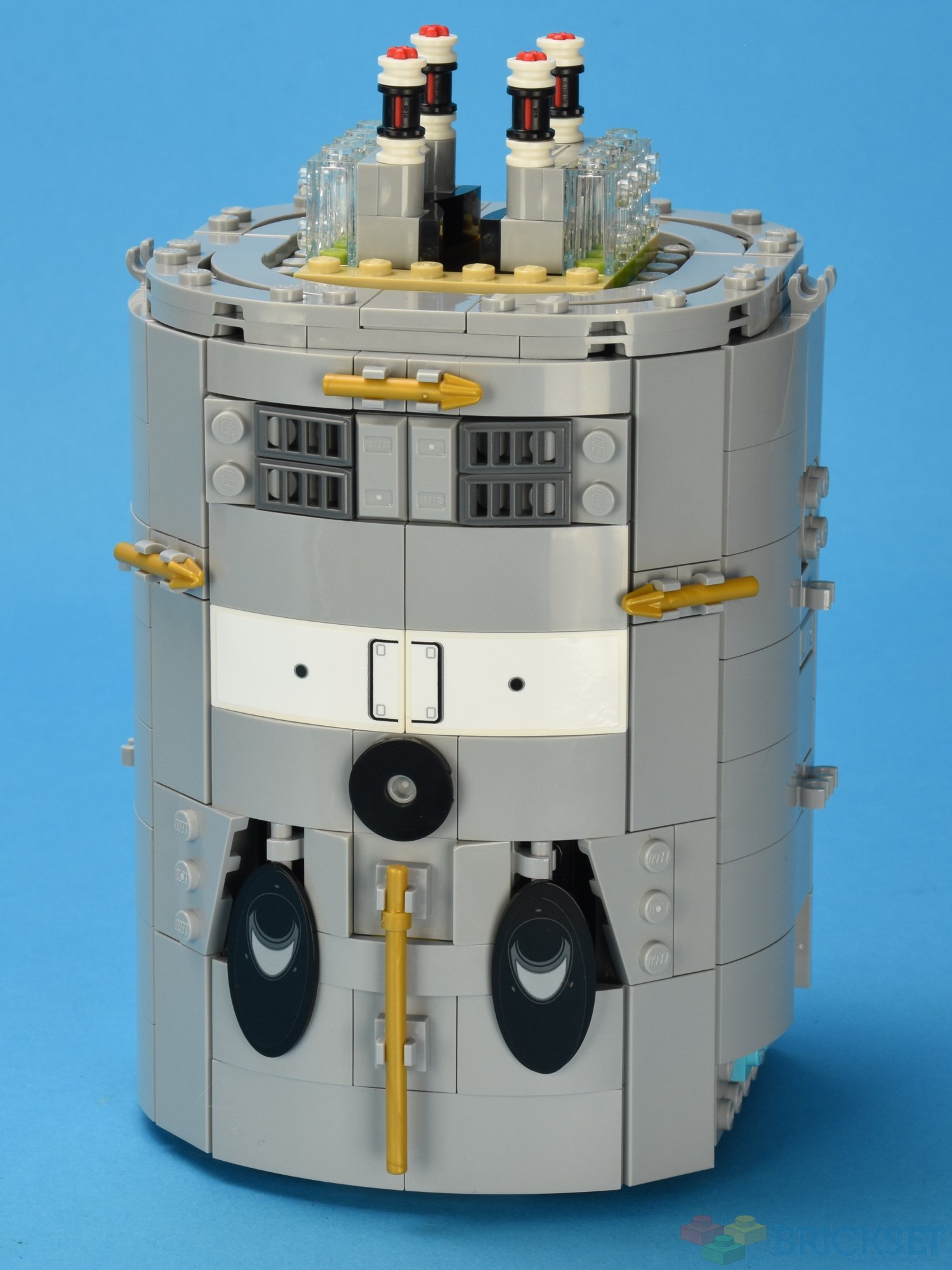
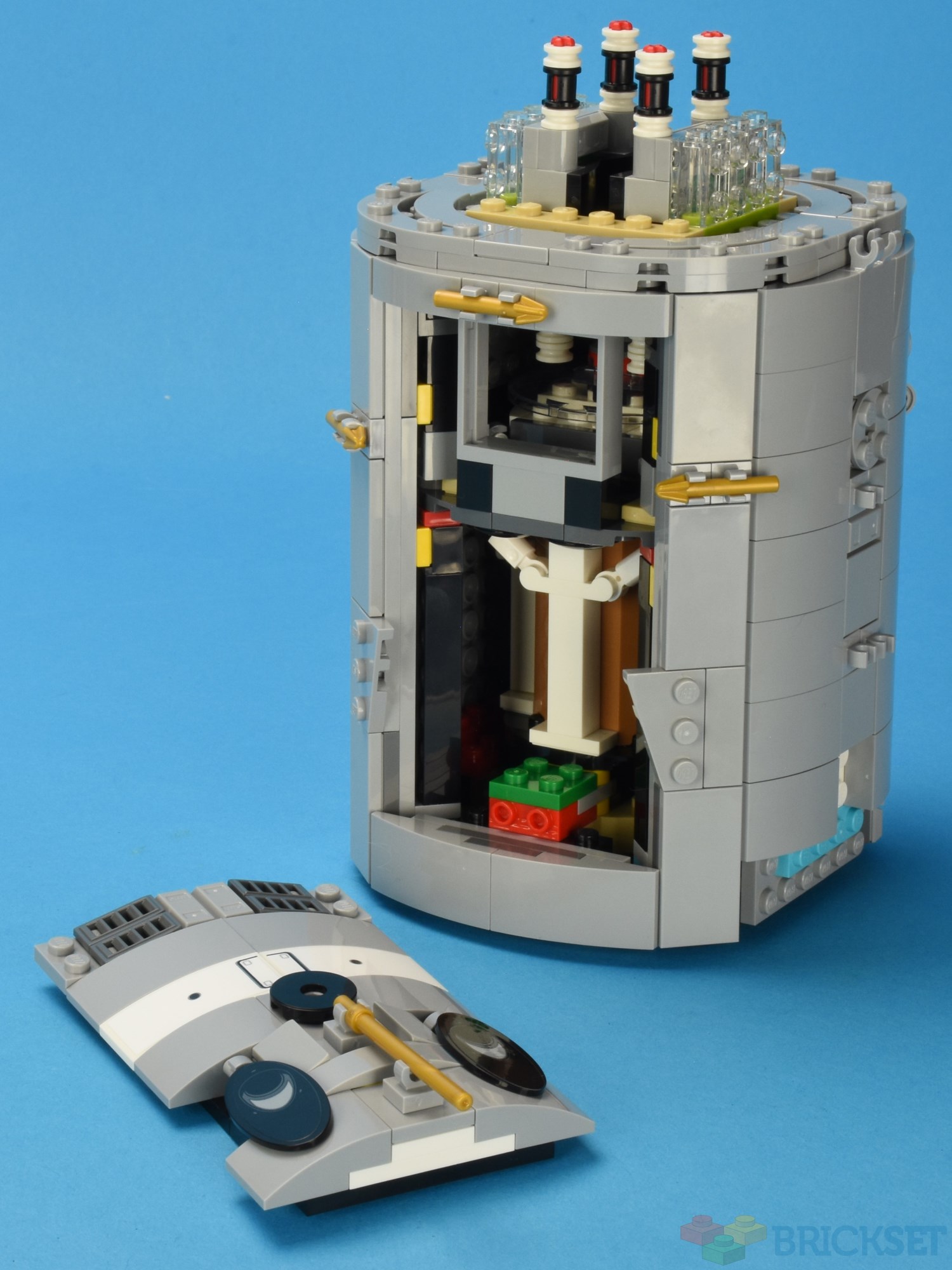
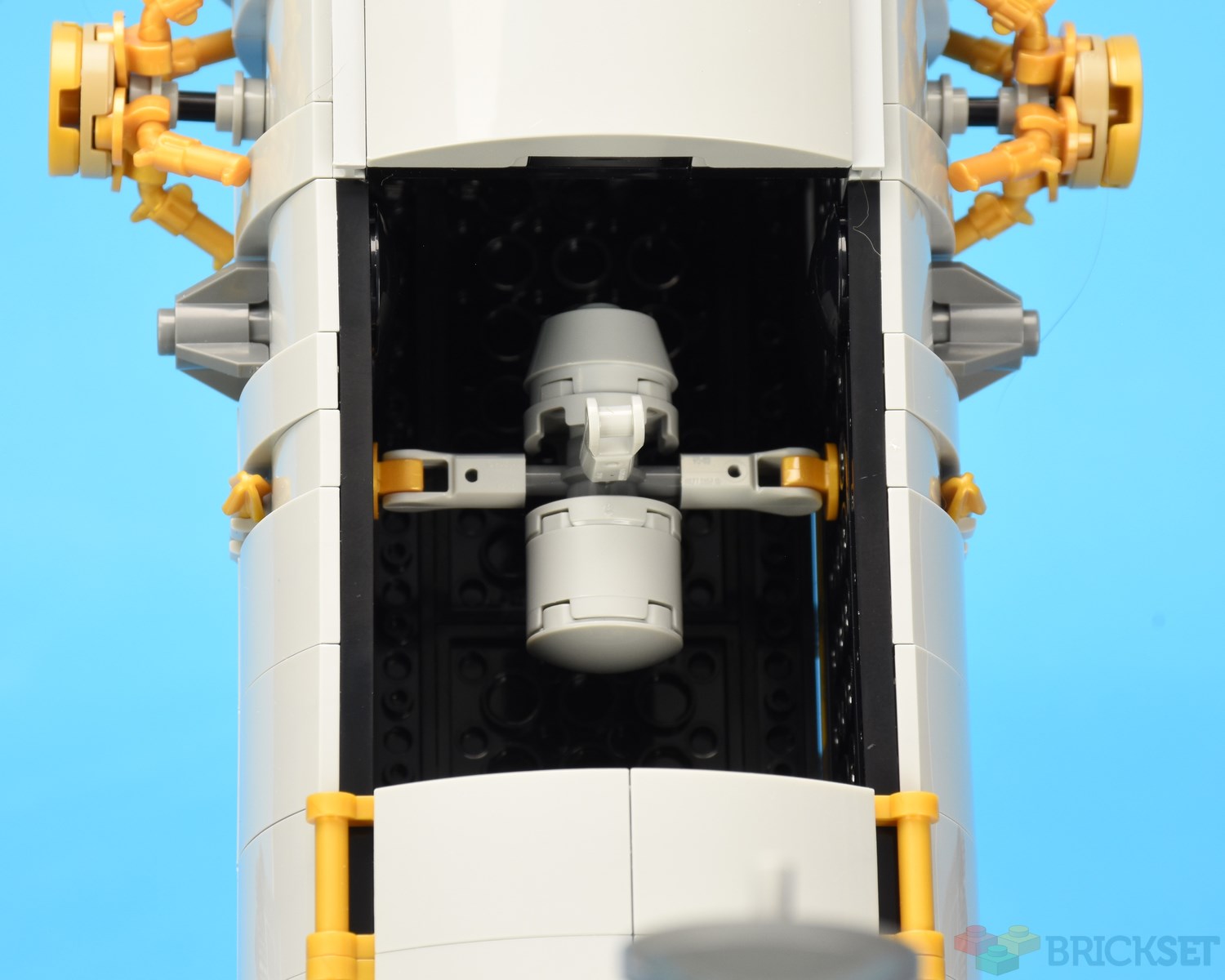
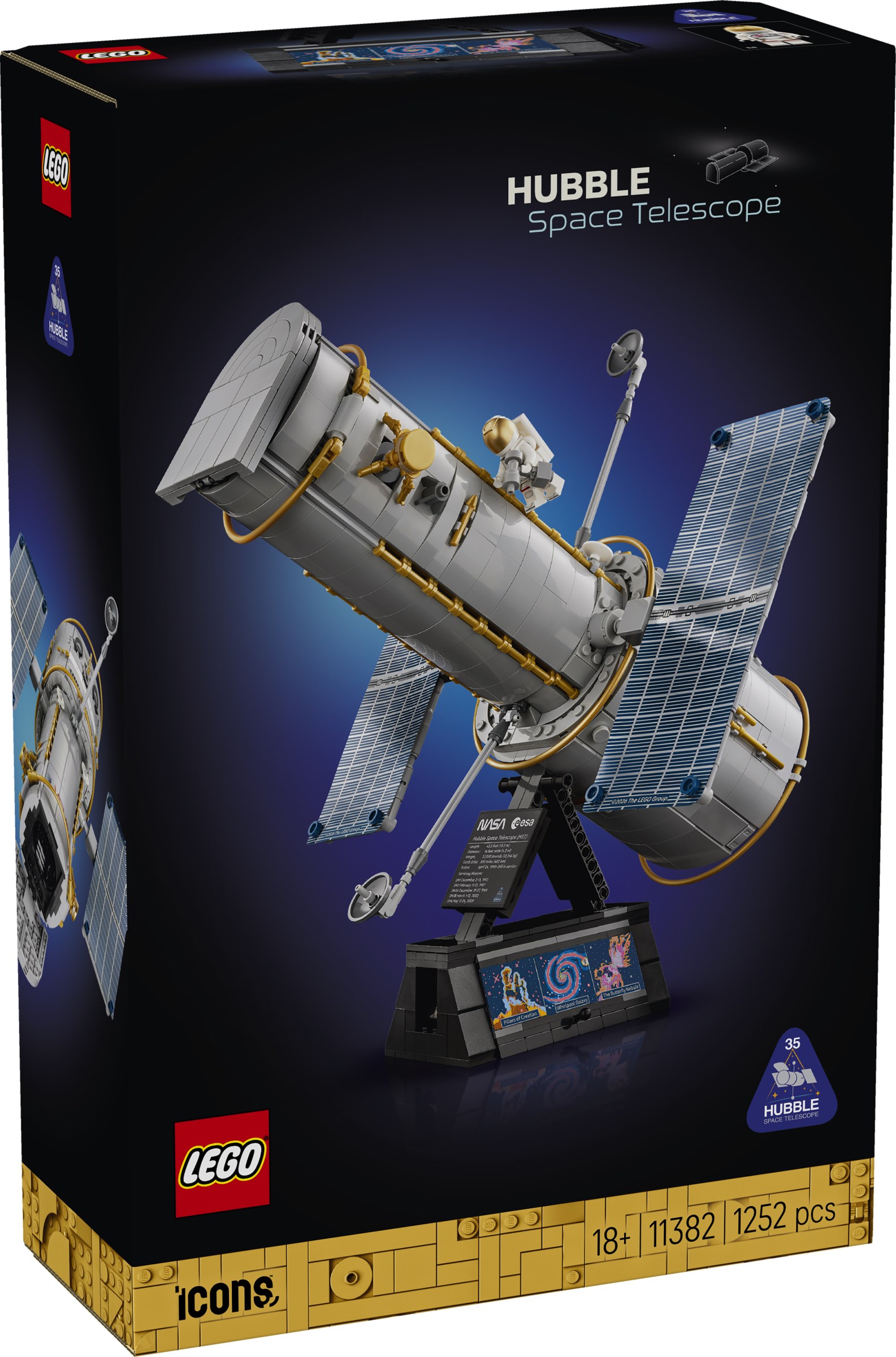
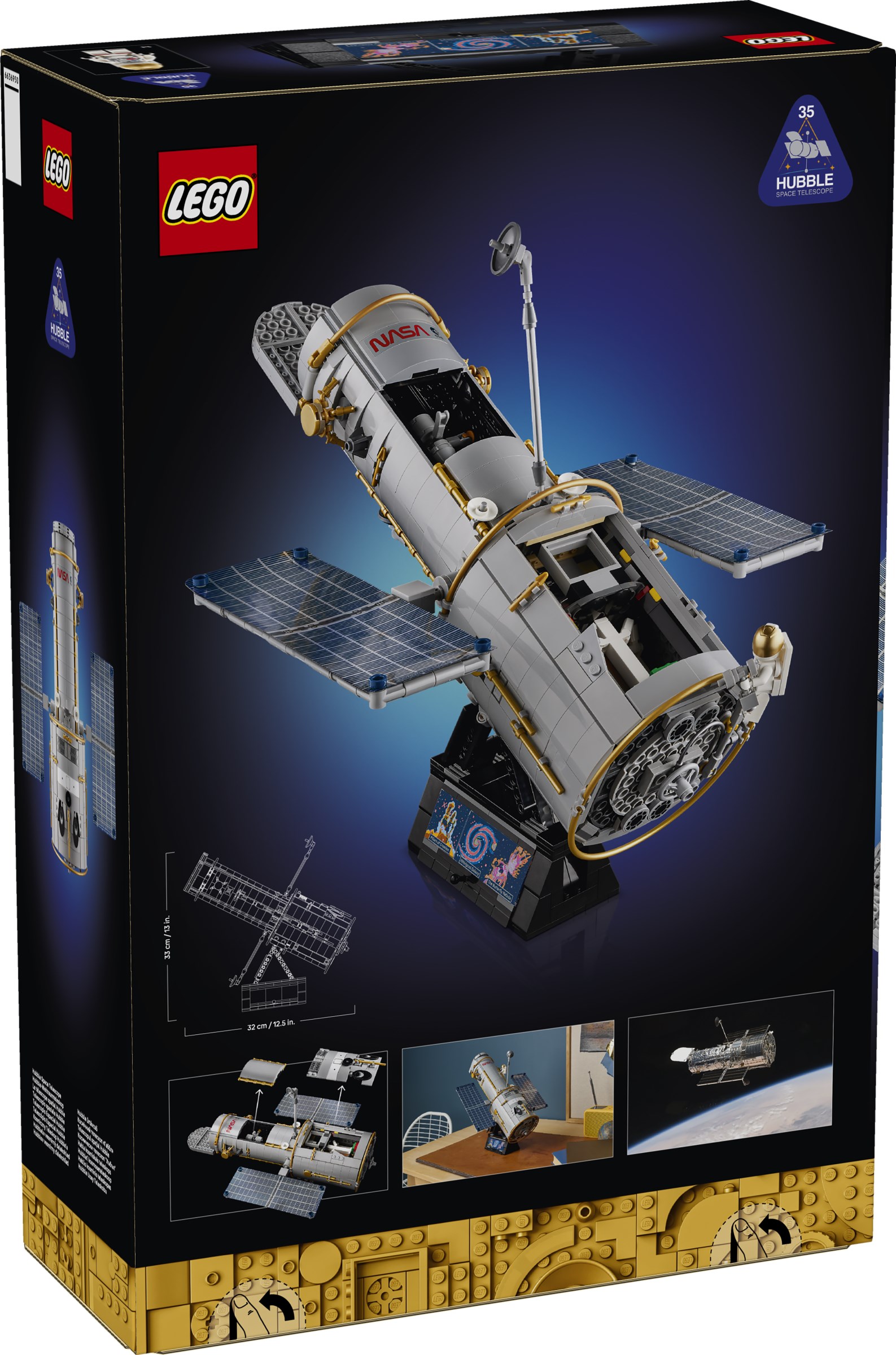
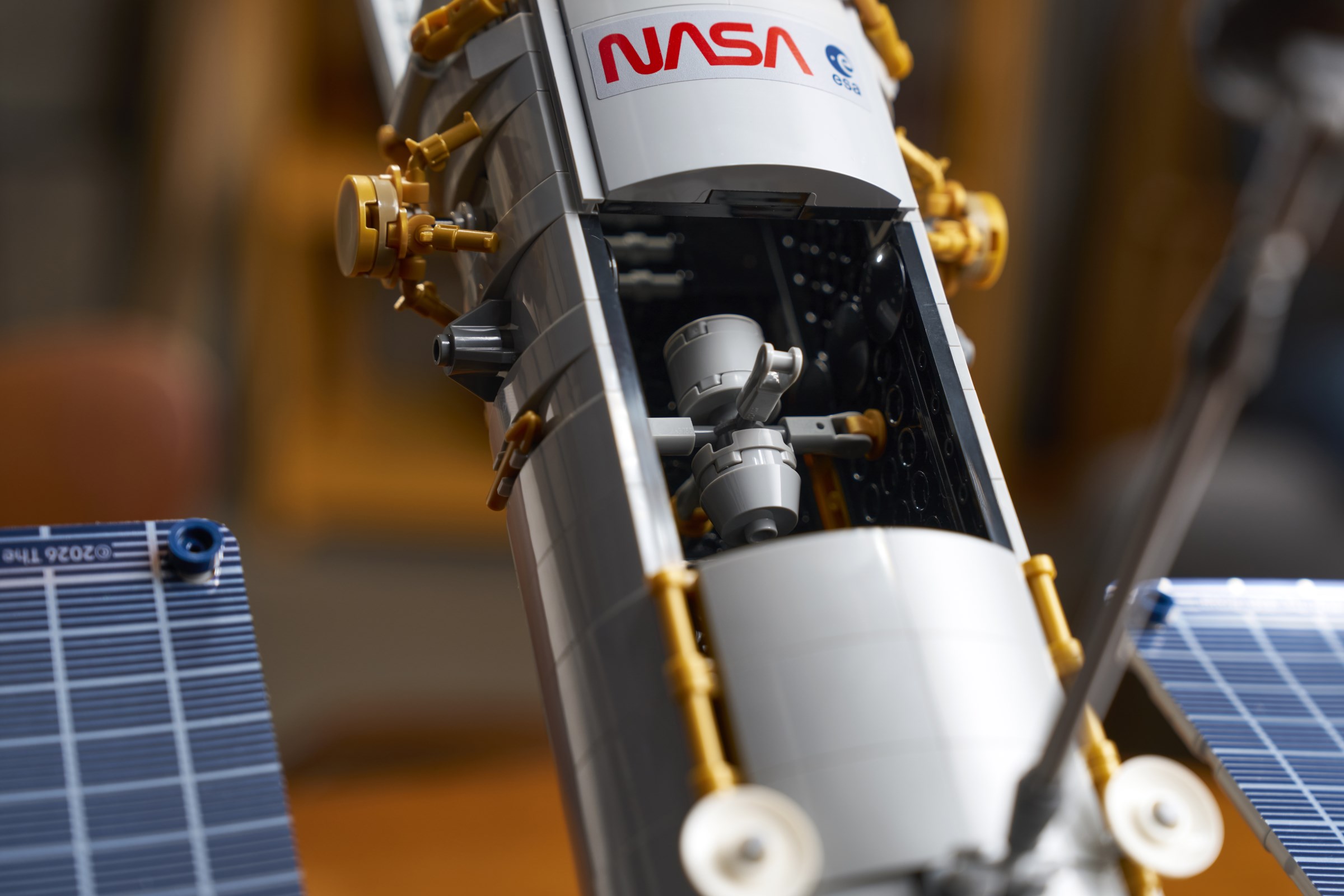
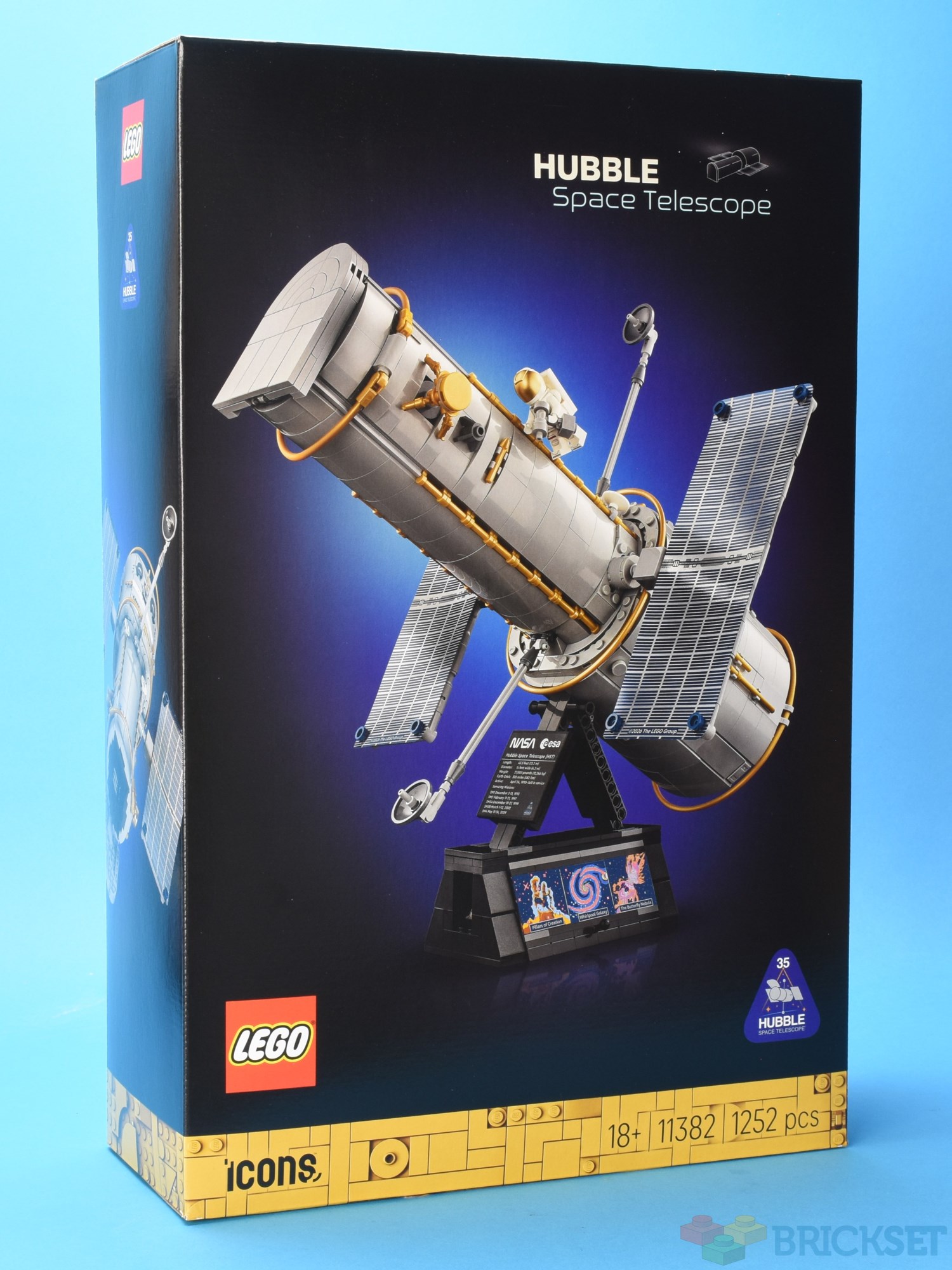
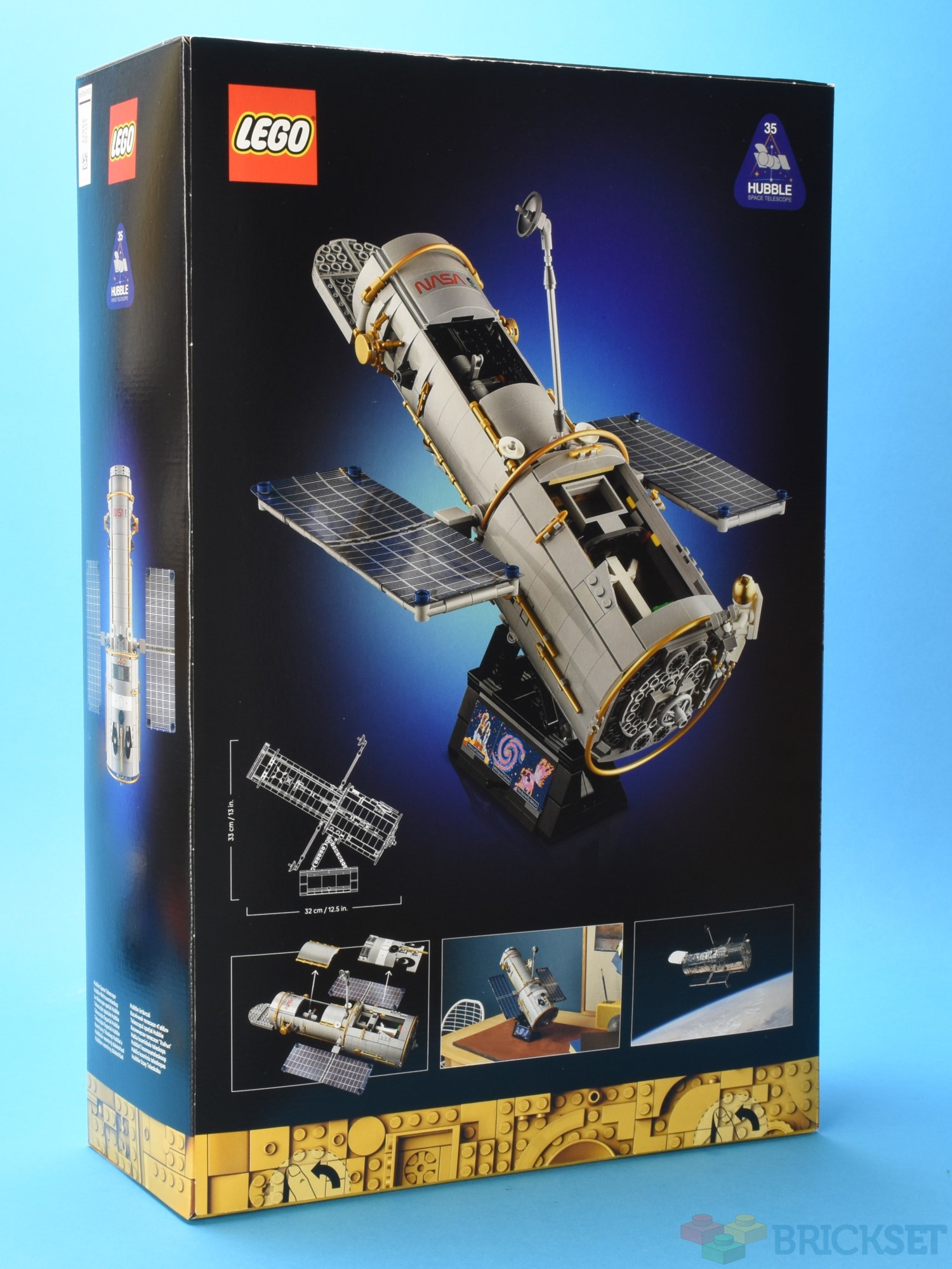
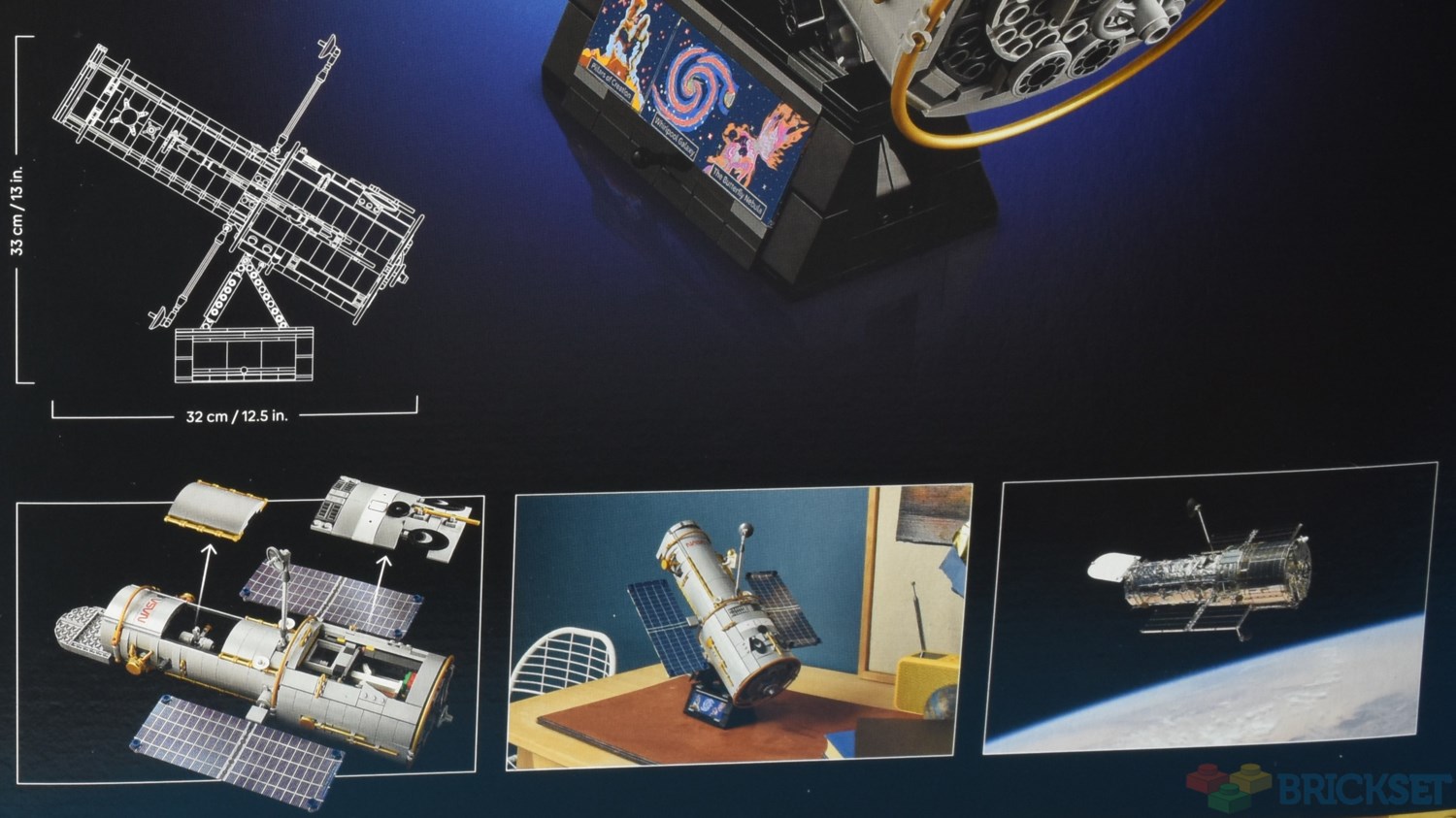
On both sides of the box are images of 11382 Hubble Space Telescope sitting on its display stand. The image on the back shows that there are two removable panels that enable you to peer into the telescope to see some of the interior components.
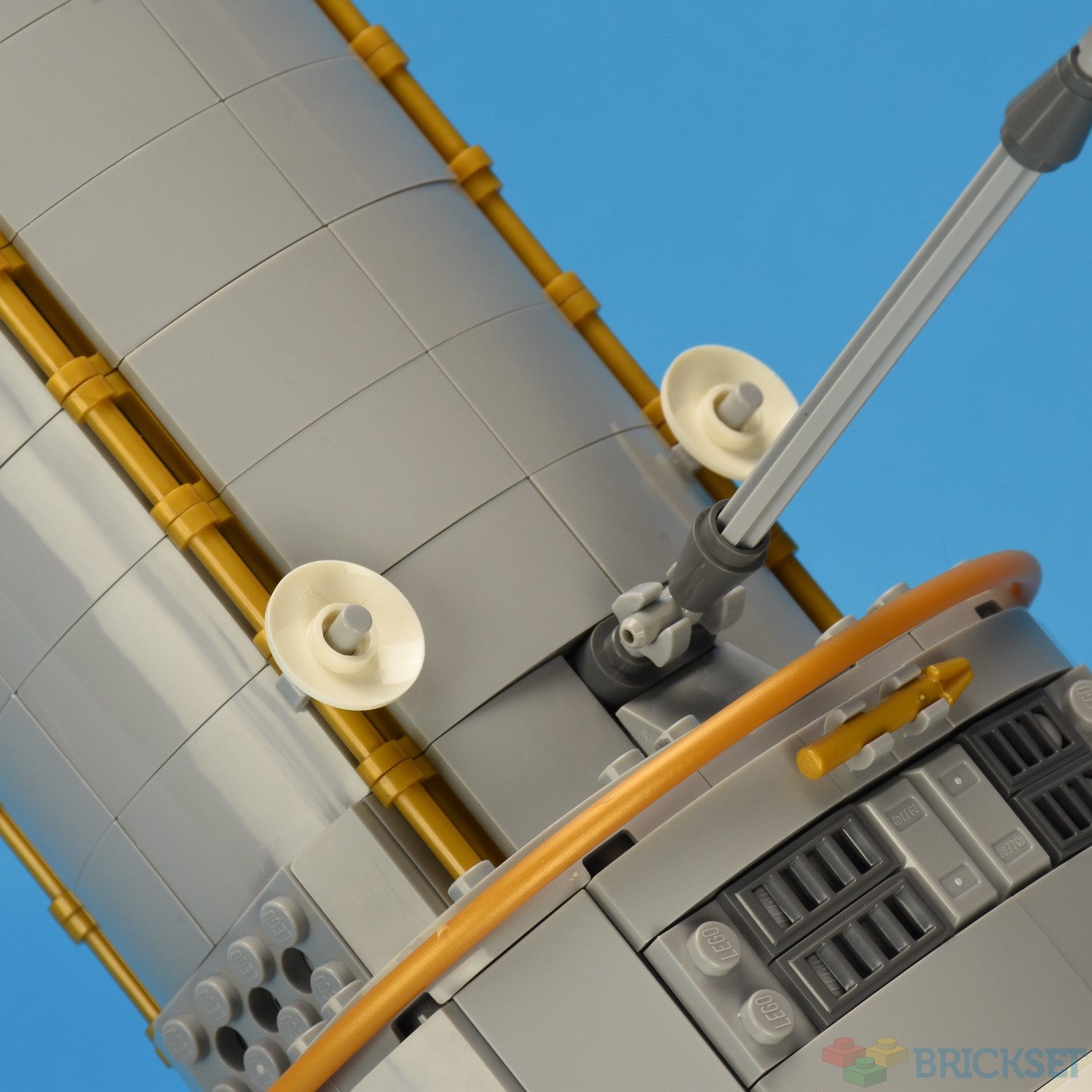
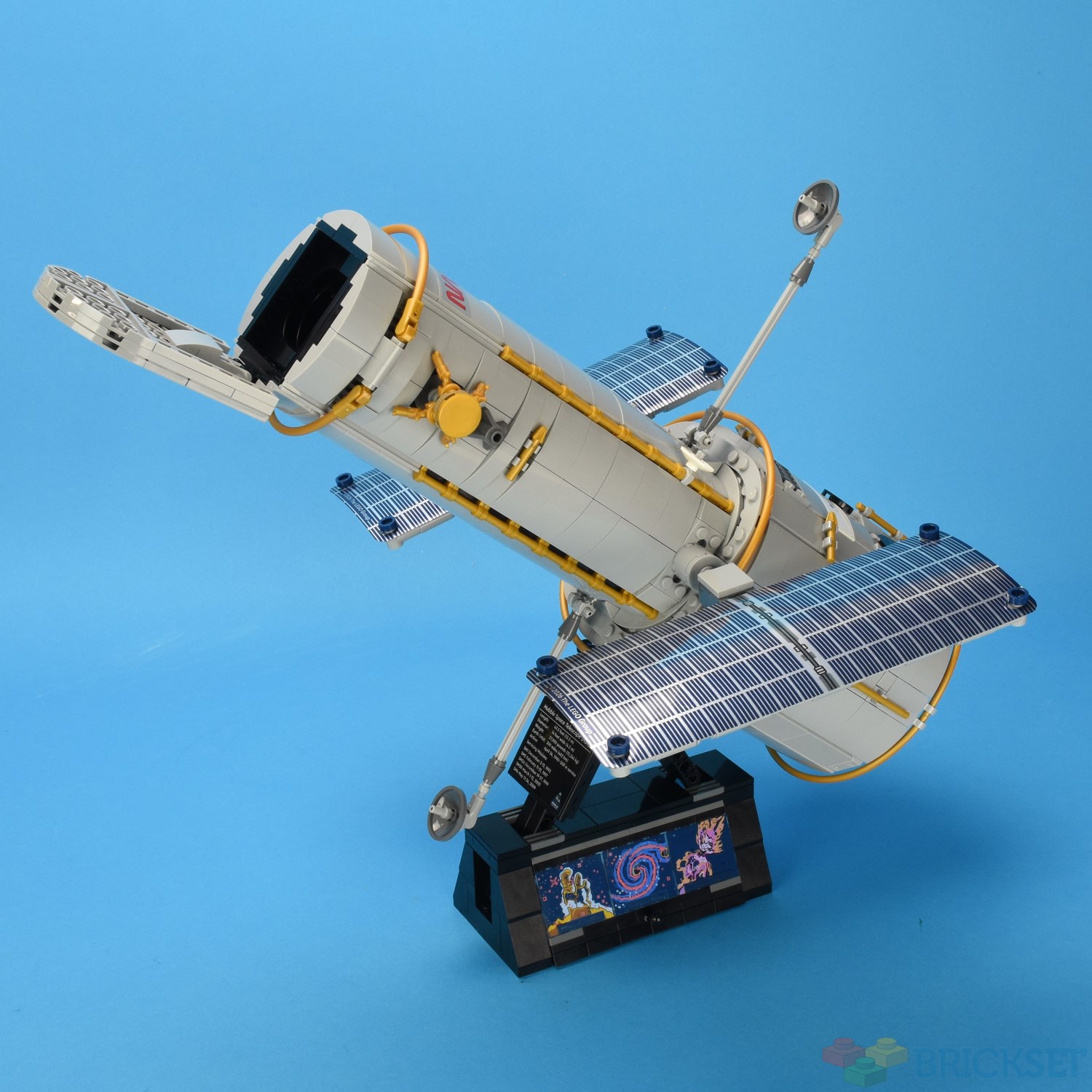
In each of the two principal images on the front and back of the box, the LEGO HST model has one of the two High Gain Antenna placed at an angle to the telescope's main body. These antennas lay flat against the HST body when it lay in the Payload Bay of space shuttle Discovery. They were folded out soon after the HST was deployed into orbit.
In all the images I have seen of the HST floating in space, these antennas are perpendicular to the principal axis of the HST. So, for me, these box art images show lack of care in correctly posing the model.
There are three smaller images on the rear of the box that show:
Two panels that can be removed to reveal some of the internal detailing of the model,
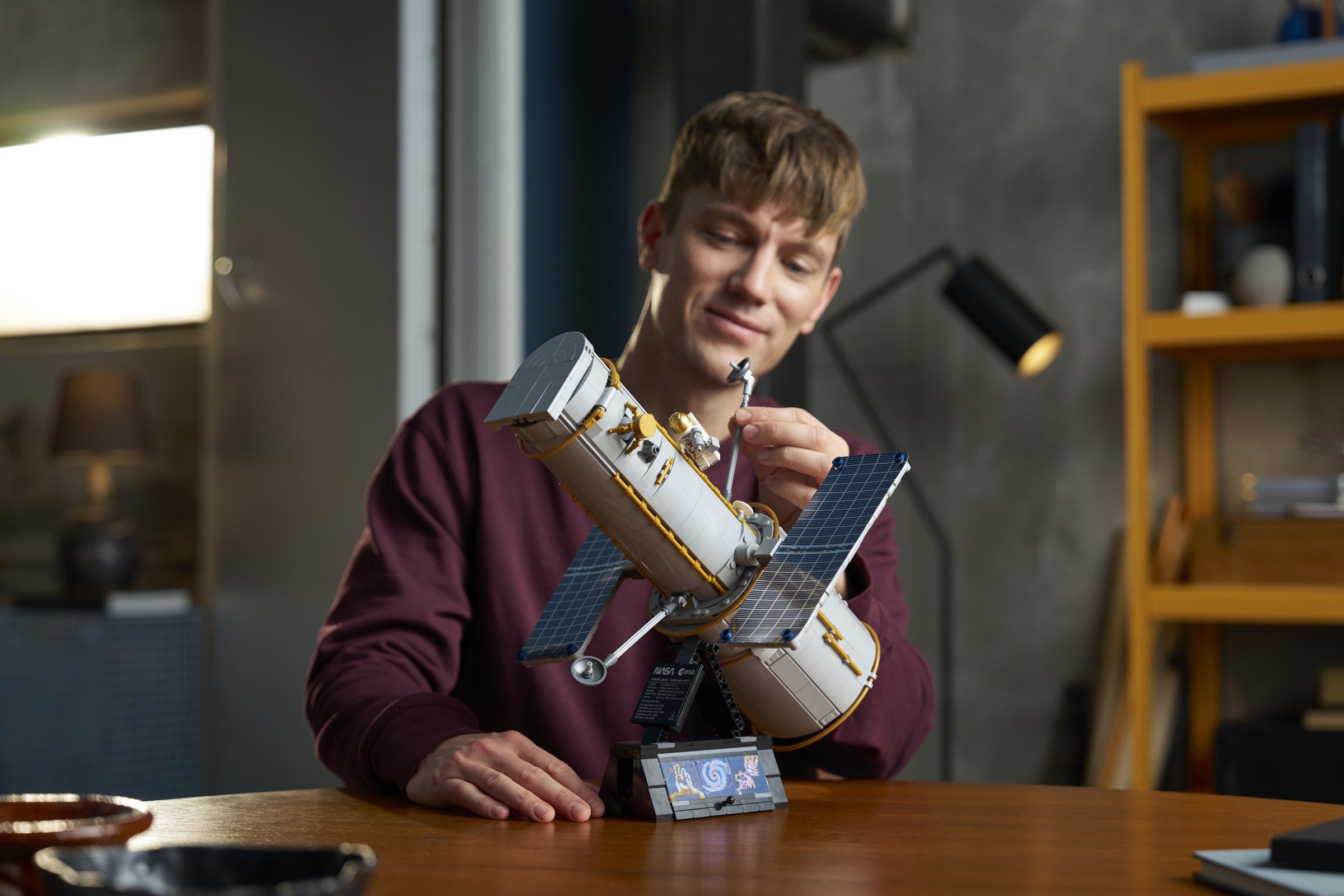
An image of the completed model displayed on a desk, and
An image of the HST floating in space high above a blue earth.
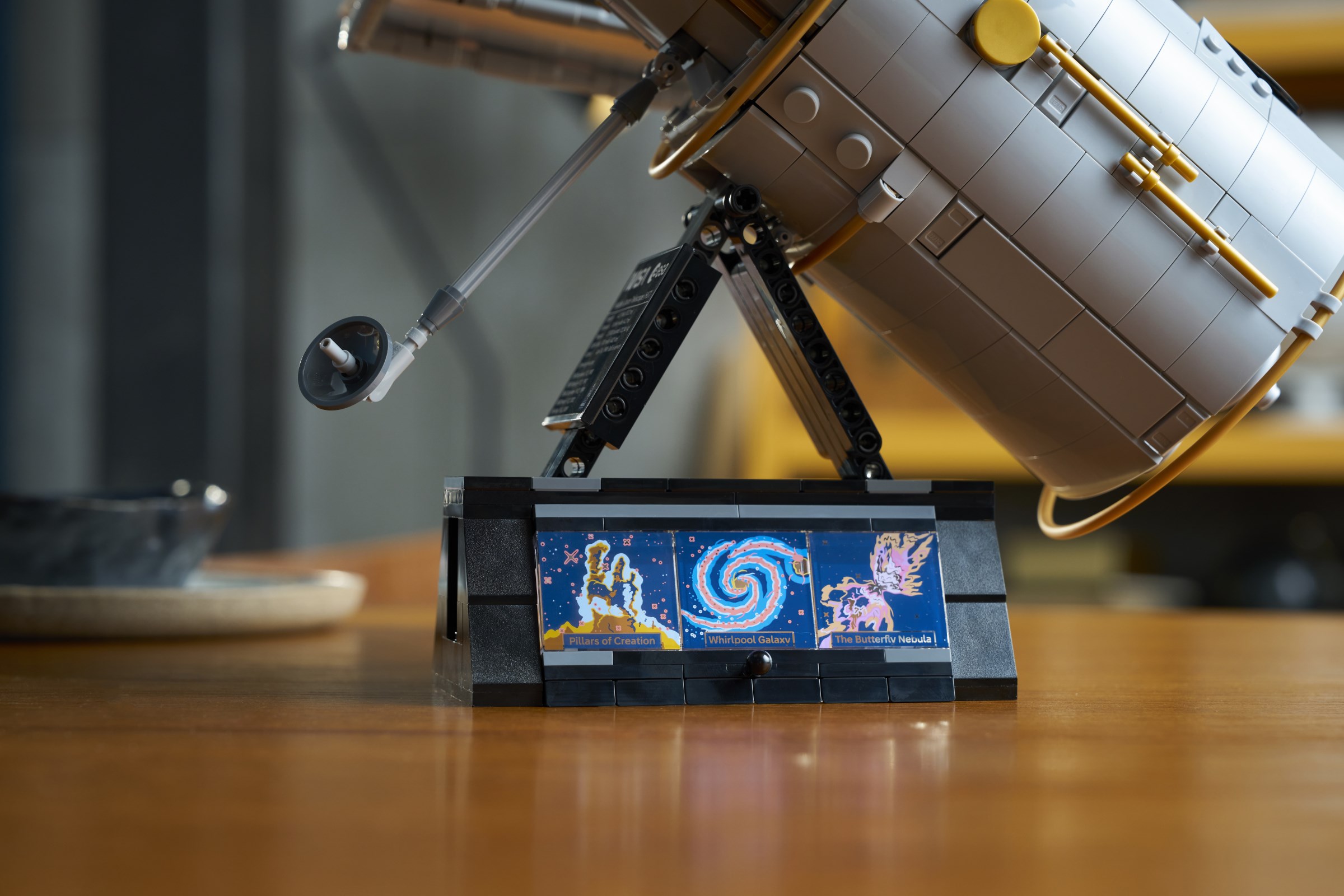
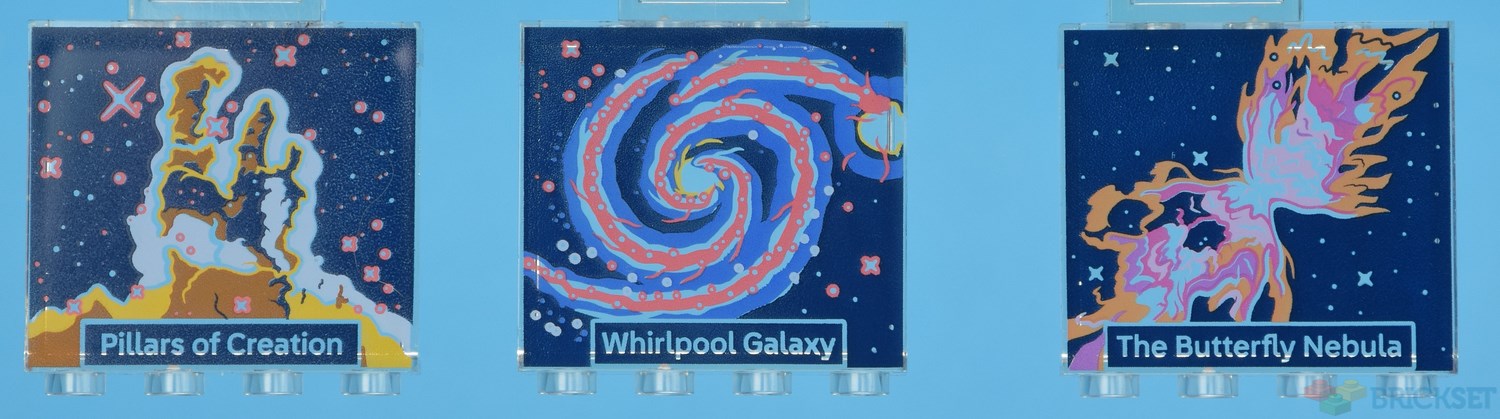
On the end of the box is an image of three printed transparent 1x4x3 Wall Elements that have three iconic HST images printed on them (these are discussed in detail later in the review).
There is also an image of the astronaut minifigure and the celebratory HST logo (also discussed later in the review).
There is a black and white blueprint-styled image of the finished model giving its dimensions.
The model measures just over 45 studs long (360mm - 14.2 inches). So, the model is produced at a scale of about 1:37. An astronaut standing 1.9 m tall (6.2 feet) would be about six studs tall. This model is close to, but marginally larger than minifigure scale.
Instructions
The instructions come in one medium-sized 174-page booklet.
Sticker sheet
There is a medium-sized sticker sheet included in the set.
For a set to be labelled in the Icons theme, marketed to adults (18+ years old) and be primarily a display model, there will be many people, myself included, who consider that this LEGO set should not have any stickers included.
It would be really helpful to have some consistency in the policy of having a fully printed element format for LEGO sets.
Parts
The 1252 parts are divided into nine numbered bags.
There is a large flexible sheet which makes up the two solar panels deployed on the HST.
The panel format is based on the solar arrays installed during Servicing Mission 3B. This was the second time that the arrays had been replaced. These new arrays and a new power control unit provide HST with more than twenty percent additional power.
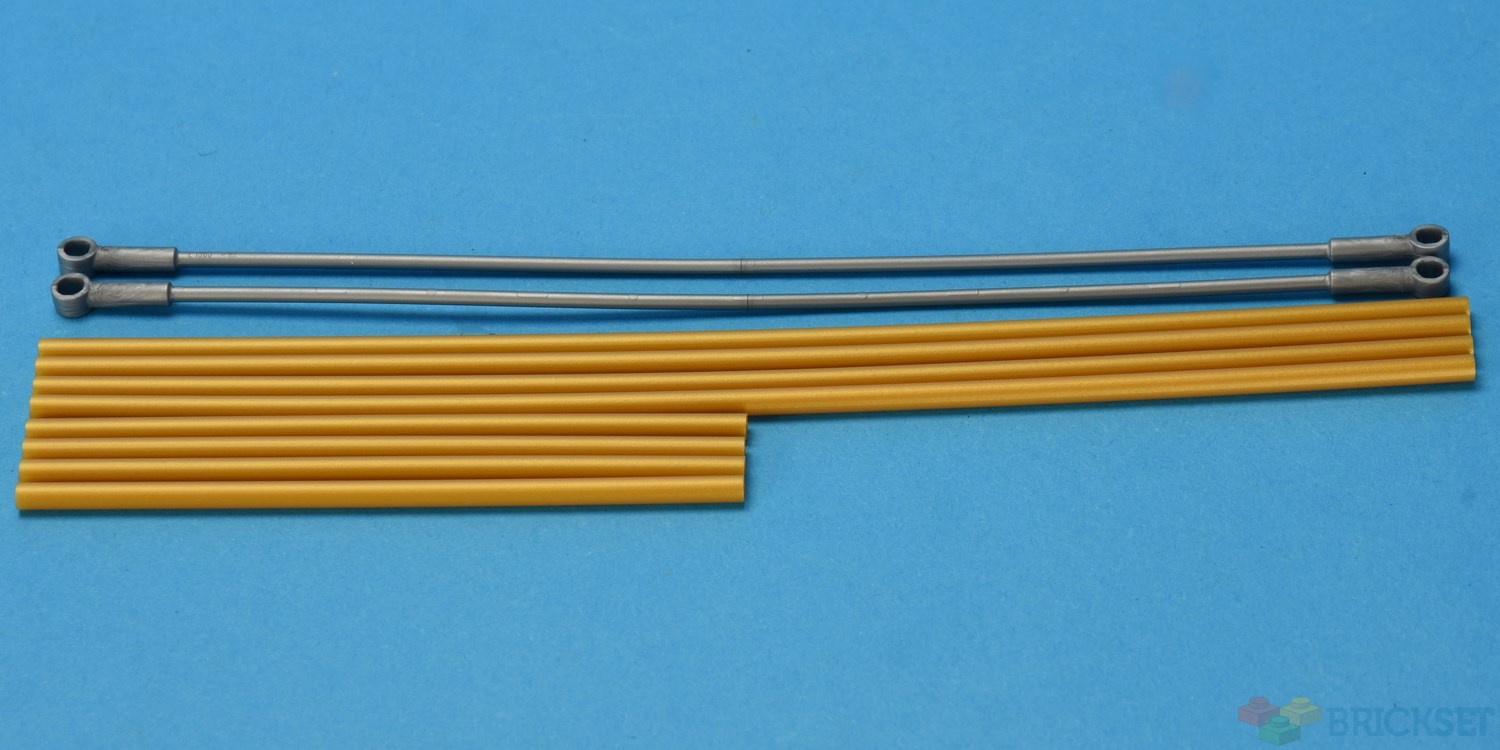
These flexible tubes come in a perforated plastic bag.
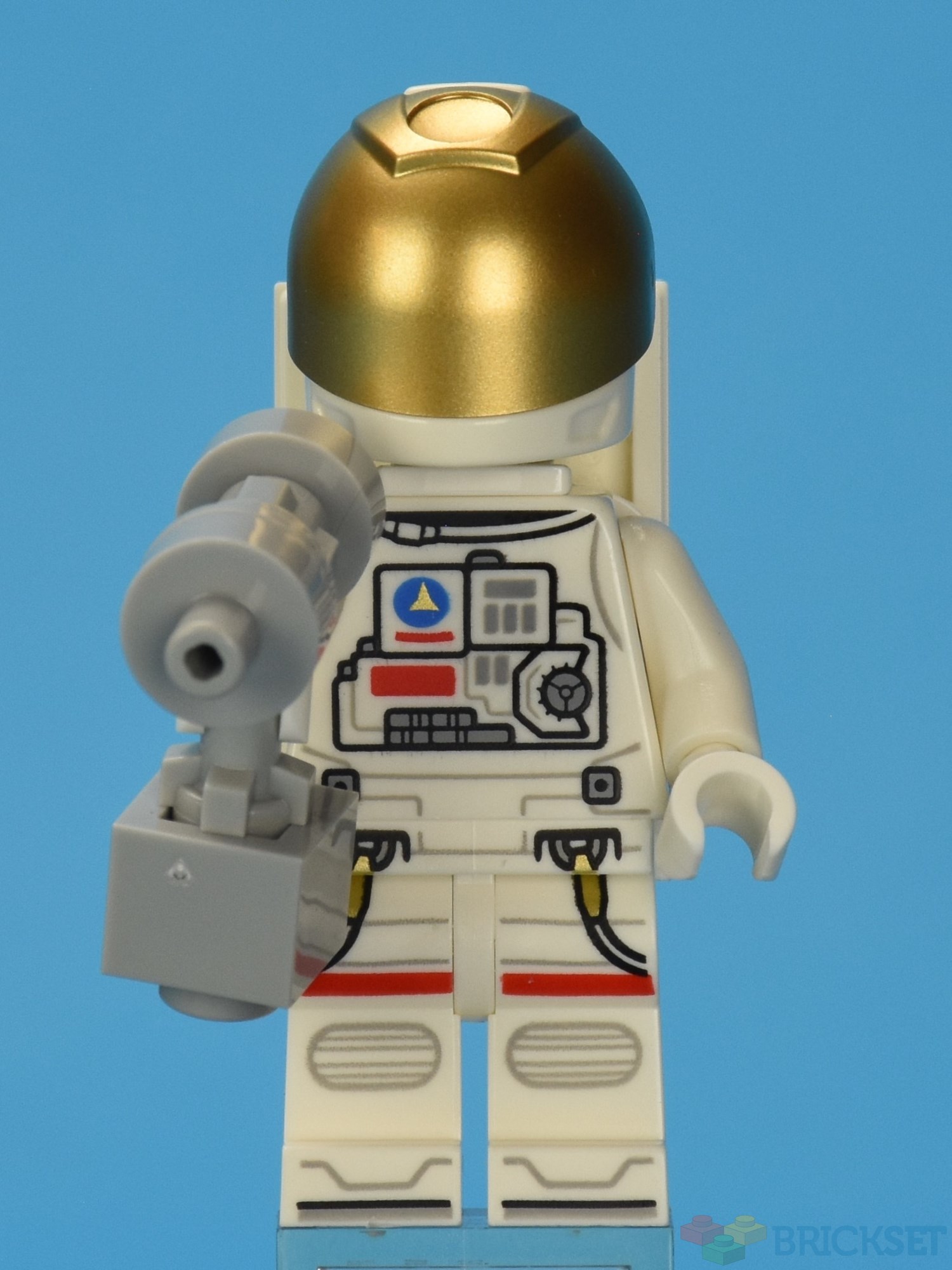
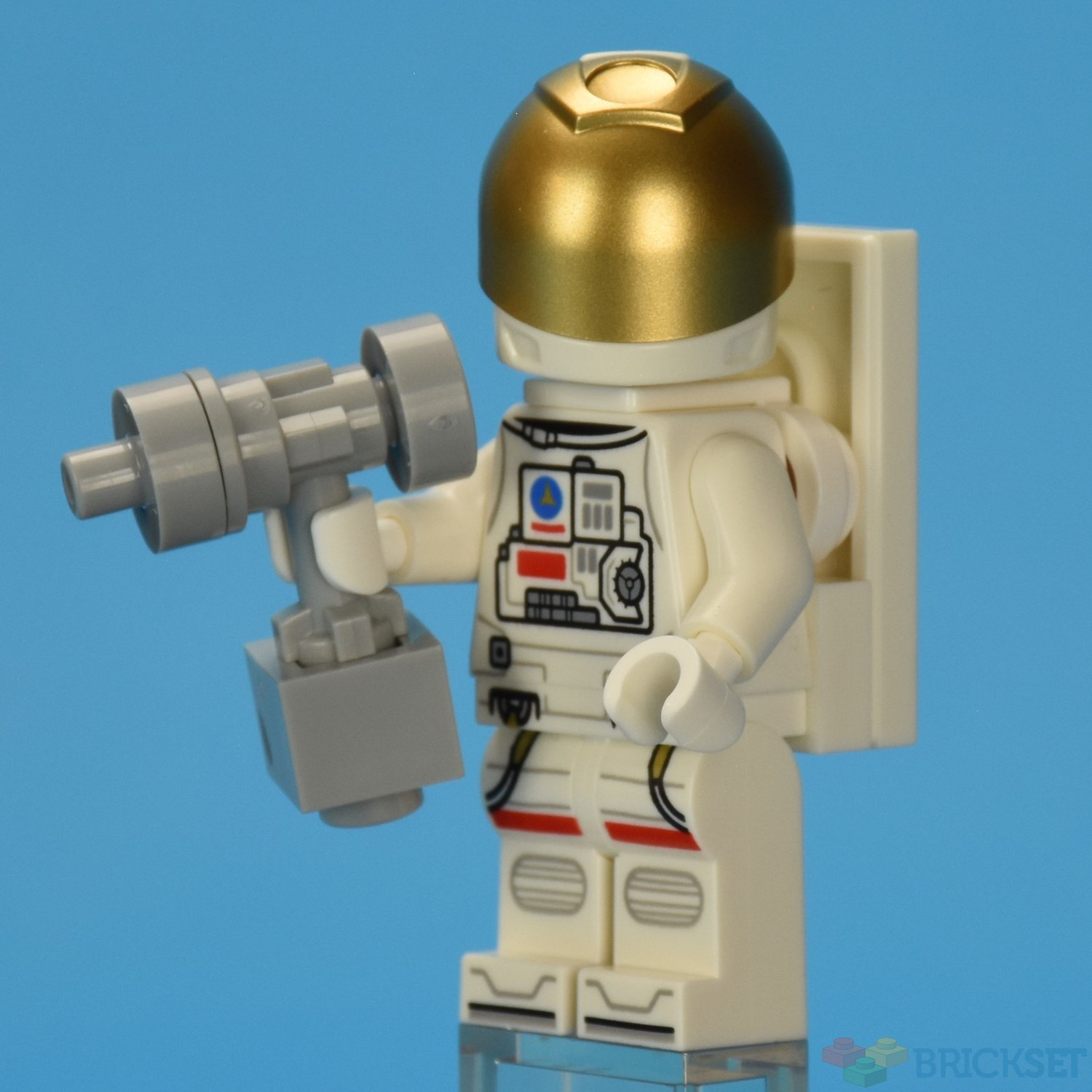
There is one minifigure astronaut included with the 11382 Hubble Space Telescope.
The astronaut is wearing a NASA Extravehicular Mobility Unit (EMU). The image on the left has the astronaut holding a brick-built battery drill, while the image on the right has the astronaut wearing an EMU without Extravehicular Visor Assembly.
The torso is effectively the Hard Upper Torso (HUT) element of the EMU.
Included in this printed design are the various EMU controls. Clockwise from the left, these include:
Push to talk (PTT) button
Fan switch
Purge valve
Cooling control valve
O2 Actuator control
Display intensity control, and
Volume controls
There are two coloured patches on the DCM. The coloured circle is the mission patch. The large red patch would have the acronym NASA on it – National Aeronautics and Space Administration.
The two square symbols below the DCM are mini-workstation mounts.
Just like real astronauts wearing an EMU, the minifigure's helmet comes in two parts:
The outer part is the Extravehicular Visor Assembly (EVVA). This includes visors that are manually adjusted to shield the astronaut's eyes.
The helmet, which would normally have a clear polycarbonate bubble, neck disconnect and ventilation pad.
Under the helmet, the astronaut is wearing a Snoopy cap – also known as the Communications Carrier Assembly (CCA).
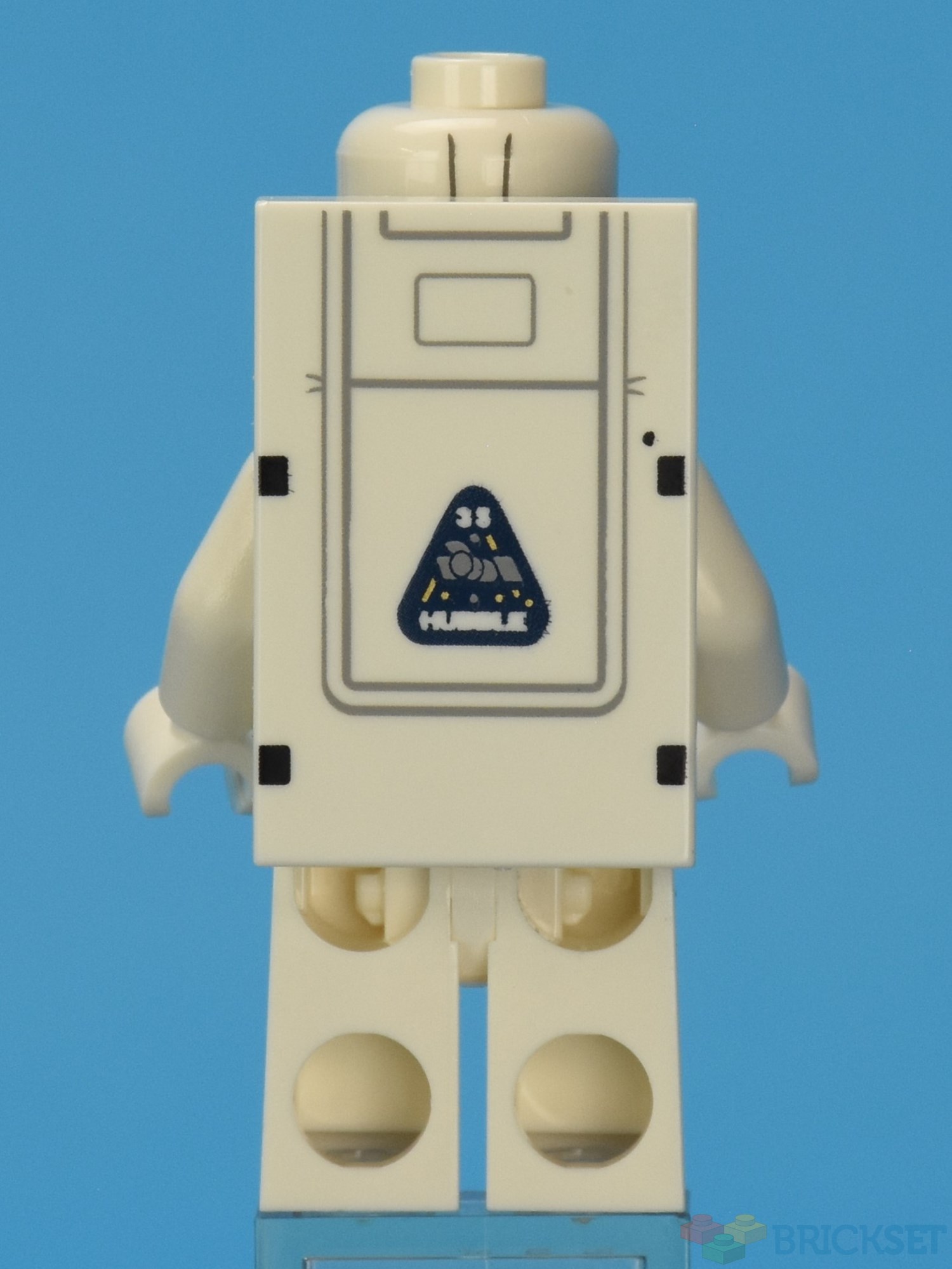
The Primary Life Support Subsystem (PLSS) is a printed 2x3 white tile. This tile also includes a HST 35th anniversary logo.
The PLSS is connected with a Neckwear Bracket with 2 Back Studs. I believe this is the first time this element has appeared in any colour other than trans clear.
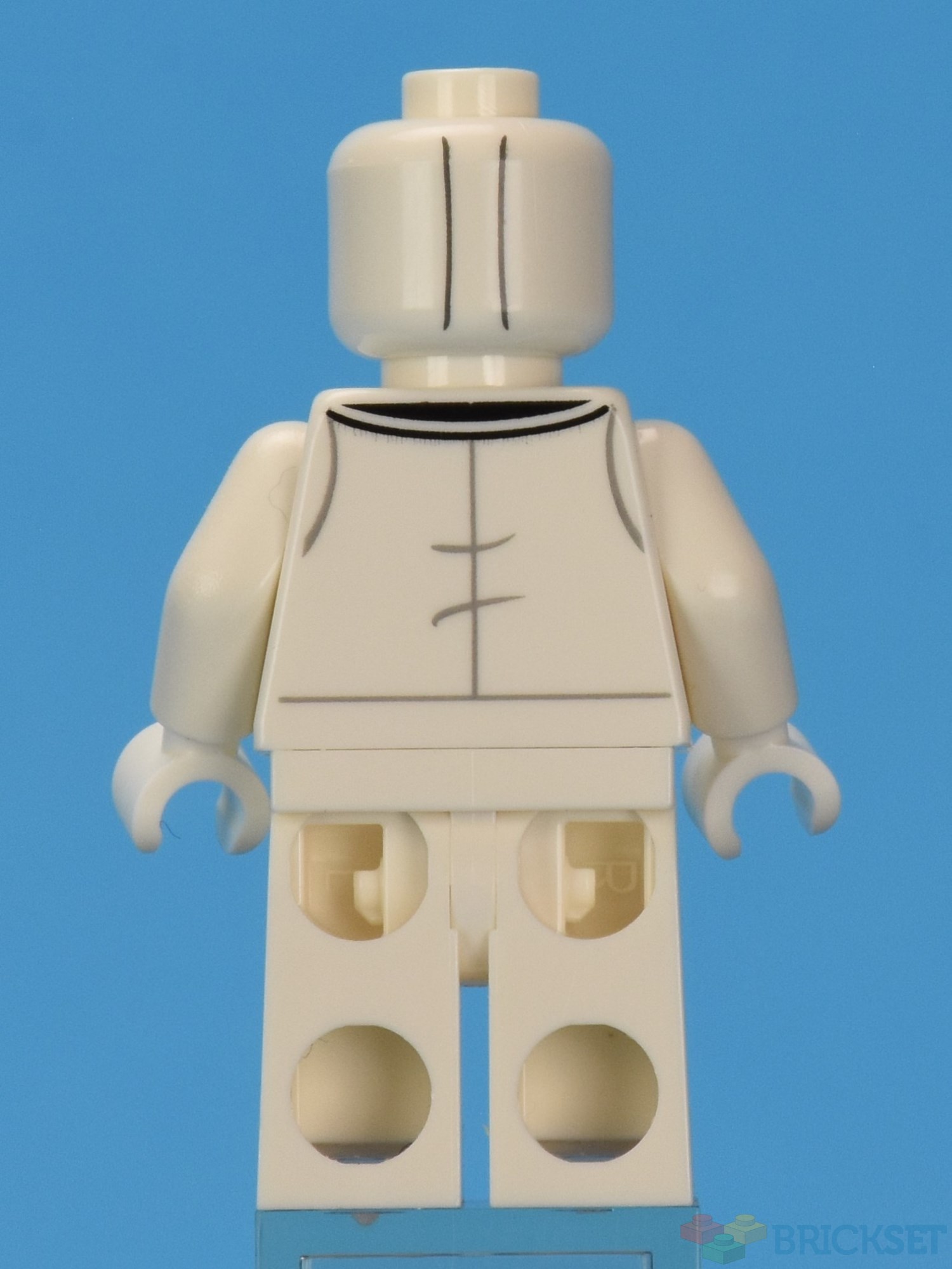
When the neck bracket is removed, you can see the stitching printed on the rear of the Hard Upper Torso element of the EMU, and also at the rear of the Snoopy cap (CCA).
Around the collar of the Hard Upper Torso can be seen the connection ring for the helmet.
The last two astronauts to conduct an EVA to service the HST were Mission Specialists John M. Grunsfeld and Andrew J. Feustel. Given that John M. Grunsfeld has a moustache, this minifigure could be Andrew J. Feustel.
The astronaut's legs are a printed element to represent the Lower Torso Assembly (LTA) of the EMU. There are two tether straps that are used to safely tether the astronaut during their EVA.
The red stripes on the legs are used to differentiate astronauts during their EVA.
NASA therefore relied on simulation to mimic the space environment and give astronauts time for preparation and carefully choreograph the Extra Vehicle Activity (EVA), described as 'a ballet of bodies and three hundred tools.'
Service mission 1 was the most significant in that a serious problem with the optical system had to be conducted in space (thiis is discussed later in this review).
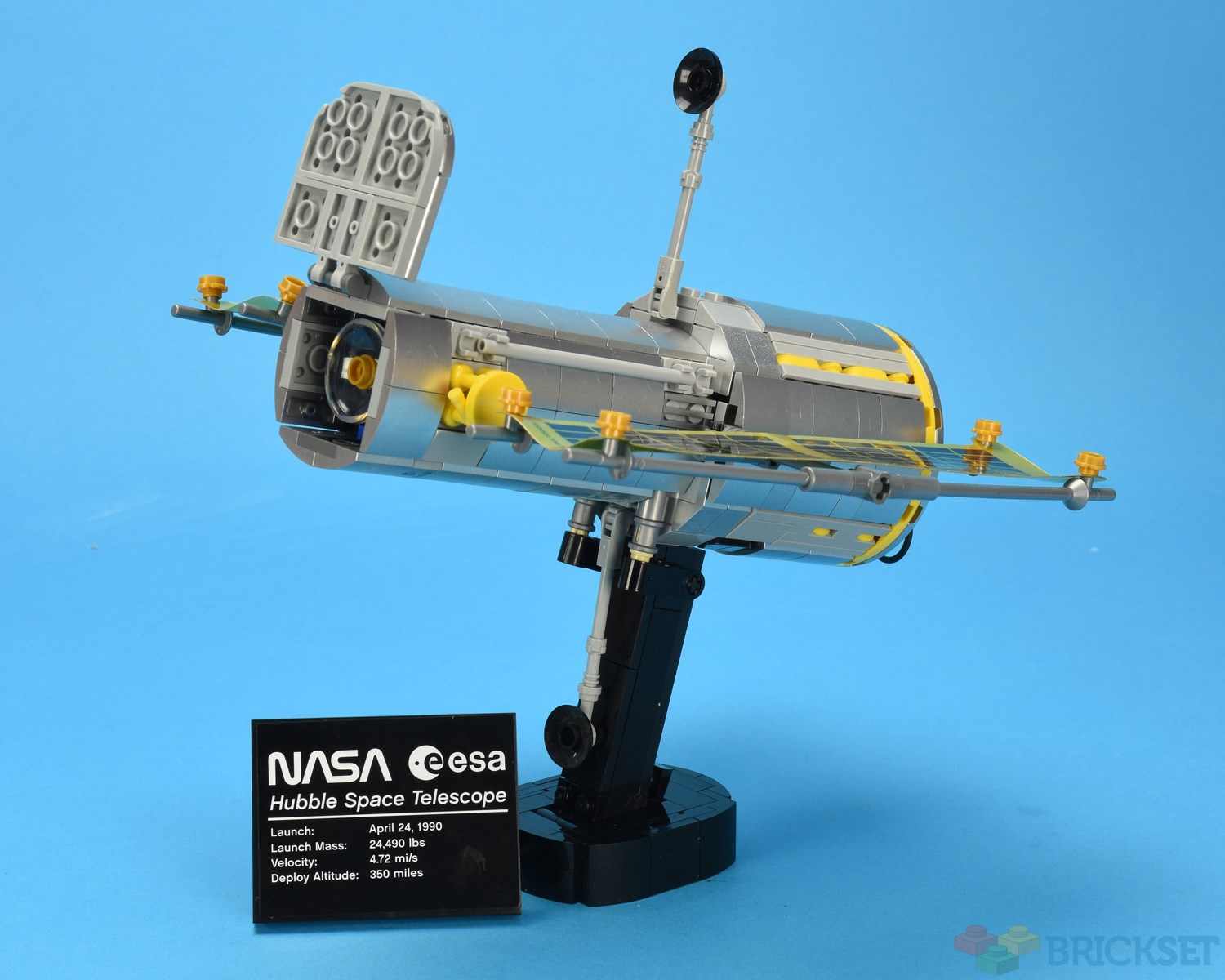
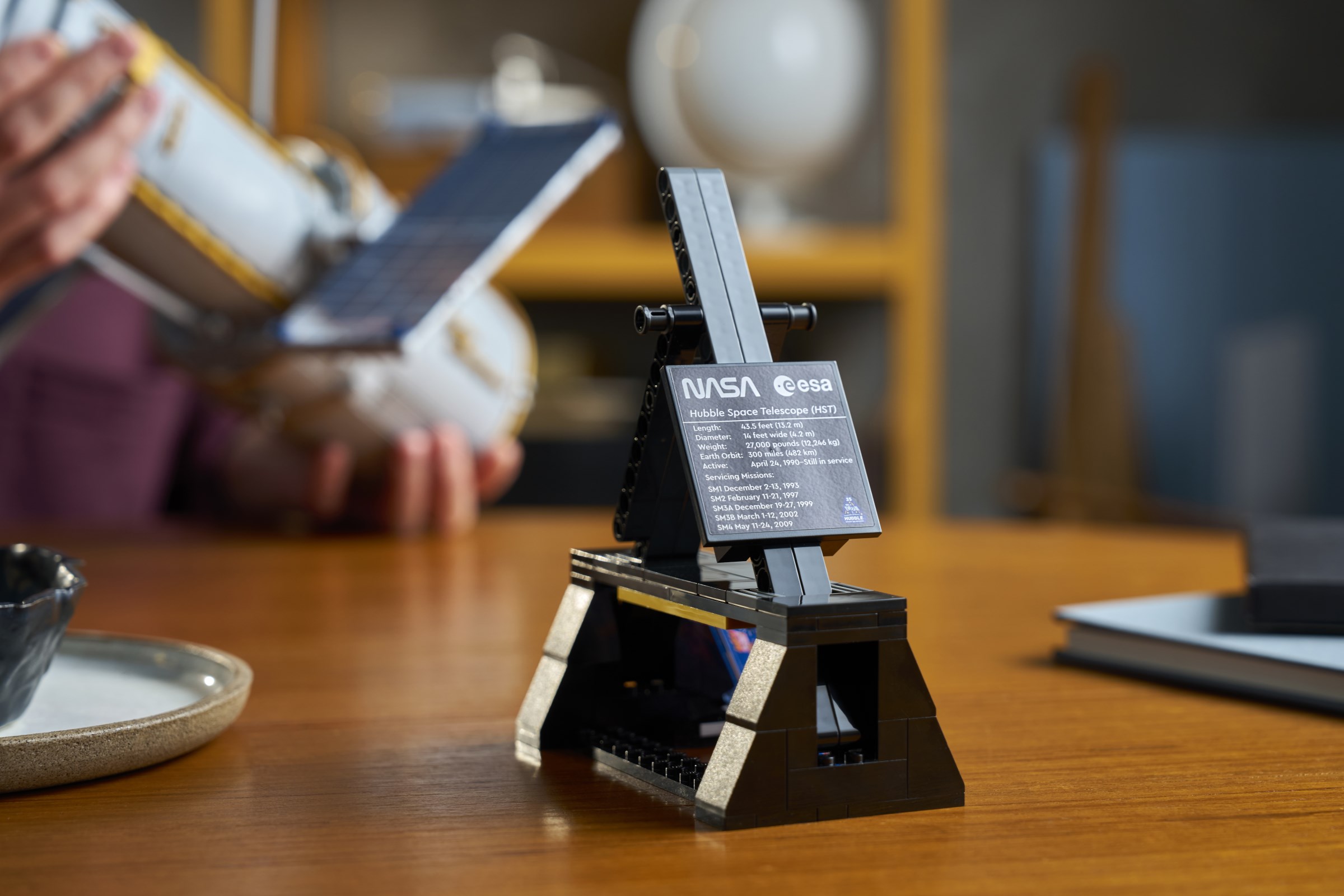
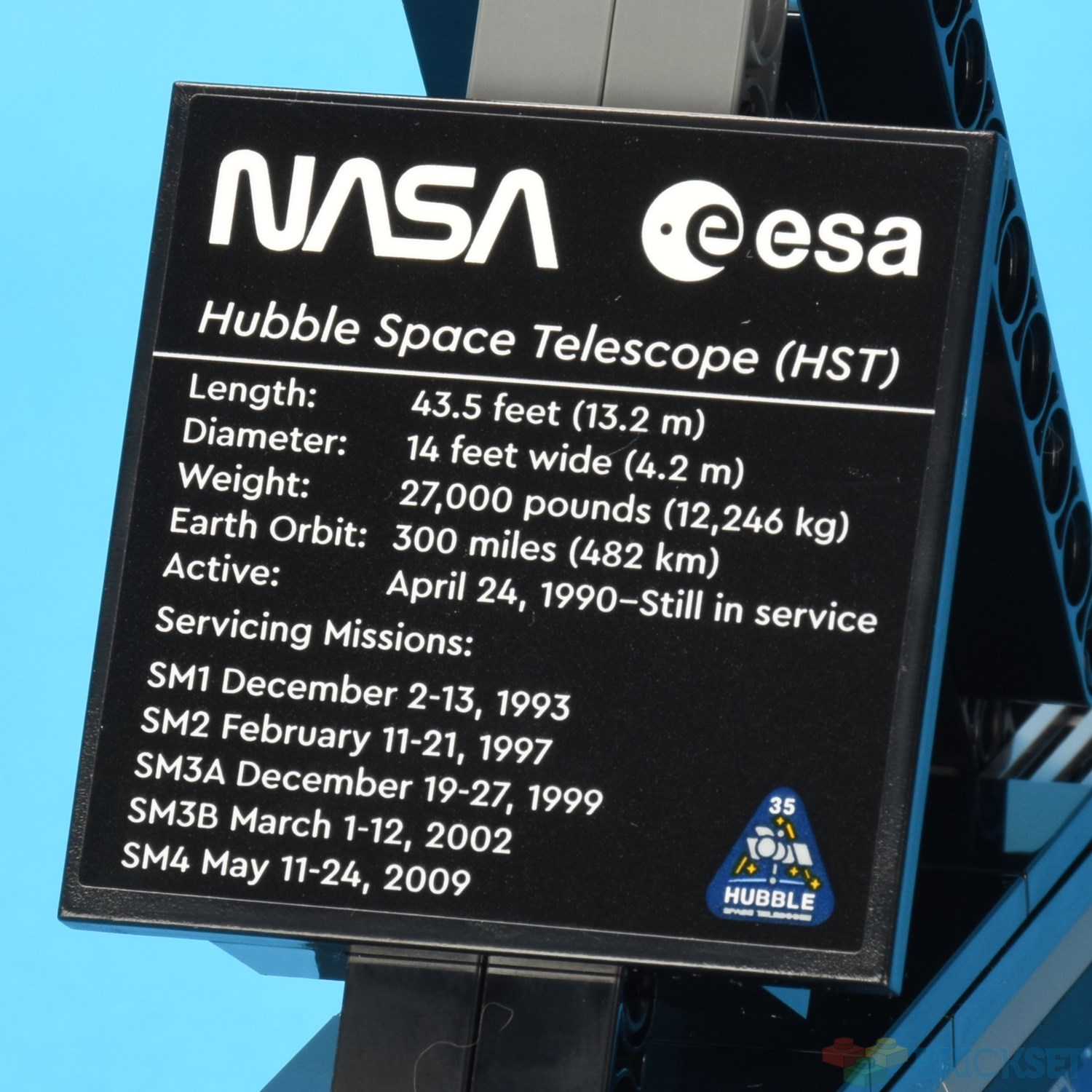
Since its inception, funding and resourcing for the HST has been shared by NASA and the European Space Agency. The display plaque has both these agencies' logos to reflect that partnership.
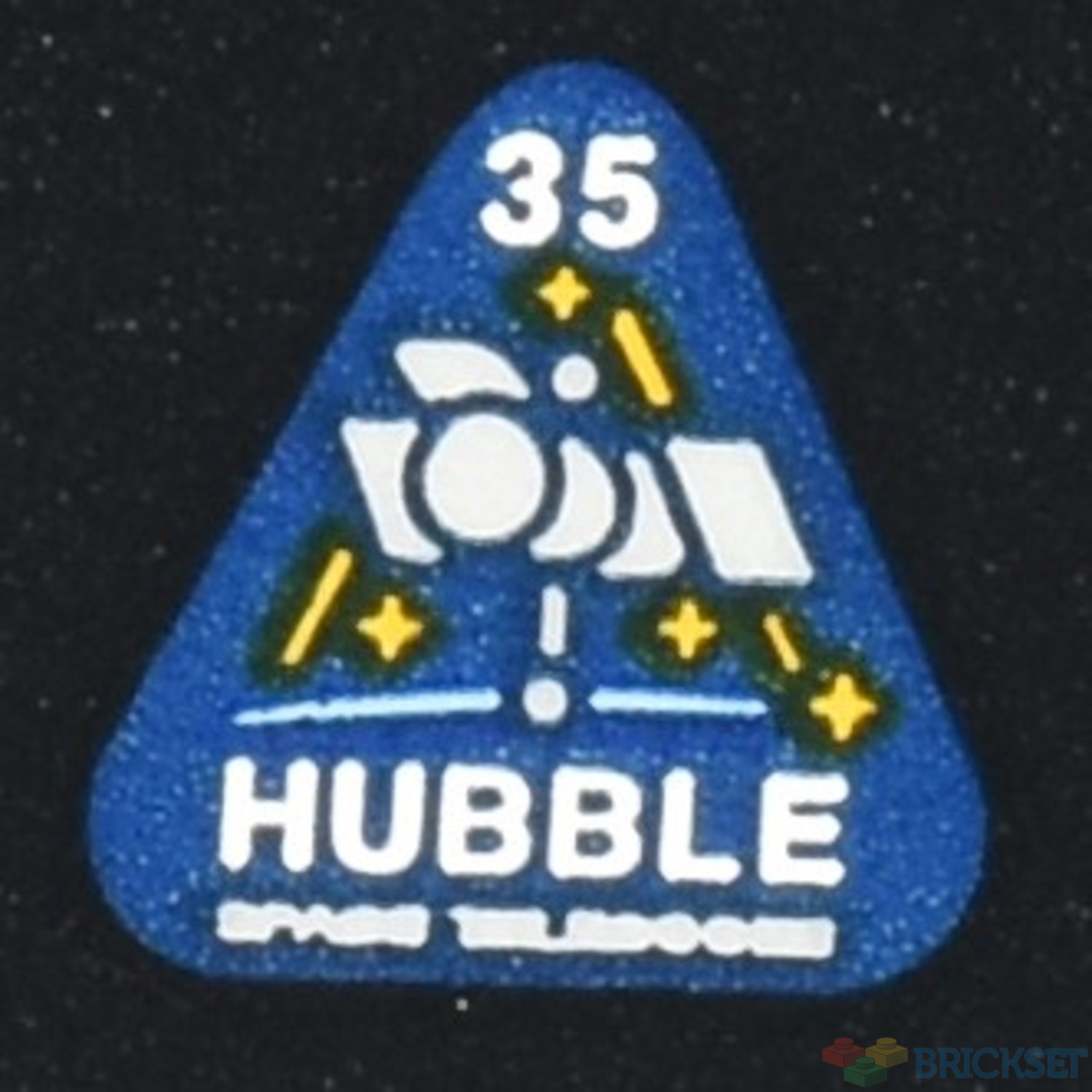
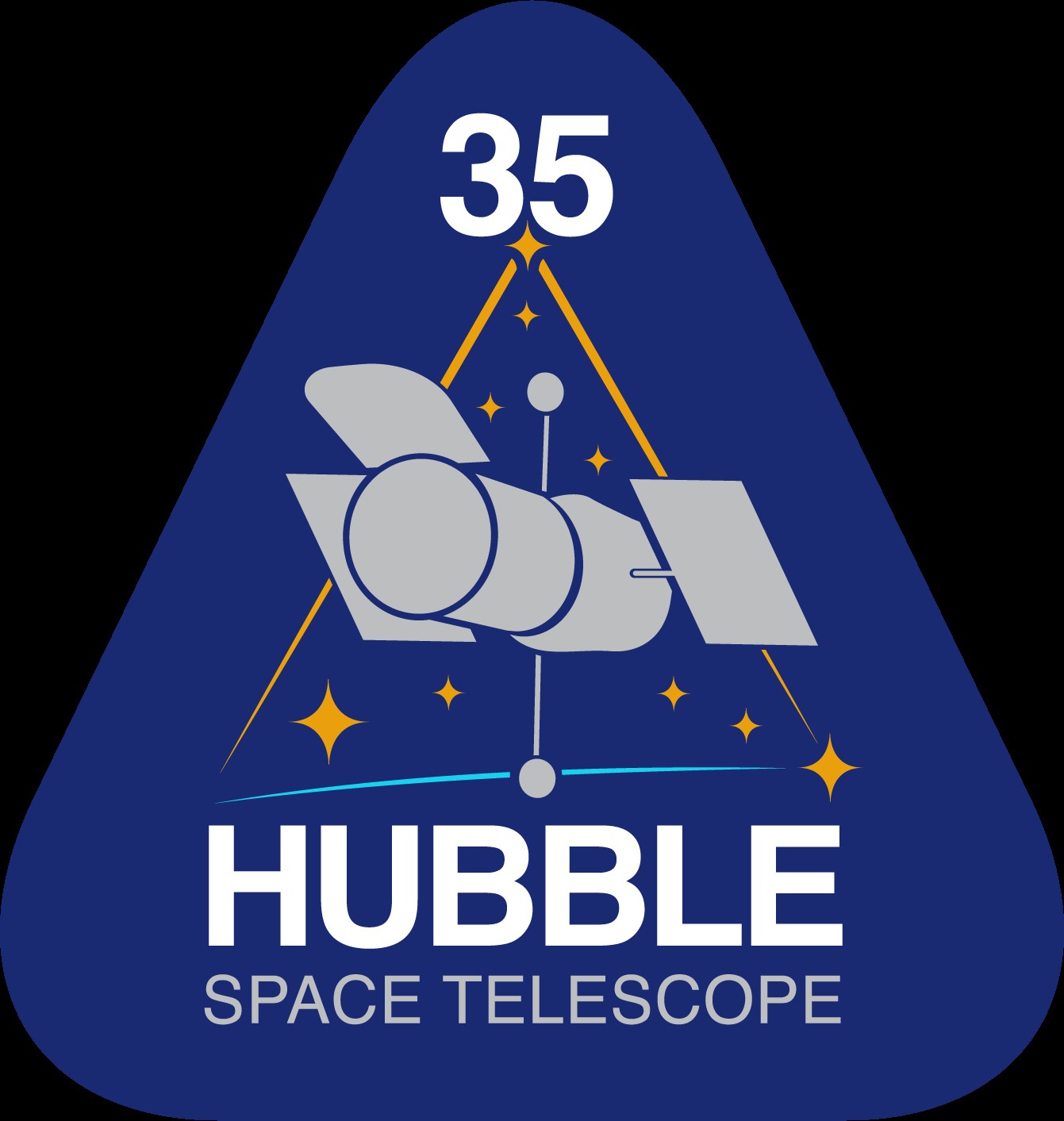
Here is the actual logo used to celebrate the HST 35th anniversary. There are similar celebratory logos for HST's 30th and 25th anniversaries,
HST celebrated 35 years of operation in April 2025, so 2026 is HST's thirty-sixth year of operation. LEGO have released 11382 Hubble Space Telescope and are therefore commemorating this milestone one year late!
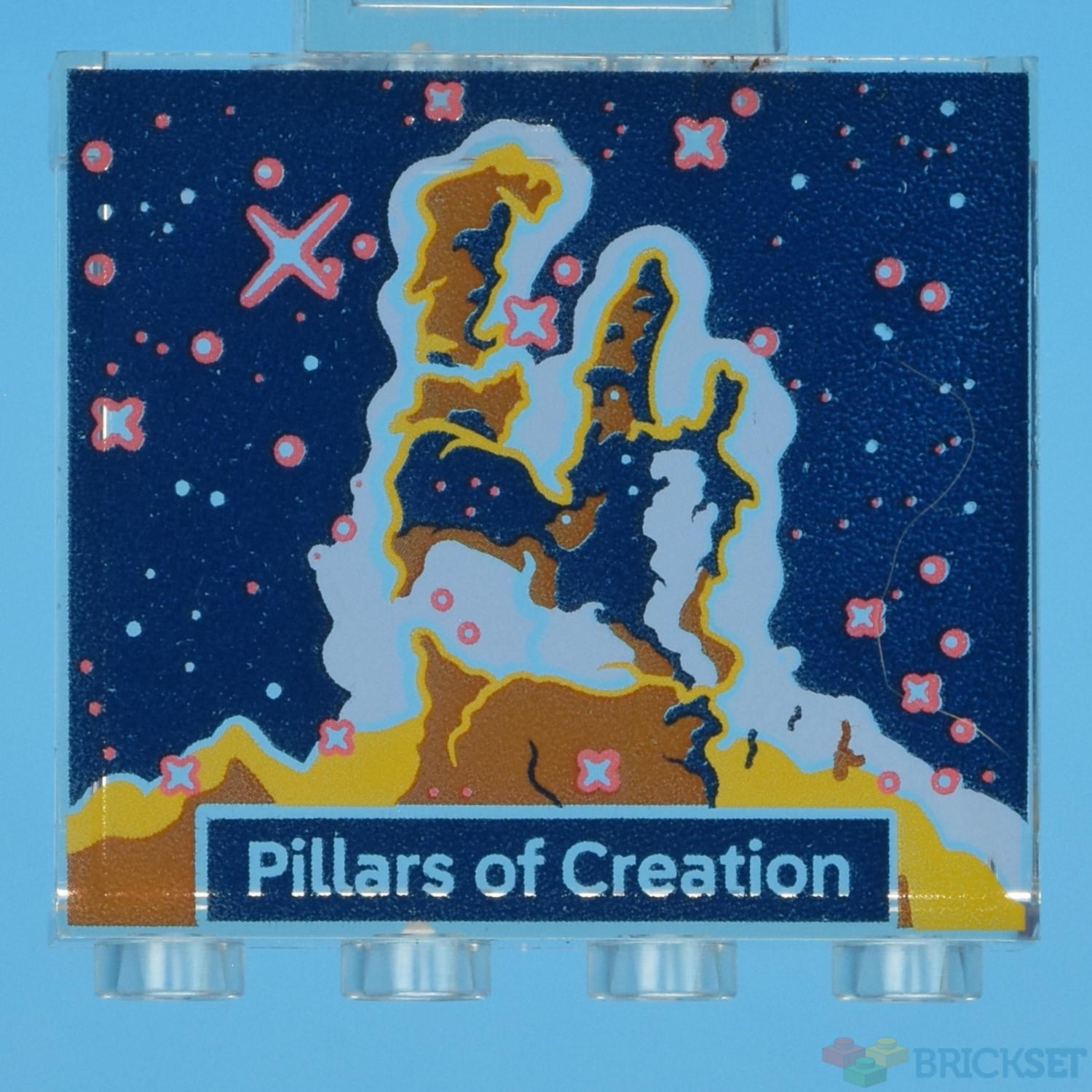
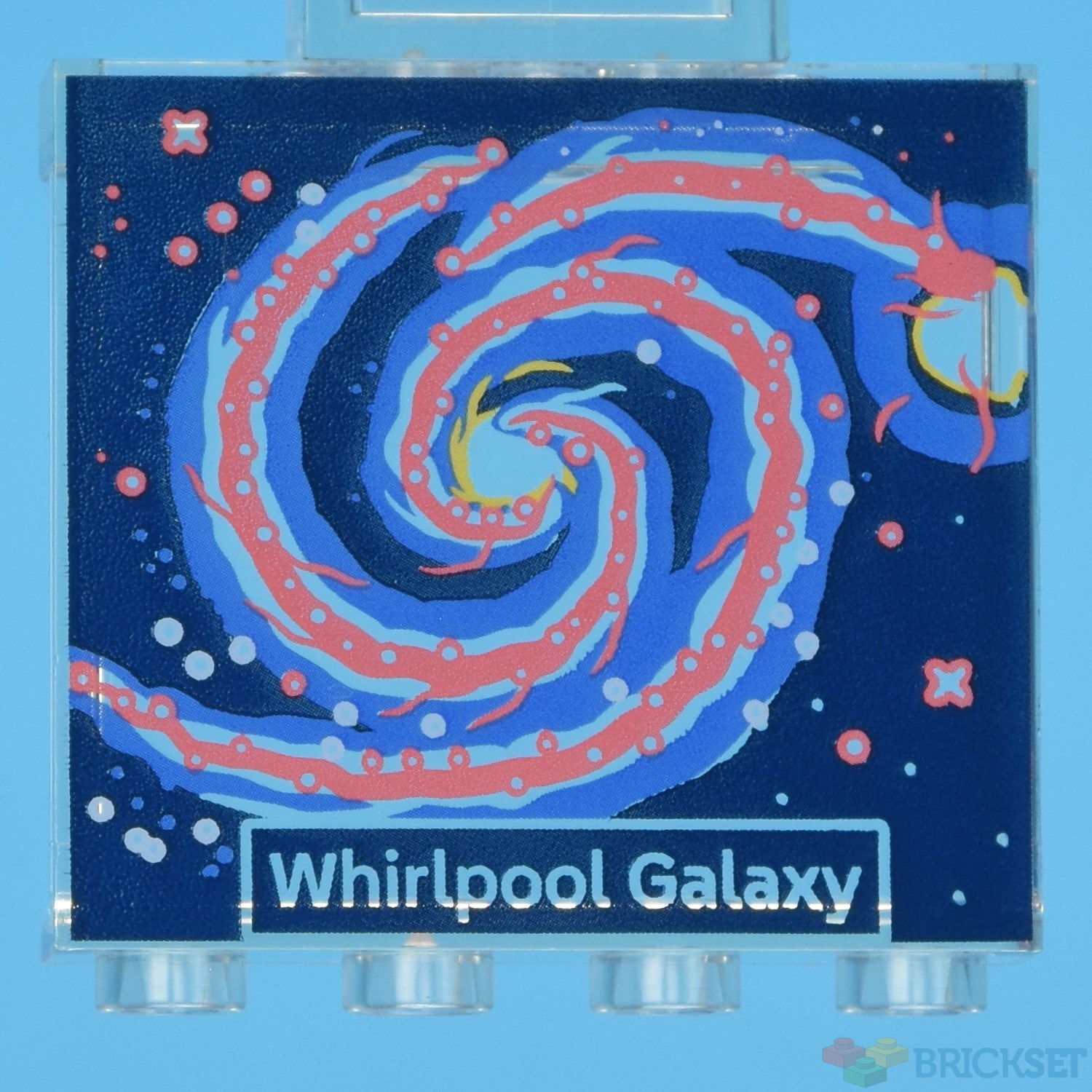
On the display stand are three printed transparent 1x4x3 Wall Elements. The prints on these three elements reflect three of the HST's iconic images:
Eagle Nebular Pillars of Creation
The Whirlpool Galaxy, and
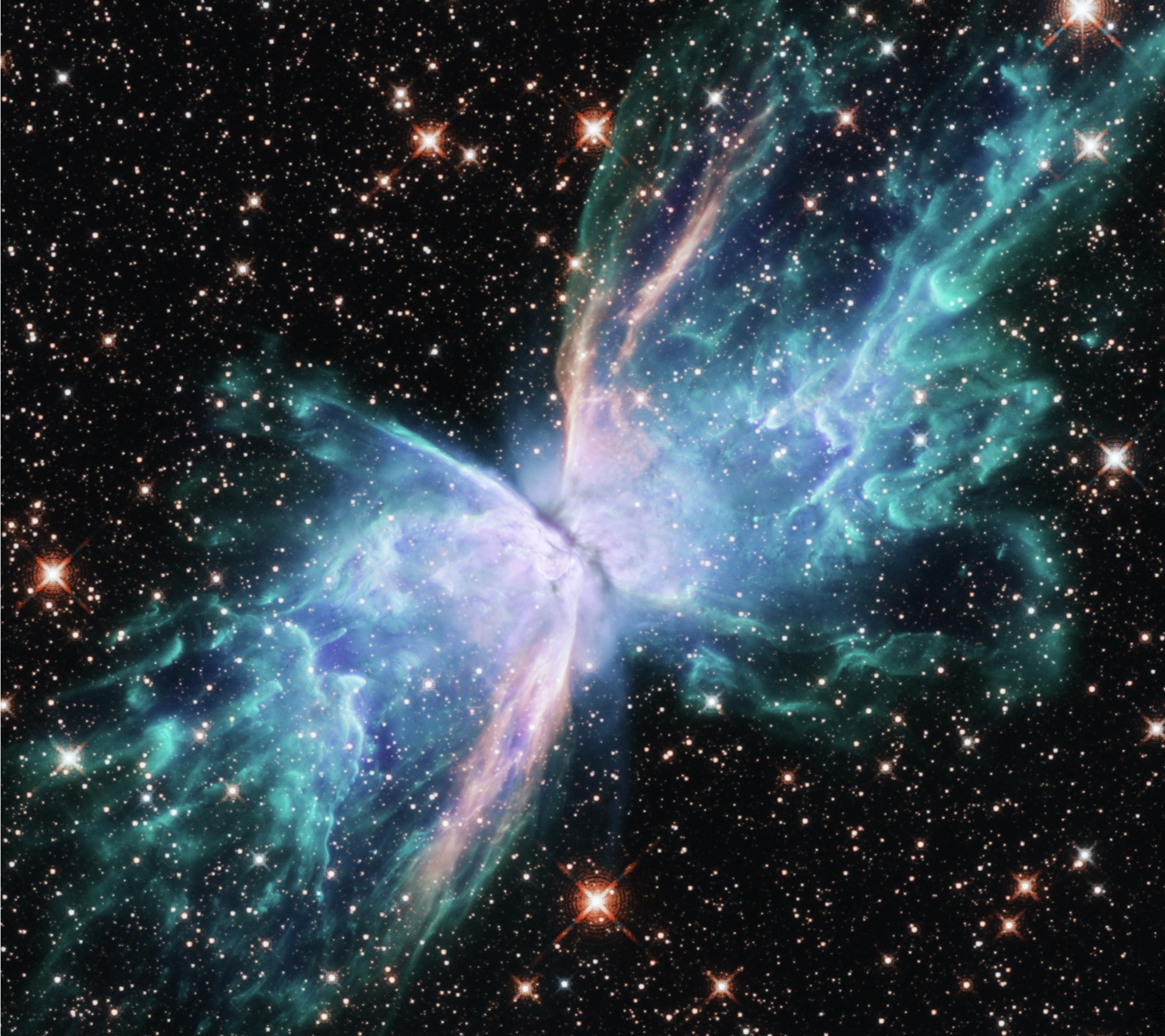
The Butterfly Nebula
When these elements are assembled on the display stand, they will be inverted, so the prints appear as if they are upside down.
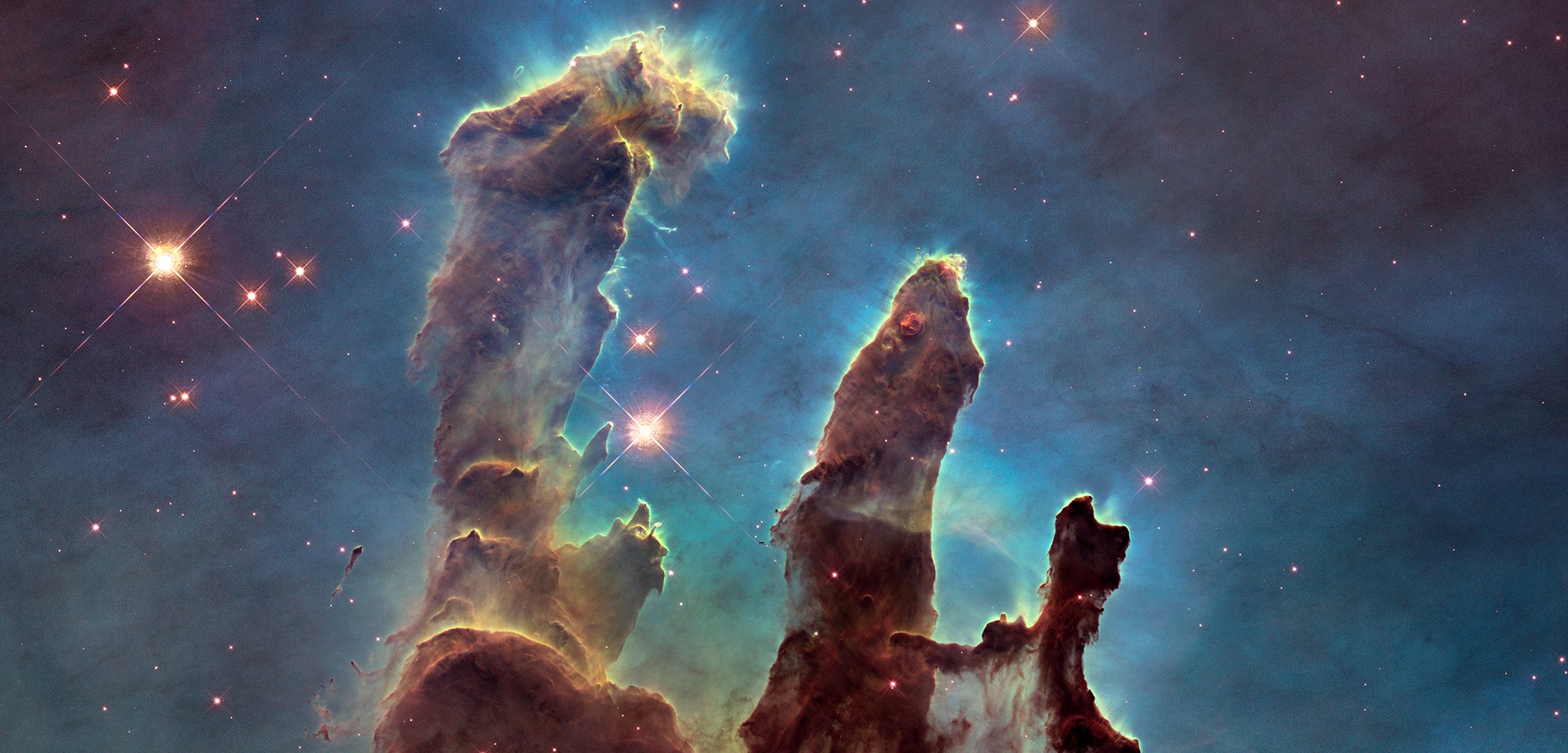
Eagle Nebula Pillars of Creation
The Eagle Nebula is catalogued as Messier 16 (M16)
The Pillars of Creation, in the Eagle Nebula (M16), were imaged by the HST in 1995, after five years in service. Then, to celebrate the HST's 25th year in orbit (2015), astronomers revisited the Pillars of Creation again. This 2015 image can be seen below.
The Whirlpool Galaxy is catalogued as Messier 51 (M51).
The graceful, winding arms of the majestic spiral galaxy M51 (NGC 5194) appear like a grand spiral staircase sweeping through space. They are actually long lanes of stars and gas laced with dust. The image below was taken by the HST in 2005, after fifteen years of operation.
NGC 6302 lies in the constellation of Scorpius and is between 2,500 and 3,800 light-years away.
The colourful wings of the Butterfly Nebula are regions of hot gas heated to more than 20,000 degrees Celsius (36,000 degrees Fahrenheit). These regions of hot gas are moving through space at more than 965,000 km/h (600,000 mph).
Support Systems Module (SSM) — spacecraft structure that encloses the OTA and science instruments
Optical Telescope Assembly (OTA) — two mirrors and associated structures that collect light from celestial objects
Science instruments — devices used to analyse the images produced by the OTA
Solar Arrays (SA)
The remainder of the 11382 Hubble Space Telescope assembly is loosely divided into those four modules.
Bag 2
A new element found in Bag 1 is this 6x6 Technic Brick in brick yellow (tan) colour.
The base of the Support Systems Module (SSM) is assembled first. The interior of the HST has four Wall 2x2x5, Deg. 45, No. 1 elements in medium nougat. This element has been seen in only five other sets.
Clockwise from left front, these four wall elements represent:
Bag 3 assembles the HST Primary Mirror as part of the Optical Telescope Assembly (OTA).
The optical system of HST is a Ritchey-Chretien design Cassegrain telescope (RCD). The RCD has two hyperbolic mirrors: the primary mirror which collects the incoming light and focusses the light onto the secondary mirror which then sends the light waves back through a hole in the primary mirror. This design eliminates off-axis optical errors.
Famously, the HST's primary mirror was originally ground to be an extremely precise polished mirror surface. The problem being that the device being used to calibrate the machine polishing the mirror's glass surface was itself calibrated incorrectly.
This link will take you to a page which outlines the causes of this fault, how it was identified and how it was fixed. The story of the manufacture of the HST primary mirror is also covered in one of the chapters in Simon Winchester's book Exactly.
In 11382 Hubble Space Telescope, the element representing the HST's primary mirror has been assembled the wrong way around. The 6x6 transparent clear dish has been installed upside down. This element has been seen in only five other sets.
With a diameter of six studs, this dish element would be approximately 1.8 m (5 feet) in diameter at the scale of this model. The real primary mirror is actually 2.4 m (7.9 feet) in diameter.
This link will take you to a page which describes the HST optics.
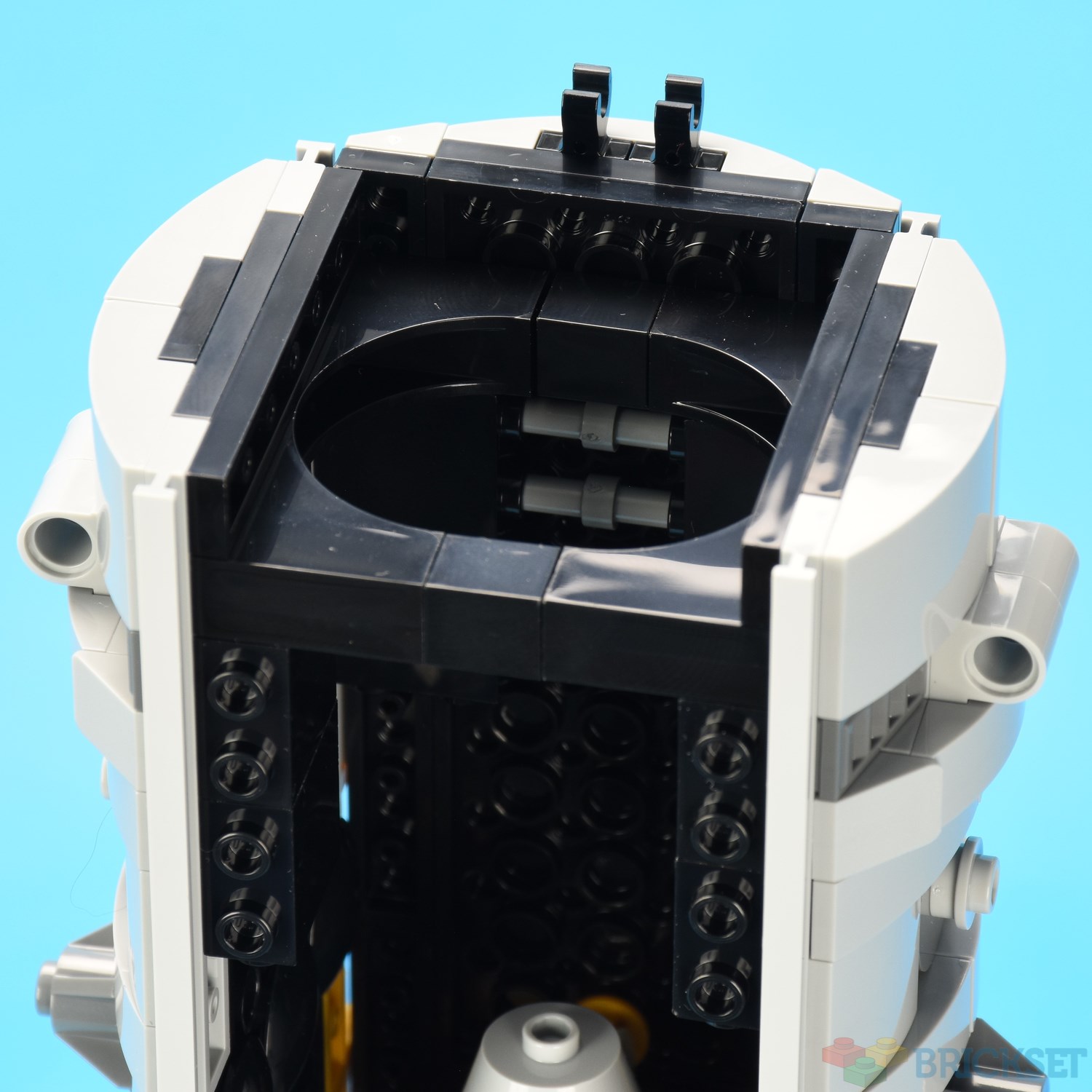
There are three brick-built gyroscopes sitting in this bay. The recess in the HST body will eventually receive the display stand.
There are optical baffles above the mirror. The Wide Field Camera and Fine Guidance Sensors sit underneath the mirror.
This link will take you to some images that show the improvements of the three Wide Field Cameras and corrective optics installed during the various Service Missions.
The recess in the HST body will eventually receive the display stand.
Bag 4
Bag 4 continues the assembly of the SSM and commences the foundation of the upper section of the Optical Telescope Assembly.
There is a small access port where you can peer into the HST primary mirror.
Bag 5
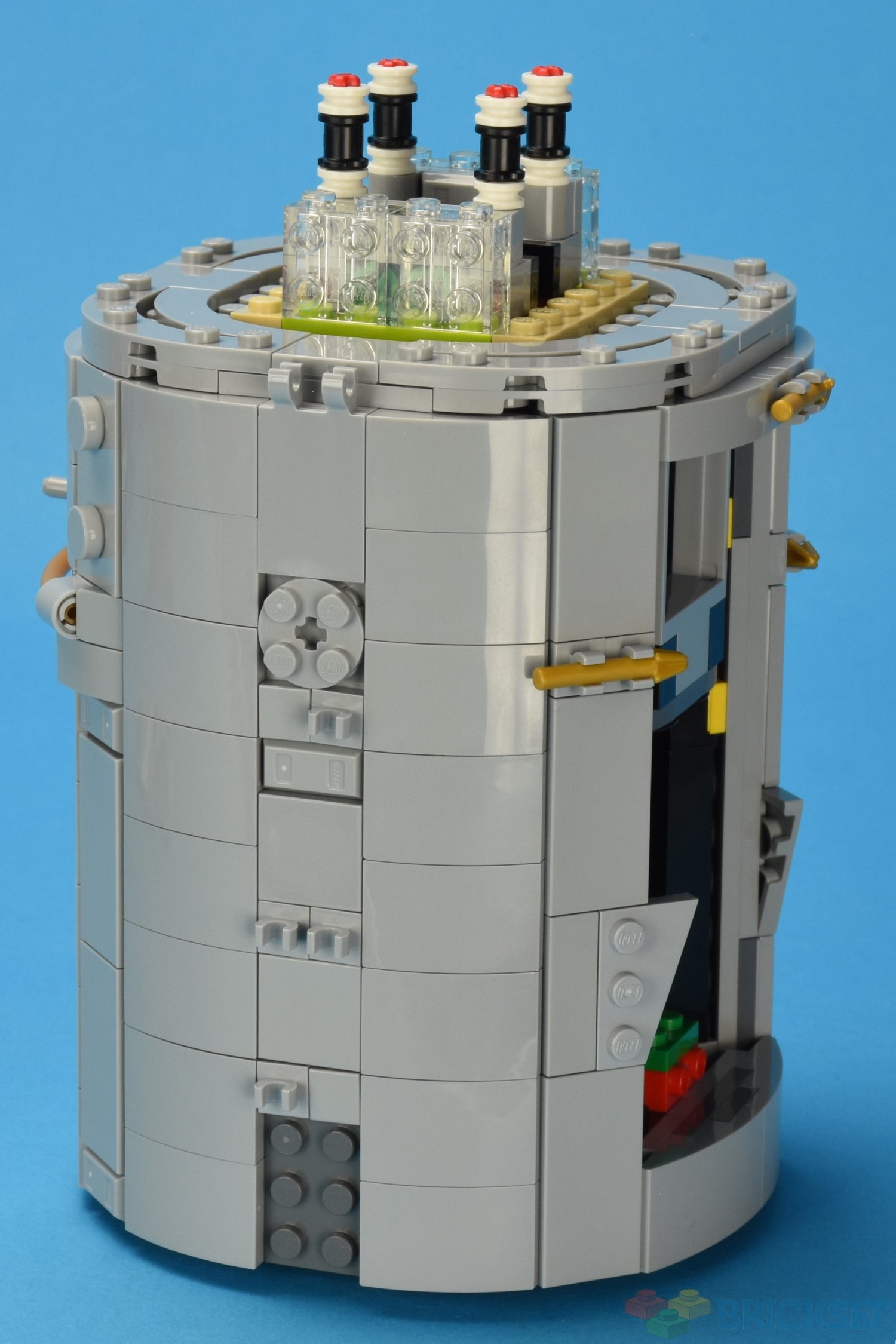
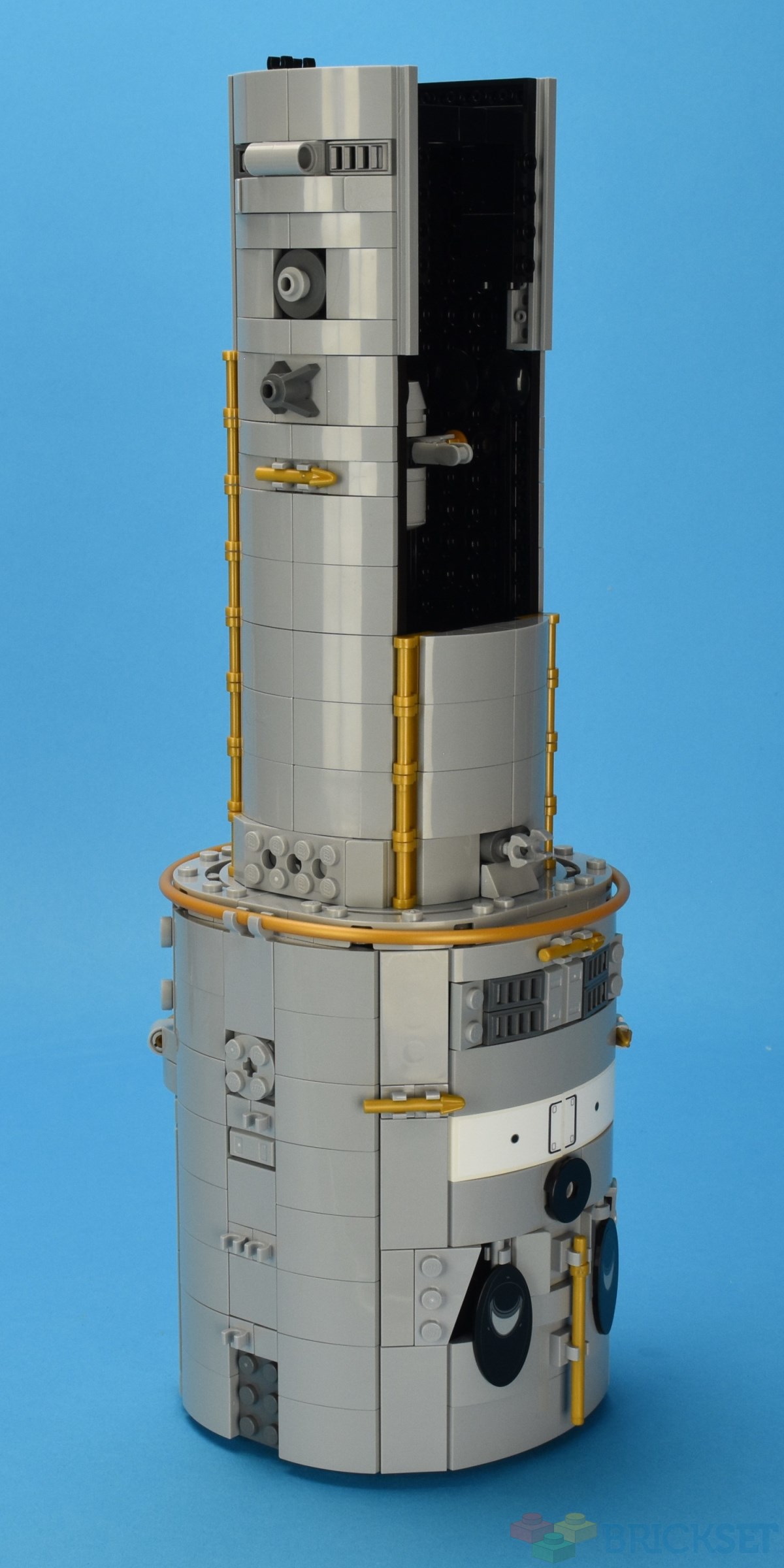
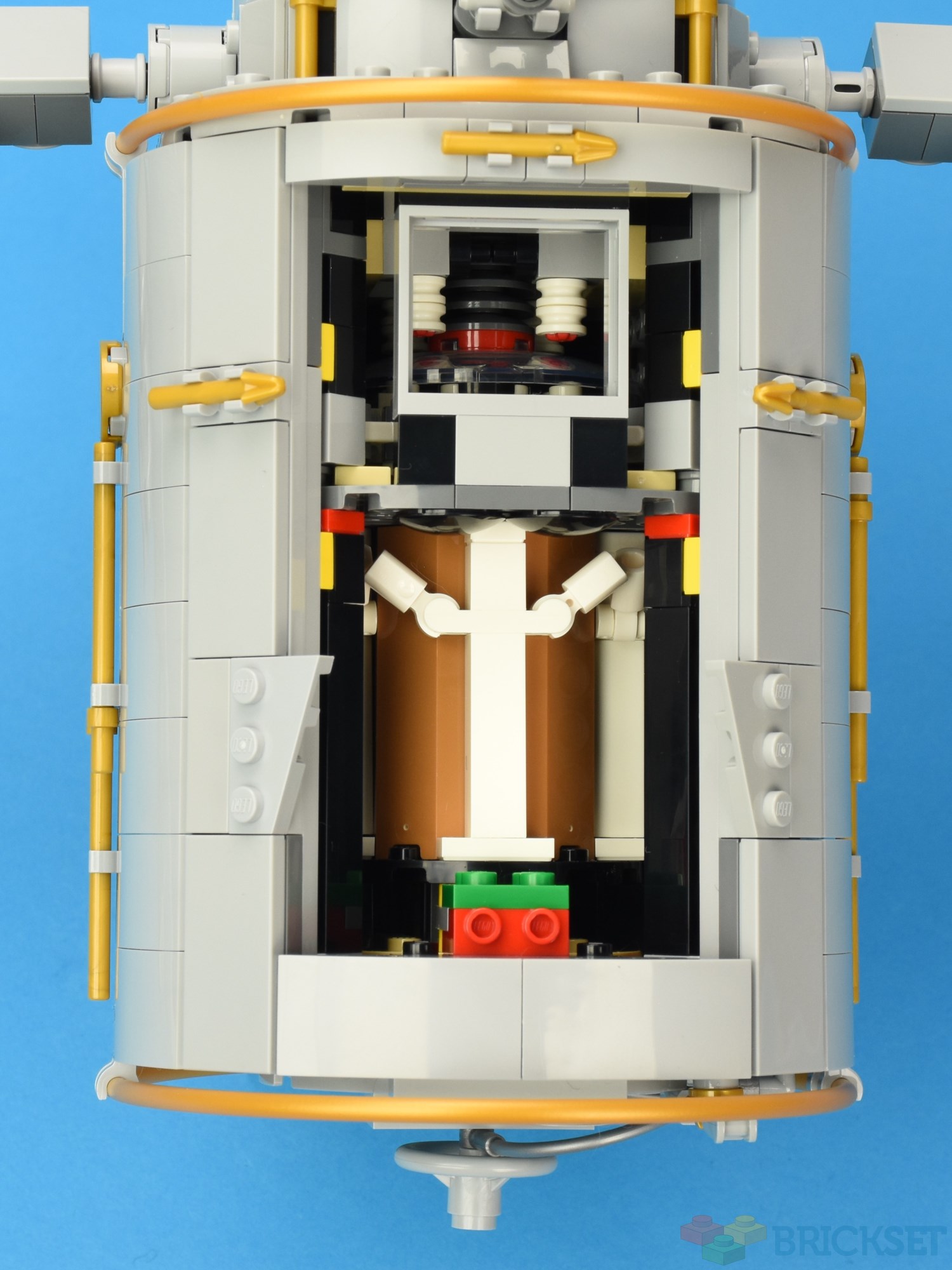
Bag 5 assembles the panelling that shields the SSM. A small panel is easily removed to reveal some of the interior detailing inside the SSM.
Beginning in Servicing Mission 3B in 2002 and continuing in Servicing Mission 4 in 2009, the HST was covered in new sections of foil insulation to repair sections that had been damaged by exposure from the sun's damaging radiation.
It is disappointing that 11382 Hubble Space Telescope is finished in predominantly medium stone grey (light bluish grey).
These are the other two sides of the SSM.
Bag 6
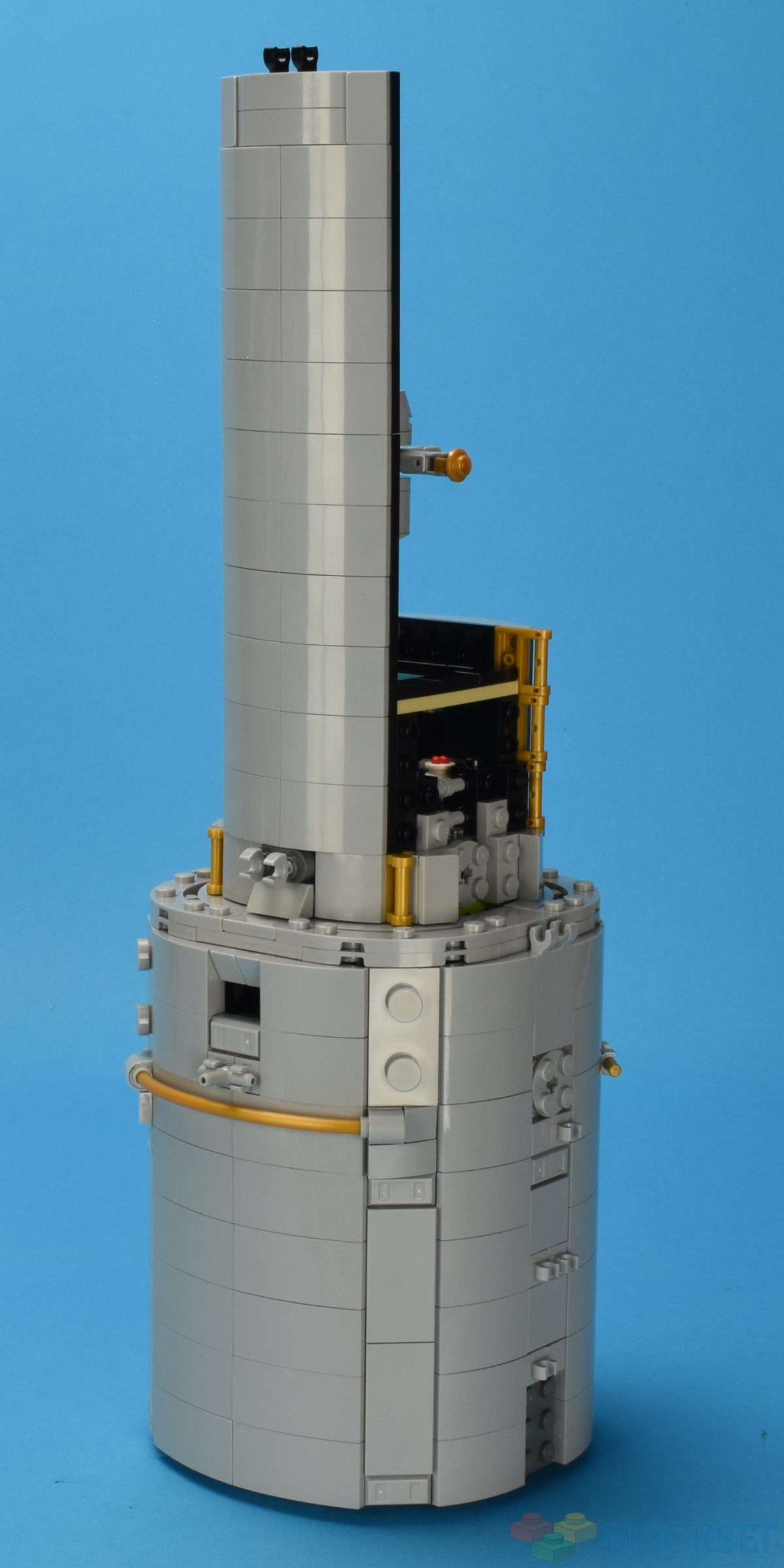
Bag 6 begins with the assembly of the light shield of the telescope body and the Secondary Mirror Assembly.
With a diameter of two studs, this dish element would be approximately 590 mm (23 inches) in diameter at the scale of this model. The real primary mirror is actually 30.5 cm (12 inches) in diameter.
Given that the 2x2 Round Slide Shoe (Boat Stud) represents the HST's secondary mirror, it would have been more accurate to offer it in transparent clear to represent the polished glass the secondary mirror is made from.
Bag 7
Bag 7 continues the assembly of the light shield of the telescope body.
The HST has handrails, foot restraint sockets, tether attachments and other fittings built into the structure to assist astronauts during the Servicing Missions. There are 225 feet (68 m) of handrails on the HST.
Bag 8 completes the main body of the HST and the Aperture Door.
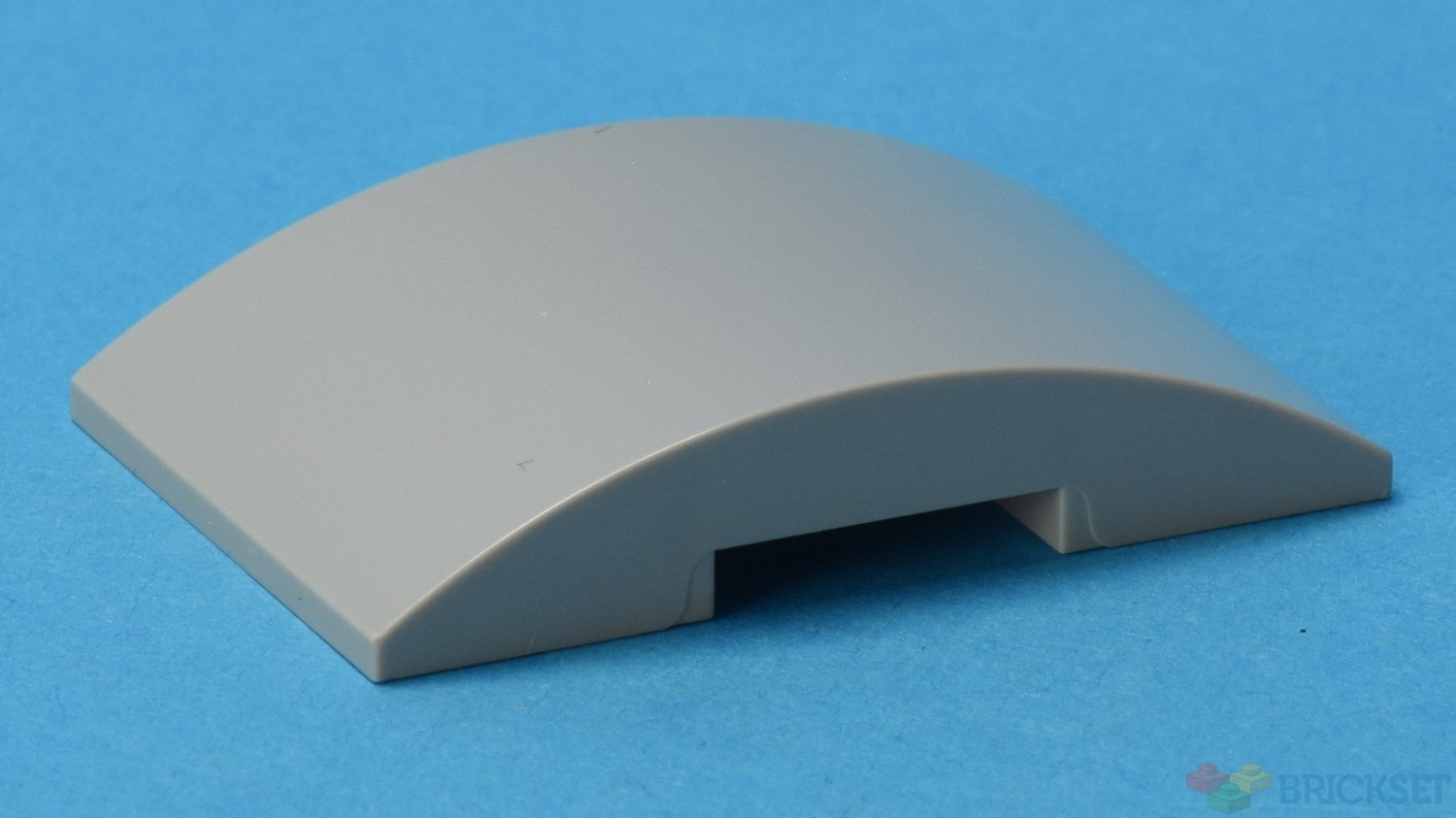
Another new element appears in Bag 8: Brick W. Bow 4x6x1 in medium stone grey.
The main body of the HST has been attached to its display stand. The Aperture Door and the two High-Gain Antennas (HGA) have been added.
The HST has sun-avoidance sensors which automatically trigger an Aperture Door closing warning before sunlight can damage the telescope’s optics.
The Aperture Door automatically begins to close when the sun is within 35 degrees of the main axis of the HST axis and is closed by the time the sun reaches 20 degrees of that axis. This takes no more than 60 seconds. The automatic closure can be overridden by the Space Telescope Operations Control Center (STOCC).
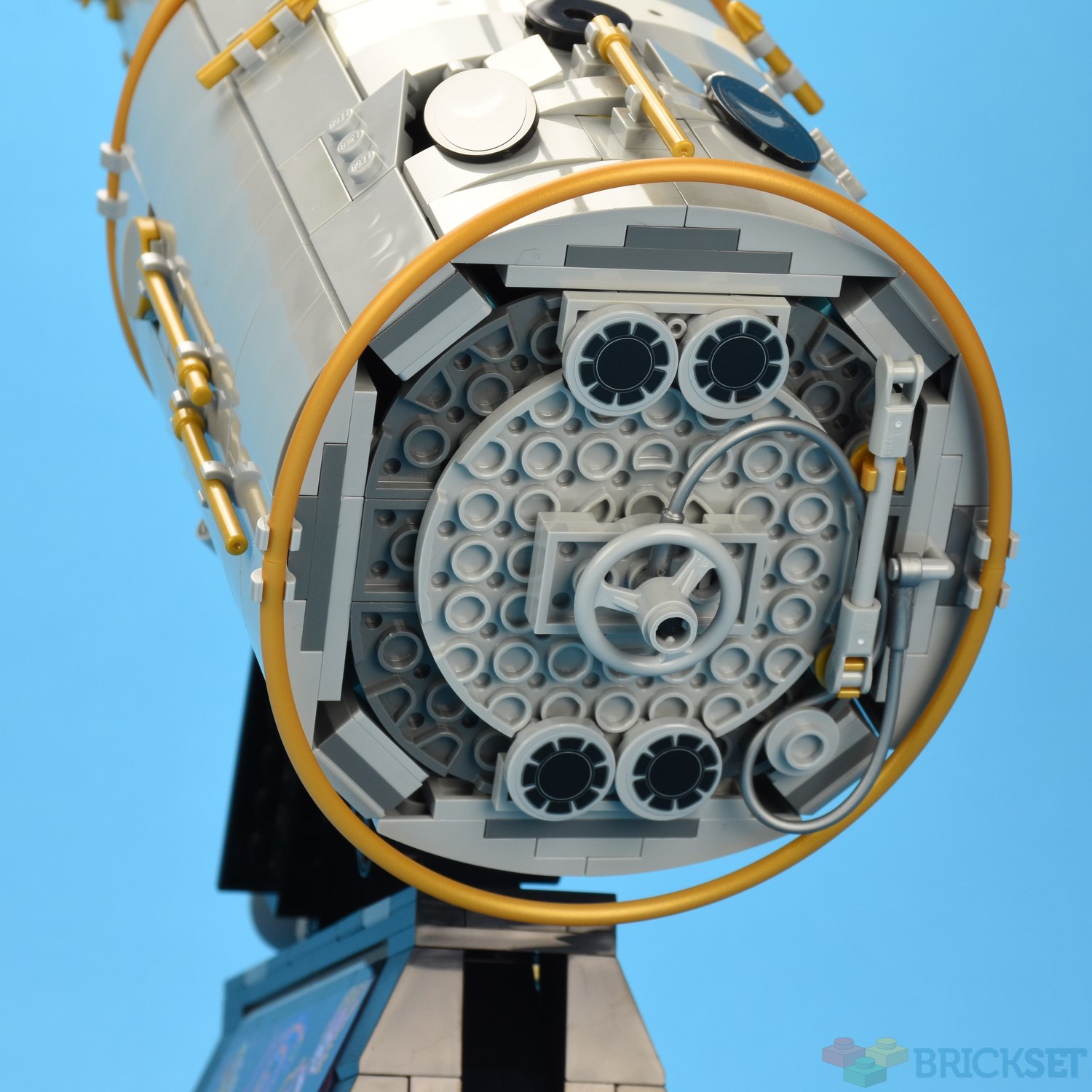
The images on the left show the HST with Aperture Door closed and antenna folded down. The image on the right has the Aperture Door opened and the HGA deployed.
The high-gain antennas are used to transmit large amounts of data, including the telescope’s images.
The two white Parabola Dishes on the image on the left represent the two HST Flight Releasable Grapple Fixtures (FRGF). These grapple points are where space shuttle astronauts manoeuvre the Space Shuttle Remote Manipulator System (SRMS) – otherwise known as the Canadarm – to capture the HST.
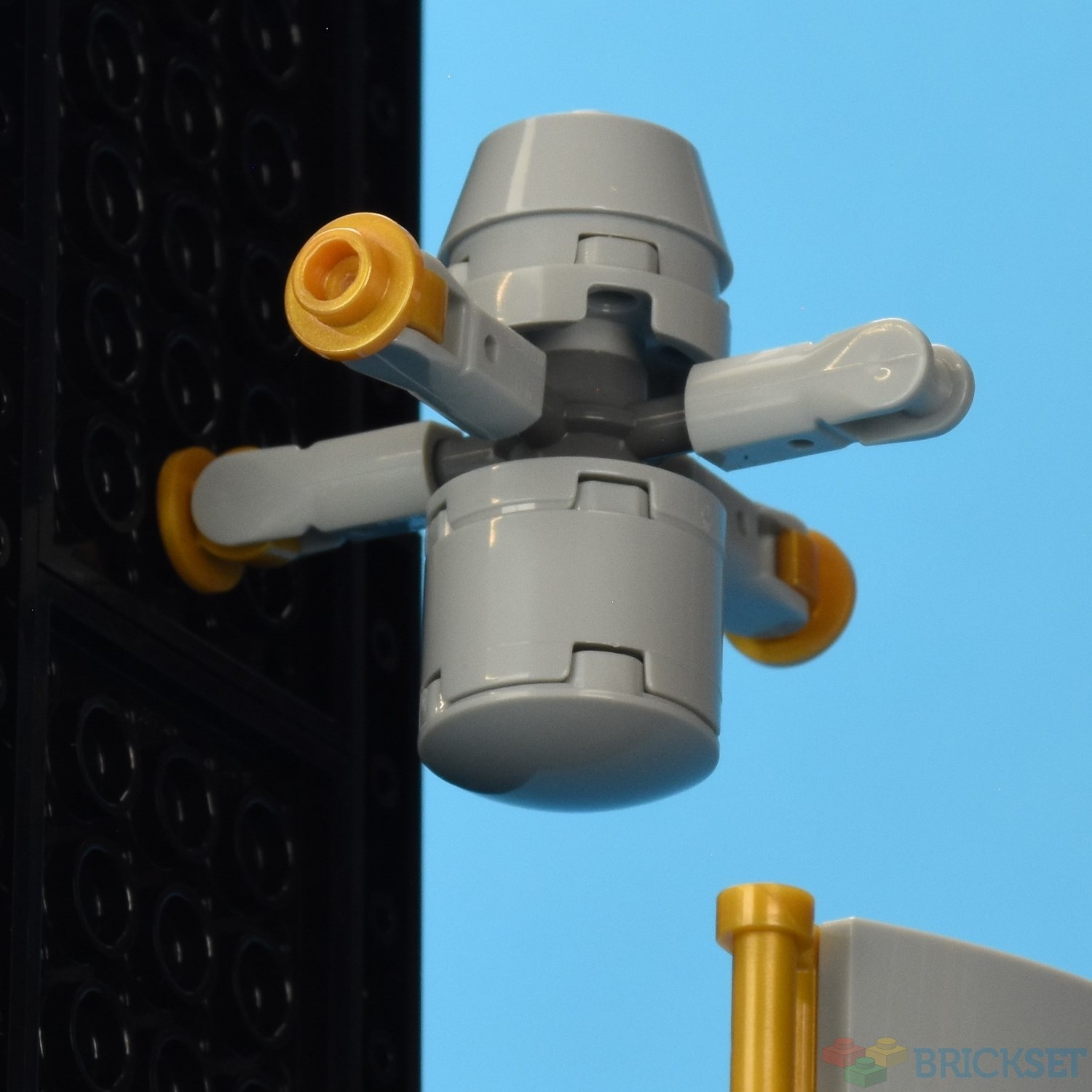
There are four warm gold pads on the HST called scuff plates. The structure is assembled using four Revolver elements in warm gold for the first time.
The pair of metal scuff plates on struts extend approximately 30 inches (76 cm) from the HST's surface on opposite sides of the light shield. Their sole purpose was protecting the telescope during launch.
The other pair of warm gold cylindrical protrusions, called trunnions (NASA call them Payload Retention Latch Assemblies), locked the HST in place by hooking to latches in the space shuttle Discovery's payload bay.
Trunnions are pivots that act as a balance point. The HST trunnions are the strong points where the entire telescope can be lifted from and supported. It could have been more accurate to have a 2x2 round jumper plates in warm gold as the trunnions.
Both pairs of scuff plates are 14 studs apart. The space shuttle payload bay was 15 feet (4.57 m) wide. This makes 11382 Hubble Space Shuttle's width slightly at a narrower scale of 1:41.
This link shows you an image of the HST in Discovery's payload bay, and you can see the metal scuff plates on opposite sides of the light shield.
The medium stone grey Steering Wheel represents the HST's Soft Capture and Rendezvous System (SCRS). This component was installed during Servicing Mission 4.
The HST's scientific life has been extended well beyond the retirement date of the space shuttle programme. The SCRS has been installed so that the HST may be safely de-orbited by a future space vehicle.
The silver metallic 21M Flex Tube with 3.2 Holes represents the power umbilical cord which has been used to connect a power supply to the HST during Servicing Missions.
There are four medium stone grey 2x2 inverted tiles which have vent stickers applied. These represent the vents from the SSM.
The image on the right peers down the aperture opening into the light shield. The top of the Secondary Mirror Assembly can just be seen.
Bag 9
Bag 9 completes the model by assembling the two Solar Arrays.
The Solar Arrays represent those that were installed in 2002 during Servicing Mission 3B. They measure 23.3 x 8.6 feet (7.1 x 2.6 m). This set of arrays uses gallium arsenide (GaAs) solar cells.
This three-minute video will take you on a virtual tour of the HST.
The HST is complete with the lone astronaut performing an EVA. He is using his PGT to complete a final repair before the telescope is sent out to capture its fantastic images.
There are two removable panels on the body of the HST that, when removed, show the key components of the HST's Optical Telescope Assembly.
The larger of the two panels can be removed to reveal the HST Primary Mirror.
The smaller panel can be removed to expose the light shield and the Secondary Mirror Assembly.
The HST orbits the Earth at an altitude of approximately 550 km (340 miles). The HST travels at 28,000 kph (17,400 mph) and completes each orbit in 96 minutes. The circular orbit is inclined to the Equator by 28.5 degrees.
Here the 11382 Hubble Space Telescope is orbiting over New Zealand. It must have drifted quite a bit off course to reach these southerly latitudes. Fortunately, the lone astronaut has been working on the HST's guidance system so that it relocates to its correct orbital inclination.
Here is a close-up of the tirelessly working lone astronaut performing his EVA. He is holding on tightly to the section of handrails near to the Aperture Door. His other hand holds onto his PGT.
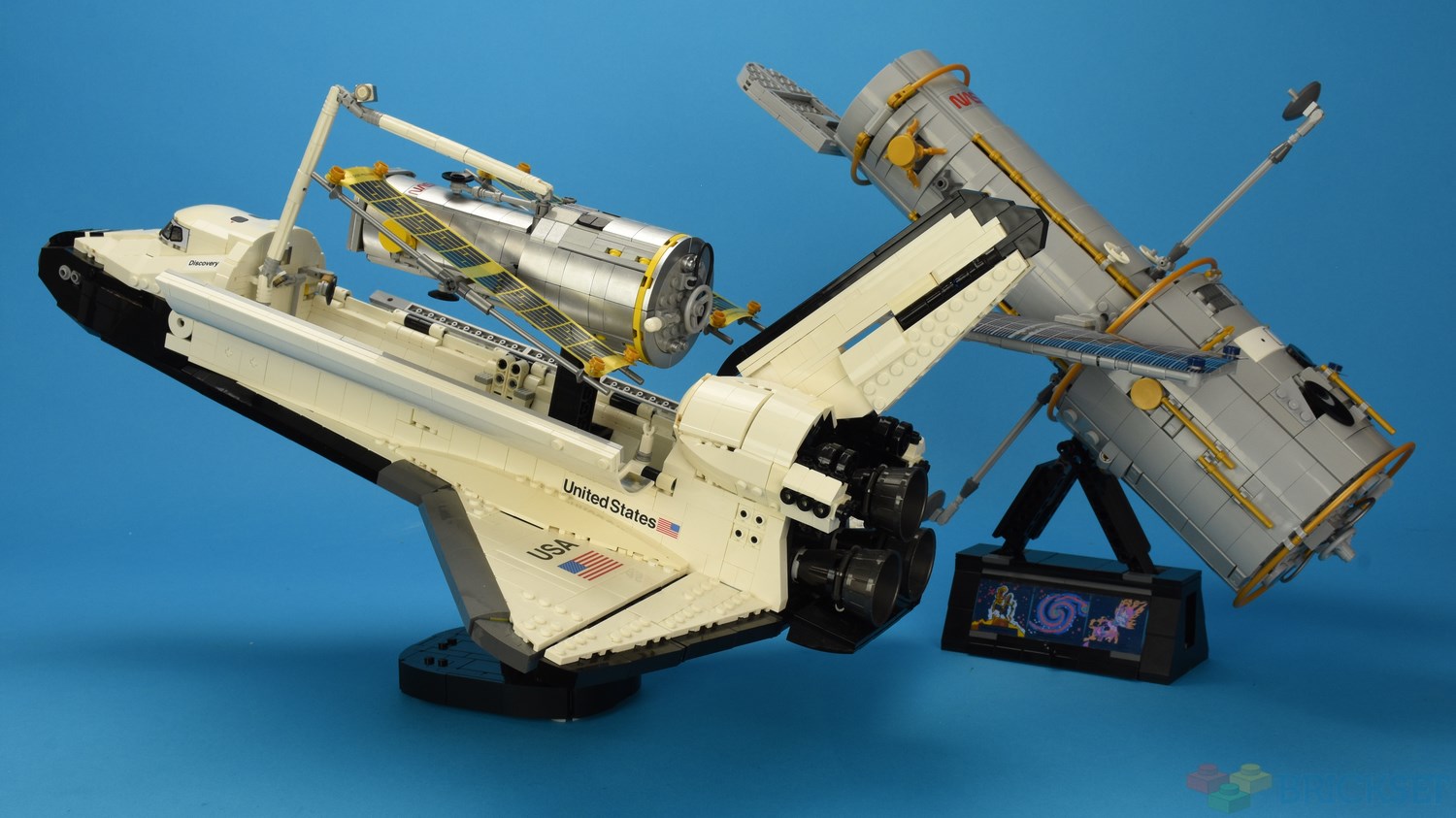
10283 NASA Space Shuttle Discovery was released five years ago. This was also released under the LEGO Icons theme.
The image below shows 10283 NASA Space Shuttle Discovery with the Hubble Space Telescope being lifted out of the Payload Bay using the SRMS – more commonly known as the Canadarm.
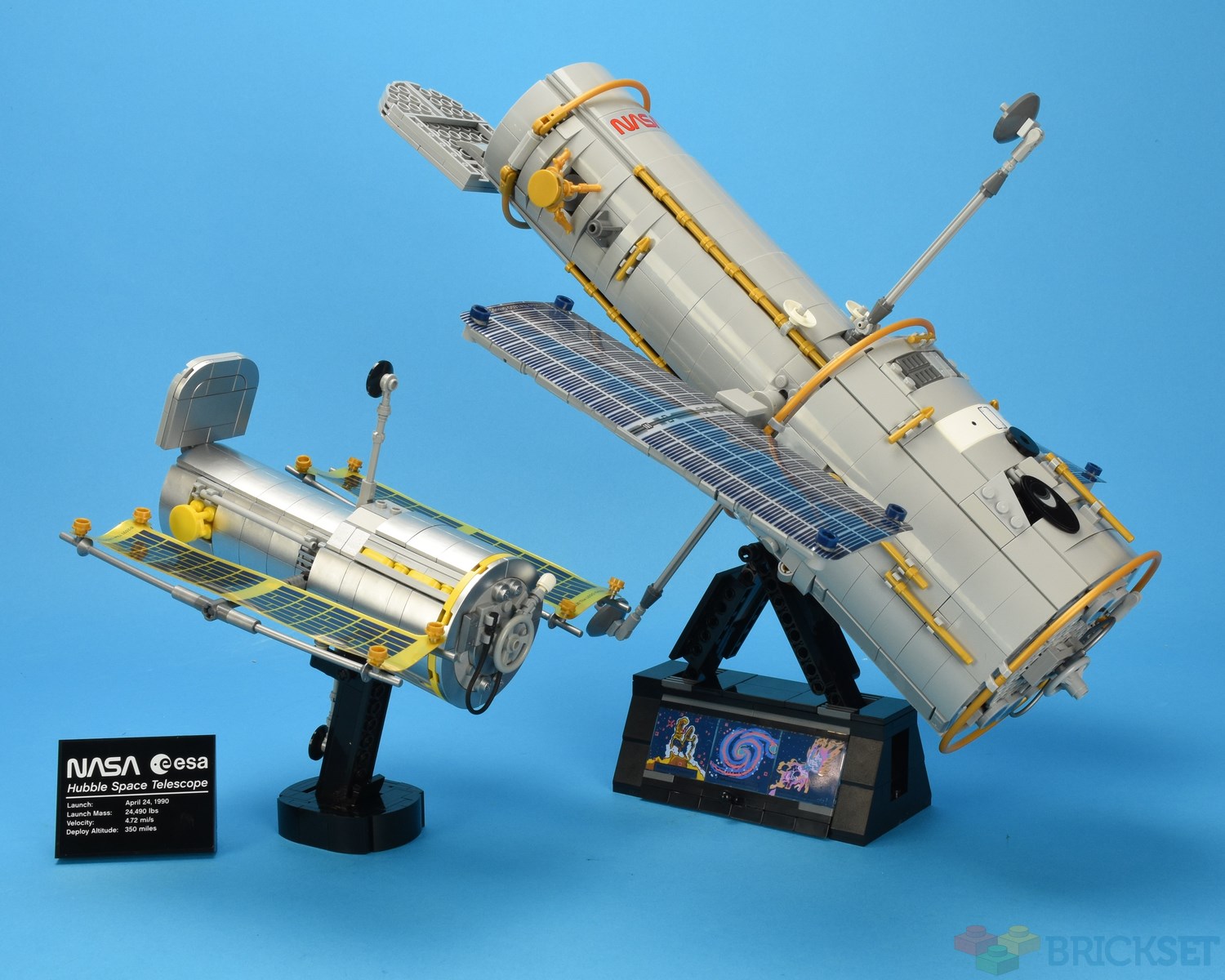
This image shows the two HSTs side by side.
Note: The Space Shuttle Discovery undertook the HST Servicing Mission 2 in February 1997, The HST's Soft Capture and Rendezvous System (SCRS) was not installed until Servicing Mission 4, which was performed by the crew flying Space Shuttle Atlantis in May 2009.
These two images clearly show the shiny metallic finish of the silver ink and silver metallic elements that have been used on this smaller LEGO HST model.
Edwin P. Hubble
The American astronomer Edwin Powell Hubble (1889–1953) was one of the greatest pioneers of modern astronomy. Hubble studied at the University of Chicago and obtained a degree in Mathematics and Astronomy in 1910.
Hubble earned a Rhodes scholarship to Oxford. There, he studied Roman and English Law and also took up Literature and Spanish. He returned to the United States in 1913, where he passed the bar examination and practised law half-heartedly for a year in Kentucky.
He served in France briefly during the end of the First World War and returned to the United States in 1919. He almost certainly never saw any action during that war.
After practising law for one year, he decided to abandon his career practising law to pursue astronomy:
I chucked the law for astronomy, and I knew that even if I were second-rate or third-rate, it was astronomy that mattered.
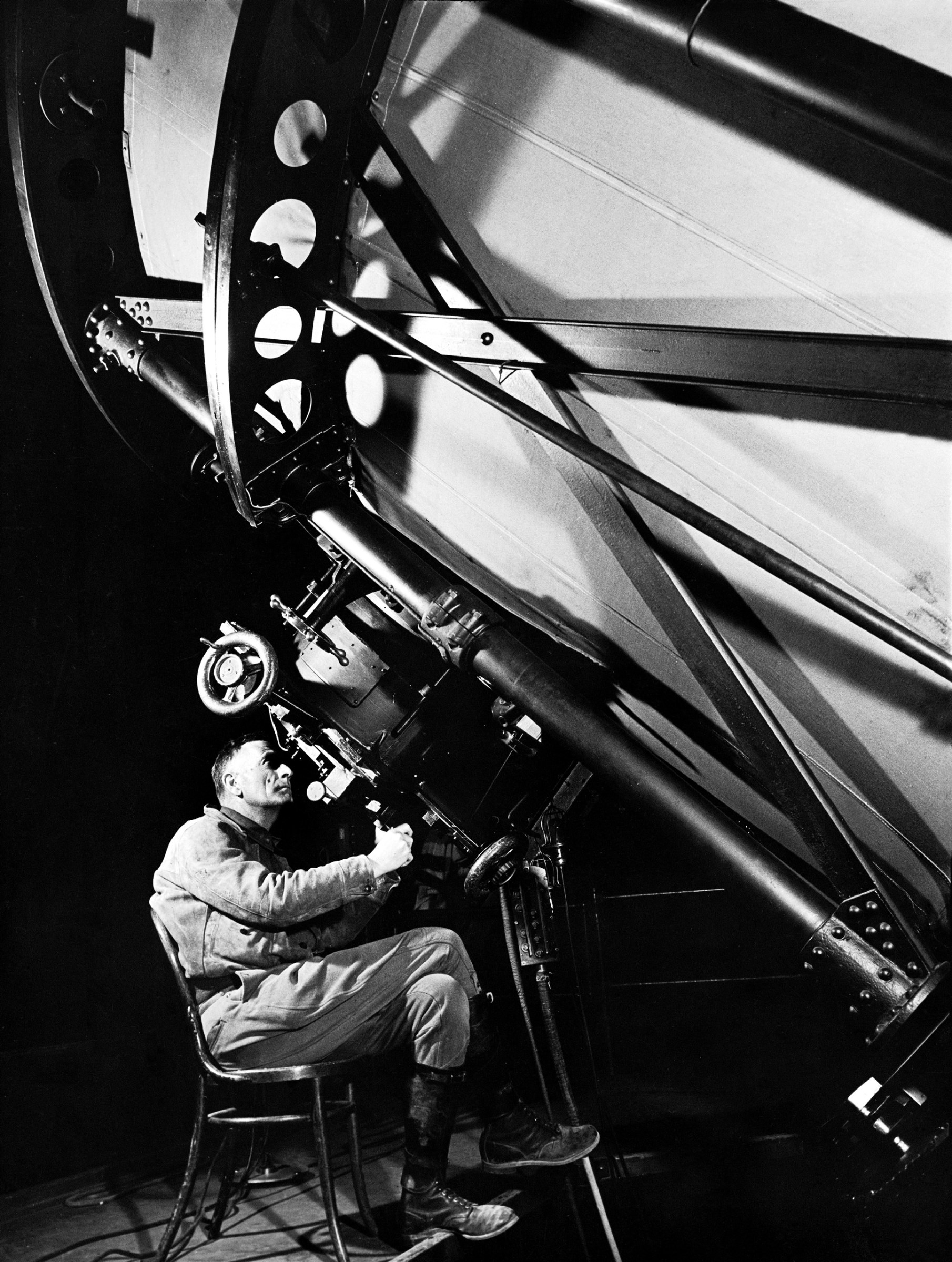
This image shows Edwin Hubble peering through the eyepiece of the 100 inch (2.5 m) Hooker Telescope at the Mount Wilson Observatory.
Credit: Margaret Bourke-White/Time & Life Pictures/Getty Images
The size of the known Universe
It is remarkable to think that just over a hundred years ago, the known universe consisted of only one galaxy: The Milky Way.
The Milky Way
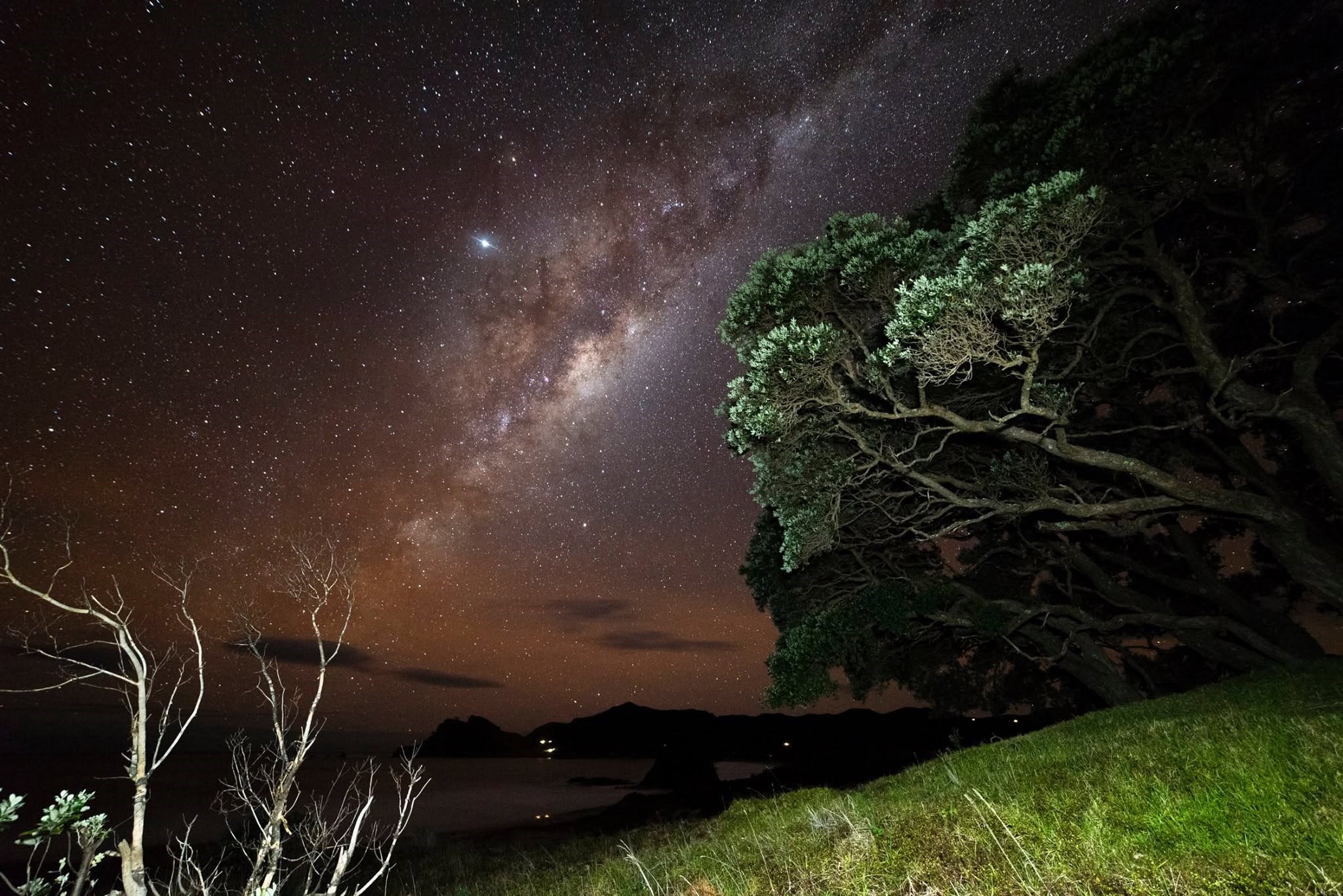
The image below was taken by my brother, Steve Wardle, using a Nikon D610 SLR camera with a 14mm lens. It shows the Milky Way spanning the night sky. He used a flashlight panned over the neighbouring trees to capture their presence in the same frame.
He lives on a remote New Zealand island called Aotea Great Barrier Island, which is well known as a Dark Sky Sanctuary.
There will be many people who live in built-up metropolitan areas who have never seen the majesty of the Milky Way arching across the night sky. Pollutants in the atmosphere and urban light pollution make seeing a clear night sky nearly impossible for most city residents.
Credit: Steve Wardle
Galaxy: late 14c., from French galaxie or directly from Late Latin galaxias "the Milky Way" as a feature in the night sky (in classical Latin via lactea or circulus lacteus), from Greek galaxias (adj.), in galaxiaskyklos, literally "milky circle," from gala (genitive galaktos) "milk"
Hubble expands the known Universe
Henrietta Swan Leavitt had discovered that there was a direct relationship between the brightness of cepheid variable stars and their distance from Earth. Cepheid variable stars have been known as standard candles ever since for their utility in determining stella distances from Earth.
Using the Hooker Telescope, Hubble found cepheids in several nebulae, including the Andromeda Nebula and Triangulum Nebula (as they were then known). Comparing their apparent luminosity to their intrinsic luminosity gave him their distance from Earth. In 1924, Hubble was able to conclusively prove that these nebulae were in fact too distant to be nebulas within the Milky Way, but they were their own galaxies that were considerably distant from our own galaxy.
Hubble devised the classification scheme for galaxies that is still in use today, and obtained extensive evidence that the laws of physics outside the galaxy are the same as on Earth, in his own words: "verifying the principle of the uniformity of nature."
In 1929, Hubble went on to analyse the speeds of recession of a number of galaxies and showed that the observed speed at which a galaxy moves away from Earth is proportional to its distance (Hubble's Law).
Stephen Hawking has commented that Edwin Hubble's 1929 discovery that the universe is expanding was "one of the great intellectual revolutions of the 20th century". This expansion laid the observational foundation for the Big Bang.
Albert Einstein could have predicted an expanding universe ten years earlier. In 1917, Einstein applied his newly developed General Theory of Relativity to the problem of the universe as a whole. Einstein was very disturbed to discover that his General Theory of Relativity predicted that the universe could not be static: it either expanded or contracted. Einstein modified his original theory in order to avoid this problem.
Upon learning of Hubble’s discoveries of an expanding universe, Einstein later referred to his arbitrary modification of his General Theory of Relativity as “the biggest blunder of my life.”
The astronomical relationship between how far away an object is, and how fast it recedes from us is called the Hubble Constant.
The three-minute video tries to explain the Hubble Constant in lay terms.
The Hubble Space Telescope
For all his work in astrophysics, Edwin Hubble never received a Nobel Prize: during his life the Nobel Prize in Physics did not cover astronomy.
When Hubble passed away, no funeral was held for him, and his wife, Grace Lillian Burke Hubble, never revealed his burial site. Grace Hubble was a Stanford University graduate and a talented astrophysicist in her own right, and she actively supported Hubble in his career as a host, wrote speeches, and kept detailed diaries of his life.
The enduring legacy and memorial to Hubble is the Hubble Space Telescope.
Bill Bryson discusses Edwin Hubble, his strengths, achievements and personality in his book A Short History of Nearly Everything: 2.0 (and the original version as well).
Space is big!
To quote Douglas Adams, author of The Hitchhiker's Guide to the Galaxy:
Space is big. You just won't believe how vastly, hugely, mind-bogglingly big it is. I mean, you may think it's a long way down the road to the chemist's, but that's just peanuts to space.
This deep-sky mosaic, created from nearly 7,500 individual exposures from the HST, provides a wide portrait of the distant universe, containing 265,000 galaxies that stretch back through 13.3 billion years of time to just 500 million years after the big bang.
The faintest and farthest galaxies are just one ten-billionth the brightness of what the human eye can see. The universe's evolutionary history is also chronicled in this one sweeping view. The portrait shows how galaxies change over time, building themselves up to become the giant galaxies seen in the nearby universe.
I have really enjoyed writing this review. It has given me a great opportunity to do extensive research into the history of the Hubble Space Telescope.
As of 2025, the HST has made over 1.7 million observations. This work has enabled astronomers to write more than 23,000 peer-reviewed scientific papers.
The HST observations are referenced in more than 1.4 million scientific papers (through 2024). That number of citations increases by an average exceeding 150 per day.
The demand for observing time remains very high with 6:1 oversubscription, making it one of the most in-demand observatories today.
With these statistics in mind, these are my overall thoughts on the LEGO model.
The negative points
There is an absence of any biographical details of Edwin Hubble in the instruction book. There are small comments regarding concepts such as the Hubble Law and Hubble Constant but nothing about the person whom the HST is named after.
It is appropriate that this model has been produced under the Icons theme pitched at adults 18 years or older. It would have been more appropriate, therefore, to have the display plaque as a printed element. All stickers should have been printed elements, but, in my opinion, the display stand plaque should never have had a sticker applied.
On a similar note, the outer skin elements on the Hubble Space Telescope would have looked so much more authentic if they had been produced in the metallic silver colour similar to the metallic coloured parts used in 10283 NASA Space Shuttle Discovery.
I cannot understand how this model was not available in the same year that the Hubble Space Telescope celebrated its 35th year of operation. Hopefully, the LEGO Design Team are already working on their next iteration to mark the 40th anniversary of the HST in April 2030. Maybe this could be a minifigure scale Space Shuttle Atlantis that enables 11382 Hubble Space Telescope to sit in the Payload Bay.
The positive points
There is an incredible amount of detail inside this model to reflect the various scientific equipment packs found in the HST.
For a set with 1252 parts, it is priced at £119.99, $139.99, €129.99 (which corresponds to 9.6p, 11.2c, 10.4c per piece). This seems to me represent reasonable value for money.
I really like the fact that the Primary Mirror 6x6 transparent clear dish has been installed upside down as an Easter Egg in reference to the HST's Primary Mirror that was precisely ground to the wrong focal length more than a decade before the HST was launched into space.
The build as a whole is incredibly detailed and is an accurate model of the HST at minifigure scale. I like the accurate printed details of the accompanying minifigure astronaut complete with his brick-built Pistol Grip Tool (PGT).
As this review goes live, I will be enjoying a day off work as New Zealand celebrates Matariki. When I return to work on Monday, I am scheduled to teach the subject of celestial navigation to future nautical navigators. This is a subject I really enjoy, but I will also be the first to admit that it is somewhat obsolete.
I am going to enjoy having the 11382 Hubble Space Telescope on display on my desk as I teach navigational astronomy, timekeeping and traditional navigational techniques using the sun, stars and planets.
Hubble images
Images captured by the HST are freely available from the respective NASA or ESA Hubble image websites.
Both agencies insist that appropriate credit is given to the sources of the images. The NASA media policy can be seen here. The ESA media policy can be seen here.
NASA
For those people celebrating the United States of America's 250 years of independence: NASA’s Hubble Spies Stellar Sparkler for July 4th.
It is by pure coincidence that the embargo for reviews for 11382 Hubble Space Telescope has been lifted on 10 July, the day that Aotearoa New Zealand celebrates Matariki.
The event called Matariki occurs when that small cluster of stars becomes visible during morning twilight on the eastern horizon before sunrise. It can typically be seen in late June or early July each year.
Matariki is the Maori name for the cluster of stars also known as the Pleiades in the constellation Taurus. Matariki is a shortened version of Nga mata o te ariki o Tawhirimatea, "the eyes of the god Tawhirimatea".
In the past, Matariki was typically celebrated during the last quarter of the moon of the lunar month Pipiri (around June). Being able to sight the individual stars enabled forecasts of the coming year to be made. It was also an opportunity to mourn the deceased from the past year. Maori made offerings of food to replenish the stars. Some Maori use the rise of Puanga (Rigel) or other stars to mark the new year.
Matariki throughout Polynesia
Matariki has very similar cultural significance to many other Polynesian Island groups:
In the Marquesas Islands the star cluster is known as Matai-i or Mata-iki,
In Hawaii, the rising of Makali-i on 20 November ushers in the four-month season Makahiki, which honours Lono, the god of agriculture and fertility.
In Tahiti, the year was divided into two seasons, named according to whether the Pleiades are visible after sunset: Matari-i i nia ('Matari-i above') and Matari-i i raro ('Matari-i below').
On Rapa Nui, Matariki heralded the New Year, and its disappearance in mid-April ended the fishing season.
The named stars
Matariki has nine named stars. The table below lists these nine stars, their more commonly associated names, their gender and their provenance:
Matariki – Alcyone – Female – Well-being and health
Tupu-a-rangi – Atlas – Male – Food that comes from above
Tupu-a-nuku – Pleione – Female – Food that grows in the soil
The Pleiades are also named in other cultures. The most commonly recognised alternative name is Subaru in Japanese, which means to cluster together.
The cluster of stars forms the badge of the car manufacturer of the same name.
The stylised Subaru logo is orientated as the cluster of stars would be seen from the Northern Hemisphere.
Marking of a New Year
Some people may wonder why a new year could be celebrated in July. For Southern Hemisphere residents, this event occurs in mid-winter, just like our more commonly accepted New Year, which is celebrated in mid-winter in the Northern Hemisphere and using a European-based calendar.
New Year has not always been celebrated on January 1st.
Until 1752, March 25th was officially celebrated as the English New Year. This was – and still is – known as Lady Day or the Feast of the Annunciation. It was chosen to mark the beginning of the year for civil and legal purposes.
The shift of New Year from March 25th to January 1st happened when Great Britain and its colonies adopted the Gregorian Calendar to align with the rest of Europe.
"Give Us Our Eleven Days!"
"Give Us Our Eleven Days," was the cry of the population during The Calendar Riots of 1752.
In 1752, the UK decided to adopt the Gregorian Calendar. Wednesday 2nd September 1752 was followed by Thursday 14th September 1752, advancing eleven days at midnight. This is no different to advancing clocks one hour during Daylight Saving, only it represents a much larger leap.
There were groups in the population that did not agree with this change. Some people thought that the government was stealing eleven days of their lives.
Remnant of those eleven days
The UK tax year runs from 6 April to 5 April the following year.
The tax year used to start on 25 March each year, but due to the public outcry over the calendar reforms, the start date for tax purposes was advanced eleven days to April 5.
The year 1800 was not a leap year. The Gregorian Calendar drops three leap years in every 400-year period. The start of the tax year was advanced one more day in the year 1800 to make it 6 April. It has remained that date ever since. The full story can be seen here at this link.
Thanks
Thanks to DigitaLion for loaning me his 71267 The Goonies Level Pack used in this review.
Thanks to Jon-Paul Hansen for the two Photoshop images of 11382 Hubble Space Telescope superimposed over the NASA images.
Thanks to Steve Wardle for use of his fabulous image of the Milky Way.
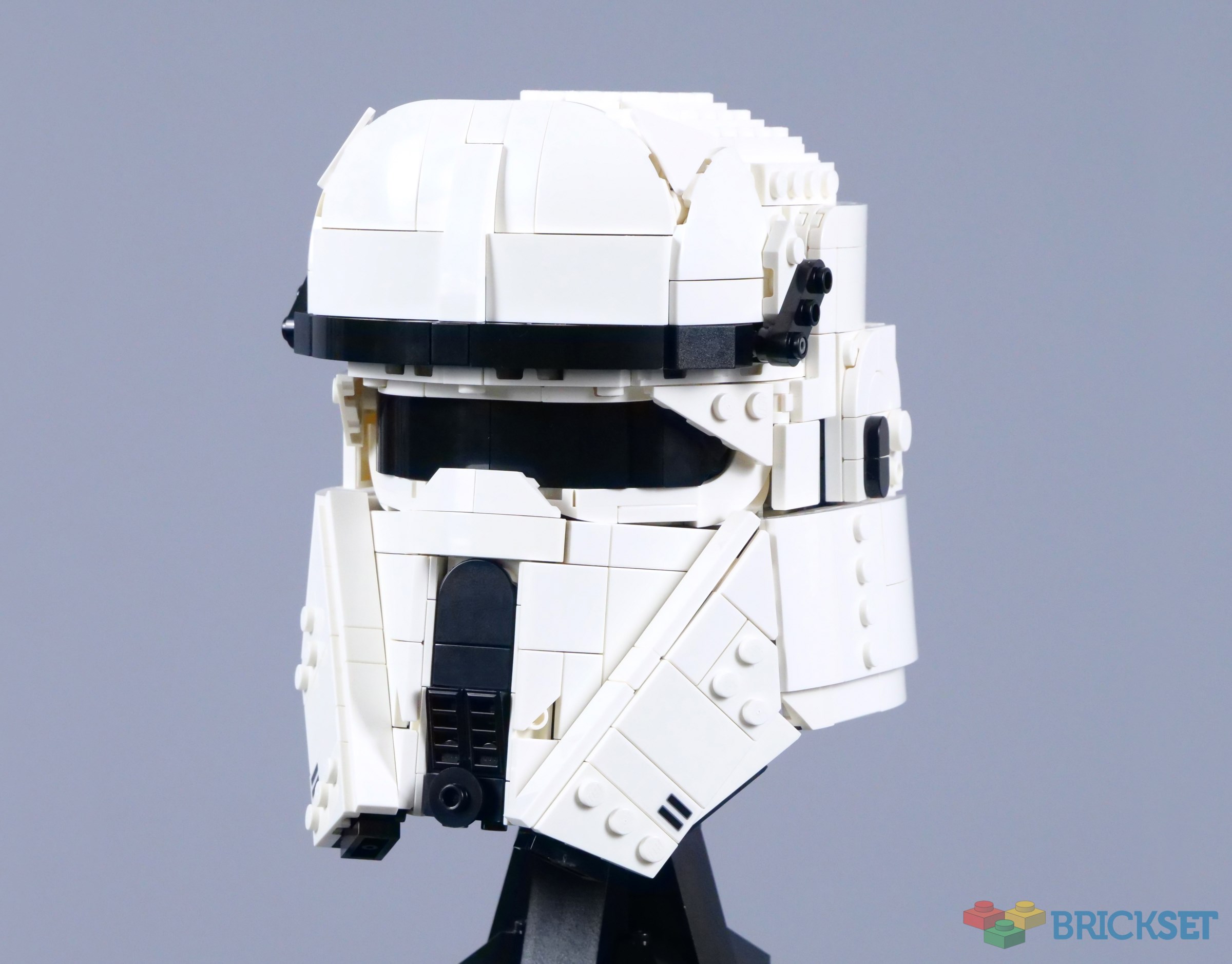
Plenty of memorable Star Wars helmets appear throughout the movies, though 75458 Imperial Remnant AT-RT Driver Helmet cannot exactly be considered among them! This trooper was only featured in The Mandalorian and Grogu for ten or perhaps twenty seconds, after all.
Nevertheless, this model looks very accurate to the movie and includes some clever techniques, as we have come to expect from the Helmet Collection. Perhaps the quality of the design will overcome the relative obscurity of the subject, in this instance.
New trooper types are introduced in most Star Wars movies and the Imperial Remnant AT-RT Driver is a dull example, in my opinion, using armour pieces from other Imperial troopers. The helmet is merely a repainted Shoretrooper helmet, which rather highlights how a Shoretrooper helmet would be a more interesting set, as a more prominent trooper and because this series already includes several white helmets, but none in tan.
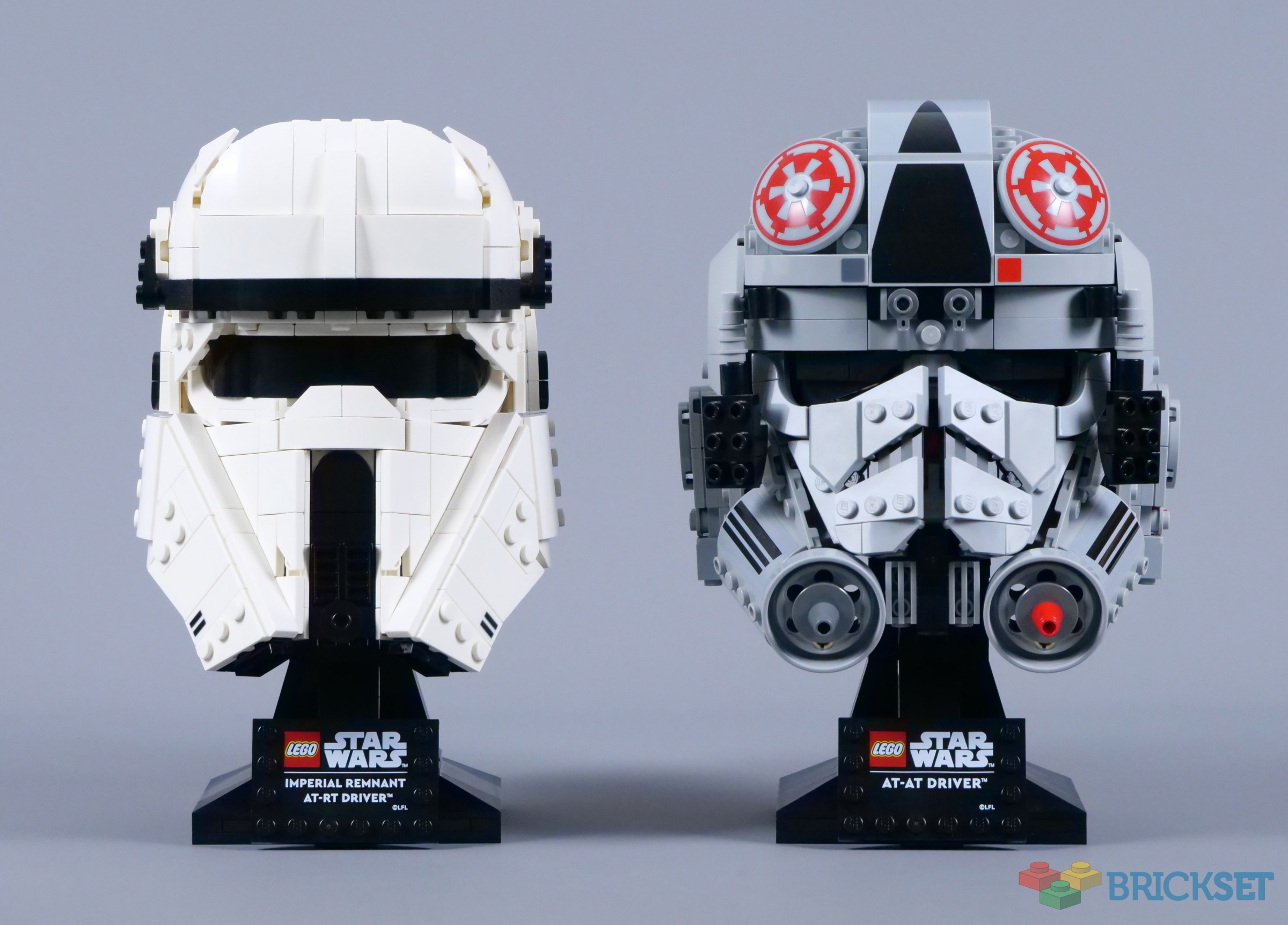
Having said that, the AT-RT driver's helmet is executed very well. I expected a model similar in size to 75305 Scout Trooper Helmet, which could be a problem given its price, but it is actually much closer to 75429 AT-AT Driver Helmet. In addition, the typical base and printed plaque are included, contrasting nicely with the driver's helmet.
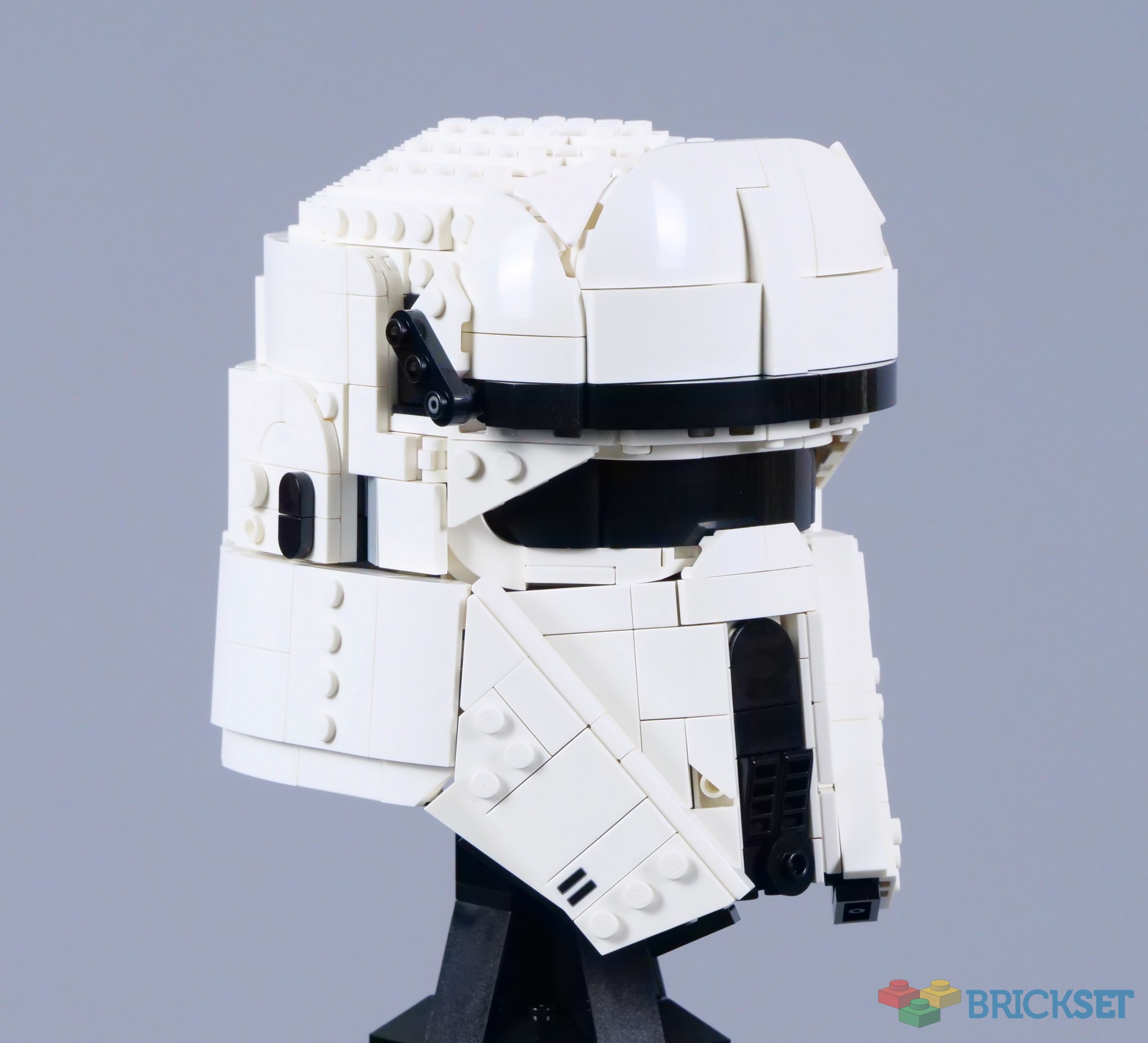
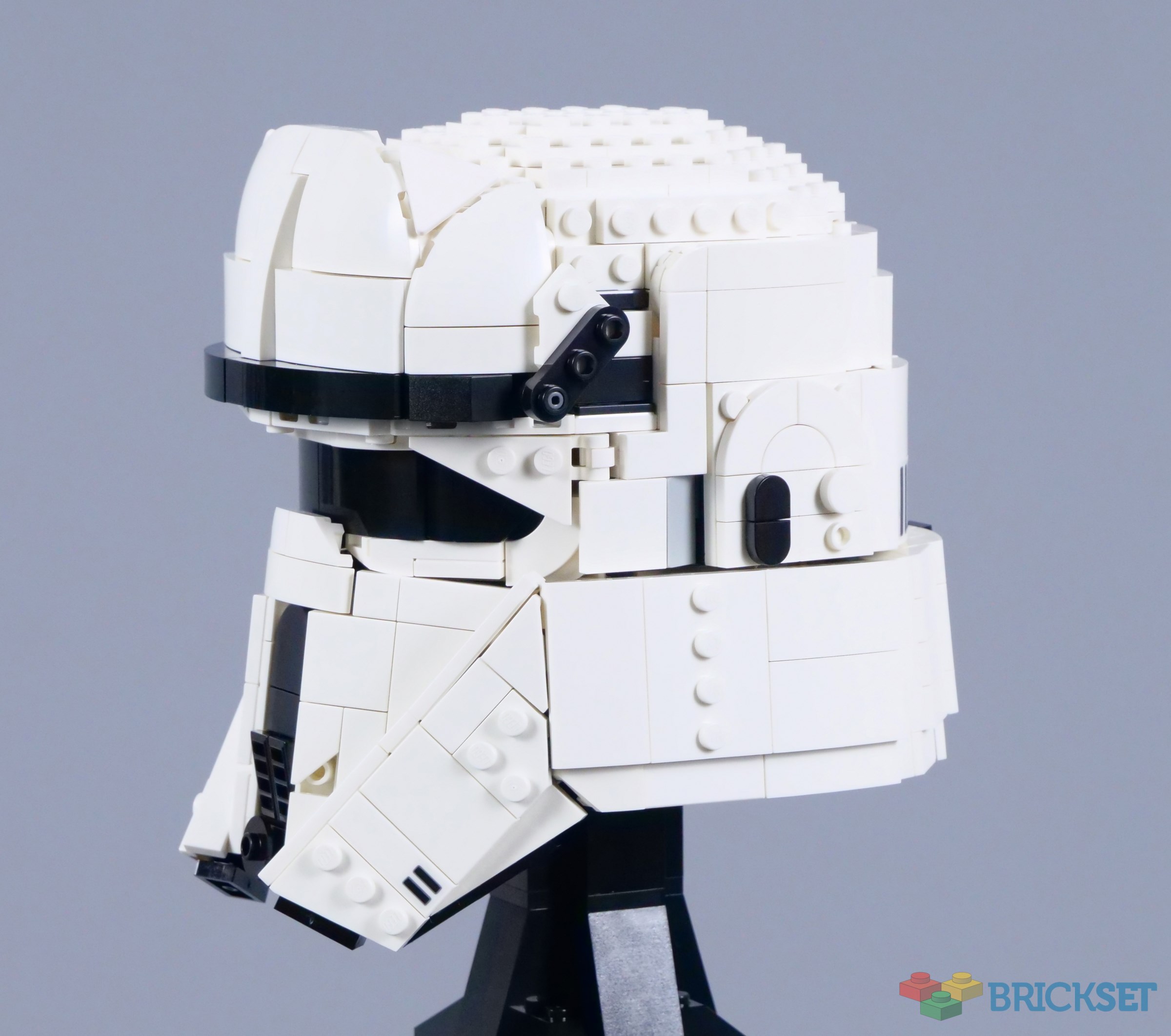
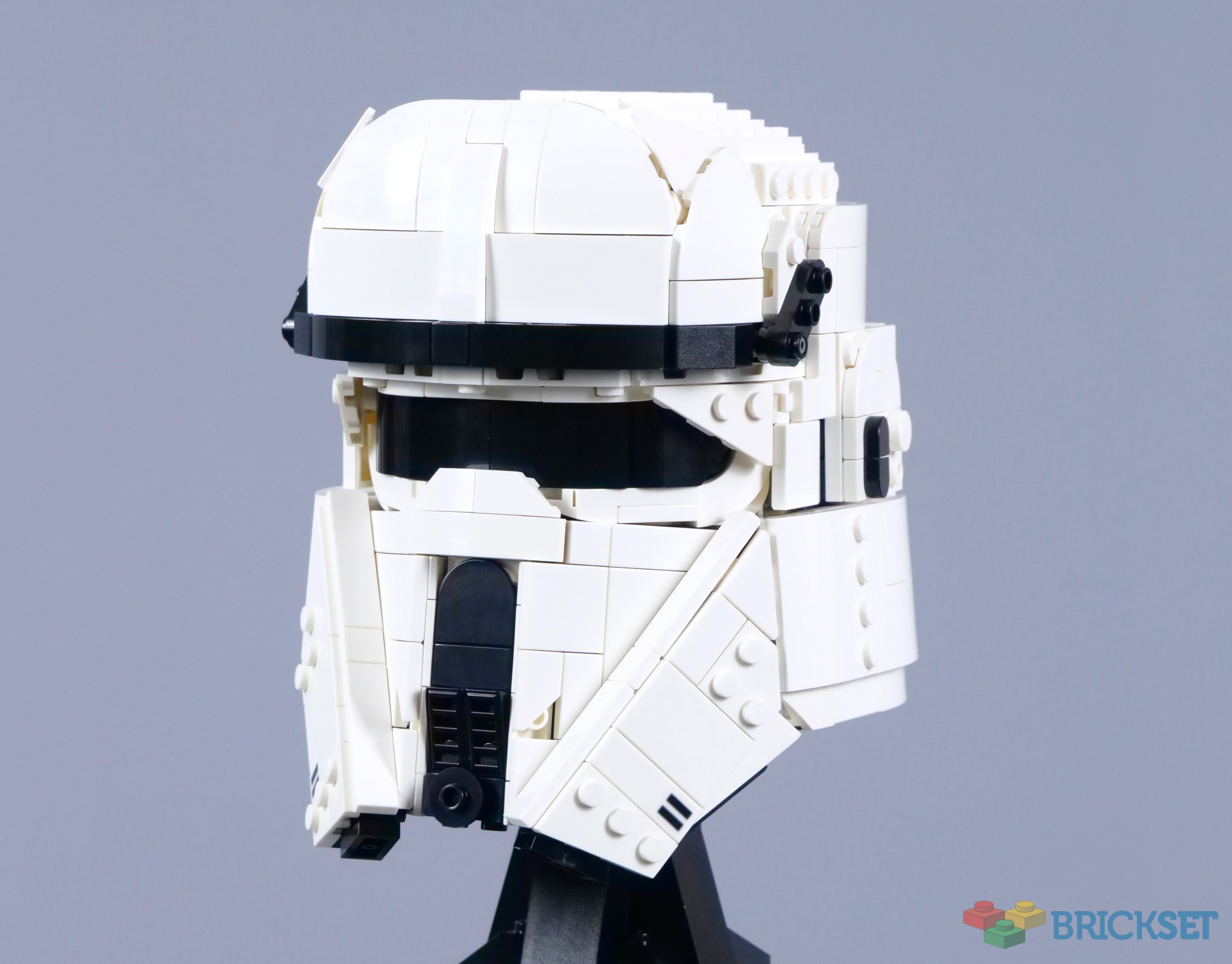
The model's proportions and shaping are superb, particularly given the subtle seams between sections of the helmet. The transition from the angled structures around the jaw to those at the sides is exceptional and I love how the face is designed, so the armour looks almost completely smooth, most notably around the nose.
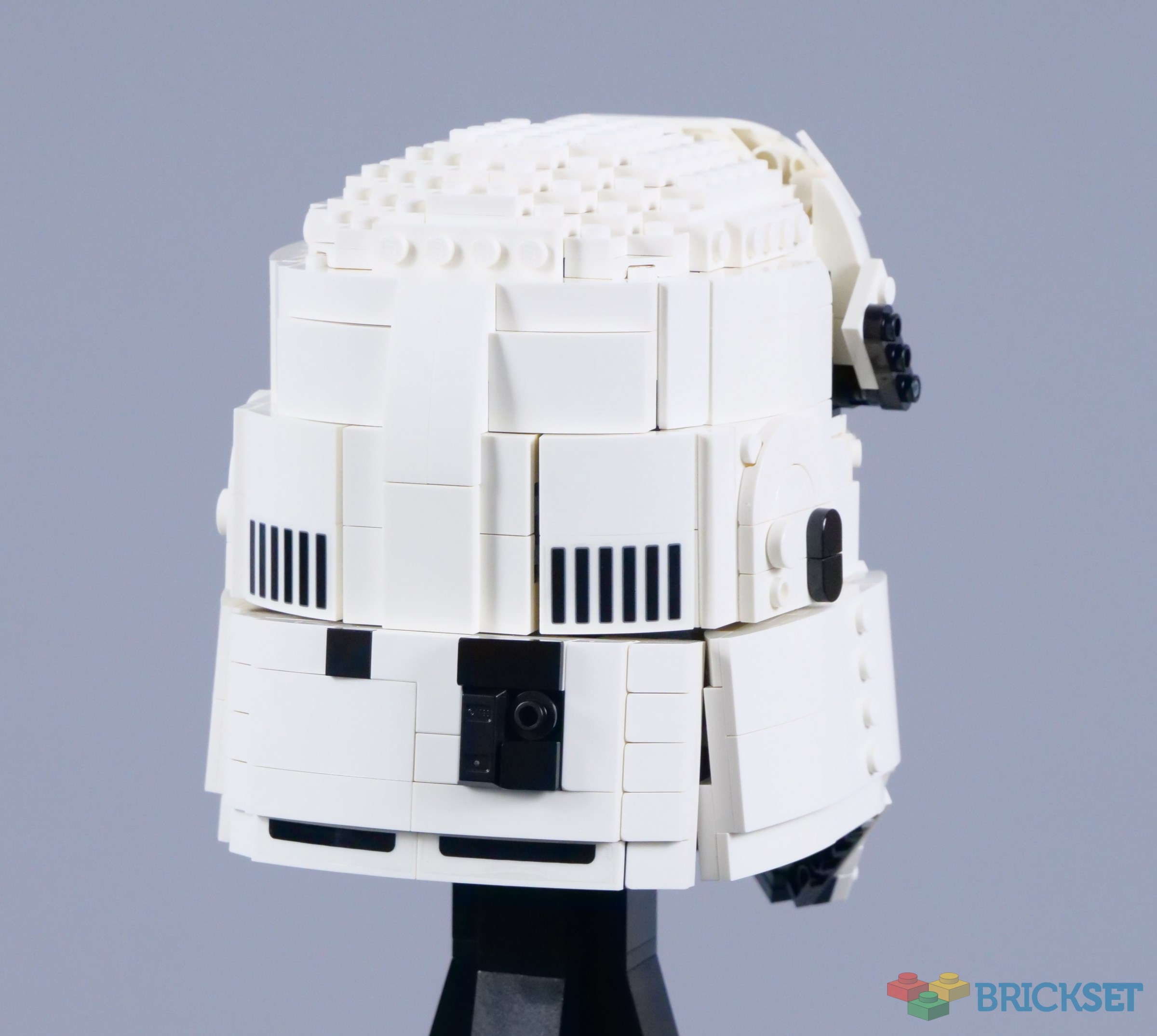
There are a few stickers, unfortunately, adding vents along the jaw and across the back of the helmet. These are clear-backed, which is useful in case you want to construct a tan version of the helmet and was apparently a deliberate choice with that in mind. No stickers are necessary for the central vocoder or the visor, however.
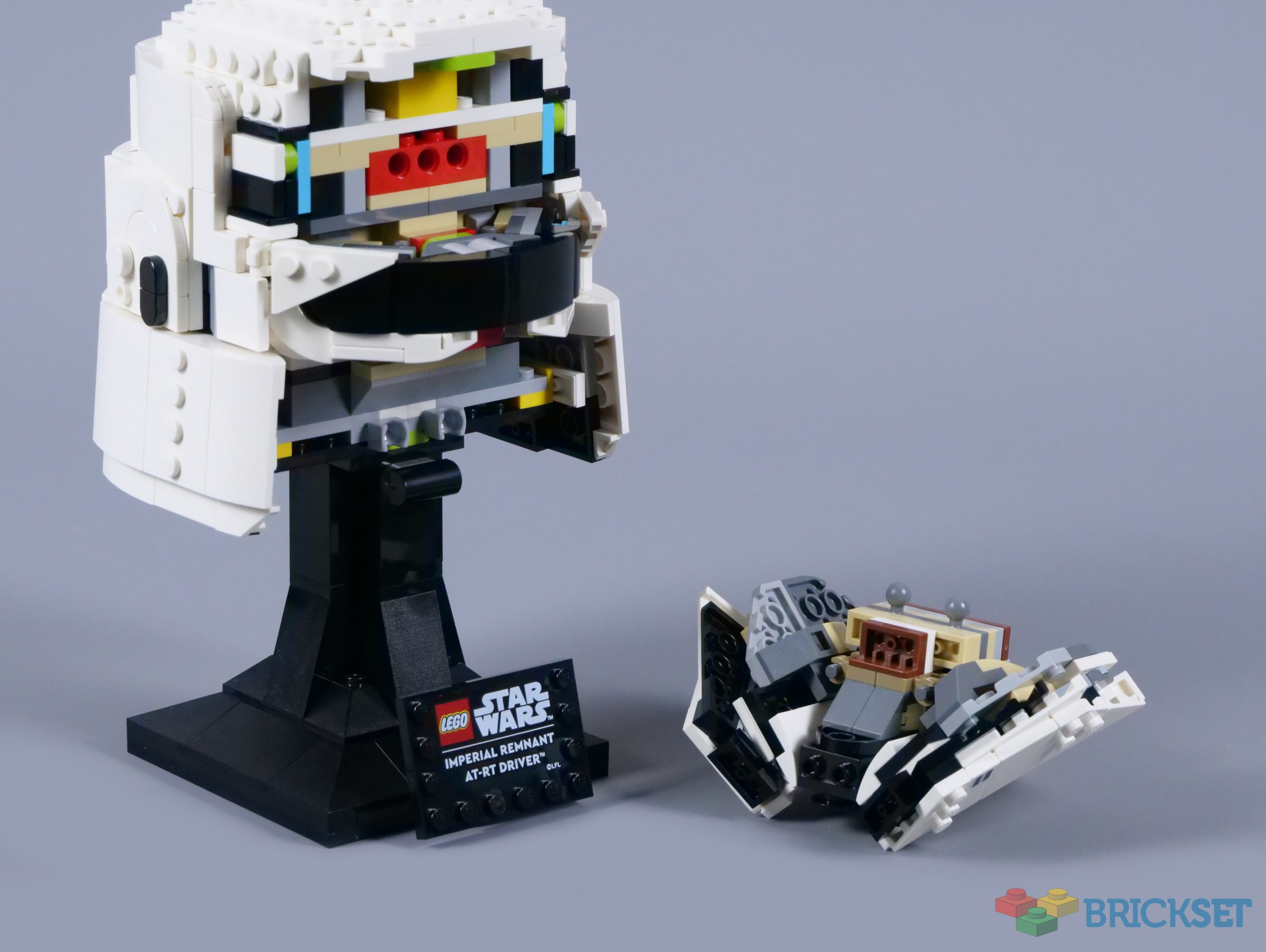
While not as complex as 75429 AT-AT Driver Helmet or the Formula 1 helmets, there are still some neat techniques included. I like how the angled air filters are fixed to turntables and the whole assembly beneath the visor is attached to ball joints, which has allowed the designer to capture its subtle angle.
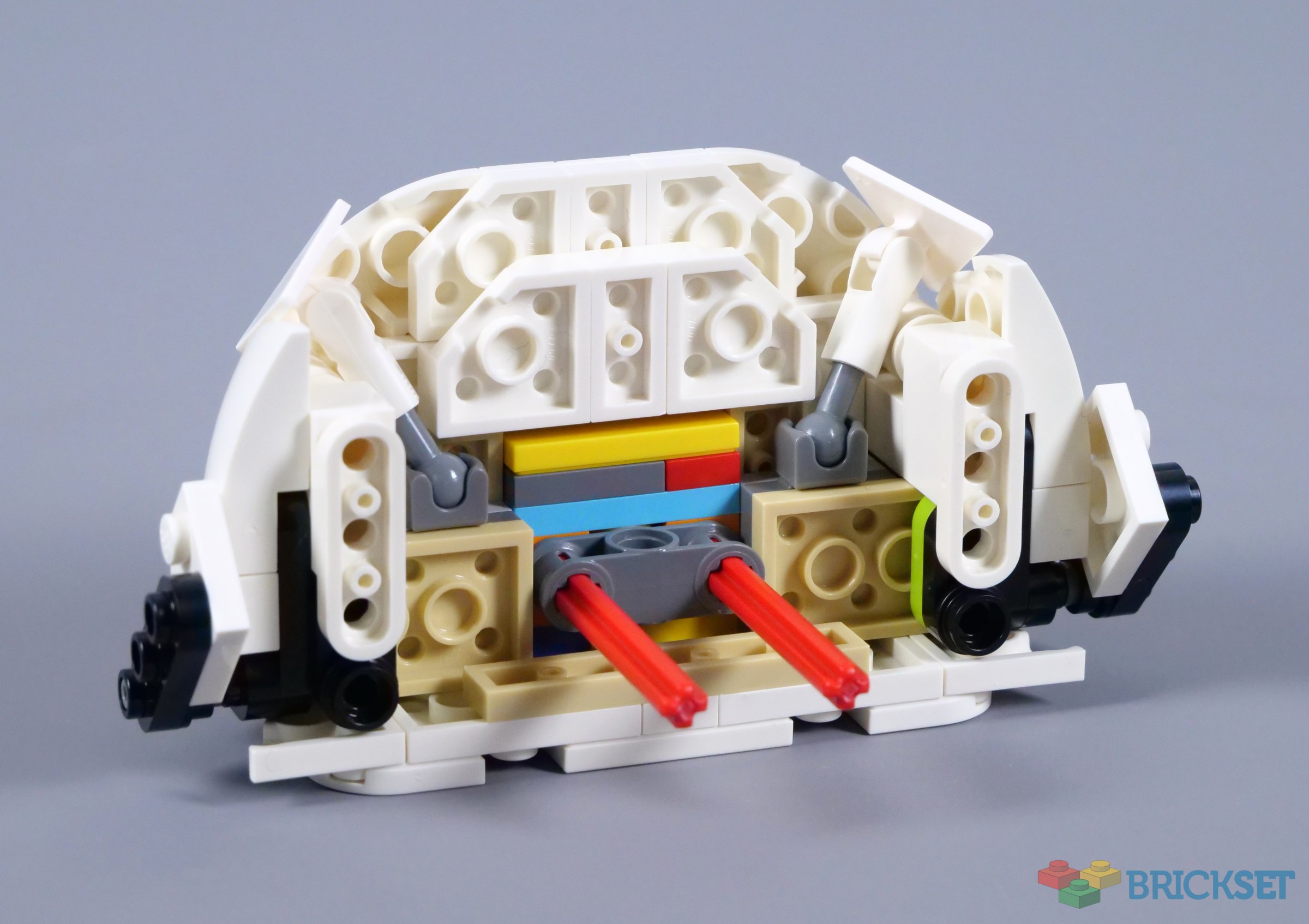
The reinforced armour on top is impressive too, incorporating triangular sign pieces to fill gaps and complete the shield's curvature. These are also connected to ball joints hidden behind the armour, as pictured below, before the structure is attached to the helmet with Technic axles.
The black band above the visor is marginally wider than it should be and the 1x4 curved slope on the brow looks awkward, but it would be essentially impossible to create a perfectly smooth curved surface at this scale, without highly specialised parts. Otherwise, details along the sides and on the back are accurate to the source material.
Notably, the areas of mechanical texture on the back are not there on the Shoretrooper helmet, so there is more to do than a colour swap. Nonetheless, the vast majority of pieces needed are available in tan, or close equivalents are, so it should be possible to adjust the helmet's colour if you choose.
Overall
Despite my qualms about the importance of the AT-RT driver helmet and therefore interest in a LEGO model, 75458 Imperial Remnant AT-RT Driver Helmet is surprisingly good! The shape is very close to the onscreen design and involves some clever building techniques, particularly on the face.
Unfortunately, I cannot get past the problem that this subject is not really worthy of the Helmet Collection. Though not all are iconic, the sets in this series to date are all broadly recognisable and quite popular, whereas the Imperial Remnant AT-RT driver helmet is known primarily for its close resemblance to a Shoretrooper. That is just not enough, in my opinion.
LEGO Icons seems to include at least one space-oriented set each year and the latest depicts the famous Hubble Space Telescope! The press release follows:
11382 Hubble Space Telescope
1,252 pieces, rated 18+
$139.99 / £119.99 / €129.99 Available at LEGO.com from 1st August
Explore one of humanity’s greatest scientific achievements with the LEGO Icons Hubble Space Telescope (11382) – a space decor building set for adults. Perfect as a gift idea for astronomy enthusiasts, this detailed replica captures the essence of the legendary observatory that helped reshape our understanding of the cosmos.
Remove the exterior panels to reveal a detailed instrument bay depicting gyroscopes and primary and secondary mirrors. Position the solar arrays and antennas, open the aperture door and display the telescope on its stand, complete with an information plaque. The set also includes an astronaut minifigure for approximate scale representation.
What do you think of the Hubble Space Telescope? Let us know in the comments and via our poll.
Our review will be published shortly, so look out for that tomorrow.







































.jpg)